Group Members: Carmen Liong
               Chan Xiang Ting
               Chong Li Ying
               Kimberly Teo
               Timothy Chong
Introduction
• Confucianism is the complex system of moral, social,
  political, and so- called religious teaching built up by
  Confucius and the ancient Chinese traditions.
• Confucianism goal is making not only the man
  virtuous, but also making him the man of learning
  and of good manners. The perfect man must combine
  the qualities of a saint, scholar, and gentleman.
• Confucianism is a religion whose worship is centered
  in offerings to the dead. The notion of duty is
  extended beyond the boundaries of morals and
  embraces the details of daily life.
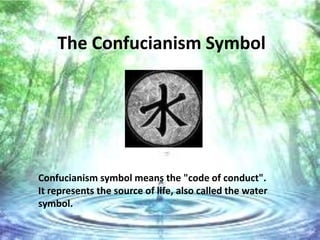
The Confucianism Symbol


Confucianism symbol means the "code of conduct".
It represents the source of life, also called the water
symbol.
Biography of Founder
•   NAME: Confucius (Confucius, also known as Kong
•                     Qui or K’ung Fu-tzu,)
•   OCCUPATION: Philosopher
•   BIRTH DATE: 551 BCE (August 27)
•   PLACE OF BIRTH: Qufu, Zhou Dynasty, China
•   DEATH DATE: 479 BCE (November 21)
•   PLACE OF DEATH: Qufu, Zhou Dynasty, China
•   Date founded: 6th-5th cent. BC
•   Place founded: China
•   Adherents: 5-6 million
Life of Confucius
Confucius was born with the name Kong Ch’iu in answer to his
parents' prayers at a sacred hill called Ni. Confucius' surname Kong
means literally an utterance of thankfulness when prayers have
been answered.

          Grown up as an adult, Ch’iu left his homeland and began wandering
          from state to state in China. His ambition was to share his philosophy
          with the ruling princes, believing that these powerful leaders had an
          obligation to lead their people with virtue. Rather than leading for
          power, control, money, or ego, the princes of China must understand
          their higher purpose, which was to do “right” and lead by selfless
          example.
At the age of fifty, when Duke Ding of Lu was on the throne of Lu,
Confucius' talents were recognized and he was appointed Minister of
Public Works and then Minister of Crime. It seemed that Confucius’
dream of a position of influence in government had come true.


                      But Confucius apparently offended members of the Lu
                      nobility and he was forced to leave office and go into exile.
                      He returned to Lu in 484 BCE and spent the remainder of
                      his life teaching, putting in order the Book of Songs, the
                      Book of Documents, and other ancient classics.

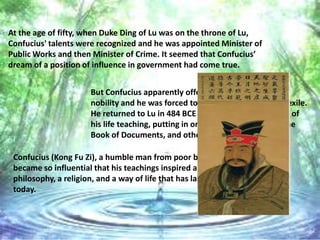
 Confucius (Kong Fu Zi), a humble man from poor beginnings,
 became so influential that his teachings inspired a
 philosophy, a religion, and a way of life that has lasted until
 today.
Major Works
 Confucius is credited with writing and editing some of the
 most influential traditional Chinese classics. These include a
 rearrangement of the Book of Odes as well as a revision of
 the historical Book of Documents.

He also compiled a historical account of the 12 dukes of Lu, called the
Spring and Autumn Annals. Lunyu, which sets forth Confucius’
philosophical and political beliefs, is thought to be compiled by his
disciples. It is one of the "Four Books" of Confucianism that Chinese
philosopher Zhu Xi, a self-proclaimed Neo-Confucian, published as
Sishu in 1190. Far-reaching in its influence, Lunyu was later translated
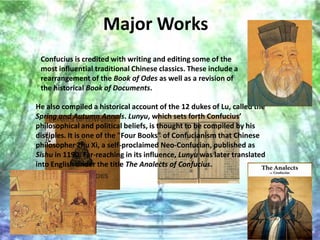
into English under the title The Analects of Confucius.
Texts
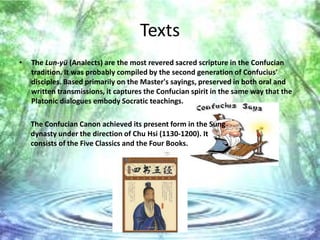
•   The Lun-yü (Analects) are the most revered sacred scripture in the Confucian
    tradition. It was probably compiled by the second generation of Confucius'
    disciples. Based primarily on the Master's sayings, preserved in both oral and
    written transmissions, it captures the Confucian spirit in the same way that the
    Platonic dialogues embody Socratic teachings.

    The Confucian Canon achieved its present form in the Sung
    dynasty under the direction of Chu Hsi (1130-1200). It
    consists of the Five Classics and the Four Books.
Philosophy
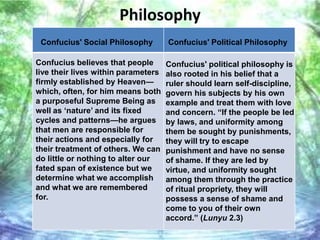
 Confucius' Social Philosophy        Confucius' Political Philosophy

Confucius believes that people       Confucius' political philosophy is
live their lives within parameters   also rooted in his belief that a
firmly established by Heaven—        ruler should learn self-discipline,
which, often, for him means both     govern his subjects by his own
a purposeful Supreme Being as        example and treat them with love
well as „nature‟ and its fixed       and concern. “If the people be led
cycles and patterns—he argues        by laws, and uniformity among
that men are responsible for         them be sought by punishments,
their actions and especially for     they will try to escape
their treatment of others. We can    punishment and have no sense
do little or nothing to alter our    of shame. If they are led by
fated span of existence but we       virtue, and uniformity sought
determine what we accomplish         among them through the practice
and what we are remembered           of ritual propriety, they will
for.                                 possess a sense of shame and
                                     come to you of their own
                                     accord.” (Lunyu 2.3)
Teaching
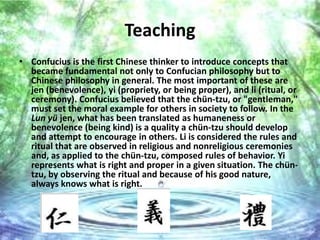
• Confucius is the first Chinese thinker to introduce concepts that
  became fundamental not only to Confucian philosophy but to
  Chinese philosophy in general. The most important of these are
  jen (benevolence), yi (propriety, or being proper), and li (ritual, or
  ceremony). Confucius believed that the chün-tzu, or "gentleman,"
  must set the moral example for others in society to follow. In the
  Lun yü jen, what has been translated as humaneness or
  benevolence (being kind) is a quality a chün-tzu should develop
  and attempt to encourage in others. Li is considered the rules and
  ritual that are observed in religious and nonreligious ceremonies
  and, as applied to the chün-tzu, composed rules of behavior. Yi
  represents what is right and proper in a given situation. The chün-
  tzu, by observing the ritual and because of his good nature,
  always knows what is right.
Confucius's Educational Theory

•   Theory of Value
•   Theory of Knowledge
•   Theory of Human Nature
•   Theory of Learning
•   Theory of Transmission
•   Theory of Society
•   Theory of Opportunity
•   Theory of Consensus
• His philosophy of education focused on the
  "Six Arts": archery, calligraphy, computation,
  music, chariot-driving and ritual.
• To Confucius, the main objective of being an
  educator was to teach people to live with
  integrity.
• Through his teachings, he strove to resurrect
  the traditional values of benevolence,
  propriety and ritual in Chinese society.
Conclusion
Confucianism is a treasure house of profound wisdom.
Chinese consider it to be a religion on the pattern of other
Divinely revealed religions of the world, there are others
among them who view it as a mere philosophy. In fact, the
teachings of Confucius are not really a religious theory.
They are more like an educational philosophy of the
Chinese people that were promulgated 2500 years ago.
However, philosophy came to be ‘worshipped’ by the
Chinese people and passed down from generation to
generation and regarded by some as some kind of unique
religion of the Chinese.

Moral ppt

  • 1.
    Group Members: CarmenLiong Chan Xiang Ting Chong Li Ying Kimberly Teo Timothy Chong
  • 2.
    Introduction • Confucianism isthe complex system of moral, social, political, and so- called religious teaching built up by Confucius and the ancient Chinese traditions. • Confucianism goal is making not only the man virtuous, but also making him the man of learning and of good manners. The perfect man must combine the qualities of a saint, scholar, and gentleman. • Confucianism is a religion whose worship is centered in offerings to the dead. The notion of duty is extended beyond the boundaries of morals and embraces the details of daily life.
  • 3.
    The Confucianism Symbol Confucianismsymbol means the "code of conduct". It represents the source of life, also called the water symbol.
  • 4.
    Biography of Founder • NAME: Confucius (Confucius, also known as Kong • Qui or K’ung Fu-tzu,) • OCCUPATION: Philosopher • BIRTH DATE: 551 BCE (August 27) • PLACE OF BIRTH: Qufu, Zhou Dynasty, China • DEATH DATE: 479 BCE (November 21) • PLACE OF DEATH: Qufu, Zhou Dynasty, China • Date founded: 6th-5th cent. BC • Place founded: China • Adherents: 5-6 million
  • 5.
    Life of Confucius Confuciuswas born with the name Kong Ch’iu in answer to his parents' prayers at a sacred hill called Ni. Confucius' surname Kong means literally an utterance of thankfulness when prayers have been answered. Grown up as an adult, Ch’iu left his homeland and began wandering from state to state in China. His ambition was to share his philosophy with the ruling princes, believing that these powerful leaders had an obligation to lead their people with virtue. Rather than leading for power, control, money, or ego, the princes of China must understand their higher purpose, which was to do “right” and lead by selfless example.
  • 6.
    At the ageof fifty, when Duke Ding of Lu was on the throne of Lu, Confucius' talents were recognized and he was appointed Minister of Public Works and then Minister of Crime. It seemed that Confucius’ dream of a position of influence in government had come true. But Confucius apparently offended members of the Lu nobility and he was forced to leave office and go into exile. He returned to Lu in 484 BCE and spent the remainder of his life teaching, putting in order the Book of Songs, the Book of Documents, and other ancient classics. Confucius (Kong Fu Zi), a humble man from poor beginnings, became so influential that his teachings inspired a philosophy, a religion, and a way of life that has lasted until today.
  • 7.
    Major Works Confuciusis credited with writing and editing some of the most influential traditional Chinese classics. These include a rearrangement of the Book of Odes as well as a revision of the historical Book of Documents. He also compiled a historical account of the 12 dukes of Lu, called the Spring and Autumn Annals. Lunyu, which sets forth Confucius’ philosophical and political beliefs, is thought to be compiled by his disciples. It is one of the "Four Books" of Confucianism that Chinese philosopher Zhu Xi, a self-proclaimed Neo-Confucian, published as Sishu in 1190. Far-reaching in its influence, Lunyu was later translated into English under the title The Analects of Confucius.
  • 8.
    Texts • The Lun-yü (Analects) are the most revered sacred scripture in the Confucian tradition. It was probably compiled by the second generation of Confucius' disciples. Based primarily on the Master's sayings, preserved in both oral and written transmissions, it captures the Confucian spirit in the same way that the Platonic dialogues embody Socratic teachings. The Confucian Canon achieved its present form in the Sung dynasty under the direction of Chu Hsi (1130-1200). It consists of the Five Classics and the Four Books.
  • 9.
    Philosophy Confucius' SocialPhilosophy Confucius' Political Philosophy Confucius believes that people Confucius' political philosophy is live their lives within parameters also rooted in his belief that a firmly established by Heaven— ruler should learn self-discipline, which, often, for him means both govern his subjects by his own a purposeful Supreme Being as example and treat them with love well as „nature‟ and its fixed and concern. “If the people be led cycles and patterns—he argues by laws, and uniformity among that men are responsible for them be sought by punishments, their actions and especially for they will try to escape their treatment of others. We can punishment and have no sense do little or nothing to alter our of shame. If they are led by fated span of existence but we virtue, and uniformity sought determine what we accomplish among them through the practice and what we are remembered of ritual propriety, they will for. possess a sense of shame and come to you of their own accord.” (Lunyu 2.3)
  • 10.
    Teaching • Confucius isthe first Chinese thinker to introduce concepts that became fundamental not only to Confucian philosophy but to Chinese philosophy in general. The most important of these are jen (benevolence), yi (propriety, or being proper), and li (ritual, or ceremony). Confucius believed that the chün-tzu, or "gentleman," must set the moral example for others in society to follow. In the Lun yü jen, what has been translated as humaneness or benevolence (being kind) is a quality a chün-tzu should develop and attempt to encourage in others. Li is considered the rules and ritual that are observed in religious and nonreligious ceremonies and, as applied to the chün-tzu, composed rules of behavior. Yi represents what is right and proper in a given situation. The chün- tzu, by observing the ritual and because of his good nature, always knows what is right.
  • 11.
    Confucius's Educational Theory • Theory of Value • Theory of Knowledge • Theory of Human Nature • Theory of Learning • Theory of Transmission • Theory of Society • Theory of Opportunity • Theory of Consensus
  • 12.
    • His philosophyof education focused on the "Six Arts": archery, calligraphy, computation, music, chariot-driving and ritual. • To Confucius, the main objective of being an educator was to teach people to live with integrity. • Through his teachings, he strove to resurrect the traditional values of benevolence, propriety and ritual in Chinese society.
  • 13.
    Conclusion Confucianism is atreasure house of profound wisdom. Chinese consider it to be a religion on the pattern of other Divinely revealed religions of the world, there are others among them who view it as a mere philosophy. In fact, the teachings of Confucius are not really a religious theory. They are more like an educational philosophy of the Chinese people that were promulgated 2500 years ago. However, philosophy came to be ‘worshipped’ by the Chinese people and passed down from generation to generation and regarded by some as some kind of unique religion of the Chinese.