Hinduism 101 -- for beginners  By  Dr. Whitney Howarth
 
Definition of Hinduism :  Hinduism can best be defined as a way of life based on the teachings of ancient sages and scriptures:   the Vedas . Hinduism is known to practitioners as   Sanatana Dharma ,  which means everlasting or eternal truth.
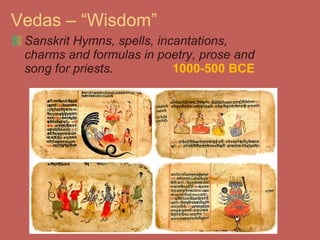
Vedas – “Wisdom” Sanskrit Hymns, spells, incantations, charms and formulas in poetry, prose and song for priests. 1000-500 BCE
Many religions under one Umbrella! Hinduism differs from Christianity and other Western religions in   that  it does not have a single founder ,  a specific theological system, a single system of morality, or a central religious organization.   Hinduism consists of  thousands  of different religious groups that have evolved in India since 1500 BCE.
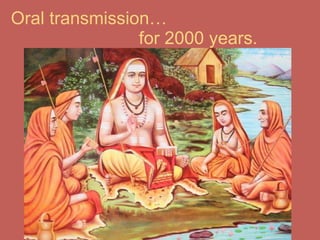
Oral transmission…  for 2000 years.
One GOD or many? Hindus worship many gods,  but recognize one Supreme Being and see the parts of the universe as ONE. Hence, many consider  Hinduism a  henotheistic   religion -- a religion which recognizes a single deity, but which identifies other gods and goddesses as facets or manifestations or aspects of that supreme God.
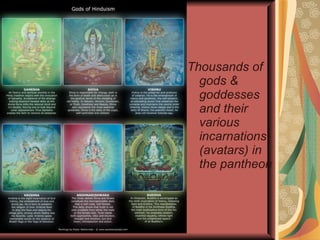
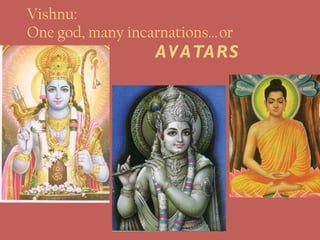
Thousands of gods & goddesses and their various incarnations (avatars) in the pantheon
Tolerance Religions which recognize the existence of multiple deities have traditionally been among the world's most   religiously tolerant .  Hinduism remains arguably one of the most tolerant of such religions.   Hindus recognize the fact that the means or ways to salvation are many.
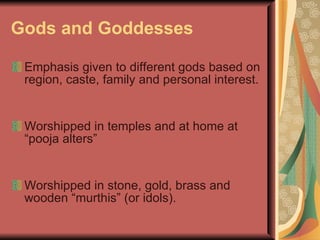
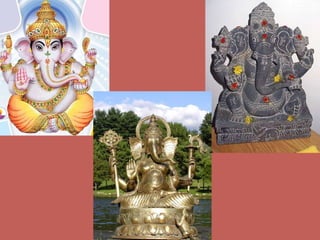
Gods and Goddesses Emphasis given to different gods based on region, caste, family and personal interest. Worshipped in temples and at home at “pooja alters” Worshipped in stone, gold, brass and wooden “murthis” (or idols).
 
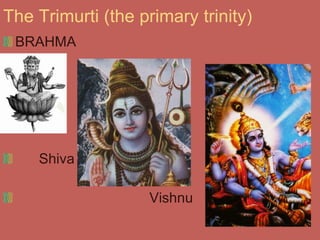
The Trimurti (the primary trinity) BRAHMA Shiva Vishnu
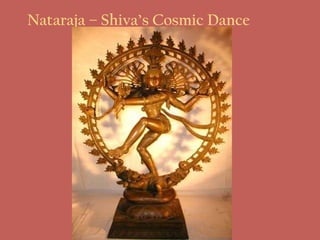
Nataraja – Shiva’s Cosmic Dance
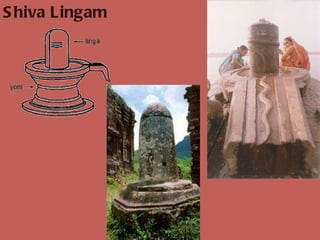
Shiva Lingam
 
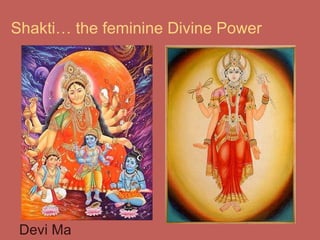
Shakti… the feminine Divine Power Devi Ma
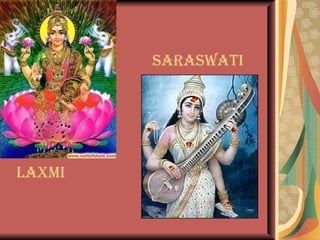
Laxmi Saraswati
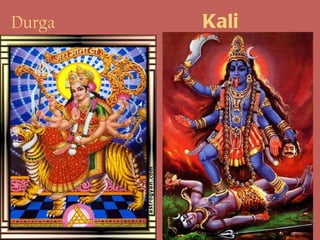
Durga Kali
Vishnu: One god, many incarnations… or AVATARS
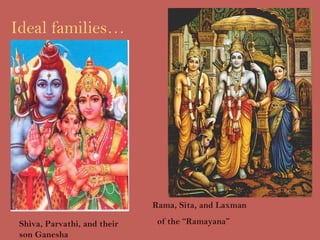
Ideal families… Shiva, Parvathi, and their son Ganesha Rama, Sita, and Laxman of the “Ramayana”
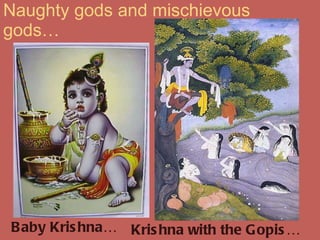
Naughty gods and mischievous gods… Baby Krishna… Krishna with the Gopis…
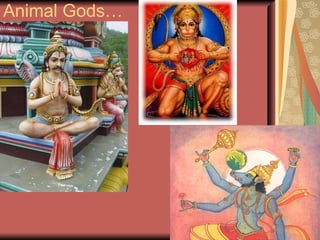
Animal Gods…
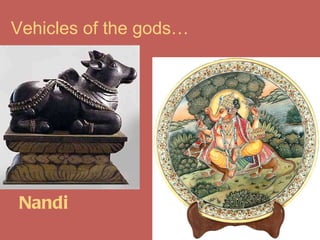
Vehicles of the gods… Nandi
Facts Hinduism is widely believed to be the  oldest world religion  still practiced today. Hinduism is the world’s third largest religion (after Christianity and Islam) and has over one billion practitioners. Hindus believe in Karma and reincarnation.
Myths Hindus do not worship cows All Hindus are not vegetarians All Hindus do not study the Kama Sutra.
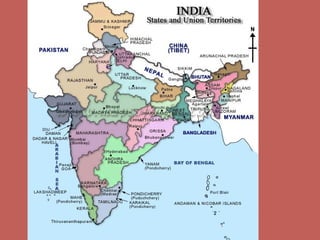
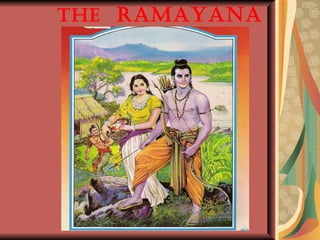
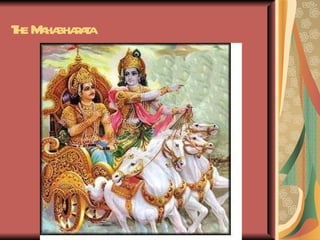
History Origins :  It is generally believed that the basic tenets of Hinduism were brought to India by the  Aryans (Indo-Europeans)  who settled along the banks of the Indus river about 2000 BCE.  Beliefs of the Harappan and Dravidian people also shaped early Hinduism.   Chants, prayers, hymns and rituals were initially  transmitted   orally   and later (between 1000 BCE-100 CE) written down.  The Great Epic stories were written down between 500 BC and the 1st century CE (these are   the   Mahabharata   and   the Ramayana ,  etc.)
The  Ramayana
The Mahabharata
Beliefs: 1)   All Hindus, regardless of sect, recognize the sacred writings called the  Vedas  which are divided into four books.  The first and oldest of these,  the Rig Veda , contains hymns, incantations, and rituals from ancient India and also explain the divine origins of the  caste system.  VEDA means WISDOM. Other scriptures include  The Upanishads  which contain Vedic philosophy, explaining the importance of Yoga, meditation and  karma .
Karma Hindus believe in  karma : the law of cause and effect by which each individual creates his own destiny by his thoughts, words and deeds.  Karma is the accumulated sum of ones good and bad deeds, and it determines how you will live your next life.
Reincarnation 3) Hindus believe in  reincarnation   (also known as  SAMSARA )   which is the transfer of one's soul after death into another body.  This produces a continuing cycle of birth, life, death and rebirth through their many lifetimes.  Karma determines how you will live your next life. Through pure acts, thoughts and devotion, one can be reborn at a higher level.  Eventually, one can escape samsara and achieve enlightenment. Bad deeds can cause a person to be reborn as a lower level, or even as an animal. The unequal distribution of wealth, prestige, suffering are thus seen as natural consequences for one's previous acts, both in this life and in previous lives.
Dharma Hindus believe in the concept of  dharma  or religious duty.  Dharma requires each person to act righteously, piously, and ethically towards his/her family, clan, community and the universe.  Moral action insures good karma and COSMIC HARMONY.  Dharma is defined differently for each person  but among these mentioned in the scriptures are non-violence, not stealing; disciplining desire; avoiding lust and greed; curbing arrogance and anger; not lying; avoiding injustice; shunning wrongdoing and evil company. Hindus are called to be pure in body, mind and speech; love mankind; seek contentment; cultivate devotion; develop forbearance; give charitably; study the scriptures; perform penance and sacrifice.  Every person has his or her path; worship God, and your dharma will become clear.  Kama  (sensual and sexual pleasures) and  Artha  (material prosperity) should be balanced with Dharma.
Worship Hindus believe in active  worship,  but worship can take many forms .  Puja  (ritualized),  bhajan  (song),  Prayer ,  meditation  and  yoga are all worshipful means of direct, personal communion with God.
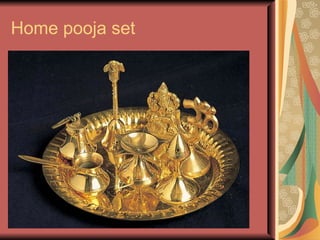
Home pooja set
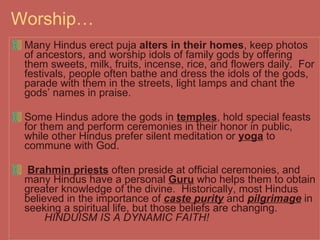
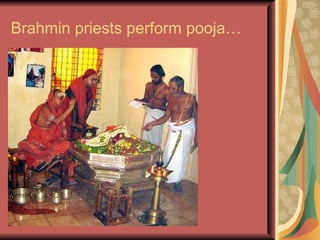
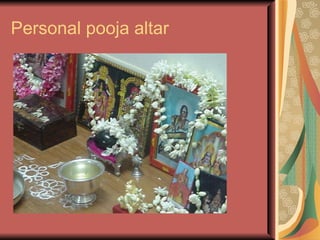
Worship… Many Hindus erect puja  alters in their homes , keep photos of ancestors, and worship idols of family gods by offering them sweets, milk, fruits, incense, rice, and flowers daily.  For festivals, people often bathe and dress the idols of the gods, parade with them in the streets, light lamps and chant the gods’ names in praise.  Some Hindus adore the gods in  temples , hold special feasts for them and perform ceremonies in their honor in public, while other Hindus prefer silent meditation or  yoga  to commune with God.  Brahmin priests  often preside at official ceremonies, and many Hindus have a personal  Guru  who helps them to obtain greater knowledge of the divine.  Historically, most Hindus believed in the importance of  caste purity  and  pilgrimage  in seeking a spiritual life, but those beliefs are changing.  HINDUISM IS A DYNAMIC FAITH!


Brahmin priests perform pooja…
Personal pooja altar
Home pooja altars…
http://www.ecoheritage.cpreec.org/innerpageof.php?$mFJyBfKPkE6
 
Why are trees sacred? What shapes our collective consciousness  about the importance of trees? When we were children, trees were magnificent and old and mysterious… Trees give us fruit, honey, places to sit – some trees are parasitic/killers! War of trees Not paying attention – they aren’t there – they are invisible to us.  We take “a” tree for granted… may lose sight of many trees…. Trees are livelihood for folks in our community Druid concept of tree – roots extended beneath earth – realm of mystery Many ancient cultures developed sense of the sacredness trees

Hinduism

  • 1.
    Hinduism 101 --for beginners By Dr. Whitney Howarth
  • 2.
  • 3.
    Definition of Hinduism: Hinduism can best be defined as a way of life based on the teachings of ancient sages and scriptures: the Vedas . Hinduism is known to practitioners as Sanatana Dharma , which means everlasting or eternal truth.
  • 4.
    Vedas – “Wisdom”Sanskrit Hymns, spells, incantations, charms and formulas in poetry, prose and song for priests. 1000-500 BCE
  • 5.
    Many religions underone Umbrella! Hinduism differs from Christianity and other Western religions in that it does not have a single founder , a specific theological system, a single system of morality, or a central religious organization. Hinduism consists of thousands of different religious groups that have evolved in India since 1500 BCE.
  • 6.
    Oral transmission… for 2000 years.
  • 7.
    One GOD ormany? Hindus worship many gods, but recognize one Supreme Being and see the parts of the universe as ONE. Hence, many consider Hinduism a henotheistic religion -- a religion which recognizes a single deity, but which identifies other gods and goddesses as facets or manifestations or aspects of that supreme God.
  • 8.
    Thousands of gods& goddesses and their various incarnations (avatars) in the pantheon
  • 9.
    Tolerance Religions whichrecognize the existence of multiple deities have traditionally been among the world's most religiously tolerant . Hinduism remains arguably one of the most tolerant of such religions. Hindus recognize the fact that the means or ways to salvation are many.
  • 10.
    Gods and GoddessesEmphasis given to different gods based on region, caste, family and personal interest. Worshipped in temples and at home at “pooja alters” Worshipped in stone, gold, brass and wooden “murthis” (or idols).
  • 11.
  • 12.
    The Trimurti (theprimary trinity) BRAHMA Shiva Vishnu
  • 13.
  • 14.
  • 15.
  • 16.
    Shakti… the feminineDivine Power Devi Ma
  • 17.
  • 18.
  • 19.
    Vishnu: One god,many incarnations… or AVATARS
  • 20.
    Ideal families… Shiva,Parvathi, and their son Ganesha Rama, Sita, and Laxman of the “Ramayana”
  • 21.
    Naughty gods andmischievous gods… Baby Krishna… Krishna with the Gopis…
  • 22.
  • 23.
    Vehicles of thegods… Nandi
  • 24.
    Facts Hinduism iswidely believed to be the oldest world religion still practiced today. Hinduism is the world’s third largest religion (after Christianity and Islam) and has over one billion practitioners. Hindus believe in Karma and reincarnation.
  • 25.
    Myths Hindus donot worship cows All Hindus are not vegetarians All Hindus do not study the Kama Sutra.
  • 26.
    History Origins : It is generally believed that the basic tenets of Hinduism were brought to India by the Aryans (Indo-Europeans) who settled along the banks of the Indus river about 2000 BCE. Beliefs of the Harappan and Dravidian people also shaped early Hinduism. Chants, prayers, hymns and rituals were initially transmitted orally and later (between 1000 BCE-100 CE) written down. The Great Epic stories were written down between 500 BC and the 1st century CE (these are the Mahabharata and the Ramayana , etc.)
  • 27.
  • 28.
  • 29.
    Beliefs: 1) All Hindus, regardless of sect, recognize the sacred writings called the Vedas which are divided into four books. The first and oldest of these, the Rig Veda , contains hymns, incantations, and rituals from ancient India and also explain the divine origins of the caste system. VEDA means WISDOM. Other scriptures include The Upanishads which contain Vedic philosophy, explaining the importance of Yoga, meditation and karma .
  • 30.
    Karma Hindus believein karma : the law of cause and effect by which each individual creates his own destiny by his thoughts, words and deeds. Karma is the accumulated sum of ones good and bad deeds, and it determines how you will live your next life.
  • 31.
    Reincarnation 3) Hindusbelieve in reincarnation (also known as SAMSARA ) which is the transfer of one's soul after death into another body. This produces a continuing cycle of birth, life, death and rebirth through their many lifetimes. Karma determines how you will live your next life. Through pure acts, thoughts and devotion, one can be reborn at a higher level. Eventually, one can escape samsara and achieve enlightenment. Bad deeds can cause a person to be reborn as a lower level, or even as an animal. The unequal distribution of wealth, prestige, suffering are thus seen as natural consequences for one's previous acts, both in this life and in previous lives.
  • 32.
    Dharma Hindus believein the concept of dharma or religious duty. Dharma requires each person to act righteously, piously, and ethically towards his/her family, clan, community and the universe. Moral action insures good karma and COSMIC HARMONY. Dharma is defined differently for each person but among these mentioned in the scriptures are non-violence, not stealing; disciplining desire; avoiding lust and greed; curbing arrogance and anger; not lying; avoiding injustice; shunning wrongdoing and evil company. Hindus are called to be pure in body, mind and speech; love mankind; seek contentment; cultivate devotion; develop forbearance; give charitably; study the scriptures; perform penance and sacrifice. Every person has his or her path; worship God, and your dharma will become clear. Kama (sensual and sexual pleasures) and Artha (material prosperity) should be balanced with Dharma.
  • 33.
    Worship Hindus believein active worship, but worship can take many forms . Puja (ritualized), bhajan (song), Prayer , meditation and yoga are all worshipful means of direct, personal communion with God.
  • 34.
  • 35.
    Worship… Many Hinduserect puja alters in their homes , keep photos of ancestors, and worship idols of family gods by offering them sweets, milk, fruits, incense, rice, and flowers daily. For festivals, people often bathe and dress the idols of the gods, parade with them in the streets, light lamps and chant the gods’ names in praise. Some Hindus adore the gods in temples , hold special feasts for them and perform ceremonies in their honor in public, while other Hindus prefer silent meditation or yoga to commune with God. Brahmin priests often preside at official ceremonies, and many Hindus have a personal Guru who helps them to obtain greater knowledge of the divine. Historically, most Hindus believed in the importance of caste purity and pilgrimage in seeking a spiritual life, but those beliefs are changing. HINDUISM IS A DYNAMIC FAITH!
  • 36.
  • 37.
  • 38.
  • 39.
  • 40.
  • 41.
    Why are treessacred? What shapes our collective consciousness about the importance of trees? When we were children, trees were magnificent and old and mysterious… Trees give us fruit, honey, places to sit – some trees are parasitic/killers! War of trees Not paying attention – they aren’t there – they are invisible to us. We take “a” tree for granted… may lose sight of many trees…. Trees are livelihood for folks in our community Druid concept of tree – roots extended beneath earth – realm of mystery Many ancient cultures developed sense of the sacredness trees