Insulins
Dr P K Maharana.
Types
• Rapid Acting – starts few minutes  2-4
hours.
• Regular or short Acting starts within 30
minutes  6 hours
• Intermediate Acting  2-4 hours  12 hours
• Long Acting  2-4 hours  24 hours
• Premixed  15 minutes  12-16 hours
• Inhaled Insulin 10 minutes  3 hours
Rapid-acting
• It works over a narrow, but more predictable
range of time.( Works quickly & drops blood sugar for a
shorter time). Onset 15 minutes, wear of 3-4 hours.
• Because they work quickly, used most often at
the start of a meal.
• Acts most like insulin that is produced by the
human pancreas.
• If a rapid-acting insulin is prefered instead of a
short-acting insulin at the start of dinner. ( may
prevent severe drops in blood sugar level in the middle of the
night).
Short-acting Insulin
• It take effect and wear off more quickly than long-
acting insulins. Onset 30 minutes, wear of 4-6 hours.
• A short-acting insulin is often used 30–60
minutes before a meal so that it has time to work.
• These liquid insulins are clear and do not settle out
when the bottle (vial) sits for a while.
Short-acting insulin analogues
• There are three short-acting insulin analogues,
(lispro, aspart, and glulisine)
• Have similar pharmacokinetic and pharmacodynamic
properties.
• With earlier onset and peak of biologic action, and
shorter duration of activity than regular insulin.
• In a meta-analysis comparing short-acting analogues with
human regular insulin, the most relevant difference reported
was a lower risk of severe hypoglycemia with the analogue
preparations.
• Better glycaemic control if administered 15-20 minutes before meal
Intermediate insulins
• Contain added substances (buffers) that make
them work over a long time and that may
make them look cloudy.
• When these types of insulin sit for even a few
minutes, the buffered insulin settles to the
bottom of the vial.
• But insulin glargine and insulin detemir are
clear liquids (not cloudy).
Isophane Insulin
• Insulin isophane is a recombinant human insulin analogue
(genetically modified insulin that is grown in a laboratory and
similar to human insulin). It is an intermediate acting insulin
preparation.
• Insulin Isophane is a man-made version of human insulin, produced
by the process of biotechnology called recombinant DNA
technology.
• Neutral Protamine Hagedorn (NPH) insulin, also known
as isophane insulin, is an intermediate-acting insulin .
• NPH insulin is made by mixing regular insulin and protamine in
exact proportions with zinc and phenol such that a neutral-pH is
maintained and crystals form.[
• It is sold as a sterile, aqueous, clear, and colorless solution.
• contains insulin aspart along with other constituents like glycerin,
phenol, metacresol, zinc, sodium chloride etc.
Long acting Insulin
• Insulin glargine and insulin detemir are long
acting insulins.
• They are clear liquids (not cloudy).
• They act for a period of 24 hours, onset slow
1-2 hours.
Long-acting insulin Analogues
• Longer-acting insulin analogues (insulin glargine and
insulin detemir) are produced by genetic engineering.
• The onset of action is within two hours and they have a longer
duration of action of up to 24 h.
• These insulins provide a steady basal insulin profile with
minimal peak action and are injected subcutaneously once
daily.
• Glargine: Insulin glargin is also known as Lantus.
Basal Insulin
The basal analogues have a longer duration of action
than insulin NPH and, more importantly, have more
stable and consistent biologic activity over a 24-hour
period, resulting in more predictable glycemic levels
and a lower risk of hypoglycemia.
 Currently available basal insulin preparations include:
Insulin glargine U-100 (Lantus),
Insulin detemir (Levemir), &
2015 FDA-approved formulations
insulin glargine U-300 (Toujeo) and
insulin degludec (Tresiba).
Premixed
• For convenience, there are premixed rapid-
and intermediate-acting insulin.
• The insulin will start to work as quickly as the
fastest-acting insulin in the combination.
• It will peak when each type of insulin
typically peaks, and it will last as long as the
longest-acting insulin.
• Usually prescribed in two daily doses.
Premixed Insulin Preparations
• 30% regular and 70% NPH (Humulin 30/70,
Novolinge 30/70).
• 50% lispro and 50% lispro protamine
(Humalog Mix 50).
• 25% lispro and 75% lispro protamine
(Humalog Mix 25).
• 30% aspart and 70% aspart protamine
(NovoMix 30).
Inhaled Insulin
• Technosphere oral-inhaled insulin (Afrezza)— was approved by
(FDA)-a in 2014.
• Inhaled insulin has low bioavailability but is absorbed much more
rapidly into the circulation than the current short-acting insulin
analogues and has a shorter duration of biologic activity.
• However, the pharmacodynamics of inhaled insulin, when
compared with insulin lispro, show only a slightly faster onset of
action and a lower peak of biologic activity.
• The benefits of using inhaled insulin need to be carefully weighed
against the potential risks, especially given the increase in lung
cancer events in smokers that was observed with the prior inhaled-
insulin preparation Exubera.
• Inhaled insulin should not be used by smokers, patients with chronic
lung disease (such as asthma and chronic obstructive pulmonary
disease), and those with acute episodes of bronchospasm.
Inhaled Insulin
• A pilot study found evidence that compared with injectable
rapid-acting insulin, supplemental doses of inhaled insulin
taken based on postprandial glucose levels may improve
blood glucose management without additional
hypoglycemia or weight gain.
• Inhaled insulin is contraindicated in patients with chronic
lung disease, such as asthma and chronic obstructive
pulmonary disease, and is not recommended in patients
who smoke or who recently stopped smoking.
• All patients require spirometry (FEV1) testing to identify
potential lung disease prior to and after starting inhaled
insulin therapy.
Human Insulin
• Insulin was the first protein to be sequenced (in
1955), and it became the first human protein to
be manufactured through human recombinant
technology.
• It was introduced into clinical practice in 1982 as
synthetic “human” insulin, with the advantage of
being less allergenic than animal insulin
preparations.
• Eventually it replaced all of the animal insulin
preparations in the US market.
Types of Insulin
Name Onset Peak Duration
Rapid Acting 15
minutes
1 hour 2 to 4 hours Right before a meal.
Regular/ Soluble 30
minutes
2 to 3 hours 3 to 6 hours 30 to 60 minutes
before a meal.
Intermediate 2 to 4
hours
4 to 12 hours 12 to 18
hours
Covers for half a day or
overnight.
Long Acting 2 hours Does not peak Up to 24
hours
Covers insulin needs
for about a full day.
Ultra Long 6 hours Dose not peak 36 hours or
longer
Provides steady insulin
for long periods.
Premixed
(intermediate+ short-
acting insulin)
5 to 60
minutes
Peak varies 10 to 16
hours
. Usually taken 10 to 30
minutes before
breakfast and dinner.
Inhaled Rapid 10 to 15
minutes
30 minute 3 hours Right before a meal.
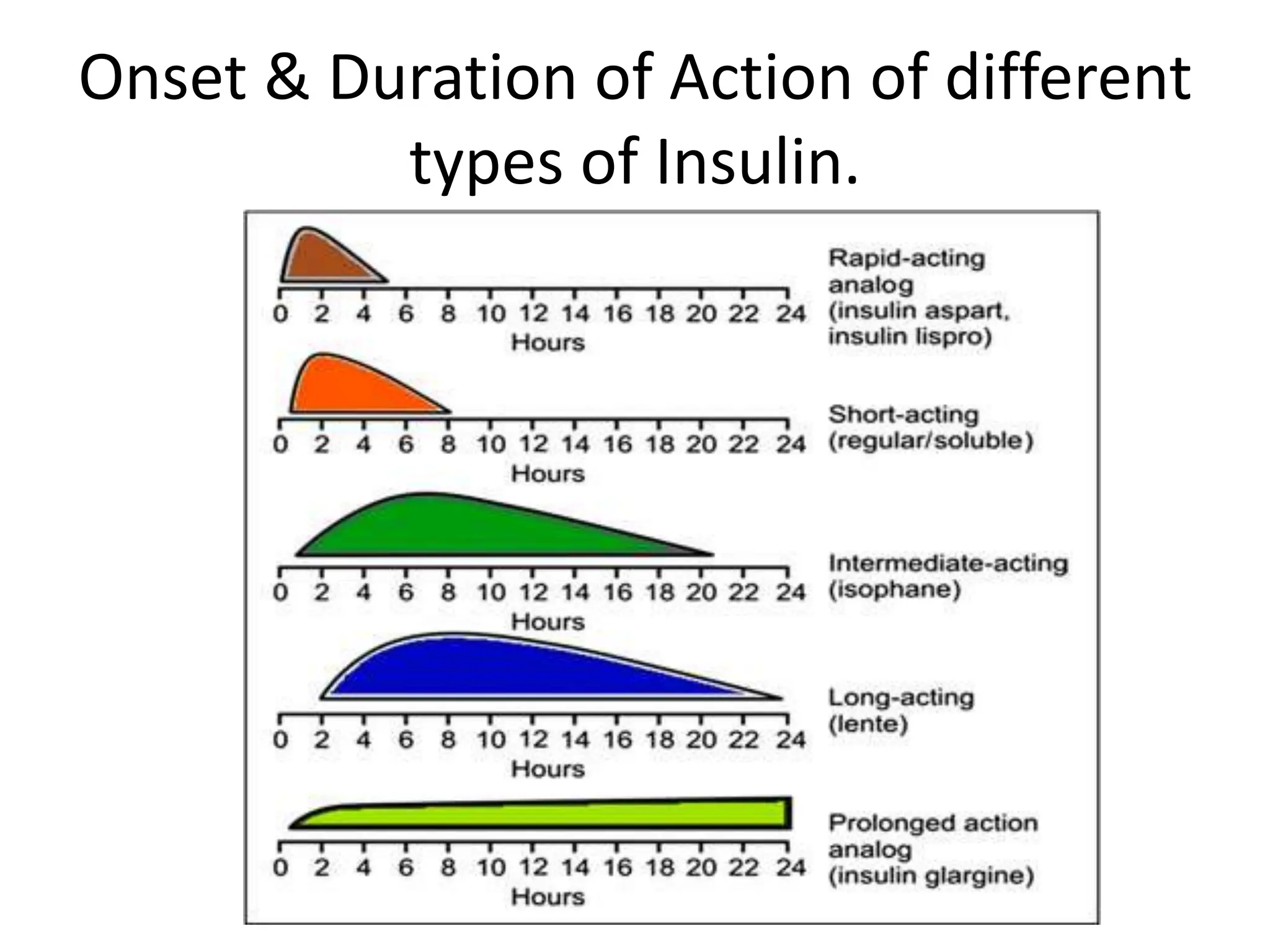
Onset & Duration of Action of different
types of Insulin.
Analogue Insulin
• Analog insulins are very similar to human insulin, but
they have one or two amino acids changed.
• Analog insulin preparations have been modified to
change how fast and how slow they act after injection
• . Examples of short-acting analog insulins are lispro,
glulisine, and aspart. Examples of long-acting analog
insulins are glargine and detemir.
• Studies have looked at NPH-regular regimens versus
glargine-lispro regimens and found that analog insulins
generally provide tighter blood sugar control with
less hypoglycemia.
NPH Insulin
• When regular insulin is suspended in a
substance called protamine, it is known
as NPH insulin (Neutral Protamine Hagedorn).
• NPH insulin is a special preparation of regular
insulin. The protamine suspension allows for
slower release of the insulin after injection, so
the NPH insulin can provide longer-term
control of metabolism. NPH insulin lasts
around 10 to 14 hours.
Determined which Insulin to Use.
• Whether to use a “human” insulin or an
analog insulin is based on the duration of
action required and the person’s risk of low
blood sugar, among other factors.
• (NPH insulin commonly leads to low blood
sugar, especially during overnight hours.)
IDDM ( Type-1)
• People with type 1 diabetes may be started on
a single daily injection of a long-acting insulin,
such as glargine, to meet the body’s insulin
requirements.
• Some people also require shorter-acting
forms of insulin, in addition to a long-acting
insulin, to help with high blood sugar after a
meal.
NIDDM ( Type-2)
• Type 2 patients who need insulin often first
require a single dose of long-acting insulin
each day, along with OHA.
• But as the condition progresses and pancreas
function continues to deteriorate over time,
they may require short-acting insulin with
their meals as well.
Insulin Preparations
 Rapid-acting
Insulin aspart (NovoLog)
Insulin lispro (Humalog)
Insulin glulisine (Apidra)
 Short-acting
Regular insulin (Humulin R, Novolin R/ReliOn R)
 Intermediate, basal
NPH insulin (Humulin N, Novolin N/ReliOn N)
 Basal analogues
Insulin glargine U-100 (Lantus, Basaglar)
Insulin detemir (Levemir)
 Longer-acting basal analogues
Insulin glargine U-300 (Toujeo)
Insulin degludec (Tresiba
 Premixed
75% Insulin lispro protamine/25% insulin lispro (Humalog mix 75/25)
50% Insulin lispro protamine/50% insulin lispro (Humalog mix 50/50)
70% Insulin lispro protamine/30% insulin aspart (Novolog mix 70/30)
70% NPH insulin/30% regular insulin (Humulin, Novolin/ ReliOn)
70% Insulin degludec/30% insulin aspart (Ryzodeg 70/30)
 Inhaled
Technosphere insulin oral-inhalation system (Afrezza)
Preparations Available
• Actrapid HM (3ml P.enenfill)  100units/ml
• Huminsulin R 100IU Cartridge ( Soluble/ regular )
• Actrapid 100 IU/ml Flexpen ( regular/ soluble)
• Insuman Rapid 100IU/ml ( regular/ Soluble)
• Insugen-R 40IU/ml ( Soluble/ regular) 10 ml vial.
• Lupisulin R 40IU/ml ( soluble/ regular) 10 ml vial
• Wosulin-R 40IU Injection
• Recosulin R 40IU/ml Injection
• Human Monotard 40IU/ml ( soluble/ Regular)
• Human Actrapid 40 U/ml ( soluble/ regular insulin),
10ml Solution
Commercial Preparations Available
• Rapid Acting:
• Lispro (Humalog)
• Aspart (Novolog)
• Glulisine (Apidra)
• Regular or short acting:
• Novolin
• Intermediate Acting:
• NPH ( N )
• Long Acting:
• Glargine (Lantus,
Basaglar, (Toujeo)
• Detemir ( Levimir )
• Degludec ( Tresiba )
• Premixed :
• Humulin (70/30)
• Humulin (50/50)
• Novolin ( 70/30)
• Humalog ( 70/30)
• Humalog ( 75/25)
Insulin Therapy
• Basal Insulin: Start with initial dose of 0.1 – 0.2/kg/day,
increase gradually in small increments of 2 units.
• Longer-acting basal analogs ( U-300 glargine or
degludec) may convey a lower hypoglycemia risk compared
with U-100 glargine when used in combination with oral
agents )
• In clinical trials, long-acting basal analogs (U-100 glargine or
detemir) have been demonstrated to reduce the risk of
symptomatic and nocturnal hypoglycemia compared with
NPH insulin, although these advantages are modest and may
not persist
How to Calculate the Dose of Insulin
• Basal insulin Dose  Approximately 40-50% of
the total daily insulin dose. It is to replace
insulin overnight, when you are fasting and
between meals.
• The basal or background insulin dose usually is
constant from day to day.
• The other 50-60% of the total daily insulin dose
is for carbohydrate coverage (food) and high
blood sugar correction. This is called the bolus
insulin replacement.
How to calculate top-up Dose for
Carbohydrate load
The insulin to carbohydrate ratio represents how
many grams of carbohydrate are covered or disposed
of by 1 unit of insulin.
• Generally, one unit of rapid-acting insulin will dispose
of 12-15 grams of carbohydrate. ( This range can vary from 4-
30 grams or more of carbohydrate depending on an individual’s sensitivity
to insulin).
• Insulin sensitivity can vary according to the time of
day, from person to person, and is also affected by
physical activity and stress.
• So if some one taking 60 gms of carbohydrate in Lunch,
then 6 units of regular insulin ( 60/10).
High blood sugar correction dose
• 1 unit will drop your blood sugar 50 points (mg/dl) and the high
blood sugar correction factor is 50.
• Pre-meal blood sugar target is 120 mg/dl.
• Your actual Measured blood sugar before lunch is 220 mg/dl.
• Now, calculate the difference between your actual blood sugar and
target blood sugar:
• 220 minus 120 mg/dl = 100 mg/dl
• To get the high blood sugar correction insulin dose, plug the
numbers into this formula:
• Correction dose = Difference between actual and target blood
glucose (100mg/dl)÷ correction factor (50) = 2 units of rapid acting
insulin.
• Total Meal Dose of Insulin is = 6+2 = 8 units
How to calculate daily dose of insulin
required
• Wt in Kg multiplied by factor 0.55 units.
• So for 70 kg the required dose will be ( 70x0.55= 38.5 units
daily.
• Basal/background insulin dose:
Basal/background Insulin Dose
= 40-50% of Total Daily Insulin Dose.
so, out of total 38.5 required 50% roughly 20 units can be given
as Basal Insulin.
Regimen of delivery
• Long-acting insulin (glargine/detemir or NPH) given
once a day.
• ( For efficient control  A long acting & three
short acting before Break Fast, Lunch & Dinner).
• NPH ( Intermediate Acting) given twice a day.
• Pre-mixed  (short-acting insulin analogs or Regular
and NPH) given twice a day.
• Short Acting  ( Regular ) three times a day.
Sliding Scale
A “sliding scale” insulin dose.
The insulin dose is based on your blood sugar.
 The higher the blood sugar, the higher the
insulin dose. – and visa versa.
Subcutaneous Insulin Delivery
Insulin Pump
• SCII ( Subcutaneous continuous insulin infusion):
Also known as insulin pumps, are the most
sophisticated form of insulin delivery.
• These are small, computerized devices that are
programmed to deliver insulin under the skin.
• The insulin pump is durable and lasts for years,
but the insulin supply and certain pump
components (insulin reservoir, tubing and
infusion set) are changed every few days.
Insulin Pump
Insulin Pump
Surgery & insulin
• For Minor Surgery:
• Pt on Long acting should be changed to intermediate acting.
• No insulin in the morning on the day of surgery.
• Morning Fasting Sugar.
• IV insulin + Glucose + Potassium should be started.
• Hourly monitoring of Blood Glucose.
• Restart the previous dose once the patient starts taking orally.
• The stoppage of infusion & starting of sc dose should be one hour.
 The preoperative evaluation should include a thorough physical
examination (with particular focus on autonomic neuropathy and
cardiac status), measurement of serum electrolytes and creatinine
and urine ketones.
Pre-operative preparation for Major
Surgery:
• Admit 2-3 days before.
• HbA1c should be < 8 %
• Target Blood Sugar preprandial 80-120 mg/dL,
& Bed time 120-140mg/dL
• Gross metabolic and electrolyte abnormalities
(e.g. hyponatraemia, dyskalaemia, acidosis)
should also be corrected before surgery.
Intra-operative Insulin Delivery
• Two main methods of insulin delivery have
been used:
i. Combining insulin with glucose and
potassium in the same bag (the GKI
regimen)
ii. Delivering insulin separately with an
infusion pump.
GKI infusion
• The combined GKI infusion is efficient, safe
and effective in many patients but does not
permit selective adjustment of insulin delivery
without changing the bag.
• The glucose component can be either 5% or
10% dextrose.
Delivery through Insulin infusion
Pump.
• 1.Patients treated with oral antidiabetic agents
who require perioperative insulin infusion, as well
as insulin-treated type 2 diabetic patients, can be
given an initial infusion rate of 1–2 units/h.
• An infusion rate of 1 unit/h is obtained by mixing 25 units
of regular insulin in 250 mL saline (0.1 unit/mL) and infusing
at a rate of 10 mL/h. Or 50 units in 50ml saline infuse at 1ml
per hour through syringe pump.
• Maintain blood glucose between 120-180 mg /dL
Glucose Delivery
• The physiological amount of glucose required to prevent catabolism
in an average non-diabetic adult is approximately 120 g/day (or
5 g/h).
• With preoperative fasting, surgical stress and ongoing insulin
therapy the caloric requirement in most diabetic patients averages
5–10 g/h glucose.
• This can be given as 5% or 10% dextrose.
• An infusion rate of 100 mL/h with 5% dextrose delivers 5 g/h
glucose.
 Adequate glucose should be provided to prevent:
•catabolism
•starvation
•ketosis
•insulin-induced hypoglycaemia.
Potassium
The infusion of insulin and glucose induces
an intracellular translocation of potassium,
resulting in a risk of hypokalaemia.
• If renal function is normal and the patient has
initially normal serum potassium, potassium
chloride (10 mmol/L) should be added routinely to
each 500 mL dextrose to maintain normokalaemia.
GIK regimen
• GIK stands for (Glucose + Insulin + Potassium).
• In surgical patients who are fasting ( NPO),
should receive insulin through GIK regimen.
• Glucose prevents break down of Glycogen
preventing negative nitrogen balance,
How to store Insulin
 Store insulin in 2-8 C
 Do not keep insulin in a hot place (eg. in a hot, closed
vehicle, on top of a television set) or expose it to heat or
sunlight.
Do not use the insulin if this happens.
 Once the insulin has been first used, do not refrigerate, but
keep it in a cool dry place.
 Discard the insulin 4 weeks (for vials that are stored at 30
degrees Celsius) and 6 weeks (penfill) after opening.
 Keep this medication out of reach of children.
 Throw away all expired medication.
Summary
• Insulin extracted from an animal pancreas was first administered in
1921; the first insulin analogue was marketed in 1996.
• Insulin is considered the therapeutic standard in patients with
advanced insulin deficiency.
• Types of available insulin products have different onset, peak, and
duration of action ranging from ultra-short-acting to ultra-long-
acting.
• The US Food and Drug Administration approved an inhaled insulin
product in 2014; all other products are administered
subcutaneously.
• Concentrated insulin preparations provide an alternative for
patients requiring consistently high daily doses of insulin.

INSULI THERAPY.pptx

  • 1.
    Insulins Dr P KMaharana.
  • 2.
    Types • Rapid Acting– starts few minutes  2-4 hours. • Regular or short Acting starts within 30 minutes  6 hours • Intermediate Acting  2-4 hours  12 hours • Long Acting  2-4 hours  24 hours • Premixed  15 minutes  12-16 hours • Inhaled Insulin 10 minutes  3 hours
  • 3.
    Rapid-acting • It worksover a narrow, but more predictable range of time.( Works quickly & drops blood sugar for a shorter time). Onset 15 minutes, wear of 3-4 hours. • Because they work quickly, used most often at the start of a meal. • Acts most like insulin that is produced by the human pancreas. • If a rapid-acting insulin is prefered instead of a short-acting insulin at the start of dinner. ( may prevent severe drops in blood sugar level in the middle of the night).
  • 4.
    Short-acting Insulin • Ittake effect and wear off more quickly than long- acting insulins. Onset 30 minutes, wear of 4-6 hours. • A short-acting insulin is often used 30–60 minutes before a meal so that it has time to work. • These liquid insulins are clear and do not settle out when the bottle (vial) sits for a while.
  • 5.
    Short-acting insulin analogues •There are three short-acting insulin analogues, (lispro, aspart, and glulisine) • Have similar pharmacokinetic and pharmacodynamic properties. • With earlier onset and peak of biologic action, and shorter duration of activity than regular insulin. • In a meta-analysis comparing short-acting analogues with human regular insulin, the most relevant difference reported was a lower risk of severe hypoglycemia with the analogue preparations. • Better glycaemic control if administered 15-20 minutes before meal
  • 6.
    Intermediate insulins • Containadded substances (buffers) that make them work over a long time and that may make them look cloudy. • When these types of insulin sit for even a few minutes, the buffered insulin settles to the bottom of the vial. • But insulin glargine and insulin detemir are clear liquids (not cloudy).
  • 7.
    Isophane Insulin • Insulinisophane is a recombinant human insulin analogue (genetically modified insulin that is grown in a laboratory and similar to human insulin). It is an intermediate acting insulin preparation. • Insulin Isophane is a man-made version of human insulin, produced by the process of biotechnology called recombinant DNA technology. • Neutral Protamine Hagedorn (NPH) insulin, also known as isophane insulin, is an intermediate-acting insulin . • NPH insulin is made by mixing regular insulin and protamine in exact proportions with zinc and phenol such that a neutral-pH is maintained and crystals form.[ • It is sold as a sterile, aqueous, clear, and colorless solution. • contains insulin aspart along with other constituents like glycerin, phenol, metacresol, zinc, sodium chloride etc.
  • 8.
    Long acting Insulin •Insulin glargine and insulin detemir are long acting insulins. • They are clear liquids (not cloudy). • They act for a period of 24 hours, onset slow 1-2 hours.
  • 9.
    Long-acting insulin Analogues •Longer-acting insulin analogues (insulin glargine and insulin detemir) are produced by genetic engineering. • The onset of action is within two hours and they have a longer duration of action of up to 24 h. • These insulins provide a steady basal insulin profile with minimal peak action and are injected subcutaneously once daily. • Glargine: Insulin glargin is also known as Lantus.
  • 10.
    Basal Insulin The basalanalogues have a longer duration of action than insulin NPH and, more importantly, have more stable and consistent biologic activity over a 24-hour period, resulting in more predictable glycemic levels and a lower risk of hypoglycemia.  Currently available basal insulin preparations include: Insulin glargine U-100 (Lantus), Insulin detemir (Levemir), & 2015 FDA-approved formulations insulin glargine U-300 (Toujeo) and insulin degludec (Tresiba).
  • 11.
    Premixed • For convenience,there are premixed rapid- and intermediate-acting insulin. • The insulin will start to work as quickly as the fastest-acting insulin in the combination. • It will peak when each type of insulin typically peaks, and it will last as long as the longest-acting insulin. • Usually prescribed in two daily doses.
  • 12.
    Premixed Insulin Preparations •30% regular and 70% NPH (Humulin 30/70, Novolinge 30/70). • 50% lispro and 50% lispro protamine (Humalog Mix 50). • 25% lispro and 75% lispro protamine (Humalog Mix 25). • 30% aspart and 70% aspart protamine (NovoMix 30).
  • 13.
    Inhaled Insulin • Technosphereoral-inhaled insulin (Afrezza)— was approved by (FDA)-a in 2014. • Inhaled insulin has low bioavailability but is absorbed much more rapidly into the circulation than the current short-acting insulin analogues and has a shorter duration of biologic activity. • However, the pharmacodynamics of inhaled insulin, when compared with insulin lispro, show only a slightly faster onset of action and a lower peak of biologic activity. • The benefits of using inhaled insulin need to be carefully weighed against the potential risks, especially given the increase in lung cancer events in smokers that was observed with the prior inhaled- insulin preparation Exubera. • Inhaled insulin should not be used by smokers, patients with chronic lung disease (such as asthma and chronic obstructive pulmonary disease), and those with acute episodes of bronchospasm.
  • 14.
    Inhaled Insulin • Apilot study found evidence that compared with injectable rapid-acting insulin, supplemental doses of inhaled insulin taken based on postprandial glucose levels may improve blood glucose management without additional hypoglycemia or weight gain. • Inhaled insulin is contraindicated in patients with chronic lung disease, such as asthma and chronic obstructive pulmonary disease, and is not recommended in patients who smoke or who recently stopped smoking. • All patients require spirometry (FEV1) testing to identify potential lung disease prior to and after starting inhaled insulin therapy.
  • 15.
    Human Insulin • Insulinwas the first protein to be sequenced (in 1955), and it became the first human protein to be manufactured through human recombinant technology. • It was introduced into clinical practice in 1982 as synthetic “human” insulin, with the advantage of being less allergenic than animal insulin preparations. • Eventually it replaced all of the animal insulin preparations in the US market.
  • 17.
    Types of Insulin NameOnset Peak Duration Rapid Acting 15 minutes 1 hour 2 to 4 hours Right before a meal. Regular/ Soluble 30 minutes 2 to 3 hours 3 to 6 hours 30 to 60 minutes before a meal. Intermediate 2 to 4 hours 4 to 12 hours 12 to 18 hours Covers for half a day or overnight. Long Acting 2 hours Does not peak Up to 24 hours Covers insulin needs for about a full day. Ultra Long 6 hours Dose not peak 36 hours or longer Provides steady insulin for long periods. Premixed (intermediate+ short- acting insulin) 5 to 60 minutes Peak varies 10 to 16 hours . Usually taken 10 to 30 minutes before breakfast and dinner. Inhaled Rapid 10 to 15 minutes 30 minute 3 hours Right before a meal.
  • 18.
    Onset & Durationof Action of different types of Insulin.
  • 19.
    Analogue Insulin • Analoginsulins are very similar to human insulin, but they have one or two amino acids changed. • Analog insulin preparations have been modified to change how fast and how slow they act after injection • . Examples of short-acting analog insulins are lispro, glulisine, and aspart. Examples of long-acting analog insulins are glargine and detemir. • Studies have looked at NPH-regular regimens versus glargine-lispro regimens and found that analog insulins generally provide tighter blood sugar control with less hypoglycemia.
  • 20.
    NPH Insulin • Whenregular insulin is suspended in a substance called protamine, it is known as NPH insulin (Neutral Protamine Hagedorn). • NPH insulin is a special preparation of regular insulin. The protamine suspension allows for slower release of the insulin after injection, so the NPH insulin can provide longer-term control of metabolism. NPH insulin lasts around 10 to 14 hours.
  • 21.
    Determined which Insulinto Use. • Whether to use a “human” insulin or an analog insulin is based on the duration of action required and the person’s risk of low blood sugar, among other factors. • (NPH insulin commonly leads to low blood sugar, especially during overnight hours.)
  • 22.
    IDDM ( Type-1) •People with type 1 diabetes may be started on a single daily injection of a long-acting insulin, such as glargine, to meet the body’s insulin requirements. • Some people also require shorter-acting forms of insulin, in addition to a long-acting insulin, to help with high blood sugar after a meal.
  • 23.
    NIDDM ( Type-2) •Type 2 patients who need insulin often first require a single dose of long-acting insulin each day, along with OHA. • But as the condition progresses and pancreas function continues to deteriorate over time, they may require short-acting insulin with their meals as well.
  • 24.
    Insulin Preparations  Rapid-acting Insulinaspart (NovoLog) Insulin lispro (Humalog) Insulin glulisine (Apidra)  Short-acting Regular insulin (Humulin R, Novolin R/ReliOn R)  Intermediate, basal NPH insulin (Humulin N, Novolin N/ReliOn N)  Basal analogues Insulin glargine U-100 (Lantus, Basaglar) Insulin detemir (Levemir)  Longer-acting basal analogues Insulin glargine U-300 (Toujeo) Insulin degludec (Tresiba  Premixed 75% Insulin lispro protamine/25% insulin lispro (Humalog mix 75/25) 50% Insulin lispro protamine/50% insulin lispro (Humalog mix 50/50) 70% Insulin lispro protamine/30% insulin aspart (Novolog mix 70/30) 70% NPH insulin/30% regular insulin (Humulin, Novolin/ ReliOn) 70% Insulin degludec/30% insulin aspart (Ryzodeg 70/30)  Inhaled Technosphere insulin oral-inhalation system (Afrezza)
  • 25.
    Preparations Available • ActrapidHM (3ml P.enenfill)  100units/ml • Huminsulin R 100IU Cartridge ( Soluble/ regular ) • Actrapid 100 IU/ml Flexpen ( regular/ soluble) • Insuman Rapid 100IU/ml ( regular/ Soluble) • Insugen-R 40IU/ml ( Soluble/ regular) 10 ml vial. • Lupisulin R 40IU/ml ( soluble/ regular) 10 ml vial • Wosulin-R 40IU Injection • Recosulin R 40IU/ml Injection • Human Monotard 40IU/ml ( soluble/ Regular) • Human Actrapid 40 U/ml ( soluble/ regular insulin), 10ml Solution
  • 26.
    Commercial Preparations Available •Rapid Acting: • Lispro (Humalog) • Aspart (Novolog) • Glulisine (Apidra) • Regular or short acting: • Novolin • Intermediate Acting: • NPH ( N ) • Long Acting: • Glargine (Lantus, Basaglar, (Toujeo) • Detemir ( Levimir ) • Degludec ( Tresiba ) • Premixed : • Humulin (70/30) • Humulin (50/50) • Novolin ( 70/30) • Humalog ( 70/30) • Humalog ( 75/25)
  • 27.
    Insulin Therapy • BasalInsulin: Start with initial dose of 0.1 – 0.2/kg/day, increase gradually in small increments of 2 units. • Longer-acting basal analogs ( U-300 glargine or degludec) may convey a lower hypoglycemia risk compared with U-100 glargine when used in combination with oral agents ) • In clinical trials, long-acting basal analogs (U-100 glargine or detemir) have been demonstrated to reduce the risk of symptomatic and nocturnal hypoglycemia compared with NPH insulin, although these advantages are modest and may not persist
  • 28.
    How to Calculatethe Dose of Insulin • Basal insulin Dose  Approximately 40-50% of the total daily insulin dose. It is to replace insulin overnight, when you are fasting and between meals. • The basal or background insulin dose usually is constant from day to day. • The other 50-60% of the total daily insulin dose is for carbohydrate coverage (food) and high blood sugar correction. This is called the bolus insulin replacement.
  • 29.
    How to calculatetop-up Dose for Carbohydrate load The insulin to carbohydrate ratio represents how many grams of carbohydrate are covered or disposed of by 1 unit of insulin. • Generally, one unit of rapid-acting insulin will dispose of 12-15 grams of carbohydrate. ( This range can vary from 4- 30 grams or more of carbohydrate depending on an individual’s sensitivity to insulin). • Insulin sensitivity can vary according to the time of day, from person to person, and is also affected by physical activity and stress. • So if some one taking 60 gms of carbohydrate in Lunch, then 6 units of regular insulin ( 60/10).
  • 30.
    High blood sugarcorrection dose • 1 unit will drop your blood sugar 50 points (mg/dl) and the high blood sugar correction factor is 50. • Pre-meal blood sugar target is 120 mg/dl. • Your actual Measured blood sugar before lunch is 220 mg/dl. • Now, calculate the difference between your actual blood sugar and target blood sugar: • 220 minus 120 mg/dl = 100 mg/dl • To get the high blood sugar correction insulin dose, plug the numbers into this formula: • Correction dose = Difference between actual and target blood glucose (100mg/dl)÷ correction factor (50) = 2 units of rapid acting insulin. • Total Meal Dose of Insulin is = 6+2 = 8 units
  • 31.
    How to calculatedaily dose of insulin required • Wt in Kg multiplied by factor 0.55 units. • So for 70 kg the required dose will be ( 70x0.55= 38.5 units daily. • Basal/background insulin dose: Basal/background Insulin Dose = 40-50% of Total Daily Insulin Dose. so, out of total 38.5 required 50% roughly 20 units can be given as Basal Insulin.
  • 32.
    Regimen of delivery •Long-acting insulin (glargine/detemir or NPH) given once a day. • ( For efficient control  A long acting & three short acting before Break Fast, Lunch & Dinner). • NPH ( Intermediate Acting) given twice a day. • Pre-mixed  (short-acting insulin analogs or Regular and NPH) given twice a day. • Short Acting  ( Regular ) three times a day.
  • 33.
    Sliding Scale A “slidingscale” insulin dose. The insulin dose is based on your blood sugar.  The higher the blood sugar, the higher the insulin dose. – and visa versa.
  • 34.
  • 35.
    Insulin Pump • SCII( Subcutaneous continuous insulin infusion): Also known as insulin pumps, are the most sophisticated form of insulin delivery. • These are small, computerized devices that are programmed to deliver insulin under the skin. • The insulin pump is durable and lasts for years, but the insulin supply and certain pump components (insulin reservoir, tubing and infusion set) are changed every few days.
  • 36.
  • 37.
  • 38.
    Surgery & insulin •For Minor Surgery: • Pt on Long acting should be changed to intermediate acting. • No insulin in the morning on the day of surgery. • Morning Fasting Sugar. • IV insulin + Glucose + Potassium should be started. • Hourly monitoring of Blood Glucose. • Restart the previous dose once the patient starts taking orally. • The stoppage of infusion & starting of sc dose should be one hour.  The preoperative evaluation should include a thorough physical examination (with particular focus on autonomic neuropathy and cardiac status), measurement of serum electrolytes and creatinine and urine ketones.
  • 39.
    Pre-operative preparation forMajor Surgery: • Admit 2-3 days before. • HbA1c should be < 8 % • Target Blood Sugar preprandial 80-120 mg/dL, & Bed time 120-140mg/dL • Gross metabolic and electrolyte abnormalities (e.g. hyponatraemia, dyskalaemia, acidosis) should also be corrected before surgery.
  • 40.
    Intra-operative Insulin Delivery •Two main methods of insulin delivery have been used: i. Combining insulin with glucose and potassium in the same bag (the GKI regimen) ii. Delivering insulin separately with an infusion pump.
  • 41.
    GKI infusion • Thecombined GKI infusion is efficient, safe and effective in many patients but does not permit selective adjustment of insulin delivery without changing the bag. • The glucose component can be either 5% or 10% dextrose.
  • 42.
    Delivery through Insulininfusion Pump. • 1.Patients treated with oral antidiabetic agents who require perioperative insulin infusion, as well as insulin-treated type 2 diabetic patients, can be given an initial infusion rate of 1–2 units/h. • An infusion rate of 1 unit/h is obtained by mixing 25 units of regular insulin in 250 mL saline (0.1 unit/mL) and infusing at a rate of 10 mL/h. Or 50 units in 50ml saline infuse at 1ml per hour through syringe pump. • Maintain blood glucose between 120-180 mg /dL
  • 43.
    Glucose Delivery • Thephysiological amount of glucose required to prevent catabolism in an average non-diabetic adult is approximately 120 g/day (or 5 g/h). • With preoperative fasting, surgical stress and ongoing insulin therapy the caloric requirement in most diabetic patients averages 5–10 g/h glucose. • This can be given as 5% or 10% dextrose. • An infusion rate of 100 mL/h with 5% dextrose delivers 5 g/h glucose.  Adequate glucose should be provided to prevent: •catabolism •starvation •ketosis •insulin-induced hypoglycaemia.
  • 44.
    Potassium The infusion ofinsulin and glucose induces an intracellular translocation of potassium, resulting in a risk of hypokalaemia. • If renal function is normal and the patient has initially normal serum potassium, potassium chloride (10 mmol/L) should be added routinely to each 500 mL dextrose to maintain normokalaemia.
  • 45.
    GIK regimen • GIKstands for (Glucose + Insulin + Potassium). • In surgical patients who are fasting ( NPO), should receive insulin through GIK regimen. • Glucose prevents break down of Glycogen preventing negative nitrogen balance,
  • 46.
    How to storeInsulin  Store insulin in 2-8 C  Do not keep insulin in a hot place (eg. in a hot, closed vehicle, on top of a television set) or expose it to heat or sunlight. Do not use the insulin if this happens.  Once the insulin has been first used, do not refrigerate, but keep it in a cool dry place.  Discard the insulin 4 weeks (for vials that are stored at 30 degrees Celsius) and 6 weeks (penfill) after opening.  Keep this medication out of reach of children.  Throw away all expired medication.
  • 47.
    Summary • Insulin extractedfrom an animal pancreas was first administered in 1921; the first insulin analogue was marketed in 1996. • Insulin is considered the therapeutic standard in patients with advanced insulin deficiency. • Types of available insulin products have different onset, peak, and duration of action ranging from ultra-short-acting to ultra-long- acting. • The US Food and Drug Administration approved an inhaled insulin product in 2014; all other products are administered subcutaneously. • Concentrated insulin preparations provide an alternative for patients requiring consistently high daily doses of insulin.