Insulation and thermal
        comfort

 Keeping the warm in and
   feeling comfortable
Some basic physics


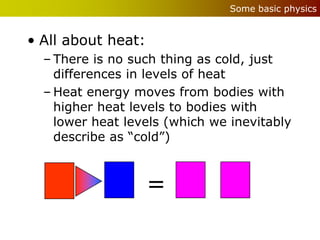
• All about heat:
  – There is no such thing as cold, just
    differences in levels of heat
  – Heat energy moves from bodies with
    higher heat levels to bodies with
    lower heat levels (which we inevitably
    describe as “cold”)


                    =
Heat in the house


• Heat in buildings
  – If our environment is at a lower
    temperature than our bodies, heat flows
    from us to it and we feel “cold”
  – We heat the environment to restore a
    comfortable balance
  – The whole building now becomes warmer
    than the external environment and heat
    starts to flow out of the building
  – Modern buildings are designed to minimise
    this heat flow.
Two crucial considerations


• When considering heating and
  insulating buildings, two points
  must be addressed:
  1. How does heat flow from one body
     to another?
  2. What is thermal comfort?
Heat flow


• Heat flows from one body to
  another through three physical
  processes
  – Conduction
  – Convection
  – Radiation
• Insulation addresses conduction
  and convection
• Radiation is more difficult to
  control
Conduction


• Heat conduction occurs when a hot
  body is in direct contact with a cold
  body
• Energy is transferred until both are at
  the same level of heat (temperature)
• Materials with high conductivity
  – Metal, glass, ceramics, stone=bad insulants
• Materials with low conductivity
  – Still air, wood, fabrics= good insulants
Insulating buildings materials


• Special materials are incorporated
  in the building enclosure which are
  good insulators (bad conductors of
  heat energy)
• Invariably the fundamental
  insulating material is stationary air
• Fibreglass quilts, expanded
  plastics, foamed paints all rely on
  the air contained in them to
  provide the insulation
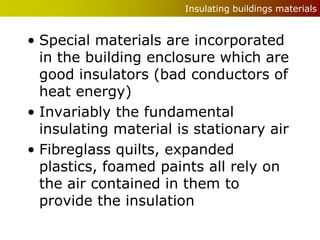
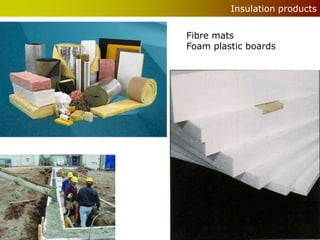
Insulation products


Fibre mats
Foam plastic boards
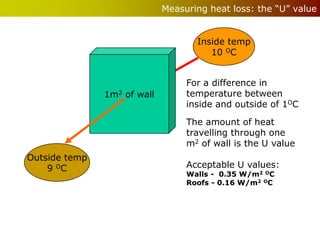
Measuring heat loss: the “U” value


                                    Inside temp
                                       10 OC


                                  For a difference in
               1m2 of wall        temperature between
                                  inside and outside of 1OC
                                  The amount of heat
                                  travelling through one
                                  m2 of wall is the U value
Outside temp
    9 OC                          Acceptable U values:
                                  Walls - 0.35 W/m2 OC
                                  Roofs - 0.16 W/m2 OC
Convection


• Fluids (liquids and gases) can
  move internally within the body of
  the fluid.
• Heating fluids makes them expand
  and their density lowers
• Under influence of gravity, denser
  fluid falls and less dense rises. This
  movement is convection
• Air is a fluid…
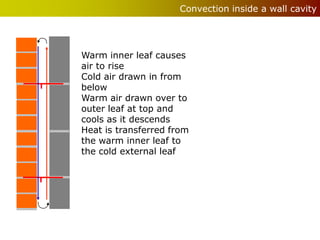
Convection inside a wall cavity


Warm inner leaf causes
air to rise
Cold air drawn in from
below
Warm air drawn over to
outer leaf at top and
cools as it descends
Heat is transferred from
the warm inner leaf to
the cold external leaf
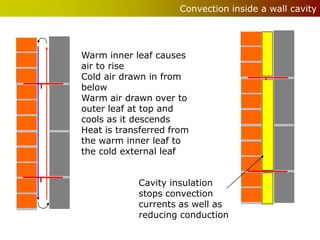
Convection inside a wall cavity


Warm inner leaf causes
air to rise
Cold air drawn in from
below
Warm air drawn over to
outer leaf at top and
cools as it descends
Heat is transferred from
the warm inner leaf to
the cold external leaf


            Cavity insulation
            stops convection
            currents as well as
            reducing conduction
Radiation


• Heat energy is carried away from a
  hot body by infra red (IR) radiation
• All bodies above 0oK emit IR
• Smooth, light coloured surfaces
  emit, and absorb, least IR
• Dark, matt surfaces emit, and
  absorb, most IR
• Smooth, shiny surfaces may reflect
  IR
Aluminium foil radiation control layers


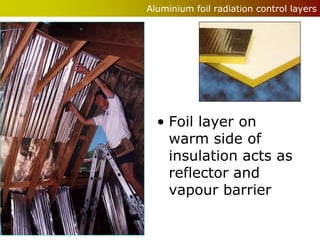
  • Foil layer on
    warm side of
    insulation acts as
    reflector and
    vapour barrier
Thermal comfort

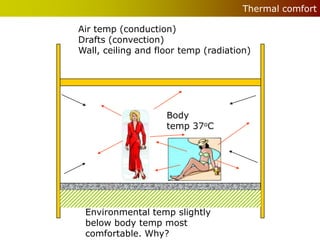
Air temp (conduction)
Drafts (convection)
Wall, ceiling and floor temp (radiation)


                    Body
                    temp 37oC


 Environmental temp slightly
 below body temp most
 comfortable. Why?
References


• Hall, F E. ; Greeno, R. (2010). Building
  services handbook. Butterworth-
  Heinemann
• Roaf, S. ; Fuentes, M. ; Thomas, S.
  (2007). Ecohouse : a design guide. 3rd
  ed. Architectural Press.

Insulation

  • 1.
    Insulation and thermal comfort Keeping the warm in and feeling comfortable
  • 2.
    Some basic physics •All about heat: – There is no such thing as cold, just differences in levels of heat – Heat energy moves from bodies with higher heat levels to bodies with lower heat levels (which we inevitably describe as “cold”) =
  • 3.
    Heat in thehouse • Heat in buildings – If our environment is at a lower temperature than our bodies, heat flows from us to it and we feel “cold” – We heat the environment to restore a comfortable balance – The whole building now becomes warmer than the external environment and heat starts to flow out of the building – Modern buildings are designed to minimise this heat flow.
  • 4.
    Two crucial considerations •When considering heating and insulating buildings, two points must be addressed: 1. How does heat flow from one body to another? 2. What is thermal comfort?
  • 5.
    Heat flow • Heatflows from one body to another through three physical processes – Conduction – Convection – Radiation • Insulation addresses conduction and convection • Radiation is more difficult to control
  • 6.
    Conduction • Heat conductionoccurs when a hot body is in direct contact with a cold body • Energy is transferred until both are at the same level of heat (temperature) • Materials with high conductivity – Metal, glass, ceramics, stone=bad insulants • Materials with low conductivity – Still air, wood, fabrics= good insulants
  • 7.
    Insulating buildings materials •Special materials are incorporated in the building enclosure which are good insulators (bad conductors of heat energy) • Invariably the fundamental insulating material is stationary air • Fibreglass quilts, expanded plastics, foamed paints all rely on the air contained in them to provide the insulation
  • 8.
  • 9.
    Measuring heat loss:the “U” value Inside temp 10 OC For a difference in 1m2 of wall temperature between inside and outside of 1OC The amount of heat travelling through one m2 of wall is the U value Outside temp 9 OC Acceptable U values: Walls - 0.35 W/m2 OC Roofs - 0.16 W/m2 OC
  • 10.
    Convection • Fluids (liquidsand gases) can move internally within the body of the fluid. • Heating fluids makes them expand and their density lowers • Under influence of gravity, denser fluid falls and less dense rises. This movement is convection • Air is a fluid…
  • 11.
    Convection inside awall cavity Warm inner leaf causes air to rise Cold air drawn in from below Warm air drawn over to outer leaf at top and cools as it descends Heat is transferred from the warm inner leaf to the cold external leaf
  • 12.
    Convection inside awall cavity Warm inner leaf causes air to rise Cold air drawn in from below Warm air drawn over to outer leaf at top and cools as it descends Heat is transferred from the warm inner leaf to the cold external leaf Cavity insulation stops convection currents as well as reducing conduction
  • 13.
    Radiation • Heat energyis carried away from a hot body by infra red (IR) radiation • All bodies above 0oK emit IR • Smooth, light coloured surfaces emit, and absorb, least IR • Dark, matt surfaces emit, and absorb, most IR • Smooth, shiny surfaces may reflect IR
  • 14.
    Aluminium foil radiationcontrol layers • Foil layer on warm side of insulation acts as reflector and vapour barrier
  • 15.
    Thermal comfort Air temp(conduction) Drafts (convection) Wall, ceiling and floor temp (radiation) Body temp 37oC Environmental temp slightly below body temp most comfortable. Why?
  • 16.
    References • Hall, FE. ; Greeno, R. (2010). Building services handbook. Butterworth- Heinemann • Roaf, S. ; Fuentes, M. ; Thomas, S. (2007). Ecohouse : a design guide. 3rd ed. Architectural Press.