Thermal insulation
Significance in buildings
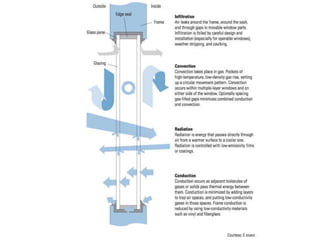
Heat transfer
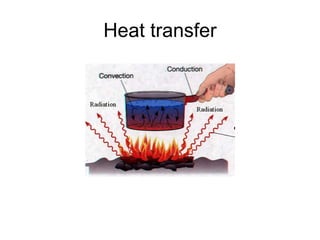
Types of heat transfer
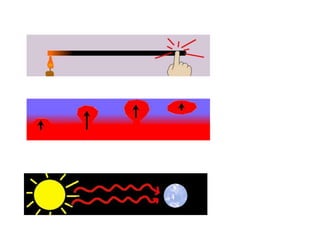
• Conduction-requires the physical contact
of two objects. In the case of a wall, heat
is conducted through the layers within the
wall from the warmer side to the cooler
side
• Convection - is heat transfer due to fluid
or airflow. A common example is when
warm air rises (or cool air falls) on a wall’s
inside surface, inducing air movement.
• Radiation -when surfaces exchange
electromagnetic waves, such as light, infrared
radiation, UV radiation or microwaves.
Radiation does not require any fluid medium or
contact, but does require an air gap or other
transparent medium between the surfaces
exchanging radiation.
• Radiation exchange occurs between two
surfaces when one is warmer than the other and
they are in “view” of each other; i.e., there is
nothing between the two surfaces.
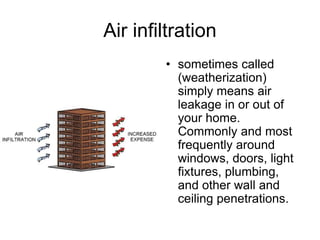
Air infiltration
• sometimes called
(weatherization)
simply means air
leakage in or out of
your home.
Commonly and most
frequently around
windows, doors, light
fixtures, plumbing,
and other wall and
ceiling penetrations.
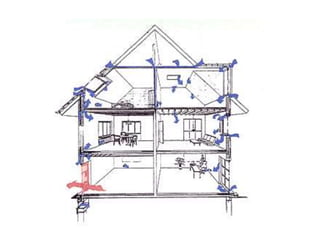
Sources of unmanaged air are
leaks:
Within the building envelope.
o Between facade elements.
o Between facade and foundation and roof.
o In the foundation and roof.
o Around envelope penetrations: vents, pipes,
window and door frames, etc.
o Poorly weather stripped windows and doors.
o In air intake or exhaust plenums and ducts.
Costs resulting from air
infiltration
• Higher utility expenses.
• Higher capital cost for larger HVAC equipment.
• Higher maintenance cost for HVAC due to it running more.
• Building maintenance costs due to moisture in the walls and possible mold
mitigation.
• Building cleaning costs due to dirt and pollutants carried into the occupied
spaces.
• Tenant dissatisfaction and frustration.
• Lower employee productivity.
• Higher employee absenteeism and illness.
• Reduced building life.
• Reduced property value.
• Cost of retro-fitting and mitigating leaks is higher than additional
construction cost if air infiltration is addressed during design and
construction.
• Cost of finding the air leaks and fixing them.
Unmanaged air can have the following affects on
the interior building environment
Puts additional load on HVAC systems to condition the additional air.
This also drives up equipment and maintenance costs and the cost
of utilities.
o Is not filtered or dehumidified.
o Can bring in moisture which results in condensation and
potentially causes mold and other damage.
o Reduces the comfort of the interior space.
o Causes drafts.
o Carries dirt and pollutants.
o Can penetrate deep into the building space through ceiling
spaces, wall cavities and other unintended plenums.
o Causes additional resources to be needed for cleaning and
maintenance.
o Causes discomfort and is distracting to the building occupants.
Low- emissivity = High Reflectivity =
Reduced Heat Transfer
• Reflectivity and emissivity are properties of a
surface that affect radiation heat transfer and
how a reflective product will perform
• The fraction of radiation arriving at a surface that
is reflected by it is called its reflectivity.
• Another property of the surface is its emissivity,
which essentially is the surface’s tendency to
emit radiation to other bodies.
• Surfaces with high emissivity are also very
absorptive, that is, they will readily absorb
radiation striking them.
• These properties may vary depending on the
wavelength of radiation falling on the surface.
• For example, the surface may reflect much of
the visible radiation (i.e., light) falling on it, but
not much of the ultraviolet (UV) radiation or
infrared radiation falling on it
Places you generally want to
reduce heat
transfer are:
• Between interior objects in a building
(including people) and the interior surfaces
of exterior walls – on both hot and cold
days
• Between the exterior surfaces of a building
and its surroundings – on both hot and
cold days
• Low-e coatings on windows save energy
in most circumstances because they
reduce heat transfer with the
surroundings.
• As another example, a low-emissivity
ceiling – such as unpainted aluminum or a
reflective aluminum paint product in an ice
rink may have very good energy savings
Building insulation
• any object in a building used
as insulation for any purpose
• important factor to achieving thermal
comfort for its occupants
• reduces unwanted heat loss or gain and
can decrease the energy demands
of heating and cooling systems
Thermal insulation
• can refer to materials used to reduce the
rate of heat transfer, or the methods and
processes used to reduce heat transfer.
• method of preventing heat from escaping
a container or from entering the container
Cold climates
• to reduce heat flow out of the building
• building envelope - windows, roofs and
walls, and air infiltration are all important
sources of heat loss
• R-value -resistance to conducted heat
loss
• Losses can be reduced by
good weatherization, bulk insulation, and
minimising the amount of non-insulative
Hot climates
• directly through windows or it can heat the
building shell to a higher temperature than
the ambient
• The Solar Heat Gain Co-efficient (SGHC) -
a measure of solar heat transmittance
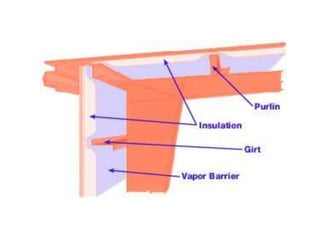
Thermal bridge
• points in the building envelope that allow
heat conduction to occur
• A thermal bridge is created when materials
create a continuous path across a
temperature difference, in which the heat
flow is not interrupted by thermal insulation
• poor insulators - glass and metal.
Advantages of thermal
insulation:
• Thermal insulation in the warm climate can reduce the
energy demand for cooling in residential buildings up to
70%.
• Reduction of energy consumption for heating (by 30 % at
least),
• Creation of a thermal comfort by increasing the surface
temperature of the inside walls, Leaking elimination,
• Reduction of thermal stress of the framework,
• Building lifetime prolongation,
• Improvement of the architectural look of the building.
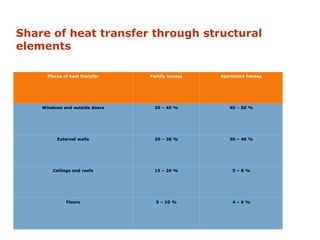
Share of heat transfer through structural
elements
Places of heat transfer Family houses Apartment houses
Windows and outside doors 30 – 40 % 40 – 50 %
External walls 20 – 30 % 30 – 40 %
Ceilings and roofs 15 – 20 % 5 – 8 %
Floors 5 – 10 % 4 – 6 %
Growth of moulds in the building
• The growth of moulds in the building is
closely associated with the dew point
temperature at which water vapor
condensates.
• The dew point temperature depends on
the temperature of the air and the
surrounding building structures (walls,
windows) and also on the relative air
humidity in the room
Measures to avoid the growth of
mould:
• Improvement of thermal insulation properties of
the external cladding in places of cold bridges;
• Inside air temperature increase;
• Increase of air circulation around the surface of
building constructions;
• Decrease in the air humidity in the room by
regular ventilation, i.e. by a fast exchange of the
warm and humid air for the outside air with lower
humidity.
Insulation systems by insulation
method
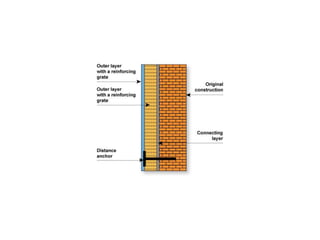
• Contact systems consist of a heat
insulator and a reinforcing layer with
a reinforcing grate. The insulator is
mechanically fastened to the base by
expanding anchors, glue or their
combination. Dispersion or mineral
plasters are usually used for the surface
and are applied on the reinforcing layer
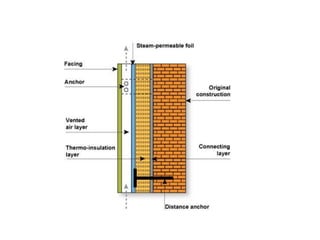
• Vented (mounted) systems have
a vented air gap between the external
cladding and the insulation. The insulation
is fastened to the wall by means of the
expanding anchors. The supporting
structure of the external cladding is placed
on the insulation.
• Plaster insulation systems are used
rather rarely. They involve an application
of a special plaster with significantly better
thermal insulation properties compared to
the usual plaster types.
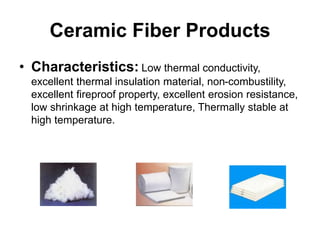
Ceramic Fiber Products
• Characteristics: Low thermal conductivity,
excellent thermal insulation material, non-combustility,
excellent fireproof property, excellent erosion resistance,
low shrinkage at high temperature, Thermally stable at
high temperature.
Rockwool Products:
• Rockwool products are
categories as thermal,
acoustical insulation and
non- combustible
material, produced form
rock fibers spun molten
basalt.
Products
Thick. Range
mm
Density Range
Kg/m3
Panel 30 - 100 30 – 140
Blanket 30 – 100 30 – 140
Felt 30 – 100 30 – 60
Pipe Section 25 – 100 100 - 150
Materials
• Bulk Insulation
• and Reflective Insulation
• combination of both
Conductive and convective
insulators
• block conductive heat transfer and
convective flow either into or out of a
building
• The denser a material is, the better it will
conduct heat
• air has such low density, air is a very poor
conductor and therefore makes a good
insulator
Radiant heat barriers
• work in conjunction with an air space to
reduce radiant heat transfer across the air
space.
• reflects heat instead of either absorbing it
or letting it pass through
• reducing downward heat flow, because
upward heat flow tends to be dominated
by convection
• most effective in hot climates
• BTU- "British Thermal Unit" which is
defined as the quantity of heat that would
be required to increase the temperature
of one pound of water by one degree
Fahrenheit.
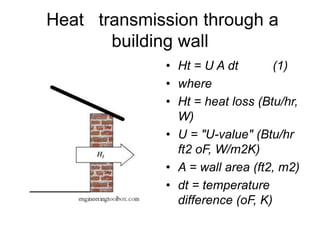
Heat transmission through a
building wall
• Ht = U A dt (1)
• where
• Ht = heat loss (Btu/hr,
W)
• U = "U-value" (Btu/hr
ft2 oF, W/m2K)
• A = wall area (ft2, m2)
• dt = temperature
difference (oF, K)
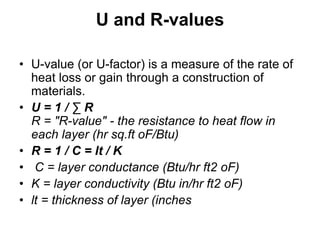
U and R-values
• U-value (or U-factor) is a measure of the rate of
heat loss or gain through a construction of
materials.
• U = 1 / ∑ R
R = "R-value" - the resistance to heat flow in
each layer (hr sq.ft oF/Btu)
• R = 1 / C = lt / K
• C = layer conductance (Btu/hr ft2 oF)
• K = layer conductivity (Btu in/hr ft2 oF)
• lt = thickness of layer (inches
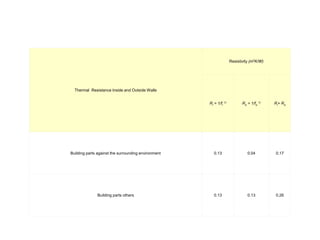
Thermal Resistance Inside and Outside Walls
Resistivity (m2K/W)
Ri = 1/fi
1) Ro = 1/fo
1) Ri+ Ro
Building parts against the surrounding environment 0.13 0.04 0.17
Building parts others 0.13 0.13 0.26
Building Heat Losses
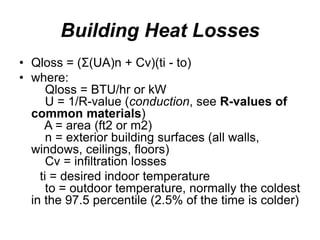
• Qloss = (Σ(UA)n + Cv)(ti - to)
• where:
Qloss = BTU/hr or kW
U = 1/R-value (conduction, see R-values of
common materials)
A = area (ft2 or m2)
n = exterior building surfaces (all walls,
windows, ceilings, floors)
Cv = infiltration losses
ti = desired indoor temperature
to = outdoor temperature, normally the coldest
in the 97.5 percentile (2.5% of the time is colder)
Building Heat Gains
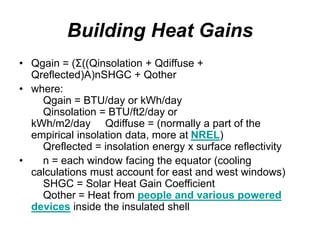
• Qgain = (Σ((Qinsolation + Qdiffuse +
Qreflected)A)nSHGC + Qother
• where:
Qgain = BTU/day or kWh/day
Qinsolation = BTU/ft2/day or
kWh/m2/day Qdiffuse = (normally a part of the
empirical insolation data, more at NREL)
Qreflected = insolation energy x surface reflectivity
• n = each window facing the equator (cooling
calculations must account for east and west windows)
SHGC = Solar Heat Gain Coefficient
Qother = Heat from people and various powered
devices inside the insulated shell
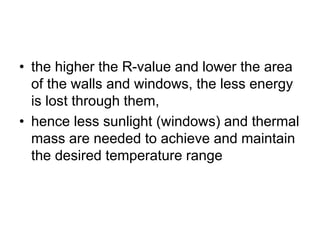
• the higher the R-value and lower the area
of the walls and windows, the less energy
is lost through them,
• hence less sunlight (windows) and thermal
mass are needed to achieve and maintain
the desired temperature range
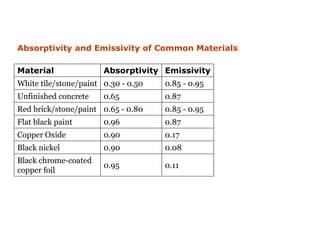
Absorptivity and Emissivity of Common Materials
Material Absorptivity Emissivity
White tile/stone/paint 0.30 - 0.50 0.85 - 0.95
Unfinished concrete 0.65 0.87
Red brick/stone/paint 0.65 - 0.80 0.85 - 0.95
Flat black paint 0.96 0.87
Copper Oxide 0.90 0.17
Black nickel 0.90 0.08
Black chrome-coated
copper foil
0.95 0.11
Benefits
• Lower (20-40%) cooling loads, which
leads to lower energy costs and better
thermal comfort.
• 􀂄 Insulation reduces the transmission of
sound from other rooms or from the
outside
Criteria for specifying thermal
insulation
Performance in use and longevity
• Stability and expected effective life.
• U-values achieved in practice, including basis of
calculation of the design performance; for
example, does the design performance assume
some degree of initial loss?
• Vulnerability to factors affecting performance
including moisture, movement and compression
of fill, and vermin attack.
• Durability of treatments such as flame
retardants.
Balance between thermal mass and
lightweight construction
• Availability of composite products such as
SIPs (structural insulated panels).
• Location of insulation – there is an
opportunity to exploit thermal mass of
building fabric if insulation is placed on the
outside face of solid construction.
• Impact on building design
• Thickness of the insulation material and effect on floors
and external wall thickness.
• Opportunities to incorporate the insulation into other
aspects of building function; for example, creating falls to
flat roofs using tapered products, or the use of a roof
void as habitable space.
• The effect of retro-fit insulation solutions on a selection
of facade options; for example, insulated render as
opposed to rain screen panels.
• Ease of future upgrades.
• Initial capital cost.
• Buildability
• Detailing required to achieve thermal integrity, including avoidance
of cold bridges, air-flow paths, opportunities for settlement or
compression of fill and other movement during and after
construction.
• Requirements for vapour and radiant barriers to maintain
performance.
• Ease of forming to shape and size, and availability of pre-cut
materials.
• Ease of testing and inspection.
• Ability to undertake remedial work without significant disturbance to
other work.
• Health and safety considerations for installers.
•
• Manufacture and disposal
• Sourcing of raw materials.
• Impact of manufacture on environment; for
example, the use of hydrochlorofluorocarbons
(HCFCs) in producing plastics-based material.
• Embodied energy in the production process.
• Ability to reuse or recycle at end of life.
• Constraints on the disposal of materials

38002586-Thermal-InsulationInsulationInsulation.ppt

  • 1.
  • 3.
  • 4.
    Types of heattransfer • Conduction-requires the physical contact of two objects. In the case of a wall, heat is conducted through the layers within the wall from the warmer side to the cooler side • Convection - is heat transfer due to fluid or airflow. A common example is when warm air rises (or cool air falls) on a wall’s inside surface, inducing air movement.
  • 6.
    • Radiation -whensurfaces exchange electromagnetic waves, such as light, infrared radiation, UV radiation or microwaves. Radiation does not require any fluid medium or contact, but does require an air gap or other transparent medium between the surfaces exchanging radiation. • Radiation exchange occurs between two surfaces when one is warmer than the other and they are in “view” of each other; i.e., there is nothing between the two surfaces.
  • 7.
    Air infiltration • sometimescalled (weatherization) simply means air leakage in or out of your home. Commonly and most frequently around windows, doors, light fixtures, plumbing, and other wall and ceiling penetrations.
  • 10.
    Sources of unmanagedair are leaks: Within the building envelope. o Between facade elements. o Between facade and foundation and roof. o In the foundation and roof. o Around envelope penetrations: vents, pipes, window and door frames, etc. o Poorly weather stripped windows and doors. o In air intake or exhaust plenums and ducts.
  • 11.
    Costs resulting fromair infiltration • Higher utility expenses. • Higher capital cost for larger HVAC equipment. • Higher maintenance cost for HVAC due to it running more. • Building maintenance costs due to moisture in the walls and possible mold mitigation. • Building cleaning costs due to dirt and pollutants carried into the occupied spaces. • Tenant dissatisfaction and frustration. • Lower employee productivity. • Higher employee absenteeism and illness. • Reduced building life. • Reduced property value. • Cost of retro-fitting and mitigating leaks is higher than additional construction cost if air infiltration is addressed during design and construction. • Cost of finding the air leaks and fixing them.
  • 12.
    Unmanaged air canhave the following affects on the interior building environment Puts additional load on HVAC systems to condition the additional air. This also drives up equipment and maintenance costs and the cost of utilities. o Is not filtered or dehumidified. o Can bring in moisture which results in condensation and potentially causes mold and other damage. o Reduces the comfort of the interior space. o Causes drafts. o Carries dirt and pollutants. o Can penetrate deep into the building space through ceiling spaces, wall cavities and other unintended plenums. o Causes additional resources to be needed for cleaning and maintenance. o Causes discomfort and is distracting to the building occupants.
  • 13.
    Low- emissivity =High Reflectivity = Reduced Heat Transfer • Reflectivity and emissivity are properties of a surface that affect radiation heat transfer and how a reflective product will perform • The fraction of radiation arriving at a surface that is reflected by it is called its reflectivity. • Another property of the surface is its emissivity, which essentially is the surface’s tendency to emit radiation to other bodies.
  • 14.
    • Surfaces withhigh emissivity are also very absorptive, that is, they will readily absorb radiation striking them. • These properties may vary depending on the wavelength of radiation falling on the surface. • For example, the surface may reflect much of the visible radiation (i.e., light) falling on it, but not much of the ultraviolet (UV) radiation or infrared radiation falling on it
  • 15.
    Places you generallywant to reduce heat transfer are: • Between interior objects in a building (including people) and the interior surfaces of exterior walls – on both hot and cold days • Between the exterior surfaces of a building and its surroundings – on both hot and cold days
  • 16.
    • Low-e coatingson windows save energy in most circumstances because they reduce heat transfer with the surroundings. • As another example, a low-emissivity ceiling – such as unpainted aluminum or a reflective aluminum paint product in an ice rink may have very good energy savings
  • 17.
    Building insulation • anyobject in a building used as insulation for any purpose • important factor to achieving thermal comfort for its occupants • reduces unwanted heat loss or gain and can decrease the energy demands of heating and cooling systems
  • 18.
    Thermal insulation • canrefer to materials used to reduce the rate of heat transfer, or the methods and processes used to reduce heat transfer. • method of preventing heat from escaping a container or from entering the container
  • 19.
    Cold climates • toreduce heat flow out of the building • building envelope - windows, roofs and walls, and air infiltration are all important sources of heat loss • R-value -resistance to conducted heat loss • Losses can be reduced by good weatherization, bulk insulation, and minimising the amount of non-insulative
  • 20.
    Hot climates • directlythrough windows or it can heat the building shell to a higher temperature than the ambient • The Solar Heat Gain Co-efficient (SGHC) - a measure of solar heat transmittance
  • 21.
    Thermal bridge • pointsin the building envelope that allow heat conduction to occur • A thermal bridge is created when materials create a continuous path across a temperature difference, in which the heat flow is not interrupted by thermal insulation • poor insulators - glass and metal.
  • 24.
    Advantages of thermal insulation: •Thermal insulation in the warm climate can reduce the energy demand for cooling in residential buildings up to 70%. • Reduction of energy consumption for heating (by 30 % at least), • Creation of a thermal comfort by increasing the surface temperature of the inside walls, Leaking elimination, • Reduction of thermal stress of the framework, • Building lifetime prolongation, • Improvement of the architectural look of the building.
  • 25.
    Share of heattransfer through structural elements Places of heat transfer Family houses Apartment houses Windows and outside doors 30 – 40 % 40 – 50 % External walls 20 – 30 % 30 – 40 % Ceilings and roofs 15 – 20 % 5 – 8 % Floors 5 – 10 % 4 – 6 %
  • 26.
    Growth of mouldsin the building • The growth of moulds in the building is closely associated with the dew point temperature at which water vapor condensates. • The dew point temperature depends on the temperature of the air and the surrounding building structures (walls, windows) and also on the relative air humidity in the room
  • 27.
    Measures to avoidthe growth of mould: • Improvement of thermal insulation properties of the external cladding in places of cold bridges; • Inside air temperature increase; • Increase of air circulation around the surface of building constructions; • Decrease in the air humidity in the room by regular ventilation, i.e. by a fast exchange of the warm and humid air for the outside air with lower humidity.
  • 28.
    Insulation systems byinsulation method • Contact systems consist of a heat insulator and a reinforcing layer with a reinforcing grate. The insulator is mechanically fastened to the base by expanding anchors, glue or their combination. Dispersion or mineral plasters are usually used for the surface and are applied on the reinforcing layer
  • 30.
    • Vented (mounted)systems have a vented air gap between the external cladding and the insulation. The insulation is fastened to the wall by means of the expanding anchors. The supporting structure of the external cladding is placed on the insulation.
  • 32.
    • Plaster insulationsystems are used rather rarely. They involve an application of a special plaster with significantly better thermal insulation properties compared to the usual plaster types.
  • 33.
    Ceramic Fiber Products •Characteristics: Low thermal conductivity, excellent thermal insulation material, non-combustility, excellent fireproof property, excellent erosion resistance, low shrinkage at high temperature, Thermally stable at high temperature.
  • 34.
    Rockwool Products: • Rockwoolproducts are categories as thermal, acoustical insulation and non- combustible material, produced form rock fibers spun molten basalt. Products Thick. Range mm Density Range Kg/m3 Panel 30 - 100 30 – 140 Blanket 30 – 100 30 – 140 Felt 30 – 100 30 – 60 Pipe Section 25 – 100 100 - 150
  • 35.
    Materials • Bulk Insulation •and Reflective Insulation • combination of both
  • 36.
    Conductive and convective insulators •block conductive heat transfer and convective flow either into or out of a building • The denser a material is, the better it will conduct heat • air has such low density, air is a very poor conductor and therefore makes a good insulator
  • 37.
    Radiant heat barriers •work in conjunction with an air space to reduce radiant heat transfer across the air space. • reflects heat instead of either absorbing it or letting it pass through • reducing downward heat flow, because upward heat flow tends to be dominated by convection • most effective in hot climates
  • 38.
    • BTU- "BritishThermal Unit" which is defined as the quantity of heat that would be required to increase the temperature of one pound of water by one degree Fahrenheit.
  • 39.
    Heat transmission througha building wall • Ht = U A dt (1) • where • Ht = heat loss (Btu/hr, W) • U = "U-value" (Btu/hr ft2 oF, W/m2K) • A = wall area (ft2, m2) • dt = temperature difference (oF, K)
  • 40.
    U and R-values •U-value (or U-factor) is a measure of the rate of heat loss or gain through a construction of materials. • U = 1 / ∑ R R = "R-value" - the resistance to heat flow in each layer (hr sq.ft oF/Btu) • R = 1 / C = lt / K • C = layer conductance (Btu/hr ft2 oF) • K = layer conductivity (Btu in/hr ft2 oF) • lt = thickness of layer (inches
  • 41.
    Thermal Resistance Insideand Outside Walls Resistivity (m2K/W) Ri = 1/fi 1) Ro = 1/fo 1) Ri+ Ro Building parts against the surrounding environment 0.13 0.04 0.17 Building parts others 0.13 0.13 0.26
  • 42.
    Building Heat Losses •Qloss = (Σ(UA)n + Cv)(ti - to) • where: Qloss = BTU/hr or kW U = 1/R-value (conduction, see R-values of common materials) A = area (ft2 or m2) n = exterior building surfaces (all walls, windows, ceilings, floors) Cv = infiltration losses ti = desired indoor temperature to = outdoor temperature, normally the coldest in the 97.5 percentile (2.5% of the time is colder)
  • 43.
    Building Heat Gains •Qgain = (Σ((Qinsolation + Qdiffuse + Qreflected)A)nSHGC + Qother • where: Qgain = BTU/day or kWh/day Qinsolation = BTU/ft2/day or kWh/m2/day Qdiffuse = (normally a part of the empirical insolation data, more at NREL) Qreflected = insolation energy x surface reflectivity • n = each window facing the equator (cooling calculations must account for east and west windows) SHGC = Solar Heat Gain Coefficient Qother = Heat from people and various powered devices inside the insulated shell
  • 44.
    • the higherthe R-value and lower the area of the walls and windows, the less energy is lost through them, • hence less sunlight (windows) and thermal mass are needed to achieve and maintain the desired temperature range
  • 45.
    Absorptivity and Emissivityof Common Materials Material Absorptivity Emissivity White tile/stone/paint 0.30 - 0.50 0.85 - 0.95 Unfinished concrete 0.65 0.87 Red brick/stone/paint 0.65 - 0.80 0.85 - 0.95 Flat black paint 0.96 0.87 Copper Oxide 0.90 0.17 Black nickel 0.90 0.08 Black chrome-coated copper foil 0.95 0.11
  • 47.
    Benefits • Lower (20-40%)cooling loads, which leads to lower energy costs and better thermal comfort. • 􀂄 Insulation reduces the transmission of sound from other rooms or from the outside
  • 48.
    Criteria for specifyingthermal insulation Performance in use and longevity • Stability and expected effective life. • U-values achieved in practice, including basis of calculation of the design performance; for example, does the design performance assume some degree of initial loss? • Vulnerability to factors affecting performance including moisture, movement and compression of fill, and vermin attack. • Durability of treatments such as flame retardants.
  • 49.
    Balance between thermalmass and lightweight construction • Availability of composite products such as SIPs (structural insulated panels). • Location of insulation – there is an opportunity to exploit thermal mass of building fabric if insulation is placed on the outside face of solid construction.
  • 50.
    • Impact onbuilding design • Thickness of the insulation material and effect on floors and external wall thickness. • Opportunities to incorporate the insulation into other aspects of building function; for example, creating falls to flat roofs using tapered products, or the use of a roof void as habitable space. • The effect of retro-fit insulation solutions on a selection of facade options; for example, insulated render as opposed to rain screen panels. • Ease of future upgrades. • Initial capital cost.
  • 51.
    • Buildability • Detailingrequired to achieve thermal integrity, including avoidance of cold bridges, air-flow paths, opportunities for settlement or compression of fill and other movement during and after construction. • Requirements for vapour and radiant barriers to maintain performance. • Ease of forming to shape and size, and availability of pre-cut materials. • Ease of testing and inspection. • Ability to undertake remedial work without significant disturbance to other work. • Health and safety considerations for installers. •
  • 52.
    • Manufacture anddisposal • Sourcing of raw materials. • Impact of manufacture on environment; for example, the use of hydrochlorofluorocarbons (HCFCs) in producing plastics-based material. • Embodied energy in the production process. • Ability to reuse or recycle at end of life. • Constraints on the disposal of materials