SEMINAR
ON
BUILDING
MATERIALS
Submitted by :
PRAKASH KUMAR
REGD.NO: 1201298038
DEPARTMENT OF CIVIL ENGINEERING
GANDHI INSTITUTE FOR TECHNOLOGY,BBSR
INTRODUCTION
The engineering structures are composed of materials which
are known as building materials.The service condition of
buildings demand a wide range of materials & various
properties such as water resistance ,strength ,durability
,temperature resistance ,Appearance ,permeability etc.
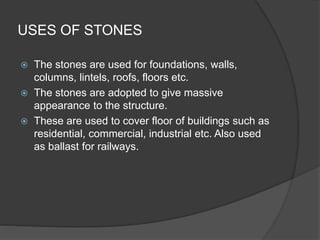
 Cement materials : Lime ,Cement ,Mortar
 Protective materials : Paints , Varnishes ,Plaster
 Solid materials : Stones ,Bricks ,Iron ,Timber
STONES
The building stones are obtained from the rocks
which are classified in three ways :
 Geological classification : Igneous Sedimentary &
Metamorphic rocks
 Physical classification : Stratified ,Unstratified
& Foliated rocks
 Chemical classification : Silicious ,Argillaceous &
calcareous rocks
USES OF STONES
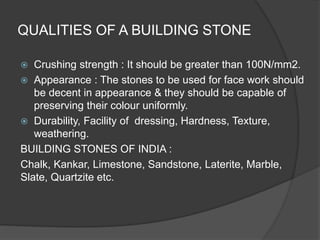
 The stones are used for foundations, walls,
columns, lintels, roofs, floors etc.
 The stones are adopted to give massive
appearance to the structure.
 These are used to cover floor of buildings such as
residential, commercial, industrial etc. Also used
as ballast for railways.
QUALITIES OF A BUILDING STONE
 Crushing strength : It should be greater than 100N/mm2.
 Appearance : The stones to be used for face work should
be decent in appearance & they should be capable of
preserving their colour uniformly.
 Durability, Facility of dressing, Hardness, Texture,
weathering.
BUILDING STONES OF INDIA :
Chalk, Kankar, Limestone, Sandstone, Laterite, Marble,
Slate, Quartzite etc.
BRICKS
The bricks are obtained by moulding clay in rectangular blocks
of uniform size & then by drying & burning these blocks. Brick
is extensively used at present as a leading material of
construction because of its durability, strength, low cost, easy
availability, etc.
CLASSIFICATION OF BRICKS :
 First class bricks : Are table moulded & are used for
structures like building, dams, roads, tunnels, etc.
 Second class bricks : Are ground moulded
 Third class brick : Are used at places where rainfall isn’t
heavy.
SHAPES OF BRICKS
QUALITIES OF BRICKS
 The bricks should be table mounded, well burnt, free from
cracks & with sharp & square edges.The colour should be
uniform & bright.
 It should give a clear metallic ringing sound when struck with
each other.
 No impression should be left on brick when scratched with
finger nail.
 Bricks shouldn’t break into pieces when dropped flat on
ground from a height of about one metre.
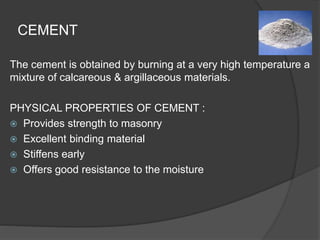
CEMENT
The cement is obtained by burning at a very high temperature a
mixture of calcareous & argillaceous materials.
PHYSICAL PROPERTIES OF CEMENT :
 Provides strength to masonry
 Excellent binding material
 Stiffens early
 Offers good resistance to the moisture
USES OF CEMENT
 Cement mortar for masonry work, plaster
 In construction of bridges, dams, tunnels, light houses docks
 Making joints for drains, pipes
 Preparation of foundations, footpaths
VARIETIES OF CEMENT :
 High alumina cement, Pozzolana cement
 Quick setting cement, coloured cement
 Rapid hardening & extra rapid hardening cement
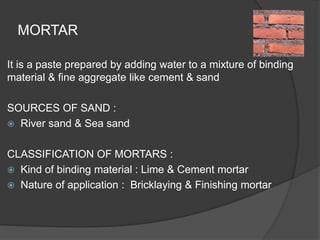
MORTAR
It is a paste prepared by adding water to a mixture of binding
material & fine aggregate like cement & sand
SOURCES OF SAND :
 River sand & Sea sand
CLASSIFICATION OF MORTARS :
 Kind of binding material : Lime & Cement mortar
 Nature of application : Bricklaying & Finishing mortar
PROPERTIES OF MORTAR
 It should be cheap, durable & easily workable
 It should be capable of developing good adhesion with the
building units such as bricks, stones etc
USES OF MORTAR :
 To bind the building units
 To form joints of pipes
 To improve the general appearance of the structure
 To form a soft bedding layer for the building units
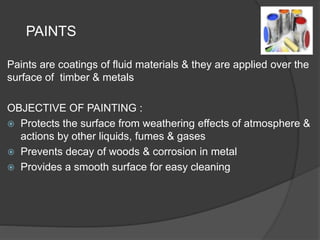
PAINTS
Paints are coatings of fluid materials & they are applied over the
surface of timber & metals
OBJECTIVE OF PAINTING :
 Protects the surface from weathering effects of atmosphere &
actions by other liquids, fumes & gases
 Prevents decay of woods & corrosion in metal
 Provides a smooth surface for easy cleaning
TYPES OF PAINTS
 Aluminium paint : Visible in darkness, Resists heat to a
certain degree
 Anticorrosive paint : Is cheap, lasts for long duration
 Emulsion paint : Easy to apply, Dries quickly in about 2 hrs
 Luminous paint : Shines like radium dials of watches, Is
applied on the surfaces which is free from corrosion
DISTEMPERS
 They are cheaper than paints & present a neat appearance
 Are light in colour
 Provides good reflective coating
 They can be applied on brickwork, cement plastered surface
 They prove to be unsatisfactory in damp locations such as
kitchen, bathroom etc
A distemper is composed of base, carrier, colouring
pigments.For base chalk is used & for carrier water is used.
REFERENCES
 www.google.com
 www.wikipedia.com
 Engineering materials by Rangwala

Building Materials

  • 1.
    SEMINAR ON BUILDING MATERIALS Submitted by : PRAKASHKUMAR REGD.NO: 1201298038 DEPARTMENT OF CIVIL ENGINEERING GANDHI INSTITUTE FOR TECHNOLOGY,BBSR
  • 2.
    INTRODUCTION The engineering structuresare composed of materials which are known as building materials.The service condition of buildings demand a wide range of materials & various properties such as water resistance ,strength ,durability ,temperature resistance ,Appearance ,permeability etc.  Cement materials : Lime ,Cement ,Mortar  Protective materials : Paints , Varnishes ,Plaster  Solid materials : Stones ,Bricks ,Iron ,Timber
  • 3.
    STONES The building stonesare obtained from the rocks which are classified in three ways :  Geological classification : Igneous Sedimentary & Metamorphic rocks  Physical classification : Stratified ,Unstratified & Foliated rocks  Chemical classification : Silicious ,Argillaceous & calcareous rocks
  • 4.
    USES OF STONES The stones are used for foundations, walls, columns, lintels, roofs, floors etc.  The stones are adopted to give massive appearance to the structure.  These are used to cover floor of buildings such as residential, commercial, industrial etc. Also used as ballast for railways.
  • 5.
    QUALITIES OF ABUILDING STONE  Crushing strength : It should be greater than 100N/mm2.  Appearance : The stones to be used for face work should be decent in appearance & they should be capable of preserving their colour uniformly.  Durability, Facility of dressing, Hardness, Texture, weathering. BUILDING STONES OF INDIA : Chalk, Kankar, Limestone, Sandstone, Laterite, Marble, Slate, Quartzite etc.
  • 6.
    BRICKS The bricks areobtained by moulding clay in rectangular blocks of uniform size & then by drying & burning these blocks. Brick is extensively used at present as a leading material of construction because of its durability, strength, low cost, easy availability, etc. CLASSIFICATION OF BRICKS :  First class bricks : Are table moulded & are used for structures like building, dams, roads, tunnels, etc.  Second class bricks : Are ground moulded  Third class brick : Are used at places where rainfall isn’t heavy.
  • 7.
  • 8.
    QUALITIES OF BRICKS The bricks should be table mounded, well burnt, free from cracks & with sharp & square edges.The colour should be uniform & bright.  It should give a clear metallic ringing sound when struck with each other.  No impression should be left on brick when scratched with finger nail.  Bricks shouldn’t break into pieces when dropped flat on ground from a height of about one metre.
  • 9.
    CEMENT The cement isobtained by burning at a very high temperature a mixture of calcareous & argillaceous materials. PHYSICAL PROPERTIES OF CEMENT :  Provides strength to masonry  Excellent binding material  Stiffens early  Offers good resistance to the moisture
  • 10.
    USES OF CEMENT Cement mortar for masonry work, plaster  In construction of bridges, dams, tunnels, light houses docks  Making joints for drains, pipes  Preparation of foundations, footpaths VARIETIES OF CEMENT :  High alumina cement, Pozzolana cement  Quick setting cement, coloured cement  Rapid hardening & extra rapid hardening cement
  • 11.
    MORTAR It is apaste prepared by adding water to a mixture of binding material & fine aggregate like cement & sand SOURCES OF SAND :  River sand & Sea sand CLASSIFICATION OF MORTARS :  Kind of binding material : Lime & Cement mortar  Nature of application : Bricklaying & Finishing mortar
  • 12.
    PROPERTIES OF MORTAR It should be cheap, durable & easily workable  It should be capable of developing good adhesion with the building units such as bricks, stones etc USES OF MORTAR :  To bind the building units  To form joints of pipes  To improve the general appearance of the structure  To form a soft bedding layer for the building units
  • 13.
    PAINTS Paints are coatingsof fluid materials & they are applied over the surface of timber & metals OBJECTIVE OF PAINTING :  Protects the surface from weathering effects of atmosphere & actions by other liquids, fumes & gases  Prevents decay of woods & corrosion in metal  Provides a smooth surface for easy cleaning
  • 14.
    TYPES OF PAINTS Aluminium paint : Visible in darkness, Resists heat to a certain degree  Anticorrosive paint : Is cheap, lasts for long duration  Emulsion paint : Easy to apply, Dries quickly in about 2 hrs  Luminous paint : Shines like radium dials of watches, Is applied on the surfaces which is free from corrosion
  • 15.
    DISTEMPERS  They arecheaper than paints & present a neat appearance  Are light in colour  Provides good reflective coating  They can be applied on brickwork, cement plastered surface  They prove to be unsatisfactory in damp locations such as kitchen, bathroom etc A distemper is composed of base, carrier, colouring pigments.For base chalk is used & for carrier water is used.
  • 16.