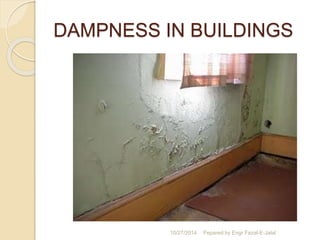
DAMPNESS IN 
BUILDINGS 
Civil Engineering Drawing & Graphics (Theory) 
10/27/2014 Pepared by Engr Fazal-E-Jalal
DAMPNESS IN BUILDINGS 
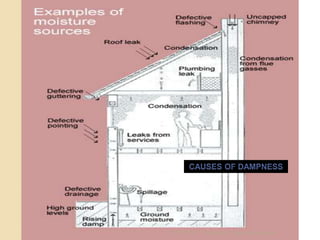
1. Rising damp 
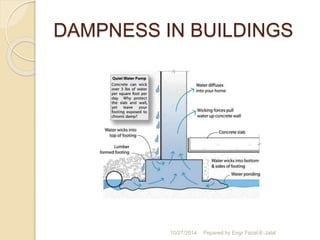
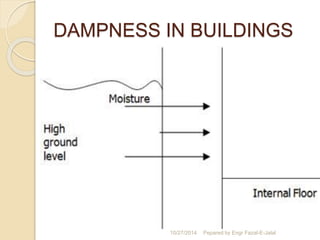
Rising damp is the result of water rising 
through the walls by means of capillary action. 
Moisture may stem from the soil around the 
outside of walls or from moisture rising through 
the floor construction. As a result of the 
capillary ‘lift’ through the fine pores in 
brickwork and masonry, moisture reaches a 
maximum height up the wall of about 1 metre. 
10/27/2014 Pepared by Engr Fazal-E-Jalal
DAMPNESS IN BUILDINGS 
10/27/2014 Pepared by Engr Fazal-E-Jalal
DAMPNESS IN BUILDINGS 
To counter this effect in walls, the path of 
water up walls is blocked by builders 
incorporating an impervious layer into the wall 
at low level. These ‘damp roof courses’ (dpc’s) 
have been made of various materials over the 
years including such things as slates, 
engineering bricks and bitumen felt. 
10/27/2014 Pepared by Engr Fazal-E-Jalal
DAMPNESS IN BUILDINGS 
10/27/2014 Pepared by Engr Fazal-E-Jalal
DAMPNESS IN BUILDINGS 
Deterioration of the dpc material leads to 
failure in the barrier and allows moisture to 
rise, and if the dpc is bridged, for example by 
external soil being placed against the wall 
above the dpc level, then the dpc is rendered 
ineffective. 
10/27/2014 Pepared by Engr Fazal-E-Jalal
DAMPNESS IN BUILDINGS 
TREATMENT 
Where a rising damp problem is caused by a 
lack of a damp-proof course (common in 
buildings over approximately 100 years old) or 
by a failed damp-proof course (comparatively 
rare) there are a wide range of possible 
solutions available. 
10/27/2014 Pepared by Engr Fazal-E-Jalal
DAMPNESS IN BUILDINGS 
These include: 
Replacement physical damp proof course 
Injection of a liquid or cream chemical damp 
proof course (DPC Injection) 
Porous tubes 
Electrical-osmotic systems 
Land drainage 
10/27/2014 Pepared by Engr Fazal-E-Jalal
DAMPNESS IN BUILDINGS 
2. Hygroscopic salts 
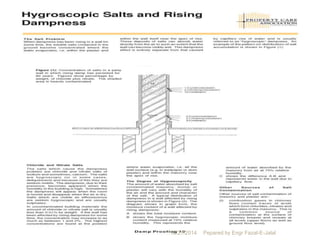
An additional problem is that the water 
absorbed into walls in this way contains 
dissolved salts in the form of nitrates, 
sulphates and chlorides. These are left on the 
wall surfaces as the water evaporates. The 
problem is that some of the salts attract 
moisture (what is known as hygroscopic). 
10/27/2014 Pepared by Engr Fazal-E-Jalal
DAMPNESS IN BUILDINGS 
As a result, if the salts aren’t removed, they 
continue to attract moisture into the wall 
surface which remains damp, even though 
other repair works have been completed. 
. 
10/27/2014 Pepared by Engr Fazal-E-Jalal
DAMPNESS IN BUILDINGS 
10/27/2014 Pepared by Engr Fazal-E-Jalal
DAMPNESS IN BUILDINGS 
Some current thinking has questioned the 
extent of genuine rising dampness in property 
and before that is given as the ultimate cause, 
therefore, a good surveyor/damp specialist will 
eliminate other potential causes of moisture, 
such as condensation, water penetration or 
plumbing leaks 
10/27/2014 Pepared by Engr Fazal-E-Jalal
DAMPNESS IN BUILDINGS 
Replastering will often be carried out as part of 
a rising damp treatment. Where plaster has 
become severely damaged by ground salts 
there is little argument about the need to 
replaster. 
10/27/2014 Pepared by Engr Fazal-E-Jalal
DAMPNESS IN BUILDINGS 
However there is considerable debate about: 
The extent of replastering required 
 The use of hard sand: cement renders to 
replaster as part of a rising damp treatment. 
10/27/2014 Pepared by Engr Fazal-E-Jalal
DAMPNESS IN BUILDINGS 
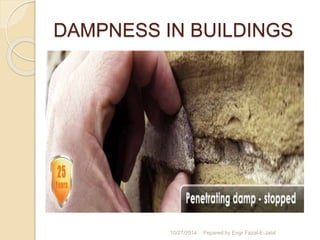
3. Penetrating dampness 
Penetrating dampness is where water gains access to the 
building through its external fabric (wall or roof) and it is not as 
simple as its name first implies. For example, water can 
penetrate a solid wall due to a number of factors: the high 
porosity or degradation of the brickwork, for example, or 
failure in a protective render (perhaps due to cracks or poor 
application), or even due to the orientation of the wall (south 
westerly elevations often face the fiercest moisture-laden 
winds). Each possible cause needs to be assessed and 
eliminated before an effective repair programme can be 
specified. 
10/27/2014 Pepared by Engr Fazal-E-Jalal
DAMPNESS IN BUILDINGS 
10/27/2014 Pepared by Engr Fazal-E-Jalal
DAMPNESS IN BUILDINGS 
Water will find any gap through which to travel 
and all surrounds to openings and junctions of 
the building fabric are potential areas of 
weakness in resisting moisture. Doors, window 
and often skylights are vulnerable and need to 
be sealed as do joints between chimneys and 
roof coverings which are protected by 
flashings and soakers. 
10/27/2014 Pepared by Engr Fazal-E-Jalal
DAMPNESS IN BUILDINGS 
10/27/2014 Pepared by Engr Fazal-E-Jalal
DAMPNESS IN BUILDINGS 
Water needs to be safely discharged away 
from walls as it drops from high level and a 
failure to do so may lead to water penetrating 
the external walls. So, guttering and 
downpipes that are leaking are a potential 
problem and even small detailing such as 
‘drips’ formed on the underside of window sills, 
door thresholds and the base of render need 
to function properly to ensure that water 
doesn’t run down the face of external walls. 
10/27/2014 Pepared by Engr Fazal-E-Jalal
DAMPNESS IN BUILDINGS 
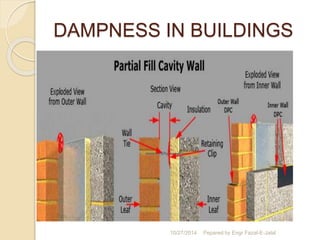
4. Bridging of Cavity Walls 
In cavity walls, water will penetrate if the 
cavity is improperly ‘bridged’ by mortar 
droppings resting on cavity ties or by rubble 
dropped into the base of the cavity during 
construction. Both are examples of routes for 
external rainwater to find a way to soak the 
internal leaf. 
10/27/2014 Pepared by Engr Fazal-E-Jalal
DAMPNESS IN BUILDINGS 
10/27/2014 Pepared by Engr Fazal-E-Jalal
DAMPNESS IN BUILDINGS 
5. Condensation 
Condensation is a very common source of 
dampness in buildings. The fact is that the air 
around us and in our homes holds moisture 
(water vapour). The amount it holds increases 
with higher temperatures and when the 
temperature is cooled and it has more water 
vapour than it can bear, moisture is dropped 
onto the surfaces that have cooled the air 
close to them in the form of condensation. 
10/27/2014 Pepared by Engr Fazal-E-Jalal
DAMPNESS IN BUILDINGS 
10/27/2014 Pepared by Engr Fazal-E-Jalal
DAMPNESS IN BUILDINGS 
To add to the problem, however, our lifestyles 
tend to create extra water vapour which enters 
the atmosphere within our homes when we 
shower or wash clothes and at the same time, 
our desire to reduce heat loss means that we 
have sealed our houses which keeps water 
vapour trapped and makes condensation more 
likely. 
10/27/2014 Pepared by Engr Fazal-E-Jalal
DAMPNESS IN BUILDINGS 
10/27/2014 Pepared by Engr Fazal-E-Jalal
DAMPNESS IN BUILDINGS 
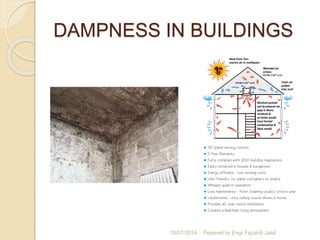
Condensation is more likely in areas where air 
flow is restricted such as behind furniture and it is 
common to discover mould growth in these 
places. 
Condensation occurs, then, when a coincidence 
of contributory factors occurs at a critical level. 
Temperature is one factor (affected by heating 
and insulation); water vapor discharged into the 
air is another; and ventilation (management of 
moisture laden air) is another. 
10/27/2014 Pepared by Engr Fazal-E-Jalal
DAMPNESS IN BUILDINGS 
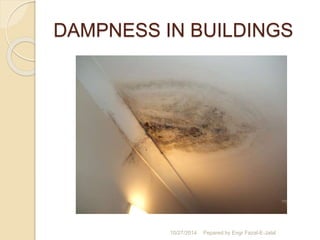
Dampness tends to cause secondary damage 
to a building. The unwanted moisture enables 
the growth of various fungi in wood, causing 
rot or mold health issues and may eventually 
lead to sick building 
syndrome. Plaster and paint deteriorate 
and wallpaper loosens. Stains, from the water, 
salts and from mold, mar surfaces. 
10/27/2014 Pepared by Engr Fazal-E-Jalal
DAMPNESS IN BUILDINGS 
The highest airborne mold concentrations are 
found in buildings where significant mold 
infestation has occurred, usually as a result of 
severe water intrusion or flood damage. Molds 
can grow on almost any surface and occurs 
where there is a lot of moisture from structural 
problems such as leaky roofs or high humidity 
levels. Airborne mold concentrations have the 
potential to be inhaled and cause serious 
health effects in humans. 
10/27/2014 Pepared by Engr Fazal-E-Jalal
ASSIGNMENT # 02 (Part A) 
Give brief short answers. 
1. What is role of drainability of soil in causing dampness in a 
building. 
2. Why it is essential to provide a DPC in a brick masonry wall. 
3. How dampness can be prevented in a building by surface 
treatment. 
4. Which cement concrete / mortar is used for laying horizontal DPC 
/ vertical DPC. 
5. What is the thickness of horizontal and vertical DPC when laid 
with concrete or mortar. 
6. What is the quantity of bitumen required for laying a DPC. 
7. What are the ill effects of dampness on various components and 
materials in a building. 
8. Why the DPC is not provided within a door or verandah openings. 
9. Why are the lead sheets not laid in cement mortar as a DPC. 
10/27/2014 Pepared by Engr Fazal-E-Jalal
ASSIGNMENT # 02 (Part B) 
What are (at least 06) causes of dampness, 
write down explaining them. 
Write in detail the methods of preventing 
dampness. 
Drawing neat sketches, do explain the 
methods of providing DPC under different 
situations. 
Q# 16 to Q#21 (Page 6-11, Dampness & 
Damp proofing; in “BUILDING 
CONSTRUCTION” by N.L Arora & B.R Gupta) 
10/27/2014 Pepared by Engr Fazal-E-Jalal

Dampness in buildings

  • 1.
    DAMPNESS IN BUILDINGS Civil Engineering Drawing & Graphics (Theory) 10/27/2014 Pepared by Engr Fazal-E-Jalal
  • 2.
    10/27/2014 Pepared byEngr Fazal-E-Jalal
  • 3.
    DAMPNESS IN BUILDINGS 1. Rising damp Rising damp is the result of water rising through the walls by means of capillary action. Moisture may stem from the soil around the outside of walls or from moisture rising through the floor construction. As a result of the capillary ‘lift’ through the fine pores in brickwork and masonry, moisture reaches a maximum height up the wall of about 1 metre. 10/27/2014 Pepared by Engr Fazal-E-Jalal
  • 4.
    DAMPNESS IN BUILDINGS 10/27/2014 Pepared by Engr Fazal-E-Jalal
  • 5.
    DAMPNESS IN BUILDINGS To counter this effect in walls, the path of water up walls is blocked by builders incorporating an impervious layer into the wall at low level. These ‘damp roof courses’ (dpc’s) have been made of various materials over the years including such things as slates, engineering bricks and bitumen felt. 10/27/2014 Pepared by Engr Fazal-E-Jalal
  • 6.
    DAMPNESS IN BUILDINGS 10/27/2014 Pepared by Engr Fazal-E-Jalal
  • 7.
    DAMPNESS IN BUILDINGS Deterioration of the dpc material leads to failure in the barrier and allows moisture to rise, and if the dpc is bridged, for example by external soil being placed against the wall above the dpc level, then the dpc is rendered ineffective. 10/27/2014 Pepared by Engr Fazal-E-Jalal
  • 8.
    DAMPNESS IN BUILDINGS TREATMENT Where a rising damp problem is caused by a lack of a damp-proof course (common in buildings over approximately 100 years old) or by a failed damp-proof course (comparatively rare) there are a wide range of possible solutions available. 10/27/2014 Pepared by Engr Fazal-E-Jalal
  • 9.
    DAMPNESS IN BUILDINGS These include: Replacement physical damp proof course Injection of a liquid or cream chemical damp proof course (DPC Injection) Porous tubes Electrical-osmotic systems Land drainage 10/27/2014 Pepared by Engr Fazal-E-Jalal
  • 10.
    DAMPNESS IN BUILDINGS 2. Hygroscopic salts An additional problem is that the water absorbed into walls in this way contains dissolved salts in the form of nitrates, sulphates and chlorides. These are left on the wall surfaces as the water evaporates. The problem is that some of the salts attract moisture (what is known as hygroscopic). 10/27/2014 Pepared by Engr Fazal-E-Jalal
  • 11.
    10/27/2014 Pepared byEngr Fazal-E-Jalal
  • 12.
    DAMPNESS IN BUILDINGS As a result, if the salts aren’t removed, they continue to attract moisture into the wall surface which remains damp, even though other repair works have been completed. . 10/27/2014 Pepared by Engr Fazal-E-Jalal
  • 13.
    DAMPNESS IN BUILDINGS 10/27/2014 Pepared by Engr Fazal-E-Jalal
  • 14.
    DAMPNESS IN BUILDINGS Some current thinking has questioned the extent of genuine rising dampness in property and before that is given as the ultimate cause, therefore, a good surveyor/damp specialist will eliminate other potential causes of moisture, such as condensation, water penetration or plumbing leaks 10/27/2014 Pepared by Engr Fazal-E-Jalal
  • 15.
    DAMPNESS IN BUILDINGS Replastering will often be carried out as part of a rising damp treatment. Where plaster has become severely damaged by ground salts there is little argument about the need to replaster. 10/27/2014 Pepared by Engr Fazal-E-Jalal
  • 16.
    DAMPNESS IN BUILDINGS However there is considerable debate about: The extent of replastering required  The use of hard sand: cement renders to replaster as part of a rising damp treatment. 10/27/2014 Pepared by Engr Fazal-E-Jalal
  • 17.
    DAMPNESS IN BUILDINGS 3. Penetrating dampness Penetrating dampness is where water gains access to the building through its external fabric (wall or roof) and it is not as simple as its name first implies. For example, water can penetrate a solid wall due to a number of factors: the high porosity or degradation of the brickwork, for example, or failure in a protective render (perhaps due to cracks or poor application), or even due to the orientation of the wall (south westerly elevations often face the fiercest moisture-laden winds). Each possible cause needs to be assessed and eliminated before an effective repair programme can be specified. 10/27/2014 Pepared by Engr Fazal-E-Jalal
  • 18.
    DAMPNESS IN BUILDINGS 10/27/2014 Pepared by Engr Fazal-E-Jalal
  • 19.
    DAMPNESS IN BUILDINGS Water will find any gap through which to travel and all surrounds to openings and junctions of the building fabric are potential areas of weakness in resisting moisture. Doors, window and often skylights are vulnerable and need to be sealed as do joints between chimneys and roof coverings which are protected by flashings and soakers. 10/27/2014 Pepared by Engr Fazal-E-Jalal
  • 20.
    DAMPNESS IN BUILDINGS 10/27/2014 Pepared by Engr Fazal-E-Jalal
  • 21.
    DAMPNESS IN BUILDINGS Water needs to be safely discharged away from walls as it drops from high level and a failure to do so may lead to water penetrating the external walls. So, guttering and downpipes that are leaking are a potential problem and even small detailing such as ‘drips’ formed on the underside of window sills, door thresholds and the base of render need to function properly to ensure that water doesn’t run down the face of external walls. 10/27/2014 Pepared by Engr Fazal-E-Jalal
  • 22.
    DAMPNESS IN BUILDINGS 4. Bridging of Cavity Walls In cavity walls, water will penetrate if the cavity is improperly ‘bridged’ by mortar droppings resting on cavity ties or by rubble dropped into the base of the cavity during construction. Both are examples of routes for external rainwater to find a way to soak the internal leaf. 10/27/2014 Pepared by Engr Fazal-E-Jalal
  • 23.
    DAMPNESS IN BUILDINGS 10/27/2014 Pepared by Engr Fazal-E-Jalal
  • 24.
    DAMPNESS IN BUILDINGS 5. Condensation Condensation is a very common source of dampness in buildings. The fact is that the air around us and in our homes holds moisture (water vapour). The amount it holds increases with higher temperatures and when the temperature is cooled and it has more water vapour than it can bear, moisture is dropped onto the surfaces that have cooled the air close to them in the form of condensation. 10/27/2014 Pepared by Engr Fazal-E-Jalal
  • 25.
    DAMPNESS IN BUILDINGS 10/27/2014 Pepared by Engr Fazal-E-Jalal
  • 26.
    DAMPNESS IN BUILDINGS To add to the problem, however, our lifestyles tend to create extra water vapour which enters the atmosphere within our homes when we shower or wash clothes and at the same time, our desire to reduce heat loss means that we have sealed our houses which keeps water vapour trapped and makes condensation more likely. 10/27/2014 Pepared by Engr Fazal-E-Jalal
  • 27.
    DAMPNESS IN BUILDINGS 10/27/2014 Pepared by Engr Fazal-E-Jalal
  • 28.
    DAMPNESS IN BUILDINGS Condensation is more likely in areas where air flow is restricted such as behind furniture and it is common to discover mould growth in these places. Condensation occurs, then, when a coincidence of contributory factors occurs at a critical level. Temperature is one factor (affected by heating and insulation); water vapor discharged into the air is another; and ventilation (management of moisture laden air) is another. 10/27/2014 Pepared by Engr Fazal-E-Jalal
  • 29.
    DAMPNESS IN BUILDINGS Dampness tends to cause secondary damage to a building. The unwanted moisture enables the growth of various fungi in wood, causing rot or mold health issues and may eventually lead to sick building syndrome. Plaster and paint deteriorate and wallpaper loosens. Stains, from the water, salts and from mold, mar surfaces. 10/27/2014 Pepared by Engr Fazal-E-Jalal
  • 30.
    DAMPNESS IN BUILDINGS The highest airborne mold concentrations are found in buildings where significant mold infestation has occurred, usually as a result of severe water intrusion or flood damage. Molds can grow on almost any surface and occurs where there is a lot of moisture from structural problems such as leaky roofs or high humidity levels. Airborne mold concentrations have the potential to be inhaled and cause serious health effects in humans. 10/27/2014 Pepared by Engr Fazal-E-Jalal
  • 31.
    ASSIGNMENT # 02(Part A) Give brief short answers. 1. What is role of drainability of soil in causing dampness in a building. 2. Why it is essential to provide a DPC in a brick masonry wall. 3. How dampness can be prevented in a building by surface treatment. 4. Which cement concrete / mortar is used for laying horizontal DPC / vertical DPC. 5. What is the thickness of horizontal and vertical DPC when laid with concrete or mortar. 6. What is the quantity of bitumen required for laying a DPC. 7. What are the ill effects of dampness on various components and materials in a building. 8. Why the DPC is not provided within a door or verandah openings. 9. Why are the lead sheets not laid in cement mortar as a DPC. 10/27/2014 Pepared by Engr Fazal-E-Jalal
  • 32.
    ASSIGNMENT # 02(Part B) What are (at least 06) causes of dampness, write down explaining them. Write in detail the methods of preventing dampness. Drawing neat sketches, do explain the methods of providing DPC under different situations. Q# 16 to Q#21 (Page 6-11, Dampness & Damp proofing; in “BUILDING CONSTRUCTION” by N.L Arora & B.R Gupta) 10/27/2014 Pepared by Engr Fazal-E-Jalal
  • 33.
    10/27/2014 Pepared byEngr Fazal-E-Jalal