 Any undesired electrical signal that is present in addition to the
voltage or current being processed or measured is known as noise.
 Nature of noise
◦ Man made noise
e.g. Machines, X-RAYS, Electric discharge machines, Power supplies.
◦ Natural Noise
e.g. Noise in different components, Atmospheric noise.
 White Noise
◦ Thermal Noise
◦ Shot Noise
 Pink Noise
◦ Flicker and Burst Noise
 Atmospheric Noise
◦ Lightening and EM radiations
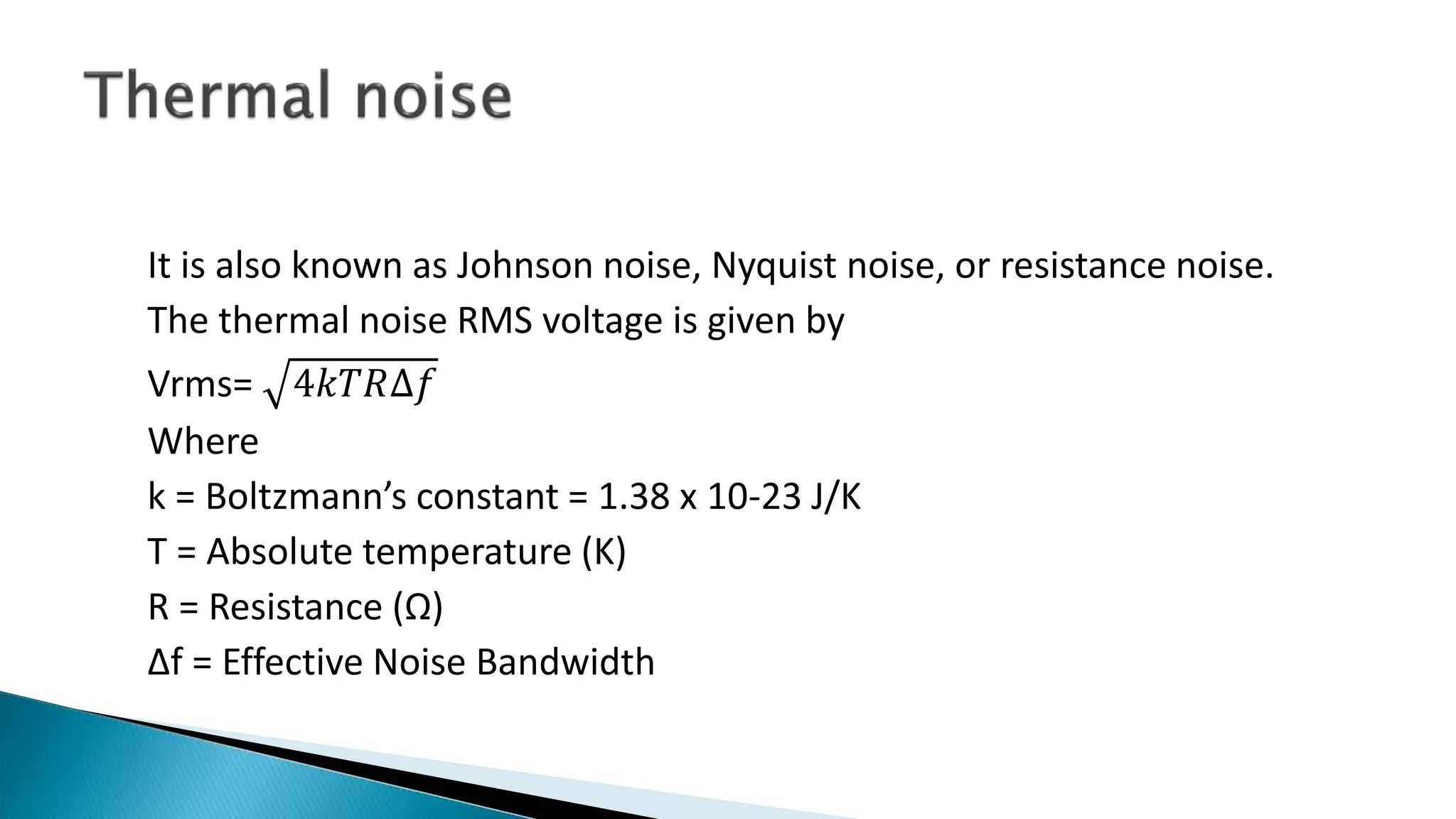
It is also known as Johnson noise, Nyquist noise, or resistance noise.
The thermal noise RMS voltage is given by
Vrms= 4𝑘𝑇𝑅∆𝑓
Where
k = Boltzmann’s constant = 1.38 x 10⁻²³ J/K
T = Absolute temperature (K)
R = Resistance (Ω)
Δf = Effective Noise Bandwidth
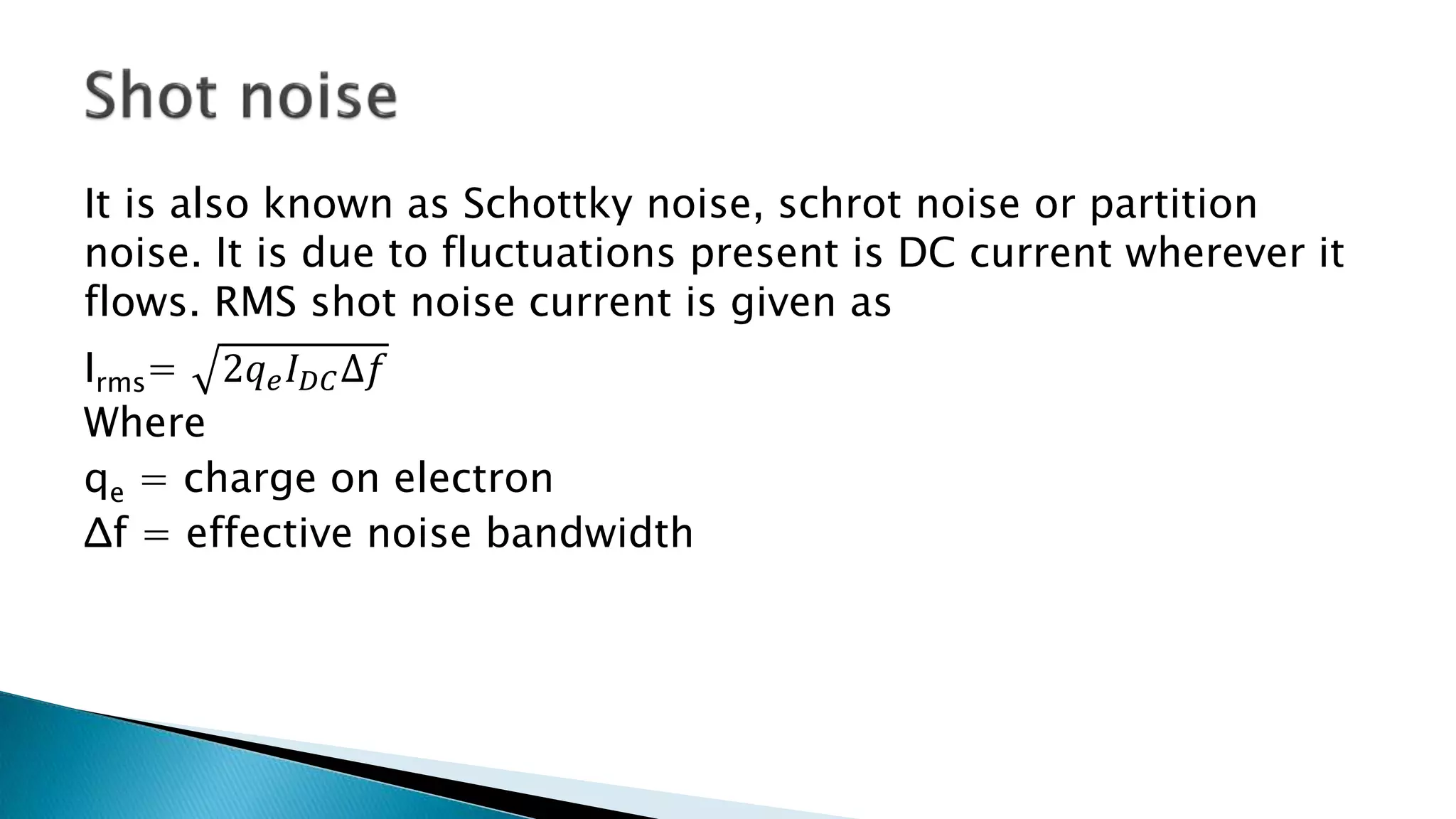
It is also known as Schottky noise, schrot noise or partition
noise. It is due to fluctuations present is DC current wherever it
flows. RMS shot noise current is given as
Irms= 2𝑞 𝑒 𝐼 𝐷𝐶∆𝑓
Where
qe = charge on electron
Δf = effective noise bandwidth
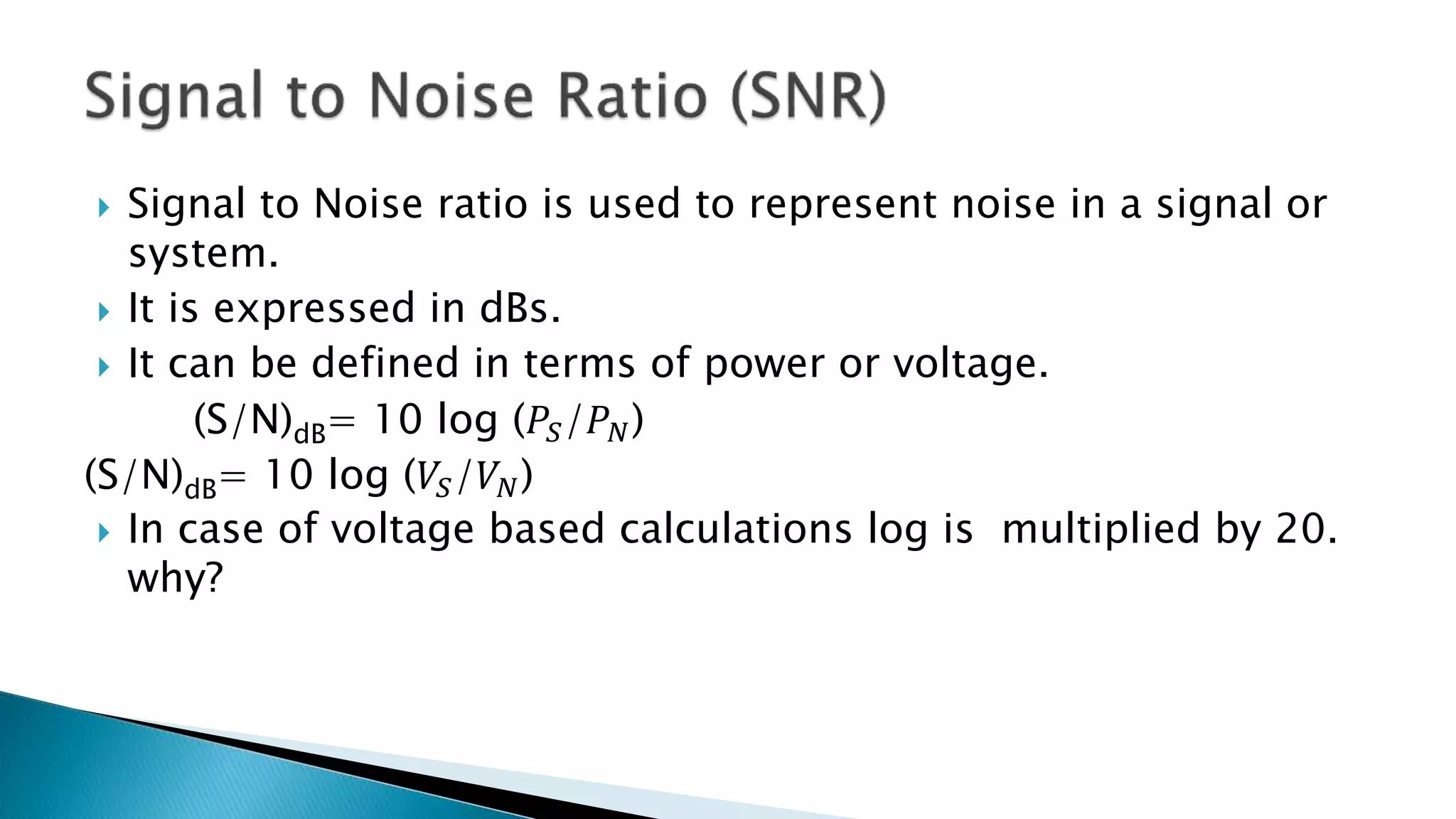
 Signal to Noise ratio is used to represent noise in a signal or
system.
 It is expressed in dBs.
 It can be defined in terms of power or voltage.
(S/N)dB= 10 log (𝑃𝑆/𝑃 𝑁)
(S/N)dB= 10 log (𝑉𝑆/𝑉𝑁)
 In case of voltage based calculations log is multiplied by 20.
why?
 Noise figure represents how much noise is added by the
system or some stage of the system or by the amplifier stage.
N.F = (S/N)in/(S/N)out
 In dBs we can represent it as
N.FdB = [(S/N)in]dB – [(S/N)out]dB
 Noise is not a symmetrical sinusoidal signal and it does not
specific peak value.
 To measure noise level in a signal, true RMS meters are
required.
 But if true RMS meters are not available, then we can measure
noise level by using AC voltmeter .
 In case of AC voltmeter, the result should be multiplied by
some correction factor to get the required result.

Instrumentation & Measurement: Noise and Its Types

  • 2.
     Any undesiredelectrical signal that is present in addition to the voltage or current being processed or measured is known as noise.  Nature of noise ◦ Man made noise e.g. Machines, X-RAYS, Electric discharge machines, Power supplies. ◦ Natural Noise e.g. Noise in different components, Atmospheric noise.
  • 3.
     White Noise ◦Thermal Noise ◦ Shot Noise  Pink Noise ◦ Flicker and Burst Noise  Atmospheric Noise ◦ Lightening and EM radiations
  • 4.
    It is alsoknown as Johnson noise, Nyquist noise, or resistance noise. The thermal noise RMS voltage is given by Vrms= 4𝑘𝑇𝑅∆𝑓 Where k = Boltzmann’s constant = 1.38 x 10⁻²³ J/K T = Absolute temperature (K) R = Resistance (Ω) Δf = Effective Noise Bandwidth
  • 5.
    It is alsoknown as Schottky noise, schrot noise or partition noise. It is due to fluctuations present is DC current wherever it flows. RMS shot noise current is given as Irms= 2𝑞 𝑒 𝐼 𝐷𝐶∆𝑓 Where qe = charge on electron Δf = effective noise bandwidth
  • 6.
     Signal toNoise ratio is used to represent noise in a signal or system.  It is expressed in dBs.  It can be defined in terms of power or voltage. (S/N)dB= 10 log (𝑃𝑆/𝑃 𝑁) (S/N)dB= 10 log (𝑉𝑆/𝑉𝑁)  In case of voltage based calculations log is multiplied by 20. why?
  • 7.
     Noise figurerepresents how much noise is added by the system or some stage of the system or by the amplifier stage. N.F = (S/N)in/(S/N)out  In dBs we can represent it as N.FdB = [(S/N)in]dB – [(S/N)out]dB
  • 8.
     Noise isnot a symmetrical sinusoidal signal and it does not specific peak value.  To measure noise level in a signal, true RMS meters are required.  But if true RMS meters are not available, then we can measure noise level by using AC voltmeter .  In case of AC voltmeter, the result should be multiplied by some correction factor to get the required result.