Musical sound Processing
MD: HASNAIN RABBY
DEPT. OF INFORMATION & COMMUNICATION ENGINEERING
ISLAMIC UNIVERSITY, BANGLADESH.
Overview
 Introduction.
 Time-domain Operation.
 Frequency-domain Operation.
 Advantage.
 Disadvantage.
What is Musical Sound?
Musical sound, any tone with characteristics such as controlled
pitch and tune. The sounds are produced by instruments in which
the periodic vibrations can be controlled by the performer.
Musical Sound Processing
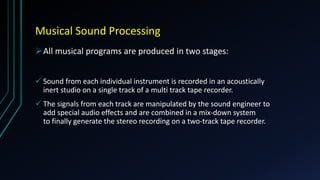
All musical programs are produced in two stages:
 Sound from each individual instrument is recorded in an acoustically
inert studio on a single track of a multi track tape recorder.
 The signals from each track are manipulated by the sound engineer to
add special audio effects and are combined in a mix-down system
to finally generate the stereo recording on a two-track tape recorder.
TIME-DOMAIN OPERATIONS
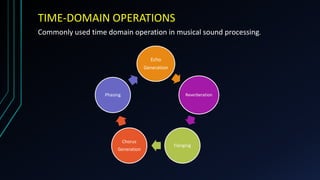
Commonly used time domain operation in musical sound processing.
Echo
Generation
Reverberation
Flanging
Chorus
Generation
Phasing
Single Echo Filter
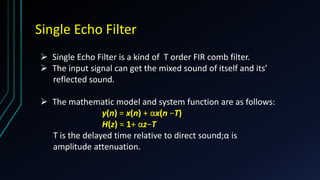
 Single Echo Filter is a kind of T order FIR comb filter.
 The input signal can get the mixed sound of itself and its’
reflected sound.
 The mathematic model and system function are as follows:
y(n) = x(n) + αx(n −T)
H(z) = 1+ αz−T
T is the delayed time relative to direct sound;α is
amplitude attenuation.
Single Echo Filter
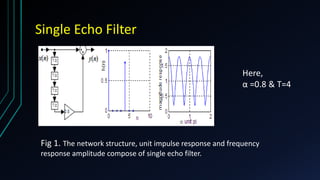
Fig 1. The network structure, unit impulse response and frequency
response amplitude compose of single echo filter.
Here,
α =0.8 & T=4
Multiple Echo Filter
 In order to reach early reflection, the signal need to have
several times emission and it can be achieved by multiple
echo filter.
 The mathematic model and system function are as follows:
y(n) = x(n) + αx(n −T) + ⋅ ⋅ ⋅ ⋅ ⋅ ⋅ +αN−1x[n − (N − 1)T]
𝐻 𝑧 = 1 − αᴺ𝑍‾ ᴺᵀ⁄1-αZ‾ ᵀ
T is the delayed time relative to direct sound;α is
amplitude attenuation.
Multiple Echo Filter
 If α=0.8 and T=4, this multiple echo filter is a T order
IIR digital filter.
Fig 2. The network structure, unit impulse response and frequency
response amplitude compose of multiple echo filter.
Reverberation
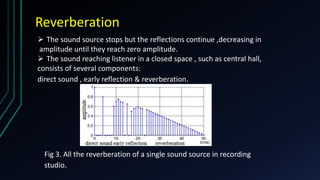
 The sound source stops but the reflections continue ,decreasing in
amplitude until they reach zero amplitude.
 The sound reaching listener in a closed space , such as central hall,
consists of several components:
direct sound , early reflection & reverberation.
Fig 3. All the reverberation of a single sound source in recording
studio.
Flanging , Chorus Generation & Phasing
 Flanging is an audio effect produced by mixing two identical signals.
This produces a swept comb filter effect .
 The chorus effect is achieved when several musicians are playing same
Musical piece at the same time but with small changes in the amplitude&
Small timing difference between sounds.
 The phasing effect is produced by processing the signal through
narrowband notch filter with variable.
Frequency Domain Operation
 These effect are achieved by passing the original signals
through an equalizer, the purpose of equalizer is to provide
“presence” by peaking the mid frequency components in the
Range of 1.5GHz to 3GHz & modify the bass-treble relationships
By providing boost or cut to components outside this range.
Advantage:
 An information can be displayed or manipulated.
 Perfect reproducibility.
 Guaranteed accuracy.
 Stored almost indefinitely without lose of information.
Disadvantage:
 Speed & cost be expensive when large bandwidth signals.
 DSP designs can be consuming plus need the necessary
resources(software etc )
 Finite word-length problems.
Thank you.
Any
Question??

Musical sound processing

  • 1.
    Musical sound Processing MD:HASNAIN RABBY DEPT. OF INFORMATION & COMMUNICATION ENGINEERING ISLAMIC UNIVERSITY, BANGLADESH.
  • 2.
    Overview  Introduction.  Time-domainOperation.  Frequency-domain Operation.  Advantage.  Disadvantage.
  • 3.
    What is MusicalSound? Musical sound, any tone with characteristics such as controlled pitch and tune. The sounds are produced by instruments in which the periodic vibrations can be controlled by the performer.
  • 4.
    Musical Sound Processing Allmusical programs are produced in two stages:  Sound from each individual instrument is recorded in an acoustically inert studio on a single track of a multi track tape recorder.  The signals from each track are manipulated by the sound engineer to add special audio effects and are combined in a mix-down system to finally generate the stereo recording on a two-track tape recorder.
  • 5.
    TIME-DOMAIN OPERATIONS Commonly usedtime domain operation in musical sound processing. Echo Generation Reverberation Flanging Chorus Generation Phasing
  • 6.
    Single Echo Filter Single Echo Filter is a kind of T order FIR comb filter.  The input signal can get the mixed sound of itself and its’ reflected sound.  The mathematic model and system function are as follows: y(n) = x(n) + αx(n −T) H(z) = 1+ αz−T T is the delayed time relative to direct sound;α is amplitude attenuation.
  • 7.
    Single Echo Filter Fig1. The network structure, unit impulse response and frequency response amplitude compose of single echo filter. Here, α =0.8 & T=4
  • 8.
    Multiple Echo Filter In order to reach early reflection, the signal need to have several times emission and it can be achieved by multiple echo filter.  The mathematic model and system function are as follows: y(n) = x(n) + αx(n −T) + ⋅ ⋅ ⋅ ⋅ ⋅ ⋅ +αN−1x[n − (N − 1)T] 𝐻 𝑧 = 1 − αᴺ𝑍‾ ᴺᵀ⁄1-αZ‾ ᵀ T is the delayed time relative to direct sound;α is amplitude attenuation.
  • 9.
    Multiple Echo Filter If α=0.8 and T=4, this multiple echo filter is a T order IIR digital filter. Fig 2. The network structure, unit impulse response and frequency response amplitude compose of multiple echo filter.
  • 10.
    Reverberation  The soundsource stops but the reflections continue ,decreasing in amplitude until they reach zero amplitude.  The sound reaching listener in a closed space , such as central hall, consists of several components: direct sound , early reflection & reverberation. Fig 3. All the reverberation of a single sound source in recording studio.
  • 11.
    Flanging , ChorusGeneration & Phasing  Flanging is an audio effect produced by mixing two identical signals. This produces a swept comb filter effect .  The chorus effect is achieved when several musicians are playing same Musical piece at the same time but with small changes in the amplitude& Small timing difference between sounds.  The phasing effect is produced by processing the signal through narrowband notch filter with variable.
  • 12.
    Frequency Domain Operation These effect are achieved by passing the original signals through an equalizer, the purpose of equalizer is to provide “presence” by peaking the mid frequency components in the Range of 1.5GHz to 3GHz & modify the bass-treble relationships By providing boost or cut to components outside this range.
  • 13.
    Advantage:  An informationcan be displayed or manipulated.  Perfect reproducibility.  Guaranteed accuracy.  Stored almost indefinitely without lose of information.
  • 14.
    Disadvantage:  Speed &cost be expensive when large bandwidth signals.  DSP designs can be consuming plus need the necessary resources(software etc )  Finite word-length problems.
  • 15.
  • 16.