Electromechanical instruments
 The function of these instruments is based on electromechanical system.
These instruments are also known as deflecting type instruments
 A pointer is used to indicate the value of measured quantity.
 Some electromechanical instruments are
 Galvanometer
 Voltmeter
 Ammeter
 Ohmmeter
 Wattmeter
 Power factor meter
Permanent Magnet Moving Coil (PMMC) Instruments
 A deflection type instrument uses a pointer that moves over a
calibrated scale to indicate measured quantity.
 PMMC instrument is one of the types of deflecting type
instruments.
 Three forces are present in electromechanical mechanism.
 Deflecting force
 Controlling force
 Damping force
 Two methods are used for supporting the moving system of a
deflection instrument.
 Jeweled bearing suspension method
 Taut band method
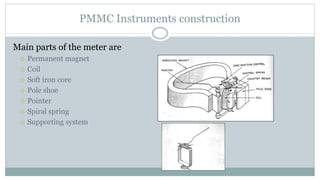
PMMC Instruments construction
Main parts of the meter are
 Permanent magnet
 Coil
 Soft iron core
 Pole shoe
 Pointer
 Spiral spring
 Supporting system
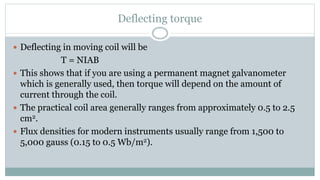
Deflecting torque
 Deflecting in moving coil will be
T = NIAB
 This shows that if you are using a permanent magnet galvanometer
which is generally used, then torque will depend on the amount of
current through the coil.
 The practical coil area generally ranges from approximately 0.5 to 2.5
cm2.
 Flux densities for modern instruments usually range from 1,500 to
5,000 gauss (0.15 to 0.5 Wb/m2).
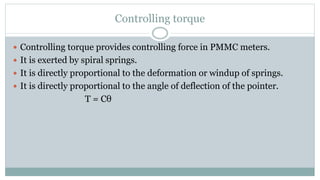
Controlling torque
 Controlling torque provides controlling force in PMMC meters.
 It is exerted by spiral springs.
 It is directly proportional to the deformation or windup of springs.
 It is directly proportional to the angle of deflection of the pointer.
T = Cθ
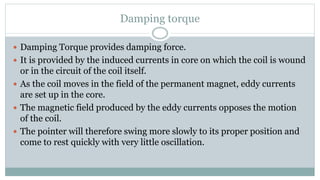
Damping torque
 Damping Torque provides damping force.
 It is provided by the induced currents in core on which the coil is wound
or in the circuit of the coil itself.
 As the coil moves in the field of the permanent magnet, eddy currents
are set up in the core.
 The magnetic field produced by the eddy currents opposes the motion
of the coil.
 The pointer will therefore swing more slowly to its proper position and
come to rest quickly with very little oscillation.
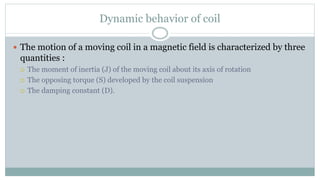
Dynamic behavior of coil
 The motion of a moving coil in a magnetic field is characterized by three
quantities :
 The moment of inertia (J) of the moving coil about its axis of rotation
 The opposing torque (S) developed by the coil suspension
 The damping constant (D).
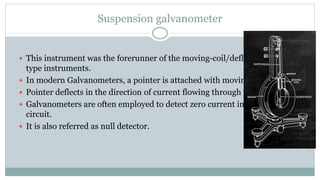
Suspension galvanometer
 This instrument was the forerunner of the moving-coil/deflecting
type instruments.
 In modern Galvanometers, a pointer is attached with moving coil.
 Pointer deflects in the direction of current flowing through the coil.
 Galvanometers are often employed to detect zero current in the
circuit.
 It is also referred as null detector.
Galvanometer sensitivity
 Voltage sensitivity of galvanometer is often expressed for a given value
of critical damping resistance.
 It is expressed in µV/mm.
 Galvanometer sensitivity is specified as mega ohm sensitivity .
 Pointer galvanometers have current sensitivities ranging from 0.1 to 1
µA/mm.
 For light beam galvanometers current sensitivities ranging from 0.01 to
0.1 µA/mm.

Instrumentation & Measurement: Electromechanical Instruments

  • 1.
  • 2.
    Electromechanical instruments  Thefunction of these instruments is based on electromechanical system. These instruments are also known as deflecting type instruments  A pointer is used to indicate the value of measured quantity.  Some electromechanical instruments are  Galvanometer  Voltmeter  Ammeter  Ohmmeter  Wattmeter  Power factor meter
  • 3.
    Permanent Magnet MovingCoil (PMMC) Instruments  A deflection type instrument uses a pointer that moves over a calibrated scale to indicate measured quantity.  PMMC instrument is one of the types of deflecting type instruments.  Three forces are present in electromechanical mechanism.  Deflecting force  Controlling force  Damping force  Two methods are used for supporting the moving system of a deflection instrument.  Jeweled bearing suspension method  Taut band method
  • 4.
    PMMC Instruments construction Mainparts of the meter are  Permanent magnet  Coil  Soft iron core  Pole shoe  Pointer  Spiral spring  Supporting system
  • 5.
    Deflecting torque  Deflectingin moving coil will be T = NIAB  This shows that if you are using a permanent magnet galvanometer which is generally used, then torque will depend on the amount of current through the coil.  The practical coil area generally ranges from approximately 0.5 to 2.5 cm2.  Flux densities for modern instruments usually range from 1,500 to 5,000 gauss (0.15 to 0.5 Wb/m2).
  • 6.
    Controlling torque  Controllingtorque provides controlling force in PMMC meters.  It is exerted by spiral springs.  It is directly proportional to the deformation or windup of springs.  It is directly proportional to the angle of deflection of the pointer. T = Cθ
  • 7.
    Damping torque  DampingTorque provides damping force.  It is provided by the induced currents in core on which the coil is wound or in the circuit of the coil itself.  As the coil moves in the field of the permanent magnet, eddy currents are set up in the core.  The magnetic field produced by the eddy currents opposes the motion of the coil.  The pointer will therefore swing more slowly to its proper position and come to rest quickly with very little oscillation.
  • 8.
    Dynamic behavior ofcoil  The motion of a moving coil in a magnetic field is characterized by three quantities :  The moment of inertia (J) of the moving coil about its axis of rotation  The opposing torque (S) developed by the coil suspension  The damping constant (D).
  • 9.
    Suspension galvanometer  Thisinstrument was the forerunner of the moving-coil/deflecting type instruments.  In modern Galvanometers, a pointer is attached with moving coil.  Pointer deflects in the direction of current flowing through the coil.  Galvanometers are often employed to detect zero current in the circuit.  It is also referred as null detector.
  • 10.
    Galvanometer sensitivity  Voltagesensitivity of galvanometer is often expressed for a given value of critical damping resistance.  It is expressed in µV/mm.  Galvanometer sensitivity is specified as mega ohm sensitivity .  Pointer galvanometers have current sensitivities ranging from 0.1 to 1 µA/mm.  For light beam galvanometers current sensitivities ranging from 0.01 to 0.1 µA/mm.