AGENDA
• 1. Putting things in the proper context
( 10 minutes )
• 2. Instructional Design Overview
( 5 minutes )
• 3. Instructional Design for IT Educators
( 10 minutes )
• 4. The future of Instructional Design
( 5 minutes )
• 5. Q & A
( 15 minutes )
1. Putting things in proper context
• Broad definition of Education
• Categories of Education
-Formal
-Non-Formal
-Informal
1. Putting things in proper context
• Psychology-scientific study of
human behavior
-Teaching and learning are psychological
processes.
-Learning: behavioral change
-Teaching: facilitated learning
1. Putting things in proper context
• Focus on Non-Formal Adult
Education
• Andragogy: The art and science of adult
learning
-Training: transfer of measurable learning.
- Goal: come up with overt behavioral change:
-Knowledge
- Attitude
-Skills
-Declarative versus Procedural Knowledge
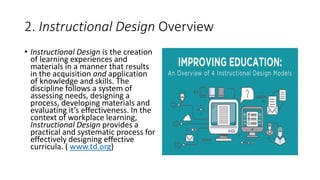
2. Instructional Design Overview
• Instructional Design is the creation
of learning experiences and
materials in a manner that results
in the acquisition and application
of knowledge and skills. The
discipline follows a system of
assessing needs, designing a
process, developing materials and
evaluating it’s effectiveness. In the
context of workplace learning,
Instructional Design provides a
practical and systematic process for
effectively designing effective
curricula. ( www.td.org)
2. Instructional Design Overview
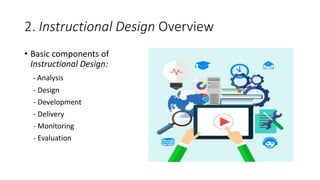
• Basic components of
Instructional Design:
- Analysis
- Design
- Development
- Delivery
- Monitoring
- Evaluation
3. Instructional Design for IT educators
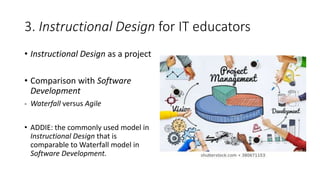
• Instructional Design as a project
• Comparison with Software
Development
- Waterfall versus Agile
• ADDIE: the commonly used model in
Instructional Design that is
comparable to Waterfall model in
Software Development.
3. Instructional Design for IT educators
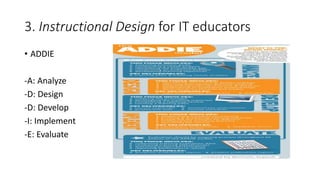
• ADDIE
-A: Analyze
-D: Design
-D: Develop
-I: Implement
-E: Evaluate
3. Instructional Design for IT educators
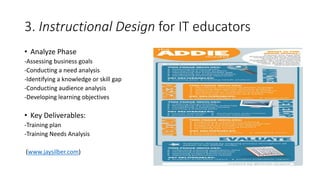
• Analyze Phase
-Assessing business goals
-Conducting a need analysis
-Identifying a knowledge or skill gap
-Conducting audience analysis
-Developing learning objectives
• Key Deliverables:
-Training plan
-Training Needs Analysis
(www.jaysilber.com)
3. Instructional Design for IT educators
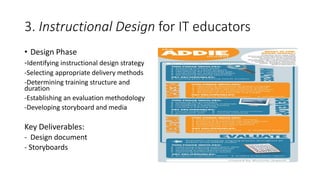
• Design Phase
-Identifying instructional design strategy
-Selecting appropriate delivery methods
-Determining training structure and
duration
-Establishing an evaluation methodology
-Developing storyboard and media
Key Deliverables:
- Design document
- Storyboards
3. Instructional Design for IT educators
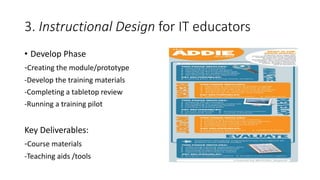
• Develop Phase
-Creating the module/prototype
-Develop the training materials
-Completing a tabletop review
-Running a training pilot
Key Deliverables:
-Course materials
-Teaching aids /tools
3. Instructional Design for IT educators
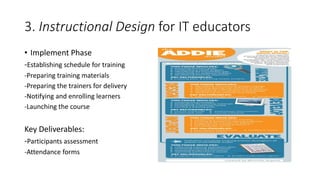
• Implement Phase
-Establishing schedule for training
-Preparing training materials
-Preparing the trainers for delivery
-Notifying and enrolling learners
-Launching the course
Key Deliverables:
-Participants assessment
-Attendance forms
3. Instructional Design for IT educators
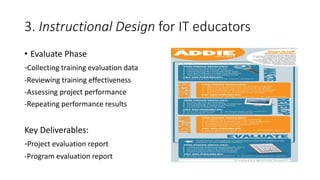
• Evaluate Phase
-Collecting training evaluation data
-Reviewing training effectiveness
-Assessing project performance
-Repeating performance results
Key Deliverables:
-Project evaluation report
-Program evaluation report
4. The future of Instructional Design
• As the business world continues to
change, so do organizations and their
learning functions. Flexibility,
creativity, and innovation are
becoming more valued. As a result,
agile and iterative design models
becoming more popular. Instructional
designers are also borrowing more
elements from the areas of User
Experience (UX) Design and Design
Thinking. No matter where the
training and talent development field
goes or what technologies are on the
horizon, a solid background in
instructional design will always be
valuable.- www.td.org
Rey Reroma
Rey Reroma
Rey Reroma
rey.reroma@gmail.com

Instructional design for i.t. educators

  • 1.
    AGENDA • 1. Puttingthings in the proper context ( 10 minutes ) • 2. Instructional Design Overview ( 5 minutes ) • 3. Instructional Design for IT Educators ( 10 minutes ) • 4. The future of Instructional Design ( 5 minutes ) • 5. Q & A ( 15 minutes )
  • 2.
    1. Putting thingsin proper context • Broad definition of Education • Categories of Education -Formal -Non-Formal -Informal
  • 3.
    1. Putting thingsin proper context • Psychology-scientific study of human behavior -Teaching and learning are psychological processes. -Learning: behavioral change -Teaching: facilitated learning
  • 4.
    1. Putting thingsin proper context • Focus on Non-Formal Adult Education • Andragogy: The art and science of adult learning -Training: transfer of measurable learning. - Goal: come up with overt behavioral change: -Knowledge - Attitude -Skills -Declarative versus Procedural Knowledge
  • 5.
    2. Instructional DesignOverview • Instructional Design is the creation of learning experiences and materials in a manner that results in the acquisition and application of knowledge and skills. The discipline follows a system of assessing needs, designing a process, developing materials and evaluating it’s effectiveness. In the context of workplace learning, Instructional Design provides a practical and systematic process for effectively designing effective curricula. ( www.td.org)
  • 6.
    2. Instructional DesignOverview • Basic components of Instructional Design: - Analysis - Design - Development - Delivery - Monitoring - Evaluation
  • 7.
    3. Instructional Designfor IT educators • Instructional Design as a project • Comparison with Software Development - Waterfall versus Agile • ADDIE: the commonly used model in Instructional Design that is comparable to Waterfall model in Software Development.
  • 8.
    3. Instructional Designfor IT educators • ADDIE -A: Analyze -D: Design -D: Develop -I: Implement -E: Evaluate
  • 9.
    3. Instructional Designfor IT educators • Analyze Phase -Assessing business goals -Conducting a need analysis -Identifying a knowledge or skill gap -Conducting audience analysis -Developing learning objectives • Key Deliverables: -Training plan -Training Needs Analysis (www.jaysilber.com)
  • 10.
    3. Instructional Designfor IT educators • Design Phase -Identifying instructional design strategy -Selecting appropriate delivery methods -Determining training structure and duration -Establishing an evaluation methodology -Developing storyboard and media Key Deliverables: - Design document - Storyboards
  • 11.
    3. Instructional Designfor IT educators • Develop Phase -Creating the module/prototype -Develop the training materials -Completing a tabletop review -Running a training pilot Key Deliverables: -Course materials -Teaching aids /tools
  • 12.
    3. Instructional Designfor IT educators • Implement Phase -Establishing schedule for training -Preparing training materials -Preparing the trainers for delivery -Notifying and enrolling learners -Launching the course Key Deliverables: -Participants assessment -Attendance forms
  • 13.
    3. Instructional Designfor IT educators • Evaluate Phase -Collecting training evaluation data -Reviewing training effectiveness -Assessing project performance -Repeating performance results Key Deliverables: -Project evaluation report -Program evaluation report
  • 14.
    4. The futureof Instructional Design • As the business world continues to change, so do organizations and their learning functions. Flexibility, creativity, and innovation are becoming more valued. As a result, agile and iterative design models becoming more popular. Instructional designers are also borrowing more elements from the areas of User Experience (UX) Design and Design Thinking. No matter where the training and talent development field goes or what technologies are on the horizon, a solid background in instructional design will always be valuable.- www.td.org
  • 15.
    Rey Reroma Rey Reroma ReyReroma rey.reroma@gmail.com