PRESENTEE: SAKSHI RANA
CONSUMER PROTECTION ACT
Consumer protection act (CPA), is an act
of the parliament of India enacted in 1986
to protect the interests of consumers in
India. The provisions of the act came into
force with the effect from 15-4-1987. It
makes provision for the establishment of
consumer councils and other authorities
for the settlement of consumer’s disputes
and for matters connected therewith.
Contt..
 This act considered patients as
consumers, i.e. buyers of services and the
doctors as provider of these services on
payment.
 Consumer Protection laws are a form of
government regulation which aim to
protect the interests of consumers.
Contt..
 Consumer protection is linked to the idea
of "consumer rights" (that consumers
have various rights as consumers), and to
the formation of consumer organizations.
Contt..
The Consumer Protection Act of India
 Specific about what a complaint is, under
the law‘s definitions.
 Complaint must be made in written
 Defects in goods or unsatisfactory service
can be the subject of written complaints,
as can excessively high charges for goods
or services.
ENACTION OF ACT
 The act was passed in Lok Sabha on 9th
December, 1986 and assented by the
president of India in December, and was
published in the Gazette of India on 26th ,
1986.
 This act was enacted in the 37th year of
the Republic of India and was amended
from time to time in the following year’s
i.e.1991, 1993, and 2002.
OBJECTIVES
 The main objective of CPA is to provide
speedy and simple redressal to consumer
disputes.
 It is one of the benevolent pieces of
legislation intended to protect the
consumers at large from exploitation
FEATURES OF CPA
During last few years, due to increased
availability of sophisticated, investigative
and therapeutic technology, modern
practice of medicine is dehumanized. This
fact is partly responsible for loss of
mutual trust. Important features of this act
as follows;
Contt..
 Services rendered by a doctor, hospital or
any other healthcare organization for
carrying out consultation, diagnosis,
investigations and treatment fall within
the purview of this act.
 If the charges are reimbursable or there is
third party payment, e.g. employer,
insurance company, etc. and then also the
act is applicable
Contt..
 If the services rendered are totally free,
then act is not possible.
 The act is applicable to the patients who
are treated free in paying hospitals.
 The act is applicable to all the patients
who are treated free hospitals having
paying beds, paying section or payment
required for any service.
Contt..
 A consumer does not have to pay court
fees or process fees.
 Prescribes time limit for settling the
disputes in 3 months. If expert’s
examination is required, no longer time is
permitted.
CONSUMER PROTECTION
COUNCILS
1) Central consumer protection council
RIGHTS
PROTECTED
INFORMED
ASSURED
HEARD
SEEK REDRESSAL
Contt..
2) State consumer protection councils:-
 The minister in charge of consumer affairs in
the state Government, who shall be its
Chairman.
 The State Council shall meet as and when
necessary, but not less than two meetings
shall be held every year .
 Objective of every state council shall be to
promote and protect within the state, the
rights of consumer.
COMMISSIONS IN CONSUMER
PROTECTION ACT
1. District Forum: Consist of 2 persons;
District judge as president.
Two persons having knowledge of any
followings:
 Law
 Economics
 Commerce
 Accounting
 Administration
 Industry
Contt..
2. State Commission: Consists of three members;
Sitting or former judge of high court as
president.
Two persons as describes in the composition of
district forum.
This commission attends to the complaints
asking for compensation
If the complaints are not satisfied with the
judgment, the appeal can be made to the
National Commission within 30 days.
Contt..
3. National Commission: Consists of five
persons:
Sitting or former judge of Supreme Court.
Four persons as described in the previous
two committees.
Contt..
This commission handles complaints
demanding more than 20 lakhs as
compensation. Consumer protection act
also provides for:
 State level consumer protection council.
 Central consumer protection council for
the purpose of:
 Protecting rights of the consumers
 Promoting rights of the consumers
 Educating consumers.
SOME DEFINITIONS UNDER
THIS ACT
CONSUMERS
COMPLAINT
DEFICIENCY
RIGHTS OF THE PATIENTS
According to American association
 Right to considerate and respectful care.
 Right to information
 Right to make decisions
 Right to expect reasonable continuity of
care
 Right to be informed
 Right to privacy
Contt..
 Right to confidentiality
 Right to ask
 Right to consent
 Right to say no
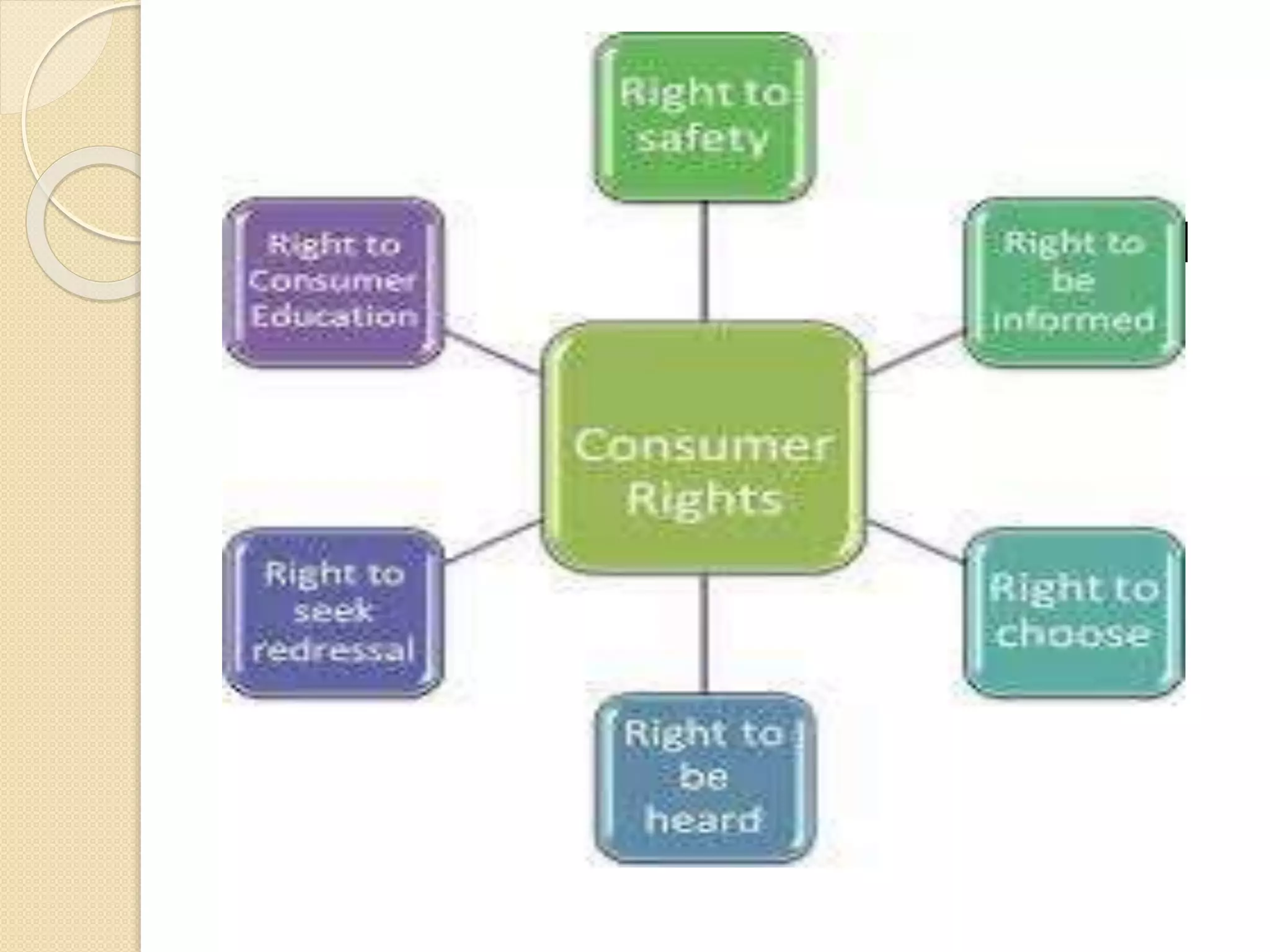
By government of india rights for all
consumers under consumer
protection act:-
 Right to safety
 Right to choice:-
 Right to information
 Right to be heard and to
representation
GRANTS OF RELIEFS
 To remove the defect.
 To replace the goods with new goods of
similar description which shall be free
from any defect.
 To return to the complainant the price.
 To pay such amount as may be awarded
as compensation to the consumer for the
loss or injury suffered by the consumer
due to negligence of opposite party.
Contt..
 To discontinue the unfair practices and
services or not to repeat them.
 To cease manufacture of hazardous goods.
 To issue corrective advertisement, do not
mislead the advertisement.
 Not to offer hazardous goods for sale.
 To provide for adequate costs to parties.
PROCEDURE
 First and foremost, the complaint must be
made in writing, defects in goods and
unsatisfactory services can be the subject for
written complaints.
 Consumers are not charged a fee for filing
such complaints. Decisions may involve
complete removal of any defect in a product
and replacement of the product. Refunds are
specifically provided for in the law. If in case
of a death of consumer, his legal
representative may make a complaint.
PERIOD OF LIMITATION
A complaint is only admitted by any of
the competent forums under consumer act
if it is filled within two years from the date
on which the cause of action has arisen
but it may be entertained after the said
period after recording its reason for
condoning such delay, if the complainant
satisfies that he had a sufficient cause for
not filling the complaint within period of
two years.
WHO CANNOT TAKE BENEFIT OF
CONSUMER PROTECTION ACT
1. Free goods/services
2. Reseller.
3. Commercial purpose.
PENALTY
According to this act , where a trader or
complainant fails to comply with an order
made by the relevant consumer forum ,
such person is liable to a punishment with
imprisonment for a term which is not less
than two thousand rupees but which may
extend to ten thousand rupees or with
both.
ADVANTAGES
1. Doctors are accountable for their actions of:
 Omission.
 Commission.
2. Speedy justice to consumers.
3. Decisions are made on the basis of law, faith
and fairness.
4. It encourages:
 Proper communication with patients.
 Proper documentation.
 Better performance.
 Reasonable charges.
DISADVANTAGES
 Medical services are personalized and
cannot be standardized. Hence there may
be unnecessary complaints.
 Doctors tend to practice defensive
medicine by ordering more tests, ordering
opinions, from other specialties and
treating doubtful conditions vigorously.
Contt..
 Blackmailing by patients, colleagues,
lawyers and social workers.
 Likely damage to the reputation.
 Doctors may refuse to take up
complicated cases.
REFERENCES
 Clement Nisha. Essentials of Management of
nursing service and education. First ed. Jaypee
brothers medical publishers (P) Ltd. p. 636-38.
 K. Deepak, C Chandran Sarath, Kumar Mithun. A
comprehensive textbook on Nursing Management.
First ed. EMMESS publishers. p. 538
 Clement I. Management of nursing services and
education. 2nd ed. ELSEVIER publishers. p. 498-
99
 Kumari Neelam. A textbook of management of
nursing services and education. 4th ed. S. Vikas &
company (Medical publeshers) India. p. 478-80.
THANK YOU

Consumer protection act

  • 1.
  • 3.
    CONSUMER PROTECTION ACT Consumerprotection act (CPA), is an act of the parliament of India enacted in 1986 to protect the interests of consumers in India. The provisions of the act came into force with the effect from 15-4-1987. It makes provision for the establishment of consumer councils and other authorities for the settlement of consumer’s disputes and for matters connected therewith.
  • 4.
    Contt..  This actconsidered patients as consumers, i.e. buyers of services and the doctors as provider of these services on payment.  Consumer Protection laws are a form of government regulation which aim to protect the interests of consumers.
  • 5.
    Contt..  Consumer protectionis linked to the idea of "consumer rights" (that consumers have various rights as consumers), and to the formation of consumer organizations.
  • 6.
    Contt.. The Consumer ProtectionAct of India  Specific about what a complaint is, under the law‘s definitions.  Complaint must be made in written  Defects in goods or unsatisfactory service can be the subject of written complaints, as can excessively high charges for goods or services.
  • 7.
    ENACTION OF ACT The act was passed in Lok Sabha on 9th December, 1986 and assented by the president of India in December, and was published in the Gazette of India on 26th , 1986.  This act was enacted in the 37th year of the Republic of India and was amended from time to time in the following year’s i.e.1991, 1993, and 2002.
  • 8.
    OBJECTIVES  The mainobjective of CPA is to provide speedy and simple redressal to consumer disputes.  It is one of the benevolent pieces of legislation intended to protect the consumers at large from exploitation
  • 9.
    FEATURES OF CPA Duringlast few years, due to increased availability of sophisticated, investigative and therapeutic technology, modern practice of medicine is dehumanized. This fact is partly responsible for loss of mutual trust. Important features of this act as follows;
  • 10.
    Contt..  Services renderedby a doctor, hospital or any other healthcare organization for carrying out consultation, diagnosis, investigations and treatment fall within the purview of this act.  If the charges are reimbursable or there is third party payment, e.g. employer, insurance company, etc. and then also the act is applicable
  • 11.
    Contt..  If theservices rendered are totally free, then act is not possible.  The act is applicable to the patients who are treated free in paying hospitals.  The act is applicable to all the patients who are treated free hospitals having paying beds, paying section or payment required for any service.
  • 12.
    Contt..  A consumerdoes not have to pay court fees or process fees.  Prescribes time limit for settling the disputes in 3 months. If expert’s examination is required, no longer time is permitted.
  • 13.
    CONSUMER PROTECTION COUNCILS 1) Centralconsumer protection council RIGHTS PROTECTED INFORMED ASSURED HEARD SEEK REDRESSAL
  • 14.
    Contt.. 2) State consumerprotection councils:-  The minister in charge of consumer affairs in the state Government, who shall be its Chairman.  The State Council shall meet as and when necessary, but not less than two meetings shall be held every year .  Objective of every state council shall be to promote and protect within the state, the rights of consumer.
  • 15.
    COMMISSIONS IN CONSUMER PROTECTIONACT 1. District Forum: Consist of 2 persons; District judge as president. Two persons having knowledge of any followings:  Law  Economics  Commerce  Accounting  Administration  Industry
  • 16.
    Contt.. 2. State Commission:Consists of three members; Sitting or former judge of high court as president. Two persons as describes in the composition of district forum. This commission attends to the complaints asking for compensation If the complaints are not satisfied with the judgment, the appeal can be made to the National Commission within 30 days.
  • 17.
    Contt.. 3. National Commission:Consists of five persons: Sitting or former judge of Supreme Court. Four persons as described in the previous two committees.
  • 18.
    Contt.. This commission handlescomplaints demanding more than 20 lakhs as compensation. Consumer protection act also provides for:  State level consumer protection council.  Central consumer protection council for the purpose of:  Protecting rights of the consumers  Promoting rights of the consumers  Educating consumers.
  • 19.
  • 20.
  • 22.
  • 24.
  • 26.
    RIGHTS OF THEPATIENTS According to American association  Right to considerate and respectful care.  Right to information  Right to make decisions  Right to expect reasonable continuity of care  Right to be informed  Right to privacy
  • 27.
    Contt..  Right toconfidentiality  Right to ask  Right to consent  Right to say no
  • 29.
    By government ofindia rights for all consumers under consumer protection act:-  Right to safety  Right to choice:-  Right to information  Right to be heard and to representation
  • 30.
    GRANTS OF RELIEFS To remove the defect.  To replace the goods with new goods of similar description which shall be free from any defect.  To return to the complainant the price.  To pay such amount as may be awarded as compensation to the consumer for the loss or injury suffered by the consumer due to negligence of opposite party.
  • 31.
    Contt..  To discontinuethe unfair practices and services or not to repeat them.  To cease manufacture of hazardous goods.  To issue corrective advertisement, do not mislead the advertisement.  Not to offer hazardous goods for sale.  To provide for adequate costs to parties.
  • 32.
    PROCEDURE  First andforemost, the complaint must be made in writing, defects in goods and unsatisfactory services can be the subject for written complaints.  Consumers are not charged a fee for filing such complaints. Decisions may involve complete removal of any defect in a product and replacement of the product. Refunds are specifically provided for in the law. If in case of a death of consumer, his legal representative may make a complaint.
  • 33.
    PERIOD OF LIMITATION Acomplaint is only admitted by any of the competent forums under consumer act if it is filled within two years from the date on which the cause of action has arisen but it may be entertained after the said period after recording its reason for condoning such delay, if the complainant satisfies that he had a sufficient cause for not filling the complaint within period of two years.
  • 34.
    WHO CANNOT TAKEBENEFIT OF CONSUMER PROTECTION ACT 1. Free goods/services 2. Reseller. 3. Commercial purpose.
  • 35.
    PENALTY According to thisact , where a trader or complainant fails to comply with an order made by the relevant consumer forum , such person is liable to a punishment with imprisonment for a term which is not less than two thousand rupees but which may extend to ten thousand rupees or with both.
  • 36.
    ADVANTAGES 1. Doctors areaccountable for their actions of:  Omission.  Commission. 2. Speedy justice to consumers. 3. Decisions are made on the basis of law, faith and fairness. 4. It encourages:  Proper communication with patients.  Proper documentation.  Better performance.  Reasonable charges.
  • 37.
    DISADVANTAGES  Medical servicesare personalized and cannot be standardized. Hence there may be unnecessary complaints.  Doctors tend to practice defensive medicine by ordering more tests, ordering opinions, from other specialties and treating doubtful conditions vigorously.
  • 38.
    Contt..  Blackmailing bypatients, colleagues, lawyers and social workers.  Likely damage to the reputation.  Doctors may refuse to take up complicated cases.
  • 39.
    REFERENCES  Clement Nisha.Essentials of Management of nursing service and education. First ed. Jaypee brothers medical publishers (P) Ltd. p. 636-38.  K. Deepak, C Chandran Sarath, Kumar Mithun. A comprehensive textbook on Nursing Management. First ed. EMMESS publishers. p. 538  Clement I. Management of nursing services and education. 2nd ed. ELSEVIER publishers. p. 498- 99  Kumari Neelam. A textbook of management of nursing services and education. 4th ed. S. Vikas & company (Medical publeshers) India. p. 478-80.
  • 40.