Computer Architecture
Lecture 04
Computer Arithmetic &
Instruction Set
Instructor: Shalah Uddin Perbhez Shakil
Lecturer, SWE, DIU
ALU
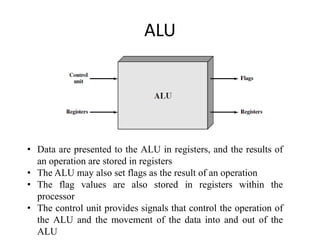
• Data are presented to the ALU in registers, and the results of
an operation are stored in registers
• The ALU may also set flags as the result of an operation
• The flag values are also stored in registers within the
processor
• The control unit provides signals that control the operation of
the ALU and the movement of the data into and out of the
ALU
Number Representation (Fixed Point)
• Integer Representation
– Straight forward, can not present signed numbers
• Sign-Magnitude Representation
– If the sign bit is 0, the number is positive; if the sign
bit is 1, the number is negative
• Disadvantages:
1) Addition and subtraction require a consideration of
both the signs of the numbers and their relative
magnitudes to carry out the required operation
2) There are two representations of 0
Number Representation (Fixed Point)
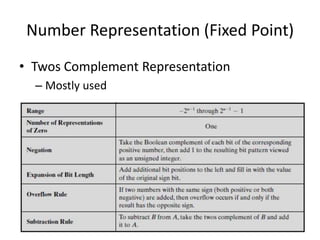
• Twos Complement Representation
– Mostly used
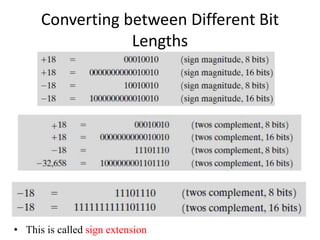
Converting between Different Bit
Lengths
• This is called sign extension
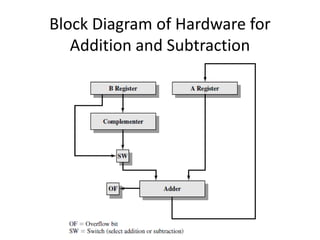
Block Diagram of Hardware for
Addition and Subtraction
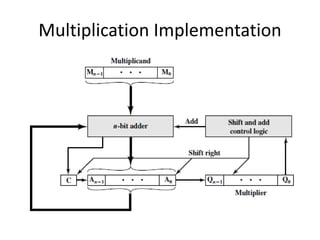
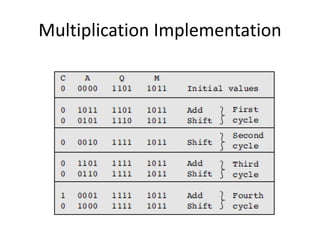
Multiplication Implementation
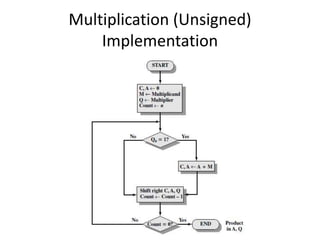
Multiplication (Unsigned)
Implementation
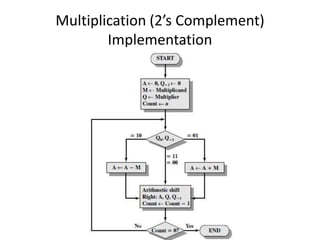
Multiplication (2’s Complement)
Implementation
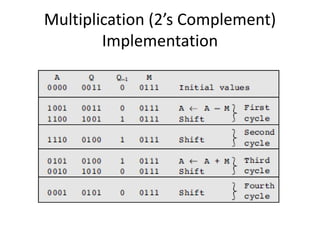
Multiplication (2’s Complement)
Implementation
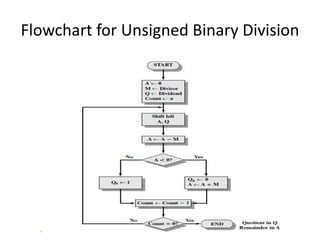
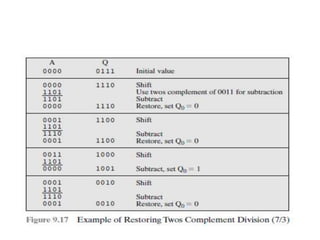
Flowchart for Unsigned Binary Division
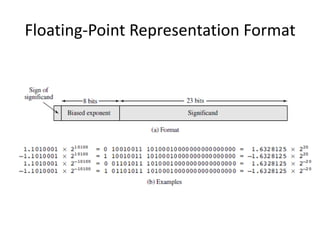
Floating-Point Representation Format
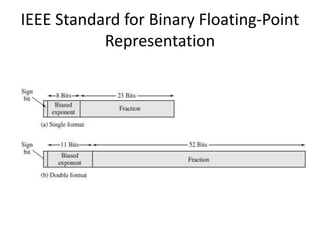
IEEE Standard for Binary Floating-Point
Representation
Machine Instruction Characteristics
• Instructions it executes
• The collection of different instructions that
the processor can execute is referred to as the
processor’s instruction set
• 4 Basic elements of an machine instruction
– Operation code
– Source operand reference
– Result operand reference
– Next instruction reference
Elements of a Machine Instruction
• Operation code: Specifies the operation to be
performed (e.g., ADD, I/O)
– The operation is specified by a binary code, known as the
operation code, or opcode
• Source operand reference: The operation may involve
one or more source operands, that is, operands that
are inputs for the operation
• Result operand reference: The operation may produce
a result
• Next instruction reference: This tells the processor
where to fetch the next instruction after the execution
of this instruction is complete
Elements of a Machine Instruction
• The address of the next instruction could be either-
– real address or
– a virtual address
• Depends on architecture
• Source and result operands can be in one of four areas:
• Main or virtual memory: As with next instruction references, the main
or virtual memory address must be supplied
• Processor register: With rare exceptions, a processor contains one or
more registers that may be referenced by machine instructions
– If only one register exists, reference to it may be implicit
– If more than one register exists, then each register is assigned a
unique name or number, and the instruction must contain the
number of the desired register
Elements of a Machine Instruction
• Immediate: The value of the operand is contained in a field in
the instruction being executed
• I/O device: The instruction must specify the I/O module and
device for the operation
– If memory-mapped I/O is used, this is just another main or virtual
memory address
Instruction Representation
• Each instruction is represented by a sequence of bits, within a
computer
• The instruction is divided into fields, corresponding to the
constituent elements of the instruction
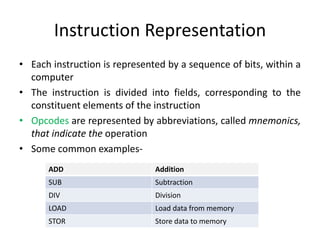
• Opcodes are represented by abbreviations, called mnemonics,
that indicate the operation
• Some common examples-
ADD Addition
SUB Subtraction
DIV Division
LOAD Load data from memory
STOR Store data to memory
Instruction Representation
• Operands are also represented symbolically
• Example: ADD R, Y
Instruction Types
• A typical high level instruction
– X = X + Y
• How is it done in low level/machine language?
• A computer should have a set of instructions that allows the user to
formulate any data processing task
• The set of machine instructions must be sufficient to express any of the
instructions from a high-level language
• Basic types-
– Arithmetic instructions
– Logic (Boolean) instructions
– memory instructions
– I/O instructions
– Test instructions
– Branch instructions
Number of Addresses
• Arithmetic and logic instructions will require the most operands
• Virtually all arithmetic and logic operations are either unary (one source
operand) or binary (two source operands)
• Thus, we would need a maximum of two addresses to reference source
operands
• The result of an operation must be stored, suggesting a third address,
which defines a destination operand
• Finally, after completion of an instruction, the next instruction must be
fetched, and its address is needed
• Zero-address instructions are applicable to a special memory organization,
called a stack
• Fewer addresses per instruction result in instructions that are more
primitive, requiring a less complex processor
Number of Addresses
• The design trade-offs involved in choosing the number of addresses per
instruction are complicated by other factors
• There is the issue of whether an address references a memory location or
a register
• Because there are fewer registers, fewer bits are needed for a register
reference
• A machine may offer a variety of addressing modes, and the specification
of mode takes one or more bits
• With one-address instructions, the programmer generally has available
only one general-purpose register, the accumulator
• With multiple-address instructions, it is common to have multiple general
purpose registers
Instruction Set Design
• Most fundamental issues include-
• Operation repertoire: How many and which operations to provide, and
how complex operations should be
• Data types: The various types of data upon which operations are
performed
• Instruction format: Instruction length (in bits), number of addresses, size
of various fields, and so on
• Registers: Number of processor registers that can be referenced by
instructions, and their use
• Addressing: The mode or modes by which the address of an operand is
specified
Types of Operands
• Important general categories are-
– Addresses
– Numbers
– Characters
– Logical data
Types of Operations
• General types-
– Data transfer
– Arithmetic
– Logical
– Conversion
– I/O
– System control
– Transfer of control
• Data Transfer: The data transfer instruction must specify several things
– First, the location of the source and destination operands must be specified
– Each location could be memory, a register, or the top of the stack
– Second, the length of data to be transferred must be indicated
– Third, as with all instructions with operands, the mode of addressing for each operand
must be specified
Types of Operations
• System Control
– System control instructions are those that can be executed only while the processor is in
a certain privileged state or is executing a program in a special privileged area of
memory
– Typically, these instructions are reserved for the use of the operating system
• Transfer of Control
• Why required?
1. In the practical use of computers, it is essential to be able to execute each
instruction more than once and perhaps many thousands of times
– It may require thousands or perhaps millions of instructions to implement an
application
– This would be unthinkable if each instruction had to be written out separately
– If a table or a list of items is to be processed, a program loop is needed
– One sequence of instructions is executed repeatedly to process all the data
Types of Operations
2. Virtually all programs involve some decision making
– We would like the computer to do one thing if one condition holds, and
another thing if another condition holds
– For example, a sequence of instructions computes the square root of a
number
– At the start of the sequence, the sign of the number is tested
– If the number is negative, the computation is not performed, but an error
condition is reported
3. To compose correctly a large or even medium-size computer
program is an exceedingly difficult task
– It helps if there are mechanisms for breaking the task up into smaller pieces
that can be worked on one at a time
• Most common transfer-of-control operations found in instruction sets:
branch, skip, and procedure call
Branch Instructions
• A branch instruction, also called a jump instruction, has as one of its
operands the address of the next instruction to be executed
• Most often, the instruction is a conditional branch instruction
• That is, the branch is made (update program counter to equal address
specified in operand) only if a certain condition is met
• Otherwise, the next instruction in sequence is executed (increment
program counter as usual)
• A branch instruction in which the branch is always taken is an
unconditional branch
• Two ways of doing this:
– First, most machines provide a 1-bit or multiple-bit condition code that is set as the
result of some operations
– This code can be thought of as a short user-visible register
– BRP X : Branch to location X if result is positive
– BRN X :Branch to location X if result is negative
Branch Instructions
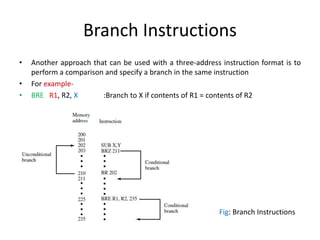
• Another approach that can be used with a three-address instruction format is to
perform a comparison and specify a branch in the same instruction
• For example-
• BRE R1, R2, X :Branch to X if contents of R1 = contents of R2
Fig: Branch Instructions
Skip Instructions
• The skip instruction includes an implied address
• Typically, the skip implies that one instruction be
skipped; thus, the implied address equals the
address of the next instruction plus one
instruction length
• Because the skip instruction does not require a
destination address field, it is free to do other
things
• A typical example is the increment-and-skip-if-
zero (ISZ) instruction
Procedure Call Instructions
• A procedure is a self contained computer program that is
incorporated into a larger program
• At any point in the program the procedure may be invoked,
or called
• Used because of-
– Economy and
– Modularity
• The procedure mechanism involves two basic instructions:
• A call instruction that branches from the present location to
the procedure, and a return instruction that returns from
the procedure to the place from which it was called
– Both of these are forms of branching instructions
Procedure Call Instructions
• Important points:
– A procedure can be called from more than one
location
– A procedure call can appear in a procedure
• This allows the nesting of procedures to an arbitrary
depth
– Each procedure call is matched by a return in the
called program
• Multiplication of Unsigned with example
• Twos Complement Integers with example
• Branch instruction with example
• Skip instruction with example
Thank you!

Computer Architecture Lecture slide 2. course se 222

  • 1.
    Computer Architecture Lecture 04 ComputerArithmetic & Instruction Set Instructor: Shalah Uddin Perbhez Shakil Lecturer, SWE, DIU
  • 2.
    ALU • Data arepresented to the ALU in registers, and the results of an operation are stored in registers • The ALU may also set flags as the result of an operation • The flag values are also stored in registers within the processor • The control unit provides signals that control the operation of the ALU and the movement of the data into and out of the ALU
  • 3.
    Number Representation (FixedPoint) • Integer Representation – Straight forward, can not present signed numbers • Sign-Magnitude Representation – If the sign bit is 0, the number is positive; if the sign bit is 1, the number is negative • Disadvantages: 1) Addition and subtraction require a consideration of both the signs of the numbers and their relative magnitudes to carry out the required operation 2) There are two representations of 0
  • 4.
    Number Representation (FixedPoint) • Twos Complement Representation – Mostly used
  • 5.
    Converting between DifferentBit Lengths • This is called sign extension
  • 6.
    Block Diagram ofHardware for Addition and Subtraction
  • 7.
  • 8.
  • 9.
  • 10.
  • 11.
  • 12.
    Flowchart for UnsignedBinary Division
  • 14.
  • 15.
    IEEE Standard forBinary Floating-Point Representation
  • 16.
    Machine Instruction Characteristics •Instructions it executes • The collection of different instructions that the processor can execute is referred to as the processor’s instruction set • 4 Basic elements of an machine instruction – Operation code – Source operand reference – Result operand reference – Next instruction reference
  • 17.
    Elements of aMachine Instruction • Operation code: Specifies the operation to be performed (e.g., ADD, I/O) – The operation is specified by a binary code, known as the operation code, or opcode • Source operand reference: The operation may involve one or more source operands, that is, operands that are inputs for the operation • Result operand reference: The operation may produce a result • Next instruction reference: This tells the processor where to fetch the next instruction after the execution of this instruction is complete
  • 18.
    Elements of aMachine Instruction • The address of the next instruction could be either- – real address or – a virtual address • Depends on architecture • Source and result operands can be in one of four areas: • Main or virtual memory: As with next instruction references, the main or virtual memory address must be supplied • Processor register: With rare exceptions, a processor contains one or more registers that may be referenced by machine instructions – If only one register exists, reference to it may be implicit – If more than one register exists, then each register is assigned a unique name or number, and the instruction must contain the number of the desired register
  • 19.
    Elements of aMachine Instruction • Immediate: The value of the operand is contained in a field in the instruction being executed • I/O device: The instruction must specify the I/O module and device for the operation – If memory-mapped I/O is used, this is just another main or virtual memory address
  • 20.
    Instruction Representation • Eachinstruction is represented by a sequence of bits, within a computer • The instruction is divided into fields, corresponding to the constituent elements of the instruction • Opcodes are represented by abbreviations, called mnemonics, that indicate the operation • Some common examples- ADD Addition SUB Subtraction DIV Division LOAD Load data from memory STOR Store data to memory
  • 21.
    Instruction Representation • Operandsare also represented symbolically • Example: ADD R, Y
  • 22.
    Instruction Types • Atypical high level instruction – X = X + Y • How is it done in low level/machine language? • A computer should have a set of instructions that allows the user to formulate any data processing task • The set of machine instructions must be sufficient to express any of the instructions from a high-level language • Basic types- – Arithmetic instructions – Logic (Boolean) instructions – memory instructions – I/O instructions – Test instructions – Branch instructions
  • 23.
    Number of Addresses •Arithmetic and logic instructions will require the most operands • Virtually all arithmetic and logic operations are either unary (one source operand) or binary (two source operands) • Thus, we would need a maximum of two addresses to reference source operands • The result of an operation must be stored, suggesting a third address, which defines a destination operand • Finally, after completion of an instruction, the next instruction must be fetched, and its address is needed • Zero-address instructions are applicable to a special memory organization, called a stack • Fewer addresses per instruction result in instructions that are more primitive, requiring a less complex processor
  • 24.
    Number of Addresses •The design trade-offs involved in choosing the number of addresses per instruction are complicated by other factors • There is the issue of whether an address references a memory location or a register • Because there are fewer registers, fewer bits are needed for a register reference • A machine may offer a variety of addressing modes, and the specification of mode takes one or more bits • With one-address instructions, the programmer generally has available only one general-purpose register, the accumulator • With multiple-address instructions, it is common to have multiple general purpose registers
  • 25.
    Instruction Set Design •Most fundamental issues include- • Operation repertoire: How many and which operations to provide, and how complex operations should be • Data types: The various types of data upon which operations are performed • Instruction format: Instruction length (in bits), number of addresses, size of various fields, and so on • Registers: Number of processor registers that can be referenced by instructions, and their use • Addressing: The mode or modes by which the address of an operand is specified
  • 26.
    Types of Operands •Important general categories are- – Addresses – Numbers – Characters – Logical data
  • 27.
    Types of Operations •General types- – Data transfer – Arithmetic – Logical – Conversion – I/O – System control – Transfer of control • Data Transfer: The data transfer instruction must specify several things – First, the location of the source and destination operands must be specified – Each location could be memory, a register, or the top of the stack – Second, the length of data to be transferred must be indicated – Third, as with all instructions with operands, the mode of addressing for each operand must be specified
  • 28.
    Types of Operations •System Control – System control instructions are those that can be executed only while the processor is in a certain privileged state or is executing a program in a special privileged area of memory – Typically, these instructions are reserved for the use of the operating system • Transfer of Control • Why required? 1. In the practical use of computers, it is essential to be able to execute each instruction more than once and perhaps many thousands of times – It may require thousands or perhaps millions of instructions to implement an application – This would be unthinkable if each instruction had to be written out separately – If a table or a list of items is to be processed, a program loop is needed – One sequence of instructions is executed repeatedly to process all the data
  • 29.
    Types of Operations 2.Virtually all programs involve some decision making – We would like the computer to do one thing if one condition holds, and another thing if another condition holds – For example, a sequence of instructions computes the square root of a number – At the start of the sequence, the sign of the number is tested – If the number is negative, the computation is not performed, but an error condition is reported 3. To compose correctly a large or even medium-size computer program is an exceedingly difficult task – It helps if there are mechanisms for breaking the task up into smaller pieces that can be worked on one at a time • Most common transfer-of-control operations found in instruction sets: branch, skip, and procedure call
  • 30.
    Branch Instructions • Abranch instruction, also called a jump instruction, has as one of its operands the address of the next instruction to be executed • Most often, the instruction is a conditional branch instruction • That is, the branch is made (update program counter to equal address specified in operand) only if a certain condition is met • Otherwise, the next instruction in sequence is executed (increment program counter as usual) • A branch instruction in which the branch is always taken is an unconditional branch • Two ways of doing this: – First, most machines provide a 1-bit or multiple-bit condition code that is set as the result of some operations – This code can be thought of as a short user-visible register – BRP X : Branch to location X if result is positive – BRN X :Branch to location X if result is negative
  • 31.
    Branch Instructions • Anotherapproach that can be used with a three-address instruction format is to perform a comparison and specify a branch in the same instruction • For example- • BRE R1, R2, X :Branch to X if contents of R1 = contents of R2 Fig: Branch Instructions
  • 32.
    Skip Instructions • Theskip instruction includes an implied address • Typically, the skip implies that one instruction be skipped; thus, the implied address equals the address of the next instruction plus one instruction length • Because the skip instruction does not require a destination address field, it is free to do other things • A typical example is the increment-and-skip-if- zero (ISZ) instruction
  • 33.
    Procedure Call Instructions •A procedure is a self contained computer program that is incorporated into a larger program • At any point in the program the procedure may be invoked, or called • Used because of- – Economy and – Modularity • The procedure mechanism involves two basic instructions: • A call instruction that branches from the present location to the procedure, and a return instruction that returns from the procedure to the place from which it was called – Both of these are forms of branching instructions
  • 34.
    Procedure Call Instructions •Important points: – A procedure can be called from more than one location – A procedure call can appear in a procedure • This allows the nesting of procedures to an arbitrary depth – Each procedure call is matched by a return in the called program
  • 35.
    • Multiplication ofUnsigned with example • Twos Complement Integers with example • Branch instruction with example • Skip instruction with example
  • 36.