Department Computer Engineering
Chapter 4: Instruction Sets
Computer Architecture
and Organization
2
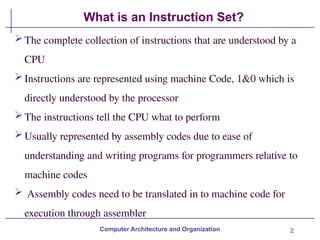
What is an Instruction Set?
Computer Architecture and Organization
The complete collection of instructions that are understood by a
CPU
Instructions are represented using machine Code, 1&0 which is
directly understood by the processor
The instructions tell the CPU what to perform
Usually represented by assembly codes due to ease of
understanding and writing programs for programmers relative to
machine codes
 Assembly codes need to be translated in to machine code for
execution through assembler
3
Elements of an Instruction
Computer Architecture and Organization
 Operation code (Op code)
 Which specifies the operation to be performed
 Source Operand reference
 which specifies the input locations for the operation
 Destination Operand reference
 which specifies the output locations for the operation, in some
instruction may specifies as an input and output location for the
operation
 Next Instruction Reference
 This tells the processor where to fetch the next instruction after the
execution of this instruction is complete, which is usually implicit
4
Where have all the Operands Gone?
Computer Architecture and Organization
Source & result operands can be in one of four areas:
Main memory (or virtual memory or cache): As with next instruction
references, the main or virtual memory address must be supplied
Processor register: a processor may contains one or more registers
that may be referenced by machine instructions
 If only one register exists, reference to it may be implicit
 If more than one register exists, then each register is assigned a
unique name or number, and the instruction must contain the
number of the desired register
5
Where have all the Operands Gone?
Computer Architecture and Organization
I/O device: The instruction must specify the I/O module and
device for the operation.
If memory-mapped I/O is used, this is just another main or
virtual memory address
Immediate: The value of the operand is contained in a field in the
instruction being executed.
6
Instruction Representation
Computer Architecture and Organization
 Within the computer, each instruction is represented by a sequence of bits
 The instruction is divided into fields, corresponding to the constituent
elements of the instruction
 With most instruction sets, more than one format is used
 During instruction execution, an instruction is read into an instruction register
(IR) in the processor
 The processor must be able to extract the data from the various instruction
fields to perform the required operation
 It is difficult for both the programmer and the reader of textbooks to deal with
binary representations of machine instructions
7
Instruction Representation
Computer Architecture and Organization
 Therefore it is common practice to use a symbolic representation of machine
instructions
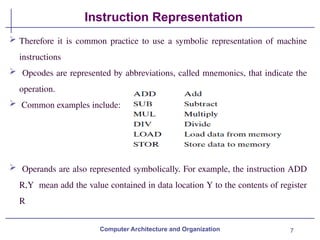
 Opcodes are represented by abbreviations, called mnemonics, that indicate the
operation.
 Common examples include:
 Operands are also represented symbolically. For example, the instruction ADD
R,Y mean add the value contained in data location Y to the contents of register
R
8
Instruction Representation
Computer Architecture and Organization
 Y refers to the address of a location in memory, and R refers to a particular
register
 Note: that the operation is performed on the contents of a location, not on its
address.
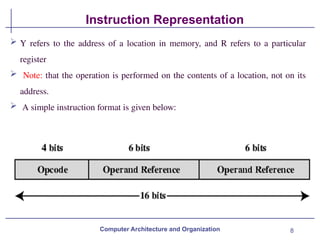
 A simple instruction format is given below:
9
Instruction Types
Computer Architecture and Organization
We can categorize instruction types as follows:
o Data processing: Arithmetic and logic instructions
o Data storage: Movement of data into or out of register and or
memory locations
o Data movement: I/O instructions
o Program flow control: Test & branch instructions
 Arithmetic instructions provide computational capabilities for
processing numeric data
 Logic (Boolean) instructions operate on the bits of a word as
bits rather than as numbers
10
Instruction Types
Computer Architecture and Organization
I/O instructions are needed to transfer programs and data into
memory and the results of computations back out to the user.
 Test instructions are used to test the value of a data word or
the status of a computation
 Branch instructions are then used to branch to a different set
of instructions depending on the decision made
11
Number of Addresses
Computer Architecture and Organization
Arithmetic and logic instructions will require the most operands
Virtually all arithmetic and logic operations are either unary (one
source operand) or binary (two source operands)
Thus, we need a maximum of two addresses to reference source
operands.
The result of an operation must be stored, suggesting a third
address, which defines a destination operand.
 After completion of an instruction, the next instruction must be
fetched, and its address is needed.
12
Number of Addresses
Computer Architecture and Organization
In most architectures, most instructions have one, two, or three
operand addresses, with the address of the next instruction being
implicit (obtained from the program counter).
 Three-address instructions:
With three addresses, each instruction specifies two source
operand locations and a destination operand location.
 Three-address instruction formats are not common because
they require a relatively long instruction format to hold the three
address references
13
Number of Addresses
Computer Architecture and Organization
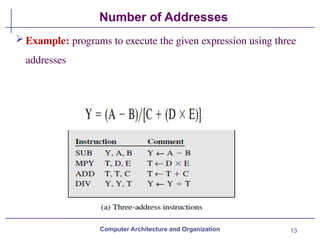
Example: programs to execute the given expression using three
addresses
14
Number of Addresses
Computer Architecture and Organization
 Two address Instructions:
With two address instructions, and for binary operations, one
address must do double duty as both an operand and a result
 The two-address format reduces the space requirement
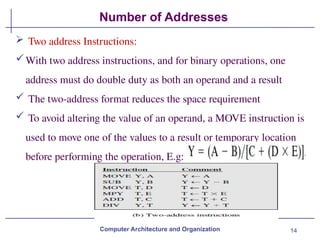
 To avoid altering the value of an operand, a MOVE instruction is
used to move one of the values to a result or temporary location
before performing the operation, E.g:
15
Number of Addresses
Computer Architecture and Organization
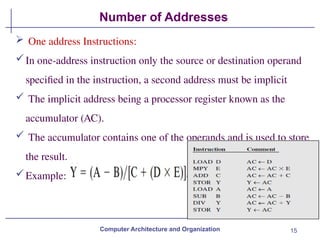
 One address Instructions:
In one-address instruction only the source or destination operand
specified in the instruction, a second address must be implicit
 The implicit address being a processor register known as the
accumulator (AC).
 The accumulator contains one of the operands and is used to store
the result.
Example:
16
Number of Addresses
Computer Architecture and Organization
 Zero address Instructions:
 It is, possible to make do with zero addresses for some
instructions.
Zero-address instructions are applicable to a special memory
organization, called a stack.
 A stack is a last-in-first-out set of locations.
 The stack is in a known location and, often, at least the top two
elements are in processor registers
17
Number of Addresses
Computer Architecture and Organization
 Example:
o push a
o push b
o add (0 address instruction)
o pop c
 After executing the last instruction the value of processor register c
becomes c= a+b which is fetched from the top of the stack which is
summed before these instruction.
18
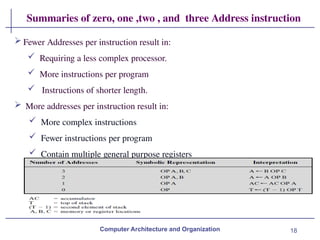
Summaries of zero, one ,two , and three Address instruction
Computer Architecture and Organization
 Fewer Addresses per instruction result in:
 Requiring a less complex processor.
 More instructions per program
 Instructions of shorter length.
 More addresses per instruction result in:
 More complex instructions
 Fewer instructions per program
 Contain multiple general purpose registers
19
Instruction Set Design
 One of the most interesting, and most analyzed, aspects of computer design is
instruction set design
 The design of an instruction set is very complex because it affects so many
aspects of the computer system
 The instruction set defines many of the functions performed by the processor
and thus has a significant effect on the implementation of the processor
 The instruction set is the programmer’s means of controlling the processor
 Thus, programmer requirements must be considered in designing the
instruction set.
Computer Architecture and Organization
20
Instruction Set Design
 The most important of these fundamental design issues include the following:
 Operation repertoire: How many and which operations to provide, and how
complex operations should be
 Data types: The various types of data upon which operations are performed
 Instruction format: Instruction length (in bits), number of addresses, size of
various fields, and so on
 Registers: Number of processor registers that can be referenced by
instructions, and their use
 Addressing: The mode or modes by which the address of an operand is
specified
 These issues are highly interrelated and must be considered together in designing
an instruction set
Computer Architecture and Organization
21
Types of Operand
Computer Architecture and Organization
 Machine instructions operate on data. The most important general categories of
data are:
o Addresses: some calculation must be performed on the operand reference in an
instruction to determine the main or virtual memory address.
o Numbers: All machine languages include numeric data types such as binary
integer, binary floating point, and decimal
o Characters: character data can not be easily stored or transmitted by data
processing and communications systems, thus it must be converted to ASCII
code or others format for processing
o Logical Data: n-bit unit as consisting of n 1-bit items of data, each item having
the value 0 or 1, When data are viewed this way, they are considered to be
logical data
22
Types of Operation
Computer Architecture and Organization
 The number of different opcodes varies widely from machine to machine
 However, the same general types of operations are found on all machines
 Therefore they categorized as follows:
 Data transfer
 Arithmetic
 Logical
 Conversion
 I/O
 System control
 Transfer of control
 We will see later some of them in detail
23
Data Transfer Instruction
Computer Architecture and Organization
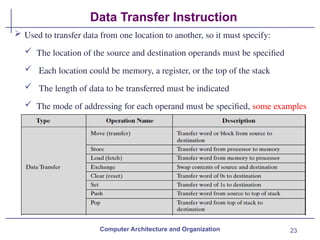
 Used to transfer data from one location to another, so it must specify:
 The location of the source and destination operands must be specified
 Each location could be memory, a register, or the top of the stack
 The length of data to be transferred must be indicated
 The mode of addressing for each operand must be specified, some examples
24
Arithmetic Instruction
Computer Architecture and Organization
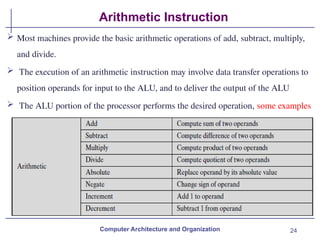
 Most machines provide the basic arithmetic operations of add, subtract, multiply,
and divide.
 The execution of an arithmetic instruction may involve data transfer operations to
position operands for input to the ALU, and to deliver the output of the ALU
 The ALU portion of the processor performs the desired operation, some examples
25
Logic Instruction
Computer Architecture and Organization
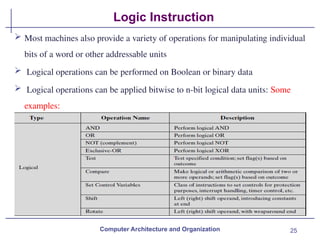
 Most machines also provide a variety of operations for manipulating individual
bits of a word or other addressable units
 Logical operations can be performed on Boolean or binary data
 Logical operations can be applied bitwise to n-bit logical data units: Some
examples:
26
Shift and Rotate Operations
Computer Architecture and Organization
 In addition to bitwise logical operations, most machines provide a variety of
shifting and rotating functions.
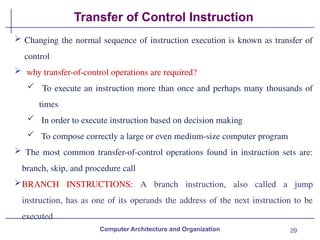
 With a logical shift, the bits of a word are shifted left or right
 On one end, the bit shifted out is lost ,on the other end, a 0 is shifted in
 Logical shifts are useful primarily for isolating fields within a word
 The 0s that are shifted into a word displace unwanted information that is shifted
off the other end.
 The arithmetic shift operation treats the data as a signed integer and does not
shift the sign bit
 On a right arithmetic shift, the sign bit is replicated into the bit position to its
right
27
Shift and Rotate Operations
Computer Architecture and Organization
 On a left arithmetic shift, a logical left shift is performed on all bits but the
sign bit, which is retained
 A right arithmetic shift corresponds to a division by 2, with truncation for
odd numbers
 Both an arithmetic left shift and a logical left shift correspond to a
multiplication by 2 when there is no overflow
 Rotate, or cyclic shift, operations preserve all of the bits being operated on.
 One use of a rotate is to bring each bit successively into the leftmost bit,
where it can be identified by testing the sign of the data
 As with arithmetic operations, logical operations involve ALU activity and
may involve data transfer operations
28
Shift and Rotate Operations
Computer Architecture and Organization
Examples of Shift and Rotate
Operations
29
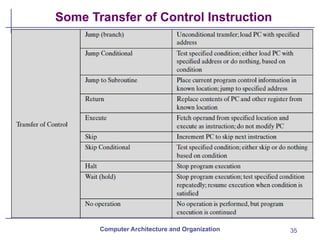
Transfer of Control Instruction
Computer Architecture and Organization
 Changing the normal sequence of instruction execution is known as transfer of
control
 why transfer-of-control operations are required?
 To execute an instruction more than once and perhaps many thousands of
times
 In order to execute instruction based on decision making
 To compose correctly a large or even medium-size computer program
 The most common transfer-of-control operations found in instruction sets are:
branch, skip, and procedure call
BRANCH INSTRUCTIONS: A branch instruction, also called a jump
instruction, has as one of its operands the address of the next instruction to be
executed
30
Transfer of Control Instruction
Computer Architecture and Organization
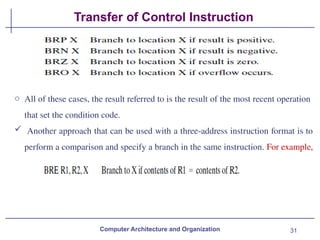
 A branch instruction in which the branch is always taken is an unconditional
branch.
 A branch instruction in which the branch is taken based on condition/decision is
conditional branch.
 There are two common ways of generating the condition to be tested in a
conditional branch instruction
o First, most machines provide a 1-bit or multiple-bit condition code that is set as
the result of some operations
o As an example, an arithmetic operation could set a 2-bit condition code with
one of the following four values: 0, positive, negative, overflow
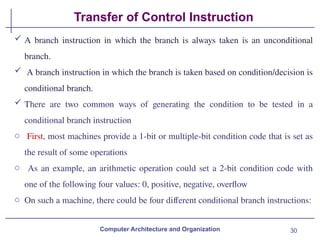
o On such a machine, there could be four different conditional branch instructions:
31
Transfer of Control Instruction
Computer Architecture and Organization
o All of these cases, the result referred to is the result of the most recent operation
that set the condition code.
 Another approach that can be used with a three-address instruction format is to
perform a comparison and specify a branch in the same instruction. For example,
32
Transfer of Control Instruction
Computer Architecture and Organization
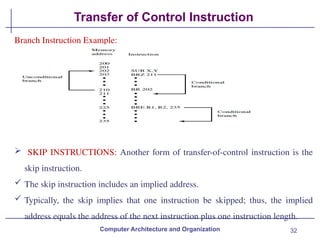
Branch Instruction Example:
 SKIP INSTRUCTIONS: Another form of transfer-of-control instruction is the
skip instruction.
 The skip instruction includes an implied address.
 Typically, the skip implies that one instruction be skipped; thus, the implied
address equals the address of the next instruction plus one instruction length.
33
Transfer of Control Instruction
Computer Architecture and Organization
 PROCEDURE CALL INSTRUCTIONS: A procedure is a self contained
computer program that is incorporated into a larger program
 At any point in the program the procedure may be invoked, or called
 The processor is instructed to go and execute the entire procedure and then
return to the point from which the call took place
 The two principal reasons for the use of procedures are economy and
modularity
 A procedure allows the same piece of code to be used many times
 This is important for economy in programming effort and for making the most
efficient use of storage space in the system
 The procedure mechanism involves two basic instructions: a call instruction that
branches from the present location to the procedure
34
Transfer of Control Instruction
Computer Architecture and Organization
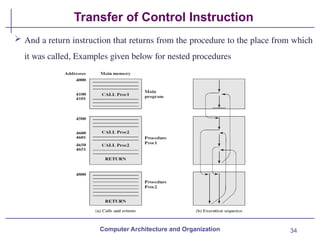
 And a return instruction that returns from the procedure to the place from which
it was called, Examples given below for nested procedures
35
Some Transfer of Control Instruction
Computer Architecture and Organization
36
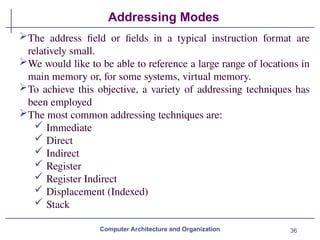
Addressing Modes
Computer Architecture and Organization
The address field or fields in a typical instruction format are
relatively small.
We would like to be able to reference a large range of locations in
main memory or, for some systems, virtual memory.
To achieve this objective, a variety of addressing techniques has
been employed
The most common addressing techniques are:
 Immediate
 Direct
 Indirect
 Register
 Register Indirect
 Displacement (Indexed)
 Stack
37
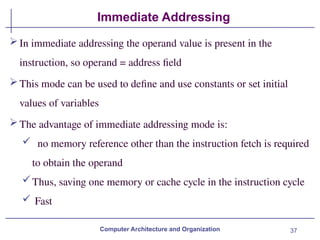
Immediate Addressing
Computer Architecture and Organization
In immediate addressing the operand value is present in the
instruction, so operand = address field
This mode can be used to define and use constants or set initial
values of variables
The advantage of immediate addressing mode is:
 no memory reference other than the instruction fetch is required
to obtain the operand
Thus, saving one memory or cache cycle in the instruction cycle
 Fast
38
Immediate Addressing
Computer Architecture and Organization
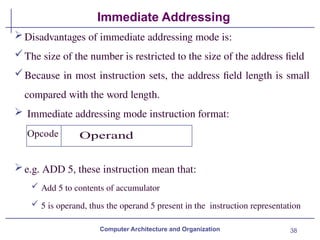
Disadvantages of immediate addressing mode is:
The size of the number is restricted to the size of the address field
Because in most instruction sets, the address field length is small
compared with the word length.
 Immediate addressing mode instruction format:
e.g. ADD 5, these instruction mean that:
 Add 5 to contents of accumulator
 5 is operand, thus the operand 5 present in the instruction representation
39
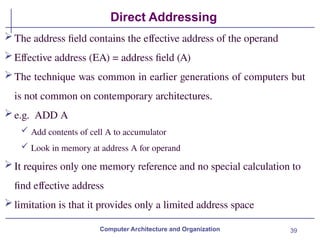
Direct Addressing
Computer Architecture and Organization
The address field contains the effective address of the operand
Effective address (EA) = address field (A)
The technique was common in earlier generations of computers but
is not common on contemporary architectures.
e.g. ADD A
 Add contents of cell A to accumulator
 Look in memory at address A for operand
It requires only one memory reference and no special calculation to
find effective address
limitation is that it provides only a limited address space
40
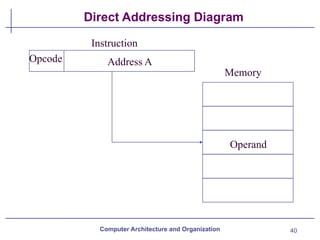
Direct Addressing Diagram
Computer Architecture and Organization
Address A
Opcode
Instruction
Memory
Operand
41
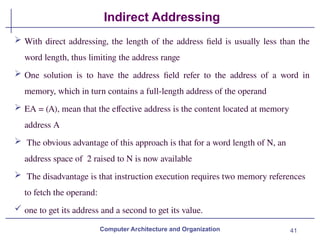
Indirect Addressing
Computer Architecture and Organization
 With direct addressing, the length of the address field is usually less than the
word length, thus limiting the address range
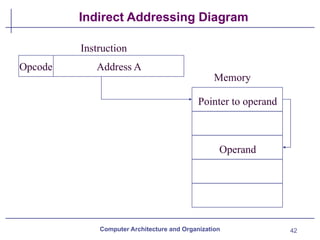
 One solution is to have the address field refer to the address of a word in
memory, which in turn contains a full-length address of the operand
 EA = (A), mean that the effective address is the content located at memory
address A
 The obvious advantage of this approach is that for a word length of N, an
address space of 2 raised to N is now available
 The disadvantage is that instruction execution requires two memory references
to fetch the operand:
 one to get its address and a second to get its value.
42
Indirect Addressing Diagram
Computer Architecture and Organization
Address A
Opcode
Instruction
Memory
Operand
Pointer to operand
43
Register Addressing
Computer Architecture and Organization
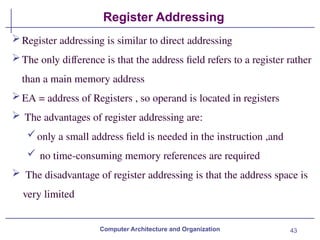
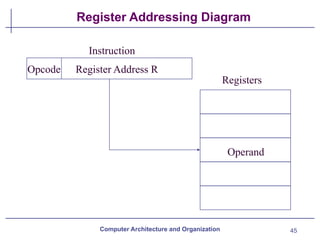
Register addressing is similar to direct addressing
The only difference is that the address field refers to a register rather
than a main memory address
EA = address of Registers , so operand is located in registers
 The advantages of register addressing are:
only a small address field is needed in the instruction ,and
 no time-consuming memory references are required
 The disadvantage of register addressing is that the address space is
very limited
44
Register Addressing
Computer Architecture and Organization
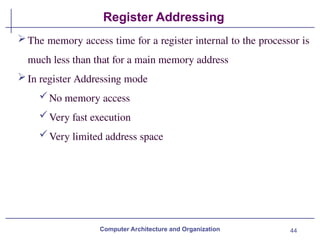
The memory access time for a register internal to the processor is
much less than that for a main memory address
In register Addressing mode
No memory access
Very fast execution
Very limited address space
45
Register Addressing Diagram
Computer Architecture and Organization
Register Address R
Opcode
Instruction
Registers
Operand
46
Register Indirect Addressing
Computer Architecture and Organization
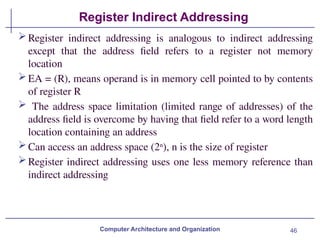
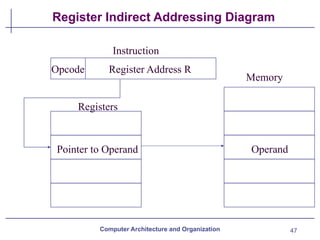
Register indirect addressing is analogous to indirect addressing
except that the address field refers to a register not memory
location
EA = (R), means operand is in memory cell pointed to by contents
of register R
 The address space limitation (limited range of addresses) of the
address field is overcome by having that field refer to a word length
location containing an address
Can access an address space (2n
), n is the size of register
Register indirect addressing uses one less memory reference than
indirect addressing
47
Register Indirect Addressing Diagram
Computer Architecture and Organization
Register Address R
Opcode
Instruction
Memory
Operand
Pointer to Operand
Registers
48
Displacement Addressing
Computer Architecture and Organization
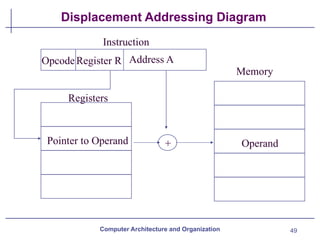
 A very powerful mode of addressing combines the capabilities of direct
addressing and register indirect addressing
 EA = A + (R)
 Displacement addressing requires that the instruction have two address fields,
at least one of which is explicit
 The value contained in one address field (value = A) is used directly
 The other address field, or an implicit reference based on opcode, refers to a
register whose contents are added to A to produce the effective address.
 The most common uses of displacement addressing:
 Relative addressing
 Base-register addressing, and Indexing addressing
49
Displacement Addressing Diagram
Computer Architecture and Organization
Register R
Opcode
Instruction
Memory
Operand
Pointer to Operand
Registers
Address A
+
50
Relative Addressing
Computer Architecture and Organization
 Also called PC-relative addressing, the implicitly referenced register is the
program counter (PC).
 the next instruction address (PC) is added to the address field (A) to produce
the EA, EA=A+(PC)
 Address field of instruction contains displacement value
 If most memory references are relatively near to the instruction being executed,
then the use of relative addressing saves address bits in the instruction
 i.e. get operand from location of memory pointed by the effective address(EA)
51
Base-Register Addressing
Computer Architecture and Organization
The referenced register contains a main memory address, and the
address field contains a displacement
 The register reference may be explicit or implicit
 It is a convenient means of implementing segmentation
 In some implementations, a single segment-base register is
employed and is used implicitly
 In others, the programmer may choose a register to hold the base
address of a segment
A holds displacement
R holds pointer to base address
EA = A + (R)
e.g. segment registers in 80x86
52
Indexed Addressing
Computer Architecture and Organization
The address field references a main memory address, and the
referenced register contains a positive displacement from that
address
EA = A + (R), where A is reference in address field and R is index
register
Used to provide an efficient mechanism for performing iterative
operations
Good for accessing arrays
EA = A + (R)
(R)++
53
Stack Addressing
Computer Architecture and Organization
Stack is a reserved block of location.
 Items are appended to the top of the stack so that, at any
given time, the block is partially filled
Associated with the stack a pointer whose value is address of
top of the stack.
The stack pointer is maintained in register
Thus, references to stack location in memory are in fact
register indirect addressing.
Instruction need not include a memory reference but
implicitly operate on the top of the stack.
e.g. ADD Pop top two items from stack and add them
54
Instruction Formats
Computer Architecture and Organization
An instruction format defines the layout of the bits of an instruction,
in terms of its constituent fields
 An instruction format must include an opcode and, implicitly or
explicitly, zero or more operands
The format must, implicitly or explicitly, indicate the addressing
mode for each operand
 For most instruction sets, more than one instruction format is used
55
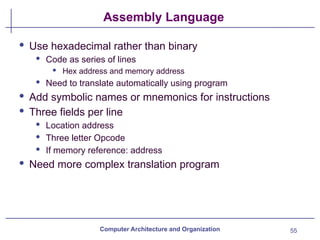
Assembly Language
Computer Architecture and Organization
· Use hexadecimal rather than binary
· Code as series of lines
· Hex address and memory address
· Need to translate automatically using program
· Add symbolic names or mnemonics for instructions
· Three fields per line
· Location address
· Three letter Opcode
· If memory reference: address
· Need more complex translation program
56
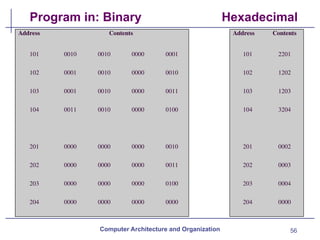
Program in: Binary Hexadecimal
Computer Architecture and Organization
Address Contents Address Contents
101 0010 0010 0000 0001 101 2201
102 0001 0010 0000 0010 102 1202
103 0001 0010 0000 0011 103 1203
104 0011 0010 0000 0100 104 3204
201 0000 0000 0000 0010 201 0002
202 0000 0000 0000 0011 202 0003
203 0000 0000 0000 0100 203 0004
204 0000 0000 0000 0000 204 0000
57
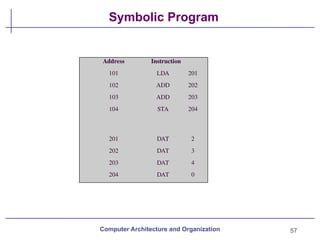
Symbolic Program
Computer Architecture and Organization
Address Instruction
101 LDA 201
102 ADD 202
103 ADD 203
104 STA 204
201 DAT 2
202 DAT 3
203 DAT 4
204 DAT 0
58
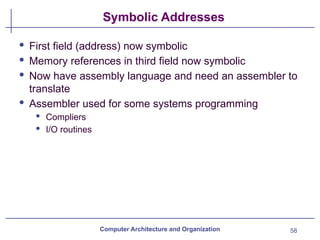
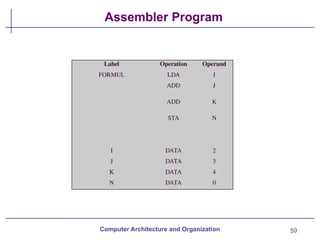
Symbolic Addresses
Computer Architecture and Organization
· First field (address) now symbolic
· Memory references in third field now symbolic
· Now have assembly language and need an assembler to
translate
· Assembler used for some systems programming
· Compliers
· I/O routines
59
Assembler Program
Computer Architecture and Organization
Label Operation Operand
FORMUL LDA I
ADD J
ADD K
STA N
I DATA 2
J DATA 3
K DATA 4
N DATA 0
Department Computer Engineering
End of Chapter 5
Computer Architecture
and Organization

introduction to computer architecture Chapter_04.pptx

  • 1.
    Department Computer Engineering Chapter4: Instruction Sets Computer Architecture and Organization
  • 2.
    2 What is anInstruction Set? Computer Architecture and Organization The complete collection of instructions that are understood by a CPU Instructions are represented using machine Code, 1&0 which is directly understood by the processor The instructions tell the CPU what to perform Usually represented by assembly codes due to ease of understanding and writing programs for programmers relative to machine codes  Assembly codes need to be translated in to machine code for execution through assembler
  • 3.
    3 Elements of anInstruction Computer Architecture and Organization  Operation code (Op code)  Which specifies the operation to be performed  Source Operand reference  which specifies the input locations for the operation  Destination Operand reference  which specifies the output locations for the operation, in some instruction may specifies as an input and output location for the operation  Next Instruction Reference  This tells the processor where to fetch the next instruction after the execution of this instruction is complete, which is usually implicit
  • 4.
    4 Where have allthe Operands Gone? Computer Architecture and Organization Source & result operands can be in one of four areas: Main memory (or virtual memory or cache): As with next instruction references, the main or virtual memory address must be supplied Processor register: a processor may contains one or more registers that may be referenced by machine instructions  If only one register exists, reference to it may be implicit  If more than one register exists, then each register is assigned a unique name or number, and the instruction must contain the number of the desired register
  • 5.
    5 Where have allthe Operands Gone? Computer Architecture and Organization I/O device: The instruction must specify the I/O module and device for the operation. If memory-mapped I/O is used, this is just another main or virtual memory address Immediate: The value of the operand is contained in a field in the instruction being executed.
  • 6.
    6 Instruction Representation Computer Architectureand Organization  Within the computer, each instruction is represented by a sequence of bits  The instruction is divided into fields, corresponding to the constituent elements of the instruction  With most instruction sets, more than one format is used  During instruction execution, an instruction is read into an instruction register (IR) in the processor  The processor must be able to extract the data from the various instruction fields to perform the required operation  It is difficult for both the programmer and the reader of textbooks to deal with binary representations of machine instructions
  • 7.
    7 Instruction Representation Computer Architectureand Organization  Therefore it is common practice to use a symbolic representation of machine instructions  Opcodes are represented by abbreviations, called mnemonics, that indicate the operation.  Common examples include:  Operands are also represented symbolically. For example, the instruction ADD R,Y mean add the value contained in data location Y to the contents of register R
  • 8.
    8 Instruction Representation Computer Architectureand Organization  Y refers to the address of a location in memory, and R refers to a particular register  Note: that the operation is performed on the contents of a location, not on its address.  A simple instruction format is given below:
  • 9.
    9 Instruction Types Computer Architectureand Organization We can categorize instruction types as follows: o Data processing: Arithmetic and logic instructions o Data storage: Movement of data into or out of register and or memory locations o Data movement: I/O instructions o Program flow control: Test & branch instructions  Arithmetic instructions provide computational capabilities for processing numeric data  Logic (Boolean) instructions operate on the bits of a word as bits rather than as numbers
  • 10.
    10 Instruction Types Computer Architectureand Organization I/O instructions are needed to transfer programs and data into memory and the results of computations back out to the user.  Test instructions are used to test the value of a data word or the status of a computation  Branch instructions are then used to branch to a different set of instructions depending on the decision made
  • 11.
    11 Number of Addresses ComputerArchitecture and Organization Arithmetic and logic instructions will require the most operands Virtually all arithmetic and logic operations are either unary (one source operand) or binary (two source operands) Thus, we need a maximum of two addresses to reference source operands. The result of an operation must be stored, suggesting a third address, which defines a destination operand.  After completion of an instruction, the next instruction must be fetched, and its address is needed.
  • 12.
    12 Number of Addresses ComputerArchitecture and Organization In most architectures, most instructions have one, two, or three operand addresses, with the address of the next instruction being implicit (obtained from the program counter).  Three-address instructions: With three addresses, each instruction specifies two source operand locations and a destination operand location.  Three-address instruction formats are not common because they require a relatively long instruction format to hold the three address references
  • 13.
    13 Number of Addresses ComputerArchitecture and Organization Example: programs to execute the given expression using three addresses
  • 14.
    14 Number of Addresses ComputerArchitecture and Organization  Two address Instructions: With two address instructions, and for binary operations, one address must do double duty as both an operand and a result  The two-address format reduces the space requirement  To avoid altering the value of an operand, a MOVE instruction is used to move one of the values to a result or temporary location before performing the operation, E.g:
  • 15.
    15 Number of Addresses ComputerArchitecture and Organization  One address Instructions: In one-address instruction only the source or destination operand specified in the instruction, a second address must be implicit  The implicit address being a processor register known as the accumulator (AC).  The accumulator contains one of the operands and is used to store the result. Example:
  • 16.
    16 Number of Addresses ComputerArchitecture and Organization  Zero address Instructions:  It is, possible to make do with zero addresses for some instructions. Zero-address instructions are applicable to a special memory organization, called a stack.  A stack is a last-in-first-out set of locations.  The stack is in a known location and, often, at least the top two elements are in processor registers
  • 17.
    17 Number of Addresses ComputerArchitecture and Organization  Example: o push a o push b o add (0 address instruction) o pop c  After executing the last instruction the value of processor register c becomes c= a+b which is fetched from the top of the stack which is summed before these instruction.
  • 18.
    18 Summaries of zero,one ,two , and three Address instruction Computer Architecture and Organization  Fewer Addresses per instruction result in:  Requiring a less complex processor.  More instructions per program  Instructions of shorter length.  More addresses per instruction result in:  More complex instructions  Fewer instructions per program  Contain multiple general purpose registers
  • 19.
    19 Instruction Set Design One of the most interesting, and most analyzed, aspects of computer design is instruction set design  The design of an instruction set is very complex because it affects so many aspects of the computer system  The instruction set defines many of the functions performed by the processor and thus has a significant effect on the implementation of the processor  The instruction set is the programmer’s means of controlling the processor  Thus, programmer requirements must be considered in designing the instruction set. Computer Architecture and Organization
  • 20.
    20 Instruction Set Design The most important of these fundamental design issues include the following:  Operation repertoire: How many and which operations to provide, and how complex operations should be  Data types: The various types of data upon which operations are performed  Instruction format: Instruction length (in bits), number of addresses, size of various fields, and so on  Registers: Number of processor registers that can be referenced by instructions, and their use  Addressing: The mode or modes by which the address of an operand is specified  These issues are highly interrelated and must be considered together in designing an instruction set Computer Architecture and Organization
  • 21.
    21 Types of Operand ComputerArchitecture and Organization  Machine instructions operate on data. The most important general categories of data are: o Addresses: some calculation must be performed on the operand reference in an instruction to determine the main or virtual memory address. o Numbers: All machine languages include numeric data types such as binary integer, binary floating point, and decimal o Characters: character data can not be easily stored or transmitted by data processing and communications systems, thus it must be converted to ASCII code or others format for processing o Logical Data: n-bit unit as consisting of n 1-bit items of data, each item having the value 0 or 1, When data are viewed this way, they are considered to be logical data
  • 22.
    22 Types of Operation ComputerArchitecture and Organization  The number of different opcodes varies widely from machine to machine  However, the same general types of operations are found on all machines  Therefore they categorized as follows:  Data transfer  Arithmetic  Logical  Conversion  I/O  System control  Transfer of control  We will see later some of them in detail
  • 23.
    23 Data Transfer Instruction ComputerArchitecture and Organization  Used to transfer data from one location to another, so it must specify:  The location of the source and destination operands must be specified  Each location could be memory, a register, or the top of the stack  The length of data to be transferred must be indicated  The mode of addressing for each operand must be specified, some examples
  • 24.
    24 Arithmetic Instruction Computer Architectureand Organization  Most machines provide the basic arithmetic operations of add, subtract, multiply, and divide.  The execution of an arithmetic instruction may involve data transfer operations to position operands for input to the ALU, and to deliver the output of the ALU  The ALU portion of the processor performs the desired operation, some examples
  • 25.
    25 Logic Instruction Computer Architectureand Organization  Most machines also provide a variety of operations for manipulating individual bits of a word or other addressable units  Logical operations can be performed on Boolean or binary data  Logical operations can be applied bitwise to n-bit logical data units: Some examples:
  • 26.
    26 Shift and RotateOperations Computer Architecture and Organization  In addition to bitwise logical operations, most machines provide a variety of shifting and rotating functions.  With a logical shift, the bits of a word are shifted left or right  On one end, the bit shifted out is lost ,on the other end, a 0 is shifted in  Logical shifts are useful primarily for isolating fields within a word  The 0s that are shifted into a word displace unwanted information that is shifted off the other end.  The arithmetic shift operation treats the data as a signed integer and does not shift the sign bit  On a right arithmetic shift, the sign bit is replicated into the bit position to its right
  • 27.
    27 Shift and RotateOperations Computer Architecture and Organization  On a left arithmetic shift, a logical left shift is performed on all bits but the sign bit, which is retained  A right arithmetic shift corresponds to a division by 2, with truncation for odd numbers  Both an arithmetic left shift and a logical left shift correspond to a multiplication by 2 when there is no overflow  Rotate, or cyclic shift, operations preserve all of the bits being operated on.  One use of a rotate is to bring each bit successively into the leftmost bit, where it can be identified by testing the sign of the data  As with arithmetic operations, logical operations involve ALU activity and may involve data transfer operations
  • 28.
    28 Shift and RotateOperations Computer Architecture and Organization Examples of Shift and Rotate Operations
  • 29.
    29 Transfer of ControlInstruction Computer Architecture and Organization  Changing the normal sequence of instruction execution is known as transfer of control  why transfer-of-control operations are required?  To execute an instruction more than once and perhaps many thousands of times  In order to execute instruction based on decision making  To compose correctly a large or even medium-size computer program  The most common transfer-of-control operations found in instruction sets are: branch, skip, and procedure call BRANCH INSTRUCTIONS: A branch instruction, also called a jump instruction, has as one of its operands the address of the next instruction to be executed
  • 30.
    30 Transfer of ControlInstruction Computer Architecture and Organization  A branch instruction in which the branch is always taken is an unconditional branch.  A branch instruction in which the branch is taken based on condition/decision is conditional branch.  There are two common ways of generating the condition to be tested in a conditional branch instruction o First, most machines provide a 1-bit or multiple-bit condition code that is set as the result of some operations o As an example, an arithmetic operation could set a 2-bit condition code with one of the following four values: 0, positive, negative, overflow o On such a machine, there could be four different conditional branch instructions:
  • 31.
    31 Transfer of ControlInstruction Computer Architecture and Organization o All of these cases, the result referred to is the result of the most recent operation that set the condition code.  Another approach that can be used with a three-address instruction format is to perform a comparison and specify a branch in the same instruction. For example,
  • 32.
    32 Transfer of ControlInstruction Computer Architecture and Organization Branch Instruction Example:  SKIP INSTRUCTIONS: Another form of transfer-of-control instruction is the skip instruction.  The skip instruction includes an implied address.  Typically, the skip implies that one instruction be skipped; thus, the implied address equals the address of the next instruction plus one instruction length.
  • 33.
    33 Transfer of ControlInstruction Computer Architecture and Organization  PROCEDURE CALL INSTRUCTIONS: A procedure is a self contained computer program that is incorporated into a larger program  At any point in the program the procedure may be invoked, or called  The processor is instructed to go and execute the entire procedure and then return to the point from which the call took place  The two principal reasons for the use of procedures are economy and modularity  A procedure allows the same piece of code to be used many times  This is important for economy in programming effort and for making the most efficient use of storage space in the system  The procedure mechanism involves two basic instructions: a call instruction that branches from the present location to the procedure
  • 34.
    34 Transfer of ControlInstruction Computer Architecture and Organization  And a return instruction that returns from the procedure to the place from which it was called, Examples given below for nested procedures
  • 35.
    35 Some Transfer ofControl Instruction Computer Architecture and Organization
  • 36.
    36 Addressing Modes Computer Architectureand Organization The address field or fields in a typical instruction format are relatively small. We would like to be able to reference a large range of locations in main memory or, for some systems, virtual memory. To achieve this objective, a variety of addressing techniques has been employed The most common addressing techniques are:  Immediate  Direct  Indirect  Register  Register Indirect  Displacement (Indexed)  Stack
  • 37.
    37 Immediate Addressing Computer Architectureand Organization In immediate addressing the operand value is present in the instruction, so operand = address field This mode can be used to define and use constants or set initial values of variables The advantage of immediate addressing mode is:  no memory reference other than the instruction fetch is required to obtain the operand Thus, saving one memory or cache cycle in the instruction cycle  Fast
  • 38.
    38 Immediate Addressing Computer Architectureand Organization Disadvantages of immediate addressing mode is: The size of the number is restricted to the size of the address field Because in most instruction sets, the address field length is small compared with the word length.  Immediate addressing mode instruction format: e.g. ADD 5, these instruction mean that:  Add 5 to contents of accumulator  5 is operand, thus the operand 5 present in the instruction representation
  • 39.
    39 Direct Addressing Computer Architectureand Organization The address field contains the effective address of the operand Effective address (EA) = address field (A) The technique was common in earlier generations of computers but is not common on contemporary architectures. e.g. ADD A  Add contents of cell A to accumulator  Look in memory at address A for operand It requires only one memory reference and no special calculation to find effective address limitation is that it provides only a limited address space
  • 40.
    40 Direct Addressing Diagram ComputerArchitecture and Organization Address A Opcode Instruction Memory Operand
  • 41.
    41 Indirect Addressing Computer Architectureand Organization  With direct addressing, the length of the address field is usually less than the word length, thus limiting the address range  One solution is to have the address field refer to the address of a word in memory, which in turn contains a full-length address of the operand  EA = (A), mean that the effective address is the content located at memory address A  The obvious advantage of this approach is that for a word length of N, an address space of 2 raised to N is now available  The disadvantage is that instruction execution requires two memory references to fetch the operand:  one to get its address and a second to get its value.
  • 42.
    42 Indirect Addressing Diagram ComputerArchitecture and Organization Address A Opcode Instruction Memory Operand Pointer to operand
  • 43.
    43 Register Addressing Computer Architectureand Organization Register addressing is similar to direct addressing The only difference is that the address field refers to a register rather than a main memory address EA = address of Registers , so operand is located in registers  The advantages of register addressing are: only a small address field is needed in the instruction ,and  no time-consuming memory references are required  The disadvantage of register addressing is that the address space is very limited
  • 44.
    44 Register Addressing Computer Architectureand Organization The memory access time for a register internal to the processor is much less than that for a main memory address In register Addressing mode No memory access Very fast execution Very limited address space
  • 45.
    45 Register Addressing Diagram ComputerArchitecture and Organization Register Address R Opcode Instruction Registers Operand
  • 46.
    46 Register Indirect Addressing ComputerArchitecture and Organization Register indirect addressing is analogous to indirect addressing except that the address field refers to a register not memory location EA = (R), means operand is in memory cell pointed to by contents of register R  The address space limitation (limited range of addresses) of the address field is overcome by having that field refer to a word length location containing an address Can access an address space (2n ), n is the size of register Register indirect addressing uses one less memory reference than indirect addressing
  • 47.
    47 Register Indirect AddressingDiagram Computer Architecture and Organization Register Address R Opcode Instruction Memory Operand Pointer to Operand Registers
  • 48.
    48 Displacement Addressing Computer Architectureand Organization  A very powerful mode of addressing combines the capabilities of direct addressing and register indirect addressing  EA = A + (R)  Displacement addressing requires that the instruction have two address fields, at least one of which is explicit  The value contained in one address field (value = A) is used directly  The other address field, or an implicit reference based on opcode, refers to a register whose contents are added to A to produce the effective address.  The most common uses of displacement addressing:  Relative addressing  Base-register addressing, and Indexing addressing
  • 49.
    49 Displacement Addressing Diagram ComputerArchitecture and Organization Register R Opcode Instruction Memory Operand Pointer to Operand Registers Address A +
  • 50.
    50 Relative Addressing Computer Architectureand Organization  Also called PC-relative addressing, the implicitly referenced register is the program counter (PC).  the next instruction address (PC) is added to the address field (A) to produce the EA, EA=A+(PC)  Address field of instruction contains displacement value  If most memory references are relatively near to the instruction being executed, then the use of relative addressing saves address bits in the instruction  i.e. get operand from location of memory pointed by the effective address(EA)
  • 51.
    51 Base-Register Addressing Computer Architectureand Organization The referenced register contains a main memory address, and the address field contains a displacement  The register reference may be explicit or implicit  It is a convenient means of implementing segmentation  In some implementations, a single segment-base register is employed and is used implicitly  In others, the programmer may choose a register to hold the base address of a segment A holds displacement R holds pointer to base address EA = A + (R) e.g. segment registers in 80x86
  • 52.
    52 Indexed Addressing Computer Architectureand Organization The address field references a main memory address, and the referenced register contains a positive displacement from that address EA = A + (R), where A is reference in address field and R is index register Used to provide an efficient mechanism for performing iterative operations Good for accessing arrays EA = A + (R) (R)++
  • 53.
    53 Stack Addressing Computer Architectureand Organization Stack is a reserved block of location.  Items are appended to the top of the stack so that, at any given time, the block is partially filled Associated with the stack a pointer whose value is address of top of the stack. The stack pointer is maintained in register Thus, references to stack location in memory are in fact register indirect addressing. Instruction need not include a memory reference but implicitly operate on the top of the stack. e.g. ADD Pop top two items from stack and add them
  • 54.
    54 Instruction Formats Computer Architectureand Organization An instruction format defines the layout of the bits of an instruction, in terms of its constituent fields  An instruction format must include an opcode and, implicitly or explicitly, zero or more operands The format must, implicitly or explicitly, indicate the addressing mode for each operand  For most instruction sets, more than one instruction format is used
  • 55.
    55 Assembly Language Computer Architectureand Organization · Use hexadecimal rather than binary · Code as series of lines · Hex address and memory address · Need to translate automatically using program · Add symbolic names or mnemonics for instructions · Three fields per line · Location address · Three letter Opcode · If memory reference: address · Need more complex translation program
  • 56.
    56 Program in: BinaryHexadecimal Computer Architecture and Organization Address Contents Address Contents 101 0010 0010 0000 0001 101 2201 102 0001 0010 0000 0010 102 1202 103 0001 0010 0000 0011 103 1203 104 0011 0010 0000 0100 104 3204 201 0000 0000 0000 0010 201 0002 202 0000 0000 0000 0011 202 0003 203 0000 0000 0000 0100 203 0004 204 0000 0000 0000 0000 204 0000
  • 57.
    57 Symbolic Program Computer Architectureand Organization Address Instruction 101 LDA 201 102 ADD 202 103 ADD 203 104 STA 204 201 DAT 2 202 DAT 3 203 DAT 4 204 DAT 0
  • 58.
    58 Symbolic Addresses Computer Architectureand Organization · First field (address) now symbolic · Memory references in third field now symbolic · Now have assembly language and need an assembler to translate · Assembler used for some systems programming · Compliers · I/O routines
  • 59.
    59 Assembler Program Computer Architectureand Organization Label Operation Operand FORMUL LDA I ADD J ADD K STA N I DATA 2 J DATA 3 K DATA 4 N DATA 0
  • 60.
    Department Computer Engineering Endof Chapter 5 Computer Architecture and Organization