Insect leg modifications
.
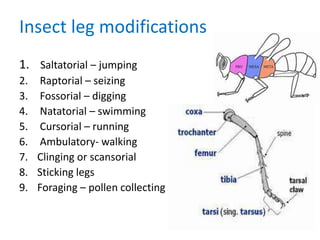
Insect leg modifications
1. Saltatorial – jumping
2. Raptorial – seizing
3. Fossorial – digging
4. Natatorial – swimming
5. Cursorial – running
6. Ambulatory- walking
7. Clinging or scansorial
8. Sticking legs
9. Foraging – pollen collecting
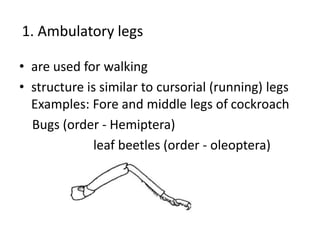
1. Ambulatory legs
• are used for walking
• structure is similar to cursorial (running) legs
Examples: Fore and middle legs of cockroach
Bugs (order - Hemiptera)
leaf beetles (order - oleoptera)
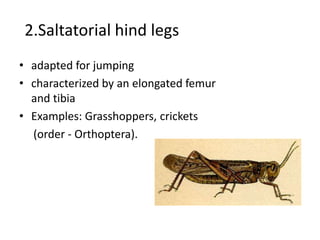
2.Saltatorial hind legs
• adapted for jumping
• characterized by an elongated femur
and tibia
• Examples: Grasshoppers, crickets
(order - Orthoptera).
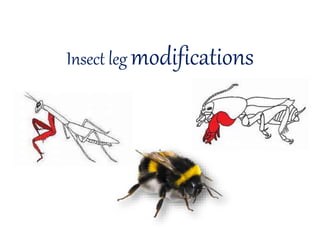
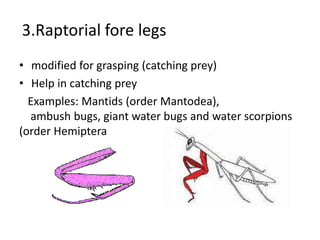
3.Raptorial fore legs
• modified for grasping (catching prey)
• Help in catching prey
Examples: Mantids (order Mantodea),
ambush bugs, giant water bugs and water scorpions
(order Hemiptera
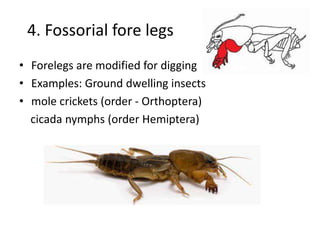
4. Fossorial fore legs
• Forelegs are modified for digging
• Examples: Ground dwelling insects
• mole crickets (order - Orthoptera)
cicada nymphs (order Hemiptera)
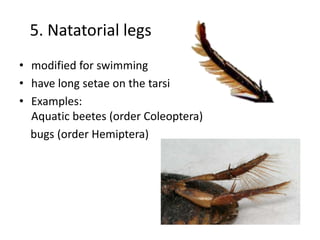
5. Natatorial legs
• modified for swimming
• have long setae on the tarsi
• Examples:
Aquatic beetes (order Coleoptera)
bugs (order Hemiptera)
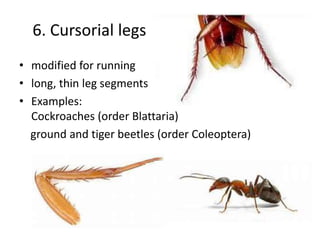
6. Cursorial legs
• modified for running
• long, thin leg segments
• Examples:
Cockroaches (order Blattaria)
ground and tiger beetles (order Coleoptera)
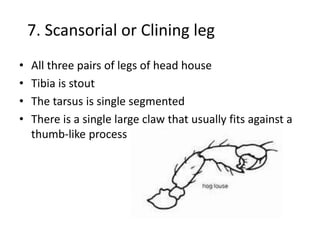
7. Scansorial or Clining leg
• All three pairs of legs of head house
• Tibia is stout
• The tarsus is single segmented
• There is a single large claw that usually fits against a
thumb-like process
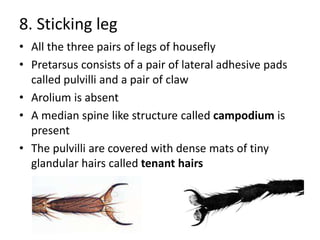
8. Sticking leg
• All the three pairs of legs of housefly
• Pretarsus consists of a pair of lateral adhesive pads
called pulvilli and a pair of claw
• Arolium is absent
• A median spine like structure called campodium is
present
• The pulvilli are covered with dense mats of tiny
glandular hairs called tenant hairs
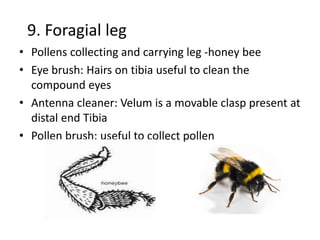
9. Foragial leg
• Pollens collecting and carrying leg -honey bee
• Eye brush: Hairs on tibia useful to clean the
compound eyes
• Antenna cleaner: Velum is a movable clasp present at
distal end Tibia
• Pollen brush: useful to collect pollen

Modifications in Insect leg

  • 1.
  • 2.
    Insect leg modifications 1.Saltatorial – jumping 2. Raptorial – seizing 3. Fossorial – digging 4. Natatorial – swimming 5. Cursorial – running 6. Ambulatory- walking 7. Clinging or scansorial 8. Sticking legs 9. Foraging – pollen collecting
  • 3.
    1. Ambulatory legs •are used for walking • structure is similar to cursorial (running) legs Examples: Fore and middle legs of cockroach Bugs (order - Hemiptera) leaf beetles (order - oleoptera)
  • 4.
    2.Saltatorial hind legs •adapted for jumping • characterized by an elongated femur and tibia • Examples: Grasshoppers, crickets (order - Orthoptera).
  • 5.
    3.Raptorial fore legs •modified for grasping (catching prey) • Help in catching prey Examples: Mantids (order Mantodea), ambush bugs, giant water bugs and water scorpions (order Hemiptera
  • 6.
    4. Fossorial forelegs • Forelegs are modified for digging • Examples: Ground dwelling insects • mole crickets (order - Orthoptera) cicada nymphs (order Hemiptera)
  • 7.
    5. Natatorial legs •modified for swimming • have long setae on the tarsi • Examples: Aquatic beetes (order Coleoptera) bugs (order Hemiptera)
  • 8.
    6. Cursorial legs •modified for running • long, thin leg segments • Examples: Cockroaches (order Blattaria) ground and tiger beetles (order Coleoptera)
  • 9.
    7. Scansorial orClining leg • All three pairs of legs of head house • Tibia is stout • The tarsus is single segmented • There is a single large claw that usually fits against a thumb-like process
  • 10.
    8. Sticking leg •All the three pairs of legs of housefly • Pretarsus consists of a pair of lateral adhesive pads called pulvilli and a pair of claw • Arolium is absent • A median spine like structure called campodium is present • The pulvilli are covered with dense mats of tiny glandular hairs called tenant hairs
  • 11.
    9. Foragial leg •Pollens collecting and carrying leg -honey bee • Eye brush: Hairs on tibia useful to clean the compound eyes • Antenna cleaner: Velum is a movable clasp present at distal end Tibia • Pollen brush: useful to collect pollen