Insect resistance:
occurs when a population of insects builds up a
tolerance to a specific chemical, or group of
chemicals with the same Mode of Action (MoA).
WHO, 1957: “The development of an ability in a strain
of insects to tolerate doses of toxicants which would
prove lethal to the majority of individuals in a normal
population of the same species”
Types of resistance
Single rasistance : Resistance is limited to only one insecticide and
not to the related ones.
 Multiple resistance: resistance to multiple insecticides of different
classes by multiple mechanisms. Consequence of sequential
application of insecticides (Pesticide treadmill) independent
resistance mechanisms, which
 often lead to resistance to chemicals from different families (i.e.,
 organophosphate and carbamate insecticides)
 double/Cross resistance: resistance to one insecticide leads to
resistance to another yet unused insecticide. Usually the two
insecticides belong to the same class and share identical or similar
mode of action.
 It refers to a type of resistance in which a pest population develops
 resistance to more than one pesticide within a chemical family
 (e.g., organophosphate insecticides, etc.).
Types of rasistance
Monogenic : single gene is involved in the development
of resistance.
Polygenic : several genes are involved in the
development of resistance.
Machanism of Resistance
 Genetic factors
• Biological factors
• Operational (application) factors
 Physiological resistance
 Behavioral resistance
Genetic factor
 Occurrence of resistance Genes Present
 Several Number of resistance mechanisms
 Gene frequency high
 Dominance of resistance
 Genes Dominant high
 Fitness of “R” individuals Good
 Cross resistance Positive
 Modifying genes Present
toxin
Detect and avoid the toxin
Anopheles mosquito: SS lives and bites inside home,
but RR remains outdoor and flies into house to bite
because DDT was applied to interior walls
 Houseflies: avoid treated surface
 Cockroaches: avoid treated surface and baits
 Diamondback moth: avoid permethrin
Biological factors that promote
resistance
• Short generation time
• High fecundity
• No (or little) migration occurs between populations
• The species is highly mobile, increasing the possibility
of exposure to insecticides
Physiological resistance
1. Reducedpenetration :
A. Cuticle contains more protein and Lipid. Increased
sclerotization.
B. Binding protein and Lipid reservoir traps
C. insecticide in the cuticle.
D. Slight resistance.
 Target siteinsensitivity
Enhanced detoxification
 Detoxifying Enzymes
a. Hydrolases –Carboxyl Esterase (CarE)
i. Esterase gene amplification
ii. Esterase mutation
b. Mixed fuction oxidases (MFO’s) Cytochrome P450
monoxygenases (P450)
c. Glutathion-S-transferases (GST)
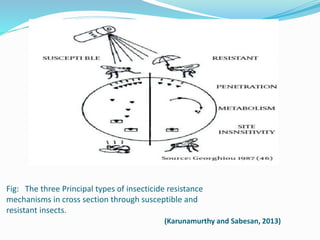
Fig: The three Principal types of insecticide resistance
mechanisms in cross section through susceptible and
resistant insects.
(Karunamurthy and Sabesan, 2013)
Simon 2008
Gour and sridevi
Resistance to Insecticides?
1) consult extension agent for spray recommendations
2) minimize insecticide use by using early-maturing or pest-
tolerant crops
3) use non-chemical techniques first (eg. Biological sprays,
crop rotation, etc.)
4) select insecticides and management tools which preserve
natural enemies
5) use products at their full, recommended doses
6) use well-maintained equipment to achieve full and proper
coverage
7) target younger, more susceptible insect stages
8) use appropriate local economic thresholds and spray
intervals
9) Follow label or extension recommendations on rotating
different classes (MoA’s) of insecticides
10) When multiple applications per year are needed rotate
different MoA’s
11) If control is not achieved do NOT spray the same
insecticide, switch to one with a different MoA
12) Do NOT mix chemicals for use against one target pest
13) Withhold a chemical from use until the population once
again becomes susceptible. Treat with a different MoA
insecticide in the mean time.
14) Use insecticides that are specific to your target pest (eg.
narrow spectrum)
 • Insects multiplying by asexual means
 • Short life cycle of insect
Management of Insecticide
Resistance
 Integrated pest management
• Grow trap crops
• Inundative release of Biological agents
• Swabbing & stem banding
• Judicious use of insecticides (Need based &
Recommendeddose)
• The use of insecticide synergists
• Window system of pesticide application
• Insecticide rotation
 Mixed use of insecticides at low dosage that differ in
 mode of actions. A-resistant individuals can be killed
 by insecticide B and vice visa.
 Combination of cultural, chemical and biological
control tactics
 • Diversifying selection forces and complicating
adaptation
 • Resistance to one tactics can be compensated for by
other tactics
Bt-transgenic crops: high resistance risk
 • Bt-transgenic crops: Bacillus thuringensis (Bt)
 toxin genes (e.g. Cry1Ac) introduced to plants
 • Simplified toxin: one or two Bt toxins in
 plant vs. 5 toxins produced by bacteria
 • Persistent selection: continual production in
 plant vs. sprayed Bt (degraded rapidly)
 • Massive plantations
Ragupathy, et al. 2004,Tamilnadu.)
2DAA1 = 2 days after the first application
(James et al., 2010)

insect resistance

  • 1.
    Insect resistance: occurs whena population of insects builds up a tolerance to a specific chemical, or group of chemicals with the same Mode of Action (MoA). WHO, 1957: “The development of an ability in a strain of insects to tolerate doses of toxicants which would prove lethal to the majority of individuals in a normal population of the same species”
  • 2.
    Types of resistance Singlerasistance : Resistance is limited to only one insecticide and not to the related ones.  Multiple resistance: resistance to multiple insecticides of different classes by multiple mechanisms. Consequence of sequential application of insecticides (Pesticide treadmill) independent resistance mechanisms, which  often lead to resistance to chemicals from different families (i.e.,  organophosphate and carbamate insecticides)  double/Cross resistance: resistance to one insecticide leads to resistance to another yet unused insecticide. Usually the two insecticides belong to the same class and share identical or similar mode of action.  It refers to a type of resistance in which a pest population develops  resistance to more than one pesticide within a chemical family  (e.g., organophosphate insecticides, etc.).
  • 3.
    Types of rasistance Monogenic: single gene is involved in the development of resistance. Polygenic : several genes are involved in the development of resistance.
  • 4.
    Machanism of Resistance Genetic factors • Biological factors • Operational (application) factors  Physiological resistance  Behavioral resistance
  • 5.
    Genetic factor  Occurrenceof resistance Genes Present  Several Number of resistance mechanisms  Gene frequency high  Dominance of resistance  Genes Dominant high  Fitness of “R” individuals Good  Cross resistance Positive  Modifying genes Present
  • 6.
    toxin Detect and avoidthe toxin Anopheles mosquito: SS lives and bites inside home, but RR remains outdoor and flies into house to bite because DDT was applied to interior walls  Houseflies: avoid treated surface  Cockroaches: avoid treated surface and baits  Diamondback moth: avoid permethrin
  • 8.
    Biological factors thatpromote resistance • Short generation time • High fecundity • No (or little) migration occurs between populations • The species is highly mobile, increasing the possibility of exposure to insecticides
  • 9.
    Physiological resistance 1. Reducedpenetration: A. Cuticle contains more protein and Lipid. Increased sclerotization. B. Binding protein and Lipid reservoir traps C. insecticide in the cuticle. D. Slight resistance.  Target siteinsensitivity
  • 10.
    Enhanced detoxification  DetoxifyingEnzymes a. Hydrolases –Carboxyl Esterase (CarE) i. Esterase gene amplification ii. Esterase mutation b. Mixed fuction oxidases (MFO’s) Cytochrome P450 monoxygenases (P450) c. Glutathion-S-transferases (GST)
  • 11.
    Fig: The threePrincipal types of insecticide resistance mechanisms in cross section through susceptible and resistant insects. (Karunamurthy and Sabesan, 2013)
  • 13.
  • 14.
  • 15.
    Resistance to Insecticides? 1)consult extension agent for spray recommendations 2) minimize insecticide use by using early-maturing or pest- tolerant crops 3) use non-chemical techniques first (eg. Biological sprays, crop rotation, etc.) 4) select insecticides and management tools which preserve natural enemies 5) use products at their full, recommended doses 6) use well-maintained equipment to achieve full and proper coverage 7) target younger, more susceptible insect stages
  • 16.
    8) use appropriatelocal economic thresholds and spray intervals 9) Follow label or extension recommendations on rotating different classes (MoA’s) of insecticides 10) When multiple applications per year are needed rotate different MoA’s 11) If control is not achieved do NOT spray the same insecticide, switch to one with a different MoA 12) Do NOT mix chemicals for use against one target pest 13) Withhold a chemical from use until the population once again becomes susceptible. Treat with a different MoA insecticide in the mean time. 14) Use insecticides that are specific to your target pest (eg. narrow spectrum)  • Insects multiplying by asexual means  • Short life cycle of insect
  • 17.
    Management of Insecticide Resistance Integrated pest management • Grow trap crops • Inundative release of Biological agents • Swabbing & stem banding • Judicious use of insecticides (Need based & Recommendeddose) • The use of insecticide synergists • Window system of pesticide application • Insecticide rotation
  • 18.
     Mixed useof insecticides at low dosage that differ in  mode of actions. A-resistant individuals can be killed  by insecticide B and vice visa.  Combination of cultural, chemical and biological control tactics  • Diversifying selection forces and complicating adaptation  • Resistance to one tactics can be compensated for by other tactics
  • 19.
    Bt-transgenic crops: highresistance risk  • Bt-transgenic crops: Bacillus thuringensis (Bt)  toxin genes (e.g. Cry1Ac) introduced to plants  • Simplified toxin: one or two Bt toxins in  plant vs. 5 toxins produced by bacteria  • Persistent selection: continual production in  plant vs. sprayed Bt (degraded rapidly)  • Massive plantations
  • 20.
    Ragupathy, et al.2004,Tamilnadu.)
  • 22.
    2DAA1 = 2days after the first application (James et al., 2010)