





What is input and intake?
What language becomes intake?
How can teachers help input become intake?
What is noticing and attention?
How can intake be used?


All the language available in the environment
◦ The language you see and hear



Imagine walking through a crowded train
station: What input is available?
◦
◦
◦
◦

Signs in Japanese and English
Posters with Japanese and English
Random bits of conversations
Announcements in Japanese and English



Language that is internalized (taken in)
What language becomes intake?
◦ Not all input becomes intake
◦ Must notice and attend to the language


Language must be at an appropriate level
◦ Not too easy
 Doesn’t offer new language for learning
 Won’t push learner to alter knowledge

◦ Not too difficult
 Overwhelm the learner with too much



Language that is frequent
Language that is infrequent
◦ Noticed because it is rare




Meaning comes first
Process content words first
Rely on meaning over grammar
◦
◦
◦
◦

8 o’clock / go home / important

I have to go home by 8 o’clock without fail.

Give / homework / tomorrow

I’ll give you my homework tomorrow.




How can teachers and native speakers help
learners?
Pronunciation
◦ Slower & louder
◦ Longer pauses
◦ Fewer contractions (I’m, we’ll, can’t, etc.)



Vocabulary
◦ Simpler & more frequent


Grammar
◦ Repetition & restatement
◦ New information at the beginning of sentences



Discourse
◦ Frequent questions
◦ Corrections


How does it help?
◦ Helps the comprehension of meaning more than
understanding of grammar


Noticing
◦ Become aware of something in the language



Attention
◦ Use mental effort to understand something in the
language
◦ Paying attention to language



Noticing comes first, then attention




Without attention, learning won’t happen
(Schmidt,1990)
Learners must be able to see the needed
changes
◦ Under the auspicious of the U.N., the collected
organizations responsible for drawing up
regulations for the new treaty, were heatedly
discussing the countries’ new borders when the
chairperson called for a review of the procedures.
◦ I was taking a bath when the telephone rang.
1.
2.

3.
4.
5.
6.

7.
8.
9.
10.
11.

The children laughed ____ the new boy’s accent.
The students looked ____ their teacher.
You shouldn’t point ____ people.
The police shot ____ the suspect.
I was happy because she smiled ____ me.
I’ll speak ____ you tomorrow.
Would you talk ____ your mother about it?
The actors waved ____ the audience.
My sister will write ____ you next week.
Please throw the ball ____ me so that I can catch it.
When the pitcher threw the ball ____ the batter, the
batter got angry.
1.
2.

3.
4.
5.
6.

7.
8.
9.
10.
11.

The children laughed at the new boy.
The students looked at their teacher.
You shouldn’t point at people.
The police shot at the suspect.
I was happy because she smiled at me.
I’ll speak to you tomorrow.
Would you talk to your mother about it?
The actors waved at the audience.
My sister will write to you next week.
Please throw the ball to me so that I can catch it.
When the pitcher threw the ball at the batter, the
batter got angry.




Noticing and paying attention to differences
can lead to changes in the learners
knowledge
Attention allows learners to notice
mismatches between
◦ What they know about a second language
◦ How native speakers express themselves


Reject a current hypothesis
◦ What a learner hears tells her that her rule is right
or wrong



Confirms a current hypothesis
◦ Strengthens the rule
◦ Helps make it automatic


Storage: Knowledge is stored but
◦ It is not used
◦ It is not analyzed
◦ It might be used or analyzed later



Intake is not understood and is not used
◦ Meaning was too difficult
◦ Grammar was too difficult






What is input and intake?
What language becomes intake?
How can teachers help input become intake?
What is noticing and attention?
How can intake be used?

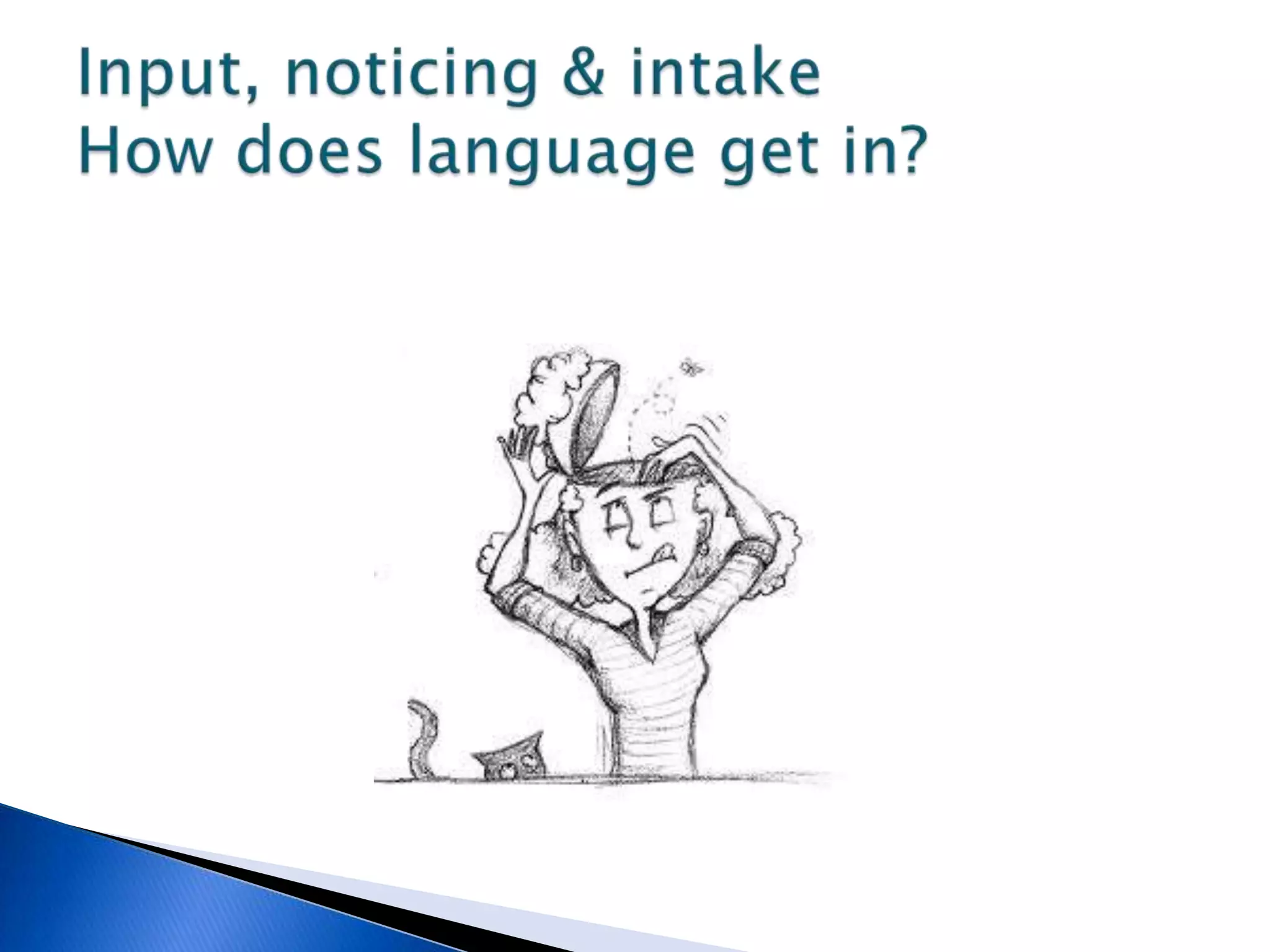
Input, noticing & intake

  • 2.
         What is inputand intake? What language becomes intake? How can teachers help input become intake? What is noticing and attention? How can intake be used?
  • 3.
     All the languageavailable in the environment ◦ The language you see and hear  Imagine walking through a crowded train station: What input is available? ◦ ◦ ◦ ◦ Signs in Japanese and English Posters with Japanese and English Random bits of conversations Announcements in Japanese and English
  • 4.
      Language that isinternalized (taken in) What language becomes intake? ◦ Not all input becomes intake ◦ Must notice and attend to the language
  • 5.
     Language must beat an appropriate level ◦ Not too easy  Doesn’t offer new language for learning  Won’t push learner to alter knowledge ◦ Not too difficult  Overwhelm the learner with too much   Language that is frequent Language that is infrequent ◦ Noticed because it is rare
  • 6.
       Meaning comes first Processcontent words first Rely on meaning over grammar ◦ ◦ ◦ ◦ 8 o’clock / go home / important I have to go home by 8 o’clock without fail. Give / homework / tomorrow I’ll give you my homework tomorrow.
  • 7.
      How can teachersand native speakers help learners? Pronunciation ◦ Slower & louder ◦ Longer pauses ◦ Fewer contractions (I’m, we’ll, can’t, etc.)  Vocabulary ◦ Simpler & more frequent
  • 8.
     Grammar ◦ Repetition &restatement ◦ New information at the beginning of sentences  Discourse ◦ Frequent questions ◦ Corrections
  • 9.
     How does ithelp? ◦ Helps the comprehension of meaning more than understanding of grammar
  • 10.
     Noticing ◦ Become awareof something in the language  Attention ◦ Use mental effort to understand something in the language ◦ Paying attention to language  Noticing comes first, then attention
  • 11.
      Without attention, learningwon’t happen (Schmidt,1990) Learners must be able to see the needed changes ◦ Under the auspicious of the U.N., the collected organizations responsible for drawing up regulations for the new treaty, were heatedly discussing the countries’ new borders when the chairperson called for a review of the procedures. ◦ I was taking a bath when the telephone rang.
  • 12.
    1. 2. 3. 4. 5. 6. 7. 8. 9. 10. 11. The children laughed____ the new boy’s accent. The students looked ____ their teacher. You shouldn’t point ____ people. The police shot ____ the suspect. I was happy because she smiled ____ me. I’ll speak ____ you tomorrow. Would you talk ____ your mother about it? The actors waved ____ the audience. My sister will write ____ you next week. Please throw the ball ____ me so that I can catch it. When the pitcher threw the ball ____ the batter, the batter got angry.
  • 13.
    1. 2. 3. 4. 5. 6. 7. 8. 9. 10. 11. The children laughedat the new boy. The students looked at their teacher. You shouldn’t point at people. The police shot at the suspect. I was happy because she smiled at me. I’ll speak to you tomorrow. Would you talk to your mother about it? The actors waved at the audience. My sister will write to you next week. Please throw the ball to me so that I can catch it. When the pitcher threw the ball at the batter, the batter got angry.
  • 14.
      Noticing and payingattention to differences can lead to changes in the learners knowledge Attention allows learners to notice mismatches between ◦ What they know about a second language ◦ How native speakers express themselves
  • 15.
     Reject a currenthypothesis ◦ What a learner hears tells her that her rule is right or wrong  Confirms a current hypothesis ◦ Strengthens the rule ◦ Helps make it automatic
  • 16.
     Storage: Knowledge isstored but ◦ It is not used ◦ It is not analyzed ◦ It might be used or analyzed later  Intake is not understood and is not used ◦ Meaning was too difficult ◦ Grammar was too difficult
  • 17.
         What is inputand intake? What language becomes intake? How can teachers help input become intake? What is noticing and attention? How can intake be used?

Editor's Notes

  • #5 Imagine a party where people are talking in pairs or small groups. You are talking to a friend and in the background you hear a murmur of voices. You are not paying attention to those voices until you hear your name from somewhere else in the room.
  • #6 Sleeping in class
  • #7 In listening, language must be processed faster than in reading. And as a result, you probably don’t notice any or few of the grammar features that I use. You focus on understanding the content, mostly vocabulary. Powerpoint presentations help your understanding by making key points and ideas available for a longer period.
  • #8 perceive > noticeaccelerate > go faster
  • #9 Use depends on how the NS perceives the NNS’s proficiency
  • #11 Noticing: new word, grammar feature, expression, etc.Noticing comes first, but for our purposes they occur togetherCan listening to a song or watching a movie lead to intake
  • #12 What is the grammar feature illustrated by the first example? Second example?
  • #14 Words that you don’t understand, can make this more difficult. You may not see the grammar feature (which verbs use the preposition “to”)