If you want to learn a new Language,
what is the FIRST thing you are going
to do?!!
Of course NOT,
the right thing is
CONTINUE :
White & Evans (2005) defined listening
as the ability to identify and understand
what others are saying, this involves
understanding a speaker’s accent or
pronunciation, grammar, vocabulary
and grasping the meaning.
• Anderson & Lynch (1988) mentioned that:
• Listening is the key to all affective
communication without the ability to
listen effectively, messages are easily
misunderstood- communication breaks
down and the sender of the message can
easily become frustrated or irritated.
CONTINUE:
• Listening helps students to acquire
language subconsciously.
• Students hear different accents and
varieties.
• Listening is receptive skill.
Learners problem
• Ur (1996) said that there are 6 problems that
face the students; they are:
1) Trouble with sounds.
2) Have to understand every word.
3) Can’t understand fast, natural native speech.
4) Need to hear things more than once.
5) Find it difficult to keep up.
6) Get tired.
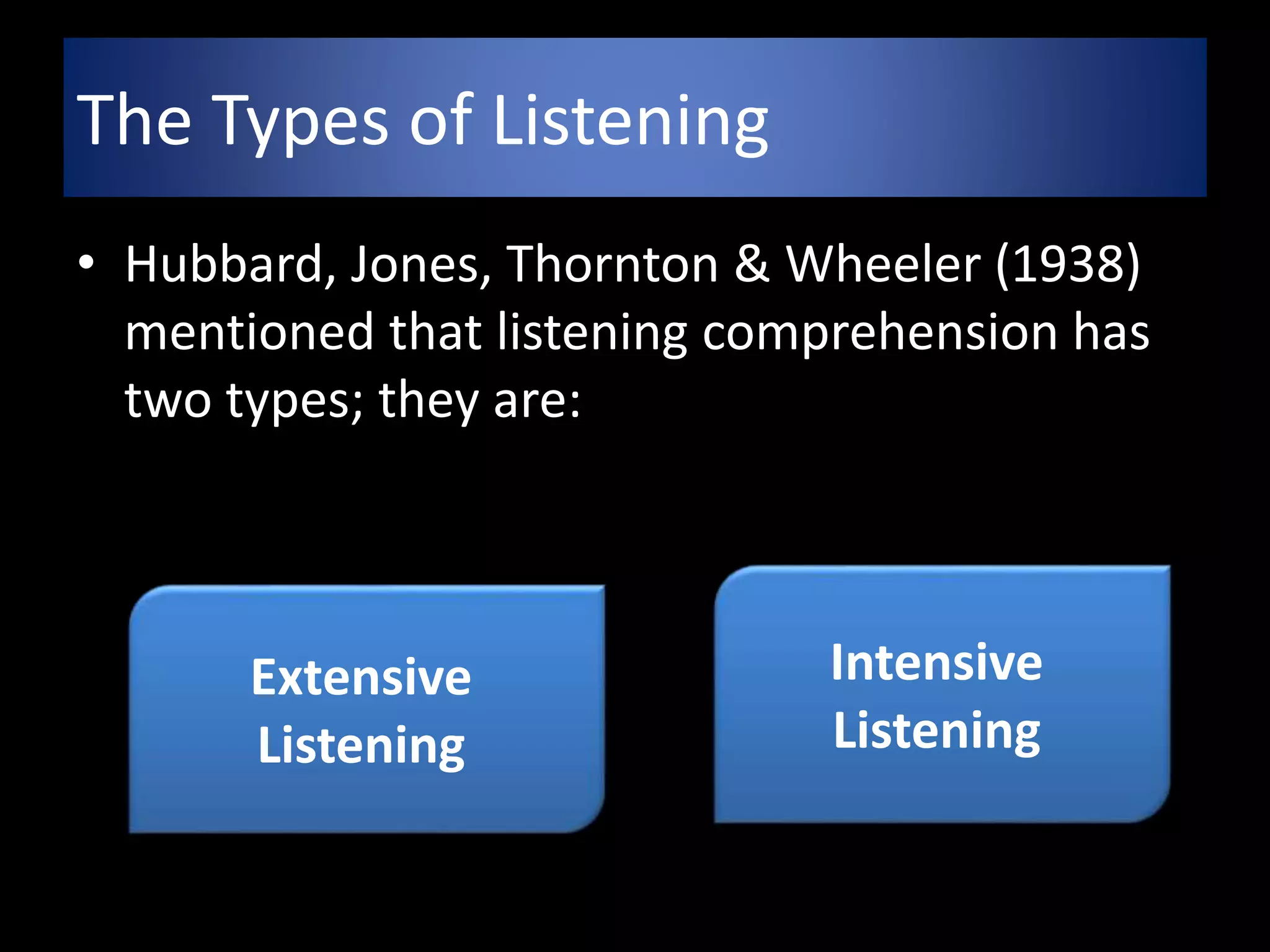
The Types of Listening
• Hubbard, Jones, Thornton & Wheeler (1938)
mentioned that listening comprehension has
two types; they are:
Intensive
Listening
Extensive
Listening
CONTINUE:
Extensive Listening
• Usually takes place outside the classroom: in
the students’ home, car or on personal MP3
players as they travel from one place to another.
Material for extensive listening can be taken
from a number of sources like books with CDs,
some writers start doing that nowadays, as they
listen & read, at the same time they will be
happy.
CONTINUE:
Intensive Listening
• Is opposite of extensive listening, here
students listen to authentic materials that
improve their communication with others
and they listen to variety of voices and
situations.
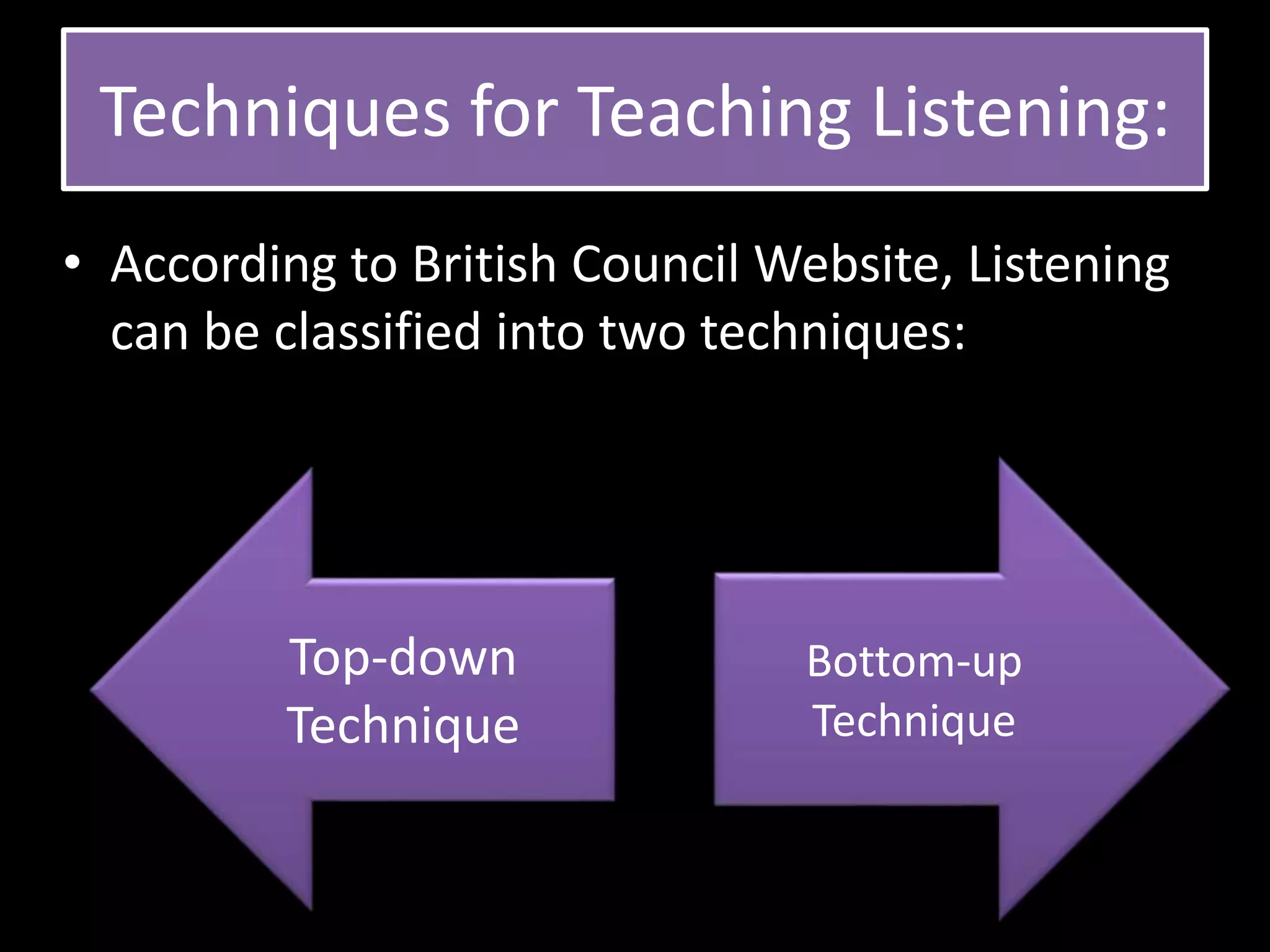
Techniques for Teaching Listening:
• According to British Council Website, Listening
can be classified into two techniques:
Top-down
Technique
Bottom-up
Technique
CONTINUE:
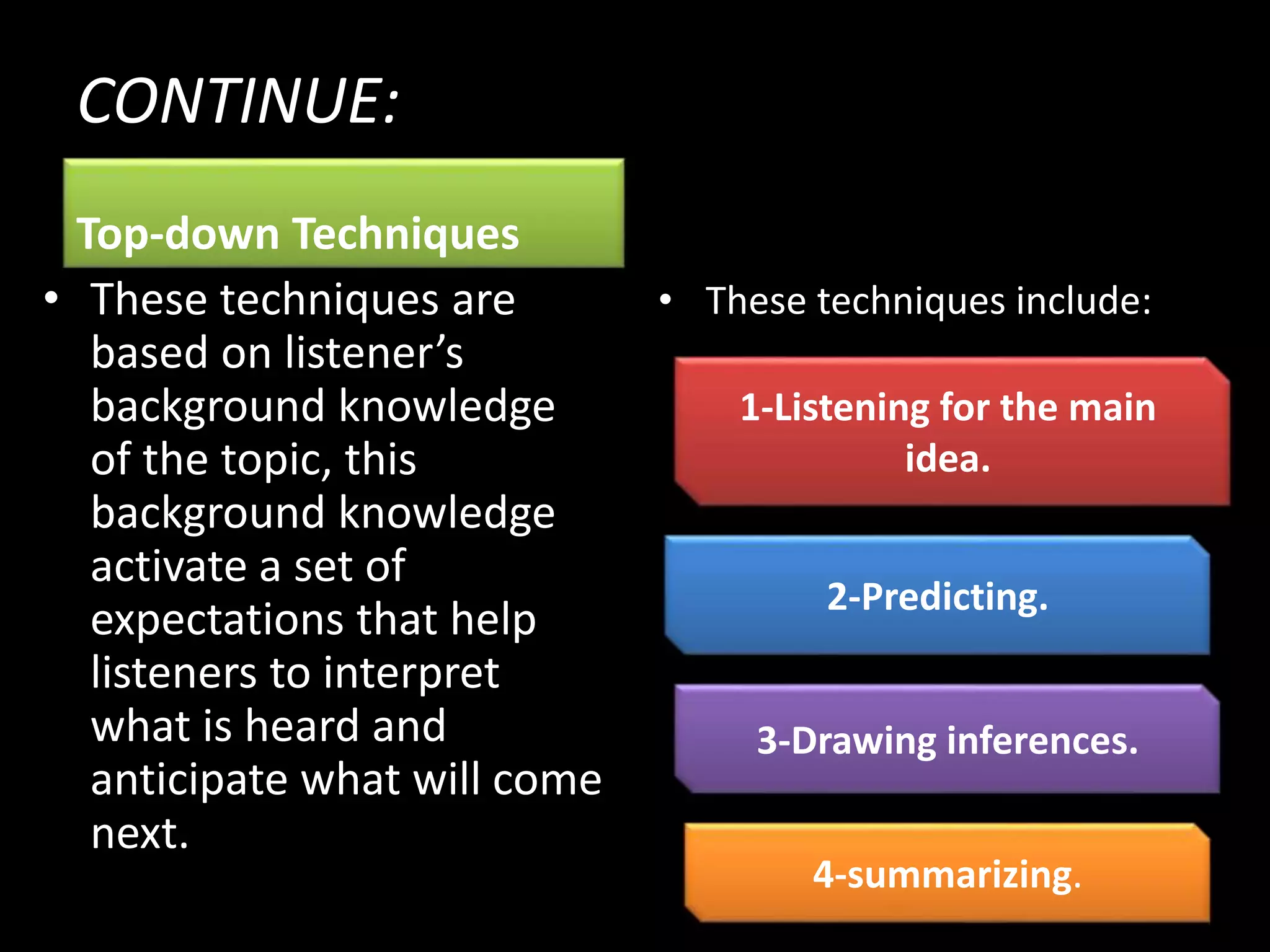
Top-down Techniques
• These techniques are
based on listener’s
background knowledge
of the topic, this
background knowledge
activate a set of
expectations that help
listeners to interpret
what is heard and
anticipate what will come
next.
• These techniques include:
1-Listening for the main
idea.
2-Predicting.
3-Drawing inferences.
4-summarizing.
CONTINUE:
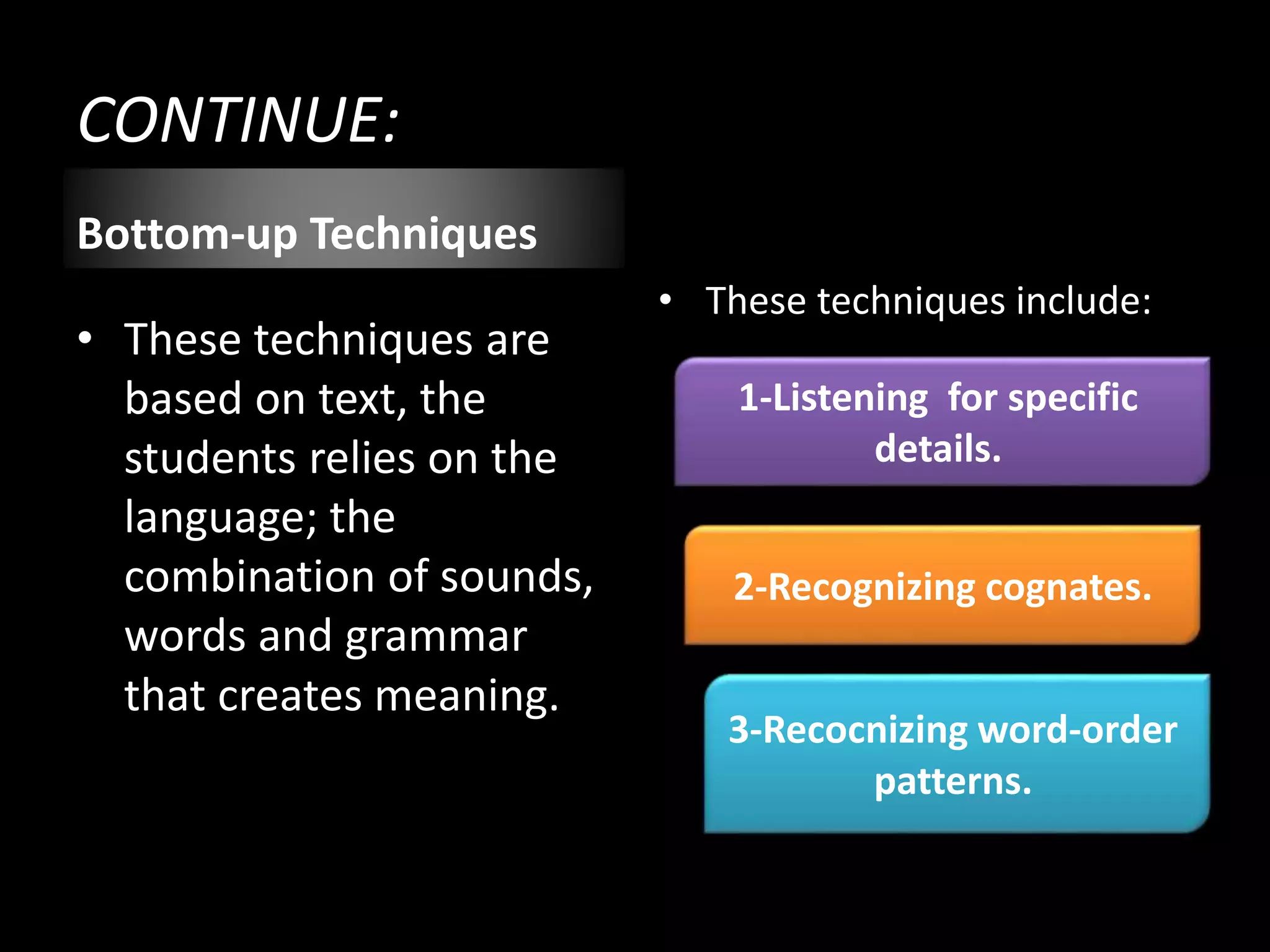
Bottom-up Techniques
• These techniques are
based on text, the
students relies on the
language; the
combination of sounds,
words and grammar
that creates meaning.
• These techniques include:
1-Listening for specific
details.
2-Recognizing cognates.
3-Recocnizing word-order
patterns.
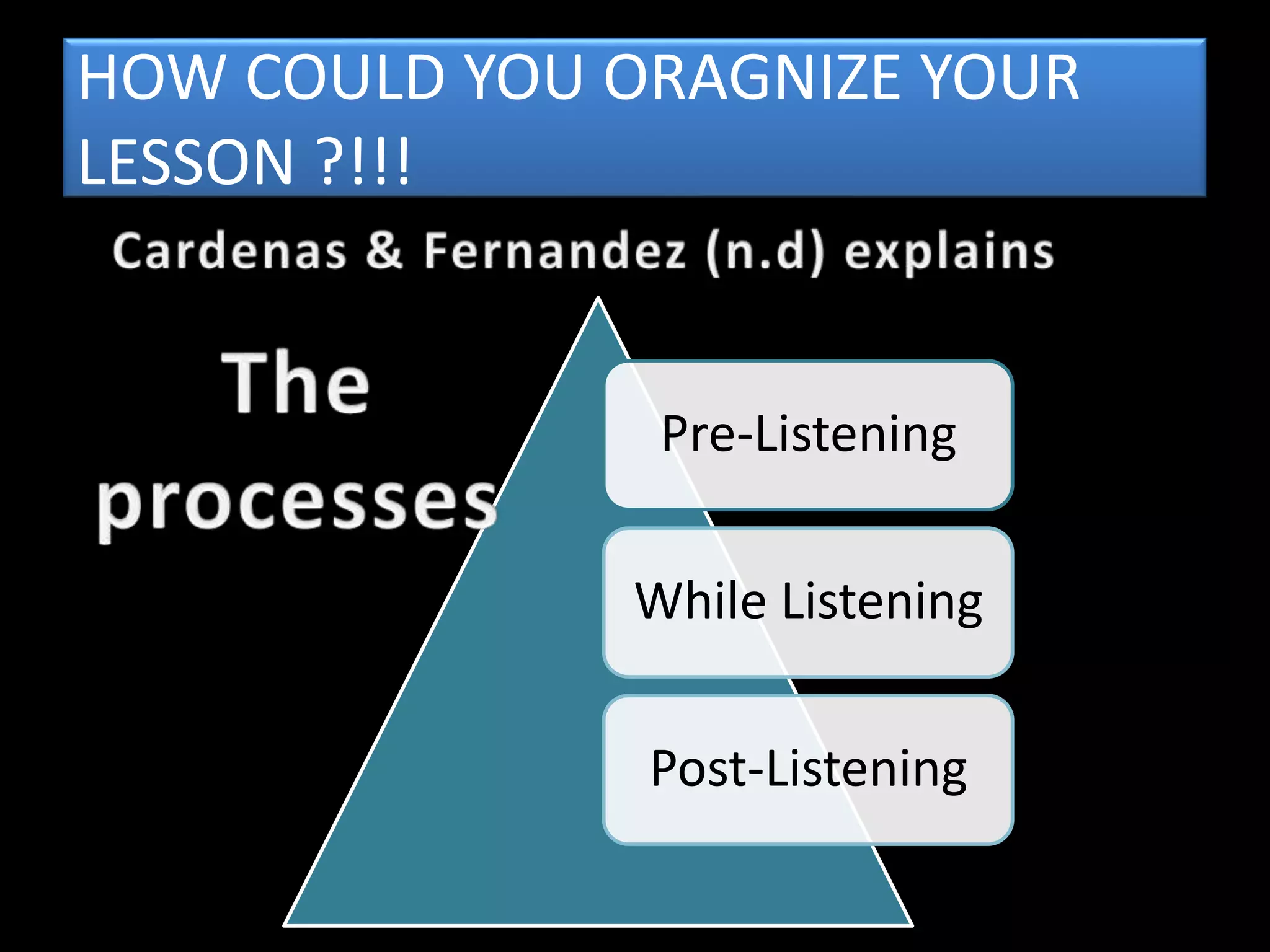
HOW COULD YOU ORAGNIZE YOUR
LESSON ?!!!
Pre-Listening
While Listening
Post-Listening
Pre-Listening:
• During Pre-Listening phase, teacher needs to
recognize that all students bring different
background to the listening experience.
• Beliefs, attitudes and biases of listeners will
affect the understanding of the message.
Continue:
• There are some strategies that teachers and
students use to prepare for listening
experience; they are:
• Activate existing knowledge.
• Build prior knowledge.
• Use a listening guide.
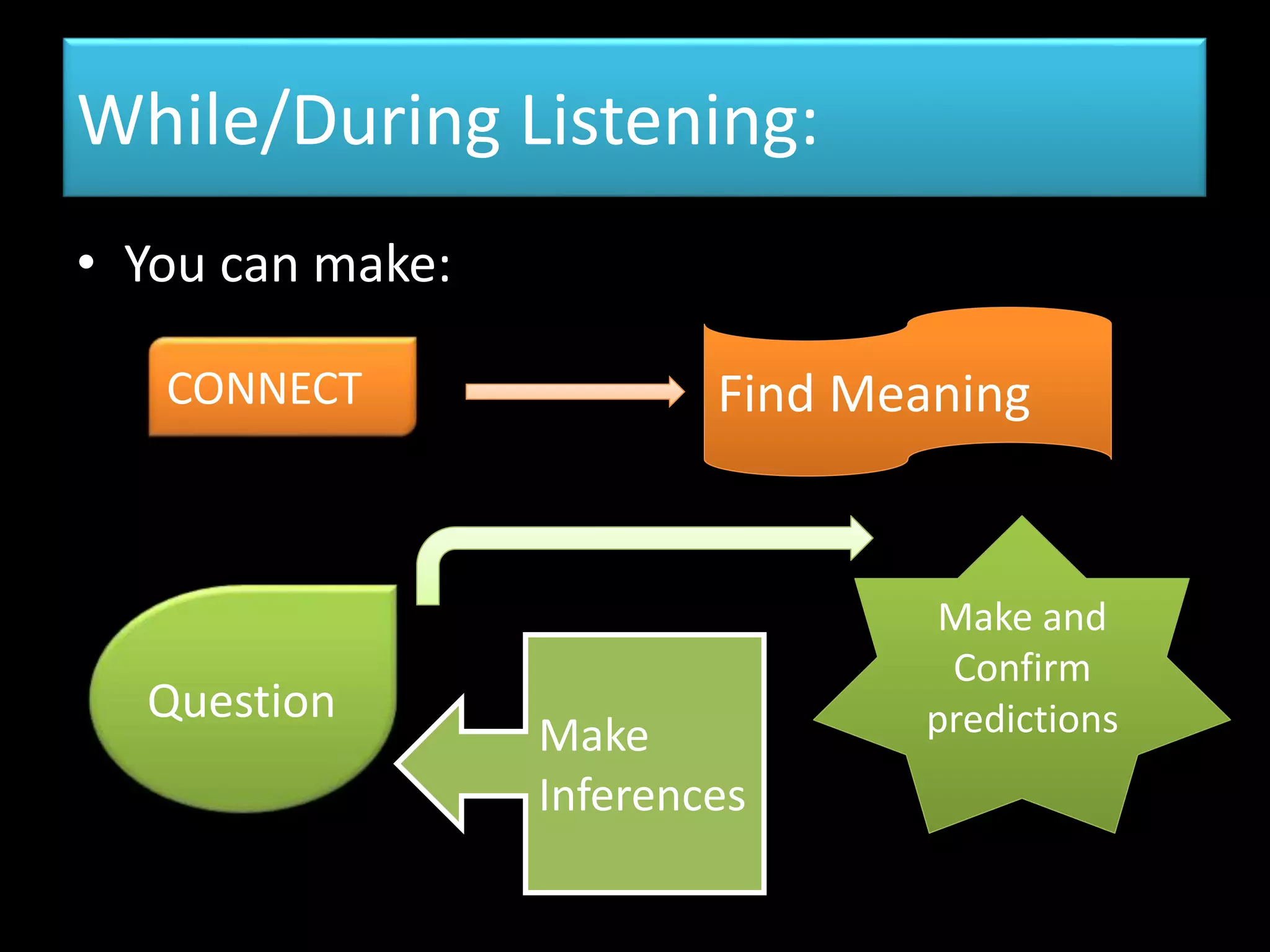
While/During Listening:
• You can make:
CONNECT Find Meaning
Question
Make and
Confirm
predictionsMake
Inferences
Post-Listening:
• You can:
• Encourage debates between students.
• Compare their notes in small groups.
• Ask them to write a summary of the main
points.
• Make a list of any new vocabulary.
Principles For Teaching Listening:
• Brown (2007) said these principles should help
the teacher to create his/her techniques; they
are:
• Use techniques that are intrinsically motivating.
• Use authentic language and context.
• Encourage the development of speaking
strategies.
• Include both bottom-up and top-down listening
techniques.
CONTINUE:
• (Harmer, 1998)
• “1- preparation is vital.
• 2- once is not enough.
• 3- students should encourage to respond to
the content of a listening, not just to the
language.
• 4- different listening stages demand different
listening tasks.” (p.100)
The Materials of Listening
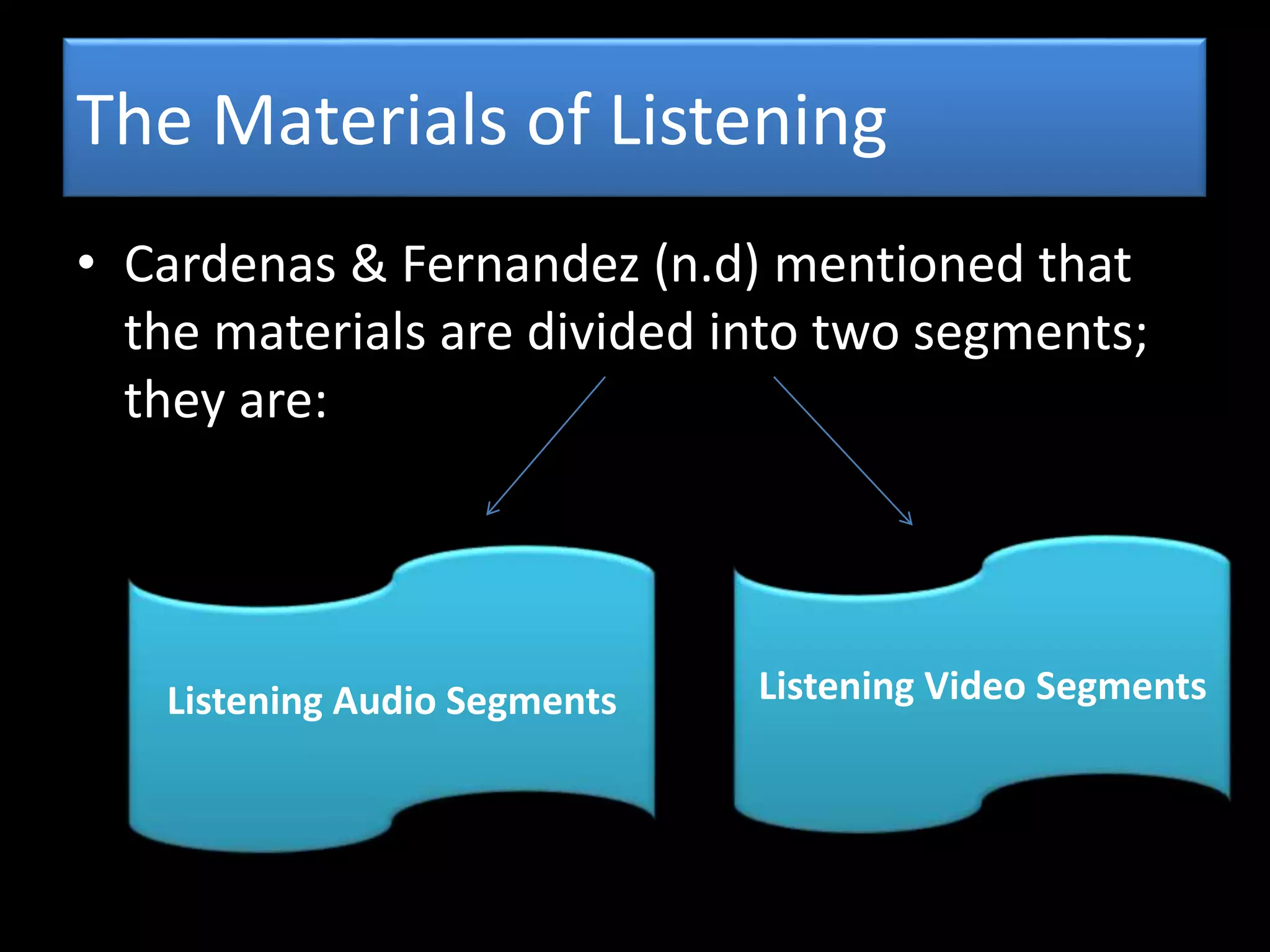
• Cardenas & Fernandez (n.d) mentioned that
the materials are divided into two segments;
they are:
Listening Video SegmentsListening Audio Segments
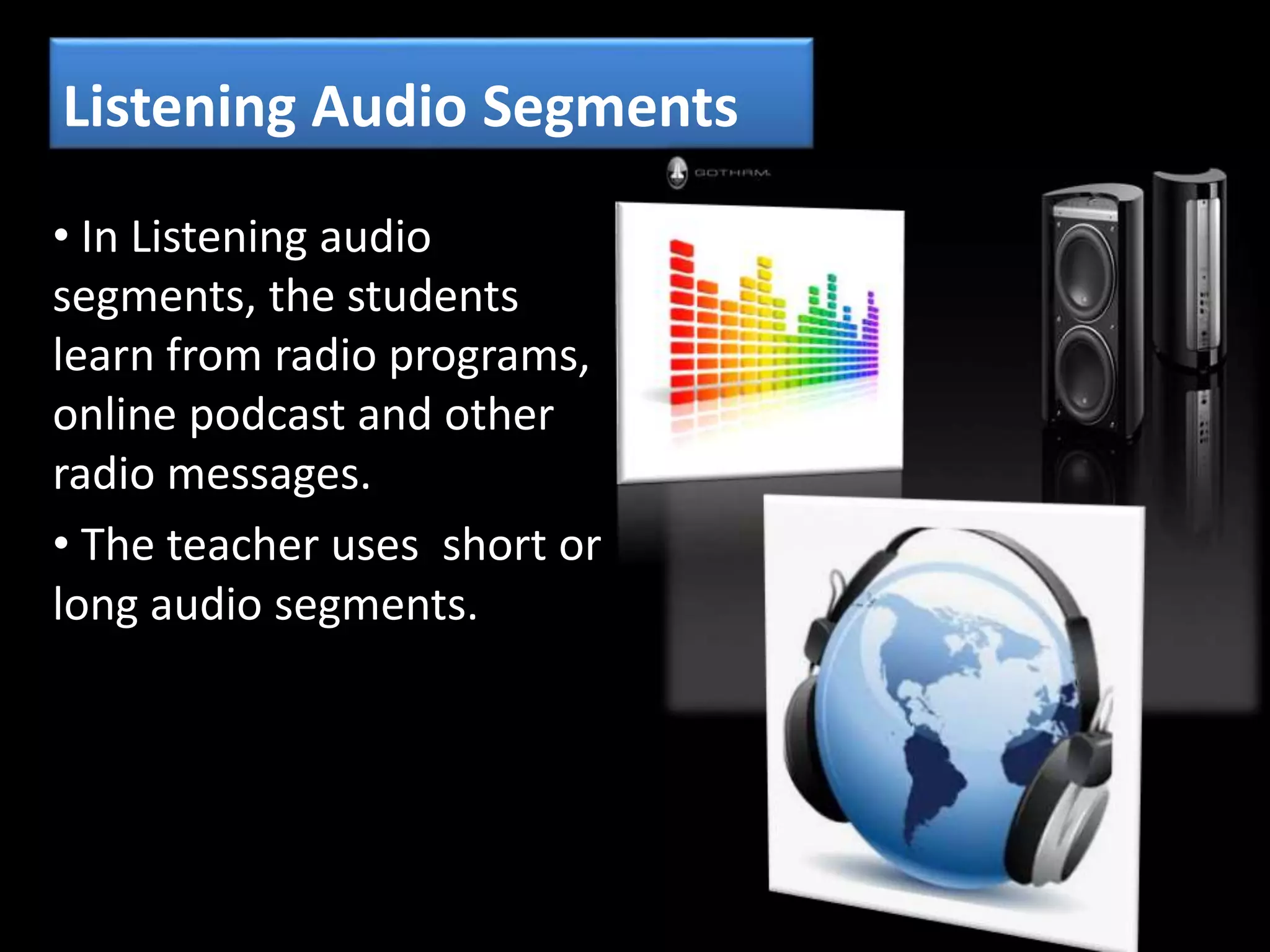
Listening Audio Segments
• In Listening audio
segments, the students
learn from radio programs,
online podcast and other
radio messages.
• The teacher uses short or
long audio segments.
Listening Video Segments
• It is another helpful
resource for teaching
listening; including: short
sketches, news programs,
documentary films,
interview segments,
dramatic and comedic
material.
• The teacher selects the
portion and length of the
video segment based on
the level of the students.
Successful Listening Activity
• Anderson & Lynch (1998) indicated that there are FIVE
ideas to make the best listening activities ever !!
1) Reduce distractions and noise during the listening
segment.
2) Make sure the equipment produces acceptable sound
equality.
3) Read and play the text 2-3 times.
4) Play a video clip with sound off and ask students to
make predictions about it.
5) Give students a listening task to do between classes.
Goals of Listening
• After knowing all these information we can
distinguish the aims of listening
comprehension, they are:
• To develop students’ awareness of the world.
• To allow students to practice by using
authentic listening tasks.
• To build students comprehension.
Application Time

How to teach listening2

  • 2.
    If you wantto learn a new Language, what is the FIRST thing you are going to do?!!
  • 3.
    Of course NOT, theright thing is
  • 4.
    CONTINUE : White &Evans (2005) defined listening as the ability to identify and understand what others are saying, this involves understanding a speaker’s accent or pronunciation, grammar, vocabulary and grasping the meaning.
  • 6.
    • Anderson &Lynch (1988) mentioned that: • Listening is the key to all affective communication without the ability to listen effectively, messages are easily misunderstood- communication breaks down and the sender of the message can easily become frustrated or irritated.
  • 7.
    CONTINUE: • Listening helpsstudents to acquire language subconsciously. • Students hear different accents and varieties. • Listening is receptive skill.
  • 8.
    Learners problem • Ur(1996) said that there are 6 problems that face the students; they are: 1) Trouble with sounds. 2) Have to understand every word. 3) Can’t understand fast, natural native speech. 4) Need to hear things more than once. 5) Find it difficult to keep up. 6) Get tired.
  • 9.
    The Types ofListening • Hubbard, Jones, Thornton & Wheeler (1938) mentioned that listening comprehension has two types; they are: Intensive Listening Extensive Listening
  • 10.
    CONTINUE: Extensive Listening • Usuallytakes place outside the classroom: in the students’ home, car or on personal MP3 players as they travel from one place to another. Material for extensive listening can be taken from a number of sources like books with CDs, some writers start doing that nowadays, as they listen & read, at the same time they will be happy.
  • 11.
    CONTINUE: Intensive Listening • Isopposite of extensive listening, here students listen to authentic materials that improve their communication with others and they listen to variety of voices and situations.
  • 12.
    Techniques for TeachingListening: • According to British Council Website, Listening can be classified into two techniques: Top-down Technique Bottom-up Technique
  • 13.
    CONTINUE: Top-down Techniques • Thesetechniques are based on listener’s background knowledge of the topic, this background knowledge activate a set of expectations that help listeners to interpret what is heard and anticipate what will come next. • These techniques include: 1-Listening for the main idea. 2-Predicting. 3-Drawing inferences. 4-summarizing.
  • 14.
    CONTINUE: Bottom-up Techniques • Thesetechniques are based on text, the students relies on the language; the combination of sounds, words and grammar that creates meaning. • These techniques include: 1-Listening for specific details. 2-Recognizing cognates. 3-Recocnizing word-order patterns.
  • 15.
    HOW COULD YOUORAGNIZE YOUR LESSON ?!!! Pre-Listening While Listening Post-Listening
  • 16.
    Pre-Listening: • During Pre-Listeningphase, teacher needs to recognize that all students bring different background to the listening experience. • Beliefs, attitudes and biases of listeners will affect the understanding of the message.
  • 17.
    Continue: • There aresome strategies that teachers and students use to prepare for listening experience; they are: • Activate existing knowledge. • Build prior knowledge. • Use a listening guide.
  • 18.
    While/During Listening: • Youcan make: CONNECT Find Meaning Question Make and Confirm predictionsMake Inferences
  • 19.
    Post-Listening: • You can: •Encourage debates between students. • Compare their notes in small groups. • Ask them to write a summary of the main points. • Make a list of any new vocabulary.
  • 20.
    Principles For TeachingListening: • Brown (2007) said these principles should help the teacher to create his/her techniques; they are: • Use techniques that are intrinsically motivating. • Use authentic language and context. • Encourage the development of speaking strategies. • Include both bottom-up and top-down listening techniques.
  • 21.
    CONTINUE: • (Harmer, 1998) •“1- preparation is vital. • 2- once is not enough. • 3- students should encourage to respond to the content of a listening, not just to the language. • 4- different listening stages demand different listening tasks.” (p.100)
  • 22.
    The Materials ofListening • Cardenas & Fernandez (n.d) mentioned that the materials are divided into two segments; they are: Listening Video SegmentsListening Audio Segments
  • 23.
    Listening Audio Segments •In Listening audio segments, the students learn from radio programs, online podcast and other radio messages. • The teacher uses short or long audio segments.
  • 24.
    Listening Video Segments •It is another helpful resource for teaching listening; including: short sketches, news programs, documentary films, interview segments, dramatic and comedic material. • The teacher selects the portion and length of the video segment based on the level of the students.
  • 25.
    Successful Listening Activity •Anderson & Lynch (1998) indicated that there are FIVE ideas to make the best listening activities ever !! 1) Reduce distractions and noise during the listening segment. 2) Make sure the equipment produces acceptable sound equality. 3) Read and play the text 2-3 times. 4) Play a video clip with sound off and ask students to make predictions about it. 5) Give students a listening task to do between classes.
  • 26.
    Goals of Listening •After knowing all these information we can distinguish the aims of listening comprehension, they are: • To develop students’ awareness of the world. • To allow students to practice by using authentic listening tasks. • To build students comprehension.
  • 29.