SHOCK
DEFINITION
• Profound hemodyamic and metabolic
disturbance characterized by failure of the
circulatory system to maintain adequate
perfusion of vital organs
Types of Shock
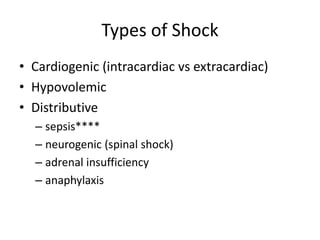
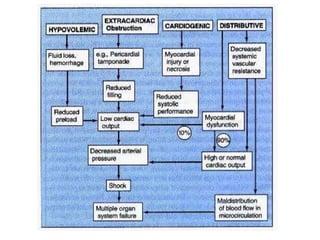
• Cardiogenic (intracardiac vs extracardiac)
• Hypovolemic
• Distributive
– sepsis****
– neurogenic (spinal shock)
– adrenal insufficiency
– anaphylaxis
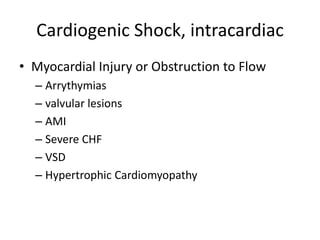
Cardiogenic Shock, intracardiac
• Myocardial Injury or Obstruction to Flow
– Arrythymias
– valvular lesions
– AMI
– Severe CHF
– VSD
– Hypertrophic Cardiomyopathy
Presentation of Cardiogenic Shock
• Pulmonary Edema
• JVD
• hypotensive
• weak pulses
• oliguria
Cardiogenic Shock, extracardiac
(Obstructive)
• Pulmonary Embolism
• Cardiac Tamponade
• Tension Pneumothorax
• Presentation will be according to underlying
disease process.
Hypovolemic Shock
• Reduced circulating blood volume with
secondary decreased cardiac output
– Acute hemorrhage
– Vomiting/Diarrhea
– Dehydration
– Burns
– Peritonitis/Pancreatitis
Presentation of Hypovolemic Shock
• Hypotensive
• flat neck veins
• clear lungs
• cool, cyanotic extremities
• evidence of bleeding?
– Anticoagulant use
– trauma, bruising
• oliguria
Distributive Shock
• Peripheral Vasodilation secondary to disruption
of cellular metabolism by the effects of
inflammatory mediators.
• Gram negative or other overwhelming
infection.
• Results in decreased Peripheral Vascular
Resistance.
Distributive Shock: Presentation
• Febrile
• Tachycardic
• clear lungs, evidence of pneumonia
• warm extremities
• flat neck veins
• oliguria
Diagnosing Shock
• Response to fluids
• Echo/EKG
• CXR
• Evidence of infection
• Swan-Ganz Catheter?
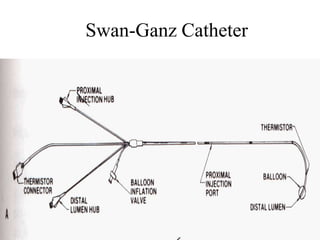
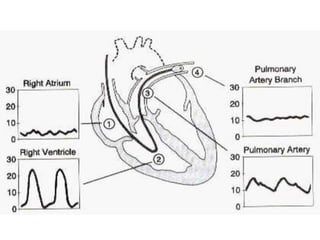
Swan-Ganz Catheter
• Utilized to differentiate types of shock and
assist in treatment response.
• Probably overused by physicians. Studies
documenting increased mortality in patients
with catheters versus no catheters, although
somewhat swayed by selection bias.
Swan-Ganz Catheter
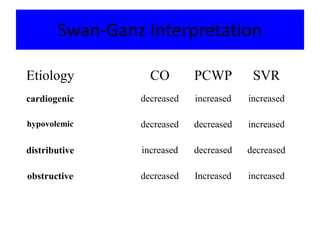
Swan-Ganz Interpretation
Etiology CO PCWP SVR
cardiogenic decreased increased increased
hypovolemic decreased decreased increased
distributive increased decreased decreased
obstructive decreased Increased increased
Management
• Correct underlying disorder if possible and
then direct efforts at increasing the blood
pressure to increase oxygen delivery to the
tissues.
• Maintain a mean arterial pressure of 60 (1/3
systolic + 2/3 diastolic)
• Keep O2 sats >92%, intubate if neccesary
Correction of hypotension
• Normal Saline should be administered
anytime a patient is hypotensive. If
hypotension exists give more NS. ***
• If possible give blood as it replaces colloid.
• Vasopressors
• Inotropic agents for cardiogenic shock
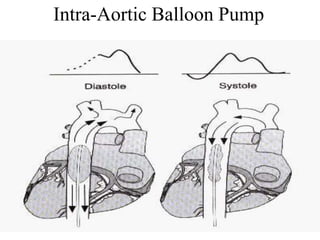
• Intra-aortic Balloon Pump for cardiogenic
Management of Cardiogenic Shock
• Attempt to correct problem and increase
cardiac output by diuresing and providing
inotropic support. IABP is utilized if medical
therapy is ineffective. Catheterization if
ongoing ischemia
• Cardiogenic shock is the exception to the rule
that NS is always given for hypotension NS
will exacerbate cardiac shock.
Intra-Aortic Balloon Pump
Management of Septic Shock
• Early goal directed therapy
• Identification of source of infection
• Broad Spectrum Antibiotics
• IV fluids
• Vasopressors
• Steroids ??
• Recombinant human activated protein C ( Xygris)
• Bicarbonate if pH < 7.1
Management of Hypovolemic Shock
• Correct bleeding abnormality
• If PT or PTT elevated then FFP
• Aggressive Fluid replacement with 2 large
bore IV’s or central line.
• Pressors are last line, but commonly required.
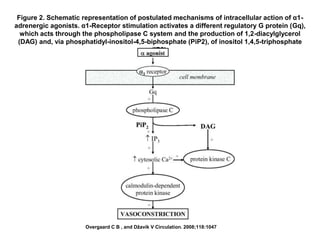
Figure 2. Schematic representation of postulated mechanisms of intracellular action of α1-
adrenergic agonists. α1-Receptor stimulation activates a different regulatory G protein (Gq),
which acts through the phospholipase C system and the production of 1,2-diacylglycerol
(DAG) and, via phosphatidyl-inositol-4,5-biphosphate (PiP2), of inositol 1,4,5-triphosphate
(IP3).
Overgaard C B , and Džavík V Circulation. 2008;118:1047
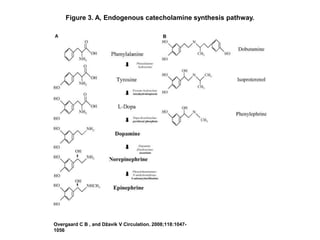
Figure 3. A, Endogenous catecholamine synthesis pathway.
Overgaard C B , and Džavík V Circulation. 2008;118:1047-
1056
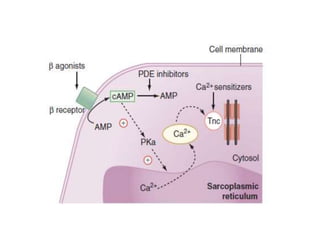
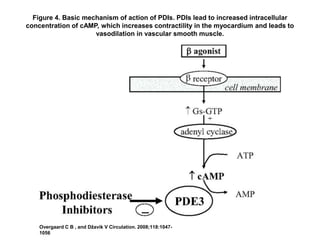
Figure 4. Basic mechanism of action of PDIs. PDIs lead to increased intracellular
concentration of cAMP, which increases contractility in the myocardium and leads to
vasodilation in vascular smooth muscle.
Overgaard C B , and Džavík V Circulation. 2008;118:1047-
1056
Background
 Vasopressors are class of drugs that elevate Mean
Arterial Pressure (MAP) by inducing vasoconstriction.
 Inotropes increase cardiac contractility.
 Many drugs have both vasopressor and inotropic
effects.
 Vasopressors are indicated for a decrease of >30 mmHg
from baseline systolic blood pressure or MAP <60
mmHg, when either condition results in end-organ
dysfunction secondary to hypoperfusion.
Receptor Physiology
• Main categories of adrenergic receptors relevant to
vasopressor activity:
– Alpha-1adrenergic receptor
– Beta-1, Beta-2 adrenergic receptors
– Dopamine receptors
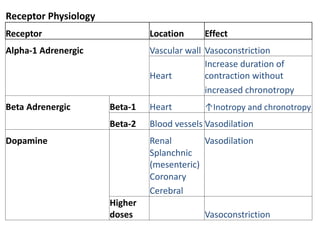
Receptor Physiology
Receptor Location Effect
Alpha-1 Adrenergic Vascular wall Vasoconstriction
Heart
Increase duration of
contraction without
increased chronotropy
Beta Adrenergic Beta-1 Heart ↑Inotropy and chronotropy
Beta-2 Blood vessels Vasodilation
Dopamine Renal Vasodilation
Splanchnic
(mesenteric)
Coronary
Cerebral
Higher
doses Vasoconstriction
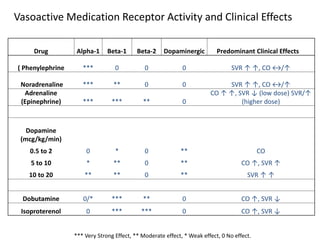
Drug Alpha-1 Beta-1 Beta-2 Dopaminergic Predominant Clinical Effects
( Phenylephrine *** 0 0 0 SVR ↑ ↑, CO ↔/↑
Noradrenaline *** ** 0 0 SVR ↑ ↑, CO ↔/↑
Adrenaline
(Epinephrine) *** *** ** 0
CO ↑ ↑, SVR ↓ (low dose) SVR/↑
(higher dose)
Dopamine
(mcg/kg/min)
0.5 to 2 0 * 0 ** CO
5 to 10 * ** 0 ** CO ↑, SVR ↑
10 to 20 ** ** 0 ** SVR ↑ ↑
Dobutamine 0/* *** ** 0 CO ↑, SVR ↓
Isoproterenol 0 *** *** 0 CO ↑, SVR ↓
*** Very Strong Effect, ** Moderate effect, * Weak effect, 0 No effect.
Vasoactive Medication Receptor Activity and Clinical Effects
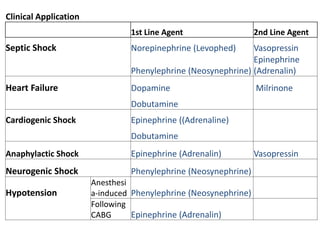
Clinical Application
1st Line Agent 2nd Line Agent
Septic Shock Norepinephrine (Levophed) Vasopressin
Phenylephrine (Neosynephrine)
Epinephrine
(Adrenalin)
Heart Failure Dopamine Milrinone
Dobutamine
Cardiogenic Shock Epinephrine ((Adrenaline)
Dobutamine
Anaphylactic Shock Epinephrine (Adrenalin) Vasopressin
Neurogenic Shock Phenylephrine (Neosynephrine)
Hypotension
Anesthesi
a-induced Phenylephrine (Neosynephrine)
Following
CABG Epinephrine (Adrenalin)
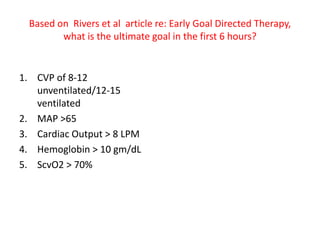
Based on Rivers et al article re: Early Goal Directed Therapy,
what is the ultimate goal in the first 6 hours?
1. CVP of 8-12
unventilated/12-15
ventilated
2. MAP >65
3. Cardiac Output > 8 LPM
4. Hemoglobin > 10 gm/dL
5. ScvO2 > 70%
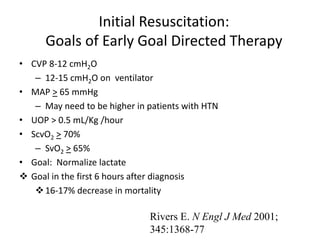
Initial Resuscitation:
Goals of Early Goal Directed Therapy
• CVP 8-12 cmH2O
– 12-15 cmH2O on ventilator
• MAP > 65 mmHg
– May need to be higher in patients with HTN
• UOP > 0.5 mL/Kg /hour
• ScvO2 > 70%
– SvO2 > 65%
• Goal: Normalize lactate
 Goal in the first 6 hours after diagnosis
16-17% decrease in mortality
Rivers E. N Engl J Med 2001;
345:1368-77
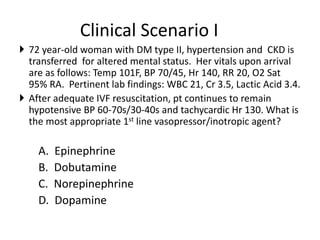
Clinical Scenario I
 72 year-old woman with DM type II, hypertension and CKD is
transferred for altered mental status. Her vitals upon arrival
are as follows: Temp 101F, BP 70/45, Hr 140, RR 20, O2 Sat
95% RA. Pertinent lab findings: WBC 21, Cr 3.5, Lactic Acid 3.4.
 After adequate IVF resuscitation, pt continues to remain
hypotensive BP 60-70s/30-40s and tachycardic Hr 130. What is
the most appropriate 1st line vasopressor/inotropic agent?
A. Epinephrine
B. Dobutamine
C. Norepinephrine
D. Dopamine
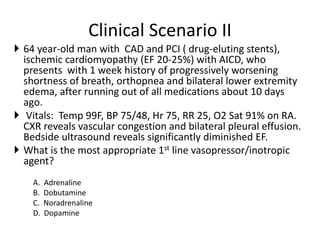
Clinical Scenario II
 64 year-old man with CAD and PCI ( drug-eluting stents),
ischemic cardiomyopathy (EF 20-25%) with AICD, who
presents with 1 week history of progressively worsening
shortness of breath, orthopnea and bilateral lower extremity
edema, after running out of all medications about 10 days
ago.
 Vitals: Temp 99F, BP 75/48, Hr 75, RR 25, O2 Sat 91% on RA.
CXR reveals vascular congestion and bilateral pleural effusion.
Bedside ultrasound reveals significantly diminished EF.
 What is the most appropriate 1st line vasopressor/inotropic
agent?
A. Adrenaline
B. Dobutamine
C. Noradrenaline
D. Dopamine
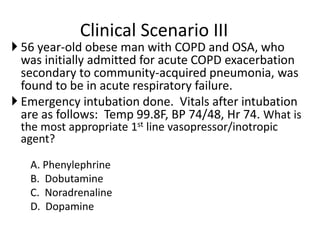
Clinical Scenario III
 56 year-old obese man with COPD and OSA, who
was initially admitted for acute COPD exacerbation
secondary to community-acquired pneumonia, was
found to be in acute respiratory failure.
 Emergency intubation done. Vitals after intubation
are as follows: Temp 99.8F, BP 74/48, Hr 74. What is
the most appropriate 1st line vasopressor/inotropic
agent?
A. Phenylephrine
B. Dobutamine
C. Noradrenaline
D. Dopamine
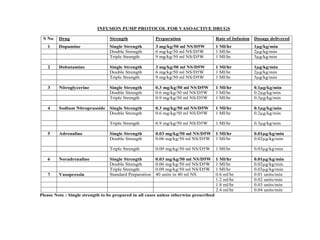
INFUSION PUMP PROTOCOL FOR VASOACTIVE DRUGS
S No. Drug Strength Preparation Rate of Infusion Dosage delivered
1 Dopamine Single Strength 3 mg/kg/50 ml NS/D5W 1 Ml/hr 1µg/kg/min
Double Strength 6 mg/kg/50 ml NS/D5W 1 Ml/hr 2µg/kg/min
Triple Strength 9 mg/kg/50 ml NS/D5W 1 Ml/hr 3µg/kg/min
2 Dobutamine Single Strength 3 mg/kg/50 ml NS/D5W 1 Ml/hr 1µg/kg/min
Double Strength 6 mg/kg/50 ml NS/D5W 1 Ml/hr 2µg/kg/min
Triple Strength 9 mg/kg/50 ml NS/D5W 1 Ml/hr 3µg/kg/min
3 Nitroglycerine Single Strength 0.3 mg/kg/50 ml NS/D5W 1 Ml/hr 0.1µg/kg/min
Double Strength 0.6 mg/kg/50 ml NS/D5W 1 Ml/hr 0.2µg/kg/min
Triple Strength 0.9 mg/kg/50 ml NS/D5W 1 Ml/hr 0.3µg/kg/min
4 Sodium Nitroprusside Single Strength 0.3 mg/kg/50 ml NS/D5W 1 Ml/hr 0.1µg/kg/min
Double Strength 0.6 mg/kg/50 ml NS/D5W 1 Ml/hr 0.2µg/kg/min
Triple Strength 0.9 mg/kg/50 ml NS/D5W 1 Ml/hr 0.3µg/kg/min
5 Adrenaline Single Strength 0.03 mg/kg/50 ml NS/D5W 1 Ml/hr 0.01µg/kg/min
Double Strength 0.06 mg/kg/50 ml NS/D5W 1 Ml/hr 0.02µg/kg/min
Triple Strength 0.09 mg/kg/50 ml NS/D5W 1 Ml/hr 0.03µg/kg/min
6 Noradrenaline Single Strength 0.03 mg/kg/50 ml NS/D5W 1 Ml/hr 0.01µg/kg/min
Double Strength 0.06 mg/kg/50 ml NS/D5W 1 Ml/hr 0.02µg/kg/min
Triple Strength 0.09 mg/kg/50 ml NS/D5W 1 Ml/hr 0.03µg/kg/min
7 Vasopressin Standard Preparation 40 units in 40 ml NS 0.6 ml/hr 0.01 units/min
1.2 ml/hr 0.02 units/min
1.8 ml/hr 0.03 units/min
2.4 ml/hr 0.04 units/min
Please Note : Single strength to be prepared in all cases unless otherwise prescribed
(GK Narula)
Col
Sr Adv Anesthesiology & Critical Care.

Shock...............................pptx

  • 1.
  • 2.
    DEFINITION • Profound hemodyamicand metabolic disturbance characterized by failure of the circulatory system to maintain adequate perfusion of vital organs
  • 3.
    Types of Shock •Cardiogenic (intracardiac vs extracardiac) • Hypovolemic • Distributive – sepsis**** – neurogenic (spinal shock) – adrenal insufficiency – anaphylaxis
  • 5.
    Cardiogenic Shock, intracardiac •Myocardial Injury or Obstruction to Flow – Arrythymias – valvular lesions – AMI – Severe CHF – VSD – Hypertrophic Cardiomyopathy
  • 6.
    Presentation of CardiogenicShock • Pulmonary Edema • JVD • hypotensive • weak pulses • oliguria
  • 7.
    Cardiogenic Shock, extracardiac (Obstructive) •Pulmonary Embolism • Cardiac Tamponade • Tension Pneumothorax • Presentation will be according to underlying disease process.
  • 8.
    Hypovolemic Shock • Reducedcirculating blood volume with secondary decreased cardiac output – Acute hemorrhage – Vomiting/Diarrhea – Dehydration – Burns – Peritonitis/Pancreatitis
  • 9.
    Presentation of HypovolemicShock • Hypotensive • flat neck veins • clear lungs • cool, cyanotic extremities • evidence of bleeding? – Anticoagulant use – trauma, bruising • oliguria
  • 10.
    Distributive Shock • PeripheralVasodilation secondary to disruption of cellular metabolism by the effects of inflammatory mediators. • Gram negative or other overwhelming infection. • Results in decreased Peripheral Vascular Resistance.
  • 11.
    Distributive Shock: Presentation •Febrile • Tachycardic • clear lungs, evidence of pneumonia • warm extremities • flat neck veins • oliguria
  • 12.
    Diagnosing Shock • Responseto fluids • Echo/EKG • CXR • Evidence of infection • Swan-Ganz Catheter?
  • 13.
    Swan-Ganz Catheter • Utilizedto differentiate types of shock and assist in treatment response. • Probably overused by physicians. Studies documenting increased mortality in patients with catheters versus no catheters, although somewhat swayed by selection bias.
  • 14.
  • 16.
    Swan-Ganz Interpretation Etiology COPCWP SVR cardiogenic decreased increased increased hypovolemic decreased decreased increased distributive increased decreased decreased obstructive decreased Increased increased
  • 17.
    Management • Correct underlyingdisorder if possible and then direct efforts at increasing the blood pressure to increase oxygen delivery to the tissues. • Maintain a mean arterial pressure of 60 (1/3 systolic + 2/3 diastolic) • Keep O2 sats >92%, intubate if neccesary
  • 18.
    Correction of hypotension •Normal Saline should be administered anytime a patient is hypotensive. If hypotension exists give more NS. *** • If possible give blood as it replaces colloid. • Vasopressors • Inotropic agents for cardiogenic shock • Intra-aortic Balloon Pump for cardiogenic
  • 19.
    Management of CardiogenicShock • Attempt to correct problem and increase cardiac output by diuresing and providing inotropic support. IABP is utilized if medical therapy is ineffective. Catheterization if ongoing ischemia • Cardiogenic shock is the exception to the rule that NS is always given for hypotension NS will exacerbate cardiac shock.
  • 20.
  • 21.
    Management of SepticShock • Early goal directed therapy • Identification of source of infection • Broad Spectrum Antibiotics • IV fluids • Vasopressors • Steroids ?? • Recombinant human activated protein C ( Xygris) • Bicarbonate if pH < 7.1
  • 22.
    Management of HypovolemicShock • Correct bleeding abnormality • If PT or PTT elevated then FFP • Aggressive Fluid replacement with 2 large bore IV’s or central line. • Pressors are last line, but commonly required.
  • 24.
    Figure 2. Schematicrepresentation of postulated mechanisms of intracellular action of α1- adrenergic agonists. α1-Receptor stimulation activates a different regulatory G protein (Gq), which acts through the phospholipase C system and the production of 1,2-diacylglycerol (DAG) and, via phosphatidyl-inositol-4,5-biphosphate (PiP2), of inositol 1,4,5-triphosphate (IP3). Overgaard C B , and Džavík V Circulation. 2008;118:1047
  • 25.
    Figure 3. A,Endogenous catecholamine synthesis pathway. Overgaard C B , and Džavík V Circulation. 2008;118:1047- 1056
  • 26.
    Figure 4. Basicmechanism of action of PDIs. PDIs lead to increased intracellular concentration of cAMP, which increases contractility in the myocardium and leads to vasodilation in vascular smooth muscle. Overgaard C B , and Džavík V Circulation. 2008;118:1047- 1056
  • 27.
    Background  Vasopressors areclass of drugs that elevate Mean Arterial Pressure (MAP) by inducing vasoconstriction.  Inotropes increase cardiac contractility.  Many drugs have both vasopressor and inotropic effects.  Vasopressors are indicated for a decrease of >30 mmHg from baseline systolic blood pressure or MAP <60 mmHg, when either condition results in end-organ dysfunction secondary to hypoperfusion.
  • 28.
    Receptor Physiology • Maincategories of adrenergic receptors relevant to vasopressor activity: – Alpha-1adrenergic receptor – Beta-1, Beta-2 adrenergic receptors – Dopamine receptors
  • 29.
    Receptor Physiology Receptor LocationEffect Alpha-1 Adrenergic Vascular wall Vasoconstriction Heart Increase duration of contraction without increased chronotropy Beta Adrenergic Beta-1 Heart ↑Inotropy and chronotropy Beta-2 Blood vessels Vasodilation Dopamine Renal Vasodilation Splanchnic (mesenteric) Coronary Cerebral Higher doses Vasoconstriction
  • 30.
    Drug Alpha-1 Beta-1Beta-2 Dopaminergic Predominant Clinical Effects ( Phenylephrine *** 0 0 0 SVR ↑ ↑, CO ↔/↑ Noradrenaline *** ** 0 0 SVR ↑ ↑, CO ↔/↑ Adrenaline (Epinephrine) *** *** ** 0 CO ↑ ↑, SVR ↓ (low dose) SVR/↑ (higher dose) Dopamine (mcg/kg/min) 0.5 to 2 0 * 0 ** CO 5 to 10 * ** 0 ** CO ↑, SVR ↑ 10 to 20 ** ** 0 ** SVR ↑ ↑ Dobutamine 0/* *** ** 0 CO ↑, SVR ↓ Isoproterenol 0 *** *** 0 CO ↑, SVR ↓ *** Very Strong Effect, ** Moderate effect, * Weak effect, 0 No effect. Vasoactive Medication Receptor Activity and Clinical Effects
  • 31.
    Clinical Application 1st LineAgent 2nd Line Agent Septic Shock Norepinephrine (Levophed) Vasopressin Phenylephrine (Neosynephrine) Epinephrine (Adrenalin) Heart Failure Dopamine Milrinone Dobutamine Cardiogenic Shock Epinephrine ((Adrenaline) Dobutamine Anaphylactic Shock Epinephrine (Adrenalin) Vasopressin Neurogenic Shock Phenylephrine (Neosynephrine) Hypotension Anesthesi a-induced Phenylephrine (Neosynephrine) Following CABG Epinephrine (Adrenalin)
  • 32.
    Based on Riverset al article re: Early Goal Directed Therapy, what is the ultimate goal in the first 6 hours? 1. CVP of 8-12 unventilated/12-15 ventilated 2. MAP >65 3. Cardiac Output > 8 LPM 4. Hemoglobin > 10 gm/dL 5. ScvO2 > 70%
  • 33.
    Initial Resuscitation: Goals ofEarly Goal Directed Therapy • CVP 8-12 cmH2O – 12-15 cmH2O on ventilator • MAP > 65 mmHg – May need to be higher in patients with HTN • UOP > 0.5 mL/Kg /hour • ScvO2 > 70% – SvO2 > 65% • Goal: Normalize lactate  Goal in the first 6 hours after diagnosis 16-17% decrease in mortality Rivers E. N Engl J Med 2001; 345:1368-77
  • 34.
    Clinical Scenario I 72 year-old woman with DM type II, hypertension and CKD is transferred for altered mental status. Her vitals upon arrival are as follows: Temp 101F, BP 70/45, Hr 140, RR 20, O2 Sat 95% RA. Pertinent lab findings: WBC 21, Cr 3.5, Lactic Acid 3.4.  After adequate IVF resuscitation, pt continues to remain hypotensive BP 60-70s/30-40s and tachycardic Hr 130. What is the most appropriate 1st line vasopressor/inotropic agent? A. Epinephrine B. Dobutamine C. Norepinephrine D. Dopamine
  • 35.
    Clinical Scenario II 64 year-old man with CAD and PCI ( drug-eluting stents), ischemic cardiomyopathy (EF 20-25%) with AICD, who presents with 1 week history of progressively worsening shortness of breath, orthopnea and bilateral lower extremity edema, after running out of all medications about 10 days ago.  Vitals: Temp 99F, BP 75/48, Hr 75, RR 25, O2 Sat 91% on RA. CXR reveals vascular congestion and bilateral pleural effusion. Bedside ultrasound reveals significantly diminished EF.  What is the most appropriate 1st line vasopressor/inotropic agent? A. Adrenaline B. Dobutamine C. Noradrenaline D. Dopamine
  • 36.
    Clinical Scenario III 56 year-old obese man with COPD and OSA, who was initially admitted for acute COPD exacerbation secondary to community-acquired pneumonia, was found to be in acute respiratory failure.  Emergency intubation done. Vitals after intubation are as follows: Temp 99.8F, BP 74/48, Hr 74. What is the most appropriate 1st line vasopressor/inotropic agent? A. Phenylephrine B. Dobutamine C. Noradrenaline D. Dopamine
  • 37.
    INFUSION PUMP PROTOCOLFOR VASOACTIVE DRUGS S No. Drug Strength Preparation Rate of Infusion Dosage delivered 1 Dopamine Single Strength 3 mg/kg/50 ml NS/D5W 1 Ml/hr 1µg/kg/min Double Strength 6 mg/kg/50 ml NS/D5W 1 Ml/hr 2µg/kg/min Triple Strength 9 mg/kg/50 ml NS/D5W 1 Ml/hr 3µg/kg/min 2 Dobutamine Single Strength 3 mg/kg/50 ml NS/D5W 1 Ml/hr 1µg/kg/min Double Strength 6 mg/kg/50 ml NS/D5W 1 Ml/hr 2µg/kg/min Triple Strength 9 mg/kg/50 ml NS/D5W 1 Ml/hr 3µg/kg/min 3 Nitroglycerine Single Strength 0.3 mg/kg/50 ml NS/D5W 1 Ml/hr 0.1µg/kg/min Double Strength 0.6 mg/kg/50 ml NS/D5W 1 Ml/hr 0.2µg/kg/min Triple Strength 0.9 mg/kg/50 ml NS/D5W 1 Ml/hr 0.3µg/kg/min 4 Sodium Nitroprusside Single Strength 0.3 mg/kg/50 ml NS/D5W 1 Ml/hr 0.1µg/kg/min Double Strength 0.6 mg/kg/50 ml NS/D5W 1 Ml/hr 0.2µg/kg/min Triple Strength 0.9 mg/kg/50 ml NS/D5W 1 Ml/hr 0.3µg/kg/min 5 Adrenaline Single Strength 0.03 mg/kg/50 ml NS/D5W 1 Ml/hr 0.01µg/kg/min Double Strength 0.06 mg/kg/50 ml NS/D5W 1 Ml/hr 0.02µg/kg/min Triple Strength 0.09 mg/kg/50 ml NS/D5W 1 Ml/hr 0.03µg/kg/min 6 Noradrenaline Single Strength 0.03 mg/kg/50 ml NS/D5W 1 Ml/hr 0.01µg/kg/min Double Strength 0.06 mg/kg/50 ml NS/D5W 1 Ml/hr 0.02µg/kg/min Triple Strength 0.09 mg/kg/50 ml NS/D5W 1 Ml/hr 0.03µg/kg/min 7 Vasopressin Standard Preparation 40 units in 40 ml NS 0.6 ml/hr 0.01 units/min 1.2 ml/hr 0.02 units/min 1.8 ml/hr 0.03 units/min 2.4 ml/hr 0.04 units/min Please Note : Single strength to be prepared in all cases unless otherwise prescribed (GK Narula) Col Sr Adv Anesthesiology & Critical Care.