• VASOPRESSORS AND
INOTROPICS
SAMIR EL ANSARY
ICU PROFESSOR
AIN SHAMS
CAIRO
Myocardial Contraction
• Contractility increases over 1st months of life

along with:
– Sympathetic nerve fibers within myocardium
– Total concentration of endogenous
norepinephrine
• There is a greater dependence of CO on HR
than contractility during this time
Immature Heart
• Limited responsiveness to medications
–  noncontractile content
–  availability of releasable NE
– Less mature sympathetic system
– Underdeveloped intracellular calcium regulatory
mechanisms
–  functional reserve capacity
Ionized Calcium
• Plays central role in maintaining
myocardial contractility
Vascular Smooth Muscle
• Calcium dependent effects
– Agents that increase intracellular cAMP increase
intracellular calcium requirements for contraction,
thus encouraging smooth muscle relaxation and
vasodilation
Effects of Agents
• Pressors: increase systemic vascular resistance and
increase blood pressure
• Inotropes: affect myocardial contractility and
enhance stroke volume
• Chronotropic Agents: affect heart rate
• Lusotropic Agents: improve relaxation during
diastole and decrease EDP in the ventricles
• Dromotropic Agents: Affects conduction speed
through AV node; increases heart rate
• Bathmotropic Agents: affect degree of excitability
Alpha-Adrenergic Agents
–Alpha1-adrenergic effects:
• Vascular smooth muscle contraction
–Alpha2-adrenergic effects:
• Vascular smooth muscle relaxation
Beta-Adrenergic Agents
• Beta1-adrenergic effects:
– Direct cardiac effects
• Inotropy (improved cardiac contractility)
• Chronotropy (increased heart rate)
• Beta2-adrenergic effects:
• Vasodilation
• Bronchodilation
Dopaminergic Agents
• Dopaminergic Agents
– Several types of receptors located throughout
body (D1-D5)
– Certain (esp. D1-like & D2-like) dopaminergic
receptors increase renal and mesenteric blood
flow
Catecholamines
• Sympathomimetic amines that contain O-
dihydrobenzene
• Dopamine, epinephrine and norepinephrine are
endogenous
• Dobutamine and isoproterenol are synthetic
• Sustained use or antecedent CHF can lead to down-
regulation of β-receptors and decrease efficacy
Epinephrine
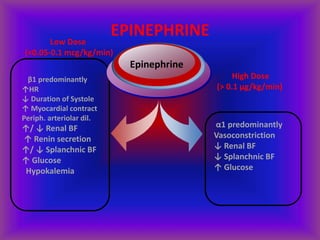
• Both an alpha- and beta-adrenergic agent 0.01
mcg/kg/min - 0.3 mcg/kg/min
– Low-dose infusion = β activation
• Increase HR, contractility, decrease SVR
– Higher doses =  activation
• Increased SVR and MAP
• Increased myocardial O2 demand
EPINEPHRINE
α1 predominantly
Vasoconstriction
↓ Renal BF
↓ Splanchnic BF
↑ Glucose
β1 predominantly
↑HR
↓ Duration of Systole
↑ Myocardial contract
Periph. arteriolar dil.
↑/ ↓ Renal BF
↑ Renin secretion
↑/ ↓ Splanchnic BF
↑ Glucose
Hypokalemia
Epinephrine
Low Dose
(<0.05-0.1 mcg/kg/min)
High Dose
(> 0.1 μg/kg/min)
Epinephrine
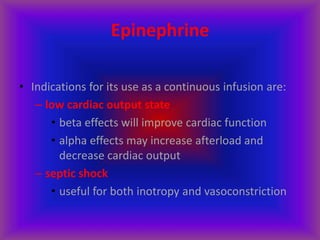
• Indications for its use as a continuous infusion are:
– low cardiac output state
• beta effects will improve cardiac function
• alpha effects may increase afterload and
decrease cardiac output
– septic shock
• useful for both inotropy and vasoconstriction
Epinephrine
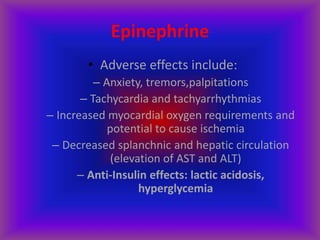
• Adverse effects include:
– Anxiety, tremors,palpitations
– Tachycardia and tachyarrhythmias
– Increased myocardial oxygen requirements and
potential to cause ischemia
– Decreased splanchnic and hepatic circulation
(elevation of AST and ALT)
– Anti-Insulin effects: lactic acidosis,
hyperglycemia
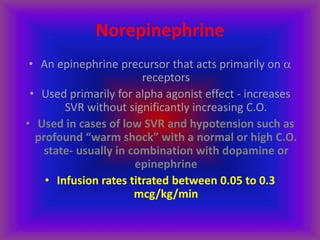
Norepinephrine
• An epinephrine precursor that acts primarily on 
receptors
• Used primarily for alpha agonist effect - increases
SVR without significantly increasing C.O.
• Used in cases of low SVR and hypotension such as
profound “warm shock” with a normal or high C.O.
state- usually in combination with dopamine or
epinephrine
• Infusion rates titrated between 0.05 to 0.3
mcg/kg/min
Norepinephrine
• Differs from epinephrine in that the
vasoconstriction outweighs any increase in
cardiac output.
– i.e. norepinephrine usually increases blood
pressure and SVR, often without increasing
cardiac output.
Norepinephrine
• Adverse Effects:
– Similar to those of Epinephrine
– Can compromise perfusion in extremities and may
need to be combined with a vasodilator e.g.
Dobutamine or Nipride
– More profound effect on splanchnic circulation
and myocardial oxygen consumption
Vasopressin
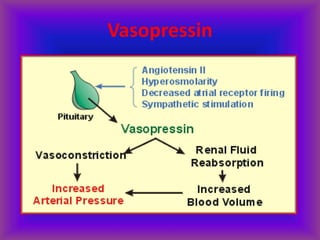
• A peptide hormone released by the posterior
pituitary in response to rising plasma tonicity
or falling blood pressure
• Antidiuretic and vasopressor properties
• Deficiency of this hormone results in diabetes
insipidus
Vasopressin
Vasopressin
• Administration
– intravenous, intramuscular, or intranasal routes
– IV is route for vasopressor activity
– The half-life of circulating ADH is approximately 20
minutes, with renal and hepatic catabolism via
reduction of the disulfide bond and peptide
cleavage
Vasopressin
• Administration
– interacts with two types of receptors
• V1 receptors are found on vascular smooth
muscle cells and mediate vasoconstriction
• V2 receptors are found on renal tubule cells
and mediate antidiuresis through increased
water permeability and water resorption in
the collecting tubules
• Use in refractory septic shock with low SVRI in
pediatrics?
Dopamine
• Intermediate product in the enzymatic
pathway leading to the production of
norepinephrine; thus, it indirectly acts by
releasing norepinephrine.
• Directly has ,  and dopaminergic actions
which are dose-dependent.
• Indications are based on the adrenergic
actions desired.
Dopamine
•  renal perfusion 2-5 mcg/kg/min (dopaminergic
effects) by  sensitivity of vascular smooth muscle to
intracellular calcium
•  C.O. in Cardiogenic or Distributive Shock 5-
10mcg/kg/min ( adrenergic effects)
• Post-resuscitation stabilization in patients with
hypotension (with fluid therapy) 10-20 mcg/kg/min
( adrenergic effects) peripheral vasoconstriction, 
SVR, PVR, HR.
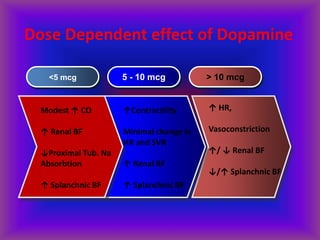
Dose Dependent effect of Dopamine
<5 mcg 5 - 10 mcg > 10 mcg
↑Contractility
Minimal change in
HR and SVR
↑ Renal BF
↑ Splanchnic BF
Modest ↑ CO
↑ Renal BF
↓Proximal Tub. Na
Absorbtion
↑ Splanchnic BF
↑ HR,
Vasoconstriction
↑/ ↓ Renal BF
↓/↑ Splanchnic BF
Dobutamine
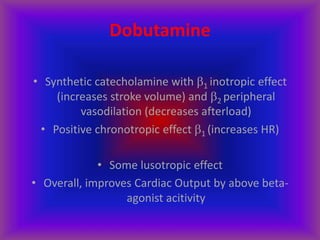
• Synthetic catecholamine with 1 inotropic effect
(increases stroke volume) and 2 peripheral
vasodilation (decreases afterload)
• Positive chronotropic effect 1 (increases HR)
• Some lusotropic effect
• Overall, improves Cardiac Output by above beta-
agonist acitivity
Dobutamine
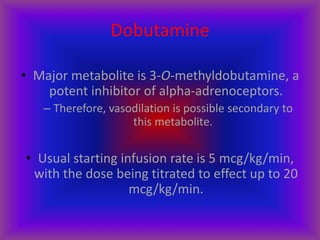
• Major metabolite is 3-O-methyldobutamine, a
potent inhibitor of alpha-adrenoceptors.
– Therefore, vasodilation is possible secondary to
this metabolite.
• Usual starting infusion rate is 5 mcg/kg/min,
with the dose being titrated to effect up to 20
mcg/kg/min.
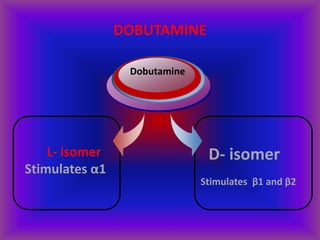
DOBUTAMINE
D- isomer
Stimulates β1 and β2
L- isomer
Stimulates α1
Dobutamine
Dobutamine
• Used in low C.O. states and CHF e.g.
myocarditis, cardiomyopathy, myocardial
infarction
• If BP adequate, can be combined with
afterload reducer (Nipride or ACE inhibitor)
• In combination with Epi/Norepi in profound
shock states to improve Cardiac Output and
provide some peripheral vasodilatation
Isoproterenol
• Synthetic catecholamine
• Non-specific beta agonist with minimal alpha-
adrenergic effects.
• Causes inotropy, chronotropy, and systemic
and pulmonary vasodilatation.
• Indications: bradycardia, decreased cardiac
output, bronchospasm (bronchodilator).
Isoproterenol
• Occasionally used to maintain heart rate
following heart transplantation.
• Dose starts at 0.01 mcg/kg/min and is
increased to 2.0 mcg/kg/min for desired
effect.
• Avoid in patients with subaortic stenosis,
and hypertrophic cardiomyopathy or TOF
lesions because increases the outflow
gradient
Milrinone/Amrinone
• Belong to class of agents “Bipyridines”
• Non-receptor mediated activity based on
selective inhibition of Phosphodiesterase Type
III enzyme resulting in cAMP accumulation in
myocardium
• cAMP increases force of contraction and rate
and extent of relaxation of myocardium
• Inotropic, vasodilator and lusotropic effect
Milrinone/Amrinone
• Advantage over catecholamines:
–Independent action from -receptor
activation, particularly when these
receptors are downregulated
(CHF and chronic catecholamine use)
Milrinone
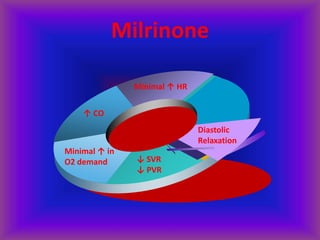
• Increases CO by improving contractility,
decreased SVR, PVR, lusotropic effect;
decreased preload due to vasodilatation
• Unique in beneficial effects on RV function
• Protein binding: 70%
• Half-life is 1-4 hours
Milrinone
• Elimination: primarily renally excreted
• Load with 50 mcg/kg over 30 mins
followed by 0.25 to 0.75 mcg/kg/min
• No increase in myocardial O2
requirement
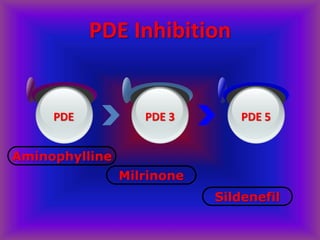
PDE Inhibition
Aminophylline
Milrinone
Sildenefil
PDE PDE 3 PDE 5
Milrinone
Minimal ↑ HR
↑ CO
Minimal ↑ in
O2 demand ↓ SVR
↓ PVR
Diastolic
Relaxation
Other Vasoactive
Agents
BNP
{ Brain natriuretic peptide }
• Secreted by ventricles in response to ↑
wall stress and volume overload
NESRITIDE
{Recombinant Human BNP}
• Venous and arteriolar dilator, acts on
Guanylate cyclase
• It reduces RA pressure, PCWP and cardiac
index
• Dose: Infusion 0.01- 0.03 mcg/kg/min
• Hypotension
Nesiritide
• Nesiritide (recombinant human BNP) is a vasodilator
with other theoretical effects including:
– natriuresis, neurohormonal inhibition, and reverse
remodeling
– In the setting of Heart Failure, it has been shown
to reduce pulmonary capillary wedge pressure
and improve shortness of breath relative to
placebo
– Linked to possible renal failure and increased
mortality in some patient populations
Vasodilators
• Classified by site of action
• Venodilators: reduce preload - Nitroglycerin
• Arteriolar dilators: reduce afterload Minoxidil and
Hydralazine
• Combined: act on both arterial and venous beds and
reduce both pre- and afterload Sodium Nitroprusside
(Nipride)
Nitroprusside
• Vasodilator that acts directly on arterial and
venous vascular smooth muscle.
• Indicated in hypertension and low cardiac
output states with increased SVR.
• Also used in post-operative cardiac surgery to
decrease afterload on an injured heart.
• Action is immediate; half-life is short;
titratable action.
Nitroprusside
• Toxicity is with cyanide, one of the metabolites of the
breakdown of nipride.
• Severe, unexplained metabolic acidosis might
suggest cyanide toxicity.
• Dose starts at 0.5 mcg/kg/min and titrate to 5
mcg/kg/min to desired effect. May go higher (up to
10 mcg/kg/min) for short periods of time.
Nitroglycerine
• Direct vasodilator as well, but the major
effect is as a venodilator with lesser effect
on arterioles.
• Not as effective as nitroprusside in lowering
blood pressure.
• Another potential benefit is relaxation of
the coronary arteries, thus improving
myocardial regional blood flow and
myocardial oxygen demand.
Nitroglycerine
• Used to improve myocardial perfusion
following cardiac surgery
• Dose ranges from 0.5 to 8 mcg/kg/min.
Typical dose is 2 mcg/kg/min for 24 to 48
hours post-operatively
• Methemoglobinemia is potential side effect
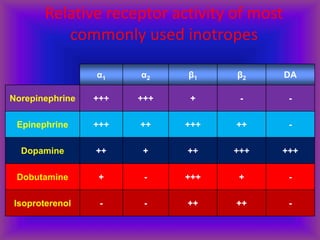
Relative receptor activity of most
commonly used inotropes
α1 α2 β1 β2 DA
Norepinephrine +++ +++ + - -
Epinephrine +++ ++ +++ ++ -
Dopamine ++ + ++ +++ +++
Dobutamine + - +++ + -
Isoproterenol - - ++ ++ -
GOOD LUCK
SAMIR EL ANSARY
ICU PROFESSOR
AIN SHAMS
CAIRO

Vasoactive and inotropic agents

  • 1.
    • VASOPRESSORS AND INOTROPICS SAMIREL ANSARY ICU PROFESSOR AIN SHAMS CAIRO
  • 2.
    Myocardial Contraction • Contractilityincreases over 1st months of life along with: – Sympathetic nerve fibers within myocardium – Total concentration of endogenous norepinephrine • There is a greater dependence of CO on HR than contractility during this time
  • 3.
    Immature Heart • Limitedresponsiveness to medications –  noncontractile content –  availability of releasable NE – Less mature sympathetic system – Underdeveloped intracellular calcium regulatory mechanisms –  functional reserve capacity
  • 4.
    Ionized Calcium • Playscentral role in maintaining myocardial contractility
  • 5.
    Vascular Smooth Muscle •Calcium dependent effects – Agents that increase intracellular cAMP increase intracellular calcium requirements for contraction, thus encouraging smooth muscle relaxation and vasodilation
  • 6.
    Effects of Agents •Pressors: increase systemic vascular resistance and increase blood pressure • Inotropes: affect myocardial contractility and enhance stroke volume • Chronotropic Agents: affect heart rate • Lusotropic Agents: improve relaxation during diastole and decrease EDP in the ventricles • Dromotropic Agents: Affects conduction speed through AV node; increases heart rate • Bathmotropic Agents: affect degree of excitability
  • 7.
    Alpha-Adrenergic Agents –Alpha1-adrenergic effects: •Vascular smooth muscle contraction –Alpha2-adrenergic effects: • Vascular smooth muscle relaxation
  • 8.
    Beta-Adrenergic Agents • Beta1-adrenergiceffects: – Direct cardiac effects • Inotropy (improved cardiac contractility) • Chronotropy (increased heart rate) • Beta2-adrenergic effects: • Vasodilation • Bronchodilation
  • 9.
    Dopaminergic Agents • DopaminergicAgents – Several types of receptors located throughout body (D1-D5) – Certain (esp. D1-like & D2-like) dopaminergic receptors increase renal and mesenteric blood flow
  • 10.
    Catecholamines • Sympathomimetic aminesthat contain O- dihydrobenzene • Dopamine, epinephrine and norepinephrine are endogenous • Dobutamine and isoproterenol are synthetic • Sustained use or antecedent CHF can lead to down- regulation of β-receptors and decrease efficacy
  • 11.
    Epinephrine • Both analpha- and beta-adrenergic agent 0.01 mcg/kg/min - 0.3 mcg/kg/min – Low-dose infusion = β activation • Increase HR, contractility, decrease SVR – Higher doses =  activation • Increased SVR and MAP • Increased myocardial O2 demand
  • 12.
    EPINEPHRINE α1 predominantly Vasoconstriction ↓ RenalBF ↓ Splanchnic BF ↑ Glucose β1 predominantly ↑HR ↓ Duration of Systole ↑ Myocardial contract Periph. arteriolar dil. ↑/ ↓ Renal BF ↑ Renin secretion ↑/ ↓ Splanchnic BF ↑ Glucose Hypokalemia Epinephrine Low Dose (<0.05-0.1 mcg/kg/min) High Dose (> 0.1 μg/kg/min)
  • 13.
    Epinephrine • Indications forits use as a continuous infusion are: – low cardiac output state • beta effects will improve cardiac function • alpha effects may increase afterload and decrease cardiac output – septic shock • useful for both inotropy and vasoconstriction
  • 14.
    Epinephrine • Adverse effectsinclude: – Anxiety, tremors,palpitations – Tachycardia and tachyarrhythmias – Increased myocardial oxygen requirements and potential to cause ischemia – Decreased splanchnic and hepatic circulation (elevation of AST and ALT) – Anti-Insulin effects: lactic acidosis, hyperglycemia
  • 15.
    Norepinephrine • An epinephrineprecursor that acts primarily on  receptors • Used primarily for alpha agonist effect - increases SVR without significantly increasing C.O. • Used in cases of low SVR and hypotension such as profound “warm shock” with a normal or high C.O. state- usually in combination with dopamine or epinephrine • Infusion rates titrated between 0.05 to 0.3 mcg/kg/min
  • 16.
    Norepinephrine • Differs fromepinephrine in that the vasoconstriction outweighs any increase in cardiac output. – i.e. norepinephrine usually increases blood pressure and SVR, often without increasing cardiac output.
  • 17.
    Norepinephrine • Adverse Effects: –Similar to those of Epinephrine – Can compromise perfusion in extremities and may need to be combined with a vasodilator e.g. Dobutamine or Nipride – More profound effect on splanchnic circulation and myocardial oxygen consumption
  • 18.
    Vasopressin • A peptidehormone released by the posterior pituitary in response to rising plasma tonicity or falling blood pressure • Antidiuretic and vasopressor properties • Deficiency of this hormone results in diabetes insipidus
  • 19.
  • 20.
    Vasopressin • Administration – intravenous,intramuscular, or intranasal routes – IV is route for vasopressor activity – The half-life of circulating ADH is approximately 20 minutes, with renal and hepatic catabolism via reduction of the disulfide bond and peptide cleavage
  • 21.
    Vasopressin • Administration – interactswith two types of receptors • V1 receptors are found on vascular smooth muscle cells and mediate vasoconstriction • V2 receptors are found on renal tubule cells and mediate antidiuresis through increased water permeability and water resorption in the collecting tubules • Use in refractory septic shock with low SVRI in pediatrics?
  • 22.
    Dopamine • Intermediate productin the enzymatic pathway leading to the production of norepinephrine; thus, it indirectly acts by releasing norepinephrine. • Directly has ,  and dopaminergic actions which are dose-dependent. • Indications are based on the adrenergic actions desired.
  • 23.
    Dopamine •  renalperfusion 2-5 mcg/kg/min (dopaminergic effects) by  sensitivity of vascular smooth muscle to intracellular calcium •  C.O. in Cardiogenic or Distributive Shock 5- 10mcg/kg/min ( adrenergic effects) • Post-resuscitation stabilization in patients with hypotension (with fluid therapy) 10-20 mcg/kg/min ( adrenergic effects) peripheral vasoconstriction,  SVR, PVR, HR.
  • 24.
    Dose Dependent effectof Dopamine <5 mcg 5 - 10 mcg > 10 mcg ↑Contractility Minimal change in HR and SVR ↑ Renal BF ↑ Splanchnic BF Modest ↑ CO ↑ Renal BF ↓Proximal Tub. Na Absorbtion ↑ Splanchnic BF ↑ HR, Vasoconstriction ↑/ ↓ Renal BF ↓/↑ Splanchnic BF
  • 25.
    Dobutamine • Synthetic catecholaminewith 1 inotropic effect (increases stroke volume) and 2 peripheral vasodilation (decreases afterload) • Positive chronotropic effect 1 (increases HR) • Some lusotropic effect • Overall, improves Cardiac Output by above beta- agonist acitivity
  • 26.
    Dobutamine • Major metaboliteis 3-O-methyldobutamine, a potent inhibitor of alpha-adrenoceptors. – Therefore, vasodilation is possible secondary to this metabolite. • Usual starting infusion rate is 5 mcg/kg/min, with the dose being titrated to effect up to 20 mcg/kg/min.
  • 27.
    DOBUTAMINE D- isomer Stimulates β1and β2 L- isomer Stimulates α1 Dobutamine
  • 28.
    Dobutamine • Used inlow C.O. states and CHF e.g. myocarditis, cardiomyopathy, myocardial infarction • If BP adequate, can be combined with afterload reducer (Nipride or ACE inhibitor) • In combination with Epi/Norepi in profound shock states to improve Cardiac Output and provide some peripheral vasodilatation
  • 29.
    Isoproterenol • Synthetic catecholamine •Non-specific beta agonist with minimal alpha- adrenergic effects. • Causes inotropy, chronotropy, and systemic and pulmonary vasodilatation. • Indications: bradycardia, decreased cardiac output, bronchospasm (bronchodilator).
  • 30.
    Isoproterenol • Occasionally usedto maintain heart rate following heart transplantation. • Dose starts at 0.01 mcg/kg/min and is increased to 2.0 mcg/kg/min for desired effect. • Avoid in patients with subaortic stenosis, and hypertrophic cardiomyopathy or TOF lesions because increases the outflow gradient
  • 31.
    Milrinone/Amrinone • Belong toclass of agents “Bipyridines” • Non-receptor mediated activity based on selective inhibition of Phosphodiesterase Type III enzyme resulting in cAMP accumulation in myocardium • cAMP increases force of contraction and rate and extent of relaxation of myocardium • Inotropic, vasodilator and lusotropic effect
  • 32.
    Milrinone/Amrinone • Advantage overcatecholamines: –Independent action from -receptor activation, particularly when these receptors are downregulated (CHF and chronic catecholamine use)
  • 33.
    Milrinone • Increases COby improving contractility, decreased SVR, PVR, lusotropic effect; decreased preload due to vasodilatation • Unique in beneficial effects on RV function • Protein binding: 70% • Half-life is 1-4 hours
  • 34.
    Milrinone • Elimination: primarilyrenally excreted • Load with 50 mcg/kg over 30 mins followed by 0.25 to 0.75 mcg/kg/min • No increase in myocardial O2 requirement
  • 35.
  • 36.
    Milrinone Minimal ↑ HR ↑CO Minimal ↑ in O2 demand ↓ SVR ↓ PVR Diastolic Relaxation
  • 37.
  • 38.
    BNP { Brain natriureticpeptide } • Secreted by ventricles in response to ↑ wall stress and volume overload
  • 39.
    NESRITIDE {Recombinant Human BNP} •Venous and arteriolar dilator, acts on Guanylate cyclase • It reduces RA pressure, PCWP and cardiac index • Dose: Infusion 0.01- 0.03 mcg/kg/min • Hypotension
  • 40.
    Nesiritide • Nesiritide (recombinanthuman BNP) is a vasodilator with other theoretical effects including: – natriuresis, neurohormonal inhibition, and reverse remodeling – In the setting of Heart Failure, it has been shown to reduce pulmonary capillary wedge pressure and improve shortness of breath relative to placebo – Linked to possible renal failure and increased mortality in some patient populations
  • 41.
    Vasodilators • Classified bysite of action • Venodilators: reduce preload - Nitroglycerin • Arteriolar dilators: reduce afterload Minoxidil and Hydralazine • Combined: act on both arterial and venous beds and reduce both pre- and afterload Sodium Nitroprusside (Nipride)
  • 42.
    Nitroprusside • Vasodilator thatacts directly on arterial and venous vascular smooth muscle. • Indicated in hypertension and low cardiac output states with increased SVR. • Also used in post-operative cardiac surgery to decrease afterload on an injured heart. • Action is immediate; half-life is short; titratable action.
  • 43.
    Nitroprusside • Toxicity iswith cyanide, one of the metabolites of the breakdown of nipride. • Severe, unexplained metabolic acidosis might suggest cyanide toxicity. • Dose starts at 0.5 mcg/kg/min and titrate to 5 mcg/kg/min to desired effect. May go higher (up to 10 mcg/kg/min) for short periods of time.
  • 44.
    Nitroglycerine • Direct vasodilatoras well, but the major effect is as a venodilator with lesser effect on arterioles. • Not as effective as nitroprusside in lowering blood pressure. • Another potential benefit is relaxation of the coronary arteries, thus improving myocardial regional blood flow and myocardial oxygen demand.
  • 45.
    Nitroglycerine • Used toimprove myocardial perfusion following cardiac surgery • Dose ranges from 0.5 to 8 mcg/kg/min. Typical dose is 2 mcg/kg/min for 24 to 48 hours post-operatively • Methemoglobinemia is potential side effect
  • 46.
    Relative receptor activityof most commonly used inotropes α1 α2 β1 β2 DA Norepinephrine +++ +++ + - - Epinephrine +++ ++ +++ ++ - Dopamine ++ + ++ +++ +++ Dobutamine + - +++ + - Isoproterenol - - ++ ++ -
  • 47.
    GOOD LUCK SAMIR ELANSARY ICU PROFESSOR AIN SHAMS CAIRO