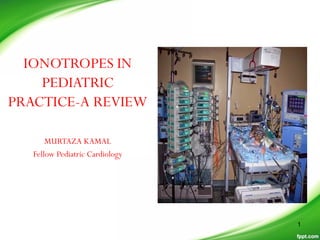
IONOTROPES IN
PEDIATRIC
PRACTICE-A REVIEW
MURTAZA KAMAL
Fellow Pediatric Cardiology
1
INTRODUCTION
• PHARMACOLOGICAL SUPPORTTO CIRCULATORY
SYSTEM- INTEGRAL PART OF INTENSIVE CARE
• AIM OFVASOACTIVEAGENTS: IMPROVEMENT OF
PERFUSION PRESSURE:
IMPROVEMENT OF CO
MODULATION OFVASCULARTONE
2
INTRODUCTION CONT…
• CO INCRESED BY:
– OPTIMISING PRELOAD
– AUGMENTING MYOCARDIAL CONTRACTILITY
(IONOTROPY)
– ENHANCING DIASTOLIC RELAXATION (LUSITROPY-
IMPROVING CORONARY CIRCULATION)
– INCREASING HR (CHRONOTROPY)
– MEDICATIONS/ MECHANICALVENTILATION:
REDUCTION OFAFTERLOAD
3
SCOPE OF THIS REVIEW
• RECEPTOR SUBTYPES
• PHARMACOLOGY OF INDIVIDUAL AGENTS
• IMPORTANT POINTS DURING
ADMINISTRATION
• PHOSPHO DIESTERASE III (-)sAND
VASOPRESSINS
• NEWER IONOTROPICAGENTS
• CHOICE OF IONOTROPES IN DIFFERENT
SITUATIONS 4
RECEPTOR SUBTYPES
5
RECEPTOR SUPTYPES
• ADRENALGIC RECEPTORS:
ALPHA 1, 2; BETA 1,2,3
• DOPAMINERGIC RECEPTORS:
D1,2,3,4,5
• VASOPRESSIN RECEPTORS:
V1, 2
6
ALPHA 1 RECEPTORS
7
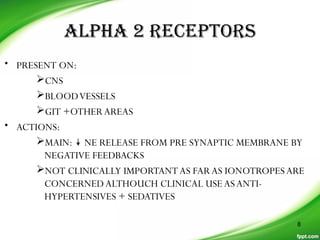
ALPHA 2 RECEPTORS
• PRESENT ON:
CNS
BLOODVESSELS
GIT +OTHER AREAS
• ACTIONS:
MAIN: NE RELEASE FROM PRE SYNAPTIC MEMBRANE BY↡
NEGATIVE FEEDBACKS
NOT CLINICALLY IMPORTANT AS FAR AS IONOTROPESARE
CONCERNEDALTHOUCH CLINICAL USEASANTI-
HYPERTENSIVES + SEDATIVES
8
BETA 1 RECEPTORS
• PRESENT ON:
HEART
KIDNEYS
• ACTIONS:
↑ RATE OF PHASE 4 DEPOLARISATION IN SA
NODE
↑ VELOCITY OF CONDUCTION THROUGH AV
NODE
HENCE: +VE CHRONOTROPHY (↑ HR)
9
BETA 1 RECEPTORS CONT…
• ACTIONS CONT…:
+VE IONOTROPY (↑ MYOCARDIAL
CONTRACTILITY)
HENCE: INCREASING STROKE VOLUME
– CO =HR X SV
– HENCE CO ↑
– ↑ RENIN RELEASE FROM KIDNEYS
10
BETA 2 RECEPTORS
• PRESENT ON:
SMOOTH MUSCLES OFAIRWAYS
BLOODVESSELS
UTERUS
UB: DETRUSUR MUSCLES
LIVER
MYOCARDIUM (LESS PROMINENTTHAN BETA 1)
11
BETA 2 RECEPTORS CONT…
• ACTIONS:
BRONCHODILATATION
VASODILATATION: MOSTLY IN MUSCLES
↑ BLOOD SUGAR: GLYCOGENOLYSIS+ NEO-
GLUCOGENESIS
SOME +VE CHRONOTROPIC AND +VE
IONOTROPIC EFFECTS
12
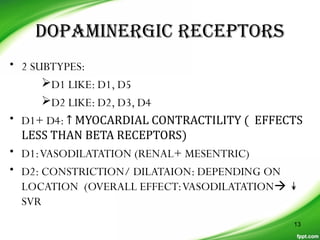
DOPAMINERGIC RECEPTORS
• 2 SUBTYPES:
D1 LIKE: D1, D5
D2 LIKE: D2, D3, D4
• D1+ D4: ↑ MYOCARDIAL CONTRACTILITY ( EFFECTS
LESS THAN BETA RECEPTORS)
• D1:VASODILATATION (RENAL+ MESENTRIC)
• D2: CONSTRICTION/ DILATAION: DEPENDING ON
LOCATION (OVERALL EFFECT:VASODILATATION ↡
SVR
13
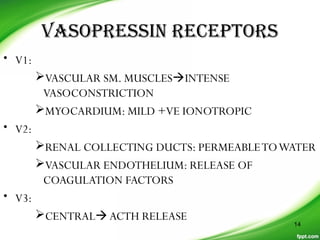
VASOPRESSIN RECEPTORS
• V1:
VASCULAR SM. MUSCLESINTENSE
VASOCONSTRICTION
MYOCARDIUM: MILD +VE IONOTROPIC
• V2:
RENAL COLLECTING DUCTS: PERMEABLETOWATER
VASCULAR ENDOTHELIUM: RELEASE OF
COAGULATION FACTORS
• V3:
CENTRALACTH RELEASE
14
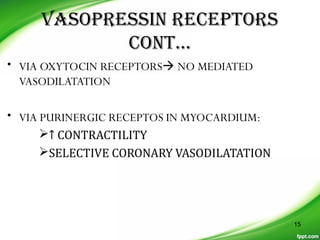
VASOPRESSIN RECEPTORS
CONT…
• VIA OXYTOCIN RECEPTORS NO MEDIATED
VASODILATATION
• VIA PURINERGIC RECEPTOS IN MYOCARDIUM:
↑ CONTRACTILITY
SELECTIVE CORONARY VASODILATATION
15
PHARMACOLOGY OF
INDIVIDUAL DRUGS
16
ADRENALINE
• STIMULATESALLADRENALGIC RECEPTORS ↑
CONTRACTILITY, ↑ HR, ↑ SVR
• ↑ CONTRACTILITY ↑ SV
• ↑ SV+ ↑HR ↑CO
• ↑CO+ ↑SVR ↑BP (SYSTERMIC+ PULMONARY)
• LOW DOSE: BETA EFFECT PREDOMINATES 17
ADR CONT…
• ↑HR+ ↑SVR ↑CARDIAC O2 DEMAND
• CORONARY VASODILATATION: DUE TO LOCAL
EFFECTS ↑ CORONARY FLOW
• BETA EFFECT: HYPERGLYCEMIA
• ↑LACTATE: METABOLIC ACIDOSIS (NO EVIDENCE
OF ADVERSE OUTCOME)
• DOSE: 0.05-1 mcg/kg/min
18
NOR ADRENALINE
 MOSTLYA PRESSORAGENT INTENSEVASO-
CONSTRICTION+ ↑ SVR HENCE, BOTH SBP+ DBP ↑
 SOME +VE IONOTROPIC EFFECT
 MINIMAL +VE CHRONOTROPY DUE TO REFLEX
BRADYCARDIA ADVANTAGEOUS IN PTS. WITH
INTRINSIC TACHYCARDIA
19
NOR ADR CONT…
 HIGH DOSAGE: MESENTRIC, RENAL, CUTANEOUS
VASCULATURE COMPROMISED: NO CLINICAL
STUDY PROOF
 RELATIVELY SPARES CEREBRAL + CORONARY
 DOSE: 0.05-1 mcg/kg/min
20
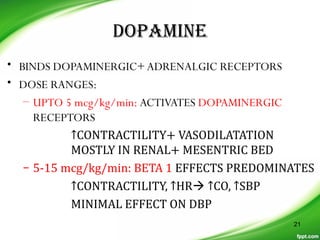
DOPAMINE
• BINDS DOPAMINERGIC+ADRENALGIC RECEPTORS
• DOSE RANGES:
– UPTO 5 mcg/kg/min: ACTIVATES DOPAMINERGIC
RECEPTORS
↑CONTRACTILITY+ VASODILATATION
MOSTLY IN RENAL+ MESENTRIC BED
– 5-15 mcg/kg/min: BETA 1 EFFECTS PREDOMINATES
↑CONTRACTILITY, ↑HR ↑CO, ↑SBP
MINIMAL EFFECT ON DBP
21
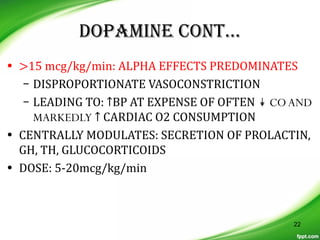
DOPAMINE CONT…
• >15 mcg/kg/min: ALPHA EFFECTS PREDOMINATES
– DISPROPORTIONATE VASOCONSTRICTION
– LEADING TO: ↑BP AT EXPENSE OF OFTEN COAND↡
MARKEDLY ↑ CARDIAC O2 CONSUMPTION
• CENTRALLY MODULATES: SECRETION OF PROLACTIN,
GH, TH, GLUCOCORTICOIDS
• DOSE: 5-20mcg/kg/min
22
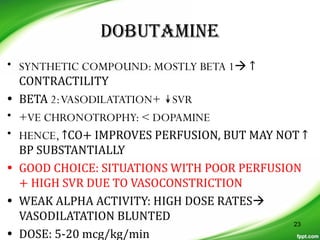
DOBUTAMINE
• SYNTHETIC COMPOUND: MOSTLY BETA 1 ↑
CONTRACTILITY
• BETA 2:VASODILATATION+ SVR↡
• +VE CHRONOTROPHY: < DOPAMINE
• HENCE, ↑CO+ IMPROVES PERFUSION, BUT MAY NOT ↑
BP SUBSTANTIALLY
• GOOD CHOICE: SITUATIONS WITH POOR PERFUSION
+ HIGH SVR DUE TO VASOCONSTRICTION
• WEAK ALPHA ACTIVITY: HIGH DOSE RATES
VASODILATATION BLUNTED
• DOSE: 5-20 mcg/kg/min
23
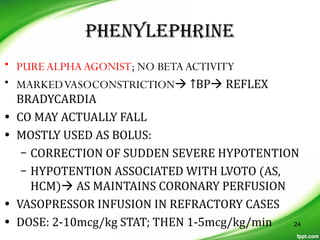
PHENYLEPHRINE
• PUREALPHAAGONIST; NO BETAACTIVITY
• MARKEDVASOCONSTRICTION ↑BP REFLEX
BRADYCARDIA
• CO MAY ACTUALLY FALL
• MOSTLY USED AS BOLUS:
– CORRECTION OF SUDDEN SEVERE HYPOTENTION
– HYPOTENTION ASSOCIATED WITH LVOTO (AS,
HCM) AS MAINTAINS CORONARY PERFUSION
• VASOPRESSOR INFUSION IN REFRACTORY CASES
• DOSE: 2-10mcg/kg STAT; THEN 1-5mcg/kg/min 24
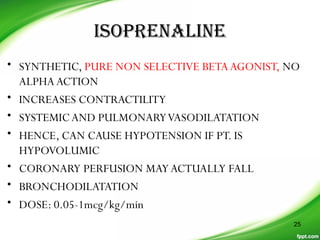
ISOPRENALINE
• SYNTHETIC, PURE NON SELECTIVE BETAAGONIST, NO
ALPHAACTION
• INCREASES CONTRACTILITY
• SYSTEMICAND PULMONARYVASODILATATION
• HENCE, CAN CAUSE HYPOTENSION IF PT. IS
HYPOVOLUMIC
• CORONARY PERFUSION MAYACTUALLY FALL
• BRONCHODILATATION
• DOSE: 0.05-1mcg/kg/min
25
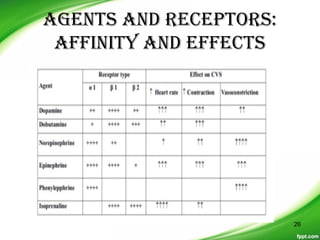
AGENTS AND RECEPTORS:
AFFINITY AND EFFECTS
26
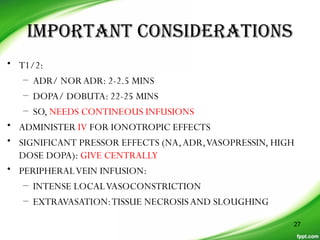
IMPORTANT CONSIDERATIONS
• T1/2:
– ADR/ NOR ADR: 2-2.5 MINS
– DOPA/ DOBUTA: 22-25 MINS
– SO, NEEDS CONTINEOUS INFUSIONS
• ADMINISTER IV FOR IONOTROPIC EFFECTS
• SIGNIFICANT PRESSOR EFFECTS (NA,ADR,VASOPRESSIN, HIGH
DOSE DOPA): GIVE CENTRALLY
• PERIPHERALVEIN INFUSION:
– INTENSE LOCALVASOCONSTRICTION
– EXTRAVASATION:TISSUE NECROSISAND SLOUGHING
27
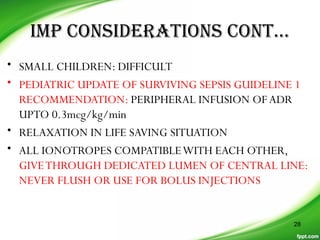
IMP CONSIDERATIONS CONT…
• SMALL CHILDREN: DIFFICULT
• PEDIATRIC UPDATE OF SURVIVING SEPSIS GUIDELINE 1
RECOMMENDATION: PERIPHERAL INFUSION OFADR
UPTO 0.3mcg/kg/min
• RELAXATION IN LIFE SAVING SITUATION
• ALL IONOTROPES COMPATIBLEWITH EACH OTHER,
GIVETHROUGH DEDICATED LUMEN OF CENTRAL LINE:
NEVER FLUSH OR USE FOR BOLUS INJECTIONS
28
IMP CONSIDERATIONS CONT…
• MYOCARDIAL O2 DEMAND ↑ BY ALL
– ↑HR+ ↑SVR ↑O2 DEMAND
– ↑HR DIASTOLE TIME↡CORONARY PERFUSION
TIME ↡
– SO, AT V. HIGH HRs CAN CRITICALLY AFFECT O2
DELIVERY TO HEART
29
IMP CONSIDERATIONS CONT…
• CORRECTABLE FACTORS CAUSING EFFECTIVENESS:↡
• 1. ACIDOSIS:
MECHANISMS:
↡ SENSITIVITYTO CALCIUM
↡ NO. OF RECEPTORS
↡ C-AMP LEVELS
ANIMAL MODELS: OVERCAME USING HIGHER DOSES
• 2. HYPOXIA: SAME EFFECTS ONALLAGENTS
EFFECT MORE PRONOUNCED
NOT OVERCOME BY ↑DOSE
• 3. HYPOCALCIMIA 30
IMP CONSIDERATIONS CONT…
• NON CORRECTABLE FACTORS CAUSING ↡
EFFECTIVENESS:
• 1. PROLONGED USE:
– DESENSITISATION
– RECEPTOR DOWN REGULATION
– ↡ GENERATION OF NEW RECEPTORS
– DOWN REGULATION OFADENYLATE CYCLASE
– G- PROTEIN MEDIATED METHODS
31
IMP CONSIDERATIONS CONT…
• 2. SEPSIS:
ENDOTOXINS
NO
INTERLEUKINS
RELATIVEADRENAL INSUFFICIENCY
STEROID REPLACEMENT IN IONOTROPE
RESISTANCE SHOKE: BEING PRACTICED
• POTENTIALAREA OF RESEARCH + DEVELOPMENT
32
PHOSPHO DIESTERASE III (-)S
MILRININE
INAMRINONE
33
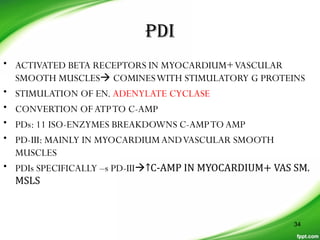
PDI
• ACTIVATED BETA RECEPTORS IN MYOCARDIUM+VASCULAR
SMOOTH MUSCLES COMINESWITH STIMULATORY G PROTEINS
• STIMULATION OF EN. ADENYLATE CYCLASE
• CONVERTION OFATPTO C-AMP
• PDs: 11 ISO-ENZYMES BREAKDOWNS C-AMPTOAMP
• PD-III: MAINLY IN MYOCARDIUMANDVASCULAR SMOOTH
MUSCLES
• PDIs SPECIFICALLY –s PD-III↑C-AMP IN MYOCARDIUM+ VAS SM.
MSLS
34
PDI CONT…
• C-AMP STIMULATES C-AMPASSOCIATED PROTEIN
KINESES ↑ INTRACELLULAR Ca++ IN
MYOCARDIUM ↑CONTRACTILITY+ CHRONOTROPY
• ↑ Ca++ IN SARCOPLASMIC RETICULUM OF VAS SM.
MSLS VASODILATATION+ AFTERLOAD: BOTH↡
SYSTEMIC+ PULMONARY CIRCULATION
• ↡ DIASTOLIC DYSFUNCTION: MAKINGVENTRICLES MORE
RELAXED+ RECEPTIVE HENCE, PRE-LOAD↡
(LUSITROPY)
• HENCE; ↑ CONTRACTILITY, BOTH PRE+AFTERLOAD↡ 
IONODILATORS 35
PDI CONT…
• ↑CO ↑ PERFUSION, NO/MINIMAL ↑ IN MYOCARDIAL
O2 CONSUMPTION
• EFFECT RECEPTOR INDEPENDENT: EFFECTIVE IN
RECEPTOR DOWN REGULATION
• BUT, SVR↡  HYPOTENSION
• HENCE, USEFUL IN SITUATIONSWITH CO,WHERE BP↡
NOT LOW+SVR ↑, OFTEN WITH PERIPHERAL
VASOCONSTRICTION
• USEFUL IN PHT+ ACUTE RT VENTRICULAR FAILURE
• USES: POST OP CARDIAC PTS, SELECTIVE PTS. WITH
SEPSIS
36
PDI CONT…
• AGENTS:
– MILRINONE (T1/2-2.3 hrs)
– IAMRINONE (AMRINONE) (T1/2-5.8 hrs)
• EFFECTS: LONG LASTING
• MAIN CONCERN: HYPOTENSION
• BOTH: SVT, JUNCTIONALANDVENTRICULAR
TACHYARRTHMIAS (↑ IN HYPOKALEMIA)
37
PDI CONT…
• Milrinone:
Most widely used
 Excreted in urine(dose adjustment in renal impairment)
Dose: Bolus 50-75mcg/kg over 1,then infusion at 0.5-
0.75mcg/kg/min
• Inamrinone :
Thrombocytopenia(2.4%). Platelets be monitored and Inamrinone
stopped if platelet count< 50,000/cmm
Dose: Bolus of 1-3mg/kg over 1 hour,then infusion at 5 -
15 mcg/kg/min
38
VASOPRESSIN(VP)/ ADH
• Natural hormone
• Posterior pituitary
• Physiologic states: Minimal role in BP maintaining, Main role: Maintining
plasma volume/ water balance-serum osmolarity
• Normal level: 4-20pg/ml
• Shock: Levels increases 1800pg/ml  Stress response:At this level
Control over vascular tone Influences BP
• Relative deficiency in sepsis in 1/3rd
patientsAdult studies
• As shock state continues: Levels drops
• This relative/ absolute deficiency: Basis of use in shock
• Pediatric data: Inconsistant
39
VASOPRESSIN(VP)/ ADH
CONT…
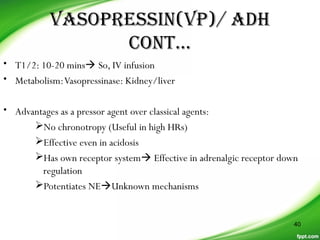
• T1/2: 10-20 mins So, IV infusion
• Metabolism:Vasopressinase: Kidney/liver
• Advantages as a pressor agent over classical agents:
No chronotropy (Useful in high HRs)
Effective even in acidosis
Has own receptor system Effective in adrenalgic receptor down
regulation
Potentiates NEUnknown mechanisms
40
Vasopressin(Vp)/ aDH
ConT…
• IntrinsicVP level frequently low in shock states: Subjects often actually found
to be highly sensitive to it, so that, even a small dose, which would have no
effect in a normotensive, healthy subject can significantly increase BP in a
patient with shock
• Clinical uses in diabetes insipidus, variceal bleeding
• Dose range:0.0003 - 0.0009 unit/kg/min
41
neWer ionoTropes
LEVOSIMENDAN
ISTAROXIME
42
LeVosimenDan
• Calcium sensitizing agent
• Binds to cardiac troponin C in a calcium-dependent process changing
configuration of tropomyosin↑contractility
• Opens up K channels in sarcolemmal membranes causing muscle relaxation in
vasculature↓SVR and coronary vasodilatation
• As do not ↑ intracellular calcium Diastolic relaxation not compromised
• Does not increase myocardial O2 demand
• SV+CO+HR↑; Mean arterial BP+ Pulmonary arterial pressure↓
43
LeVosimenDan
• ADVERSE EFFECTS:
AF: MC than dobu
Ventricular arrthmias: MC than placebo, less common than dobu
Mild hypokalemia
• T1/2: 1.5 – 2h
• Active metabolite OR-1896 :T1/2 -70-80 hours
• Measurable in serum even 14 days after stopping infusion
• Hemodynamic effects of LM persists for days after stopping
• Concerning if LM cause hypotension
• Excretion: Urine+faeces
44
LeVosimenDan
• DOSAGE:
• IV Loading dose 12 mcg/kg over 10 minutes f/by continuous infusion
of 0.1– 0.2 mcg/kg/min
• Dissolve 0.3 mg/kg of LM in 5% dextrose and run at 12 ml/hr for 10
minutes and then reduce infusion to 1–2 ml/hr
• Range loading dose: 6 – 24 mcg/kg and range of infusion:0.05 – 0.6
mcg/kg/min
45
LeVosimenDan TriaLs
• LIDO, CASINO, SURVIVE trials: Compared LM with dobutamine
• REVIVE, RUSSLAN trials: Evaluated LM in a placebo controlled fashion
• Study population had low-output heart failure of different etiologies
• All demonstrated hemodynamic benefits with greater increase in CO in LM
group
• REVIVE and SURVIVE trials could not demonstrate survival benefits
• Meta-analysis of 45 adult studies with 5480 patients: Significant mortality
benefit with 6% absolute risk reduction
• Follath F, Cleland JG, Just H, et al. Efficacy and safety of intravenous levosimendan compared with dobutamine in severe low-output heart failure (the LIDO
study): a randomised double-blind trial. Lancet. 2002;360:196–202
• Mebazaa A, Nieminen MS, Packer M, et al. Levosimendan vs dobutamine for patients with acute decompensated heart failure: the SURVIVE Randomized
Trial. JAMA. 2007;297:1883–1891
• Packer M, Leier CV. Survival in congestive heart failure during treatment with drugs with positive inotropic actions. Circulation. 1987;75(Suppl 4):55–63
• MoiseyevVS, Poder P,Andrejevs N, et al. Safety and efficacy of a novel calcium sensitizer, levosimendan, in patients with left ventricular failure due to an
acute myocardial infarction.A randomized, placebo-controlled, double-blind study (RUSSLAN). Eur Heart J. 2002; 23:1422–32
46
LeVosimenDan TriaLs
• LeoPARDS study: Multicentre UK trial underway
• Study effect of LM in sepsis Pediatric studies retrospective case series, 4 RCTs
conducted
• Majority in postoperative LCOS situations and LM compared with milrinone
• Showed trend toward an improvement in hemodynamics, reduction in lactate,
reduction in need for conventional inotrope use and ability to wean
catecholamines
• Mortality benefit: Not proven
• More data needed to further establish role
• Egan JR, Clarke AJ,Williams S, et al. Levosimendan for low cardiac output: a pediatric experience. J Int Care Med. 2006;21:183–7
• Namachivayam P, Crossland DS, ButtWW, et al. Early experience with Levosimendan in children with ventricular dysfunction. Pediatr Crit Care Med.
2006;7:445–448
• Magliola R, Moreno G,Vassallo JC, et al. Levosimendan, a new inotropic drug: experience in children with acute heart failure.Arch Argent Pediatr.
2009;107:139–145
47
isTaroxime
• Ino-lusitropy
• Short t1/2-Useful as its potential for hypotension
• ↓HR
• No reported pediatric experience
• Experimental molecule
48
inFUsion preparaTion oF
VasoaCTiVe DrUGs
• RULE OF 6:
• 6 x BodyWeight (kg) =Amount (in mg) to mix in
100ml of Solvent to give 1ml/hr = 1 microgram
/kg/min
49
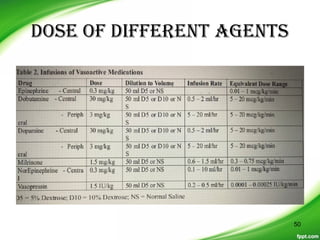
Dose oF DiFFerenT aGenTs
50
CHanGinG ionoTrope
inFUsions
• Changed under many circumstances:
Infusion running out
Changing strength of infusion (for fluid restriction)
Changing diluent of infusion (in hypo- or hyper-glycemic states)
Changing site of infusion (eg. between femoral and neck veins)
• Serious adverse incidents can take place: Patients with very labile BP and high
inotrope requirement
• Preparing next syringe should never be left until last minute
• Inotrope infusions should never be allowed to run out
• Some patients are very dependent: Not tolerate them being turned off for
even a short period of time
51
CHanGinG ionoTrope
inFUsions
• Inotropes should never be purged either: Results in uneven doses of inotropes
being delivered leading to sudden huge changes in hemodynamics and also
runs risk of causing life-threatening arrhythmias, particularly epinephrine
• 2 techniques:
Double-Pumping (piggy back):Starting 2nd
infusion through a 3 way
while 1st
is still running.When BP rises, 1st
is stopped immediately
Quick Change (Switching Technique): Running the new infusion at the
same rate as old and connecting it to pt. via 3 way turning old off:
Quickest/ Cost effective-RCTs
No statistically significant difference in variation in mean arterial
pressure
52
ionoTrope CHoiCe in
DiFFerenT siTUaTions
53
siTUaTions
• Post cardiac surgery
• Myocarditis/ Heart failure
• Resuscitation
• Septic shock
• Post cardiac arrest syndrome
• Brain dead child
54
1. posT CarDiaC sUrGerY
• LCOS: Cardiac index < 2.0 L/min per m2
• Very common between 6-18 hours after a cardiopulmonary bypass surgery
• Contributes significantly to postoperative morbidity and mortality following
cardiac surgeries
• Fall in CI may also be associated with ↑SVR +↑PVR
• Causes of LCOS:
Myocardial ischemia during aortic cross-clamping
Effects of cardioplegia
Activation of inflammatory and complement cascades
Alterations in systemic and pulmonary vascular activity
Any residual cardiac lesions
55
1. posT CarDiaC sUrGerY
ConT…
• Prevention of this hemodynamic deterioration: Significant implications for
clinical outcome
• Preload adjustments do not always suffice to provide adequate CO
pharmacological support often necessary
• Primary aim: Support myocardial contractility without increasing workload
and O2 consumption
• Traditionally, inotropic agents and vasodilators: Used to enhance tissue
perfusion and facilitate postoperative recovery
• Many prefer to use dopamine3-10 mcg/kg/min; but doses > 15 mcg/kg/min
rarely used:Vasoconstriction and tachycardia at very high doses
56
1. posT CarDiaC sUrGerY
ConT…
• Alternatives:Dobutamine, Low-dose epinephrine
• Use of catecholamines: Several drawbacks:
Increased myocardial O2 consumption
Tachycardia
↑ EDP and afterload and
Risk of arrhythmias
• Less compliant neonatal myocardium: ↑ EDP during higher-dose infusions of
catecholamines Impairing ventricular compliance and further reducing
ventricular filling
• PDI milrinone: Important vasoactive agent for use in post-cardiac surgery
children
57
1. posT CarDiaC sUrGerY
ConT…
• Efficacy and safety of prophylactic use
of milrinone in pediatric patients at
high risk of developing LCOS after
cardiac surgery
• Concluded that prophylactic use of
high-dose milrinone after pediatric
congenital heart surgery reduces risk
of LCOS
58
1. posT CarDiaC sUrGerY
ConT…
• NE + vasopressin used infrequently in select group with states of refractory
vasodilation as may sometimes occur after cardio-pulmonary bypass in
children
• Vasopressin: Useful when patients have tachyarrhythmias or sinus rates that
prohibitively limit the length of diastole
• Levosemandan: New agent that have generated a lot of interest – especially in
postoperative LCOS states
59
2. mYoCarDiTis/ HearT
FaiLUre
• Inotropic support required only in acute heart failure that is complicated by
hypotension and peripheral hypoperfusion
• Ideal inotrope in this setting:
Improves systolic and diastolic myocardial function
While decreasing systemic and PVR
Without increasing myocardial o2 consumption
– None of available agents completely fulfil all 3
• Adult studies show that use of inotropes can actually adversely impact survival
• In chronic heart failure setting there is very good adult and pediatric evidence
suggesting betablockers improve morbidity as well as mortality
60
2. MYOCARDITIS/ HEART
FAILURE
• So, inotropes should be used only if necessary and as less as possible
• Pediatric data scanty: Practices relating to use of inotropes in children with
heart failure mostly extrapolated from adult studies
• Recommended initial inotropic therapies for refractory heart failure:
Dobutamine, dopamine and milrinoneTo improve CO + enhance diuresis
by improving renal blood flow and decreasing SVR without exacerbating
systemic hypotension
• Dopamine: Increase mortality in cardiogenic shock (not specifically
myocarditis) when compared to norepinephrine
61
2. MYOCARDITIS/ HEART
FAILURE
• Desperate situations: Low dose epinephrineUsed and this should prompt
consideration for ventricular mechanical support device
• Positive pressure ventilation (Invasive/noninvasive) : Helpful by both
decreasing the work of breathing and reducing LV afterload
• Catecholamines limited by several acute and chronic factors:
(1) Down-regulation of adrenergic receptors
(2) Increased myocardial oxygen consumption
(3) Excessive chronotropy
• PDI: Other hand+ve inotropy and enhanced lusitropy, and reduce systemic
and PVR:Advantage not increasing myocardial O2 consumption
62
2. MYOCARDITIS/ HEART
FAILURE
• Milrinone sometime cause severe systemic hypotensionNecessitating co-
administration of additional pressor therapies
• These medications often used in combinationoffsetting limitations of each
other
• Randomized comparisons of milrinone and dobutamine Similar clinical
outcomes
• Levosimendan, a calcium sensitizing agent – generated a lot of interest
63
3. RESUSCITATION
• Pediatric arrests: Respiratory origin
• Epinephrine:
For ages:Vasoconstrictor effect as important as ionotropic effect to
increase coronary circulation during CPR
Makes myocardium responsive to defibrillation attempts
Dosage: IV/IO/IT
• Vasopressin:
Levels higher in survivors than non- survivors
Ability to increase BP by inc. SVR and inc. flow in coronary,
pulmonary and cerebral circulations
AHA+ERC 2010: 40U as an alternative to adr
No definite recommendation for use in CPR
64
4. POST CARDIAC ARREST
SYNDROME
• Unique and complex combination of pathophysiological processes:
(1) Post–cardiac arrest brain injury
(2) Post–cardiac arrest myocardial dysfunction
(3) Systemic ischemia/reperfusion response
• Unresolved pathological process that caused cardiac arrest
• Hemodynamic instability common after cardiac arrest
• ROSC after prolonged, complete, whole-body ischemia:An unnatural
pathophysiological state created by successful CPR
• Vasodilation: From loss of sympathetic tone and metabolic acidosis
• Persistence of reversible vasopressor dependency has been reported for up to
72 hours after out-of-hospital cardiac arrest despite preload optimization and
reversal of global myocardial dysfunction 65
4. POST CARDIAC ARREST
SYNDROME
• Critical knowledge gap exists for post-arrest interventions
• Management strategies based primarily on general principles of intensive care
or extrapolation from adults, newborns, and animal studies
• Optimal hemodynamic targets in postresuscitative period: Unclear
• Optimal MAP for post–cardiac arrest patients: Not been defined by
prospective clinical trials
• Post-cardiac arrest anoxic brain injury: Major cause of morbidity+ mortality,
responsible for 2/3rds of deaths in post- cardiac arrest period
• Loss of cerebrovascular pressure auto-regulation makes cerebral perfusion
dependent on cerebral perfusion pressure (CPP=MAP–ICP) and hence
predominantly on MAP
66
4. POST CARDIAC ARREST
SYNDROME
• Hypotension must be avoided and BP should be kept at somewhat high levels
• Good outcomes: MAP target was as low as 65 to 75 mm Hg or as high as 90
to 100 mm Hg for patients admitted after out-of-hospital cardiac arrest
• Simultaneous need to perfuse post-ischemic brain adequately without putting
unnecessary strain on post-ischemic heart: Unique to post–cardiac arrest
syndrome Selection of inotropes difficult
• Paucity of data about which vasoactive drug to select first but dopamine,
dobutamine,epinephrine all used to treat postarrest myocardial dysfunction
• Vasopressin infusion shown to have higher short term survival
• Although inotropes improve hemodynamic status of patient and ensures blood
flow to heart and brain, this improvement in organ perfusion does not
necessarily translates into improvement in outcome which still remains low
67
5. BRAIN DEAD CHILD
• Special circumstances:
– Family requests continuation of life support for some time
– Organ harvesting for a heart-beating donor organ transplant
• Maintenance of BP Crucial to maintain perfusion other organs, heart
• Develop marked hemodynamic instability: Due to loss of brain-stem reflexes
• 1st
priority when managing a brain dead patient with hypotension is to
maintain adequate effective intravascular volume
• 80% of brain-stem dead patients develop diabetes insipidus and it is common
for them to be hypovolemic
• Catecholamines are liberally used by transplant retrieval services
• Dopamine has traditionally been used for 1st-line cardiovascular support
68
5. BRAIN DEAD CHILD
• Low dose vasopressin infusion:
Treating DI during brain death evaluation and organ recovery
Restores vasomotor tone
Improve blood pressure
Reduce exogenous catecholamine requirements
• Increasingly being used as first line pressor support
• May allow reduction or complete elimination of catecholamine use in such
circumstances
• Terlipressin has also been used for similar purposes
• Canadian guidelines:Vasopressin 1st
choice vasopressor for donor resuscitation,
the second-line agents for hemodynamic support being norepinephrine,
epinephrine and phenylephrine 69
6. SEPTIC SHOCK
• One of commonest indication
• Adults problem settled:
– A state of profound vasoplagia, high CI, low SVR Needs vasopressor
primarily
• Dopa/ NA Contenders
• Sepsis occurrence in acutely ill patients study (SOAP): 1058 patients, in
shock Dopamine administration An independent risk factor for ICU
death
• Dopa: Higher HR,Arrhythmic eventsThan NA (COCHRAIN REVIEW)
• So, NA 1st
choice agent in sepsis (SURVIVING SEPSIS 2012 GUIDELINES)
70
6. SEPTIC SHOCK CONT…
• Different situation in kids:Variety of haemodynamics
• Case series 50 children with fluid refractory shock:
58%: Presented with low CO Responded to just ionotropes
±vasodilators
22%: Presented with both cardiac contractility + SVR issues
Needed both ionotropes+ vasopressors
20%: High CO+low SVR Responded to vasopressors alone
• Child can change from one state to another with illness cource
• Ceneviva G, Paschall JA, Maffei F, Carcillo JA. Hemodynamic support in fluid-refractory pediatric septicshock . Pediatrics .
1998;102(2):e19
71
6. SEPTIC SHOCK CONT…
• Cochrane review on vasopressors for hypotensive shock:
3212 patients in 23 studies
Compared 6 vasopresors –NE, dopa, vasopressin, epinephrine,
terlipressin and phenylephrine along with dobuta in different
combinations
• No evidence of superiority of any agent or combination of agents over other
• Concluded – 'Probably the choice of vasopressors in patients with shock does
not influence outcome' and‘Choice of specific vasopressor may therefore be
individualized and left to discretion of treating physicians'
72
6. SEPTIC SHOCK CONT…
• Vasopressin: Reduced need of other vasopressors and significantly increased
BP in many studies but has not shown mortality benefit
• Vasopressin is often used as a last resort vasopressor in severe shock
• VAAST: Largest multicentre adult RCT (N=778) involvingVP also did not
find any difference in 28 day or 90 day mortality betweenVP and NE
• Largest multi centre pediatric RCT (N=69) involving vasopressin in
vasodilatory shock compared vasopressin with placebo and did not find any
significant difference in any of outcomes
• Actually, mortality in vasopressin group was double that of control group –
though it did not reach statistical significance
• However, vasopressin is still largely used as a rescue vasopressor in severe
vasodilatory shock where NE has not been effective
• James A. Russell, M.D., Keith R.Walley.Vasopressin versus Norepinephrine Infusion in Patients with Septic Shock. N Engl J Med 2008;358:877-87
73
6. SEPTIC SHOCK CONT…
• Clinical practice parameters for hemodynamic support of peds and neonatal
septic shock: 2007 update fromAmerican college of critical care medicine
• Optimise preload 1st
by fluid boluses + dopa peripherally centarl access
obtained dopa increased if not working catecholamines started or
increased No response Cathecolamine resistant shock:
1. COLD SHOCKWITH NORMAL BP-LOW CI/ HIGH SVR
2. COLD SHOCKWITH LOW BP- LOW CI/ LOW SVR
3.WARM SHOCKWITH LOW BP- HIGH CI/LOW SVR
74
1. COLD SHOCK WITH NORMAL
BP-LOW CI/ HIGH SVR
• Who has not responded to fluid and epinephrine Nitrosovasodilators like
nitroprusside or nitroglycerine (1st
line)
• Toxic side effects or continued low CO state: Milrinone/ inamrinone (2nd
line)
• Levosimendan and enoximone has also been suggested
• 2012 guideline does not mention primary vasodilators as first line
• Mentions PDIs first and that probably reflects practice of most pediatric
intensivists
75
2. COLD SHOCK WITH LOW BP-
LOW CI/ LOW SVR
• Who has not responded to fluid and epinephrineAdd NE to increase DBP
and SVR
• Once an adequate BP is achieved, PDIs or levosimendan can be added to
improve CI/ MVO2
76
3. WARM SHOCK WITH LOW BP-
HIGH CI/LOW SVR
• Who have not responded to fluid and NE Low doseVP, angiotensin and
terlipressin
• These potent vasoconstrictors can reduce CO Recommended that these are
used with CO/ MVO2 monitoring, and if these low, additional inotropes like
low dose epinephrine or dobutamine may be needed or vasopressors may
need to be reduced
77
TAKE HOME MESSAGE
• One of the most commonly used group of drugs in intensive care setting
• Not much evidence base; pediatric esp regarding classical adrenergic agents
• Surprising: Considering fact that they have been in use for long time
• A significant void: Need of more robust clinical studies to generate more
evidence
• On the other hand: Important new entrant: Milrinone, in the group with
properties that are significantly different from traditional agents and they have
found their well earned place in modern therapeutics
• Newer agents: Levosimendan – which has been used for some time and their
role in Pediatric practice is being established
• There are yet other molecules – which are in the process of development
• : 78
THANK YOU FOR YOR
PATIENCE
79

IONOTROPES IN PEDIATRIC PRACTICE

  • 1.
    IONOTROPES IN PEDIATRIC PRACTICE-A REVIEW MURTAZAKAMAL Fellow Pediatric Cardiology 1
  • 2.
    INTRODUCTION • PHARMACOLOGICAL SUPPORTTOCIRCULATORY SYSTEM- INTEGRAL PART OF INTENSIVE CARE • AIM OFVASOACTIVEAGENTS: IMPROVEMENT OF PERFUSION PRESSURE: IMPROVEMENT OF CO MODULATION OFVASCULARTONE 2
  • 3.
    INTRODUCTION CONT… • COINCRESED BY: – OPTIMISING PRELOAD – AUGMENTING MYOCARDIAL CONTRACTILITY (IONOTROPY) – ENHANCING DIASTOLIC RELAXATION (LUSITROPY- IMPROVING CORONARY CIRCULATION) – INCREASING HR (CHRONOTROPY) – MEDICATIONS/ MECHANICALVENTILATION: REDUCTION OFAFTERLOAD 3
  • 4.
    SCOPE OF THISREVIEW • RECEPTOR SUBTYPES • PHARMACOLOGY OF INDIVIDUAL AGENTS • IMPORTANT POINTS DURING ADMINISTRATION • PHOSPHO DIESTERASE III (-)sAND VASOPRESSINS • NEWER IONOTROPICAGENTS • CHOICE OF IONOTROPES IN DIFFERENT SITUATIONS 4
  • 5.
  • 6.
    RECEPTOR SUPTYPES • ADRENALGICRECEPTORS: ALPHA 1, 2; BETA 1,2,3 • DOPAMINERGIC RECEPTORS: D1,2,3,4,5 • VASOPRESSIN RECEPTORS: V1, 2 6
  • 7.
  • 8.
    ALPHA 2 RECEPTORS •PRESENT ON: CNS BLOODVESSELS GIT +OTHER AREAS • ACTIONS: MAIN: NE RELEASE FROM PRE SYNAPTIC MEMBRANE BY↡ NEGATIVE FEEDBACKS NOT CLINICALLY IMPORTANT AS FAR AS IONOTROPESARE CONCERNEDALTHOUCH CLINICAL USEASANTI- HYPERTENSIVES + SEDATIVES 8
  • 9.
    BETA 1 RECEPTORS •PRESENT ON: HEART KIDNEYS • ACTIONS: ↑ RATE OF PHASE 4 DEPOLARISATION IN SA NODE ↑ VELOCITY OF CONDUCTION THROUGH AV NODE HENCE: +VE CHRONOTROPHY (↑ HR) 9
  • 10.
    BETA 1 RECEPTORSCONT… • ACTIONS CONT…: +VE IONOTROPY (↑ MYOCARDIAL CONTRACTILITY) HENCE: INCREASING STROKE VOLUME – CO =HR X SV – HENCE CO ↑ – ↑ RENIN RELEASE FROM KIDNEYS 10
  • 11.
    BETA 2 RECEPTORS •PRESENT ON: SMOOTH MUSCLES OFAIRWAYS BLOODVESSELS UTERUS UB: DETRUSUR MUSCLES LIVER MYOCARDIUM (LESS PROMINENTTHAN BETA 1) 11
  • 12.
    BETA 2 RECEPTORSCONT… • ACTIONS: BRONCHODILATATION VASODILATATION: MOSTLY IN MUSCLES ↑ BLOOD SUGAR: GLYCOGENOLYSIS+ NEO- GLUCOGENESIS SOME +VE CHRONOTROPIC AND +VE IONOTROPIC EFFECTS 12
  • 13.
    DOPAMINERGIC RECEPTORS • 2SUBTYPES: D1 LIKE: D1, D5 D2 LIKE: D2, D3, D4 • D1+ D4: ↑ MYOCARDIAL CONTRACTILITY ( EFFECTS LESS THAN BETA RECEPTORS) • D1:VASODILATATION (RENAL+ MESENTRIC) • D2: CONSTRICTION/ DILATAION: DEPENDING ON LOCATION (OVERALL EFFECT:VASODILATATION ↡ SVR 13
  • 14.
    VASOPRESSIN RECEPTORS • V1: VASCULARSM. MUSCLESINTENSE VASOCONSTRICTION MYOCARDIUM: MILD +VE IONOTROPIC • V2: RENAL COLLECTING DUCTS: PERMEABLETOWATER VASCULAR ENDOTHELIUM: RELEASE OF COAGULATION FACTORS • V3: CENTRALACTH RELEASE 14
  • 15.
    VASOPRESSIN RECEPTORS CONT… • VIAOXYTOCIN RECEPTORS NO MEDIATED VASODILATATION • VIA PURINERGIC RECEPTOS IN MYOCARDIUM: ↑ CONTRACTILITY SELECTIVE CORONARY VASODILATATION 15
  • 16.
  • 17.
    ADRENALINE • STIMULATESALLADRENALGIC RECEPTORS↑ CONTRACTILITY, ↑ HR, ↑ SVR • ↑ CONTRACTILITY ↑ SV • ↑ SV+ ↑HR ↑CO • ↑CO+ ↑SVR ↑BP (SYSTERMIC+ PULMONARY) • LOW DOSE: BETA EFFECT PREDOMINATES 17
  • 18.
    ADR CONT… • ↑HR+↑SVR ↑CARDIAC O2 DEMAND • CORONARY VASODILATATION: DUE TO LOCAL EFFECTS ↑ CORONARY FLOW • BETA EFFECT: HYPERGLYCEMIA • ↑LACTATE: METABOLIC ACIDOSIS (NO EVIDENCE OF ADVERSE OUTCOME) • DOSE: 0.05-1 mcg/kg/min 18
  • 19.
    NOR ADRENALINE  MOSTLYAPRESSORAGENT INTENSEVASO- CONSTRICTION+ ↑ SVR HENCE, BOTH SBP+ DBP ↑  SOME +VE IONOTROPIC EFFECT  MINIMAL +VE CHRONOTROPY DUE TO REFLEX BRADYCARDIA ADVANTAGEOUS IN PTS. WITH INTRINSIC TACHYCARDIA 19
  • 20.
    NOR ADR CONT… HIGH DOSAGE: MESENTRIC, RENAL, CUTANEOUS VASCULATURE COMPROMISED: NO CLINICAL STUDY PROOF  RELATIVELY SPARES CEREBRAL + CORONARY  DOSE: 0.05-1 mcg/kg/min 20
  • 21.
    DOPAMINE • BINDS DOPAMINERGIC+ADRENALGICRECEPTORS • DOSE RANGES: – UPTO 5 mcg/kg/min: ACTIVATES DOPAMINERGIC RECEPTORS ↑CONTRACTILITY+ VASODILATATION MOSTLY IN RENAL+ MESENTRIC BED – 5-15 mcg/kg/min: BETA 1 EFFECTS PREDOMINATES ↑CONTRACTILITY, ↑HR ↑CO, ↑SBP MINIMAL EFFECT ON DBP 21
  • 22.
    DOPAMINE CONT… • >15mcg/kg/min: ALPHA EFFECTS PREDOMINATES – DISPROPORTIONATE VASOCONSTRICTION – LEADING TO: ↑BP AT EXPENSE OF OFTEN COAND↡ MARKEDLY ↑ CARDIAC O2 CONSUMPTION • CENTRALLY MODULATES: SECRETION OF PROLACTIN, GH, TH, GLUCOCORTICOIDS • DOSE: 5-20mcg/kg/min 22
  • 23.
    DOBUTAMINE • SYNTHETIC COMPOUND:MOSTLY BETA 1 ↑ CONTRACTILITY • BETA 2:VASODILATATION+ SVR↡ • +VE CHRONOTROPHY: < DOPAMINE • HENCE, ↑CO+ IMPROVES PERFUSION, BUT MAY NOT ↑ BP SUBSTANTIALLY • GOOD CHOICE: SITUATIONS WITH POOR PERFUSION + HIGH SVR DUE TO VASOCONSTRICTION • WEAK ALPHA ACTIVITY: HIGH DOSE RATES VASODILATATION BLUNTED • DOSE: 5-20 mcg/kg/min 23
  • 24.
    PHENYLEPHRINE • PUREALPHAAGONIST; NOBETAACTIVITY • MARKEDVASOCONSTRICTION ↑BP REFLEX BRADYCARDIA • CO MAY ACTUALLY FALL • MOSTLY USED AS BOLUS: – CORRECTION OF SUDDEN SEVERE HYPOTENTION – HYPOTENTION ASSOCIATED WITH LVOTO (AS, HCM) AS MAINTAINS CORONARY PERFUSION • VASOPRESSOR INFUSION IN REFRACTORY CASES • DOSE: 2-10mcg/kg STAT; THEN 1-5mcg/kg/min 24
  • 25.
    ISOPRENALINE • SYNTHETIC, PURENON SELECTIVE BETAAGONIST, NO ALPHAACTION • INCREASES CONTRACTILITY • SYSTEMICAND PULMONARYVASODILATATION • HENCE, CAN CAUSE HYPOTENSION IF PT. IS HYPOVOLUMIC • CORONARY PERFUSION MAYACTUALLY FALL • BRONCHODILATATION • DOSE: 0.05-1mcg/kg/min 25
  • 26.
  • 27.
    IMPORTANT CONSIDERATIONS • T1/2: –ADR/ NOR ADR: 2-2.5 MINS – DOPA/ DOBUTA: 22-25 MINS – SO, NEEDS CONTINEOUS INFUSIONS • ADMINISTER IV FOR IONOTROPIC EFFECTS • SIGNIFICANT PRESSOR EFFECTS (NA,ADR,VASOPRESSIN, HIGH DOSE DOPA): GIVE CENTRALLY • PERIPHERALVEIN INFUSION: – INTENSE LOCALVASOCONSTRICTION – EXTRAVASATION:TISSUE NECROSISAND SLOUGHING 27
  • 28.
    IMP CONSIDERATIONS CONT… •SMALL CHILDREN: DIFFICULT • PEDIATRIC UPDATE OF SURVIVING SEPSIS GUIDELINE 1 RECOMMENDATION: PERIPHERAL INFUSION OFADR UPTO 0.3mcg/kg/min • RELAXATION IN LIFE SAVING SITUATION • ALL IONOTROPES COMPATIBLEWITH EACH OTHER, GIVETHROUGH DEDICATED LUMEN OF CENTRAL LINE: NEVER FLUSH OR USE FOR BOLUS INJECTIONS 28
  • 29.
    IMP CONSIDERATIONS CONT… •MYOCARDIAL O2 DEMAND ↑ BY ALL – ↑HR+ ↑SVR ↑O2 DEMAND – ↑HR DIASTOLE TIME↡CORONARY PERFUSION TIME ↡ – SO, AT V. HIGH HRs CAN CRITICALLY AFFECT O2 DELIVERY TO HEART 29
  • 30.
    IMP CONSIDERATIONS CONT… •CORRECTABLE FACTORS CAUSING EFFECTIVENESS:↡ • 1. ACIDOSIS: MECHANISMS: ↡ SENSITIVITYTO CALCIUM ↡ NO. OF RECEPTORS ↡ C-AMP LEVELS ANIMAL MODELS: OVERCAME USING HIGHER DOSES • 2. HYPOXIA: SAME EFFECTS ONALLAGENTS EFFECT MORE PRONOUNCED NOT OVERCOME BY ↑DOSE • 3. HYPOCALCIMIA 30
  • 31.
    IMP CONSIDERATIONS CONT… •NON CORRECTABLE FACTORS CAUSING ↡ EFFECTIVENESS: • 1. PROLONGED USE: – DESENSITISATION – RECEPTOR DOWN REGULATION – ↡ GENERATION OF NEW RECEPTORS – DOWN REGULATION OFADENYLATE CYCLASE – G- PROTEIN MEDIATED METHODS 31
  • 32.
    IMP CONSIDERATIONS CONT… •2. SEPSIS: ENDOTOXINS NO INTERLEUKINS RELATIVEADRENAL INSUFFICIENCY STEROID REPLACEMENT IN IONOTROPE RESISTANCE SHOKE: BEING PRACTICED • POTENTIALAREA OF RESEARCH + DEVELOPMENT 32
  • 33.
    PHOSPHO DIESTERASE III(-)S MILRININE INAMRINONE 33
  • 34.
    PDI • ACTIVATED BETARECEPTORS IN MYOCARDIUM+VASCULAR SMOOTH MUSCLES COMINESWITH STIMULATORY G PROTEINS • STIMULATION OF EN. ADENYLATE CYCLASE • CONVERTION OFATPTO C-AMP • PDs: 11 ISO-ENZYMES BREAKDOWNS C-AMPTOAMP • PD-III: MAINLY IN MYOCARDIUMANDVASCULAR SMOOTH MUSCLES • PDIs SPECIFICALLY –s PD-III↑C-AMP IN MYOCARDIUM+ VAS SM. MSLS 34
  • 35.
    PDI CONT… • C-AMPSTIMULATES C-AMPASSOCIATED PROTEIN KINESES ↑ INTRACELLULAR Ca++ IN MYOCARDIUM ↑CONTRACTILITY+ CHRONOTROPY • ↑ Ca++ IN SARCOPLASMIC RETICULUM OF VAS SM. MSLS VASODILATATION+ AFTERLOAD: BOTH↡ SYSTEMIC+ PULMONARY CIRCULATION • ↡ DIASTOLIC DYSFUNCTION: MAKINGVENTRICLES MORE RELAXED+ RECEPTIVE HENCE, PRE-LOAD↡ (LUSITROPY) • HENCE; ↑ CONTRACTILITY, BOTH PRE+AFTERLOAD↡  IONODILATORS 35
  • 36.
    PDI CONT… • ↑CO↑ PERFUSION, NO/MINIMAL ↑ IN MYOCARDIAL O2 CONSUMPTION • EFFECT RECEPTOR INDEPENDENT: EFFECTIVE IN RECEPTOR DOWN REGULATION • BUT, SVR↡  HYPOTENSION • HENCE, USEFUL IN SITUATIONSWITH CO,WHERE BP↡ NOT LOW+SVR ↑, OFTEN WITH PERIPHERAL VASOCONSTRICTION • USEFUL IN PHT+ ACUTE RT VENTRICULAR FAILURE • USES: POST OP CARDIAC PTS, SELECTIVE PTS. WITH SEPSIS 36
  • 37.
    PDI CONT… • AGENTS: –MILRINONE (T1/2-2.3 hrs) – IAMRINONE (AMRINONE) (T1/2-5.8 hrs) • EFFECTS: LONG LASTING • MAIN CONCERN: HYPOTENSION • BOTH: SVT, JUNCTIONALANDVENTRICULAR TACHYARRTHMIAS (↑ IN HYPOKALEMIA) 37
  • 38.
    PDI CONT… • Milrinone: Mostwidely used  Excreted in urine(dose adjustment in renal impairment) Dose: Bolus 50-75mcg/kg over 1,then infusion at 0.5- 0.75mcg/kg/min • Inamrinone : Thrombocytopenia(2.4%). Platelets be monitored and Inamrinone stopped if platelet count< 50,000/cmm Dose: Bolus of 1-3mg/kg over 1 hour,then infusion at 5 - 15 mcg/kg/min 38
  • 39.
    VASOPRESSIN(VP)/ ADH • Naturalhormone • Posterior pituitary • Physiologic states: Minimal role in BP maintaining, Main role: Maintining plasma volume/ water balance-serum osmolarity • Normal level: 4-20pg/ml • Shock: Levels increases 1800pg/ml  Stress response:At this level Control over vascular tone Influences BP • Relative deficiency in sepsis in 1/3rd patientsAdult studies • As shock state continues: Levels drops • This relative/ absolute deficiency: Basis of use in shock • Pediatric data: Inconsistant 39
  • 40.
    VASOPRESSIN(VP)/ ADH CONT… • T1/2:10-20 mins So, IV infusion • Metabolism:Vasopressinase: Kidney/liver • Advantages as a pressor agent over classical agents: No chronotropy (Useful in high HRs) Effective even in acidosis Has own receptor system Effective in adrenalgic receptor down regulation Potentiates NEUnknown mechanisms 40
  • 41.
    Vasopressin(Vp)/ aDH ConT… • IntrinsicVPlevel frequently low in shock states: Subjects often actually found to be highly sensitive to it, so that, even a small dose, which would have no effect in a normotensive, healthy subject can significantly increase BP in a patient with shock • Clinical uses in diabetes insipidus, variceal bleeding • Dose range:0.0003 - 0.0009 unit/kg/min 41
  • 42.
  • 43.
    LeVosimenDan • Calcium sensitizingagent • Binds to cardiac troponin C in a calcium-dependent process changing configuration of tropomyosin↑contractility • Opens up K channels in sarcolemmal membranes causing muscle relaxation in vasculature↓SVR and coronary vasodilatation • As do not ↑ intracellular calcium Diastolic relaxation not compromised • Does not increase myocardial O2 demand • SV+CO+HR↑; Mean arterial BP+ Pulmonary arterial pressure↓ 43
  • 44.
    LeVosimenDan • ADVERSE EFFECTS: AF:MC than dobu Ventricular arrthmias: MC than placebo, less common than dobu Mild hypokalemia • T1/2: 1.5 – 2h • Active metabolite OR-1896 :T1/2 -70-80 hours • Measurable in serum even 14 days after stopping infusion • Hemodynamic effects of LM persists for days after stopping • Concerning if LM cause hypotension • Excretion: Urine+faeces 44
  • 45.
    LeVosimenDan • DOSAGE: • IVLoading dose 12 mcg/kg over 10 minutes f/by continuous infusion of 0.1– 0.2 mcg/kg/min • Dissolve 0.3 mg/kg of LM in 5% dextrose and run at 12 ml/hr for 10 minutes and then reduce infusion to 1–2 ml/hr • Range loading dose: 6 – 24 mcg/kg and range of infusion:0.05 – 0.6 mcg/kg/min 45
  • 46.
    LeVosimenDan TriaLs • LIDO,CASINO, SURVIVE trials: Compared LM with dobutamine • REVIVE, RUSSLAN trials: Evaluated LM in a placebo controlled fashion • Study population had low-output heart failure of different etiologies • All demonstrated hemodynamic benefits with greater increase in CO in LM group • REVIVE and SURVIVE trials could not demonstrate survival benefits • Meta-analysis of 45 adult studies with 5480 patients: Significant mortality benefit with 6% absolute risk reduction • Follath F, Cleland JG, Just H, et al. Efficacy and safety of intravenous levosimendan compared with dobutamine in severe low-output heart failure (the LIDO study): a randomised double-blind trial. Lancet. 2002;360:196–202 • Mebazaa A, Nieminen MS, Packer M, et al. Levosimendan vs dobutamine for patients with acute decompensated heart failure: the SURVIVE Randomized Trial. JAMA. 2007;297:1883–1891 • Packer M, Leier CV. Survival in congestive heart failure during treatment with drugs with positive inotropic actions. Circulation. 1987;75(Suppl 4):55–63 • MoiseyevVS, Poder P,Andrejevs N, et al. Safety and efficacy of a novel calcium sensitizer, levosimendan, in patients with left ventricular failure due to an acute myocardial infarction.A randomized, placebo-controlled, double-blind study (RUSSLAN). Eur Heart J. 2002; 23:1422–32 46
  • 47.
    LeVosimenDan TriaLs • LeoPARDSstudy: Multicentre UK trial underway • Study effect of LM in sepsis Pediatric studies retrospective case series, 4 RCTs conducted • Majority in postoperative LCOS situations and LM compared with milrinone • Showed trend toward an improvement in hemodynamics, reduction in lactate, reduction in need for conventional inotrope use and ability to wean catecholamines • Mortality benefit: Not proven • More data needed to further establish role • Egan JR, Clarke AJ,Williams S, et al. Levosimendan for low cardiac output: a pediatric experience. J Int Care Med. 2006;21:183–7 • Namachivayam P, Crossland DS, ButtWW, et al. Early experience with Levosimendan in children with ventricular dysfunction. Pediatr Crit Care Med. 2006;7:445–448 • Magliola R, Moreno G,Vassallo JC, et al. Levosimendan, a new inotropic drug: experience in children with acute heart failure.Arch Argent Pediatr. 2009;107:139–145 47
  • 48.
    isTaroxime • Ino-lusitropy • Shortt1/2-Useful as its potential for hypotension • ↓HR • No reported pediatric experience • Experimental molecule 48
  • 49.
    inFUsion preparaTion oF VasoaCTiVeDrUGs • RULE OF 6: • 6 x BodyWeight (kg) =Amount (in mg) to mix in 100ml of Solvent to give 1ml/hr = 1 microgram /kg/min 49
  • 50.
  • 51.
    CHanGinG ionoTrope inFUsions • Changedunder many circumstances: Infusion running out Changing strength of infusion (for fluid restriction) Changing diluent of infusion (in hypo- or hyper-glycemic states) Changing site of infusion (eg. between femoral and neck veins) • Serious adverse incidents can take place: Patients with very labile BP and high inotrope requirement • Preparing next syringe should never be left until last minute • Inotrope infusions should never be allowed to run out • Some patients are very dependent: Not tolerate them being turned off for even a short period of time 51
  • 52.
    CHanGinG ionoTrope inFUsions • Inotropesshould never be purged either: Results in uneven doses of inotropes being delivered leading to sudden huge changes in hemodynamics and also runs risk of causing life-threatening arrhythmias, particularly epinephrine • 2 techniques: Double-Pumping (piggy back):Starting 2nd infusion through a 3 way while 1st is still running.When BP rises, 1st is stopped immediately Quick Change (Switching Technique): Running the new infusion at the same rate as old and connecting it to pt. via 3 way turning old off: Quickest/ Cost effective-RCTs No statistically significant difference in variation in mean arterial pressure 52
  • 53.
  • 54.
    siTUaTions • Post cardiacsurgery • Myocarditis/ Heart failure • Resuscitation • Septic shock • Post cardiac arrest syndrome • Brain dead child 54
  • 55.
    1. posT CarDiaCsUrGerY • LCOS: Cardiac index < 2.0 L/min per m2 • Very common between 6-18 hours after a cardiopulmonary bypass surgery • Contributes significantly to postoperative morbidity and mortality following cardiac surgeries • Fall in CI may also be associated with ↑SVR +↑PVR • Causes of LCOS: Myocardial ischemia during aortic cross-clamping Effects of cardioplegia Activation of inflammatory and complement cascades Alterations in systemic and pulmonary vascular activity Any residual cardiac lesions 55
  • 56.
    1. posT CarDiaCsUrGerY ConT… • Prevention of this hemodynamic deterioration: Significant implications for clinical outcome • Preload adjustments do not always suffice to provide adequate CO pharmacological support often necessary • Primary aim: Support myocardial contractility without increasing workload and O2 consumption • Traditionally, inotropic agents and vasodilators: Used to enhance tissue perfusion and facilitate postoperative recovery • Many prefer to use dopamine3-10 mcg/kg/min; but doses > 15 mcg/kg/min rarely used:Vasoconstriction and tachycardia at very high doses 56
  • 57.
    1. posT CarDiaCsUrGerY ConT… • Alternatives:Dobutamine, Low-dose epinephrine • Use of catecholamines: Several drawbacks: Increased myocardial O2 consumption Tachycardia ↑ EDP and afterload and Risk of arrhythmias • Less compliant neonatal myocardium: ↑ EDP during higher-dose infusions of catecholamines Impairing ventricular compliance and further reducing ventricular filling • PDI milrinone: Important vasoactive agent for use in post-cardiac surgery children 57
  • 58.
    1. posT CarDiaCsUrGerY ConT… • Efficacy and safety of prophylactic use of milrinone in pediatric patients at high risk of developing LCOS after cardiac surgery • Concluded that prophylactic use of high-dose milrinone after pediatric congenital heart surgery reduces risk of LCOS 58
  • 59.
    1. posT CarDiaCsUrGerY ConT… • NE + vasopressin used infrequently in select group with states of refractory vasodilation as may sometimes occur after cardio-pulmonary bypass in children • Vasopressin: Useful when patients have tachyarrhythmias or sinus rates that prohibitively limit the length of diastole • Levosemandan: New agent that have generated a lot of interest – especially in postoperative LCOS states 59
  • 60.
    2. mYoCarDiTis/ HearT FaiLUre •Inotropic support required only in acute heart failure that is complicated by hypotension and peripheral hypoperfusion • Ideal inotrope in this setting: Improves systolic and diastolic myocardial function While decreasing systemic and PVR Without increasing myocardial o2 consumption – None of available agents completely fulfil all 3 • Adult studies show that use of inotropes can actually adversely impact survival • In chronic heart failure setting there is very good adult and pediatric evidence suggesting betablockers improve morbidity as well as mortality 60
  • 61.
    2. MYOCARDITIS/ HEART FAILURE •So, inotropes should be used only if necessary and as less as possible • Pediatric data scanty: Practices relating to use of inotropes in children with heart failure mostly extrapolated from adult studies • Recommended initial inotropic therapies for refractory heart failure: Dobutamine, dopamine and milrinoneTo improve CO + enhance diuresis by improving renal blood flow and decreasing SVR without exacerbating systemic hypotension • Dopamine: Increase mortality in cardiogenic shock (not specifically myocarditis) when compared to norepinephrine 61
  • 62.
    2. MYOCARDITIS/ HEART FAILURE •Desperate situations: Low dose epinephrineUsed and this should prompt consideration for ventricular mechanical support device • Positive pressure ventilation (Invasive/noninvasive) : Helpful by both decreasing the work of breathing and reducing LV afterload • Catecholamines limited by several acute and chronic factors: (1) Down-regulation of adrenergic receptors (2) Increased myocardial oxygen consumption (3) Excessive chronotropy • PDI: Other hand+ve inotropy and enhanced lusitropy, and reduce systemic and PVR:Advantage not increasing myocardial O2 consumption 62
  • 63.
    2. MYOCARDITIS/ HEART FAILURE •Milrinone sometime cause severe systemic hypotensionNecessitating co- administration of additional pressor therapies • These medications often used in combinationoffsetting limitations of each other • Randomized comparisons of milrinone and dobutamine Similar clinical outcomes • Levosimendan, a calcium sensitizing agent – generated a lot of interest 63
  • 64.
    3. RESUSCITATION • Pediatricarrests: Respiratory origin • Epinephrine: For ages:Vasoconstrictor effect as important as ionotropic effect to increase coronary circulation during CPR Makes myocardium responsive to defibrillation attempts Dosage: IV/IO/IT • Vasopressin: Levels higher in survivors than non- survivors Ability to increase BP by inc. SVR and inc. flow in coronary, pulmonary and cerebral circulations AHA+ERC 2010: 40U as an alternative to adr No definite recommendation for use in CPR 64
  • 65.
    4. POST CARDIACARREST SYNDROME • Unique and complex combination of pathophysiological processes: (1) Post–cardiac arrest brain injury (2) Post–cardiac arrest myocardial dysfunction (3) Systemic ischemia/reperfusion response • Unresolved pathological process that caused cardiac arrest • Hemodynamic instability common after cardiac arrest • ROSC after prolonged, complete, whole-body ischemia:An unnatural pathophysiological state created by successful CPR • Vasodilation: From loss of sympathetic tone and metabolic acidosis • Persistence of reversible vasopressor dependency has been reported for up to 72 hours after out-of-hospital cardiac arrest despite preload optimization and reversal of global myocardial dysfunction 65
  • 66.
    4. POST CARDIACARREST SYNDROME • Critical knowledge gap exists for post-arrest interventions • Management strategies based primarily on general principles of intensive care or extrapolation from adults, newborns, and animal studies • Optimal hemodynamic targets in postresuscitative period: Unclear • Optimal MAP for post–cardiac arrest patients: Not been defined by prospective clinical trials • Post-cardiac arrest anoxic brain injury: Major cause of morbidity+ mortality, responsible for 2/3rds of deaths in post- cardiac arrest period • Loss of cerebrovascular pressure auto-regulation makes cerebral perfusion dependent on cerebral perfusion pressure (CPP=MAP–ICP) and hence predominantly on MAP 66
  • 67.
    4. POST CARDIACARREST SYNDROME • Hypotension must be avoided and BP should be kept at somewhat high levels • Good outcomes: MAP target was as low as 65 to 75 mm Hg or as high as 90 to 100 mm Hg for patients admitted after out-of-hospital cardiac arrest • Simultaneous need to perfuse post-ischemic brain adequately without putting unnecessary strain on post-ischemic heart: Unique to post–cardiac arrest syndrome Selection of inotropes difficult • Paucity of data about which vasoactive drug to select first but dopamine, dobutamine,epinephrine all used to treat postarrest myocardial dysfunction • Vasopressin infusion shown to have higher short term survival • Although inotropes improve hemodynamic status of patient and ensures blood flow to heart and brain, this improvement in organ perfusion does not necessarily translates into improvement in outcome which still remains low 67
  • 68.
    5. BRAIN DEADCHILD • Special circumstances: – Family requests continuation of life support for some time – Organ harvesting for a heart-beating donor organ transplant • Maintenance of BP Crucial to maintain perfusion other organs, heart • Develop marked hemodynamic instability: Due to loss of brain-stem reflexes • 1st priority when managing a brain dead patient with hypotension is to maintain adequate effective intravascular volume • 80% of brain-stem dead patients develop diabetes insipidus and it is common for them to be hypovolemic • Catecholamines are liberally used by transplant retrieval services • Dopamine has traditionally been used for 1st-line cardiovascular support 68
  • 69.
    5. BRAIN DEADCHILD • Low dose vasopressin infusion: Treating DI during brain death evaluation and organ recovery Restores vasomotor tone Improve blood pressure Reduce exogenous catecholamine requirements • Increasingly being used as first line pressor support • May allow reduction or complete elimination of catecholamine use in such circumstances • Terlipressin has also been used for similar purposes • Canadian guidelines:Vasopressin 1st choice vasopressor for donor resuscitation, the second-line agents for hemodynamic support being norepinephrine, epinephrine and phenylephrine 69
  • 70.
    6. SEPTIC SHOCK •One of commonest indication • Adults problem settled: – A state of profound vasoplagia, high CI, low SVR Needs vasopressor primarily • Dopa/ NA Contenders • Sepsis occurrence in acutely ill patients study (SOAP): 1058 patients, in shock Dopamine administration An independent risk factor for ICU death • Dopa: Higher HR,Arrhythmic eventsThan NA (COCHRAIN REVIEW) • So, NA 1st choice agent in sepsis (SURVIVING SEPSIS 2012 GUIDELINES) 70
  • 71.
    6. SEPTIC SHOCKCONT… • Different situation in kids:Variety of haemodynamics • Case series 50 children with fluid refractory shock: 58%: Presented with low CO Responded to just ionotropes ±vasodilators 22%: Presented with both cardiac contractility + SVR issues Needed both ionotropes+ vasopressors 20%: High CO+low SVR Responded to vasopressors alone • Child can change from one state to another with illness cource • Ceneviva G, Paschall JA, Maffei F, Carcillo JA. Hemodynamic support in fluid-refractory pediatric septicshock . Pediatrics . 1998;102(2):e19 71
  • 72.
    6. SEPTIC SHOCKCONT… • Cochrane review on vasopressors for hypotensive shock: 3212 patients in 23 studies Compared 6 vasopresors –NE, dopa, vasopressin, epinephrine, terlipressin and phenylephrine along with dobuta in different combinations • No evidence of superiority of any agent or combination of agents over other • Concluded – 'Probably the choice of vasopressors in patients with shock does not influence outcome' and‘Choice of specific vasopressor may therefore be individualized and left to discretion of treating physicians' 72
  • 73.
    6. SEPTIC SHOCKCONT… • Vasopressin: Reduced need of other vasopressors and significantly increased BP in many studies but has not shown mortality benefit • Vasopressin is often used as a last resort vasopressor in severe shock • VAAST: Largest multicentre adult RCT (N=778) involvingVP also did not find any difference in 28 day or 90 day mortality betweenVP and NE • Largest multi centre pediatric RCT (N=69) involving vasopressin in vasodilatory shock compared vasopressin with placebo and did not find any significant difference in any of outcomes • Actually, mortality in vasopressin group was double that of control group – though it did not reach statistical significance • However, vasopressin is still largely used as a rescue vasopressor in severe vasodilatory shock where NE has not been effective • James A. Russell, M.D., Keith R.Walley.Vasopressin versus Norepinephrine Infusion in Patients with Septic Shock. N Engl J Med 2008;358:877-87 73
  • 74.
    6. SEPTIC SHOCKCONT… • Clinical practice parameters for hemodynamic support of peds and neonatal septic shock: 2007 update fromAmerican college of critical care medicine • Optimise preload 1st by fluid boluses + dopa peripherally centarl access obtained dopa increased if not working catecholamines started or increased No response Cathecolamine resistant shock: 1. COLD SHOCKWITH NORMAL BP-LOW CI/ HIGH SVR 2. COLD SHOCKWITH LOW BP- LOW CI/ LOW SVR 3.WARM SHOCKWITH LOW BP- HIGH CI/LOW SVR 74
  • 75.
    1. COLD SHOCKWITH NORMAL BP-LOW CI/ HIGH SVR • Who has not responded to fluid and epinephrine Nitrosovasodilators like nitroprusside or nitroglycerine (1st line) • Toxic side effects or continued low CO state: Milrinone/ inamrinone (2nd line) • Levosimendan and enoximone has also been suggested • 2012 guideline does not mention primary vasodilators as first line • Mentions PDIs first and that probably reflects practice of most pediatric intensivists 75
  • 76.
    2. COLD SHOCKWITH LOW BP- LOW CI/ LOW SVR • Who has not responded to fluid and epinephrineAdd NE to increase DBP and SVR • Once an adequate BP is achieved, PDIs or levosimendan can be added to improve CI/ MVO2 76
  • 77.
    3. WARM SHOCKWITH LOW BP- HIGH CI/LOW SVR • Who have not responded to fluid and NE Low doseVP, angiotensin and terlipressin • These potent vasoconstrictors can reduce CO Recommended that these are used with CO/ MVO2 monitoring, and if these low, additional inotropes like low dose epinephrine or dobutamine may be needed or vasopressors may need to be reduced 77
  • 78.
    TAKE HOME MESSAGE •One of the most commonly used group of drugs in intensive care setting • Not much evidence base; pediatric esp regarding classical adrenergic agents • Surprising: Considering fact that they have been in use for long time • A significant void: Need of more robust clinical studies to generate more evidence • On the other hand: Important new entrant: Milrinone, in the group with properties that are significantly different from traditional agents and they have found their well earned place in modern therapeutics • Newer agents: Levosimendan – which has been used for some time and their role in Pediatric practice is being established • There are yet other molecules – which are in the process of development • : 78
  • 79.
    THANK YOU FORYOR PATIENCE 79