Inotropes
&
Vasopressors
Dr.M.Elakiya
Definitions
Inotropes:
Agents administered to increase myocardial
contractility and therefore cardiac index
Vasopressor
Agents are administered to increase vascular
tone and thereby elevate mean arterial
pressure (MAP).
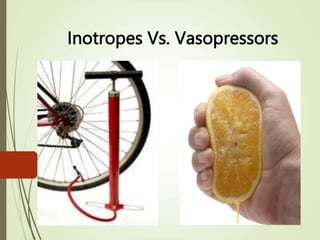
Inotropes Vs. Vasopressors
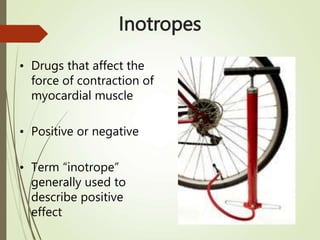
Inotropes
• Drugs that affect the
force of contraction of
myocardial muscle
• Positive or negative
• Term “inotrope”
generally used to
describe positive
effect
Vasopressor
• Drugs that stimulates
smooth muscle
contraction of the
capillaries & arteries
• Cause
vasoconstriction & a
consequent rise in
blood pressure
Main Goal
Tissue
perfusion &
oxygenation
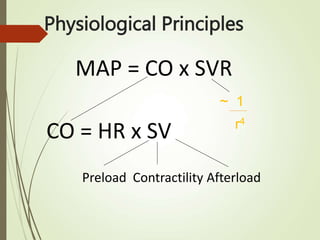
Physiological Principles
MAP = CO x SVR
CO = HR x SV
Preload Contractility Afterload
~ 1
r4
Basic principles - Vasopressors
MAP = CO x SVR
CO = HR x SV
Preload Contractility Afterload
~ 1
r4
Basic principles - Inotropes
MAP = CO x SVR
CO = HR x SV
Preload Contractility Afterload
Use of inotropes & vasopressors
Drug Classification
• Catecholamines : Dopamine, Dobutamine,
Adrenaline, Noradrenaline
• Phosphodiesterase Inhibitors : Milrinone,
Amrinone
• Vasopressors : Vasopressin, Phenylephrine
• Vasodilators : Nitroglycerine,Sodium
Nitroprusside
?????
A 10yrs old child presented to the ER with complaints of
nausea,bilious vomiting,abdominal pain with altered
sensorium
He has history of recurrent bowel obstructions
VITALS
HR- 162/min
RR-32/min
T- 101 F
BP-70/42 mmHg
SPO2-95% in RA
The child is in hypotensive shock.
crystalloids had to be given at 20ml/kg
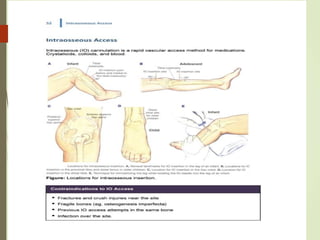
But iv line couldn’t be secured,so INTRAOSSEOUS line
inserted
 After securing intraosseous line and after receiving 3
boluses of crystalloids at 20ml/kg the child remained
hypotensive
 WHAT IS THE NEXT STEP?
 WHAT MEDICATION TO START?
 WHAT DOSAGE?
 The examination findings important in guiding the therapy
are
- Capillary refill time
- tactile temperature of extremities
- mental status
- peripheral and central pulses
Choice of inotropes
 Cold shock with narrow pulse pressure with low MAP for age
- Dopamine is started at 10mics/kg/min
- if hypotension is profound and pt is unstable start
adrenaline 0.3-0.5 mics/kg/min
- if BP is still low Noradrenaline is preferred
 cold normotensive shock (MAP normal/high)
- Start dobutamine at 7.5-10 mics/kg/min
-consider PDE Inhibitors for myocardial dysfunction or
pulmonary hypertension
 Warm shock with hypotension
- first choice is Nor adrenaline 0.05-
0.5mics/kg/min
- if refractory vasopressin or
terlipressin can be used
 Warm shock with normal BP
- aggressive fluid therapy.usually
inotropes not required
- noradrenaline if diastolic BP
excessively low
- dobutamine in cases of metabolic
acidosis and low ScVo2
Dopamine
Hemodynamic effects
 Dose dependent - At low doses (0.5-3.0 μg/kg/min),
dopamine acts predominantly on D1 receptors in the renal,
mesenteric, cerebral and coronary beds resulting in selective
vasodilation.
 At intermediate doses (3-10 μg/kg/min), also stimulates β1
receptor and increases cardiac output (CO), predominantly by
increasing stroke volume with variable effect on heart rate.
 At higher dose (10-20 μg/kg/min), the predominant effect is
to stimulate α1-adrenergic receptors and produce
vasoconstriction with an increased systemic vascular
resistance (SVR),and the sum of these effects is an increase in
mean arterial pressure (MAP).
DOPAMINE
 Indication :
Fluid refractory septic shock
Cardiogenic shock with vasodilation(warm septic shock)
 Side effects
• tachycardia
• Arryhthmias
• Extravasation
• Tachyphyllaxis
 Reconstitution
1ml=40mg
6 X body weight in 50ml NS
5ml/hr will deliver 10 mics/kg/min
7.5ml/hr will deliver 15 mics/kg/min
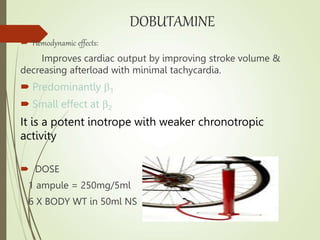
DOBUTAMINE
 Hemodynamic effects:
Improves cardiac output by improving stroke volume &
decreasing afterload with minimal tachycardia.
 Predominantly 1
 Small effect at 2
It is a potent inotrope with weaker chronotropic
activity
 DOSE
1 ampule = 250mg/5ml
6 X BODY WT in 50ml NS
Indications
 Normotensive cardiogenic shock due to primary
myocardial pathology
Fluid refractory septic shock when the blood pressure is
normal /high
Cardiogenic shock due to severe hypoxia ischemia of any
etiology
Adrenaline
 Adrenaline is a potent agonist for β1, β2 and α1 receptors
present in cardiac and vascular smooth muscle.
Hemodynamic effects:
 0.05 – 0.3 mics/kg/min – inotropy, chronotropy
 0.3- 1 mics/kg/min – pressor
Low dose of adrenaline increases cardiac output because of
β1 receptor mediated inotropic and chronotropic effects
At higher doses α-receptor mediated vasoconstriction
predominates which results increased SVR in addition to
increased CO.
indications
 Cardiogenic shock with decompensated shock { Improves
diastolic BP, resulting in better coronary perfusion & improved
myocardial function }
 Myocardial dysfunction after cardiac arrest
 Anaphylactic shock
 Fluid unresponsive dopamine refractory hypotensive septic
shock
 Severe shock of any etiology
ADRENALINE INFUSION Preparation
1 ampoule 1ml (1:1000 = 1mg / ml)
Rate: 1ml/hr = 1mcg/min (Document rate on Syringe Pump
& in Patient’s Notes) Dose: 0.05 – 0.5mcg/kg/min (starting
infusion rate 0.1 mcg/kg/min) Titrate accordingly to desired
BP
Calculations : 0.3 x body weight;dilute the required dose in
NS(Eg: 10kg - 3ml in 47ml NS)
Use single strength in ED, especially if infusion is through a
peripheral line.
Make sure BP cuff is not on the Arm of the peripheral line.
Regularly inspect the site of insertion of the peripheral line.
How to start and titrate
• Start infusion @0.1-0.3 mcg/kg/min.
• If BP improves but perfusion worsens add inodilators
• Doses > 0.6 mics/kg/min are rarely useful as ensuing organ
ischemia may lead to MODS
Anaphylaxis
a) IV Adrenaline 1:10 000 -Dilute 1mg (1ml) to 10 cc N/S -Dose: Give
titrating bolus 1 ml up to 0.1ml/kg
b) or if IV line not available, give deep IM Adrenaline 1:1000 -Dose:
0.01mg/kg (i.e: Body wt 50kg= 0.5mg = 0.5ml) Max 0.5mg
c) IV Infusion if patient not response with boluses.
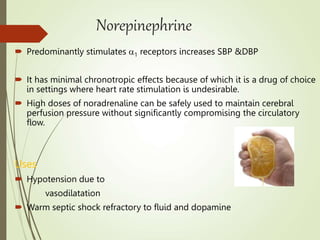
Norepinephrine
 Predominantly stimulates 1 receptors increases SBP &DBP
 It has minimal chronotropic effects because of which it is a drug of choice
in settings where heart rate stimulation is undesirable.
 High doses of noradrenaline can be safely used to maintain cerebral
perfusion pressure without significantly compromising the circulatory
flow.
Uses
 Hypotension due to
vasodilatation
 Warm septic shock refractory to fluid and dopamine
Side effects
↑ Afterload { not appropriate in cardiogenic shock}
Worsens perfusion leading to multi organ failure
DOSE
0.1-1 mics/kg/min (titrate based on assessment)
PREPARATION
0.3 x body weight;dilute the required dose in
5%dextrose
Rate: 1ml/hr = 1mcg/min
conclusion
 Early recognition and management in initial
stages is very critical in treating shock
 Ultimate treatment of underlying cause
forms the cornerstone of management
That’s All
Thank You

INOTROPES IN SHOCK.pptx

  • 1.
  • 2.
    Definitions Inotropes: Agents administered toincrease myocardial contractility and therefore cardiac index Vasopressor Agents are administered to increase vascular tone and thereby elevate mean arterial pressure (MAP).
  • 3.
  • 4.
    Inotropes • Drugs thataffect the force of contraction of myocardial muscle • Positive or negative • Term “inotrope” generally used to describe positive effect
  • 5.
    Vasopressor • Drugs thatstimulates smooth muscle contraction of the capillaries & arteries • Cause vasoconstriction & a consequent rise in blood pressure
  • 6.
  • 7.
    Physiological Principles MAP =CO x SVR CO = HR x SV Preload Contractility Afterload ~ 1 r4
  • 8.
    Basic principles -Vasopressors MAP = CO x SVR CO = HR x SV Preload Contractility Afterload ~ 1 r4
  • 9.
    Basic principles -Inotropes MAP = CO x SVR CO = HR x SV Preload Contractility Afterload
  • 10.
    Use of inotropes& vasopressors
  • 11.
    Drug Classification • Catecholamines: Dopamine, Dobutamine, Adrenaline, Noradrenaline • Phosphodiesterase Inhibitors : Milrinone, Amrinone • Vasopressors : Vasopressin, Phenylephrine • Vasodilators : Nitroglycerine,Sodium Nitroprusside
  • 13.
    ????? A 10yrs oldchild presented to the ER with complaints of nausea,bilious vomiting,abdominal pain with altered sensorium He has history of recurrent bowel obstructions VITALS HR- 162/min RR-32/min T- 101 F BP-70/42 mmHg SPO2-95% in RA The child is in hypotensive shock. crystalloids had to be given at 20ml/kg But iv line couldn’t be secured,so INTRAOSSEOUS line inserted
  • 16.
     After securingintraosseous line and after receiving 3 boluses of crystalloids at 20ml/kg the child remained hypotensive  WHAT IS THE NEXT STEP?  WHAT MEDICATION TO START?  WHAT DOSAGE?  The examination findings important in guiding the therapy are - Capillary refill time - tactile temperature of extremities - mental status - peripheral and central pulses
  • 18.
    Choice of inotropes Cold shock with narrow pulse pressure with low MAP for age - Dopamine is started at 10mics/kg/min - if hypotension is profound and pt is unstable start adrenaline 0.3-0.5 mics/kg/min - if BP is still low Noradrenaline is preferred  cold normotensive shock (MAP normal/high) - Start dobutamine at 7.5-10 mics/kg/min -consider PDE Inhibitors for myocardial dysfunction or pulmonary hypertension
  • 19.
     Warm shockwith hypotension - first choice is Nor adrenaline 0.05- 0.5mics/kg/min - if refractory vasopressin or terlipressin can be used  Warm shock with normal BP - aggressive fluid therapy.usually inotropes not required - noradrenaline if diastolic BP excessively low - dobutamine in cases of metabolic acidosis and low ScVo2
  • 20.
    Dopamine Hemodynamic effects  Dosedependent - At low doses (0.5-3.0 μg/kg/min), dopamine acts predominantly on D1 receptors in the renal, mesenteric, cerebral and coronary beds resulting in selective vasodilation.  At intermediate doses (3-10 μg/kg/min), also stimulates β1 receptor and increases cardiac output (CO), predominantly by increasing stroke volume with variable effect on heart rate.  At higher dose (10-20 μg/kg/min), the predominant effect is to stimulate α1-adrenergic receptors and produce vasoconstriction with an increased systemic vascular resistance (SVR),and the sum of these effects is an increase in mean arterial pressure (MAP).
  • 21.
    DOPAMINE  Indication : Fluidrefractory septic shock Cardiogenic shock with vasodilation(warm septic shock)  Side effects • tachycardia • Arryhthmias • Extravasation • Tachyphyllaxis  Reconstitution 1ml=40mg 6 X body weight in 50ml NS 5ml/hr will deliver 10 mics/kg/min 7.5ml/hr will deliver 15 mics/kg/min
  • 22.
    DOBUTAMINE  Hemodynamic effects: Improvescardiac output by improving stroke volume & decreasing afterload with minimal tachycardia.  Predominantly 1  Small effect at 2 It is a potent inotrope with weaker chronotropic activity  DOSE 1 ampule = 250mg/5ml 6 X BODY WT in 50ml NS
  • 23.
    Indications  Normotensive cardiogenicshock due to primary myocardial pathology Fluid refractory septic shock when the blood pressure is normal /high Cardiogenic shock due to severe hypoxia ischemia of any etiology
  • 24.
    Adrenaline  Adrenaline isa potent agonist for β1, β2 and α1 receptors present in cardiac and vascular smooth muscle. Hemodynamic effects:  0.05 – 0.3 mics/kg/min – inotropy, chronotropy  0.3- 1 mics/kg/min – pressor Low dose of adrenaline increases cardiac output because of β1 receptor mediated inotropic and chronotropic effects At higher doses α-receptor mediated vasoconstriction predominates which results increased SVR in addition to increased CO.
  • 25.
    indications  Cardiogenic shockwith decompensated shock { Improves diastolic BP, resulting in better coronary perfusion & improved myocardial function }  Myocardial dysfunction after cardiac arrest  Anaphylactic shock  Fluid unresponsive dopamine refractory hypotensive septic shock  Severe shock of any etiology
  • 26.
    ADRENALINE INFUSION Preparation 1ampoule 1ml (1:1000 = 1mg / ml) Rate: 1ml/hr = 1mcg/min (Document rate on Syringe Pump & in Patient’s Notes) Dose: 0.05 – 0.5mcg/kg/min (starting infusion rate 0.1 mcg/kg/min) Titrate accordingly to desired BP Calculations : 0.3 x body weight;dilute the required dose in NS(Eg: 10kg - 3ml in 47ml NS) Use single strength in ED, especially if infusion is through a peripheral line. Make sure BP cuff is not on the Arm of the peripheral line. Regularly inspect the site of insertion of the peripheral line.
  • 27.
    How to startand titrate • Start infusion @0.1-0.3 mcg/kg/min. • If BP improves but perfusion worsens add inodilators • Doses > 0.6 mics/kg/min are rarely useful as ensuing organ ischemia may lead to MODS Anaphylaxis a) IV Adrenaline 1:10 000 -Dilute 1mg (1ml) to 10 cc N/S -Dose: Give titrating bolus 1 ml up to 0.1ml/kg b) or if IV line not available, give deep IM Adrenaline 1:1000 -Dose: 0.01mg/kg (i.e: Body wt 50kg= 0.5mg = 0.5ml) Max 0.5mg c) IV Infusion if patient not response with boluses.
  • 28.
    Norepinephrine  Predominantly stimulates1 receptors increases SBP &DBP  It has minimal chronotropic effects because of which it is a drug of choice in settings where heart rate stimulation is undesirable.  High doses of noradrenaline can be safely used to maintain cerebral perfusion pressure without significantly compromising the circulatory flow. Uses  Hypotension due to vasodilatation  Warm septic shock refractory to fluid and dopamine
  • 29.
    Side effects ↑ Afterload{ not appropriate in cardiogenic shock} Worsens perfusion leading to multi organ failure DOSE 0.1-1 mics/kg/min (titrate based on assessment) PREPARATION 0.3 x body weight;dilute the required dose in 5%dextrose Rate: 1ml/hr = 1mcg/min
  • 31.
    conclusion  Early recognitionand management in initial stages is very critical in treating shock  Ultimate treatment of underlying cause forms the cornerstone of management
  • 32.