By
Mahmoud E. Abou El-Magd
Assistant lecturer of pulmonary and critical care medicine
INHALER THERAPY
• rapid onset of action .
• low incidence of systemic side
effects.
ADVANTAGES OF INHALATION
THERAPY
TYPES OF INHALATION
DEVICES - ASTHMA INHALERS
• The most common is the metered – dose inhaler (MDI),
• Dry powder inhalers (DPIs) .
• Nebulizers deliver fine liquid mists of medication through a tube or a
"mask" that fits over the nose and mouth, using air or oxygen under
pressure.
The MDIs widely
used in practice
since 1960.
• A metered-dose inhaler consists of
three major components:
• The canister where the formulation
resides.
• The metering valve, which allows a
metered quantity of the formulation to
be dispensed with each actuation.
• An actuator (or mouthpiece) which
allows the patient to operate the device
and directs the aerosol into the patient's
lungs..
1-Warm MDI to hand or body temperature
2-Assemble apparatus(make sure there are no objects or coins in
device that could be aspirated or obstruct out flow)
3-Shake the canister vigorously and hold canister up-right,
placing actuator 4cm (two fingers) away from open mouth
(aimed directly into mouth)
4- After a normal exhalation, begin to inspire slowly (0.5 L/min),
while actuating MDI. Continue inspiration to total lung
capacity.
5-Hold breath for 10 seconds
6-Wait 1 minute between actuations
TO USE AN MDI
• Remove the metal canister by pulling it out.
• Clean the plastic parts of the device using mild soap and
water. (Never wash the metal canister or put it in water.)
• Let the plastic parts dry in the air (for example, leave
them out overnight).
• Put the MDI back together.
• Test the MDI by releasing a puff into the air.
CLEANING MDI
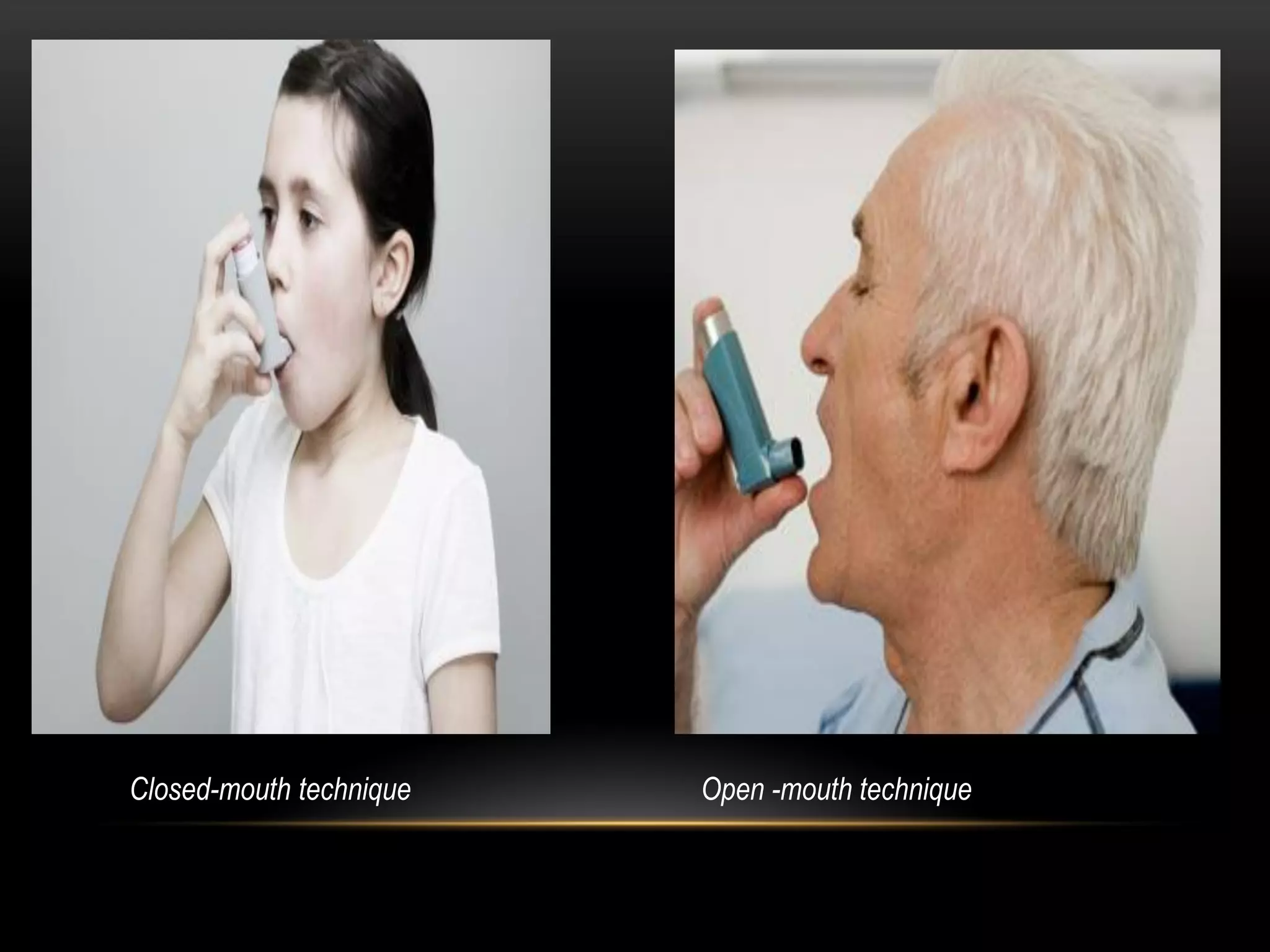
Open -mouth techniqueClosed-mouth technique
• A metered dose inhaler contains enough medication for a
certain number of actuations (or puffs) which is printed
on the canister.
• Even though the inhaler may continue to work beyond
that number of uses, the amount of medication delivered
may not be correct.
LIFE SPAN
COMMON MISTAKES IN USE OF MDI:
1. Not shaking well
2. No, or shallow, or forcible breathing out before inhalation
3. Exhaling through inhaler
4. Lips, teeth, tongue obstructing the way
5. Pressing before start inspiration
6. Pressing near end inspiration
7. No or too weak breathing in
8. Short time breathing in, not deep inspiration
9. Pressing more than once during inspiration
10. Not holding breath ≥ 10 seconds
SPACER
A spacer device holds the medicine in a
chamber after it has been released from the
canister. So, it acts as a reservoir or holding
chamber and reduce the speed at which the
aerosol enters the mouth, allowing the
patient to inhale slowly and deeply once or
twice.
• People who use corticosteroid inhalers
should use a spacer to prevent getting the
medicine in their mouth, where oral yeast
infections and dysphonia can occur.
Using a dry powder inhaler is very different than an MDI. A lever may
need to be pressed, a button squeezed, a cap removed or a dial
twisted before inhalation. Dry powder inhalers need a stronger,
faster inhalation and are not used with spacers
DRY POWDER INHALER
• DPIs eliminate the need to coordinate inhalation and
hand movement MDIs.
• They require faster inspiratory flows to disimpact the
powder and allow the inhaled fraction to be  5m.
• Also, it is important not to blow (exhale) directly into
the device before breathing in, as this can scatter the
medicine before it can be inhaled.
• Thus, DPIs may not be suitable for elderly people or
people with nerve or muscle weakness
MECHANISM
• Dry powder
inhalers(DPIs)
deliver a fine
powder to the
lungs when the
patient breathes
in.
• DPI capsules
should NOT be
swallowed.
COMMON MISTAKES IN USE OF DRY POWDER INHALERS:
1. Turning inhaler upside down after preparation of the dose
2. Exhaling into the inhaler after preparation of the dose; that will
blow the dose out / sticking of powder by water vapour.
3. Obstructing openings of the inhaler during inhalation
4. Not continuing inhalation using sufficient speed
5. Storage mistakes
TURBOHALER
• Is a 50 -200 dose of DPI that
delivers micronized drug only.
• It is loaded in the upright position
by twisting the base.
• Patients are sometimes
disconcerned because the dose is
so tiny that they feel nothing.
• A dose indicator show how many
doses remain.
Turbohaler
• It contain up to 120 dose.
• The drug is released by
pressing a trigger to
puncture the blister and
then inspiring deeply
from the mouth piece.
• It has counter.
DISKUS
HANDIHALER
1. Push green lever in once all the way and
release. This will release the outer cover.
2. Lift open outer cover and then lift open the
white mouthpiece.
3. Right before use, remove one (only) SPIRIVA
capsule from the blister pack and place it in
the capsule chamber.
4. Close the mouthpiece firmly until you hear a
click, leaving the lid open.
5. Hold the HandiHaler upright and press the
green button once all the way in and release.
• Multiple dose devices( seretide ) which contain
up to 200 doses.
• Single dose devices (Foradil, Meflonide, Spiriva)
which require the person to place a capsule in the
device immediately before each treatment.
DPI COME IN TWO MAIN TYPES
• Remove the cap. For single use devices, load a capsule into the
device as directed.
• Breathe out slowly and completely (not into the mouthpiece).
• Place the mouthpiece between the front teeth and seal the lips
around it.
• Breathe in through the mouth quickly and deeply over two to three
seconds.
• Remove the inhaler from the mouth. Hold your breath for as long as
possible (4 to 10 seconds).
• Breathe out slowly.
HOW TO USE THE DPI
NEBULIZERS
NEBULIZERS
Nebulizers deliver asthma medications in a fine mist
through mouthpieces or masks. You can breathe normally
and there is no special coordination required.
Nebulizers are useful for young children and some patients
with more severe or acute asthma who are unable to use
an MDI or DPI.
Using a nebulizer can be more time-consuming, and may
take five to 15 minutes for a treatment.
• Currently there seems to be a tendency among
physicians to prefer prescription of a (pMDI) for their
patients, instead of a Jet nebulizer that generates a lot
more noise and is less portable due to a heavier
weight.
• However Jet nebulizers are commonly used for
patients in hospitals who have difficulty using inhalers,
such as in serious cases of respiratory disease, or
severe asthma attacks.
Disadvantages
•A large amount of the medication is lost to the air during the
exhalation phase because aerosol output is constant during both
inspiration and expiration.
•nebulization is more expensive
•give them a false sense of security.
Advantages
bronchodilator administration in the acute care setting
TAKING THE NEBULIZER TREATMENT
• Recent evidence show that nebulizers are no more effective than
Metered Dose Inhalers MDIs with spacers and that MDIs may
offer advantages in children with acute asthma
INHALER THERAPY 30
INHALER THERAPY 31

Inhaler therapy

  • 1.
    By Mahmoud E. AbouEl-Magd Assistant lecturer of pulmonary and critical care medicine INHALER THERAPY
  • 2.
    • rapid onsetof action . • low incidence of systemic side effects. ADVANTAGES OF INHALATION THERAPY
  • 3.
    TYPES OF INHALATION DEVICES- ASTHMA INHALERS • The most common is the metered – dose inhaler (MDI), • Dry powder inhalers (DPIs) . • Nebulizers deliver fine liquid mists of medication through a tube or a "mask" that fits over the nose and mouth, using air or oxygen under pressure.
  • 4.
    The MDIs widely usedin practice since 1960.
  • 5.
    • A metered-doseinhaler consists of three major components: • The canister where the formulation resides. • The metering valve, which allows a metered quantity of the formulation to be dispensed with each actuation. • An actuator (or mouthpiece) which allows the patient to operate the device and directs the aerosol into the patient's lungs..
  • 6.
    1-Warm MDI tohand or body temperature 2-Assemble apparatus(make sure there are no objects or coins in device that could be aspirated or obstruct out flow) 3-Shake the canister vigorously and hold canister up-right, placing actuator 4cm (two fingers) away from open mouth (aimed directly into mouth) 4- After a normal exhalation, begin to inspire slowly (0.5 L/min), while actuating MDI. Continue inspiration to total lung capacity. 5-Hold breath for 10 seconds 6-Wait 1 minute between actuations TO USE AN MDI
  • 7.
    • Remove themetal canister by pulling it out. • Clean the plastic parts of the device using mild soap and water. (Never wash the metal canister or put it in water.) • Let the plastic parts dry in the air (for example, leave them out overnight). • Put the MDI back together. • Test the MDI by releasing a puff into the air. CLEANING MDI
  • 9.
  • 10.
    • A metereddose inhaler contains enough medication for a certain number of actuations (or puffs) which is printed on the canister. • Even though the inhaler may continue to work beyond that number of uses, the amount of medication delivered may not be correct. LIFE SPAN
  • 11.
    COMMON MISTAKES INUSE OF MDI: 1. Not shaking well 2. No, or shallow, or forcible breathing out before inhalation 3. Exhaling through inhaler 4. Lips, teeth, tongue obstructing the way 5. Pressing before start inspiration 6. Pressing near end inspiration 7. No or too weak breathing in 8. Short time breathing in, not deep inspiration 9. Pressing more than once during inspiration 10. Not holding breath ≥ 10 seconds
  • 12.
    SPACER A spacer deviceholds the medicine in a chamber after it has been released from the canister. So, it acts as a reservoir or holding chamber and reduce the speed at which the aerosol enters the mouth, allowing the patient to inhale slowly and deeply once or twice. • People who use corticosteroid inhalers should use a spacer to prevent getting the medicine in their mouth, where oral yeast infections and dysphonia can occur.
  • 15.
    Using a drypowder inhaler is very different than an MDI. A lever may need to be pressed, a button squeezed, a cap removed or a dial twisted before inhalation. Dry powder inhalers need a stronger, faster inhalation and are not used with spacers DRY POWDER INHALER
  • 16.
    • DPIs eliminatethe need to coordinate inhalation and hand movement MDIs. • They require faster inspiratory flows to disimpact the powder and allow the inhaled fraction to be  5m. • Also, it is important not to blow (exhale) directly into the device before breathing in, as this can scatter the medicine before it can be inhaled. • Thus, DPIs may not be suitable for elderly people or people with nerve or muscle weakness MECHANISM
  • 17.
    • Dry powder inhalers(DPIs) delivera fine powder to the lungs when the patient breathes in. • DPI capsules should NOT be swallowed.
  • 18.
    COMMON MISTAKES INUSE OF DRY POWDER INHALERS: 1. Turning inhaler upside down after preparation of the dose 2. Exhaling into the inhaler after preparation of the dose; that will blow the dose out / sticking of powder by water vapour. 3. Obstructing openings of the inhaler during inhalation 4. Not continuing inhalation using sufficient speed 5. Storage mistakes
  • 19.
    TURBOHALER • Is a50 -200 dose of DPI that delivers micronized drug only. • It is loaded in the upright position by twisting the base. • Patients are sometimes disconcerned because the dose is so tiny that they feel nothing. • A dose indicator show how many doses remain.
  • 20.
  • 21.
    • It containup to 120 dose. • The drug is released by pressing a trigger to puncture the blister and then inspiring deeply from the mouth piece. • It has counter. DISKUS
  • 22.
    HANDIHALER 1. Push greenlever in once all the way and release. This will release the outer cover. 2. Lift open outer cover and then lift open the white mouthpiece. 3. Right before use, remove one (only) SPIRIVA capsule from the blister pack and place it in the capsule chamber. 4. Close the mouthpiece firmly until you hear a click, leaving the lid open. 5. Hold the HandiHaler upright and press the green button once all the way in and release.
  • 23.
    • Multiple dosedevices( seretide ) which contain up to 200 doses. • Single dose devices (Foradil, Meflonide, Spiriva) which require the person to place a capsule in the device immediately before each treatment. DPI COME IN TWO MAIN TYPES
  • 24.
    • Remove thecap. For single use devices, load a capsule into the device as directed. • Breathe out slowly and completely (not into the mouthpiece). • Place the mouthpiece between the front teeth and seal the lips around it. • Breathe in through the mouth quickly and deeply over two to three seconds. • Remove the inhaler from the mouth. Hold your breath for as long as possible (4 to 10 seconds). • Breathe out slowly. HOW TO USE THE DPI
  • 25.
  • 26.
    NEBULIZERS Nebulizers deliver asthmamedications in a fine mist through mouthpieces or masks. You can breathe normally and there is no special coordination required. Nebulizers are useful for young children and some patients with more severe or acute asthma who are unable to use an MDI or DPI. Using a nebulizer can be more time-consuming, and may take five to 15 minutes for a treatment.
  • 27.
    • Currently thereseems to be a tendency among physicians to prefer prescription of a (pMDI) for their patients, instead of a Jet nebulizer that generates a lot more noise and is less portable due to a heavier weight. • However Jet nebulizers are commonly used for patients in hospitals who have difficulty using inhalers, such as in serious cases of respiratory disease, or severe asthma attacks.
  • 28.
    Disadvantages •A large amountof the medication is lost to the air during the exhalation phase because aerosol output is constant during both inspiration and expiration. •nebulization is more expensive •give them a false sense of security. Advantages bronchodilator administration in the acute care setting
  • 29.
    TAKING THE NEBULIZERTREATMENT • Recent evidence show that nebulizers are no more effective than Metered Dose Inhalers MDIs with spacers and that MDIs may offer advantages in children with acute asthma
  • 30.
  • 31.