

A S A N O N L I N E P H A R M A C Y W E
S T R O N G L Y B E L I E V E I T I S I M P O R T A N T
T O P R O M O T E I N H A L E R T E C H N I Q U E S S O
T H A T P E O P L E W H O S U F F E R F R O M
A S T H M A U S E T H E C O R R E C T I N H A L E R
T E C H N I Q U E S F O R T H E I R O W N H E A L T H
S A F E T Y A N D W E L L - B E I N G .
Inhaler Techniques
Introduction to Asthma
๏‚— Asthma is a common lung condition that causes occasional breathing difficulties. This affects
people of all ages. Although there is currently no cure for asthma, there are simple treatments that
help to keep the symptoms under control so it does not have a significant impact in your life.
๏‚— There are 5.4 million people with asthma in the UK, which means that asthma affects one in every
11 people and one in five households. It is proven around 1.1 million children and 4.3 million adults
in the UK have asthma.
๏‚— The main symptoms of asthma are wheezing (a whistling sound when breathing), breathlessness, a
tight chest, cough. The severity of the symptoms varies from person to person. They usually come
and go but for some people they are more serious dependent on the person.
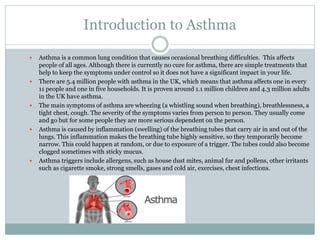
๏‚— Asthma is caused by inflammation (swelling) of the breathing tubes that carry air in and out of the
lungs. This inflammation makes the breathing tube highly sensitive, so they temporarily become
narrow. This could happen at random, or due to exposure of a trigger. The tubes could also become
clogged sometimes with sticky mucus.
๏‚— Asthma triggers include allergens, such as house dust mites, animal fur and pollens, other irritants
such as cigarette smoke, strong smells, gases and cold air, exercises, chest infections.
Treatments for asthma
๏‚— Most asthma treatments are taken using an inhaler, a small device which delivers a spray or powder
medicine to your breathing tubes as your breath in. The main treatments are identifying and avoiding
asthma triggers if possible, reliever inhalers which are inhalers used when somebody quickly needs to
relieve asthma symptoms for a short time, preventer inhalers which are inhalers that are used
regularly every day to reduce the inflammation in the breathing tubes, which prevents asthma
symptoms from occurring.
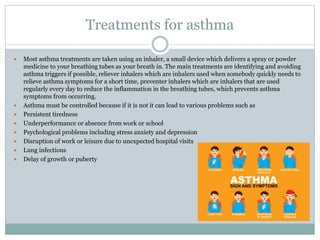
๏‚— Asthma must be controlled because if it is not it can lead to various problems such as
๏‚— Persistent tiredness
๏‚— Underperformance or absence from work or school
๏‚— Psychological problems including stress anxiety and depression
๏‚— Disruption of work or leisure due to unexpected hospital visits
๏‚— Lung infections
๏‚— Delay of growth or puberty
How to use a meter dose inhaler
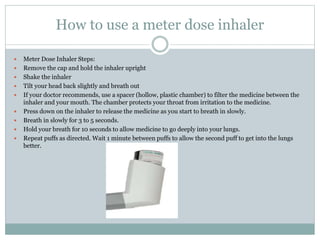
๏‚— Meter Dose Inhaler Steps:
๏‚— Remove the cap and hold the inhaler upright
๏‚— Shake the inhaler
๏‚— Tilt your head back slightly and breath out
๏‚— If your doctor recommends, use a spacer (hollow, plastic chamber) to filter the medicine between the
inhaler and your mouth. The chamber protects your throat from irritation to the medicine.
๏‚— Press down on the inhaler to release the medicine as you start to breath in slowly.
๏‚— Breath in slowly for 3 to 5 seconds.
๏‚— Hold your breath for 10 seconds to allow medicine to go deeply into your lungs.
๏‚— Repeat puffs as directed. Wait 1 minute between puffs to allow the second puff to get into the lungs
better.
How to use Dry-powder inhaler
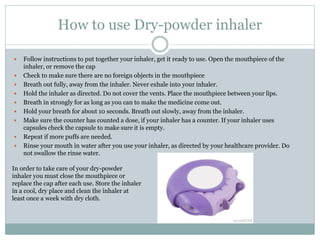
๏‚— Follow instructions to put together your inhaler, get it ready to use. Open the mouthpiece of the
inhaler, or remove the cap
๏‚— Check to make sure there are no foreign objects in the mouthpiece
๏‚— Breath out fully, away from the inhaler. Never exhale into your inhaler.
๏‚— Hold the inhaler as directed. Do not cover the vents. Place the mouthpiece between your lips.
๏‚— Breath in strongly for as long as you can to make the medicine come out.
๏‚— Hold your breath for about 10 seconds. Breath out slowly, away from the inhaler.
๏‚— Make sure the counter has counted a dose, if your inhaler has a counter. If your inhaler uses
capsules check the capsule to make sure it is empty.
๏‚— Repeat if more puffs are needed.
๏‚— Rinse your mouth in water after you use your inhaler, as directed by your healthcare provider. Do
not swallow the rinse water.
In order to take care of your dry-powder
inhaler you must close the mouthpiece or
replace the cap after each use. Store the inhaler
in a cool, dry place and clean the inhaler at
least once a week with dry cloth.
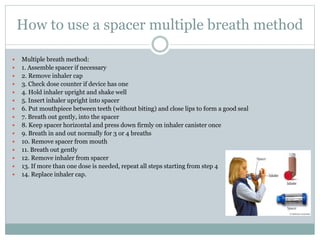
How to use a spacer multiple breath method
๏‚— Multiple breath method:
๏‚— 1. Assemble spacer if necessary
๏‚— 2. Remove inhaler cap
๏‚— 3. Check dose counter if device has one
๏‚— 4. Hold inhaler upright and shake well
๏‚— 5. Insert inhaler upright into spacer
๏‚— 6. Put mouthpiece between teeth (without biting) and close lips to form a good seal
๏‚— 7. Breath out gently, into the spacer
๏‚— 8. Keep spacer horizontal and press down firmly on inhaler canister once
๏‚— 9. Breath in and out normally for 3 or 4 breaths
๏‚— 10. Remove spacer from mouth
๏‚— 11. Breath out gently
๏‚— 12. Remove inhaler from spacer
๏‚— 13. If more than one dose is needed, repeat all steps starting from step 4
๏‚— 14. Replace inhaler cap.
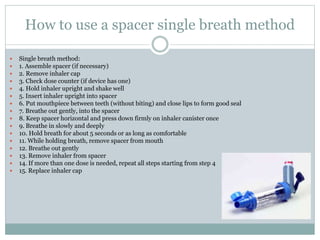
How to use a spacer single breath method
๏‚— Single breath method:
๏‚— 1. Assemble spacer (if necessary)
๏‚— 2. Remove inhaler cap
๏‚— 3. Check dose counter (if device has one)
๏‚— 4. Hold inhaler upright and shake well
๏‚— 5. Insert inhaler upright into spacer
๏‚— 6. Put mouthpiece between teeth (without biting) and close lips to form good seal
๏‚— 7. Breathe out gently, into the spacer
๏‚— 8. Keep spacer horizontal and press down firmly on inhaler canister once
๏‚— 9. Breathe in slowly and deeply
๏‚— 10. Hold breath for about 5 seconds or as long as comfortable
๏‚— 11. While holding breath, remove spacer from mouth
๏‚— 12. Breathe out gently
๏‚— 13. Remove inhaler from spacer
๏‚— 14. If more than one dose is needed, repeat all steps starting from step 4
๏‚— 15. Replace inhaler cap
When you should contact your healthcare
provider
๏‚— Your inhaler does not work properly.
๏‚— You cannot inhale strongly enough to make the medicine come out of the inhaler.
๏‚— Your medicine is not controlling your symptoms.
๏‚— The medicine irritates your mouth or your throat, or it causes you to lose your voice.
๏‚— It feels like most of the medicine lands in your mouth or your throat.
๏‚— You run out of medicine before your next refill is due, or sooner than your healthcare provider says you
should.
๏‚— You have questions or concern about your condition or care.
Inhaler technique importance
๏‚— It is vital to use inhalers correctly and asthma medications and demonstrate to your doctor how you
are using your inhalers/asthma medications to be sure that you are using it to your best knowledge
and ability.
๏‚— Asthma inhalers can be very difficult to use correctly and it is always advisable to show your doctor
how you are using your inhalers to offer you help and guidance on how to improve your asthma
condition.
๏‚— If you have a long term lung condition then inhalers are the best way to improve this condition. There
are many different types of inhalers so it is important that no matter what type of inhaler you use, your
inhaler technique must be the best that it possibly can be.
๏‚— A good inhaler technique makes sure that the medicine gets delivered into your lungs effectively and
ensures that you benefit from each dose. This helps to keep the dose of medicine needed to control
your condition as low as possible and side effects to a minimum.
CLEANING YOUR INHALERS
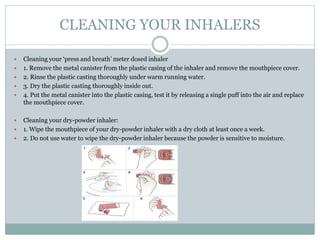
๏‚— Cleaning your โ€˜press and breathโ€™ meter dosed inhaler
๏‚— 1. Remove the metal canister from the plastic casing of the inhaler and remove the mouthpiece cover.
๏‚— 2. Rinse the plastic casting thoroughly under warm running water.
๏‚— 3. Dry the plastic casting thoroughly inside out.
๏‚— 4. Put the metal canister into the plastic casing, test it by releasing a single puff into the air and replace
the mouthpiece cover.
๏‚— Cleaning your dry-powder inhaler:
๏‚— 1. Wipe the mouthpiece of your dry-powder inhaler with a dry cloth at least once a week.
๏‚— 2. Do not use water to wipe the dry-powder inhaler because the powder is sensitive to moisture.
Inhaler techniques
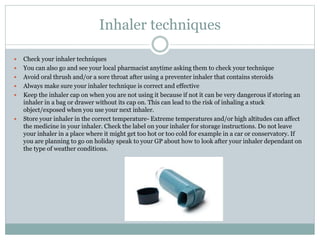
๏‚— Check your inhaler techniques
๏‚— You can also go and see your local pharmacist anytime asking them to check your technique
๏‚— Avoid oral thrush and/or a sore throat after using a preventer inhaler that contains steroids
๏‚— Always make sure your inhaler technique is correct and effective
๏‚— Keep the inhaler cap on when you are not using it because if not it can be very dangerous if storing an
inhaler in a bag or drawer without its cap on. This can lead to the risk of inhaling a stuck
object/exposed when you use your next inhaler.
๏‚— Store your inhaler in the correct temperature- Extreme temperatures and/or high altitudes can affect
the medicine in your inhaler. Check the label on your inhaler for storage instructions. Do not leave
your inhaler in a place where it might get too hot or too cold for example in a car or conservatory. If
you are planning to go on holiday speak to your GP about how to look after your inhaler dependant on
the type of weather conditions.
END OF PRESENTATION!
THANK YOU FOR READING!
FOR MORE INFORMATION AND DETAILS ON
ASTHMA VISIT OUR WEBSITE
https://www.nationwidepharmacies.co.uk/nwp-
news/inhaler-technique/
ANOTHER USEFUL WEBSITE
https://www.asthma.org.uk/advice/inhalers-
medicines-treatments/using-inhalers/#Videos

Inhaler techniques presentation

  • 1.
    A S AN O N L I N E P H A R M A C Y W E S T R O N G L Y B E L I E V E I T I S I M P O R T A N T T O P R O M O T E I N H A L E R T E C H N I Q U E S S O T H A T P E O P L E W H O S U F F E R F R O M A S T H M A U S E T H E C O R R E C T I N H A L E R T E C H N I Q U E S F O R T H E I R O W N H E A L T H S A F E T Y A N D W E L L - B E I N G . Inhaler Techniques
  • 2.
    Introduction to Asthma ๏‚—Asthma is a common lung condition that causes occasional breathing difficulties. This affects people of all ages. Although there is currently no cure for asthma, there are simple treatments that help to keep the symptoms under control so it does not have a significant impact in your life. ๏‚— There are 5.4 million people with asthma in the UK, which means that asthma affects one in every 11 people and one in five households. It is proven around 1.1 million children and 4.3 million adults in the UK have asthma. ๏‚— The main symptoms of asthma are wheezing (a whistling sound when breathing), breathlessness, a tight chest, cough. The severity of the symptoms varies from person to person. They usually come and go but for some people they are more serious dependent on the person. ๏‚— Asthma is caused by inflammation (swelling) of the breathing tubes that carry air in and out of the lungs. This inflammation makes the breathing tube highly sensitive, so they temporarily become narrow. This could happen at random, or due to exposure of a trigger. The tubes could also become clogged sometimes with sticky mucus. ๏‚— Asthma triggers include allergens, such as house dust mites, animal fur and pollens, other irritants such as cigarette smoke, strong smells, gases and cold air, exercises, chest infections.
  • 3.
    Treatments for asthma ๏‚—Most asthma treatments are taken using an inhaler, a small device which delivers a spray or powder medicine to your breathing tubes as your breath in. The main treatments are identifying and avoiding asthma triggers if possible, reliever inhalers which are inhalers used when somebody quickly needs to relieve asthma symptoms for a short time, preventer inhalers which are inhalers that are used regularly every day to reduce the inflammation in the breathing tubes, which prevents asthma symptoms from occurring. ๏‚— Asthma must be controlled because if it is not it can lead to various problems such as ๏‚— Persistent tiredness ๏‚— Underperformance or absence from work or school ๏‚— Psychological problems including stress anxiety and depression ๏‚— Disruption of work or leisure due to unexpected hospital visits ๏‚— Lung infections ๏‚— Delay of growth or puberty
  • 4.
    How to usea meter dose inhaler ๏‚— Meter Dose Inhaler Steps: ๏‚— Remove the cap and hold the inhaler upright ๏‚— Shake the inhaler ๏‚— Tilt your head back slightly and breath out ๏‚— If your doctor recommends, use a spacer (hollow, plastic chamber) to filter the medicine between the inhaler and your mouth. The chamber protects your throat from irritation to the medicine. ๏‚— Press down on the inhaler to release the medicine as you start to breath in slowly. ๏‚— Breath in slowly for 3 to 5 seconds. ๏‚— Hold your breath for 10 seconds to allow medicine to go deeply into your lungs. ๏‚— Repeat puffs as directed. Wait 1 minute between puffs to allow the second puff to get into the lungs better.
  • 5.
    How to useDry-powder inhaler ๏‚— Follow instructions to put together your inhaler, get it ready to use. Open the mouthpiece of the inhaler, or remove the cap ๏‚— Check to make sure there are no foreign objects in the mouthpiece ๏‚— Breath out fully, away from the inhaler. Never exhale into your inhaler. ๏‚— Hold the inhaler as directed. Do not cover the vents. Place the mouthpiece between your lips. ๏‚— Breath in strongly for as long as you can to make the medicine come out. ๏‚— Hold your breath for about 10 seconds. Breath out slowly, away from the inhaler. ๏‚— Make sure the counter has counted a dose, if your inhaler has a counter. If your inhaler uses capsules check the capsule to make sure it is empty. ๏‚— Repeat if more puffs are needed. ๏‚— Rinse your mouth in water after you use your inhaler, as directed by your healthcare provider. Do not swallow the rinse water. In order to take care of your dry-powder inhaler you must close the mouthpiece or replace the cap after each use. Store the inhaler in a cool, dry place and clean the inhaler at least once a week with dry cloth.
  • 6.
    How to usea spacer multiple breath method ๏‚— Multiple breath method: ๏‚— 1. Assemble spacer if necessary ๏‚— 2. Remove inhaler cap ๏‚— 3. Check dose counter if device has one ๏‚— 4. Hold inhaler upright and shake well ๏‚— 5. Insert inhaler upright into spacer ๏‚— 6. Put mouthpiece between teeth (without biting) and close lips to form a good seal ๏‚— 7. Breath out gently, into the spacer ๏‚— 8. Keep spacer horizontal and press down firmly on inhaler canister once ๏‚— 9. Breath in and out normally for 3 or 4 breaths ๏‚— 10. Remove spacer from mouth ๏‚— 11. Breath out gently ๏‚— 12. Remove inhaler from spacer ๏‚— 13. If more than one dose is needed, repeat all steps starting from step 4 ๏‚— 14. Replace inhaler cap.
  • 7.
    How to usea spacer single breath method ๏‚— Single breath method: ๏‚— 1. Assemble spacer (if necessary) ๏‚— 2. Remove inhaler cap ๏‚— 3. Check dose counter (if device has one) ๏‚— 4. Hold inhaler upright and shake well ๏‚— 5. Insert inhaler upright into spacer ๏‚— 6. Put mouthpiece between teeth (without biting) and close lips to form good seal ๏‚— 7. Breathe out gently, into the spacer ๏‚— 8. Keep spacer horizontal and press down firmly on inhaler canister once ๏‚— 9. Breathe in slowly and deeply ๏‚— 10. Hold breath for about 5 seconds or as long as comfortable ๏‚— 11. While holding breath, remove spacer from mouth ๏‚— 12. Breathe out gently ๏‚— 13. Remove inhaler from spacer ๏‚— 14. If more than one dose is needed, repeat all steps starting from step 4 ๏‚— 15. Replace inhaler cap
  • 8.
    When you shouldcontact your healthcare provider ๏‚— Your inhaler does not work properly. ๏‚— You cannot inhale strongly enough to make the medicine come out of the inhaler. ๏‚— Your medicine is not controlling your symptoms. ๏‚— The medicine irritates your mouth or your throat, or it causes you to lose your voice. ๏‚— It feels like most of the medicine lands in your mouth or your throat. ๏‚— You run out of medicine before your next refill is due, or sooner than your healthcare provider says you should. ๏‚— You have questions or concern about your condition or care.
  • 9.
    Inhaler technique importance ๏‚—It is vital to use inhalers correctly and asthma medications and demonstrate to your doctor how you are using your inhalers/asthma medications to be sure that you are using it to your best knowledge and ability. ๏‚— Asthma inhalers can be very difficult to use correctly and it is always advisable to show your doctor how you are using your inhalers to offer you help and guidance on how to improve your asthma condition. ๏‚— If you have a long term lung condition then inhalers are the best way to improve this condition. There are many different types of inhalers so it is important that no matter what type of inhaler you use, your inhaler technique must be the best that it possibly can be. ๏‚— A good inhaler technique makes sure that the medicine gets delivered into your lungs effectively and ensures that you benefit from each dose. This helps to keep the dose of medicine needed to control your condition as low as possible and side effects to a minimum.
  • 10.
    CLEANING YOUR INHALERS ๏‚—Cleaning your โ€˜press and breathโ€™ meter dosed inhaler ๏‚— 1. Remove the metal canister from the plastic casing of the inhaler and remove the mouthpiece cover. ๏‚— 2. Rinse the plastic casting thoroughly under warm running water. ๏‚— 3. Dry the plastic casting thoroughly inside out. ๏‚— 4. Put the metal canister into the plastic casing, test it by releasing a single puff into the air and replace the mouthpiece cover. ๏‚— Cleaning your dry-powder inhaler: ๏‚— 1. Wipe the mouthpiece of your dry-powder inhaler with a dry cloth at least once a week. ๏‚— 2. Do not use water to wipe the dry-powder inhaler because the powder is sensitive to moisture.
  • 11.
    Inhaler techniques ๏‚— Checkyour inhaler techniques ๏‚— You can also go and see your local pharmacist anytime asking them to check your technique ๏‚— Avoid oral thrush and/or a sore throat after using a preventer inhaler that contains steroids ๏‚— Always make sure your inhaler technique is correct and effective ๏‚— Keep the inhaler cap on when you are not using it because if not it can be very dangerous if storing an inhaler in a bag or drawer without its cap on. This can lead to the risk of inhaling a stuck object/exposed when you use your next inhaler. ๏‚— Store your inhaler in the correct temperature- Extreme temperatures and/or high altitudes can affect the medicine in your inhaler. Check the label on your inhaler for storage instructions. Do not leave your inhaler in a place where it might get too hot or too cold for example in a car or conservatory. If you are planning to go on holiday speak to your GP about how to look after your inhaler dependant on the type of weather conditions.
  • 12.
    END OF PRESENTATION! THANKYOU FOR READING! FOR MORE INFORMATION AND DETAILS ON ASTHMA VISIT OUR WEBSITE https://www.nationwidepharmacies.co.uk/nwp- news/inhaler-technique/ ANOTHER USEFUL WEBSITE https://www.asthma.org.uk/advice/inhalers- medicines-treatments/using-inhalers/#Videos