HOW DO WE CHOOSE
THE RIGHT INHALER
DEVICE?
DR PRAVEEN G S
WHY INHALER MEDICINES??
• Directly to the target organ
• Lower dosages needed in comparison with systemic
dosing
WHY CHOOSING A INHALER DEVICE SO
IMPORTANT?
• Because if you are wrong, it defeats the entire purpose
of treatment.
• Your inhaler device is more important than the inhaler
medicine.
www.inhalers4u.orgThe Aerosol Drug Management Improvement Team
Less than 25% of asthma and COPD patients use their inhaler at
the right time and in the correct way
HISTORY OF INHALER DEVICES
KNOW YOUR OPTIONS
 pMDI
 pMDI with spacers or VHC
 BA-pMDI
 DPI
 SMI
 Nebuliser
www.inhalers4u.orgThe Aerosol Drug Management Improvement Team
Lavorini et al Respir Med 2011;105(7)1099-1103)
DPIs are the most commonly used in
Europe, but marked differences
are seen between countries
Worldwide pMDIs are the
most commonly used
Inhalation therapy: retail sales of inhalation devices in Europe
MDI
This Photo by Unknown Author is licensed under CC BY-SA
WHAT IS MEANT BY CORRECT INHALER TECHNIC
• Delivering medication to the airways with minimal
oro-pharyngeal deposition
www.inhalers4u.orgThe Aerosol Drug Management Improvement Team
pMDI DPI
without spacer with spacer
Open the device or take off the cap
Shake the inhaler Don't shake the inhaler
Breathe out slowly and almost fully away from the inhaler
Seal your lips around mouthpiece or the spacer mouthpiece
Take a slow deep breath in and
near the breath actuate the inhaler
After actuating the
inhaler breath in
Breath in briskly, quickly and
deeply until the lungs are full
Hold breath as long as comfortably you can
Replace the cap or close the device
Always keep a spare device or spare capsules
Handling pMDIs and DPIs correctly: similarities and differences
• Priming
• Shake 5 sec before each actuation
• Gap of 15-30 sec before each puff
• If ICS rinse with water, gargle and spit out water
• Breath hold 5-10 sec
• Clean mouth piece at least once per wk
www.inhalers4u.orgThe Aerosol Drug Management Improvement Team
Melani (GENEBI) Resp Med 2011;105:930-938
Technique pMDI
Remove cap 0.2
Shake inhaler 37
Exhale before inhalation 50
Not holding upright 9
Forceful inhalation 52
Actuate against teeth lips or tongue 0.7
Press only once per inhalation 19
Actuation in 2nd half inspiration 18
Activation after end of inhalation 5
Stopping inhalation immediately after actuation 10
Inhalation through nose while & after actuation 2
No or short breath hold (2-3 seconds) 53
Critical errors
Inhaler mishandling associated with reduced disease control – pMDI
www.inhalers4u.orgThe Aerosol Drug Management Improvement Team
• Low velocity “soft” spray; long plume duration
• Small droplet size and high lung deposition
• Clinically effective at half the dose of traditional pMDI
pMDI technology changes: HFA-driven pMDIs producing extrafine particles
www.inhalers4u.orgThe Aerosol Drug Management Improvement Team
De Backer JAMPDD 2010
No influence of disease/airflow
obstruction when delivering
ultra-fine particles
Mean FEV1:
43% (COPD)-70%(asthma)
N=8 per group
Deposition versus particle size
BREATH ACTUATED METERED DOSE INHALERS
Autohaler
(3M)
Autohaler
(3M)
www.inhalers4u.orgThe Aerosol Drug Management Improvement Team
Disadvantages
• “Cold Freon” effect
pMDI poor
coordination
BA-pMDI
same patient
Advantages
• No hand-mouth co-ordination needed
• Usually higher lung deposition than
a pMDI
Autohaler
(3M)
Autohaler
(3M)
Breath-actuated metered dose inhalers
www.inhalers4u.orgThe Aerosol Drug Management Improvement Team
Review of a large number of patients in “real-life” primary care setting;
Patients using breath-actuated pMDI:
• Better asthma control
• Trend to fewer asthma exacerbations
• Possibly used fewer healthcare resources
Price et al, Respir Med 2003; 97: 12-19
Breath-actuated pMDIs: potential clinical benefits
SPACERS AND VHC
This Photo by Unknown Author is licensed under CC BY-SA
www.inhalers4u.orgThe Aerosol Drug Management Improvement Team
Reverse-flow devices, in which the spray is fired either into a
collapsible bag or into a small volume through which outside air is
entrained
Holding chambers, which include a one-way inhalation valve,
intended to retrain the aerosol within the device until the patient
inhales
Home-made spacer
Open tube spacers, that simply distance the
inhaler from the patient’s oropharynx
spacers
Decrease velocity of particles before reaching the mouth
Allows sequential actuation
Ideal volume 100-700 ml
Should provide a distance of 10-13 cm between MDI nostril and mouth
Electro static charges reduced by adding antistatic resin to the polymer
PRO
Improves co-ordination of actuation and
inhalation
Slow aerosol transit time and particle size
Decreases oro pharyngeal deposition(80-20%)
Deliver more drug to the lung periphery
CON
May be bulky leading to patient dislike
Cause loss of excessive dose if there is delsy after actuation or multiple actuation.
Can accumulate static electricity
www.inhalers4u.orgThe Aerosol Drug Management Improvement Team
Barry PW, O’Callaghan C. Brit J Clin Pharmacol , 1996
Reduction in respirable particles
Lengthy delay between pMDI actuation
and inhalation from the spacer
Firing multiple puffs into the
spacer before inhaling
Spacers do not obviate all errors of inhalation technique
www.inhalers4u.orgThe Aerosol Drug Management Improvement Team
When a pMDI is used alone,
medicine ends up in the mouth,
throat, stomach and lungs
When a pMDI is used with a
spacer more medicine is delivered
to the lungs
Newman SP et al. Chest 1986
Spacers increase lung deposition
DPI
www.inhalers4u.orgThe Aerosol Drug Management Improvement Team
DPI design
www.inhalers4u.orgThe Aerosol Drug Management Improvement Team
pMDI DPI
without spacer with spacer
Open the device or take off the cap
Shake the inhaler Don't shake the inhaler
Breathe out slowly and almost fully away from the inhaler
Seal your lips around mouthpiece or the spacer mouthpiece
Take a slow deep breath in and
near the breath actuate the inhaler
After actuating the
inhaler breath in
Breath in briskly, quickly and
deeply until the lungs are full
Hold breath as long as comfortably you can
Replace the cap or close the device
Always keep a spare device or spare capsules
Handling pMDIs and DPIs correctly: similarities and differences
PRO
• Breath actuated devices , so no coordination issues
• Simple to use and generally more acceptable
CON
• Flow rate of 30 to 60 ml/ mt required
• Oro pharyngeal deposition
• Sensitive to increased ambient humidity
www.inhalers4u.orgThe Aerosol Drug Management Improvement Team
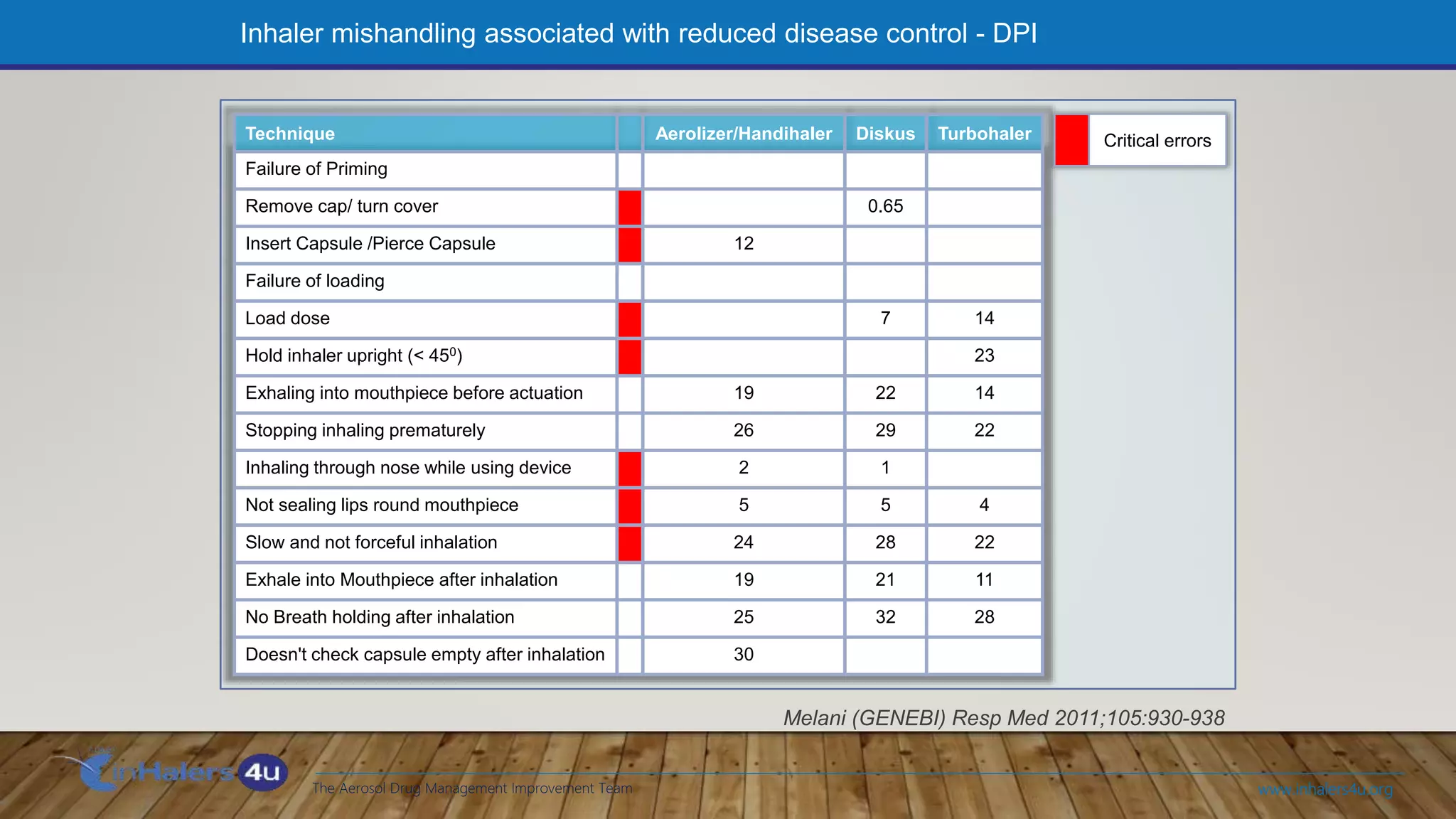
Melani (GENEBI) Resp Med 2011;105:930-938
Technique Aerolizer/Handihaler Diskus Turbohaler
Failure of Priming
Remove cap/ turn cover 0.65
Insert Capsule /Pierce Capsule 12
Failure of loading
Load dose 7 14
Hold inhaler upright (< 450) 23
Exhaling into mouthpiece before actuation 19 22 14
Stopping inhaling prematurely 26 29 22
Inhaling through nose while using device 2 1
Not sealing lips round mouthpiece 5 5 4
Slow and not forceful inhalation 24 28 22
Exhale into Mouthpiece after inhalation 19 21 11
No Breath holding after inhalation 25 32 28
Doesn't check capsule empty after inhalation 30
Critical errors
Inhaler mishandling associated with reduced disease control - DPI
• Don’t wash with soap and water, use dry cloth
• IN CHECK DIAL
SMI
www.inhalers4u.orgThe Aerosol Drug Management Improvement Team
The Respimat is a marriage of pMDI portability
with small-volume nebuliser ease of use.
«metered dose
liquid inhaler»
Propellant-Free technologies under investigation (Dolovich)
PRO
o Generate fine mist that moves slowly and lasts long , no coordination issues,
reduced oro pharyngeal deposition
o Better lung deposition(2-3 times that of pMDI)
o Dose delivery and particle fraction independent of inspiratory flow
o Shaking not necessary
o Permit dose reduction
CON
Cost
availability
NEBULISER
TYPES
1. JET OR PNEUMATIC
2. MESH
3. ULTRASONIC
JET NEBULISER
• Air compressor or pressured gas acts as driving force
• Noisy
• No precise dose delivery
• cheaper
MESH NEBULISER
Use a mesh or plate with multiple aperture to produce a liquid aerosol
High fine particle fraction and more efficient drug delivery than conventional
nebulisers
Quicker than Jet N
Portable and battery operated
Minimal residual volume
Precise dosing and minimal wasting
I-NEB use mesh with ADD(adaptive aerosol delivery)
ULTRA SONIC
• Uses a power unit and transducer to convert electrical energy into high frequency
US waves and this waves create aerosol
• Slightly higher MMAD than Jet N
• Quicker medicine delivery
• Poor battery, overheating, drug inactivation by US waves
ADVANCEMENTS
• Breath actuated nebulisers
• Storage bag circuits
IMPORTANT POINTS
 budesonide medication in suspension should not be used with US nebulisers
I-NEB with ADD for iloprost
Treprostenil to be used with US nebuliser
POINTS TO REMEMBER
Mouth piece generally preferred over facemask
In acute exacerbation of asthma , for severe exb continuous nebulisation is
preferred over intermittent
Breath actuating nebuliser has a drug delivery more than 5 fold compared to
conventional
Heliox mixture decreases the gas density but clinical benefit not clear
Slow breathing pattern with normal TV and occasional deep breaths is advised
Flow rate of 6-8l/mt is required to optimise drug delivery
Mind the dead volume concept.
Drug concentration occurs due to evaporation , so patient should nebulise till
reservoir sputtering occurs
www.inhalers4u.orgThe Aerosol Drug Management Improvement Team
How does incorrect inhaler technique impact on asthma and
COPD control?
www.inhalers4u.orgThe Aerosol Drug Management Improvement Team
“Errors may lead to insufficient drug delivery, which adversely
influences drug efficacy and may contribute to inadequate
control of asthma and COPD”
BEYOND THEORY
• For a spontaneous breathing patient without a tracheostomy the selection of an
aerosol delivery devise is usually based upon
1. Preference and convenience of the clinician and patient
2. Patients ability
3. Durability of the device
4. Cost factor
rather than a clear superiority of one device over another
TIP 1 EFFECTS OF TRAINING
• Patients
• Health care providers
Service tools for medical professionals
ADMIT email news letter
Publications
Conferences
TIP 2
• Check the patient characteristics
www.inhalers4u.orgThe Aerosol Drug Management Improvement Team
P.N.R. Dekhuijzen, W. Vincken, J.C. Virchow, N. Roche, A. Agusti, F. Lavorini,
W.M. van Aalderen, D. Price - Respiratory Medicine (2013) 107, 1817-1821
pMDI + spacer
DPI
Ba-pMDI
pMDI
DPI
Ba-pMDI
SMI
pMDI +/- spacer
Ba-pMDI
SMI
pMDI + spacer
Ba-pMDI
pMDI +spacer
Nebuliser
Hand breath
coordination
Hand breath
discoordination
Hand breath
coordination
Hand breath
discoordination
Inspiratory flow >30 L/min Inspiratory flow <30 L/min
Conscious inhalation possible Conscious inhalation not possible
Patient
Prescription of inhalers in asthma and COPD: towards a rational, rapid and effective approach
ADDITIONAL POINTS
 Limited dexterity
Pmdi +/- spacer, nebuliser, SMI
 Cannot load / handle device
Helper
 Forgets to shake
DPI
TIP 3
It may be better for a clinician to focus
on a limited number of inhalers to get better experience with
the devices used
TIP 4
WHENEVER POSSIBLE AVOID COMBINATION OF INHALER DEVISES
eg DPI and MDI to same patient.
TIP 5
• Patient education is a shared responsibility of all health care professionals
participating in the asthma or COPD management
Clinician
Respiratory therapists
Nurses
pharmacists
TIP 6 WELCOME TECHNOLOGICAL ADVANCEMENTS
MDI
1 DOSE COUNTERS
2 BREATH ACTUATED DEVICES
3 ULTRA FINE PARTICLE
4 PUFF MINDER FROM 3 M
DPI
1 DOSE COUNTERS
2 EXHALATION INTO THE SAME PORT ISSUES
3 DOSE RELEASE AT SUFFICIENT INSPIRATORY FLOW RATE
www.inhalers4u.orgThe Aerosol Drug Management Improvement Team
1. Information about disease and requirement for treatment
9. Provide additional information (e.g. handout, mention www.admit-inhalers.org)
10. Check again after a short interval, then regularly thereafter
2. Information about drugs and their effects
3. Information about important unwanted effects
4. Doctor - patient relationship
5. Choice of drug(s)
6. Choice of inhaler (if possible only one type)
7. Demonstration of inhalation technique
8. Practice if placebo inhalers are available
10 rules for inhalation
www.inhalers4u.orgThe Aerosol Drug Management Improvement Team
Crompton GK et al. Respir Med, 2006
Which inhaler is right for your patient?
“The proliferation of inhalation devices has resulted in a confusing number of
choices for the health-care provider and in confusion for both clinicians and
patients trying to use these devices correctly.”
Inhaler devices & drugs > 250 = confusion!
TO MAKE IT SIMPLE
• 1 CAN THEY BUY IT
• 2 CAN THEY USE IT
• 3 DO THEY LIKE IT

Cme asthma day may 19, inhaler devices.

  • 1.
    HOW DO WECHOOSE THE RIGHT INHALER DEVICE? DR PRAVEEN G S
  • 5.
    WHY INHALER MEDICINES?? •Directly to the target organ • Lower dosages needed in comparison with systemic dosing
  • 6.
    WHY CHOOSING AINHALER DEVICE SO IMPORTANT? • Because if you are wrong, it defeats the entire purpose of treatment. • Your inhaler device is more important than the inhaler medicine.
  • 7.
    www.inhalers4u.orgThe Aerosol DrugManagement Improvement Team Less than 25% of asthma and COPD patients use their inhaler at the right time and in the correct way
  • 8.
  • 9.
  • 10.
     pMDI  pMDIwith spacers or VHC  BA-pMDI  DPI  SMI  Nebuliser
  • 11.
    www.inhalers4u.orgThe Aerosol DrugManagement Improvement Team Lavorini et al Respir Med 2011;105(7)1099-1103) DPIs are the most commonly used in Europe, but marked differences are seen between countries Worldwide pMDIs are the most commonly used Inhalation therapy: retail sales of inhalation devices in Europe
  • 12.
  • 13.
    This Photo byUnknown Author is licensed under CC BY-SA
  • 14.
    WHAT IS MEANTBY CORRECT INHALER TECHNIC • Delivering medication to the airways with minimal oro-pharyngeal deposition
  • 15.
    www.inhalers4u.orgThe Aerosol DrugManagement Improvement Team pMDI DPI without spacer with spacer Open the device or take off the cap Shake the inhaler Don't shake the inhaler Breathe out slowly and almost fully away from the inhaler Seal your lips around mouthpiece or the spacer mouthpiece Take a slow deep breath in and near the breath actuate the inhaler After actuating the inhaler breath in Breath in briskly, quickly and deeply until the lungs are full Hold breath as long as comfortably you can Replace the cap or close the device Always keep a spare device or spare capsules Handling pMDIs and DPIs correctly: similarities and differences
  • 16.
    • Priming • Shake5 sec before each actuation • Gap of 15-30 sec before each puff • If ICS rinse with water, gargle and spit out water • Breath hold 5-10 sec • Clean mouth piece at least once per wk
  • 17.
    www.inhalers4u.orgThe Aerosol DrugManagement Improvement Team Melani (GENEBI) Resp Med 2011;105:930-938 Technique pMDI Remove cap 0.2 Shake inhaler 37 Exhale before inhalation 50 Not holding upright 9 Forceful inhalation 52 Actuate against teeth lips or tongue 0.7 Press only once per inhalation 19 Actuation in 2nd half inspiration 18 Activation after end of inhalation 5 Stopping inhalation immediately after actuation 10 Inhalation through nose while & after actuation 2 No or short breath hold (2-3 seconds) 53 Critical errors Inhaler mishandling associated with reduced disease control – pMDI
  • 18.
    www.inhalers4u.orgThe Aerosol DrugManagement Improvement Team • Low velocity “soft” spray; long plume duration • Small droplet size and high lung deposition • Clinically effective at half the dose of traditional pMDI pMDI technology changes: HFA-driven pMDIs producing extrafine particles
  • 19.
    www.inhalers4u.orgThe Aerosol DrugManagement Improvement Team De Backer JAMPDD 2010 No influence of disease/airflow obstruction when delivering ultra-fine particles Mean FEV1: 43% (COPD)-70%(asthma) N=8 per group Deposition versus particle size
  • 20.
    BREATH ACTUATED METEREDDOSE INHALERS Autohaler (3M) Autohaler (3M)
  • 21.
    www.inhalers4u.orgThe Aerosol DrugManagement Improvement Team Disadvantages • “Cold Freon” effect pMDI poor coordination BA-pMDI same patient Advantages • No hand-mouth co-ordination needed • Usually higher lung deposition than a pMDI Autohaler (3M) Autohaler (3M) Breath-actuated metered dose inhalers
  • 22.
    www.inhalers4u.orgThe Aerosol DrugManagement Improvement Team Review of a large number of patients in “real-life” primary care setting; Patients using breath-actuated pMDI: • Better asthma control • Trend to fewer asthma exacerbations • Possibly used fewer healthcare resources Price et al, Respir Med 2003; 97: 12-19 Breath-actuated pMDIs: potential clinical benefits
  • 23.
    SPACERS AND VHC ThisPhoto by Unknown Author is licensed under CC BY-SA
  • 24.
    www.inhalers4u.orgThe Aerosol DrugManagement Improvement Team Reverse-flow devices, in which the spray is fired either into a collapsible bag or into a small volume through which outside air is entrained Holding chambers, which include a one-way inhalation valve, intended to retrain the aerosol within the device until the patient inhales Home-made spacer Open tube spacers, that simply distance the inhaler from the patient’s oropharynx spacers
  • 25.
    Decrease velocity ofparticles before reaching the mouth Allows sequential actuation Ideal volume 100-700 ml Should provide a distance of 10-13 cm between MDI nostril and mouth Electro static charges reduced by adding antistatic resin to the polymer
  • 26.
    PRO Improves co-ordination ofactuation and inhalation Slow aerosol transit time and particle size Decreases oro pharyngeal deposition(80-20%) Deliver more drug to the lung periphery
  • 27.
    CON May be bulkyleading to patient dislike Cause loss of excessive dose if there is delsy after actuation or multiple actuation. Can accumulate static electricity
  • 28.
    www.inhalers4u.orgThe Aerosol DrugManagement Improvement Team Barry PW, O’Callaghan C. Brit J Clin Pharmacol , 1996 Reduction in respirable particles Lengthy delay between pMDI actuation and inhalation from the spacer Firing multiple puffs into the spacer before inhaling Spacers do not obviate all errors of inhalation technique
  • 29.
    www.inhalers4u.orgThe Aerosol DrugManagement Improvement Team When a pMDI is used alone, medicine ends up in the mouth, throat, stomach and lungs When a pMDI is used with a spacer more medicine is delivered to the lungs Newman SP et al. Chest 1986 Spacers increase lung deposition
  • 30.
  • 31.
    www.inhalers4u.orgThe Aerosol DrugManagement Improvement Team DPI design
  • 32.
    www.inhalers4u.orgThe Aerosol DrugManagement Improvement Team pMDI DPI without spacer with spacer Open the device or take off the cap Shake the inhaler Don't shake the inhaler Breathe out slowly and almost fully away from the inhaler Seal your lips around mouthpiece or the spacer mouthpiece Take a slow deep breath in and near the breath actuate the inhaler After actuating the inhaler breath in Breath in briskly, quickly and deeply until the lungs are full Hold breath as long as comfortably you can Replace the cap or close the device Always keep a spare device or spare capsules Handling pMDIs and DPIs correctly: similarities and differences
  • 33.
    PRO • Breath actuateddevices , so no coordination issues • Simple to use and generally more acceptable
  • 34.
    CON • Flow rateof 30 to 60 ml/ mt required • Oro pharyngeal deposition • Sensitive to increased ambient humidity
  • 35.
    www.inhalers4u.orgThe Aerosol DrugManagement Improvement Team Melani (GENEBI) Resp Med 2011;105:930-938 Technique Aerolizer/Handihaler Diskus Turbohaler Failure of Priming Remove cap/ turn cover 0.65 Insert Capsule /Pierce Capsule 12 Failure of loading Load dose 7 14 Hold inhaler upright (< 450) 23 Exhaling into mouthpiece before actuation 19 22 14 Stopping inhaling prematurely 26 29 22 Inhaling through nose while using device 2 1 Not sealing lips round mouthpiece 5 5 4 Slow and not forceful inhalation 24 28 22 Exhale into Mouthpiece after inhalation 19 21 11 No Breath holding after inhalation 25 32 28 Doesn't check capsule empty after inhalation 30 Critical errors Inhaler mishandling associated with reduced disease control - DPI
  • 36.
    • Don’t washwith soap and water, use dry cloth • IN CHECK DIAL
  • 37.
  • 38.
    www.inhalers4u.orgThe Aerosol DrugManagement Improvement Team The Respimat is a marriage of pMDI portability with small-volume nebuliser ease of use. «metered dose liquid inhaler» Propellant-Free technologies under investigation (Dolovich)
  • 39.
    PRO o Generate finemist that moves slowly and lasts long , no coordination issues, reduced oro pharyngeal deposition o Better lung deposition(2-3 times that of pMDI) o Dose delivery and particle fraction independent of inspiratory flow o Shaking not necessary o Permit dose reduction
  • 40.
  • 41.
  • 42.
    TYPES 1. JET ORPNEUMATIC 2. MESH 3. ULTRASONIC
  • 43.
    JET NEBULISER • Aircompressor or pressured gas acts as driving force • Noisy • No precise dose delivery • cheaper
  • 44.
    MESH NEBULISER Use amesh or plate with multiple aperture to produce a liquid aerosol High fine particle fraction and more efficient drug delivery than conventional nebulisers Quicker than Jet N Portable and battery operated Minimal residual volume Precise dosing and minimal wasting I-NEB use mesh with ADD(adaptive aerosol delivery)
  • 45.
    ULTRA SONIC • Usesa power unit and transducer to convert electrical energy into high frequency US waves and this waves create aerosol • Slightly higher MMAD than Jet N • Quicker medicine delivery • Poor battery, overheating, drug inactivation by US waves
  • 46.
    ADVANCEMENTS • Breath actuatednebulisers • Storage bag circuits
  • 47.
    IMPORTANT POINTS  budesonidemedication in suspension should not be used with US nebulisers I-NEB with ADD for iloprost Treprostenil to be used with US nebuliser
  • 48.
    POINTS TO REMEMBER Mouthpiece generally preferred over facemask In acute exacerbation of asthma , for severe exb continuous nebulisation is preferred over intermittent Breath actuating nebuliser has a drug delivery more than 5 fold compared to conventional Heliox mixture decreases the gas density but clinical benefit not clear Slow breathing pattern with normal TV and occasional deep breaths is advised Flow rate of 6-8l/mt is required to optimise drug delivery Mind the dead volume concept. Drug concentration occurs due to evaporation , so patient should nebulise till reservoir sputtering occurs
  • 49.
    www.inhalers4u.orgThe Aerosol DrugManagement Improvement Team How does incorrect inhaler technique impact on asthma and COPD control?
  • 50.
    www.inhalers4u.orgThe Aerosol DrugManagement Improvement Team “Errors may lead to insufficient drug delivery, which adversely influences drug efficacy and may contribute to inadequate control of asthma and COPD”
  • 51.
    BEYOND THEORY • Fora spontaneous breathing patient without a tracheostomy the selection of an aerosol delivery devise is usually based upon 1. Preference and convenience of the clinician and patient 2. Patients ability 3. Durability of the device 4. Cost factor rather than a clear superiority of one device over another
  • 52.
    TIP 1 EFFECTSOF TRAINING • Patients • Health care providers Service tools for medical professionals ADMIT email news letter Publications Conferences
  • 53.
    TIP 2 • Checkthe patient characteristics
  • 54.
    www.inhalers4u.orgThe Aerosol DrugManagement Improvement Team P.N.R. Dekhuijzen, W. Vincken, J.C. Virchow, N. Roche, A. Agusti, F. Lavorini, W.M. van Aalderen, D. Price - Respiratory Medicine (2013) 107, 1817-1821 pMDI + spacer DPI Ba-pMDI pMDI DPI Ba-pMDI SMI pMDI +/- spacer Ba-pMDI SMI pMDI + spacer Ba-pMDI pMDI +spacer Nebuliser Hand breath coordination Hand breath discoordination Hand breath coordination Hand breath discoordination Inspiratory flow >30 L/min Inspiratory flow <30 L/min Conscious inhalation possible Conscious inhalation not possible Patient Prescription of inhalers in asthma and COPD: towards a rational, rapid and effective approach
  • 55.
    ADDITIONAL POINTS  Limiteddexterity Pmdi +/- spacer, nebuliser, SMI  Cannot load / handle device Helper  Forgets to shake DPI
  • 56.
    TIP 3 It maybe better for a clinician to focus on a limited number of inhalers to get better experience with the devices used
  • 57.
    TIP 4 WHENEVER POSSIBLEAVOID COMBINATION OF INHALER DEVISES eg DPI and MDI to same patient.
  • 58.
    TIP 5 • Patienteducation is a shared responsibility of all health care professionals participating in the asthma or COPD management Clinician Respiratory therapists Nurses pharmacists
  • 59.
    TIP 6 WELCOMETECHNOLOGICAL ADVANCEMENTS MDI 1 DOSE COUNTERS 2 BREATH ACTUATED DEVICES 3 ULTRA FINE PARTICLE 4 PUFF MINDER FROM 3 M DPI 1 DOSE COUNTERS 2 EXHALATION INTO THE SAME PORT ISSUES 3 DOSE RELEASE AT SUFFICIENT INSPIRATORY FLOW RATE
  • 60.
    www.inhalers4u.orgThe Aerosol DrugManagement Improvement Team 1. Information about disease and requirement for treatment 9. Provide additional information (e.g. handout, mention www.admit-inhalers.org) 10. Check again after a short interval, then regularly thereafter 2. Information about drugs and their effects 3. Information about important unwanted effects 4. Doctor - patient relationship 5. Choice of drug(s) 6. Choice of inhaler (if possible only one type) 7. Demonstration of inhalation technique 8. Practice if placebo inhalers are available 10 rules for inhalation
  • 61.
    www.inhalers4u.orgThe Aerosol DrugManagement Improvement Team Crompton GK et al. Respir Med, 2006 Which inhaler is right for your patient? “The proliferation of inhalation devices has resulted in a confusing number of choices for the health-care provider and in confusion for both clinicians and patients trying to use these devices correctly.” Inhaler devices & drugs > 250 = confusion!
  • 62.
    TO MAKE ITSIMPLE • 1 CAN THEY BUY IT • 2 CAN THEY USE IT • 3 DO THEY LIKE IT