






Inhaler Devices for Asthma Control
Dr. S. K. Jindal, Medical Director, Jindal Clinics
SCO 21, Sector 20 D, Chandigarh
www.jindalchest.com
“Clinicians Choose Inhaler Device By
Personal Preference and more out of
Instinct than Science”
Perfect Inhaler !!!!!!
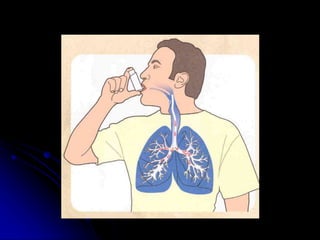
MDI or DPI ????
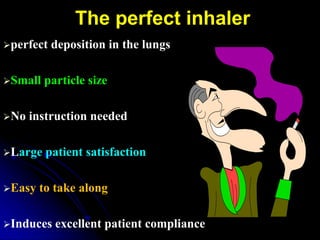
The perfect inhaler
perfect deposition in the lungs
Small particle size
No instruction needed
Large patient satisfaction
Easy to take along
Induces excellent patient compliance
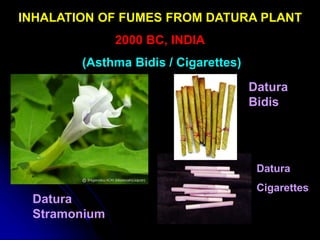
INHALATION OF FUMES FROM DATURA PLANT
2000 BC, INDIA
(Asthma Bidis / Cigarettes)
Datura
Stramonium
Datura
Bidis
Datura
Cigarettes
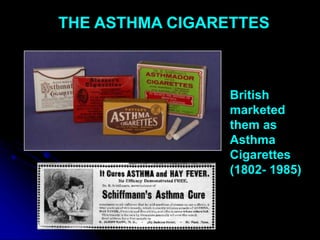
THE ASTHMA CIGARETTES
British
marketed
them as
Asthma
Cigarettes
(1802- 1985)
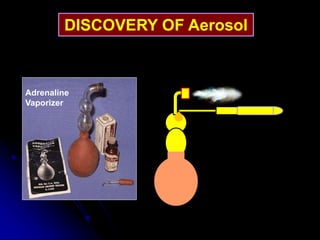
Adrenaline
Vaporizer
DISCOVERY OF Aerosol
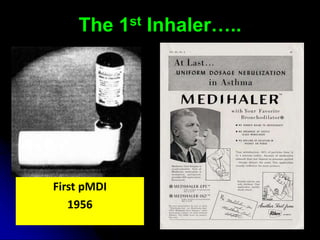
First pMDI
1956
The 1st Inhaler…..
Inhaler devices are likely to become more Important
than development of new drugs in the future
Barnes PJ. Resp Med 2004;Suppl A:S1-S7
Inhaler is the second most common medication form in
the world (after pills)
Resp Care 2005;50:1360-75
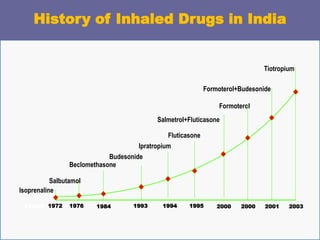
History of Inhaled Drugs in India
1972 1976
Salbutamol
Beclomethasone
Budesonide
Ipratropium
Fluticasone
Salmetrol+Fluticasone
Formoterol
Tiotropium
YEARS 1984 1993 1994 1995 2000 2000 2001 2003
Formoterol+Budesonide
Isoprenaline
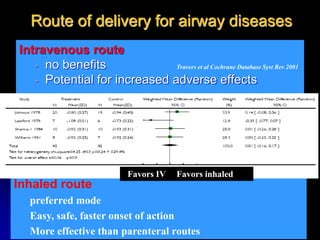
Route of delivery for airway diseases
Intravenous route
- no benefits
- Potential for increased adverse effects
Inhaled route
preferred mode
Easy, safe, faster onset of action
More effective than parenteral routes
Favors IV Favors inhaled
Travers et al Cochrane Database Syst Rev 2001
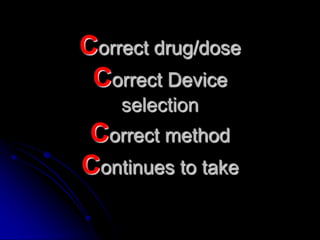
Correct drug/dose
Correct Device
selection
Correct method
Continues to take
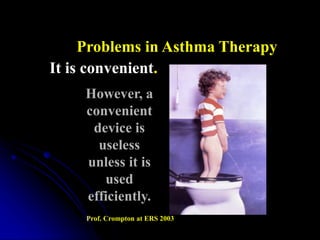
It is convenient.
However, a
convenient
device is
useless
unless it is
used
efficiently.
Prof. Crompton at ERS 2003
Problems in Asthma Therapy
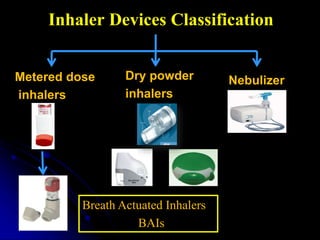
Metered dose
inhalers
Dry powder
inhalers
Nebulizer
Inhaler Devices Classification
Breath Actuated Inhalers
BAIs
Metered dose
inhalers
MDIs: The good
 Compact
 Portable
 200 doses
 Convenient to carry
 Quick to use
 Economical
 Long track record - > 50yrs
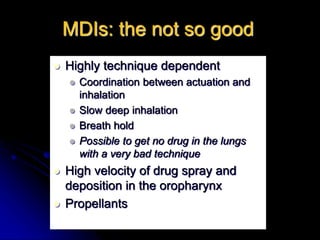
MDIs: the not so good
 Highly technique dependent
 Coordination between actuation and
inhalation
 Slow deep inhalation
 Breath hold
 Possible to get no drug in the lungs
with a very bad technique
 High velocity of drug spray and
deposition in the oropharynx
 Propellants
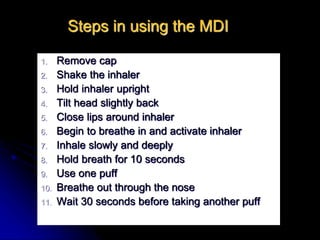
Steps in using the MDI
1. Remove cap
2. Shake the inhaler
3. Hold inhaler upright
4. Tilt head slightly back
5. Close lips around inhaler
6. Begin to breathe in and activate inhaler
7. Inhale slowly and deeply
8. Hold breath for 10 seconds
9. Use one puff
10. Breathe out through the nose
11. Wait 30 seconds before taking another puff
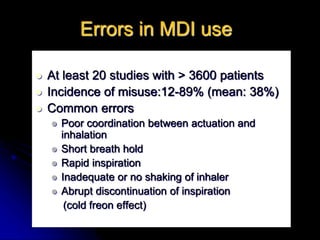
Errors in MDI use
 At least 20 studies with > 3600 patients
 Incidence of misuse:12-89% (mean: 38%)
 Common errors
 Poor coordination between actuation and
inhalation
 Short breath hold
 Rapid inspiration
 Inadequate or no shaking of inhaler
 Abrupt discontinuation of inspiration
(cold freon effect)
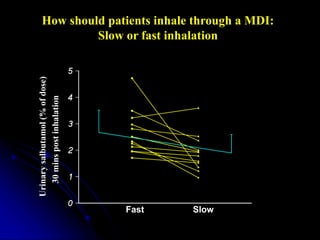
How should patients inhale through a MDI:
Slow or fast inhalation
Fast Slow
Urinary
salbutamol
(%
of
dose)
30
mins
post
inhalation
Brit J Clin Pharmacol 2005
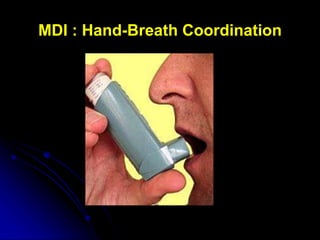
MDI : Hand-Breath Coordination
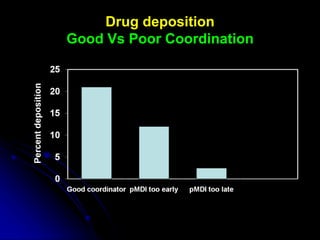
Drug deposition
Good Vs Poor Coordination
Thorax. 1991; 46(10):71
10
20
30
%
15 30 60 90
Min
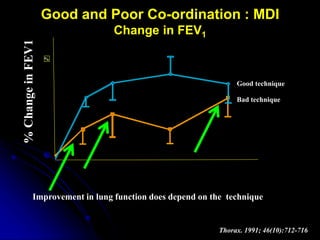
Thorax. 1991; 46(10):712-716
Good technique
Bad technique
Improvement in lung function does depend on the technique
Good and Poor Co-ordination : MDI
Change in FEV1
%
Change
in
FEV1
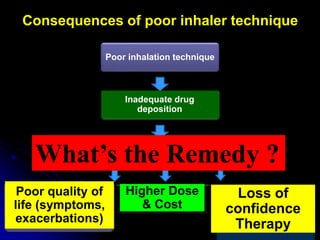
Consequences of poor inhaler technique
Poor inhalation technique
Inadequate drug
deposition
Poor Asthma control
Poor quality of
life (symptoms,
exacerbations)
Higher Dose
& Cost
Loss of
confidence
Therapy
What’s the Remedy ?
What is the Remedy?
 Appropriate and repeated patient
education with training
 Alternated devices:
Breath actuated devices
Dry powder inhalers
Use of spacers
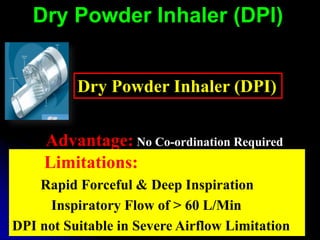
Dry Powder Inhaler (DPI)
Dry Powder Inhalers
 Introduced in the 1960s
 In India in the 1980s
 No propellants
 Breath actuated delivery
 Patient’s own inspiratory effort
 Many different types are available
or in development
 Capsules, blisters, reservoirs and
replaceable reservoirs
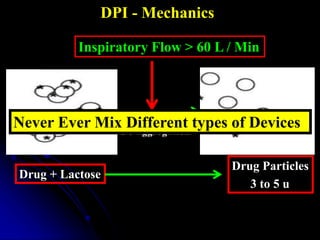
Inspiratory Flow > 60 L / Min
De-aggregation
Drug Particles
3 to 5 u
Drug + Lactose
DPI - Mechanics
Never Ever Mix Different types of Devices
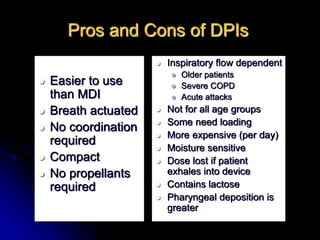
Pros and Cons of DPIs
 Easier to use
than MDI
 Breath actuated
 No coordination
required
 Compact
 No propellants
required
 Inspiratory flow dependent
 Older patients
 Severe COPD
 Acute attacks
 Not for all age groups
 Some need loading
 More expensive (per day)
 Moisture sensitive
 Dose lost if patient
exhales into device
 Contains lactose
 Pharyngeal deposition is
greater
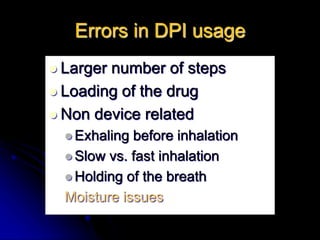
Errors in DPI usage
 Larger number of steps
 Loading of the drug
 Non device related
 Exhaling before inhalation
 Slow vs. fast inhalation
 Holding of the breath
Moisture issues
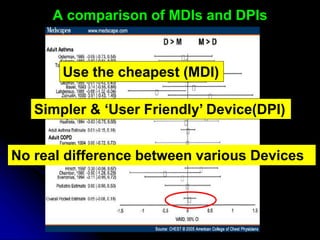
A comparison of MDIs and DPIs
Chest 2005;
127:335-71
No real difference between various Devices
Use the cheapest (MDI)
Simpler & ‘User Friendly’ Device(DPI)
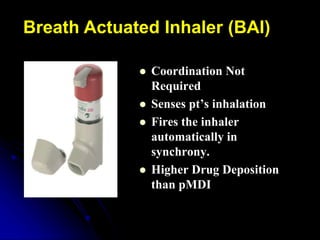
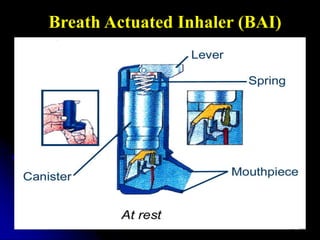
Breath Actuated Inhaler (BAI)
 Coordination Not
Required
 Senses pt’s inhalation
 Fires the inhaler
automatically in
synchrony.
 Higher Drug Deposition
than pMDI
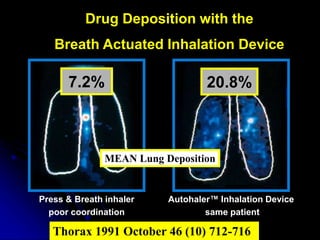
Press & Breath inhaler
poor coordination
Autohaler™ Inhalation Device
same patient
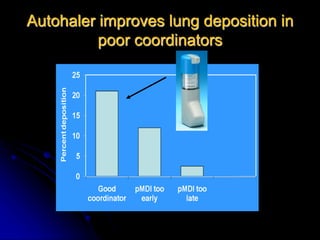
20.8%
7.2%
Drug Deposition with the
Breath Actuated Inhalation Device
MEAN Lung Deposition
. Thorax. 1991; 46(10):712-716
Thorax 1991 October 46 (10) 712-716
Breath Actuated Inhaler (BAI)
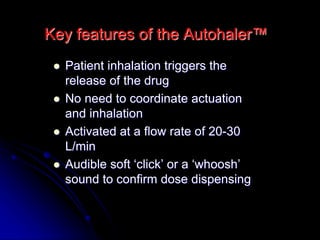
Key features of the Autohaler™
 Patient inhalation triggers the
release of the drug
 No need to coordinate actuation
and inhalation
 Activated at a flow rate of 20-30
L/min
 Audible soft ‘click’ or a ‘whoosh’
sound to confirm dose dispensing
Autohaler improves lung deposition in
poor coordinators
Thorax. 1991; 46(10):712
Choice ????
BAI ( Breath Actuated
Inhaler)
MDI + Spacer
Spacers
Large-volume and small-volume spacers:
Fit into the end of aerosol inhalers only
Can increase the amount of medication
reaching the lungs
Reduce the amount that stays in the throat
Are especially useful for
· children
· people with poor co-ordination
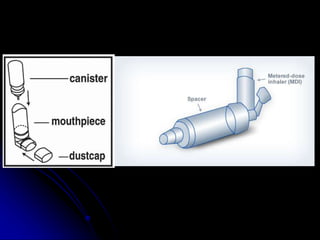
· acute asthma attacks
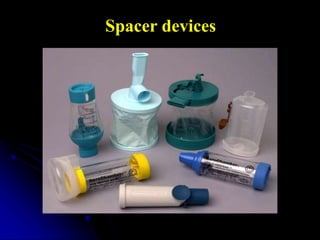
Spacer devices
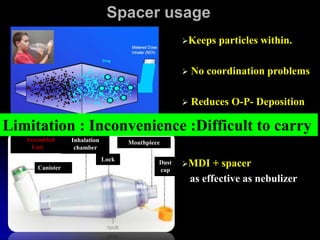
Spacer usage
Assembled
Unit
Inhalation
chamber
Mouthpiece
Canister
Dust
cap
Lock
Keeps particles within.
 No coordination problems
 Reduces O-P- Deposition
Reduces side effects
MDI + spacer
as effective as nebulizer
Limitation : Inconvenience :Difficult to carry
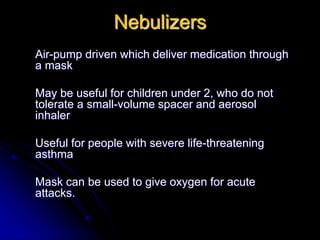
Nebulizers
Air-pump driven which deliver medication through
a mask
May be useful for children under 2, who do not
tolerate a small-volume spacer and aerosol
inhaler
Useful for people with severe life-threatening
asthma
Mask can be used to give oxygen for acute
attacks.
Worsening Asthma
 You need to recognize when asthma is getting
worse in your patient - respond promptly.
 Develop a written Action Plan with your patient
so he/ she knows what to do.
 Watch out for:
increasing symptoms, especially waking
at night
need for more reliever medication
failure of reliever medication to relieve
symptoms
drop in peak flow
A good Action Plan should tell
the patient:
 what medication to take?
 how much to take?
 when and how to increase
medication?
 when to seek medical help
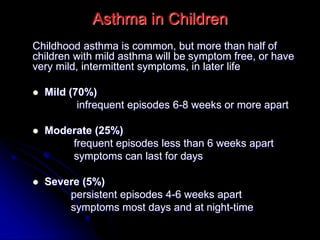
Asthma in Children
Childhood asthma is common, but more than half of
children with mild asthma will be symptom free, or have
very mild, intermittent symptoms, in later life
 Mild (70%)
infrequent episodes 6-8 weeks or more apart
 Moderate (25%)
frequent episodes less than 6 weeks apart
symptoms can last for days
 Severe (5%)
persistent episodes 4-6 weeks apart
symptoms most days and at night-time
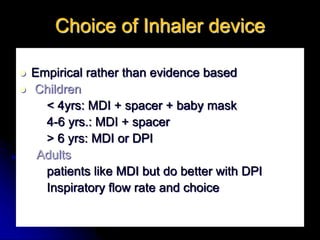
Choice of Inhaler device
 Empirical rather than evidence based
 Children
< 4yrs: MDI + spacer + baby mask
4-6 yrs.: MDI + spacer
> 6 yrs: MDI or DPI
Adults
patients like MDI but do better with DPI
Inspiratory flow rate and choice
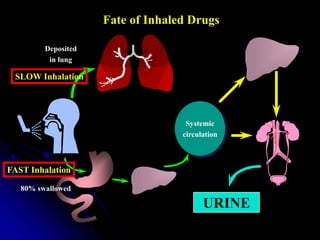
Fate of Inhaled Drugs
Systemic
circulation
Deposited
in lung
80% swallowed
URINE
SLOW Inhalation
FAST Inhalation
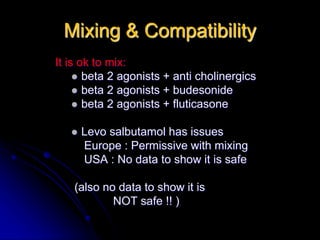
Mixing & Compatibility
It is ok to mix:
 beta 2 agonists + anti cholinergics
 beta 2 agonists + budesonide
 beta 2 agonists + fluticasone
 Levo salbutamol has issues
Europe : Permissive with mixing
USA : No data to show it is safe
(also no data to show it is
NOT safe !! )
Some Practical points…
 Avoid different types of devices to
the same patient
 Don’t change device again and
again
- Patient looses faith in the drug,
device and doctor.
 First coaching is the most crucial
 Insist on checking at every visit
 Involve other staff
Conclusions
 Use of inhalation device is the most critical
step in achieving good asthma control
 MDI: Check for Hand Breath Coordination.
In case of poor Coordination, use:
MDI + Spacer or Breath Actuated Inhaler
 DPI: Easy to use and patient friendly
Avoid in the presence of Severe obstruction (< 60 L/min)
 Never Mix Different Devices
 Inhaler Technique:
Train & Retrain Check & Recheck
THANKS
Selecting the Right
Device
•Age
•IQ
•Severity of disease
•Inspiratory flow rate
•Acute situations
•Local side effects
•Economics
•It’s cool !!
David E Geller et al, Comparing Clinical Features of the Nebulizer,
Metered-Dose Inhaler, and Dry Powder InhalerRespiratory Care
October, 2005, VOL 50 NO 10
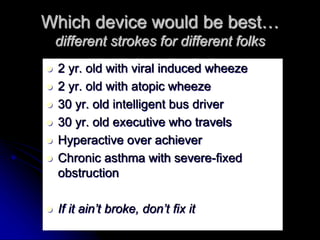
Which device would be best…
different strokes for different folks
 2 yr. old with viral induced wheeze
 2 yr. old with atopic wheeze
 30 yr. old intelligent bus driver
 30 yr. old executive who travels
 Hyperactive over achiever
 Chronic asthma with severe-fixed
obstruction
 If it ain’t broke, don’t fix it
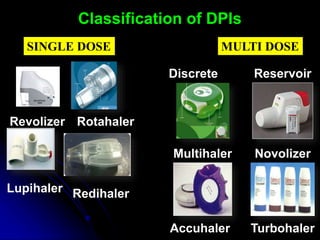
SINGLE DOSE MULTI DOSE
Reservoir
Discrete
Novolizer
Revolizer Rotahaler
Lupihaler Redihaler
Multihaler
Accuhaler Turbohaler
Classification of DPIs
Dry Powder Inhaler (DPI)
Advantage: No Co-ordination Required
Limitations:
Rapid Forceful & Deep Inspiration
Inspiratory Flow of > 60 L/Min
DPI not Suitable in Severe Airflow Limitation
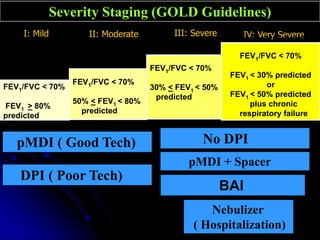
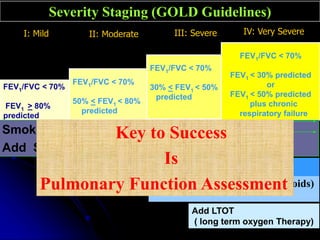
IV: Very Severe
III: Severe
II: Moderate
I: Mild
Severity Staging (GOLD Guidelines)
FEV1/FVC < 70%
FEV1 > 80%
predicted
FEV1/FVC < 70%
50% < FEV1 < 80%
predicted
FEV1/FVC < 70%
30% < FEV1 < 50%
predicted
FEV1/FVC < 70%
FEV1 < 30% predicted
or
FEV1 < 50% predicted
plus chronic
respiratory failure
Nebulizer
( Hospitalization)
BAI
pMDI + Spacer
No DPI
pMDI ( Good Tech)
DPI ( Poor Tech)
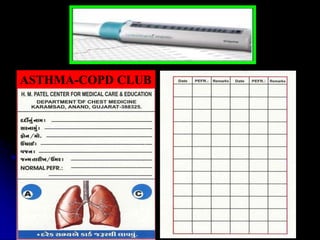
ASTHMA-COPD CLUB
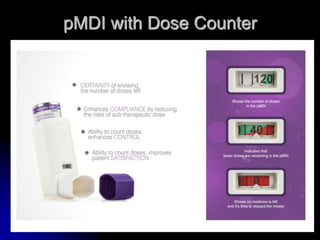
pMDI with Dose Counter
Aerosol Therapy
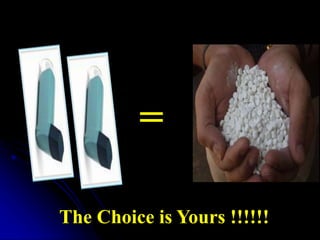
“In No Way different”
1100 mg
Salbutamol
=
The Choice is Yours !!!!!!
ANY INHALER WITH POOR TECHNIQUE
IS
THE MOST EXPENSIVE INHALER.
Thank You
Dr. Rajiv Paliwal
Chest Physician,
Shree Krishna Hospital, Karamsad
Cell No : 982 505 6084
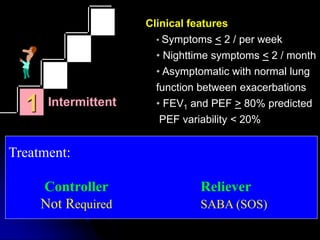
Intermittent
Clinical features
• Symptoms < 2 / per week
• Nighttime symptoms < 2 / month
• Asymptomatic with normal lung
function between exacerbations
• FEV1 and PEF > 80% predicted
PEF variability < 20%
1
Treatment:
Controller Reliever
Not Required SABA (SOS)
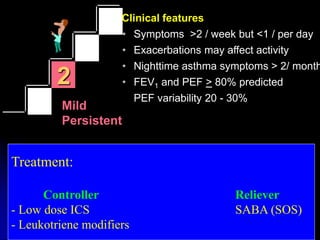
Clinical features
• Symptoms >2 / week but <1 / per day
• Exacerbations may affect activity
• Nighttime asthma symptoms > 2/ month
• FEV1 and PEF > 80% predicted
PEF variability 20 - 30%
Mild
Persistent
2
Treatment:
Controller Reliever
- Low dose ICS SABA (SOS)
- Leukotriene modifiers
Clinical features
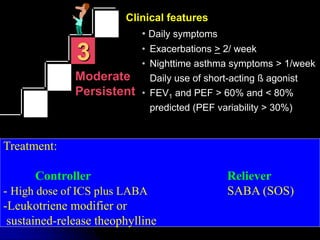
• Daily symptoms
• Exacerbations > 2/ week
• Nighttime asthma symptoms > 1/week
Daily use of short-acting ß agonist
• FEV1 and PEF > 60% and < 80%
predicted (PEF variability > 30%)
3
Moderate
Persistent
Treatment:
Controller Reliever
- High dose of ICS plus LABA SABA (SOS)
-Leukotriene modifier or
sustained-release theophylline
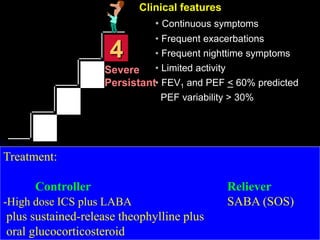
Clinical features
• Continuous symptoms
• Frequent exacerbations
• Frequent nighttime symptoms
• Limited activity
• FEV1 and PEF < 60% predicted
PEF variability > 30%
4
Treatment:
Controller Reliever
-High dose ICS plus LABA SABA (SOS)
plus sustained-release theophylline plus
oral glucocorticosteroid
Severe
Persistant
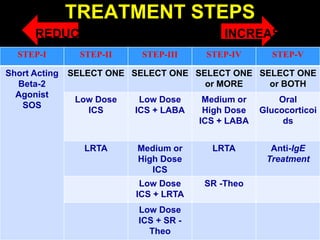
TREATMENT STEPS
STEP-I STEP-II STEP-III STEP-IV STEP-V
Short Acting
Beta-2
Agonist
SOS
SELECT ONE SELECT ONE SELECT ONE
or MORE
SELECT ONE
or BOTH
Low Dose
ICS
Low Dose
ICS + LABA
Medium or
High Dose
ICS + LABA
Oral
Glucocorticoi
ds
LRTA Medium or
High Dose
ICS
LRTA Anti-IgE
Treatment
Low Dose
ICS + LRTA
SR -Theo
Low Dose
ICS + SR -
Theo
REDUCE INCREASE
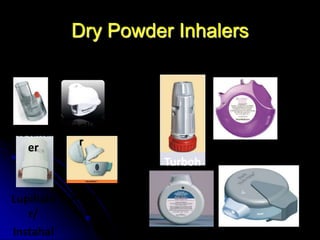
Dry Powder Inhalers
Single dose
Handiha
ler
Lupihale
r/
Instahal
Revolize
r
Rotahal
er
Multi dose
Turboh
aler
Accuhal
er
Aerosol a Topical Therapy
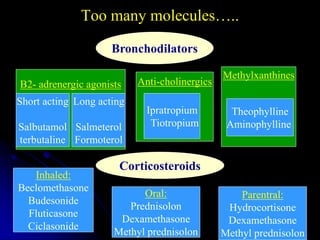
Too many molecules…..
B2- adrenergic agonists Anti-cholinergics
Methylxanthines
Short acting
Salbutamol
terbutaline
Long acting
Salmeterol
Formoterol
Ipratropium
Tiotropium
Theophylline
Aminophylline
Inhaled:
Beclomethasone
Budesonide
Fluticasone
Ciclasonide
Oral:
Prednisolon
Dexamethasone
Methyl prednisolon
Parentral:
Hydrocortisone
Dexamethasone
Methyl prednisolon
Bronchodilators
Corticosteroids
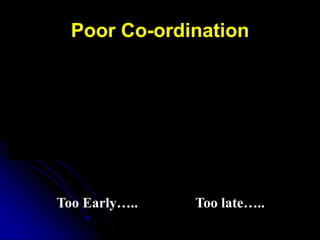
Poor Co-ordination
Too Early….. Too late…..
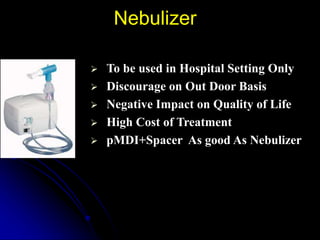
Nebulizer
 To be used in Hospital Setting Only
 Discourage on Out Door Basis
 Negative Impact on Quality of Life
 High Cost of Treatment
 pMDI+Spacer As good As Nebulizer
IV: Very Severe
III: Severe
II: Moderate
I: Mild
Severity Staging (GOLD Guidelines)
FEV1/FVC < 70%
FEV1 > 80%
predicted
FEV1/FVC < 70%
50% < FEV1 < 80%
predicted
FEV1/FVC < 70%
30% < FEV1 < 50%
predicted
FEV1/FVC < 70%
FEV1 < 30% predicted
or
FEV1 < 50% predicted
plus chronic
respiratory failure
Add Tiotropium Bomide +/- LABA
Add ICS (inhaled corticosteroids)
Smoking Cessation (Avoid risk factor(s))
Add SABA (short-acting bronchodilator) SOS
Add LTOT
( long term oxygen Therapy)
Key to Success
Is
Pulmonary Function Assessment
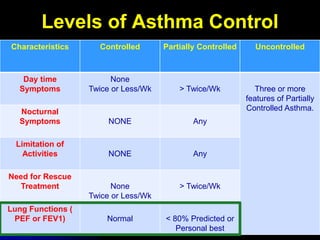
Levels of Asthma Control
Characteristics Controlled Partially Controlled Uncontrolled
Day time
Symptoms
None
Twice or Less/Wk > Twice/Wk Three or more
features of Partially
Controlled Asthma.
Nocturnal
Symptoms NONE Any
Limitation of
Activities NONE Any
Need for Rescue
Treatment None
Twice or Less/Wk
> Twice/Wk
Lung Functions (
PEF or FEV1) Normal < 80% Predicted or
Personal best
Gap Between
‘Expectations’ & ‘Outcome’
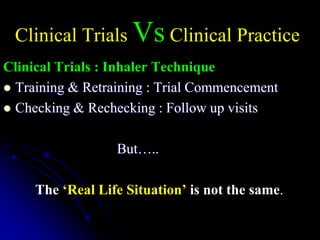
Clinical Trials Vs Clinical Practice
Clinical Trials : Inhaler Technique
 Training & Retraining : Trial Commencement
 Checking & Rechecking : Follow up visits
But…..
The ‘Real Life Situation’ is not the same.
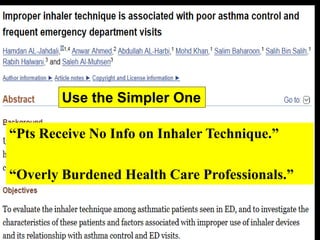
“Pts Receive No Info on Inhaler Technique.”
“Overly Burdened Health Care Professionals.”
Use the Simpler One
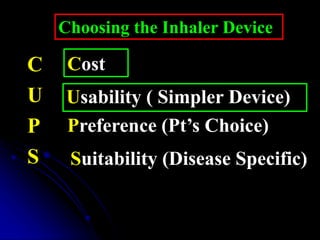
C
U
P
S
Cost
Usability ( Simpler Device)
Preference (Pt’s Choice)
Suitability (Disease Specific)
Choosing the Inhaler Device
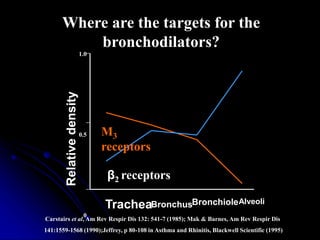
Carstairs et al, Am Rev Respir Dis 132: 541-7 (1985); Mak & Barnes, Am Rev Respir Dis
141:1559-1568 (1990);Jeffrey, p 80-108 in Asthma and Rhinitis, Blackwell Scientific (1995)
M3
receptors
Where are the targets for the
bronchodilators?
TracheaBronchusBronchioleAlveoli
β2 receptors
Relative
density
1.0
0.5
0
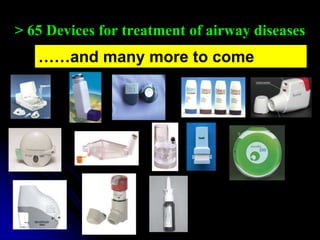
> 65 Devices for treatment of airway diseases
> 65 different inhaled products of more than 20 ingredients
……and many more to come
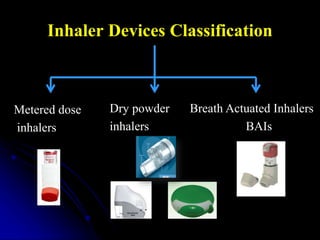
Inhaler Devices Classification
Metered dose
inhalers
Dry powder
inhalers
Breath Actuated Inhalers
BAIs
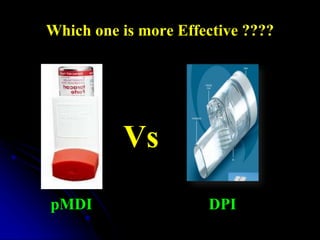
Which one is more Effective ????
Vs
pMDI DPI
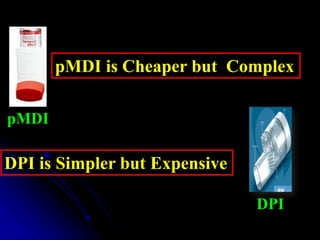
pMDI
DPI
pMDI is Cheaper but Complex
DPI is Simpler but Expensive

Inhalational devices.ppt

  • 1.
    Inhaler Devices forAsthma Control Dr. S. K. Jindal, Medical Director, Jindal Clinics SCO 21, Sector 20 D, Chandigarh www.jindalchest.com
  • 2.
    “Clinicians Choose InhalerDevice By Personal Preference and more out of Instinct than Science” Perfect Inhaler !!!!!! MDI or DPI ????
  • 3.
    The perfect inhaler perfectdeposition in the lungs Small particle size No instruction needed Large patient satisfaction Easy to take along Induces excellent patient compliance
  • 4.
    INHALATION OF FUMESFROM DATURA PLANT 2000 BC, INDIA (Asthma Bidis / Cigarettes) Datura Stramonium Datura Bidis Datura Cigarettes
  • 5.
    THE ASTHMA CIGARETTES British marketed themas Asthma Cigarettes (1802- 1985)
  • 6.
  • 7.
  • 8.
    Inhaler devices arelikely to become more Important than development of new drugs in the future Barnes PJ. Resp Med 2004;Suppl A:S1-S7 Inhaler is the second most common medication form in the world (after pills) Resp Care 2005;50:1360-75
  • 9.
    History of InhaledDrugs in India 1972 1976 Salbutamol Beclomethasone Budesonide Ipratropium Fluticasone Salmetrol+Fluticasone Formoterol Tiotropium YEARS 1984 1993 1994 1995 2000 2000 2001 2003 Formoterol+Budesonide Isoprenaline
  • 10.
    Route of deliveryfor airway diseases Intravenous route - no benefits - Potential for increased adverse effects Inhaled route preferred mode Easy, safe, faster onset of action More effective than parenteral routes Favors IV Favors inhaled Travers et al Cochrane Database Syst Rev 2001
  • 11.
  • 13.
    It is convenient. However,a convenient device is useless unless it is used efficiently. Prof. Crompton at ERS 2003 Problems in Asthma Therapy
  • 14.
    Metered dose inhalers Dry powder inhalers Nebulizer InhalerDevices Classification Breath Actuated Inhalers BAIs
  • 15.
  • 16.
    MDIs: The good Compact  Portable  200 doses  Convenient to carry  Quick to use  Economical  Long track record - > 50yrs
  • 17.
    MDIs: the notso good  Highly technique dependent  Coordination between actuation and inhalation  Slow deep inhalation  Breath hold  Possible to get no drug in the lungs with a very bad technique  High velocity of drug spray and deposition in the oropharynx  Propellants
  • 18.
    Steps in usingthe MDI 1. Remove cap 2. Shake the inhaler 3. Hold inhaler upright 4. Tilt head slightly back 5. Close lips around inhaler 6. Begin to breathe in and activate inhaler 7. Inhale slowly and deeply 8. Hold breath for 10 seconds 9. Use one puff 10. Breathe out through the nose 11. Wait 30 seconds before taking another puff
  • 19.
    Errors in MDIuse  At least 20 studies with > 3600 patients  Incidence of misuse:12-89% (mean: 38%)  Common errors  Poor coordination between actuation and inhalation  Short breath hold  Rapid inspiration  Inadequate or no shaking of inhaler  Abrupt discontinuation of inspiration (cold freon effect)
  • 20.
    How should patientsinhale through a MDI: Slow or fast inhalation Fast Slow Urinary salbutamol (% of dose) 30 mins post inhalation Brit J Clin Pharmacol 2005
  • 21.
    MDI : Hand-BreathCoordination
  • 22.
    Drug deposition Good VsPoor Coordination Thorax. 1991; 46(10):71
  • 23.
    10 20 30 % 15 30 6090 Min Thorax. 1991; 46(10):712-716 Good technique Bad technique Improvement in lung function does depend on the technique Good and Poor Co-ordination : MDI Change in FEV1 % Change in FEV1
  • 24.
    Consequences of poorinhaler technique Poor inhalation technique Inadequate drug deposition Poor Asthma control Poor quality of life (symptoms, exacerbations) Higher Dose & Cost Loss of confidence Therapy What’s the Remedy ?
  • 25.
    What is theRemedy?  Appropriate and repeated patient education with training  Alternated devices: Breath actuated devices Dry powder inhalers Use of spacers
  • 26.
  • 27.
    Dry Powder Inhalers Introduced in the 1960s  In India in the 1980s  No propellants  Breath actuated delivery  Patient’s own inspiratory effort  Many different types are available or in development  Capsules, blisters, reservoirs and replaceable reservoirs
  • 28.
    Inspiratory Flow >60 L / Min De-aggregation Drug Particles 3 to 5 u Drug + Lactose DPI - Mechanics Never Ever Mix Different types of Devices
  • 29.
    Pros and Consof DPIs  Easier to use than MDI  Breath actuated  No coordination required  Compact  No propellants required  Inspiratory flow dependent  Older patients  Severe COPD  Acute attacks  Not for all age groups  Some need loading  More expensive (per day)  Moisture sensitive  Dose lost if patient exhales into device  Contains lactose  Pharyngeal deposition is greater
  • 30.
    Errors in DPIusage  Larger number of steps  Loading of the drug  Non device related  Exhaling before inhalation  Slow vs. fast inhalation  Holding of the breath Moisture issues
  • 31.
    A comparison ofMDIs and DPIs Chest 2005; 127:335-71 No real difference between various Devices Use the cheapest (MDI) Simpler & ‘User Friendly’ Device(DPI)
  • 32.
    Breath Actuated Inhaler(BAI)  Coordination Not Required  Senses pt’s inhalation  Fires the inhaler automatically in synchrony.  Higher Drug Deposition than pMDI
  • 33.
    Press & Breathinhaler poor coordination Autohaler™ Inhalation Device same patient 20.8% 7.2% Drug Deposition with the Breath Actuated Inhalation Device MEAN Lung Deposition . Thorax. 1991; 46(10):712-716 Thorax 1991 October 46 (10) 712-716
  • 34.
  • 35.
    Key features ofthe Autohaler™  Patient inhalation triggers the release of the drug  No need to coordinate actuation and inhalation  Activated at a flow rate of 20-30 L/min  Audible soft ‘click’ or a ‘whoosh’ sound to confirm dose dispensing
  • 37.
    Autohaler improves lungdeposition in poor coordinators Thorax. 1991; 46(10):712
  • 38.
    Choice ???? BAI (Breath Actuated Inhaler) MDI + Spacer
  • 39.
    Spacers Large-volume and small-volumespacers: Fit into the end of aerosol inhalers only Can increase the amount of medication reaching the lungs Reduce the amount that stays in the throat Are especially useful for · children · people with poor co-ordination · acute asthma attacks
  • 40.
  • 41.
    Spacer usage Assembled Unit Inhalation chamber Mouthpiece Canister Dust cap Lock Keeps particleswithin.  No coordination problems  Reduces O-P- Deposition Reduces side effects MDI + spacer as effective as nebulizer Limitation : Inconvenience :Difficult to carry
  • 42.
    Nebulizers Air-pump driven whichdeliver medication through a mask May be useful for children under 2, who do not tolerate a small-volume spacer and aerosol inhaler Useful for people with severe life-threatening asthma Mask can be used to give oxygen for acute attacks.
  • 43.
    Worsening Asthma  Youneed to recognize when asthma is getting worse in your patient - respond promptly.  Develop a written Action Plan with your patient so he/ she knows what to do.  Watch out for: increasing symptoms, especially waking at night need for more reliever medication failure of reliever medication to relieve symptoms drop in peak flow
  • 44.
    A good ActionPlan should tell the patient:  what medication to take?  how much to take?  when and how to increase medication?  when to seek medical help
  • 45.
    Asthma in Children Childhoodasthma is common, but more than half of children with mild asthma will be symptom free, or have very mild, intermittent symptoms, in later life  Mild (70%) infrequent episodes 6-8 weeks or more apart  Moderate (25%) frequent episodes less than 6 weeks apart symptoms can last for days  Severe (5%) persistent episodes 4-6 weeks apart symptoms most days and at night-time
  • 46.
    Choice of Inhalerdevice  Empirical rather than evidence based  Children < 4yrs: MDI + spacer + baby mask 4-6 yrs.: MDI + spacer > 6 yrs: MDI or DPI Adults patients like MDI but do better with DPI Inspiratory flow rate and choice
  • 47.
    Fate of InhaledDrugs Systemic circulation Deposited in lung 80% swallowed URINE SLOW Inhalation FAST Inhalation
  • 48.
    Mixing & Compatibility Itis ok to mix:  beta 2 agonists + anti cholinergics  beta 2 agonists + budesonide  beta 2 agonists + fluticasone  Levo salbutamol has issues Europe : Permissive with mixing USA : No data to show it is safe (also no data to show it is NOT safe !! )
  • 49.
    Some Practical points… Avoid different types of devices to the same patient  Don’t change device again and again - Patient looses faith in the drug, device and doctor.  First coaching is the most crucial  Insist on checking at every visit  Involve other staff
  • 50.
    Conclusions  Use ofinhalation device is the most critical step in achieving good asthma control  MDI: Check for Hand Breath Coordination. In case of poor Coordination, use: MDI + Spacer or Breath Actuated Inhaler  DPI: Easy to use and patient friendly Avoid in the presence of Severe obstruction (< 60 L/min)  Never Mix Different Devices  Inhaler Technique: Train & Retrain Check & Recheck
  • 51.
  • 54.
    Selecting the Right Device •Age •IQ •Severityof disease •Inspiratory flow rate •Acute situations •Local side effects •Economics •It’s cool !!
  • 57.
    David E Gelleret al, Comparing Clinical Features of the Nebulizer, Metered-Dose Inhaler, and Dry Powder InhalerRespiratory Care October, 2005, VOL 50 NO 10
  • 58.
    Which device wouldbe best… different strokes for different folks  2 yr. old with viral induced wheeze  2 yr. old with atopic wheeze  30 yr. old intelligent bus driver  30 yr. old executive who travels  Hyperactive over achiever  Chronic asthma with severe-fixed obstruction  If it ain’t broke, don’t fix it
  • 59.
    SINGLE DOSE MULTIDOSE Reservoir Discrete Novolizer Revolizer Rotahaler Lupihaler Redihaler Multihaler Accuhaler Turbohaler Classification of DPIs
  • 60.
    Dry Powder Inhaler(DPI) Dry Powder Inhaler (DPI) Advantage: No Co-ordination Required Limitations: Rapid Forceful & Deep Inspiration Inspiratory Flow of > 60 L/Min DPI not Suitable in Severe Airflow Limitation
  • 61.
    IV: Very Severe III:Severe II: Moderate I: Mild Severity Staging (GOLD Guidelines) FEV1/FVC < 70% FEV1 > 80% predicted FEV1/FVC < 70% 50% < FEV1 < 80% predicted FEV1/FVC < 70% 30% < FEV1 < 50% predicted FEV1/FVC < 70% FEV1 < 30% predicted or FEV1 < 50% predicted plus chronic respiratory failure Nebulizer ( Hospitalization) BAI pMDI + Spacer No DPI pMDI ( Good Tech) DPI ( Poor Tech)
  • 62.
  • 63.
  • 64.
    Aerosol Therapy “In NoWay different”
  • 65.
  • 67.
    ANY INHALER WITHPOOR TECHNIQUE IS THE MOST EXPENSIVE INHALER. Thank You Dr. Rajiv Paliwal Chest Physician, Shree Krishna Hospital, Karamsad Cell No : 982 505 6084
  • 68.
    Intermittent Clinical features • Symptoms< 2 / per week • Nighttime symptoms < 2 / month • Asymptomatic with normal lung function between exacerbations • FEV1 and PEF > 80% predicted PEF variability < 20% 1 Treatment: Controller Reliever Not Required SABA (SOS)
  • 69.
    Clinical features • Symptoms>2 / week but <1 / per day • Exacerbations may affect activity • Nighttime asthma symptoms > 2/ month • FEV1 and PEF > 80% predicted PEF variability 20 - 30% Mild Persistent 2 Treatment: Controller Reliever - Low dose ICS SABA (SOS) - Leukotriene modifiers
  • 70.
    Clinical features • Dailysymptoms • Exacerbations > 2/ week • Nighttime asthma symptoms > 1/week Daily use of short-acting ß agonist • FEV1 and PEF > 60% and < 80% predicted (PEF variability > 30%) 3 Moderate Persistent Treatment: Controller Reliever - High dose of ICS plus LABA SABA (SOS) -Leukotriene modifier or sustained-release theophylline
  • 71.
    Clinical features • Continuoussymptoms • Frequent exacerbations • Frequent nighttime symptoms • Limited activity • FEV1 and PEF < 60% predicted PEF variability > 30% 4 Treatment: Controller Reliever -High dose ICS plus LABA SABA (SOS) plus sustained-release theophylline plus oral glucocorticosteroid Severe Persistant
  • 72.
    TREATMENT STEPS STEP-I STEP-IISTEP-III STEP-IV STEP-V Short Acting Beta-2 Agonist SOS SELECT ONE SELECT ONE SELECT ONE or MORE SELECT ONE or BOTH Low Dose ICS Low Dose ICS + LABA Medium or High Dose ICS + LABA Oral Glucocorticoi ds LRTA Medium or High Dose ICS LRTA Anti-IgE Treatment Low Dose ICS + LRTA SR -Theo Low Dose ICS + SR - Theo REDUCE INCREASE
  • 73.
    Dry Powder Inhalers Singledose Handiha ler Lupihale r/ Instahal Revolize r Rotahal er Multi dose Turboh aler Accuhal er
  • 74.
  • 75.
    Too many molecules….. B2-adrenergic agonists Anti-cholinergics Methylxanthines Short acting Salbutamol terbutaline Long acting Salmeterol Formoterol Ipratropium Tiotropium Theophylline Aminophylline Inhaled: Beclomethasone Budesonide Fluticasone Ciclasonide Oral: Prednisolon Dexamethasone Methyl prednisolon Parentral: Hydrocortisone Dexamethasone Methyl prednisolon Bronchodilators Corticosteroids
  • 76.
  • 77.
    Nebulizer  To beused in Hospital Setting Only  Discourage on Out Door Basis  Negative Impact on Quality of Life  High Cost of Treatment  pMDI+Spacer As good As Nebulizer
  • 79.
    IV: Very Severe III:Severe II: Moderate I: Mild Severity Staging (GOLD Guidelines) FEV1/FVC < 70% FEV1 > 80% predicted FEV1/FVC < 70% 50% < FEV1 < 80% predicted FEV1/FVC < 70% 30% < FEV1 < 50% predicted FEV1/FVC < 70% FEV1 < 30% predicted or FEV1 < 50% predicted plus chronic respiratory failure Add Tiotropium Bomide +/- LABA Add ICS (inhaled corticosteroids) Smoking Cessation (Avoid risk factor(s)) Add SABA (short-acting bronchodilator) SOS Add LTOT ( long term oxygen Therapy) Key to Success Is Pulmonary Function Assessment
  • 80.
    Levels of AsthmaControl Characteristics Controlled Partially Controlled Uncontrolled Day time Symptoms None Twice or Less/Wk > Twice/Wk Three or more features of Partially Controlled Asthma. Nocturnal Symptoms NONE Any Limitation of Activities NONE Any Need for Rescue Treatment None Twice or Less/Wk > Twice/Wk Lung Functions ( PEF or FEV1) Normal < 80% Predicted or Personal best
  • 81.
  • 82.
    Clinical Trials VsClinical Practice Clinical Trials : Inhaler Technique  Training & Retraining : Trial Commencement  Checking & Rechecking : Follow up visits But….. The ‘Real Life Situation’ is not the same.
  • 83.
    “Pts Receive NoInfo on Inhaler Technique.” “Overly Burdened Health Care Professionals.” Use the Simpler One
  • 84.
    C U P S Cost Usability ( SimplerDevice) Preference (Pt’s Choice) Suitability (Disease Specific) Choosing the Inhaler Device
  • 85.
    Carstairs et al,Am Rev Respir Dis 132: 541-7 (1985); Mak & Barnes, Am Rev Respir Dis 141:1559-1568 (1990);Jeffrey, p 80-108 in Asthma and Rhinitis, Blackwell Scientific (1995) M3 receptors Where are the targets for the bronchodilators? TracheaBronchusBronchioleAlveoli β2 receptors Relative density 1.0 0.5 0
  • 86.
    > 65 Devicesfor treatment of airway diseases > 65 different inhaled products of more than 20 ingredients ……and many more to come
  • 87.
    Inhaler Devices Classification Metereddose inhalers Dry powder inhalers Breath Actuated Inhalers BAIs
  • 88.
    Which one ismore Effective ???? Vs pMDI DPI
  • 89.
    pMDI DPI pMDI is Cheaperbut Complex DPI is Simpler but Expensive