
Mahmoud Elhusseiny Abolmagd MSc, MD
Lecturer of pulmonary & Critical Care Medicine
Faculty of Medicine – Mansoura University
Diagnosis and Treatment of Adults with
Community Acquired Pneumonia
ATS Guidelines
• Should gram stain & culture of lower respiratory secretions be
obtained at the time of diagnosis?
Question 1
ATS recommendation
* Outpatient setting : not recommended (strong recommendation).
* Hospital setting :
1. Severe CAP, especially if they are intubated (strong recommendation).
2. If being empirically treated for MRSA or P. aeruginosa (strong
recommendation).
3. Previously infected with MRSA or P. aeruginosa, especially those with
prior respiratory tract infection (conditional recommendation).
4. Received parenteral antibiotics, whether during the hospitalization event
or not, in the last 90 days (conditional recommendation).
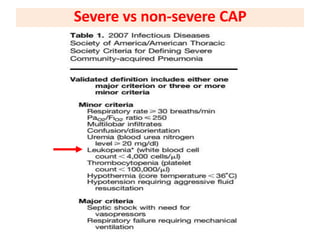
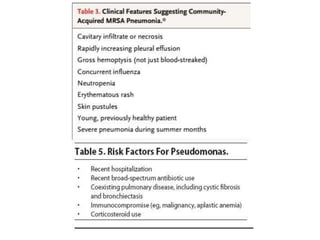
Severe vs non-severe CAP
• Should Blood Cultures Be Obtained at the Time of Diagnosis?
Question 2
- The same recommendations as before
ATS recommendation
• Should legionella and pneumococcal urinary antigen testing be
performed at the time of diagnosis?
Question 3
* Both: not suggested (conditional recommendation), except in adults
with severe CAP.
??Legionella outbreak.
ATS recommendation
• Should a respiratory sample be tested for Influenza virus at the
time of diagnosis?
Question 4
• When influenza viruses are circulating in the community, they
recommend testing for influenza with a rapid influenza
molecular assay (i.e., nucleic acid amplification)(strong
recommendation).
ATS recommendation
• Should serum PCT plus clinical judgment vs clinical judgment
alone be used to withhold initiation of antibiotics?
Question 5
• They recommend that empiric antibiotic therapy should be
initiated in adults with clinically suspected & radiographically
confirmed CAP regardless of initial serum PCT
level (strong recommendation).
ATS recommendation
• Should a clinical prediction rule plus clinical judgment vs clinical
judgment alone be used to determine inpatient vs outpatient
treatment location?
Question 6
• In addition to clinical judgement, they recommend that
clinicians use a validated clinical prediction rule for prognosis,
preferentially the Pneumonia Severity Index (PSI) (strong
recommendation) over the CURB-65 to determine the need for
hospitalization in adults diagnosed with CAP.
ATS recommendation
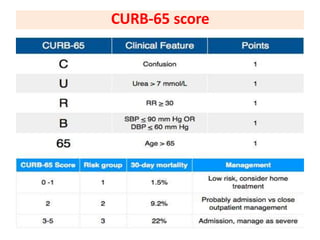
CURB-65 score
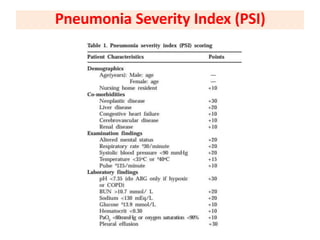
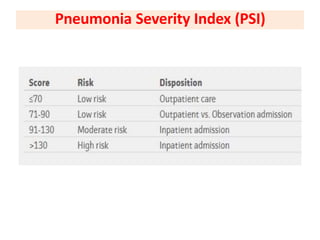
Pneumonia Severity Index (PSI)
• Should a clinical prediction rule plus clinical judgment vs clinical
judgment alone be used to determine inpatient ward vs ICU?
Question 7
- They recommend direct admission to an ICU for patients with
hypotension requiring vasopressors or respiratory failure requiring
mechanical ventilation (strong recommendation).
- For patients not requiring vasopressors or mechanical ventilator
support, they suggest using the IDSA/ATS 2007 minor severity
criteria together with clinical judgment to guide the need for
higher levels of treatment intensity (conditional recommendation).
ATS recommendation
• In the outpatient setting, which antibiotics are recommended
for empiric treatment of CAP in Adults?
Question 8
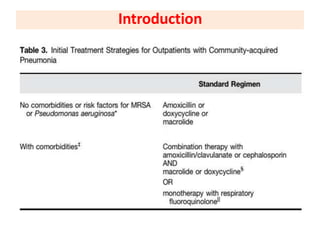
Introduction
• In the inpatient setting, which antibiotic regimens are
recommended for empiric treatment of CAP in adults without
risk factors for MRSA and P. aeruginosa?
Question 9
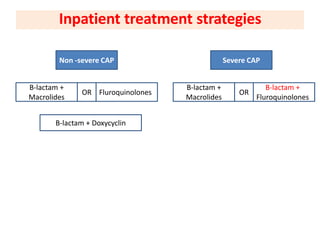
Inpatient treatment strategies
Non -severe CAP Severe CAP
B-lactam +
Macrolides
Fluroquinolones
OR
B-lactam +
Macrolides
B-lactam +
Fluroquinolones
OR
B-lactam + Doxycyclin
• In the inpatient Setting, should patients with suspected
aspiration pneumonia receive additional anaerobic coverage
beyond standard empiric treatment for CAP?
Question 10
• Not suggested unless lung abscess or empyema is suspected
(conditional recommendation).
ATS recommendation
• In the inpatient setting, should adults with CAP and risk
factors for MRSA or P. aeruginosa be treated with extended-
spectrum antibiotic therapy instead of standard CAP
regimens?
Question 11
• They recommend abandoning use of the prior categorization of
HCAP to guide selection of extended antibiotic coverage in adults
with CAP (strong recommendation).
They recommend clinicians only cover empirically for MRSA or P.
aeruginosa if locally validated risk factors for either pathogen are
present (strong recommendation).
- Empiric treatment options for MRSA include vancomycin or
linezolid.
- Empiric treatment options for P. aeruginosa include piperacillin-
tazobactam, cefepime, ceftazidime, meropenem or imipenem.
ATS recommendation
• In the inpatient Setting, should adults with CAP be treated
with corticosteroids?
Question 12
• Not recommended in adults with non-severe CAP (strong
recommendation).
- Not suggested in adults with severe CAP (conditional recommendation).
- Not suggested in adults with severe influenza pneumonia (conditional
recommendation).
ATS recommendation
• In adults with CAP who test positive for influenza, should the
treatment regimen include antiviral therapy?
Question 13
• They recommend that oseltamivir should be prescribed for
adults with CAP with test positive for influenza in the inpatient
setting, independent of duration of illness before diagnosis
(strong recommendation).
- They suggest that anti-influenza treatment be prescribed for
adults with CAP who test positive for influenza in the
outpatient setting, independent of duration of illness before
diagnosis (conditional recommendation).
ATS recommendation
• In adults with CAP who test positive for influenza, should the
treatment regimen include antibacterial therapy?
Question 14
• They recommend that standard antibacterial treatment should
be initially prescribed for adults with clinical and radiographic
evidence of CAP who test positive for influenza in the inpatient
and outpatient settings (strong recommendation).
ATS recommendation
• In outpatient and inpatient adults with CAP who are
improving, what is the appropriate duration of antibiotic
treatment?
Question 15
• They recommend that the duration of antibiotic therapy should
be guided by a validated measure of clinical stability (resolution
of vital sign abnormalities, ability to eat, and normal mentation),
and antibiotic therapy should be continued until the patient
achieves stability and for no less than a total of 5 days (strong
recommendation).
ATS recommendation
• In adults with CAP who are improving, should follow-up
chest imaging be obtained?
Question 16
• In adults with CAP whose symptoms have resolved within 5 to
7 days, follow-up chest imaging not suggested (conditional
recommendation).
ATS recommendation
Thank You..

ATS CAP guidelines

  • 1.
    Mahmoud Elhusseiny AbolmagdMSc, MD Lecturer of pulmonary & Critical Care Medicine Faculty of Medicine – Mansoura University Diagnosis and Treatment of Adults with Community Acquired Pneumonia ATS Guidelines
  • 5.
    • Should gramstain & culture of lower respiratory secretions be obtained at the time of diagnosis? Question 1
  • 6.
    ATS recommendation * Outpatientsetting : not recommended (strong recommendation). * Hospital setting : 1. Severe CAP, especially if they are intubated (strong recommendation). 2. If being empirically treated for MRSA or P. aeruginosa (strong recommendation). 3. Previously infected with MRSA or P. aeruginosa, especially those with prior respiratory tract infection (conditional recommendation). 4. Received parenteral antibiotics, whether during the hospitalization event or not, in the last 90 days (conditional recommendation).
  • 7.
  • 8.
    • Should BloodCultures Be Obtained at the Time of Diagnosis? Question 2
  • 9.
    - The samerecommendations as before ATS recommendation
  • 10.
    • Should legionellaand pneumococcal urinary antigen testing be performed at the time of diagnosis? Question 3
  • 11.
    * Both: notsuggested (conditional recommendation), except in adults with severe CAP. ??Legionella outbreak. ATS recommendation
  • 12.
    • Should arespiratory sample be tested for Influenza virus at the time of diagnosis? Question 4
  • 13.
    • When influenzaviruses are circulating in the community, they recommend testing for influenza with a rapid influenza molecular assay (i.e., nucleic acid amplification)(strong recommendation). ATS recommendation
  • 14.
    • Should serumPCT plus clinical judgment vs clinical judgment alone be used to withhold initiation of antibiotics? Question 5
  • 15.
    • They recommendthat empiric antibiotic therapy should be initiated in adults with clinically suspected & radiographically confirmed CAP regardless of initial serum PCT level (strong recommendation). ATS recommendation
  • 16.
    • Should aclinical prediction rule plus clinical judgment vs clinical judgment alone be used to determine inpatient vs outpatient treatment location? Question 6
  • 17.
    • In additionto clinical judgement, they recommend that clinicians use a validated clinical prediction rule for prognosis, preferentially the Pneumonia Severity Index (PSI) (strong recommendation) over the CURB-65 to determine the need for hospitalization in adults diagnosed with CAP. ATS recommendation
  • 18.
  • 19.
  • 20.
  • 21.
    • Should aclinical prediction rule plus clinical judgment vs clinical judgment alone be used to determine inpatient ward vs ICU? Question 7
  • 22.
    - They recommenddirect admission to an ICU for patients with hypotension requiring vasopressors or respiratory failure requiring mechanical ventilation (strong recommendation). - For patients not requiring vasopressors or mechanical ventilator support, they suggest using the IDSA/ATS 2007 minor severity criteria together with clinical judgment to guide the need for higher levels of treatment intensity (conditional recommendation). ATS recommendation
  • 23.
    • In theoutpatient setting, which antibiotics are recommended for empiric treatment of CAP in Adults? Question 8
  • 24.
  • 26.
    • In theinpatient setting, which antibiotic regimens are recommended for empiric treatment of CAP in adults without risk factors for MRSA and P. aeruginosa? Question 9
  • 27.
    Inpatient treatment strategies Non-severe CAP Severe CAP B-lactam + Macrolides Fluroquinolones OR B-lactam + Macrolides B-lactam + Fluroquinolones OR B-lactam + Doxycyclin
  • 28.
    • In theinpatient Setting, should patients with suspected aspiration pneumonia receive additional anaerobic coverage beyond standard empiric treatment for CAP? Question 10
  • 29.
    • Not suggestedunless lung abscess or empyema is suspected (conditional recommendation). ATS recommendation
  • 30.
    • In theinpatient setting, should adults with CAP and risk factors for MRSA or P. aeruginosa be treated with extended- spectrum antibiotic therapy instead of standard CAP regimens? Question 11
  • 31.
    • They recommendabandoning use of the prior categorization of HCAP to guide selection of extended antibiotic coverage in adults with CAP (strong recommendation). They recommend clinicians only cover empirically for MRSA or P. aeruginosa if locally validated risk factors for either pathogen are present (strong recommendation). - Empiric treatment options for MRSA include vancomycin or linezolid. - Empiric treatment options for P. aeruginosa include piperacillin- tazobactam, cefepime, ceftazidime, meropenem or imipenem. ATS recommendation
  • 32.
    • In theinpatient Setting, should adults with CAP be treated with corticosteroids? Question 12
  • 33.
    • Not recommendedin adults with non-severe CAP (strong recommendation). - Not suggested in adults with severe CAP (conditional recommendation). - Not suggested in adults with severe influenza pneumonia (conditional recommendation). ATS recommendation
  • 34.
    • In adultswith CAP who test positive for influenza, should the treatment regimen include antiviral therapy? Question 13
  • 35.
    • They recommendthat oseltamivir should be prescribed for adults with CAP with test positive for influenza in the inpatient setting, independent of duration of illness before diagnosis (strong recommendation). - They suggest that anti-influenza treatment be prescribed for adults with CAP who test positive for influenza in the outpatient setting, independent of duration of illness before diagnosis (conditional recommendation). ATS recommendation
  • 36.
    • In adultswith CAP who test positive for influenza, should the treatment regimen include antibacterial therapy? Question 14
  • 37.
    • They recommendthat standard antibacterial treatment should be initially prescribed for adults with clinical and radiographic evidence of CAP who test positive for influenza in the inpatient and outpatient settings (strong recommendation). ATS recommendation
  • 38.
    • In outpatientand inpatient adults with CAP who are improving, what is the appropriate duration of antibiotic treatment? Question 15
  • 39.
    • They recommendthat the duration of antibiotic therapy should be guided by a validated measure of clinical stability (resolution of vital sign abnormalities, ability to eat, and normal mentation), and antibiotic therapy should be continued until the patient achieves stability and for no less than a total of 5 days (strong recommendation). ATS recommendation
  • 40.
    • In adultswith CAP who are improving, should follow-up chest imaging be obtained? Question 16
  • 41.
    • In adultswith CAP whose symptoms have resolved within 5 to 7 days, follow-up chest imaging not suggested (conditional recommendation). ATS recommendation
  • 43.