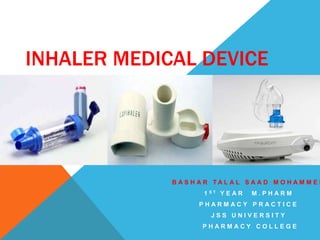
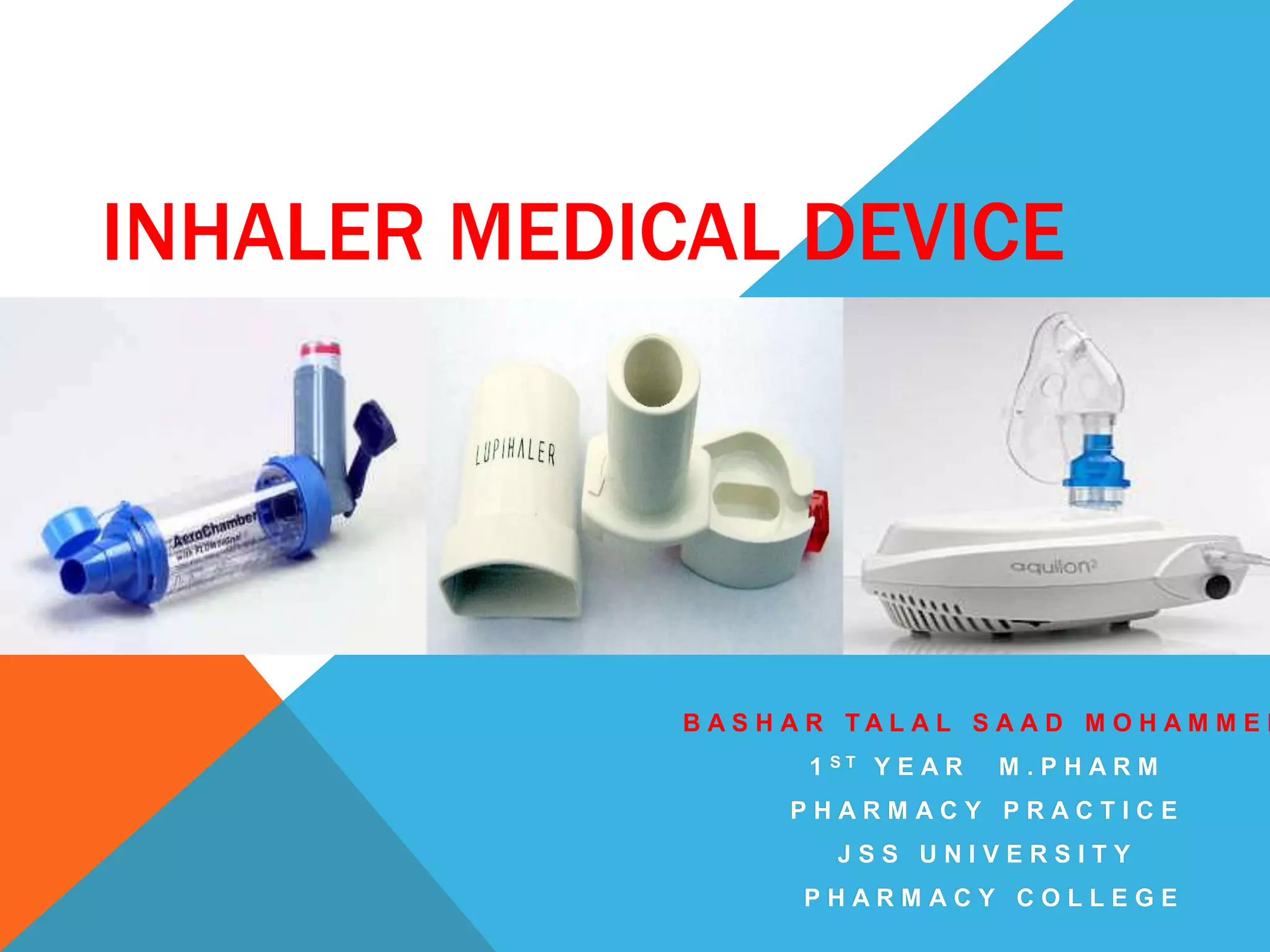
INHALER MEDICAL DEVICE
B A S H A R T A L A L S A A D M O H A M M E D
1 S T Y E A R M . P H A R M
P H A R M A C Y P R A C T I C E
J S S U N I V E R S I T Y
P H A R M A C Y C O L L E G E
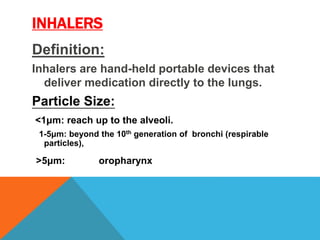
INHALERS
Definition:
Inhalers are hand-held portable devices that
deliver medication directly to the lungs.
Particle Size:
<1μm: reach up to the alveoli.
1-5μm: beyond the 10th generation of bronchi (respirable
particles),
>5μm: oropharynx
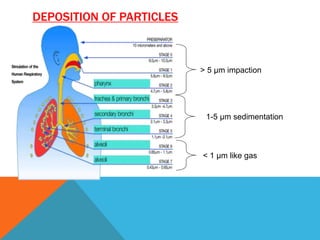
> 5 µm impaction
1-5 µm sedimentation
< 1 µm like gas
DEPOSITION OF PARTICLES
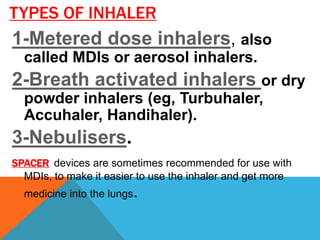
TYPES OF INHALER
1-Metered dose inhalers, also
called MDIs or aerosol inhalers.
2-Breath activated inhalers or dry
powder inhalers (eg, Turbuhaler,
Accuhaler, Handihaler).
3-Nebulisers.
SPACER devices are sometimes recommended for use with
MDIs, to make it easier to use the inhaler and get more
medicine into the lungs.
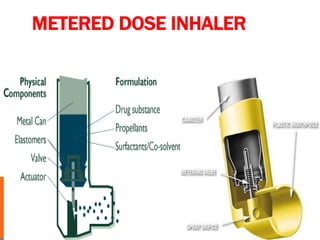
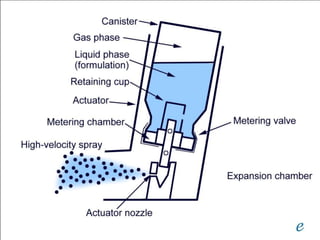
METERED DOSE INHALER
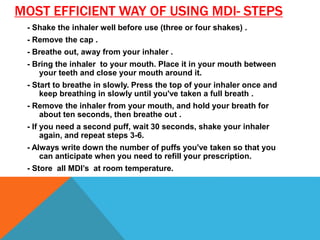
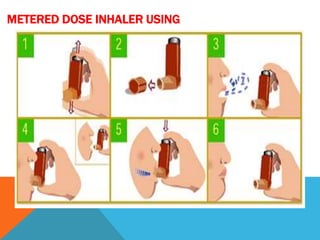
MOST EFFICIENT WAY OF USING MDI- STEPS
- Shake the inhaler well before use (three or four shakes) .
- Remove the cap .
- Breathe out, away from your inhaler .
- Bring the inhaler to your mouth. Place it in your mouth between
your teeth and close your mouth around it.
- Start to breathe in slowly. Press the top of your inhaler once and
keep breathing in slowly until you've taken a full breath .
- Remove the inhaler from your mouth, and hold your breath for
about ten seconds, then breathe out .
- If you need a second puff, wait 30 seconds, shake your inhaler
again, and repeat steps 3-6.
- Always write down the number of puffs you've taken so that you
can anticipate when you need to refill your prescription.
- Store all MDI’s at room temperature.
METERED DOSE INHALER USING
ADVANTAGES OF MDIS
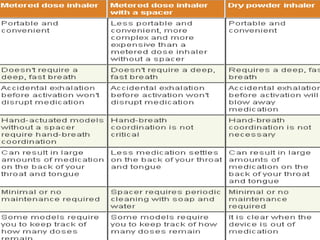
- Compact, portable ,convenient
- Multidose delivery capability
- Lower risk of bacterial contamination
- Suitable for emergency situation
DISADVANTAGES OF MDIS
- Needs correct actuation and inhalation.
- coordination difficult for children and
elderly. - Cold Freon effect.
- High pharyngeal drug deposition.
- Flammability possibility of new
propellants.
- Remaining dose –difficult to determine.
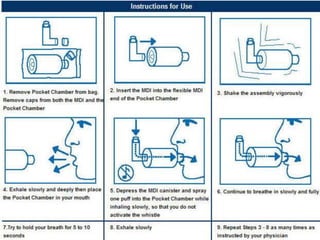
SPACER
A spacer is a tube that MDI is placed
into and it holds the medication that
is released (with activation of the
MDI) until patient can breathe it in.
The spacer can be cleaned by
soaking in a solution of mild
detergent and water for 15
minutes. Shake out the excess
water and allow to air dry. Replace
the device after 24 months of
continuous use.
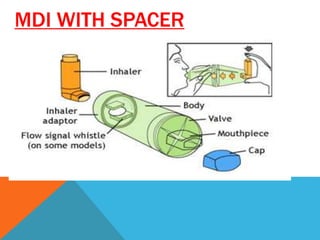
MDI WITH SPACER
MDI WITH SPACER
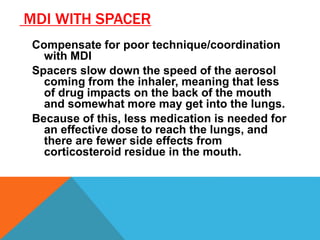
Compensate for poor technique/coordination
with MDI
Spacers slow down the speed of the aerosol
coming from the inhaler, meaning that less
of drug impacts on the back of the mouth
and somewhat more may get into the lungs.
Because of this, less medication is needed for
an effective dose to reach the lungs, and
there are fewer side effects from
corticosteroid residue in the mouth.
DISADVANTAGES OF SPACER
- Large size and volume of device.
- Bacterial contamination is possible .
- device needs to be cleaned periodically.
- Electrostatic charges may reduce
drug delivery to the lungs.
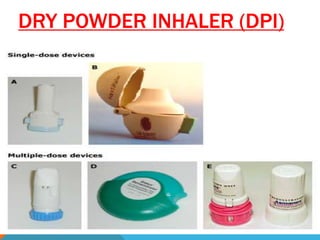
DRY POWDER INHALER (DPI)
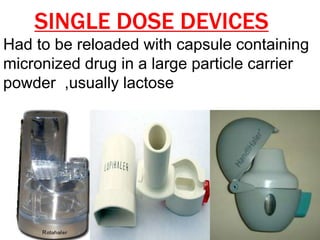
SINGLE DOSE DEVICES
Had to be reloaded with capsule containing
micronized drug in a large particle carrier
powder ,usually lactose
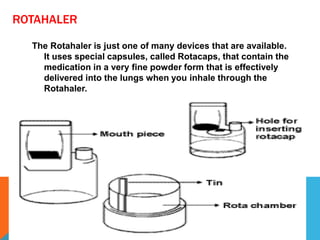
ROTAHALER
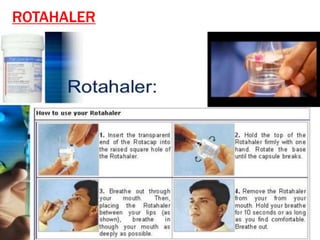
The Rotahaler is just one of many devices that are available.
It uses special capsules, called Rotacaps, that contain the
medication in a very fine powder form that is effectively
delivered into the lungs when you inhale through the
Rotahaler.
ROTAHALER
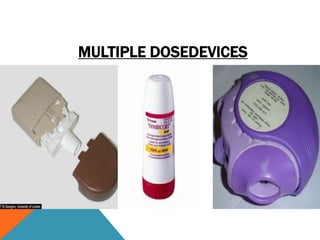
MULTIPLE DOSEDEVICES
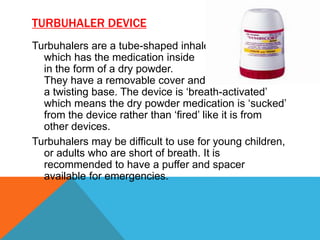
TURBUHALER DEVICE
Turbuhalers are a tube-shaped inhaler
which has the medication inside
in the form of a dry powder.
They have a removable cover and
a twisting base. The device is ‘breath-activated’
which means the dry powder medication is ‘sucked’
from the device rather than ‘fired’ like it is from
other devices.
Turbuhalers may be difficult to use for young children,
or adults who are short of breath. It is
recommended to have a puffer and spacer
available for emergencies.
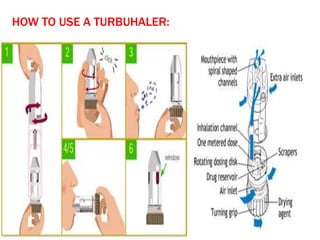
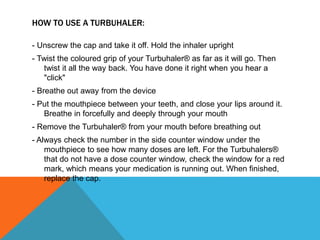
HOW TO USE A TURBUHALER:
- Unscrew the cap and take it off. Hold the inhaler upright
- Twist the coloured grip of your Turbuhaler® as far as it will go. Then
twist it all the way back. You have done it right when you hear a
"click"
- Breathe out away from the device
- Put the mouthpiece between your teeth, and close your lips around it.
Breathe in forcefully and deeply through your mouth
- Remove the Turbuhaler® from your mouth before breathing out
- Always check the number in the side counter window under the
mouthpiece to see how many doses are left. For the Turbuhalers®
that do not have a dose counter window, check the window for a red
mark, which means your medication is running out. When finished,
replace the cap.
ADVANTAGES OF DPIS
- Breath-actuated.
- Less patient coordination
required.
- Spacer not necessary.
- Compact Portable.
- No propellant.
- Usually higher lung deposition
than a pMDI.
DISADVANTAGES OF DPIS
- Work poorly if inhalation is not forceful
enough.
- Many patients cannot use them correctly
(e.g.
capsule handling problems for elderly.
- Most types are moisture sensitive,
Humidity potentially causes powder
clumping and reduced dispersal of fine
particle mass.
- Need to reload capsule each time.
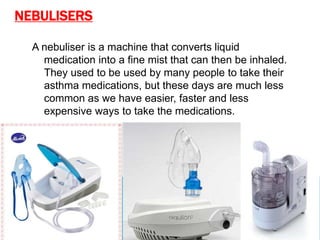
NEBULISERS
A nebuliser is a machine that converts liquid
medication into a fine mist that can then be inhaled.
They used to be used by many people to take their
asthma medications, but these days are much less
common as we have easier, faster and less
expensive ways to take the medications.
TYPE OF NEBULISER:
Jet nebulizer:-The most commonly used nebulizers are Jet
nebulizers, which are also called "atomizers". Jet nebulizers are
connected by tubing to a compressor, that causes compressed air or
oxygen to flow at high velocity through a liquid medicine to turn it into
an aerosol, which is then inhaled by the patient.
Ultrasonic wave nebulizer:-
a new type of portable nebulizer. The technology inside an ultrasonic
wave nebulizer is to have an electronic oscillator generate a high
frequency ultrasonic wave, which causes the mechanical vibration of
a piezoelectric element. This vibrating element is in contact with a
liquid reservoir and its high frequency vibration is sufficient to
produce a vapor mist.
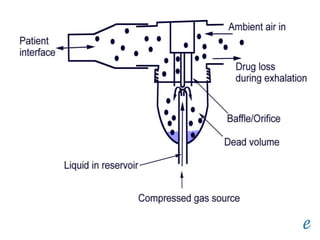
JET NEBULIZER
Delivers compressed gas through a jet, causing
an area of negative pressure and drawing the
liquid up the tube by the Bernoulli effect. The
solution is entrained into the gas stream and
then sheared into a liquid film that is unstable
and is broken into droplets by surface tension
forces. The fundamental concept of nebulizer
performance is the conversion of the
medication solution into droplets in the
respirable range of 1-5 micrometers
ULTRASONIC NEBULIZER
Generates high-frequency ultrasonic waves
(1.63 MHz) from electrical energy via a
piezoelectric element in the transducer.
These ultrasonic waves are transmitted to
the surface of the solution to create an
aerosol. Aerosol delivery is by a fan or the
patient’s inspiratory flow; particle sizes may
be larger with this device. A limitation of
ultrasonic nebulizers is that they do not
nebulize suspensions efficiently
ADVANTAGES OF NEBULIZERS
- Provide therapy for patients who
cannot use other inhalation modalities
(eg, MDI, DPI)
- Allow administration of large doses of
medicine
- Patient coordination not required
- Effective with tidal breathing
- Dose modification possible
- Can be used with supplemental
oxygen
DISADVANTAGES OF NEBULIZERS
- Decreased portability
- Longer set-up and
administration time
- Higher cost
- Electrical power source
required
- Contamination possible
CONCLUSION
A number of inhalation devices are
available for the treatment of
pulmonary diseases, each with its
own advantages and disadvantages.
None has proven to be superior to
the others in any of the clinical
situations tested. Whichever device
is chosen, the key to successful
treatment lies at a proper inhaler
technique
Thank you !!

Inhaler medication devices and patient counselling.

  • 1.
    INHALER MEDICAL DEVICE BA S H A R T A L A L S A A D M O H A M M E D 1 S T Y E A R M . P H A R M P H A R M A C Y P R A C T I C E J S S U N I V E R S I T Y P H A R M A C Y C O L L E G E
  • 2.
    INHALERS Definition: Inhalers are hand-heldportable devices that deliver medication directly to the lungs. Particle Size: <1μm: reach up to the alveoli. 1-5μm: beyond the 10th generation of bronchi (respirable particles), >5μm: oropharynx
  • 3.
    > 5 µmimpaction 1-5 µm sedimentation < 1 µm like gas DEPOSITION OF PARTICLES
  • 4.
    TYPES OF INHALER 1-Metereddose inhalers, also called MDIs or aerosol inhalers. 2-Breath activated inhalers or dry powder inhalers (eg, Turbuhaler, Accuhaler, Handihaler). 3-Nebulisers. SPACER devices are sometimes recommended for use with MDIs, to make it easier to use the inhaler and get more medicine into the lungs.

  • 5.
  • 7.
    MOST EFFICIENT WAYOF USING MDI- STEPS - Shake the inhaler well before use (three or four shakes) . - Remove the cap . - Breathe out, away from your inhaler . - Bring the inhaler to your mouth. Place it in your mouth between your teeth and close your mouth around it. - Start to breathe in slowly. Press the top of your inhaler once and keep breathing in slowly until you've taken a full breath . - Remove the inhaler from your mouth, and hold your breath for about ten seconds, then breathe out . - If you need a second puff, wait 30 seconds, shake your inhaler again, and repeat steps 3-6. - Always write down the number of puffs you've taken so that you can anticipate when you need to refill your prescription. - Store all MDI’s at room temperature.
  • 8.
  • 9.
    ADVANTAGES OF MDIS -Compact, portable ,convenient - Multidose delivery capability - Lower risk of bacterial contamination - Suitable for emergency situation
  • 10.
    DISADVANTAGES OF MDIS -Needs correct actuation and inhalation. - coordination difficult for children and elderly. - Cold Freon effect. - High pharyngeal drug deposition. - Flammability possibility of new propellants. - Remaining dose –difficult to determine.
  • 11.
    SPACER A spacer isa tube that MDI is placed into and it holds the medication that is released (with activation of the MDI) until patient can breathe it in. The spacer can be cleaned by soaking in a solution of mild detergent and water for 15 minutes. Shake out the excess water and allow to air dry. Replace the device after 24 months of continuous use.
  • 12.
  • 13.
    MDI WITH SPACER Compensatefor poor technique/coordination with MDI Spacers slow down the speed of the aerosol coming from the inhaler, meaning that less of drug impacts on the back of the mouth and somewhat more may get into the lungs. Because of this, less medication is needed for an effective dose to reach the lungs, and there are fewer side effects from corticosteroid residue in the mouth.
  • 15.
    DISADVANTAGES OF SPACER -Large size and volume of device. - Bacterial contamination is possible . - device needs to be cleaned periodically. - Electrostatic charges may reduce drug delivery to the lungs.
  • 16.
  • 17.
    SINGLE DOSE DEVICES Hadto be reloaded with capsule containing micronized drug in a large particle carrier powder ,usually lactose
  • 18.
    ROTAHALER The Rotahaler isjust one of many devices that are available. It uses special capsules, called Rotacaps, that contain the medication in a very fine powder form that is effectively delivered into the lungs when you inhale through the Rotahaler.
  • 19.
  • 20.
  • 21.
    TURBUHALER DEVICE Turbuhalers area tube-shaped inhaler which has the medication inside in the form of a dry powder. They have a removable cover and a twisting base. The device is ‘breath-activated’ which means the dry powder medication is ‘sucked’ from the device rather than ‘fired’ like it is from other devices. Turbuhalers may be difficult to use for young children, or adults who are short of breath. It is recommended to have a puffer and spacer available for emergencies.
  • 22.
    HOW TO USEA TURBUHALER:
  • 23.
    HOW TO USEA TURBUHALER: - Unscrew the cap and take it off. Hold the inhaler upright - Twist the coloured grip of your Turbuhaler® as far as it will go. Then twist it all the way back. You have done it right when you hear a "click" - Breathe out away from the device - Put the mouthpiece between your teeth, and close your lips around it. Breathe in forcefully and deeply through your mouth - Remove the Turbuhaler® from your mouth before breathing out - Always check the number in the side counter window under the mouthpiece to see how many doses are left. For the Turbuhalers® that do not have a dose counter window, check the window for a red mark, which means your medication is running out. When finished, replace the cap.
  • 24.
    ADVANTAGES OF DPIS -Breath-actuated. - Less patient coordination required. - Spacer not necessary. - Compact Portable. - No propellant. - Usually higher lung deposition than a pMDI.
  • 25.
    DISADVANTAGES OF DPIS -Work poorly if inhalation is not forceful enough. - Many patients cannot use them correctly (e.g. capsule handling problems for elderly. - Most types are moisture sensitive, Humidity potentially causes powder clumping and reduced dispersal of fine particle mass. - Need to reload capsule each time.
  • 26.
    NEBULISERS A nebuliser isa machine that converts liquid medication into a fine mist that can then be inhaled. They used to be used by many people to take their asthma medications, but these days are much less common as we have easier, faster and less expensive ways to take the medications.
  • 27.
    TYPE OF NEBULISER: Jetnebulizer:-The most commonly used nebulizers are Jet nebulizers, which are also called "atomizers". Jet nebulizers are connected by tubing to a compressor, that causes compressed air or oxygen to flow at high velocity through a liquid medicine to turn it into an aerosol, which is then inhaled by the patient. Ultrasonic wave nebulizer:- a new type of portable nebulizer. The technology inside an ultrasonic wave nebulizer is to have an electronic oscillator generate a high frequency ultrasonic wave, which causes the mechanical vibration of a piezoelectric element. This vibrating element is in contact with a liquid reservoir and its high frequency vibration is sufficient to produce a vapor mist.
  • 28.
    JET NEBULIZER Delivers compressedgas through a jet, causing an area of negative pressure and drawing the liquid up the tube by the Bernoulli effect. The solution is entrained into the gas stream and then sheared into a liquid film that is unstable and is broken into droplets by surface tension forces. The fundamental concept of nebulizer performance is the conversion of the medication solution into droplets in the respirable range of 1-5 micrometers
  • 30.
    ULTRASONIC NEBULIZER Generates high-frequencyultrasonic waves (1.63 MHz) from electrical energy via a piezoelectric element in the transducer. These ultrasonic waves are transmitted to the surface of the solution to create an aerosol. Aerosol delivery is by a fan or the patient’s inspiratory flow; particle sizes may be larger with this device. A limitation of ultrasonic nebulizers is that they do not nebulize suspensions efficiently
  • 31.
    ADVANTAGES OF NEBULIZERS -Provide therapy for patients who cannot use other inhalation modalities (eg, MDI, DPI) - Allow administration of large doses of medicine - Patient coordination not required - Effective with tidal breathing - Dose modification possible - Can be used with supplemental oxygen
  • 32.
    DISADVANTAGES OF NEBULIZERS -Decreased portability - Longer set-up and administration time - Higher cost - Electrical power source required - Contamination possible
  • 34.
    CONCLUSION A number ofinhalation devices are available for the treatment of pulmonary diseases, each with its own advantages and disadvantages. None has proven to be superior to the others in any of the clinical situations tested. Whichever device is chosen, the key to successful treatment lies at a proper inhaler technique
  • 35.