General Anesthesia
JasonRyan,MD,MPH
AfraTafreeh.com
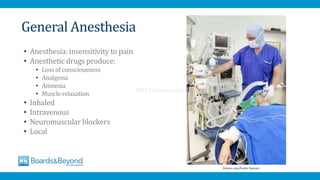
General Anesthesia
• Anesthesia: insensitivity to pain
• Anesthetic drugs produce:
• Loss of consciousness
• Analgesia
• Amnesia
• Muscle relaxation
• Inhaled
• Intravenous
• Neuromuscular blockers
• Local
Pxhere.com/Public Domain
AfraTafreeh.com
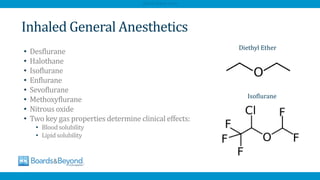
Inhaled General Anesthetics
• Desflurane
• Halothane
• Isoflurane
• Enflurane
• Sevoflurane
• Methoxyflurane
• Nitrous oxide
• Two key gas properties determine clinical effects:
• Blood solubility
• Lipid solubility
Diethyl Ether
Isoflurane
AfraTafreeh.com
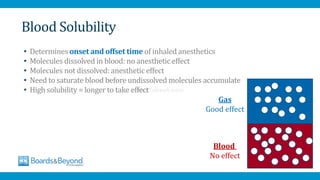
Blood Solubility
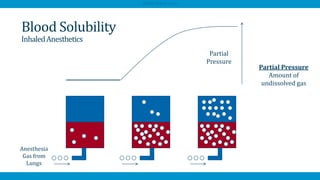
• Determines onset and offset time of inhaled anesthetics
• Molecules dissolved in blood: no anesthetic effect
• Molecules not dissolved: anesthetic effect
• Need to saturate blood before undissolved molecules accumulate
• High solubility = longer to take effect
Blood
No effect
Gas
Good effect
AfraTafreeh.com
Blood Solubility
InhaledAnesthetics
Partial
Pressure
Anesthesia
Gas from
Lungs
Partial Pressure
Amount of
undissolved gas
AfraTafreeh.com
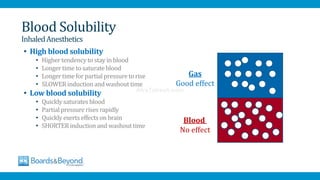
• High blood solubility
• Higher tendencyto stay in blood
• Longertime to saturateblood
• Longertime for partialpressureto rise
• SLOWER inductionand washout time
• Low blood solubility
• Quickly saturates blood
• Partialpressurerises rapidly
• Quickly exerts effects on brain
• SHORTERinductionand washouttime
Blood Solubility
InhaledAnesthetics
Blood
No effect
Gas
Good effect
AfraTafreeh.com
• Blood solubility described by blood/gas partition coefficient
• Isoflurane:1.4
• [blood]1.4 > [alveoli]
• High partition coefficient = high solubility
• Low partition coefficient = low solubility
Blood Solubility
InhaledAnesthetics
Blood
No effect
Gas
Good effect
AfraTafreeh.com
Blood Solubility
InhaledAnesthetics
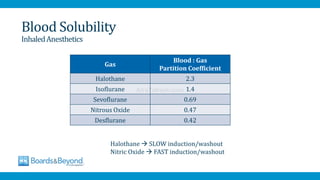
Gas
Blood : Gas
Partition Coefficient
Halothane 2.3
Isoflurane 1.4
Sevoflurane 0.69
Nitrous Oxide 0.47
Desflurane 0.42
Halothane → SLOW induction/washout
Nitric Oxide → FAST induction/washout
AfraTafreeh.com
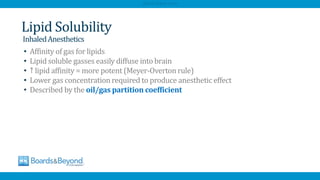
• Affinity of gas for lipids
• Lipid soluble gasses easily diffuse into brain
• ↑ lipid affinity = more potent (Meyer-Overton rule)
• Lower gas concentration required to produce anesthetic effect
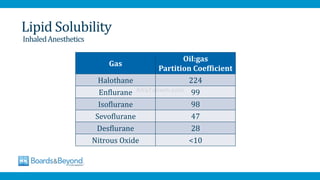
• Described by the oil/gas partition coefficient
Lipid Solubility
InhaledAnesthetics
AfraTafreeh.com
Lipid Solubility
InhaledAnesthetics
Gas
Oil:gas
Partition Coefficient
Halothane 224
Enflurane 99
Isoflurane 98
Sevoflurane 47
Desflurane 28
Nitrous Oxide <10
AfraTafreeh.com
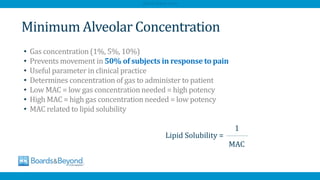
• Gas concentration (1%, 5%, 10%)
• Prevents movement in 50% of subjects in response to pain
• Useful parameter in clinical practice
• Determines concentration of gas to administer to patient
• Low MAC = low gas concentration needed = high potency
• High MAC = high gas concentration needed = low potency
• MAC related to lipid solubility
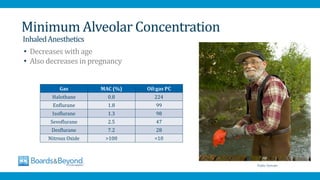
Minimum Alveolar Concentration
Lipid Solubility =
1
MAC
AfraTafreeh.com
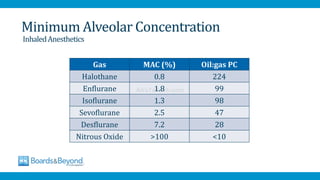
Minimum Alveolar Concentration
InhaledAnesthetics
Gas MAC (%) Oil:gas PC
Halothane 0.8 224
Enflurane 1.8 99
Isoflurane 1.3 98
Sevoflurane 2.5 47
Desflurane 7.2 28
Nitrous Oxide >100 <10
AfraTafreeh.com
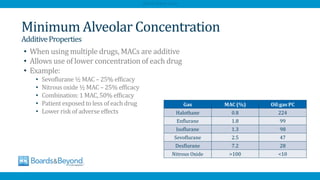
• When using multiple drugs, MACs are additive
• Allows use of lower concentration of each drug
• Example:
• Sevoflurane ½ MAC – 25% efficacy
• Nitrous oxide ½ MAC – 25% efficacy
• Combination:1 MAC, 50% efficacy
• Patientexposed to less of each drug
• Lower risk of adverse effects
Minimum Alveolar Concentration
AdditiveProperties
AfraTafreeh.com
• Decreases with age
• Also decreases in pregnancy
Minimum Alveolar Concentration
InhaledAnesthetics
Public Domain
AfraTafreeh.com
Inhaled Anesthetics Summary
• Onset of action and washout
• Blood : gas partitioncoefficient (higher= slower)
• Solubility in blood (higher= slower)
• Potency
• Oil : gas partitioncoefficient(higher= more potent)
• Solubility in lipids (higher= more potent)
• MAC (lower = more potent)
Pxhere.com/Public Domain
AfraTafreeh.com
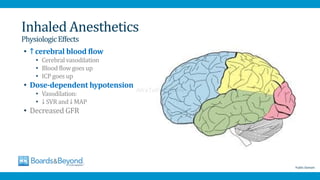
Inhaled Anesthetics
PhysiologicEffects
• ↑ cerebral blood flow
• Cerebral vasodilation
• Blood flow goes up
• ICP goes up
• Dose-dependent hypotension
• Vasodilation:
• ↓ SVR and ↓ MAP
• Decreased GFR
Public Domain
AfraTafreeh.com
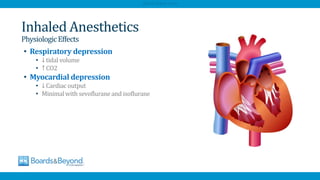
Inhaled Anesthetics
PhysiologicEffects
• Respiratory depression
• ↓ tidal volume
• ↑ CO2
• Myocardial depression
• ↓ Cardiac output
• Minimalwith sevofluraneand isoflurane
AfraTafreeh.com
Specific Inhaled Anesthetics
• Desflurane, isoflurane, and sevoflurane
• Most commonlyused agents
• Least adverse effects
• Minimalmyocardialdepression
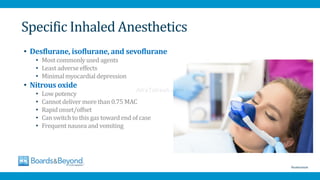
• Nitrous oxide
• Low potency
• Cannotdeliver more than 0.75 MAC
• Rapid onset/offset
• Can switch to this gas toward end of case
• Frequent nausea and vomiting
Shutterstock
AfraTafreeh.com
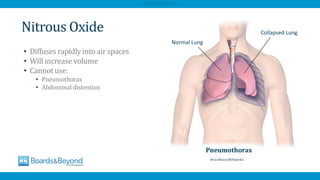
Nitrous Oxide
• Diffuses rapidly into air spaces
• Will increase volume
• Cannot use:
• Pneumothorax
• Abdominaldistention
Normal Lung
Collapsed Lung
AfraTafreeh.com
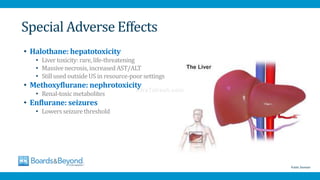
Special Adverse Effects
• Halothane: hepatotoxicity
• Liver toxicity: rare, life-threatening
• Massivenecrosis, increased AST/ALT
• Stillused outside US in resource-poorsettings
• Methoxyflurane: nephrotoxicity
• Renal-toxic metabolites
• Enflurane: seizures
• Lowers seizure threshold
Public Domain
AfraTafreeh.com
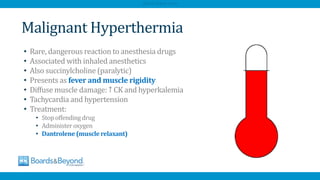
Malignant Hyperthermia
• Rare, dangerous reaction to anesthesia drugs
• Associated with inhaled anesthetics
• Also succinylcholine (paralytic)
• Presents as fever and muscle rigidity
• Diffuse muscle damage: ↑ CK and hyperkalemia
• Tachycardia and hypertension
• Treatment:
• Stop offending drug
• Administeroxygen
• Dantrolene (musclerelaxant)
AfraTafreeh.com
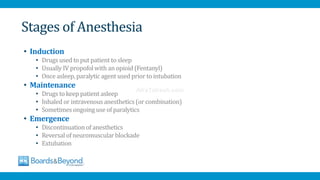
Stages of Anesthesia
• Induction
• Drugs used to put patient to sleep
• Usually IV propofolwith an opioid (Fentanyl)
• Once asleep, paralytic agent used prior to intubation
• Maintenance
• Drugs to keep patient asleep
• Inhaled or intravenous anesthetics (or combination)
• Sometimes ongoinguse of paralytics
• Emergence
• Discontinuationof anesthetics
• Reversal of neuromuscularblockade
• Extubation
AfraTafreeh.com

General Anesthesia description for Anesthesia

  • 1.
  • 2.
    General Anesthesia • Anesthesia:insensitivity to pain • Anesthetic drugs produce: • Loss of consciousness • Analgesia • Amnesia • Muscle relaxation • Inhaled • Intravenous • Neuromuscular blockers • Local Pxhere.com/Public Domain AfraTafreeh.com
  • 3.
    Inhaled General Anesthetics •Desflurane • Halothane • Isoflurane • Enflurane • Sevoflurane • Methoxyflurane • Nitrous oxide • Two key gas properties determine clinical effects: • Blood solubility • Lipid solubility Diethyl Ether Isoflurane AfraTafreeh.com
  • 4.
    Blood Solubility • Determinesonset and offset time of inhaled anesthetics • Molecules dissolved in blood: no anesthetic effect • Molecules not dissolved: anesthetic effect • Need to saturate blood before undissolved molecules accumulate • High solubility = longer to take effect Blood No effect Gas Good effect AfraTafreeh.com
  • 5.
  • 6.
    • High bloodsolubility • Higher tendencyto stay in blood • Longertime to saturateblood • Longertime for partialpressureto rise • SLOWER inductionand washout time • Low blood solubility • Quickly saturates blood • Partialpressurerises rapidly • Quickly exerts effects on brain • SHORTERinductionand washouttime Blood Solubility InhaledAnesthetics Blood No effect Gas Good effect AfraTafreeh.com
  • 7.
    • Blood solubilitydescribed by blood/gas partition coefficient • Isoflurane:1.4 • [blood]1.4 > [alveoli] • High partition coefficient = high solubility • Low partition coefficient = low solubility Blood Solubility InhaledAnesthetics Blood No effect Gas Good effect AfraTafreeh.com
  • 8.
    Blood Solubility InhaledAnesthetics Gas Blood :Gas Partition Coefficient Halothane 2.3 Isoflurane 1.4 Sevoflurane 0.69 Nitrous Oxide 0.47 Desflurane 0.42 Halothane → SLOW induction/washout Nitric Oxide → FAST induction/washout AfraTafreeh.com
  • 9.
    • Affinity ofgas for lipids • Lipid soluble gasses easily diffuse into brain • ↑ lipid affinity = more potent (Meyer-Overton rule) • Lower gas concentration required to produce anesthetic effect • Described by the oil/gas partition coefficient Lipid Solubility InhaledAnesthetics AfraTafreeh.com
  • 10.
    Lipid Solubility InhaledAnesthetics Gas Oil:gas Partition Coefficient Halothane224 Enflurane 99 Isoflurane 98 Sevoflurane 47 Desflurane 28 Nitrous Oxide <10 AfraTafreeh.com
  • 11.
    • Gas concentration(1%, 5%, 10%) • Prevents movement in 50% of subjects in response to pain • Useful parameter in clinical practice • Determines concentration of gas to administer to patient • Low MAC = low gas concentration needed = high potency • High MAC = high gas concentration needed = low potency • MAC related to lipid solubility Minimum Alveolar Concentration Lipid Solubility = 1 MAC AfraTafreeh.com
  • 12.
    Minimum Alveolar Concentration InhaledAnesthetics GasMAC (%) Oil:gas PC Halothane 0.8 224 Enflurane 1.8 99 Isoflurane 1.3 98 Sevoflurane 2.5 47 Desflurane 7.2 28 Nitrous Oxide >100 <10 AfraTafreeh.com
  • 13.
    • When usingmultiple drugs, MACs are additive • Allows use of lower concentration of each drug • Example: • Sevoflurane ½ MAC – 25% efficacy • Nitrous oxide ½ MAC – 25% efficacy • Combination:1 MAC, 50% efficacy • Patientexposed to less of each drug • Lower risk of adverse effects Minimum Alveolar Concentration AdditiveProperties AfraTafreeh.com
  • 14.
    • Decreases withage • Also decreases in pregnancy Minimum Alveolar Concentration InhaledAnesthetics Public Domain AfraTafreeh.com
  • 15.
    Inhaled Anesthetics Summary •Onset of action and washout • Blood : gas partitioncoefficient (higher= slower) • Solubility in blood (higher= slower) • Potency • Oil : gas partitioncoefficient(higher= more potent) • Solubility in lipids (higher= more potent) • MAC (lower = more potent) Pxhere.com/Public Domain AfraTafreeh.com
  • 16.
    Inhaled Anesthetics PhysiologicEffects • ↑cerebral blood flow • Cerebral vasodilation • Blood flow goes up • ICP goes up • Dose-dependent hypotension • Vasodilation: • ↓ SVR and ↓ MAP • Decreased GFR Public Domain AfraTafreeh.com
  • 17.
    Inhaled Anesthetics PhysiologicEffects • Respiratorydepression • ↓ tidal volume • ↑ CO2 • Myocardial depression • ↓ Cardiac output • Minimalwith sevofluraneand isoflurane AfraTafreeh.com
  • 18.
    Specific Inhaled Anesthetics •Desflurane, isoflurane, and sevoflurane • Most commonlyused agents • Least adverse effects • Minimalmyocardialdepression • Nitrous oxide • Low potency • Cannotdeliver more than 0.75 MAC • Rapid onset/offset • Can switch to this gas toward end of case • Frequent nausea and vomiting Shutterstock AfraTafreeh.com
  • 19.
    Nitrous Oxide • Diffusesrapidly into air spaces • Will increase volume • Cannot use: • Pneumothorax • Abdominaldistention Normal Lung Collapsed Lung AfraTafreeh.com
  • 20.
    Special Adverse Effects •Halothane: hepatotoxicity • Liver toxicity: rare, life-threatening • Massivenecrosis, increased AST/ALT • Stillused outside US in resource-poorsettings • Methoxyflurane: nephrotoxicity • Renal-toxic metabolites • Enflurane: seizures • Lowers seizure threshold Public Domain AfraTafreeh.com
  • 21.
    Malignant Hyperthermia • Rare,dangerous reaction to anesthesia drugs • Associated with inhaled anesthetics • Also succinylcholine (paralytic) • Presents as fever and muscle rigidity • Diffuse muscle damage: ↑ CK and hyperkalemia • Tachycardia and hypertension • Treatment: • Stop offending drug • Administeroxygen • Dantrolene (musclerelaxant) AfraTafreeh.com
  • 22.
    Stages of Anesthesia •Induction • Drugs used to put patient to sleep • Usually IV propofolwith an opioid (Fentanyl) • Once asleep, paralytic agent used prior to intubation • Maintenance • Drugs to keep patient asleep • Inhaled or intravenous anesthetics (or combination) • Sometimes ongoinguse of paralytics • Emergence • Discontinuationof anesthetics • Reversal of neuromuscularblockade • Extubation AfraTafreeh.com