Case Presentation
Ppt for Reading
Name : Mr. Harshad Ram Khade
M.Sc. Medical Technology
PRN : 20040143003
Case -
• A 43 year old male patient was transferred with an ambulance in the
emergency department of the hospital with bleeding from right thigh
after a motorcycle accident. He had become a trapped under the
motorcycle.
• Discuss the medical, surgical and anesthetic management of this
patient.
Day-1
On day 1 when patient come in the emergency department
Provisional diagnosis
• Physical examination revealed
A small puncture wound Laterally and 2 puncture wound
Anteriorly in the mid thigh.
The larger of which was approximately 5 mm in diameter.
• Patient blood group AB+
ABCDE Approach
• Airway : No Airway obstruction.
• Breathing : Spontaneous Breathing
• Circulation : Bleeding from Right thigh,
Low Blood Pressure
Estimated blood loss 600ml.
• Disability : No Disability is found, patient is Alert.
Head and neck movement is good and also check spine mobility in
( Active and passive Motion )
• Exposure & Environment : Remove cloths to enable examination of the body.
• No any Injury on the body other than Right thigh.
• First Emergency Team was stop bleeding by direct pressure and
with surgical instruments.
• Vitals sings -
• Temperature – 98.8 F
• Pulse rate – 78 bpm
• Respiratory rate – 16 bpm
• Blood pressure 105 / 70 mmHg
• Intravenous Access taken with
• 20g IV cannula for Fluid Therapy
• 16g IV cannula for Blood Transfusion.
• Intravenous fluid therapy start with Ringer lactated solution.
• Immediate start blood transfusion and FFP.
Investigations in Emergency Department
• Blood sample is Taken for lab investigation.
• CBC
• PT / INR
• Blood grouping
• Electrolytes
• ABG
• Radiographic investigation
• AP & Lateral X-Ray of Right Femur
• Chest X-Ray
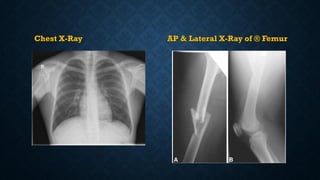
Chest X-Ray AP & Lateral X-Ray of ® Femur
• Anteroposterior and lateral radiographs revealed a right femoral
shaft fracture.
• CMO give reference to the orthopaedics surgeon.
• The patient was taken in the Minor OT for debridement of the
fracture.
• Gross contamination which include several pieces of gross or
other organic material was removed.
• Open fracture was then irrigated with 10 L of isotonic sodium
chloride solution.
• The wounds were dressed and the leg was splinted with
Thomas Splint.
• The patient received intravenous antibiotics Inj. cefuroxime and
Inj.Tetanus immunization in the emergency department.
Final Diagnosis – from Orthopaedic surgeon
® Femur Shaft Fracture
Surgery –
® Closed Reduction Internal Fixation with
Intramedullary Interlocking Nailing.
® CRIF with IMIL Nailing
Day-2
• Patient was shifted to the Orthopedic ward.
• Orthopedic surgeon give call note to the anesthesiologist for Pre
anesthetic check up.
• on day 2 Anesthesiologist came for pre anesthetic check up.
History Taking
Personal Demographic History :
Date and Time of PAC - 31/01/2020 10:00 AM
Patient Name - Mr. X Y Z
Age / Sex - 43 years / Male
Source of Reference - Ortho Ward, Bed No. 09
PRN – 808778
IPD No. / OPD No. – 788417 / 19.345678
Source of History - Patient
Past History :
Past medical History
• No any known Medical History like ( DM, HTN,TB, IHD, Cancer )
Past Surgical History
• Laparoscopic Appendectomy done in 2013 in General Anesthesia ,
No Complications and Easy Intubation at that time.
Past Injuries and Accident
• No Previous Major Injuries and Accident happened with patient.
Medical History :
Current medications
• No any Current Treatment and Medications.
Allergies
• No any Allergies from any Medications in the past.
Family History
• No any Disorder in the Direct Blood relative of the patient.
Personal History
• Patient have No addiction of the Smoking,Tobacco and Drugs.
• Minimal Alcohol drinker.
• Patient follow Little Diet formula and Daily 1 hr Workout in the gym.
• Occupation – Teacher.
• No Travel History.
Clinical Examination
Vital signs
Temperature – 98.3 F
Pulse rate – 72 bpm
Respiratory rate -14 bpm
Blood pressure -120 / 80 mmHg
General examination
Pallor - No Pale color found on the skin and conjunctivae of the eyes.
Icterus – No yellowish pigmentation found on the skin, tissue and
body fluids.
Cyanosis – No bluish discoloration are seen on the Lips, Nose,
Cheeks and Oral cavity.
Clubbing – No clubbing seen in Fingernails and Toenails.
Lymphadenopathy – No Swelling on the Lymph Nodes.
Edema – No swelling on the hands and feet
Physical appearances
Height -165 cm
Weight – 60 kg
BMI – 22.04 kg / m2 which denote Healthy Patient.
Local examination
Injury – Injury on Right thigh.
 Fracture – Right Femur Shaft Fracture.
Skin Rashes – Absent.
Ulcer – No Ulcer Found.
Abscess – No Abscess found.
Airway examination
Teeth – Adequate, No any lose Teeth, No dentures are found.
Mouth opening – Inter Incisor gap is Normal
Thyromental Distance – normal
Length and the thickness of the Neck - Adequate
Movement of the Head and Neck – Good
Mallampati Grading – Grade I
• The Mullampati classification is used to predict the ease of intubation
• Class 1 : Soft palate, uvula, fauces, pillars, visible.
• Class 2 : Soft palate, Major part of Uvula, Fauces visible.
• Class 3 : Soft Palate, Base of Uvula visible.
• Class 4 : Only Hard Palate Visible.
• Mallampati Classes 1 & 2 are associated with relatively easy intubation.
• Classes 3 & 4are associated with increased difficulty.
Systemic examination
Respiratory system
Inspection
• Patient is comfortable at rest.
• Patient in supine position.
• Shape of the Chest – Bilaterally symmetrical and Elliptical in cross
section.
• Movement of the chest – Equal on both side
• No abnormalities on the chest
• No Tracheal deviation are present.
• No Abnormalities in Upper respiratory system.
Palpation
• Surface temperature is afebrile.
• No abnormalities in Apical Impulse.
Percussion
• Percussion done on entire lung field.
• No any dullness are found.
Auscultation
• No any Abnormal sound are present.
Cardiovascular system
Inspection
• Patient is comfortable at rest.
• Shape of the Chest – Bilaterally symmetrical and Elliptical in cross
section.
• Movement of the chest – Equal on both side
• No abnormalities on the chest
• JVP is normal.
Palpation
• No any abnormalities in apex beat.
• Thrill and Heave are absent.
Percussion
• Percussion done on 3rd, 4th, 5th Intercostal space.
• No abnormalities found in percussion.
Auscultation
• Heart sounds are normal.
Per Abdomen system
Inspection
• General appearance – patient is well Build, well Nourished.
• No any abnormal signs are seen on the abdomen
• Oral examination are done – ( Mouth,Tongue,Teeth, Breath )
Palpation
• Superficial and deep palpation are done
• No abnormalities are found.
Percussion
• Percussion over the abdomen was given.
• No Fluid thrill Found.
Auscultation
• Bowel sound are heard.
• No any abnormal sound are present.
Central Nervous System
• Patient is alert.
• Well Oriented.
• No any abnormalities in Cranial nerves.
• Motor Response and Sensory response are good.
• Coordination
Gait – Patient unable to walk. Due to femour fracture
Investigation
Routine Investigation
Complete Blood Count
Blood sugar – Fasting & post prandial
Urine routine
Liver Function Tests
Renal Function Tests
BT, CT, PT, PTT, INR
ABG
Serological Test
• HIV
• HbSAg
• HCV
Electrocardiography
Chest X-Ray
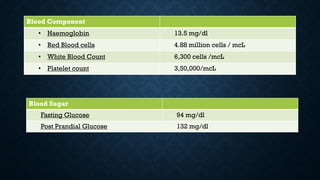
Blood Component
• Haemoglobin 13.5 mg/dl
• Red Blood cells 4.88 million cells / mcL
• White Blood Count 6,300 cells /mcL
• Platelet count 3,50,000/mcL
Blood Sugar
Fasting Glucose 94 mg/dl
Post Prandial Glucose 132 mg/dl
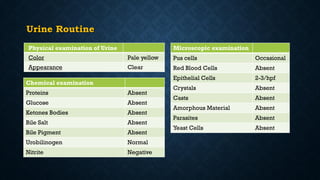
Urine Routine
Physical examination of Urine
Color Pale yellow
Appearance Clear
Microscopic examination
Pus cells Occasional
Red Blood Cells Absent
Epithelial Cells 2-3/hpf
Crystals Absent
Casts Absent
Amorphous Material Absent
Parasites Absent
Yeast Cells Absent
Chemical examination
Proteins Absent
Glucose Absent
Ketones Bodies Absent
Bile Salt Absent
Bile Pigment Absent
Urobilinogen Normal
Nitrite Negative
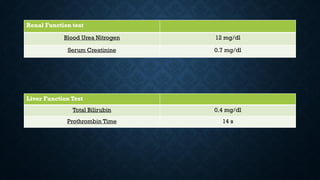
Renal Function test
Blood Urea Nitrogen 12 mg/dl
Serum Creatinine 0.7 mg/dl
Liver Function Test
Total Bilirubin 0.4 mg/dl
Prothrombin Time 14 s
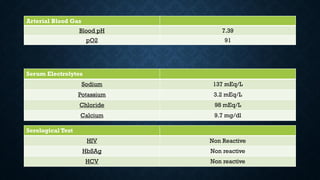
Arterial Blood Gas
Blood pH 7.39
pO2 91
Serum Electrolytes
Sodium 137 mEq/L
Potassium 3.2 mEq/L
Chloride 98 mEq/L
Calcium 9.7 mg/dl
Serological Test
HIV Non Reactive
HbSAg Non reactive
HCV Non reactive
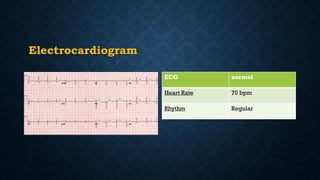
Electrocardiogram
ECG normal
Heart Rate 70 bpm
Rhythm Regular
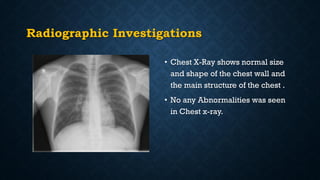
Radiographic Investigations
• Chest X-Ray shows normal size
and shape of the chest wall and
the main structure of the chest .
• No any Abnormalities was seen
in Chest x-ray.
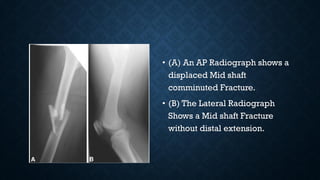
• (A) An AP Radiograph shows a
displaced Mid shaft
comminuted Fracture.
• (B) The Lateral Radiograph
Shows a Mid shaft Fracture
without distal extension.
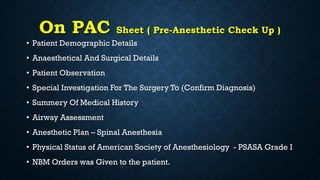
On PAC Sheet ( Pre-Anesthetic Check Up )
• Patient Demographic Details
• Anaesthetical And Surgical Details
• Patient Observation
• Special Investigation For The Surgery To (Confirm Diagnosis)
• Summery Of Medical History
• Airway Assessment
• Anesthetic Plan – Spinal Anesthesia
• Physical Status of American Society of Anesthesiology - PSASA Grade I
• NBM Orders was Given to the patient.
Day-3
Day of surgery
Pre Operative Preparation in ward
• Patient was Nil By mouth from last night.
• Oral and Dental Hygiene done with chlorhexidine 0.2%.
• Operative area shaved and cleaned with Spirit.
• Surgical site was Marked.
• Antiseptic bath was given in Morning.
• Intravenous catheter checked with NS Flush.
• Insertion of Foleys catheter done With 16 Fr Size.
• Chest Physiotherapy was done.
Patient was shifted in Pre Operative area from Ortho Ward
Pre Operative Vitals Signs
• Temperature – 97.8 F
• Pulse rate – 72 bpm
• Respiratory rate – 14 bpm
• Blood pressure -120 / 80 mmHg
• SpO2 – 98 %
Morning RBS - 127 mg/dl
Counselling and written informed consent was done in pre-op area.
AB+ Blood was reserved for Surgery.
Premedication
• Antiemetic – Inj. Ondansetron.
• Antacid – Inj. Pantoprazole.
• Antibiotic prophylaxis - Inj. Cefuroxime 1.5 gm.Was given 1hr
before the surgery.
• Order for intra operative preparation
Parts preparation : on Fracture site and Incision site Of Right Thigh
Position : patient is placed in supine position with the arm abducted.
Intra-Operative care
Patient was shifted in OT from Pre operative area.
• Intravenous fluid therapy start with Ringer Lactated.
Anesthesia
Induction Time – 09: 45 AM
• Anesthesia Procedure – Spinal Anesthesia was given in sitting position
with 27 g Quincke spinal needle.
• Spinal Drug is Inj. Bupivacaine heavy 0.5% + Adjuvant Inj. Clonidine.
Intra operative Monitoring
• ECG, Blood Pressure, SpO2, Respiratory rate - Normal
Incision Time – 10:13 AM
• The femoral canal was reamed with 1.5 cm reamer, and 1.4cm x 38 cm
locked T2 femoral Nail was placed.
• The rotational alignment and length of the patient right leg were
checked in comparison to the left leg and thought to be acceptable.
Sign out – 12:45 PM
• The open fracture wounds were closed loosely with 2-0 vertical
mattress nylon sutures.
• Intra-operative Blood loss was 400 ml.
• Patient was shifted in Post Anaesthesia care unit.
Post Operative Orders From Anesthetist
• NBM – 4 hrs
• Monitor Vitals in post opp area.
• Maintain Supine position For 24hrs ( To avoid PDPH )
• Intravenous fluids - 2 pint of RL / NS at 100 ml/hr.
• Inj. Paracetamol 1gm SOS
• Inj. Dynapar 75 mg SOS
Post Anaesthetic Care Unit
Monitoring Vitals –
• Pulse value and regularity.
• Depth and nature of respiration
Surgical site assessment – No Blood loss from surgical site
Vitals Signs
• Temperature – 98.2 F
• Pulse rate – 72 bpm
• Respiratory rate – 14 bpm
• Blood pressure -120 / 80 mmHg
• SpO2 – 98 %
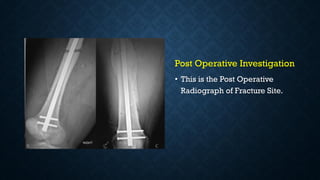
Post Operative Investigation
• This is the Post Operative
Radiograph of Fracture Site.
• Patient was shifted to Ortho Ward for Recovery.
• Post operative assessment was continued till discharge of the
patient.
• After 12 days patient was discharge from Hospital with
support of walker.
“
”
Thank You

Case presentation for Reading

  • 1.
    Case Presentation Ppt forReading Name : Mr. Harshad Ram Khade M.Sc. Medical Technology PRN : 20040143003
  • 2.
    Case - • A43 year old male patient was transferred with an ambulance in the emergency department of the hospital with bleeding from right thigh after a motorcycle accident. He had become a trapped under the motorcycle. • Discuss the medical, surgical and anesthetic management of this patient.
  • 3.
    Day-1 On day 1when patient come in the emergency department
  • 4.
    Provisional diagnosis • Physicalexamination revealed A small puncture wound Laterally and 2 puncture wound Anteriorly in the mid thigh. The larger of which was approximately 5 mm in diameter. • Patient blood group AB+
  • 5.
    ABCDE Approach • Airway: No Airway obstruction. • Breathing : Spontaneous Breathing • Circulation : Bleeding from Right thigh, Low Blood Pressure Estimated blood loss 600ml. • Disability : No Disability is found, patient is Alert. Head and neck movement is good and also check spine mobility in ( Active and passive Motion ) • Exposure & Environment : Remove cloths to enable examination of the body. • No any Injury on the body other than Right thigh.
  • 6.
    • First EmergencyTeam was stop bleeding by direct pressure and with surgical instruments. • Vitals sings - • Temperature – 98.8 F • Pulse rate – 78 bpm • Respiratory rate – 16 bpm • Blood pressure 105 / 70 mmHg • Intravenous Access taken with • 20g IV cannula for Fluid Therapy • 16g IV cannula for Blood Transfusion. • Intravenous fluid therapy start with Ringer lactated solution. • Immediate start blood transfusion and FFP.
  • 7.
    Investigations in EmergencyDepartment • Blood sample is Taken for lab investigation. • CBC • PT / INR • Blood grouping • Electrolytes • ABG • Radiographic investigation • AP & Lateral X-Ray of Right Femur • Chest X-Ray
  • 8.
    Chest X-Ray AP& Lateral X-Ray of ® Femur
  • 9.
    • Anteroposterior andlateral radiographs revealed a right femoral shaft fracture. • CMO give reference to the orthopaedics surgeon. • The patient was taken in the Minor OT for debridement of the fracture. • Gross contamination which include several pieces of gross or other organic material was removed.
  • 10.
    • Open fracturewas then irrigated with 10 L of isotonic sodium chloride solution. • The wounds were dressed and the leg was splinted with Thomas Splint. • The patient received intravenous antibiotics Inj. cefuroxime and Inj.Tetanus immunization in the emergency department.
  • 11.
    Final Diagnosis –from Orthopaedic surgeon ® Femur Shaft Fracture Surgery – ® Closed Reduction Internal Fixation with Intramedullary Interlocking Nailing. ® CRIF with IMIL Nailing
  • 12.
    Day-2 • Patient wasshifted to the Orthopedic ward. • Orthopedic surgeon give call note to the anesthesiologist for Pre anesthetic check up. • on day 2 Anesthesiologist came for pre anesthetic check up.
  • 13.
    History Taking Personal DemographicHistory : Date and Time of PAC - 31/01/2020 10:00 AM Patient Name - Mr. X Y Z Age / Sex - 43 years / Male Source of Reference - Ortho Ward, Bed No. 09 PRN – 808778 IPD No. / OPD No. – 788417 / 19.345678 Source of History - Patient
  • 14.
    Past History : Pastmedical History • No any known Medical History like ( DM, HTN,TB, IHD, Cancer ) Past Surgical History • Laparoscopic Appendectomy done in 2013 in General Anesthesia , No Complications and Easy Intubation at that time. Past Injuries and Accident • No Previous Major Injuries and Accident happened with patient.
  • 15.
    Medical History : Currentmedications • No any Current Treatment and Medications. Allergies • No any Allergies from any Medications in the past. Family History • No any Disorder in the Direct Blood relative of the patient.
  • 16.
    Personal History • Patienthave No addiction of the Smoking,Tobacco and Drugs. • Minimal Alcohol drinker. • Patient follow Little Diet formula and Daily 1 hr Workout in the gym. • Occupation – Teacher. • No Travel History.
  • 17.
    Clinical Examination Vital signs Temperature– 98.3 F Pulse rate – 72 bpm Respiratory rate -14 bpm Blood pressure -120 / 80 mmHg
  • 18.
    General examination Pallor -No Pale color found on the skin and conjunctivae of the eyes. Icterus – No yellowish pigmentation found on the skin, tissue and body fluids. Cyanosis – No bluish discoloration are seen on the Lips, Nose, Cheeks and Oral cavity. Clubbing – No clubbing seen in Fingernails and Toenails. Lymphadenopathy – No Swelling on the Lymph Nodes. Edema – No swelling on the hands and feet
  • 19.
    Physical appearances Height -165cm Weight – 60 kg BMI – 22.04 kg / m2 which denote Healthy Patient. Local examination Injury – Injury on Right thigh.  Fracture – Right Femur Shaft Fracture. Skin Rashes – Absent. Ulcer – No Ulcer Found. Abscess – No Abscess found.
  • 20.
    Airway examination Teeth –Adequate, No any lose Teeth, No dentures are found. Mouth opening – Inter Incisor gap is Normal Thyromental Distance – normal Length and the thickness of the Neck - Adequate Movement of the Head and Neck – Good Mallampati Grading – Grade I
  • 21.
    • The Mullampaticlassification is used to predict the ease of intubation • Class 1 : Soft palate, uvula, fauces, pillars, visible. • Class 2 : Soft palate, Major part of Uvula, Fauces visible. • Class 3 : Soft Palate, Base of Uvula visible. • Class 4 : Only Hard Palate Visible. • Mallampati Classes 1 & 2 are associated with relatively easy intubation. • Classes 3 & 4are associated with increased difficulty.
  • 22.
    Systemic examination Respiratory system Inspection •Patient is comfortable at rest. • Patient in supine position. • Shape of the Chest – Bilaterally symmetrical and Elliptical in cross section. • Movement of the chest – Equal on both side • No abnormalities on the chest • No Tracheal deviation are present. • No Abnormalities in Upper respiratory system.
  • 23.
    Palpation • Surface temperatureis afebrile. • No abnormalities in Apical Impulse. Percussion • Percussion done on entire lung field. • No any dullness are found. Auscultation • No any Abnormal sound are present.
  • 24.
    Cardiovascular system Inspection • Patientis comfortable at rest. • Shape of the Chest – Bilaterally symmetrical and Elliptical in cross section. • Movement of the chest – Equal on both side • No abnormalities on the chest • JVP is normal.
  • 25.
    Palpation • No anyabnormalities in apex beat. • Thrill and Heave are absent. Percussion • Percussion done on 3rd, 4th, 5th Intercostal space. • No abnormalities found in percussion. Auscultation • Heart sounds are normal.
  • 26.
    Per Abdomen system Inspection •General appearance – patient is well Build, well Nourished. • No any abnormal signs are seen on the abdomen • Oral examination are done – ( Mouth,Tongue,Teeth, Breath ) Palpation • Superficial and deep palpation are done • No abnormalities are found.
  • 27.
    Percussion • Percussion overthe abdomen was given. • No Fluid thrill Found. Auscultation • Bowel sound are heard. • No any abnormal sound are present.
  • 28.
    Central Nervous System •Patient is alert. • Well Oriented. • No any abnormalities in Cranial nerves. • Motor Response and Sensory response are good. • Coordination Gait – Patient unable to walk. Due to femour fracture
  • 29.
  • 30.
    Routine Investigation Complete BloodCount Blood sugar – Fasting & post prandial Urine routine Liver Function Tests Renal Function Tests BT, CT, PT, PTT, INR ABG Serological Test • HIV • HbSAg • HCV Electrocardiography Chest X-Ray
  • 31.
    Blood Component • Haemoglobin13.5 mg/dl • Red Blood cells 4.88 million cells / mcL • White Blood Count 6,300 cells /mcL • Platelet count 3,50,000/mcL Blood Sugar Fasting Glucose 94 mg/dl Post Prandial Glucose 132 mg/dl
  • 32.
    Urine Routine Physical examinationof Urine Color Pale yellow Appearance Clear Microscopic examination Pus cells Occasional Red Blood Cells Absent Epithelial Cells 2-3/hpf Crystals Absent Casts Absent Amorphous Material Absent Parasites Absent Yeast Cells Absent Chemical examination Proteins Absent Glucose Absent Ketones Bodies Absent Bile Salt Absent Bile Pigment Absent Urobilinogen Normal Nitrite Negative
  • 33.
    Renal Function test BloodUrea Nitrogen 12 mg/dl Serum Creatinine 0.7 mg/dl Liver Function Test Total Bilirubin 0.4 mg/dl Prothrombin Time 14 s
  • 34.
    Arterial Blood Gas BloodpH 7.39 pO2 91 Serum Electrolytes Sodium 137 mEq/L Potassium 3.2 mEq/L Chloride 98 mEq/L Calcium 9.7 mg/dl Serological Test HIV Non Reactive HbSAg Non reactive HCV Non reactive
  • 35.
  • 36.
    Radiographic Investigations • ChestX-Ray shows normal size and shape of the chest wall and the main structure of the chest . • No any Abnormalities was seen in Chest x-ray.
  • 37.
    • (A) AnAP Radiograph shows a displaced Mid shaft comminuted Fracture. • (B) The Lateral Radiograph Shows a Mid shaft Fracture without distal extension.
  • 38.
    On PAC Sheet( Pre-Anesthetic Check Up ) • Patient Demographic Details • Anaesthetical And Surgical Details • Patient Observation • Special Investigation For The Surgery To (Confirm Diagnosis) • Summery Of Medical History • Airway Assessment • Anesthetic Plan – Spinal Anesthesia • Physical Status of American Society of Anesthesiology - PSASA Grade I • NBM Orders was Given to the patient.
  • 39.
  • 40.
    Pre Operative Preparationin ward • Patient was Nil By mouth from last night. • Oral and Dental Hygiene done with chlorhexidine 0.2%. • Operative area shaved and cleaned with Spirit. • Surgical site was Marked. • Antiseptic bath was given in Morning. • Intravenous catheter checked with NS Flush. • Insertion of Foleys catheter done With 16 Fr Size. • Chest Physiotherapy was done.
  • 41.
    Patient was shiftedin Pre Operative area from Ortho Ward Pre Operative Vitals Signs • Temperature – 97.8 F • Pulse rate – 72 bpm • Respiratory rate – 14 bpm • Blood pressure -120 / 80 mmHg • SpO2 – 98 % Morning RBS - 127 mg/dl Counselling and written informed consent was done in pre-op area. AB+ Blood was reserved for Surgery.
  • 42.
    Premedication • Antiemetic –Inj. Ondansetron. • Antacid – Inj. Pantoprazole. • Antibiotic prophylaxis - Inj. Cefuroxime 1.5 gm.Was given 1hr before the surgery. • Order for intra operative preparation Parts preparation : on Fracture site and Incision site Of Right Thigh Position : patient is placed in supine position with the arm abducted.
  • 43.
    Intra-Operative care Patient wasshifted in OT from Pre operative area. • Intravenous fluid therapy start with Ringer Lactated. Anesthesia Induction Time – 09: 45 AM • Anesthesia Procedure – Spinal Anesthesia was given in sitting position with 27 g Quincke spinal needle. • Spinal Drug is Inj. Bupivacaine heavy 0.5% + Adjuvant Inj. Clonidine. Intra operative Monitoring • ECG, Blood Pressure, SpO2, Respiratory rate - Normal
  • 44.
    Incision Time –10:13 AM • The femoral canal was reamed with 1.5 cm reamer, and 1.4cm x 38 cm locked T2 femoral Nail was placed. • The rotational alignment and length of the patient right leg were checked in comparison to the left leg and thought to be acceptable. Sign out – 12:45 PM • The open fracture wounds were closed loosely with 2-0 vertical mattress nylon sutures. • Intra-operative Blood loss was 400 ml. • Patient was shifted in Post Anaesthesia care unit.
  • 45.
    Post Operative OrdersFrom Anesthetist • NBM – 4 hrs • Monitor Vitals in post opp area. • Maintain Supine position For 24hrs ( To avoid PDPH ) • Intravenous fluids - 2 pint of RL / NS at 100 ml/hr. • Inj. Paracetamol 1gm SOS • Inj. Dynapar 75 mg SOS
  • 46.
    Post Anaesthetic CareUnit Monitoring Vitals – • Pulse value and regularity. • Depth and nature of respiration Surgical site assessment – No Blood loss from surgical site Vitals Signs • Temperature – 98.2 F • Pulse rate – 72 bpm • Respiratory rate – 14 bpm • Blood pressure -120 / 80 mmHg • SpO2 – 98 %
  • 47.
    Post Operative Investigation •This is the Post Operative Radiograph of Fracture Site.
  • 48.
    • Patient wasshifted to Ortho Ward for Recovery. • Post operative assessment was continued till discharge of the patient. • After 12 days patient was discharge from Hospital with support of walker.
  • 49.