Information Leakage &
Data Loss Prevention
ACC626
Presented by: Carol Qianyun Lu
July 23rd, 2013
Agenda
What is Information Leakage?
How and when it occurs?
Impact on organizations
Frameworks & DLP tools
Implications for CA
Conclusion
What is Information
Leakage?
Information leakage is an alternate term for
information exposure
Information exposure is the intentional or
unintentional disclosure of information to a party
that does not have access to that information (CWE,
2008)
Common form of data loss
Severity range widely depending on type of
information that is revealed
How and when it occurs?
External hack to organization’s confidential
information
Occur during outsourcing
Acts of consultants who works for different firms
concurrently
Relevant to CAs who works as consultants and C-Suite
Executive
Between alliances and collaborating companies
Leak from inside by employees
Leak from Inside
Ways information can be leaked:
Flash drives , USB devices, Other “lifestyle” devices
iPods
Bring-Your-Own-Device
Former employees – Internal Control Deficiency
Cyberspace
Online Storage (e.g. Google – Gmail)
Instant messages, emails, blogs
Impact on
Organizations
Financial and reputational loss
Small leaks accumulate to big loss
Loss of customer and employee private information
Loss of competitive position
Lawsuits or regulatory consequences
Frameworks
The Privacy Act of 1974 – U.S.
The Payment Card Industry Data Security Standards –
U.S.
Sarbanes-Oxley Act (SOX) – U.S.
Federal Information Security Management Act (FISMA)
– U.S.
DLP Tools
Full DLP suites
McAfee Data Loss Prevention - Commercial email
security platform
Controls for emails
Websense TruWeb DLP, CISCO IronPort email and
Google – Postini
Stand-alone DLP products
Code Green Networks, intrusion Inc., Workshare
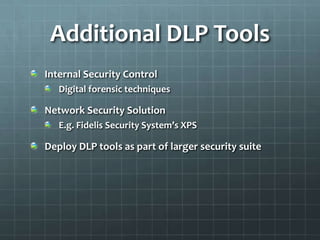
Additional DLP Tools
Internal Security Control
Digital forensic techniques
Network Security Solution
E.g. Fidelis Security System’s XPS
Deploy DLP tools as part of larger security suite
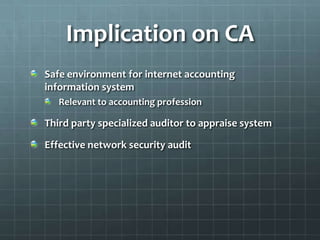
Implication on CA
Safe environment for internet accounting
information system
Relevant to accounting profession
Third party specialized auditor to appraise system
Effective network security audit
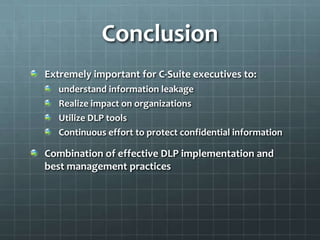
Conclusion
Extremely important for C-Suite executives to:
understand information leakage
Realize impact on organizations
Utilize DLP tools
Continuous effort to protect confidential information
Combination of effective DLP implementation and
best management practices
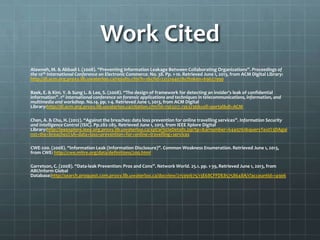
Work Cited
Alawneh, M. & Abbadi I. (2008). “Preventing Information Leakage Between Collaborating Organizations”. Proceedings of
the 10th International Conference on Electronic Commerce. No. 38. Pp. 1-10. Retrieved June 1, 2013, from ACM Digital Library:
http://dl.acm.org.proxy.lib.uwaterloo.ca/results.cfm?h=1&cfid=221214407&cftoken=69627990
Baek, E. & Kim. Y. & Sung L. & Lee, S. (2008). “The design of framework for detecting an insider’s leak of confidential
information”. 1st international conference on forensic applications and techniques in telecommunications, information, and
multimedia and workshop. No.14. pp. 1-4. Retrieved June 1, 2013, from ACM Digital
Library:http://dl.acm.org.proxy.lib.uwaterloo.ca/citation.cfm?id=1363217.1363236&coll=portal&dl=ACM
Chen, A. & Chu, H. (2012). “Against the breaches: data loss prevention for online travelling services”. Information Security
and Intelligence Control (ISIC). Pp.282-285. Retrieved June 1, 2013, from IEEE Xplore Digital
Library:http://ieeexplore.ieee.org.proxy.lib.uwaterloo.ca/xpl/articleDetails.jsp?tp=&arnumber=6449761&queryText%3DAgai
nst+the+breaches%3A+data+loss+prevention+for+online+travelling+services
CWE-200. (2008). “Information Leak (Information Disclosure)”. Common Weakness Enumeration. Retrieved June 1, 2013,
from CWE: http://cwe.mitre.org/data/definitions/200.html
Garretson, C. (2008). “Data-leak Prevention: Pros and Cons”. Network World. 25.1. pp. 1-39, Retrieved June 1, 2013, from
ABI/Inform Global
Database:http://search.proquest.com.proxy.lib.uwaterloo.ca/docview/215991675/13E68CFFDE85758648A/1?accountid=14906
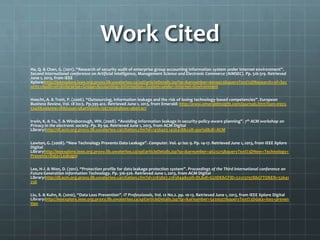
Work Cited
He, Q. & Chen, G. (2011). “Research of security audit of enterprise group accounting information system under internet environment”.
Second international conference on Artificial Intelligence, Management Science and Electronic Commerce (AIMSEC). Pp. 516-519. Retrieved
June 1, 2013, from IEEE
Xplore:http://ieeexplore.ieee.org.proxy.lib.uwaterloo.ca/xpl/articleDetails.jsp?tp=&arnumber=6010453&queryText%3DResearch+of+Sec
urity+Audit+of+Enterprise+Group+Accounting+Information+System+under+Internet+Environment
Hoecht, A. & Trott, P. (2006). “Outsourcing, information leakage and the risk of losing technology-based competencies”. European
Business Review, Vol. 18 Iss:5. Pp.395-412. Retrieved June 1, 2013, from Emerald: http://www.emeraldinsight.com/journals.htm?issn=0955-
534X&volume=18&issue=5&articleid=1567303&show=abstract
Irwin, K. & Yu, T. & Winsborough, WH. (2008). “Avoiding information leakage in security-policy-aware planning”. 7th ACM workshop on
Privacy in the electronic society. Pp. 85-94. Retrieved June 1, 2013, from ACM Digital
Library:http://dl.acm.org.proxy.lib.uwaterloo.ca/citation.cfm?id=1456403.1456418&coll=portal&dl=ACM
Lawton, G. (2008). “New Technology Prevents Data Leakage”. Computer. Vol. 41 Iss: 9. Pp. 14-17. Retrieved June 1, 2013, from IEEE Xplore
Digital
Libraryhttp://ieeexplore.ieee.org.proxy.lib.uwaterloo.ca/xpl/articleDetails.jsp?tp=&arnumber=4623215&queryText%3DNew+Technology+
Prevents+Data+Leakage:
Lee, H-J. & Won, D. (2011). “Protection profile for data leakage protection system”. Proceedings of the Third international conference on
Future Generation Information Technology. Pp. 316-326. Retrieved June 1, 2013, from ACM Digital
Library:http://dl.acm.org.proxy.lib.uwaterloo.ca/citation.cfm?id=2183807.2183844&coll=DL&dl=GUIDE&CFID=221237978&CFTOKEN=52641
256
Liu, S. & Kuhn, R. (2010), “Data Loss Prevention”. IT Professionals, Vol. 12 No.2. pp. 10-13. Retrieved June 1, 2013, from IEEE Xplore Digital
Library:http://ieeexplore.ieee.org.proxy.lib.uwaterloo.ca/xpl/articleDetails.jsp?tp=&arnumber=5439507&queryText%3Ddata+loss+preven
tion
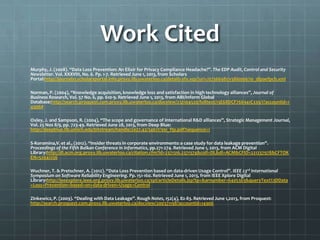
Work Cited
Murphy, J. (2008). “Data Loss Prevention: An Elixir for Privacy Compliance Headache?”. The EDP Audit, Control and Security
Newsletter. Vol. XXXVIII, No. 6. Pp. 1-7. Retrieved June 1, 2013, from Scholars
Portal:http://journals1.scholarsportal.info.proxy.lib.uwaterloo.ca/details-sfx.xqy?uri=/07366981/v38i0006/10_dlpaefpch.xml
Norman, P. (2004), “Knowledge acquisition, knowledge loss and satisfaction in high technology alliances”, Journal of
Business Research, Vol. 57 No. 6, pp. 610-9. Retrieved June 1, 2013, from ABI/Inform Global
Database:http://search.proquest.com.proxy.lib.uwaterloo.ca/docview/232104520/fulltext/13E68DCF766941C339/1?accountid=1
4906#
Oxley, J. and Sampson, R. (2004), “The scope and governance of international R&D alliances”, Strategic Management Journal,
Vol. 25 Nos 8/9, pp. 723-49. Retrieved June 28, 2013, from Deep Blue:
http://deepblue.lib.umich.edu/bitstream/handle/2027.42/34617/391_ftp.pdf?sequence=1
S-Koromina,V. et al., (2012). “Insider threats in corporate environments: a case study for data leakage prevention”.
Proceedings of the Fifth Balkan Conference in Informatics, pp.271-274. Retrieved June 1, 2013, from ACM Digital
Library:http://dl.acm.org.proxy.lib.uwaterloo.ca/citation.cfm?id=2371316.2371374&coll=DL&dl=ACM&CFID=221237978&CFTOK
EN=52641256
Wuchner, T. & Pretschner, A. (2012). “Data Loss Prevention based on data-driven Usage Control”. IEEE 23rd International
Symposium on Software Reliability Engineering. Pp. 151-160. Retrieved June 1, 2013, from IEEE Xplore Digital
Library:http://ieeexplore.ieee.org.proxy.lib.uwaterloo.ca/xpl/articleDetails.jsp?tp=&arnumber=6405363&queryText%3DData
+Loss+Prevention+based+on+data-driven+Usage+Control
Zinkewicz, P. (2009). “Dealing with Data Leakage”. Rough Notes, 152(4), 82-83. Retrieved June 1,2013, from Proquest:
http://search.proquest.com.proxy.lib.uwaterloo.ca/docview/200371198?accountid=14906

Information Leakage & DLP

  • 1.
    Information Leakage & DataLoss Prevention ACC626 Presented by: Carol Qianyun Lu July 23rd, 2013
  • 2.
    Agenda What is InformationLeakage? How and when it occurs? Impact on organizations Frameworks & DLP tools Implications for CA Conclusion
  • 3.
    What is Information Leakage? Informationleakage is an alternate term for information exposure Information exposure is the intentional or unintentional disclosure of information to a party that does not have access to that information (CWE, 2008) Common form of data loss Severity range widely depending on type of information that is revealed
  • 4.
    How and whenit occurs? External hack to organization’s confidential information Occur during outsourcing Acts of consultants who works for different firms concurrently Relevant to CAs who works as consultants and C-Suite Executive Between alliances and collaborating companies Leak from inside by employees
  • 5.
    Leak from Inside Waysinformation can be leaked: Flash drives , USB devices, Other “lifestyle” devices iPods Bring-Your-Own-Device Former employees – Internal Control Deficiency Cyberspace Online Storage (e.g. Google – Gmail) Instant messages, emails, blogs
  • 6.
    Impact on Organizations Financial andreputational loss Small leaks accumulate to big loss Loss of customer and employee private information Loss of competitive position Lawsuits or regulatory consequences
  • 7.
    Frameworks The Privacy Actof 1974 – U.S. The Payment Card Industry Data Security Standards – U.S. Sarbanes-Oxley Act (SOX) – U.S. Federal Information Security Management Act (FISMA) – U.S.
  • 8.
    DLP Tools Full DLPsuites McAfee Data Loss Prevention - Commercial email security platform Controls for emails Websense TruWeb DLP, CISCO IronPort email and Google – Postini Stand-alone DLP products Code Green Networks, intrusion Inc., Workshare
  • 9.
    Additional DLP Tools InternalSecurity Control Digital forensic techniques Network Security Solution E.g. Fidelis Security System’s XPS Deploy DLP tools as part of larger security suite
  • 10.
    Implication on CA Safeenvironment for internet accounting information system Relevant to accounting profession Third party specialized auditor to appraise system Effective network security audit
  • 11.
    Conclusion Extremely important forC-Suite executives to: understand information leakage Realize impact on organizations Utilize DLP tools Continuous effort to protect confidential information Combination of effective DLP implementation and best management practices
  • 12.
    Work Cited Alawneh, M.& Abbadi I. (2008). “Preventing Information Leakage Between Collaborating Organizations”. Proceedings of the 10th International Conference on Electronic Commerce. No. 38. Pp. 1-10. Retrieved June 1, 2013, from ACM Digital Library: http://dl.acm.org.proxy.lib.uwaterloo.ca/results.cfm?h=1&cfid=221214407&cftoken=69627990 Baek, E. & Kim. Y. & Sung L. & Lee, S. (2008). “The design of framework for detecting an insider’s leak of confidential information”. 1st international conference on forensic applications and techniques in telecommunications, information, and multimedia and workshop. No.14. pp. 1-4. Retrieved June 1, 2013, from ACM Digital Library:http://dl.acm.org.proxy.lib.uwaterloo.ca/citation.cfm?id=1363217.1363236&coll=portal&dl=ACM Chen, A. & Chu, H. (2012). “Against the breaches: data loss prevention for online travelling services”. Information Security and Intelligence Control (ISIC). Pp.282-285. Retrieved June 1, 2013, from IEEE Xplore Digital Library:http://ieeexplore.ieee.org.proxy.lib.uwaterloo.ca/xpl/articleDetails.jsp?tp=&arnumber=6449761&queryText%3DAgai nst+the+breaches%3A+data+loss+prevention+for+online+travelling+services CWE-200. (2008). “Information Leak (Information Disclosure)”. Common Weakness Enumeration. Retrieved June 1, 2013, from CWE: http://cwe.mitre.org/data/definitions/200.html Garretson, C. (2008). “Data-leak Prevention: Pros and Cons”. Network World. 25.1. pp. 1-39, Retrieved June 1, 2013, from ABI/Inform Global Database:http://search.proquest.com.proxy.lib.uwaterloo.ca/docview/215991675/13E68CFFDE85758648A/1?accountid=14906
  • 13.
    Work Cited He, Q.& Chen, G. (2011). “Research of security audit of enterprise group accounting information system under internet environment”. Second international conference on Artificial Intelligence, Management Science and Electronic Commerce (AIMSEC). Pp. 516-519. Retrieved June 1, 2013, from IEEE Xplore:http://ieeexplore.ieee.org.proxy.lib.uwaterloo.ca/xpl/articleDetails.jsp?tp=&arnumber=6010453&queryText%3DResearch+of+Sec urity+Audit+of+Enterprise+Group+Accounting+Information+System+under+Internet+Environment Hoecht, A. & Trott, P. (2006). “Outsourcing, information leakage and the risk of losing technology-based competencies”. European Business Review, Vol. 18 Iss:5. Pp.395-412. Retrieved June 1, 2013, from Emerald: http://www.emeraldinsight.com/journals.htm?issn=0955- 534X&volume=18&issue=5&articleid=1567303&show=abstract Irwin, K. & Yu, T. & Winsborough, WH. (2008). “Avoiding information leakage in security-policy-aware planning”. 7th ACM workshop on Privacy in the electronic society. Pp. 85-94. Retrieved June 1, 2013, from ACM Digital Library:http://dl.acm.org.proxy.lib.uwaterloo.ca/citation.cfm?id=1456403.1456418&coll=portal&dl=ACM Lawton, G. (2008). “New Technology Prevents Data Leakage”. Computer. Vol. 41 Iss: 9. Pp. 14-17. Retrieved June 1, 2013, from IEEE Xplore Digital Libraryhttp://ieeexplore.ieee.org.proxy.lib.uwaterloo.ca/xpl/articleDetails.jsp?tp=&arnumber=4623215&queryText%3DNew+Technology+ Prevents+Data+Leakage: Lee, H-J. & Won, D. (2011). “Protection profile for data leakage protection system”. Proceedings of the Third international conference on Future Generation Information Technology. Pp. 316-326. Retrieved June 1, 2013, from ACM Digital Library:http://dl.acm.org.proxy.lib.uwaterloo.ca/citation.cfm?id=2183807.2183844&coll=DL&dl=GUIDE&CFID=221237978&CFTOKEN=52641 256 Liu, S. & Kuhn, R. (2010), “Data Loss Prevention”. IT Professionals, Vol. 12 No.2. pp. 10-13. Retrieved June 1, 2013, from IEEE Xplore Digital Library:http://ieeexplore.ieee.org.proxy.lib.uwaterloo.ca/xpl/articleDetails.jsp?tp=&arnumber=5439507&queryText%3Ddata+loss+preven tion
  • 14.
    Work Cited Murphy, J.(2008). “Data Loss Prevention: An Elixir for Privacy Compliance Headache?”. The EDP Audit, Control and Security Newsletter. Vol. XXXVIII, No. 6. Pp. 1-7. Retrieved June 1, 2013, from Scholars Portal:http://journals1.scholarsportal.info.proxy.lib.uwaterloo.ca/details-sfx.xqy?uri=/07366981/v38i0006/10_dlpaefpch.xml Norman, P. (2004), “Knowledge acquisition, knowledge loss and satisfaction in high technology alliances”, Journal of Business Research, Vol. 57 No. 6, pp. 610-9. Retrieved June 1, 2013, from ABI/Inform Global Database:http://search.proquest.com.proxy.lib.uwaterloo.ca/docview/232104520/fulltext/13E68DCF766941C339/1?accountid=1 4906# Oxley, J. and Sampson, R. (2004), “The scope and governance of international R&D alliances”, Strategic Management Journal, Vol. 25 Nos 8/9, pp. 723-49. Retrieved June 28, 2013, from Deep Blue: http://deepblue.lib.umich.edu/bitstream/handle/2027.42/34617/391_ftp.pdf?sequence=1 S-Koromina,V. et al., (2012). “Insider threats in corporate environments: a case study for data leakage prevention”. Proceedings of the Fifth Balkan Conference in Informatics, pp.271-274. Retrieved June 1, 2013, from ACM Digital Library:http://dl.acm.org.proxy.lib.uwaterloo.ca/citation.cfm?id=2371316.2371374&coll=DL&dl=ACM&CFID=221237978&CFTOK EN=52641256 Wuchner, T. & Pretschner, A. (2012). “Data Loss Prevention based on data-driven Usage Control”. IEEE 23rd International Symposium on Software Reliability Engineering. Pp. 151-160. Retrieved June 1, 2013, from IEEE Xplore Digital Library:http://ieeexplore.ieee.org.proxy.lib.uwaterloo.ca/xpl/articleDetails.jsp?tp=&arnumber=6405363&queryText%3DData +Loss+Prevention+based+on+data-driven+Usage+Control Zinkewicz, P. (2009). “Dealing with Data Leakage”. Rough Notes, 152(4), 82-83. Retrieved June 1,2013, from Proquest: http://search.proquest.com.proxy.lib.uwaterloo.ca/docview/200371198?accountid=14906