Neetu Bose et.al. Int. Journal of Engineering Research and Applications www.ijera.com
ISSN: 2248-9622, Vol. 6, Issue 4, (Part - 6) April 2016, pp.01-07
www.ijera.com 1|P a g e
An Improved Method for Preventing Data Leakage in an
Organization
Neetu Bose1
, Dr. N. Vishwanath2
1
M.Tech Scholar, CSE, Toc H Institute Of Science & Technology Ernakulam,India.Pin-682313
2
Professor, CSE, Toc H Institute Of Science & Technology Ernakulam,India.Pin-682313
ABSTRACT
Data is one of the most important assets an organisation has since it denes each organisations unique- ness.It
includes data on members and prospects, their inter- ests and purchases, your events, speakers, your content,
social media, press, your staff, budget, strategic plan, and much more. As organizations open their doors to
employees, part- ners, customers and suppliers to provide deeper access to sensitive information, the risk
sassociated with business increase. Now, more than ever, within creasing threats of cyber terrorism, cor- porate
governance issues, fraud, and identity theft, the need for securing corporate information has become paramount.
Informa- tion theft is not just about external hackers and unauthorized external users stealing your data, it is also
about managing internal employees and even contractors who may be working within your organization for
short periods of time. Adding to the challenge of securing information is the increasing push for corporate
governance and adherence to legislative or regulatory requirements. Failure to comply and provide privacy,
audit and internal controls could result in penalties ranging from large nes to jail terms. Non-compliance can
result in not only potential implications for executives, but also possible threats to the viability of a corporation.
Insiders too represent a sign cant risk to data security. The task of detecting malicious insiders is very
challenging as the methods of deception become more and more sophisticated. There are various solutions
present to avoid data leakage. Data leakage detection, prevention (DLPM) and monitoring solutions became an
inherent component of the organizations security suite.DLP solutions monitors sensitive data when at rest, in
motion, or in use and enforce the organizational data protection policy.These solutions focus mainly on the data
and its sensitivity level, and on preventing it from reaching an unauthorized person. They ignore the fact that an
insider is gradually exposed to more and more sensitive data,to which she is authorized to access. Such data
may cause great damage to the organization when leaked or misused. Data can be leaked via emails, instant
messaging, le transfer etc. This research is focusing on email data leakage monitoring, detection and
prevention. It is proposed to be carried out in two phases: leakage detection through mining and prevention
through encryption of email content.
Keywords-Data misuse, Insider threat, Text analysis, Security measures, Misuseability
I. INTRODUCTION
Data leakage is dened as the accidental or
unintentional distribution of private or sensitive
data to an unauthorized entity. Sensitive data in
companies and organizations include intellectual
property (IP), nancial information, patient infor-
mation, personal credit-card data, and other
information depending on the business and the
industry. Data leakage poses a serious issue for
companies as the number of incidents and the cost
to those experiencing them continue to increase.
Data leakage is enhanced by the fact that
transmitted data (both inbound and out- bound),
including emails, instant messaging, website forms,
and le transfers among others, are largely
unregulated and unmonitored on their way to their
destinations. The potential damage and adverse
consequences of a data leakage incident can be
classied into two categories: Direct and Indirect
Losses. Direct losses refer to tangible damage that
Is easy to measure or to estimate
quantitatively. Indirect losses, on the other hand,
are much harder to quantify and have a much
broader impact in terms of cost, place, and time.
Direct losses include violations of regulations such
as those protecting customer privacy resulting in
nes, settlements or customer compensation fees
litigation involving lawsuits loss of future sales
costs of investigation and remedial or restoration
fees. Indirect losses include reduced share price as
a result of negative publicity damage to a
companys goodwill and reputation customer
abandonment and exposure of intellectual property
such as business plans, code, nancial reports, and
meet- ing agendas to competitors.
Data leakage is an error condition in
information systems in which information is
destroyed by failures or neglect in storage,
transmission, or processing. Information systems
im- plement backup and disaster recovery
RESEARCH ARTICLE OPEN ACCESS
Neetu Bose et.al. Int. Journal of Engineering Research and Applications www.ijera.com
ISSN: 2248-9622, Vol. 6, Issue 4, (Part - 6) April 2016, pp.01-07
www.ijera.com 2|P a g e
equipment and processes to prevent data loss or
restore lost data. Data leakage is distinguished
from data unavailability, such as that arise from a
network outage.
While attacks on computers by outside
intruders are more publicized, attacks perpetrated
by insiders are very common and often more
damaging. Insiders represent the greatest threat to
computer security because they understand their
organizations business and how their computer
systems work. They have both the condentiality
and access to perform these attacks. An inside
attacker will have a higher probability of
successfully breaking into the system and
extracting critical information. The insiders also
represent the greatest challenge to securing the
company network because they are authorized a
level of access to the le system and granted a
degree of trust. The task of detecting malicious
insiders is very chal- lenging as the methods of
deception become more and more sophisticated.
According to the 2010 Cyber Security Watch
Survey 26 percent of the cyber-security events,
recorded in a 12-month period, were caused by
insiders. These insiders were
the most damaging with 43 percent of the
respondentsreporting that their organization
suffered data loss. Of the attacks, 16 percent were
caused by theft of sensitive data and 15 percent by
exposure of condential data. Email is one of the
most popular forms of communication nowadays,
mainly due to its efciency, low cost, and
compatibility of diversied types of information. An
insider can leak the condential data through email.
There is a need of mining the email and nding a
way to detect what potential damage it can cause to
an organization if leaked.
II. RELATED WORKS EARLIER
DONE WORKS INCLUDES
A. Monitoring System Call Activity
One approach of Detecting insider
misbehavior is to mon- itor system call activity and
watch for danger signs or unusual behavior. Nam
Nguyen and Peter Reiher, Geoffrey H.Kuenning [1]
describes an experimental system designed to test
this approach. They tested the systems ability to
detect common insider misbehavior by examining
le system and process- related system calls. Their
results shows that this approach can detect many
such activities.In this paper, they want to look at
these raw data in a different manner: the
relationships between users and les, users and
processes, and processes and les. The work
described here indicates some promising directions
for detecting misbehavior by insiders,as well as
intruders whose initial penetration has gone
unnoticed. The patterns of le accesses by many
programs are sufcientlyregular that attackers trying
to misuse them will quickly be noticed. Similarly,
process-calling behavior is sufciently regular for
large classes of programs to serve as a good
indicator of misbehavior. Other patterns of le
systems access and process behavior do not appear
to be good candidates for detecting attacks.
Individual users have too much variability in their
access patterns to allow simple statistical methods
to detect suspicious changes in behavior, without
also triggering alerts in many innocuous situations.
Similarly, some processes, by their nature, tend to
fork a wide variety of other processes. Thus, a
system that merely implemented the effective tools
discussed in this paper would not catch all attacks.
However, these techniques do appear to be useful
candidates to include in a system that monitors
computers for possible misbehavior. A system that
merely implemented the effective tools discussed
in this paper would not catch all attacks. However,
these techniques do appear to be useful
candidates to include in a system that monitors
computers for possible misbehavior. The
experience with the data gathering and monitoring
steps shows that the necessary data can be gathered
and threats checked without causing noticeable
delays to the user. There are challenges to
collecting and managing the large quantities of data
necessary to build good models, but these
challenges can be overcome.
B. Document Control System
Another approach for mitigating the risk of
an unauthorized person accessing sensitive
document is the implementation of mandatory
access control (MAC) models and frameworks. The
MAC mechanism regulates user access to data
accord- ing to predened classications of both
the user (the subject) and the documents (the
object). The classication is based on partially
ordered access classes (e.g., top secret, secret,
condential,unclassied).Both the objects and the
subjects are labeled with one of these classes, and
the permission is granted by comparing the subject
access class to that of the ob- ject in question.
JunghoEom ,NamukKim,Sunghwan Kim and
TaiMyoungChung [2] proposed Document Control
system.In this paper,they architected a document
control system for monitoring leakage of important
documents related to military information. The
proposed system inspects all documents when they
are downloaded and sent. It consists of 3 modules;
au- thentication module, access control module and
watermarking module. The authentication module
checks insider information for allow to log on
system. The access control module control access
authorization to do operations by insiders
according to their role and security level. The
Neetu Bose et.al. Int. Journal of Engineering Research and Applications www.ijera.com
ISSN: 2248-9622, Vol. 6, Issue 4, (Part - 6) April 2016, pp.01-07
www.ijera.com 3|P a g e
watermarking module is used to track transmission
path of documents. The document control system
controls illegal information ow by insiders and does
not allow access to documents which are not
related to the insiders duties.
C. Inserting Fake Objects(Perturbation
S.W. Ahmad Dr G.R.Bamnote [3]
developed a model for assessing the guilt of agents.
They also present algorithms for distributing
objects to agents, in a way that improves the
chances of identifying a leaker. Finally,they
considered the option of adding fake objects to
the distributed set. Such objects do not correspond
to real entities but appear realistic to the agents. In
a sense, the fake objects acts as a type of
watermark for the entire set, without modifying
any individual members. Perturbation is a very
useful technique where the data is modied and
made less sensitive before being handed to
agents.
D. Misuse Detection In Databases
In recent years, several methods have
been proposed for mitigating data leakage and data
misuse in database systems. These methods can
generally be classied as syntax-centric or data-
centric. The syntax-centric approach relies on the
SQLex- pression representation of queries to
construct user proles. For example, a query can be
represented by a vector of features extracted from
the SQL statement, such as the query type (e.g.,
SELECT or INSERT), and the tables or attributes
requested by the query. Celikelet [4] presented a
model for risk management in distributed database
systems. The model is used to measure the risk
poses by a user in order to prevent her from
misusing or abusing her role privileges. In the
model, a Risk Priority Number (RPN) is calculated
for each user, which is the product of the
Occurrence Rating (OR) that reects the number of
times the same query was issued with respect to the
other users in the same role; the Severity
Rating (SR) that measures the risk by referring to
the quality of the data the user might get from the
queries she issued; and the Detection Rating (DR)
indicates how close the behavior of the user is to
the behavior of users in other roles. Another
syntax-centric method is the framework to enforce
access control over data streams that dene a set of
secure actions (e.g., secure join) that replaces any
unsecure action (e.g., join) the user makes. When a
user issues an unsecure action, the appropriate
secure action is used instead, and by addressing
the user permissions, retrieves only data that this
user is eligible to see. The data-centric approach
focuses on what the user is trying to accessinstead
of how she expresses it. With this approach, an
action is modeled by extracting features from the
obtained result-set. Since they are dealing with data
leakage, they assume that analyzing what a user
sees (i.e., the resultsets) can provide a more direct
indication of a possible data misuse. An interesting
work presents a data-centric approach and
considers a querys expression syntax as irrelevant
for discerning user intent; only the resulting data
matters. For every access to a database, a statistical
vector (S-Vector) is created, holding various
statisti- cal details on the result-set data, such as
minimum, maximum, and average for numeric
attributes, or counts of the different values for text
attributes. Evaluation results showed that the S-
Vector signicantly outperforms the syntax centric
approach presented in Yaseen and Panda also
proposed a data-centric method that uses
dependency graphs based on domain expert
knowledge. These graphs are used inorder to
predict the ability of a user to infer sensitive
information that might harm the organization using
information she already obtained. Then, utilizing
dependency graphs, the system prevents
unauthorized users from gaining information that
enables them to infer or calculate restricted data
they are not eligible to have. Closely related to this
line of works are the preventive approaches. The
insider prediction tool uses taxonomy of insider
threats to calculate the Evaluated Potential Threat
(EPT) measure. This measure tries to estimate
whether a users action is correlated with a part of
the taxonomy that is labeled as malicious. The EPT
is calculated by considering features describing the
user, the context of the action and the action itself.
In addition, the tool uses a set of malicious actions
that were previously discovered. To prevent
insiders from misusing their privileges, Bishop and
Gates suggested the Group-Based Access Control
(GBAC) mechanism, which is a generalization of
RBAC mechanism. This mechanism uses, in
addition to the users basic job description(role),the
user characteristics and behavioral attributes such
as the times he normally comes to work or the
customers with whom she usually interacts. As
already mentioned, none of the proposed methods
consider the sensitivity level of the data to which
the user may be exposed. This factor can greatly
impact the outcome when trying to estimate the
potential damage to the organization if the data is
leaked or misused. Consequently, they adopted the
data-centric approachthe data retrieved by a user
action is examined and its sensitivity level
computed.
III. PROPOSED SYSTEM
Collection of large amount of data and managing it
is a challenge in method of monitoring system
calls, also embed- ding a unique code in each
Neetu Bose et.al. Int. Journal of Engineering Research and Applications www.ijera.com
ISSN: 2248-9622, Vol. 6, Issue 4, (Part - 6) April 2016, pp.01-07
www.ijera.com 4|P a g e
distributed copy can be sometimes destroyed if the
recipient is malicious. Watermarking system a
simple technique of data authorization, there are
various software which can remove the watermark
from the data and makes the data as original. There
is a need of applying a better concept of
misuseability weight measure which can serve as
complementary to present data leakage detection
systems. The existing solutions for detecting data
leakage focuses mostly on restricting outsiders and
to the databases. Measuring potential damage
caused in case of a document is leaked in an
organisation is a complementary method which can
be embedded with existing solutions present for
data
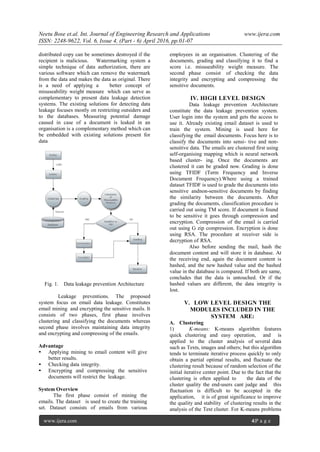
Fig. 1. Data leakage prevention Architecture
Leakage preventions. The proposed
system focus on email data leakage. Constitutes
email mining and encrypting the sensitive mails. It
consists of two phases, first phase involves
clustering and classifying the documents whereas
second phase involves maintaining data integrity
and encrypting and compressing of the emails.
Advantage
• Applying mining to email content will give
better results.
• Checking data integrity.
• Encrypting and compressing the sensitive
documents will restrict the leakage.
System Overview
The first phase consist of mining the
emails. The dataset is used to create the training
set. Dataset consists of emails from various
employees in an organisation. Clustering of the
documents, grading and classifying it to find a
score i.e. misuseability weight measure. The
second phase consist of checking the data
integrity and encrypting and compressing the
sensitive documents.
IV. HIGH LEVEL DESIGN
Data leakage prevention Architecture
constitute the data leakage prevention system.
User login into the system and gets the access to
use it. Already existing email dataset is used to
train the system. Mining is used here for
classifying the email documents. Focus here is to
classify the documents into sensi- tive and non-
sensitive data. The emails are clustered first using
self-organising mapping which is neural network
based cluster- ing. Once the documents are
clustered it can be graded now. Grading is done
using TFIDF (Term Frequency and Inverse
Document Frequency).Where using a trained
dataset TFIDF is used to grade the documents into
sensitive andnon-sensitive documents by finding
the similarity between the documents. After
grading the documents, classification procedure is
carried out using TM score. If document is found
to be sensitive it goes through compression and
encryption. Compression of the email is carried
out using G zip compression. Encryption is done
using RSA. The procedure at receiver side is
decryption of RSA.
Also before sending the mail, hash the
document content and will store it in database. At
the receiving end, again the document content is
hashed, and the new hashed value and the hashed
value in the database is compared. If both are same,
concludes that the data is untouched. Or if the
hashed values are different, the data integrity is
lost.
V. LOW LEVEL DESIGN THE
MODULES INCLUDED IN THE
SYSTEM ARE:
A. Clustering
1) K-means: K-means algorithm features
quick clustering and easy operation, and is
applied to the cluster analysis of several data
such as Texts, images and others; but this algorithm
tends to terminate iterative process quickly to only
obtain a partial optimal results, and fluctuate the
clustering result because of random selection of the
initial iterative center point. Due to the fact that the
clustering is often applied to the data of the
cluster quality the end-users cant judge and this
fluctuation is difficult to be accepted in the
application, it is of great significance to improve
the quality and stability of clustering results in the
analysis of the Text cluster. For K-means problems
Neetu Bose et.al. Int. Journal of Engineering Research and Applications www.ijera.com
ISSN: 2248-9622, Vol. 6, Issue 4, (Part - 6) April 2016, pp.01-07
www.ijera.com 5|P a g e
concerning the selection of initial point and the
sensitivity of isolated point in the Text clustering,
combining the advantages of SOM and K-means
algorithms will enhance the stability and quality of
the Text clustering of the algorithm.
Steps for K-means clustering algorithm are:
(a) Select n objects as the initial cluster seeds on
principle;
(b) Repeat (c) and (d) until no change in each
cluster;
(c) Reassign each object to the most similar
cluster in terms of the value of the cluster
seeds;
(d) Update the cluster seeds, i.e., recompute the
mean value of the object in each cluster, and
take the mean value points of the objects as
new cluster seeds.
2) Self organising map: Clustering the
documents will provide a better picture of the data
present.Aim is to classify the documents into
sensitive and non sensitive data. The emails are
clustered using self- organizing mapping which is
neural network. A self-organizing map (SOM) is a
type of artificial neural network (ANN) that is
trained using unsupervised learn- ing to produce a
low- dimensional (typically two-dimensional),
discretized represen- tation of the input space of the
training samples, and called a map. A self-
organizing map consists of components called
nodes or neurons. Associated with each node is a
weight vector of the same dimension as the input
data vectors, and a position in the map space.It
describes a mapping from a higher-dimensional
input space to a lower- dimensional map space. The
procedure for placing a vector from data space onto
the map is to find the node with the closest
(smallest distance metric) weight vector to the data
space vector.
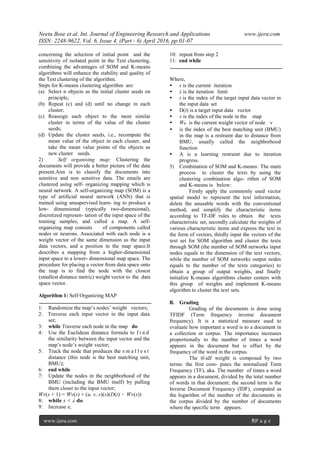
Algorithm 1: Self Organizing MAP
1: Randomize the map’s nodes’ weight vectors;
2: Traverse each input vector in the input data
set;
3: while Traverse each node in the map do
4: Use the Euclidean distance formula to f i n d
the similarity between the input vector and the
map’s node’s weight vector;
5: Track the node that produces the s m a l l e s t
distance (this node is the best matching unit,
BMU);
6: end while
7: Update the nodes in the neighborhood of the
BMU (including the BMU itself) by pulling
them closer to the input vector;
Wv(s + 1) = Wv(s) + (u, v, s)(s)(D(t) − Wv(s))
8: while s < λ do
9: Increase s;
10: repeat from step 2
11: end while
Where,
• s is the current iteration
• λ is the iteration limit
• t is the index of the target input data vector in
the input data set
• D(t) is a target input data vector
• v is the index of the node in the map
• Wv is the current weight vector of node v
• is the index of the best matching unit (BMU)
in the map is a restraint due to distance from
BMU, usually called the neighborhood
function
• Α is a learning restraint due to iteration
progress.
3) Combination of SOM and K-means: The main
process to cluster the texts by using the
clustering combination algo- rithm of SOM
and K-means is below:
Firstly apply the commonly used vector
spatial model to represent the text information,
delete the unusable words with the conventional
method, and simplify the characteristic items
according to TF-DF rules to obtain the texts
characteristic set, secondly calculate the weights of
various characteristic items and express the text in
the form of vectors, thirdly input the vectors of the
text set for SOM algorithm and cluster the texts
through SOM (the number of SOM networks input
nodes equals to the dimension of the text vectors,
while the number of SOM networks output nodes
equals to the number of the texts categories) to
obtain a group of output weights, and finally
initialize K-means algorithms cluster centers with
this group of weights and implement K-means
algorithm to cluster the text sets.
B. Grading
Grading of the documents is done using
TFIDF (Term frequency inverse document
frequency). It is a statistical measure used to
evaluate how important a word is to a document in
a collection or corpus. The importance increases
proportionally to the number of times a word
appears in the document but is offset by the
frequency of the word in the corpus.
The tf-idf weight is composed by two
terms: the first com- putes the normalized Term
Frequency (TF), aka. The number of times a word
appears in a document, divided by the total number
of words in that document; the second term is the
Inverse Document Frequency (IDF), computed as
the logarithm of the number of the documents in
the corpus divided by the number of documents
where the specific term appears.
Neetu Bose et.al. Int. Journal of Engineering Research and Applications www.ijera.com
ISSN: 2248-9622, Vol. 6, Issue 4, (Part - 6) April 2016, pp.01-07
www.ijera.com 6|P a g e
• TF: Term Frequency, which measures how
frequently a term occurs in a documen t. Since
every document is different in length, it is
possible that a term would appear much more
times in long documents than shorter ones.
Thus, the term frequency is often divided by
the document length (aka. the total number of
terms in the document) as a way of
normalization:
TF(t) = (Number of times term t appears in a
docu- ment) / (Total number of terms in the
document).
• IDF: Inverse Document Frequency, which
measures how important a term is. While
computing TF, all terms are considered equally
important. However it is known that certain
terms, such as ”is”, ”of”, and ”that”, may
appear a lot of times but have little importance.
Thus we need to weigh down the frequent
terms while scale up the rare ones, by
computing the following:
IDF(t) = loge(Total number of documents
/ Number of documents with term t in it).
Assigning the misuseability score requires
the assistance of a domain expert. Since the number
of documents can be very high, it would be
infeasible to have the domain expert to assign the
score to each and every document. Therefore, a
procedure is presented in which intelligently select
a reasonable amount of documents that are
presented and manually graded by the domain
expert. Then, by modelling the experts rankings
apply the model on the remaining documents and
estimate their individual misuseability score.
Domain expert ranking:
Expert need to answer this in one of the
option given. If leaked, how much damage would
the document can cause the company?
[1 - None/ 2 - Not Signicant/ 3 - Signicant/ 4 - Very
Signicant/ 5 - Critical]
Here now few documents are graded, rest
of the documents in each cluster can be graded
using cosine similarity.
Misuseability Measure
Misuseability measure is calculated using
TM score (tex- tual misuseability score). TM score
calculation is divided into two phase: In the first
phase each document is assigned with an
individual score which is independent of the rest of
the documents. This individual TM score embeds
the amount of the data in the document and the
sensitivity of the data. In second phase
accumulated TM score is calculated which
considers the number of times the document is
exposed to the user.Accumulated tm score is
calculated as the addition of the number of times
the document has been accessed and the individual
tm score which is obtained in grading.
C. Compression And Encryption
If document is found to be sensitive it
goes through compression and encryption.
Compression of the email is carried out using G zip
compression. GZIP performs best on text-based
content, often achieving compression rates of as
high as 50-70% for larger files.Encryption is done
using RSA. RSA involves a public key and private
key. The public key can be known to everyone, it
is used to encrypt messages. Messages encrypted
using the public key can only be decrypted with the
private key.
Also before sending the mail, hash the
document content and will store it in database. At
the receiving end, again the document content is
hashed, and the new hashed value and the hashed
value in the database is compared. If both are same,
concludes that the data is untouched. Or if the
hashed values are different, the data integrity is
lost.
VI. CONCLUSION
Data leakage poses a serious issue for
companies as the number of incidents and the cost
to those experiencing them continue to increase.
Data leakage is enhanced by the fact that
transmitted data (both inbound and out- bound),
including emails, instant messaging, website forms,
transfers among others, are largely unregulated and
unmonitored on their way to their destinations. The
insiders were the most damaging to their
organisation and responsible for exposure of
confidential data.
Mining the documents and assuring the
data integrity will make the data leakage system
more efficient. Proving clus- tering and
classification through supervised learning will give
better results for finding the documents which can
cause potential damage to an organisation. Once
the classification has been done for the documents,
encrypting and compression of the document
content will assure data privacy.
REFERENCES
[1]. N. T. Nguyen, P. L. Reiher, and G. H.
Kuenning,Detecting insider threats by
monitoring system call activity Proc. Inf.
Assurance Workshop, Jun. 2003, pp. 45-
52.
[2]. J. H. Eom, N. U. Kim, S. H. Kim, and T.
M. Chung,An architecture of
document control system for blocking
information leakage in military
information system Int. J. Secur. Appl.,
vol. 6, no. 2, pp. 109114, 2012.
[3]. Miss S.W. Ahmad, Dr G.R.Bamnote Data
Neetu Bose et.al. Int. Journal of Engineering Research and Applications www.ijera.com
ISSN: 2248-9622, Vol. 6, Issue 4, (Part - 6) April 2016, pp.01-07
www.ijera.com 7|P a g e
leakage detection and data prevention
using algorithm International Journal Of
Computer Science And Applications Vol.
6, No.2, Apr 2013.
[1]. S. Mathew, M. Petropoulos, H.Q. Ngo,
and S. Upadhyaya,Data-Centric Approach
to Insider Attack Detection in Database
Systems International Proc. 13th Conf.
Recent Advances in Intrusion Detection,
2010.
[2]. C.M. Fung, K. Wang, R. Chen, and P.S.
Yu, Privacy-Preserving Data Publishing:
A Survey on Recent Developments ACM
Computing Surveys, vol. 42, no. 4, pp. 1-
53, 2010.
[3]. S. J. Stolfo, S. Hershkop, L. H. Bui, R.
Ferster, and K. Wang,Anomaly detection
in computer security and an application to
file system accesses Foundations of
Intelligent Systems. Berlin, Germany:
Springer-Verlag, 2005, pp. 1428.
[4]. Y. Shapira, B. Shapira, and A. Shabtai.
Content-based data leakage detection
using extended fingerprinting,2013.
[5]. T. F. Gharib, M. M. Fouad, A. Mashat,
and I. Bidawi,Self organizing map-based
document clustering using WordNet
ontologies Int. J. Com- put. Sci. Issues,
vol. 9, no. 1, pp. 8895, 2012.
[6]. M. Gafny, A. Shabtai, L. Rokach, and Y.
Elovici, OCCT: A one-class clustering
tree for implementing one-to-many data
linkage IEEE Trans. Knowl. Data Eng.,
vol. 26, no. 3, pp. 682697, Mar. 2014.
Conference on.
[7]. A. Harel, A. Shabtai, L. Rokach, and Y.
Elovici,M-score: A misuse- ability weight
measure IEEE Trans. Dependable Secure
Comput., vol. 9, no. 3, pp. 414428,
May/Jun. 20 12.

An Improved Method for Preventing Data Leakage in an Organization

  • 1.
    Neetu Bose et.al.Int. Journal of Engineering Research and Applications www.ijera.com ISSN: 2248-9622, Vol. 6, Issue 4, (Part - 6) April 2016, pp.01-07 www.ijera.com 1|P a g e An Improved Method for Preventing Data Leakage in an Organization Neetu Bose1 , Dr. N. Vishwanath2 1 M.Tech Scholar, CSE, Toc H Institute Of Science & Technology Ernakulam,India.Pin-682313 2 Professor, CSE, Toc H Institute Of Science & Technology Ernakulam,India.Pin-682313 ABSTRACT Data is one of the most important assets an organisation has since it denes each organisations unique- ness.It includes data on members and prospects, their inter- ests and purchases, your events, speakers, your content, social media, press, your staff, budget, strategic plan, and much more. As organizations open their doors to employees, part- ners, customers and suppliers to provide deeper access to sensitive information, the risk sassociated with business increase. Now, more than ever, within creasing threats of cyber terrorism, cor- porate governance issues, fraud, and identity theft, the need for securing corporate information has become paramount. Informa- tion theft is not just about external hackers and unauthorized external users stealing your data, it is also about managing internal employees and even contractors who may be working within your organization for short periods of time. Adding to the challenge of securing information is the increasing push for corporate governance and adherence to legislative or regulatory requirements. Failure to comply and provide privacy, audit and internal controls could result in penalties ranging from large nes to jail terms. Non-compliance can result in not only potential implications for executives, but also possible threats to the viability of a corporation. Insiders too represent a sign cant risk to data security. The task of detecting malicious insiders is very challenging as the methods of deception become more and more sophisticated. There are various solutions present to avoid data leakage. Data leakage detection, prevention (DLPM) and monitoring solutions became an inherent component of the organizations security suite.DLP solutions monitors sensitive data when at rest, in motion, or in use and enforce the organizational data protection policy.These solutions focus mainly on the data and its sensitivity level, and on preventing it from reaching an unauthorized person. They ignore the fact that an insider is gradually exposed to more and more sensitive data,to which she is authorized to access. Such data may cause great damage to the organization when leaked or misused. Data can be leaked via emails, instant messaging, le transfer etc. This research is focusing on email data leakage monitoring, detection and prevention. It is proposed to be carried out in two phases: leakage detection through mining and prevention through encryption of email content. Keywords-Data misuse, Insider threat, Text analysis, Security measures, Misuseability I. INTRODUCTION Data leakage is dened as the accidental or unintentional distribution of private or sensitive data to an unauthorized entity. Sensitive data in companies and organizations include intellectual property (IP), nancial information, patient infor- mation, personal credit-card data, and other information depending on the business and the industry. Data leakage poses a serious issue for companies as the number of incidents and the cost to those experiencing them continue to increase. Data leakage is enhanced by the fact that transmitted data (both inbound and out- bound), including emails, instant messaging, website forms, and le transfers among others, are largely unregulated and unmonitored on their way to their destinations. The potential damage and adverse consequences of a data leakage incident can be classied into two categories: Direct and Indirect Losses. Direct losses refer to tangible damage that Is easy to measure or to estimate quantitatively. Indirect losses, on the other hand, are much harder to quantify and have a much broader impact in terms of cost, place, and time. Direct losses include violations of regulations such as those protecting customer privacy resulting in nes, settlements or customer compensation fees litigation involving lawsuits loss of future sales costs of investigation and remedial or restoration fees. Indirect losses include reduced share price as a result of negative publicity damage to a companys goodwill and reputation customer abandonment and exposure of intellectual property such as business plans, code, nancial reports, and meet- ing agendas to competitors. Data leakage is an error condition in information systems in which information is destroyed by failures or neglect in storage, transmission, or processing. Information systems im- plement backup and disaster recovery RESEARCH ARTICLE OPEN ACCESS
  • 2.
    Neetu Bose et.al.Int. Journal of Engineering Research and Applications www.ijera.com ISSN: 2248-9622, Vol. 6, Issue 4, (Part - 6) April 2016, pp.01-07 www.ijera.com 2|P a g e equipment and processes to prevent data loss or restore lost data. Data leakage is distinguished from data unavailability, such as that arise from a network outage. While attacks on computers by outside intruders are more publicized, attacks perpetrated by insiders are very common and often more damaging. Insiders represent the greatest threat to computer security because they understand their organizations business and how their computer systems work. They have both the condentiality and access to perform these attacks. An inside attacker will have a higher probability of successfully breaking into the system and extracting critical information. The insiders also represent the greatest challenge to securing the company network because they are authorized a level of access to the le system and granted a degree of trust. The task of detecting malicious insiders is very chal- lenging as the methods of deception become more and more sophisticated. According to the 2010 Cyber Security Watch Survey 26 percent of the cyber-security events, recorded in a 12-month period, were caused by insiders. These insiders were the most damaging with 43 percent of the respondentsreporting that their organization suffered data loss. Of the attacks, 16 percent were caused by theft of sensitive data and 15 percent by exposure of condential data. Email is one of the most popular forms of communication nowadays, mainly due to its efciency, low cost, and compatibility of diversied types of information. An insider can leak the condential data through email. There is a need of mining the email and nding a way to detect what potential damage it can cause to an organization if leaked. II. RELATED WORKS EARLIER DONE WORKS INCLUDES A. Monitoring System Call Activity One approach of Detecting insider misbehavior is to mon- itor system call activity and watch for danger signs or unusual behavior. Nam Nguyen and Peter Reiher, Geoffrey H.Kuenning [1] describes an experimental system designed to test this approach. They tested the systems ability to detect common insider misbehavior by examining le system and process- related system calls. Their results shows that this approach can detect many such activities.In this paper, they want to look at these raw data in a different manner: the relationships between users and les, users and processes, and processes and les. The work described here indicates some promising directions for detecting misbehavior by insiders,as well as intruders whose initial penetration has gone unnoticed. The patterns of le accesses by many programs are sufcientlyregular that attackers trying to misuse them will quickly be noticed. Similarly, process-calling behavior is sufciently regular for large classes of programs to serve as a good indicator of misbehavior. Other patterns of le systems access and process behavior do not appear to be good candidates for detecting attacks. Individual users have too much variability in their access patterns to allow simple statistical methods to detect suspicious changes in behavior, without also triggering alerts in many innocuous situations. Similarly, some processes, by their nature, tend to fork a wide variety of other processes. Thus, a system that merely implemented the effective tools discussed in this paper would not catch all attacks. However, these techniques do appear to be useful candidates to include in a system that monitors computers for possible misbehavior. A system that merely implemented the effective tools discussed in this paper would not catch all attacks. However, these techniques do appear to be useful candidates to include in a system that monitors computers for possible misbehavior. The experience with the data gathering and monitoring steps shows that the necessary data can be gathered and threats checked without causing noticeable delays to the user. There are challenges to collecting and managing the large quantities of data necessary to build good models, but these challenges can be overcome. B. Document Control System Another approach for mitigating the risk of an unauthorized person accessing sensitive document is the implementation of mandatory access control (MAC) models and frameworks. The MAC mechanism regulates user access to data accord- ing to predened classications of both the user (the subject) and the documents (the object). The classication is based on partially ordered access classes (e.g., top secret, secret, condential,unclassied).Both the objects and the subjects are labeled with one of these classes, and the permission is granted by comparing the subject access class to that of the ob- ject in question. JunghoEom ,NamukKim,Sunghwan Kim and TaiMyoungChung [2] proposed Document Control system.In this paper,they architected a document control system for monitoring leakage of important documents related to military information. The proposed system inspects all documents when they are downloaded and sent. It consists of 3 modules; au- thentication module, access control module and watermarking module. The authentication module checks insider information for allow to log on system. The access control module control access authorization to do operations by insiders according to their role and security level. The
  • 3.
    Neetu Bose et.al.Int. Journal of Engineering Research and Applications www.ijera.com ISSN: 2248-9622, Vol. 6, Issue 4, (Part - 6) April 2016, pp.01-07 www.ijera.com 3|P a g e watermarking module is used to track transmission path of documents. The document control system controls illegal information ow by insiders and does not allow access to documents which are not related to the insiders duties. C. Inserting Fake Objects(Perturbation S.W. Ahmad Dr G.R.Bamnote [3] developed a model for assessing the guilt of agents. They also present algorithms for distributing objects to agents, in a way that improves the chances of identifying a leaker. Finally,they considered the option of adding fake objects to the distributed set. Such objects do not correspond to real entities but appear realistic to the agents. In a sense, the fake objects acts as a type of watermark for the entire set, without modifying any individual members. Perturbation is a very useful technique where the data is modied and made less sensitive before being handed to agents. D. Misuse Detection In Databases In recent years, several methods have been proposed for mitigating data leakage and data misuse in database systems. These methods can generally be classied as syntax-centric or data- centric. The syntax-centric approach relies on the SQLex- pression representation of queries to construct user proles. For example, a query can be represented by a vector of features extracted from the SQL statement, such as the query type (e.g., SELECT or INSERT), and the tables or attributes requested by the query. Celikelet [4] presented a model for risk management in distributed database systems. The model is used to measure the risk poses by a user in order to prevent her from misusing or abusing her role privileges. In the model, a Risk Priority Number (RPN) is calculated for each user, which is the product of the Occurrence Rating (OR) that reects the number of times the same query was issued with respect to the other users in the same role; the Severity Rating (SR) that measures the risk by referring to the quality of the data the user might get from the queries she issued; and the Detection Rating (DR) indicates how close the behavior of the user is to the behavior of users in other roles. Another syntax-centric method is the framework to enforce access control over data streams that dene a set of secure actions (e.g., secure join) that replaces any unsecure action (e.g., join) the user makes. When a user issues an unsecure action, the appropriate secure action is used instead, and by addressing the user permissions, retrieves only data that this user is eligible to see. The data-centric approach focuses on what the user is trying to accessinstead of how she expresses it. With this approach, an action is modeled by extracting features from the obtained result-set. Since they are dealing with data leakage, they assume that analyzing what a user sees (i.e., the resultsets) can provide a more direct indication of a possible data misuse. An interesting work presents a data-centric approach and considers a querys expression syntax as irrelevant for discerning user intent; only the resulting data matters. For every access to a database, a statistical vector (S-Vector) is created, holding various statisti- cal details on the result-set data, such as minimum, maximum, and average for numeric attributes, or counts of the different values for text attributes. Evaluation results showed that the S- Vector signicantly outperforms the syntax centric approach presented in Yaseen and Panda also proposed a data-centric method that uses dependency graphs based on domain expert knowledge. These graphs are used inorder to predict the ability of a user to infer sensitive information that might harm the organization using information she already obtained. Then, utilizing dependency graphs, the system prevents unauthorized users from gaining information that enables them to infer or calculate restricted data they are not eligible to have. Closely related to this line of works are the preventive approaches. The insider prediction tool uses taxonomy of insider threats to calculate the Evaluated Potential Threat (EPT) measure. This measure tries to estimate whether a users action is correlated with a part of the taxonomy that is labeled as malicious. The EPT is calculated by considering features describing the user, the context of the action and the action itself. In addition, the tool uses a set of malicious actions that were previously discovered. To prevent insiders from misusing their privileges, Bishop and Gates suggested the Group-Based Access Control (GBAC) mechanism, which is a generalization of RBAC mechanism. This mechanism uses, in addition to the users basic job description(role),the user characteristics and behavioral attributes such as the times he normally comes to work or the customers with whom she usually interacts. As already mentioned, none of the proposed methods consider the sensitivity level of the data to which the user may be exposed. This factor can greatly impact the outcome when trying to estimate the potential damage to the organization if the data is leaked or misused. Consequently, they adopted the data-centric approachthe data retrieved by a user action is examined and its sensitivity level computed. III. PROPOSED SYSTEM Collection of large amount of data and managing it is a challenge in method of monitoring system calls, also embed- ding a unique code in each
  • 4.
    Neetu Bose et.al.Int. Journal of Engineering Research and Applications www.ijera.com ISSN: 2248-9622, Vol. 6, Issue 4, (Part - 6) April 2016, pp.01-07 www.ijera.com 4|P a g e distributed copy can be sometimes destroyed if the recipient is malicious. Watermarking system a simple technique of data authorization, there are various software which can remove the watermark from the data and makes the data as original. There is a need of applying a better concept of misuseability weight measure which can serve as complementary to present data leakage detection systems. The existing solutions for detecting data leakage focuses mostly on restricting outsiders and to the databases. Measuring potential damage caused in case of a document is leaked in an organisation is a complementary method which can be embedded with existing solutions present for data Fig. 1. Data leakage prevention Architecture Leakage preventions. The proposed system focus on email data leakage. Constitutes email mining and encrypting the sensitive mails. It consists of two phases, first phase involves clustering and classifying the documents whereas second phase involves maintaining data integrity and encrypting and compressing of the emails. Advantage • Applying mining to email content will give better results. • Checking data integrity. • Encrypting and compressing the sensitive documents will restrict the leakage. System Overview The first phase consist of mining the emails. The dataset is used to create the training set. Dataset consists of emails from various employees in an organisation. Clustering of the documents, grading and classifying it to find a score i.e. misuseability weight measure. The second phase consist of checking the data integrity and encrypting and compressing the sensitive documents. IV. HIGH LEVEL DESIGN Data leakage prevention Architecture constitute the data leakage prevention system. User login into the system and gets the access to use it. Already existing email dataset is used to train the system. Mining is used here for classifying the email documents. Focus here is to classify the documents into sensi- tive and non- sensitive data. The emails are clustered first using self-organising mapping which is neural network based cluster- ing. Once the documents are clustered it can be graded now. Grading is done using TFIDF (Term Frequency and Inverse Document Frequency).Where using a trained dataset TFIDF is used to grade the documents into sensitive andnon-sensitive documents by finding the similarity between the documents. After grading the documents, classification procedure is carried out using TM score. If document is found to be sensitive it goes through compression and encryption. Compression of the email is carried out using G zip compression. Encryption is done using RSA. The procedure at receiver side is decryption of RSA. Also before sending the mail, hash the document content and will store it in database. At the receiving end, again the document content is hashed, and the new hashed value and the hashed value in the database is compared. If both are same, concludes that the data is untouched. Or if the hashed values are different, the data integrity is lost. V. LOW LEVEL DESIGN THE MODULES INCLUDED IN THE SYSTEM ARE: A. Clustering 1) K-means: K-means algorithm features quick clustering and easy operation, and is applied to the cluster analysis of several data such as Texts, images and others; but this algorithm tends to terminate iterative process quickly to only obtain a partial optimal results, and fluctuate the clustering result because of random selection of the initial iterative center point. Due to the fact that the clustering is often applied to the data of the cluster quality the end-users cant judge and this fluctuation is difficult to be accepted in the application, it is of great significance to improve the quality and stability of clustering results in the analysis of the Text cluster. For K-means problems
  • 5.
    Neetu Bose et.al.Int. Journal of Engineering Research and Applications www.ijera.com ISSN: 2248-9622, Vol. 6, Issue 4, (Part - 6) April 2016, pp.01-07 www.ijera.com 5|P a g e concerning the selection of initial point and the sensitivity of isolated point in the Text clustering, combining the advantages of SOM and K-means algorithms will enhance the stability and quality of the Text clustering of the algorithm. Steps for K-means clustering algorithm are: (a) Select n objects as the initial cluster seeds on principle; (b) Repeat (c) and (d) until no change in each cluster; (c) Reassign each object to the most similar cluster in terms of the value of the cluster seeds; (d) Update the cluster seeds, i.e., recompute the mean value of the object in each cluster, and take the mean value points of the objects as new cluster seeds. 2) Self organising map: Clustering the documents will provide a better picture of the data present.Aim is to classify the documents into sensitive and non sensitive data. The emails are clustered using self- organizing mapping which is neural network. A self-organizing map (SOM) is a type of artificial neural network (ANN) that is trained using unsupervised learn- ing to produce a low- dimensional (typically two-dimensional), discretized represen- tation of the input space of the training samples, and called a map. A self- organizing map consists of components called nodes or neurons. Associated with each node is a weight vector of the same dimension as the input data vectors, and a position in the map space.It describes a mapping from a higher-dimensional input space to a lower- dimensional map space. The procedure for placing a vector from data space onto the map is to find the node with the closest (smallest distance metric) weight vector to the data space vector. Algorithm 1: Self Organizing MAP 1: Randomize the map’s nodes’ weight vectors; 2: Traverse each input vector in the input data set; 3: while Traverse each node in the map do 4: Use the Euclidean distance formula to f i n d the similarity between the input vector and the map’s node’s weight vector; 5: Track the node that produces the s m a l l e s t distance (this node is the best matching unit, BMU); 6: end while 7: Update the nodes in the neighborhood of the BMU (including the BMU itself) by pulling them closer to the input vector; Wv(s + 1) = Wv(s) + (u, v, s)(s)(D(t) − Wv(s)) 8: while s < λ do 9: Increase s; 10: repeat from step 2 11: end while Where, • s is the current iteration • λ is the iteration limit • t is the index of the target input data vector in the input data set • D(t) is a target input data vector • v is the index of the node in the map • Wv is the current weight vector of node v • is the index of the best matching unit (BMU) in the map is a restraint due to distance from BMU, usually called the neighborhood function • Α is a learning restraint due to iteration progress. 3) Combination of SOM and K-means: The main process to cluster the texts by using the clustering combination algo- rithm of SOM and K-means is below: Firstly apply the commonly used vector spatial model to represent the text information, delete the unusable words with the conventional method, and simplify the characteristic items according to TF-DF rules to obtain the texts characteristic set, secondly calculate the weights of various characteristic items and express the text in the form of vectors, thirdly input the vectors of the text set for SOM algorithm and cluster the texts through SOM (the number of SOM networks input nodes equals to the dimension of the text vectors, while the number of SOM networks output nodes equals to the number of the texts categories) to obtain a group of output weights, and finally initialize K-means algorithms cluster centers with this group of weights and implement K-means algorithm to cluster the text sets. B. Grading Grading of the documents is done using TFIDF (Term frequency inverse document frequency). It is a statistical measure used to evaluate how important a word is to a document in a collection or corpus. The importance increases proportionally to the number of times a word appears in the document but is offset by the frequency of the word in the corpus. The tf-idf weight is composed by two terms: the first com- putes the normalized Term Frequency (TF), aka. The number of times a word appears in a document, divided by the total number of words in that document; the second term is the Inverse Document Frequency (IDF), computed as the logarithm of the number of the documents in the corpus divided by the number of documents where the specific term appears.
  • 6.
    Neetu Bose et.al.Int. Journal of Engineering Research and Applications www.ijera.com ISSN: 2248-9622, Vol. 6, Issue 4, (Part - 6) April 2016, pp.01-07 www.ijera.com 6|P a g e • TF: Term Frequency, which measures how frequently a term occurs in a documen t. Since every document is different in length, it is possible that a term would appear much more times in long documents than shorter ones. Thus, the term frequency is often divided by the document length (aka. the total number of terms in the document) as a way of normalization: TF(t) = (Number of times term t appears in a docu- ment) / (Total number of terms in the document). • IDF: Inverse Document Frequency, which measures how important a term is. While computing TF, all terms are considered equally important. However it is known that certain terms, such as ”is”, ”of”, and ”that”, may appear a lot of times but have little importance. Thus we need to weigh down the frequent terms while scale up the rare ones, by computing the following: IDF(t) = loge(Total number of documents / Number of documents with term t in it). Assigning the misuseability score requires the assistance of a domain expert. Since the number of documents can be very high, it would be infeasible to have the domain expert to assign the score to each and every document. Therefore, a procedure is presented in which intelligently select a reasonable amount of documents that are presented and manually graded by the domain expert. Then, by modelling the experts rankings apply the model on the remaining documents and estimate their individual misuseability score. Domain expert ranking: Expert need to answer this in one of the option given. If leaked, how much damage would the document can cause the company? [1 - None/ 2 - Not Signicant/ 3 - Signicant/ 4 - Very Signicant/ 5 - Critical] Here now few documents are graded, rest of the documents in each cluster can be graded using cosine similarity. Misuseability Measure Misuseability measure is calculated using TM score (tex- tual misuseability score). TM score calculation is divided into two phase: In the first phase each document is assigned with an individual score which is independent of the rest of the documents. This individual TM score embeds the amount of the data in the document and the sensitivity of the data. In second phase accumulated TM score is calculated which considers the number of times the document is exposed to the user.Accumulated tm score is calculated as the addition of the number of times the document has been accessed and the individual tm score which is obtained in grading. C. Compression And Encryption If document is found to be sensitive it goes through compression and encryption. Compression of the email is carried out using G zip compression. GZIP performs best on text-based content, often achieving compression rates of as high as 50-70% for larger files.Encryption is done using RSA. RSA involves a public key and private key. The public key can be known to everyone, it is used to encrypt messages. Messages encrypted using the public key can only be decrypted with the private key. Also before sending the mail, hash the document content and will store it in database. At the receiving end, again the document content is hashed, and the new hashed value and the hashed value in the database is compared. If both are same, concludes that the data is untouched. Or if the hashed values are different, the data integrity is lost. VI. CONCLUSION Data leakage poses a serious issue for companies as the number of incidents and the cost to those experiencing them continue to increase. Data leakage is enhanced by the fact that transmitted data (both inbound and out- bound), including emails, instant messaging, website forms, transfers among others, are largely unregulated and unmonitored on their way to their destinations. The insiders were the most damaging to their organisation and responsible for exposure of confidential data. Mining the documents and assuring the data integrity will make the data leakage system more efficient. Proving clus- tering and classification through supervised learning will give better results for finding the documents which can cause potential damage to an organisation. Once the classification has been done for the documents, encrypting and compression of the document content will assure data privacy. REFERENCES [1]. N. T. Nguyen, P. L. Reiher, and G. H. Kuenning,Detecting insider threats by monitoring system call activity Proc. Inf. Assurance Workshop, Jun. 2003, pp. 45- 52. [2]. J. H. Eom, N. U. Kim, S. H. Kim, and T. M. Chung,An architecture of document control system for blocking information leakage in military information system Int. J. Secur. Appl., vol. 6, no. 2, pp. 109114, 2012. [3]. Miss S.W. Ahmad, Dr G.R.Bamnote Data
  • 7.
    Neetu Bose et.al.Int. Journal of Engineering Research and Applications www.ijera.com ISSN: 2248-9622, Vol. 6, Issue 4, (Part - 6) April 2016, pp.01-07 www.ijera.com 7|P a g e leakage detection and data prevention using algorithm International Journal Of Computer Science And Applications Vol. 6, No.2, Apr 2013. [1]. S. Mathew, M. Petropoulos, H.Q. Ngo, and S. Upadhyaya,Data-Centric Approach to Insider Attack Detection in Database Systems International Proc. 13th Conf. Recent Advances in Intrusion Detection, 2010. [2]. C.M. Fung, K. Wang, R. Chen, and P.S. Yu, Privacy-Preserving Data Publishing: A Survey on Recent Developments ACM Computing Surveys, vol. 42, no. 4, pp. 1- 53, 2010. [3]. S. J. Stolfo, S. Hershkop, L. H. Bui, R. Ferster, and K. Wang,Anomaly detection in computer security and an application to file system accesses Foundations of Intelligent Systems. Berlin, Germany: Springer-Verlag, 2005, pp. 1428. [4]. Y. Shapira, B. Shapira, and A. Shabtai. Content-based data leakage detection using extended fingerprinting,2013. [5]. T. F. Gharib, M. M. Fouad, A. Mashat, and I. Bidawi,Self organizing map-based document clustering using WordNet ontologies Int. J. Com- put. Sci. Issues, vol. 9, no. 1, pp. 8895, 2012. [6]. M. Gafny, A. Shabtai, L. Rokach, and Y. Elovici, OCCT: A one-class clustering tree for implementing one-to-many data linkage IEEE Trans. Knowl. Data Eng., vol. 26, no. 3, pp. 682697, Mar. 2014. Conference on. [7]. A. Harel, A. Shabtai, L. Rokach, and Y. Elovici,M-score: A misuse- ability weight measure IEEE Trans. Dependable Secure Comput., vol. 9, no. 3, pp. 414428, May/Jun. 20 12.