
Influence
http://www.flickr.com/photos/tomas_sobek/4649690892/sizes/l/in/photostream
Utah State Library Webinar, 2/24/15
Peter Bromberg | peterbromberg.com
{When you have no power or authority}
Being an attempt to
answer the question:
How to be effective?
Or …
“Some things I’ve noticed or
learned along the way”
I Believe that…
We all exert influence
We can make conscious choices
that will improve our influence
We can learn to make better choices
more consciously and consistently
http://www.flickr.com/photos/tomas_sobek/4649690892/sizes/l/in/photostream
I Believe that…
Higher emotional and social Intelligence
correlates with our ability to have
positive influence in the world and…
These competencies can
be developed.
Why Are We Here Today?
Here
Why Are We Here Today?
Why Are YOU Here Today?
Think about someone who has influenced you
WHO? CHARACTERISTICS?
Influence v. Positional Authority
“A piece of spaghetti
or a military unit can only
be led from the
front end.”
- General George Patton
Influence or Leadership?
Influence is something we do
not something we (i.e. “a LEADER”
are or a position we hold.
Influence is situational.
It’s about the choices we make
moment by moment that either move
things in the direction of a desired
goal or not.
If not, we can choose again.
Warren Bennis says…
Leadership is management of:
Attention
Self
Meaning
Trust
Attention
Do you consciously
direct your attention
and focus it in ways
that help you direct
energy effectively?
Self
Are you tuned into, and
take responsibility for
your needs, wants,
behaviors, and
emotions?
Meaning
Do you distinguish
between the data you
observe and the
meaning you create?
Trust
Are your values, words,
and actions congruent?
Does your behavior
generally inspire the trust
of others?
Emotional and Social Intelligence
Adapted from: A Framework of Emotional Competencies – 2002 - Daniel Goleman
Emotional and Social Intelligence
Competencies
• Emotional Awareness:
Recognize one's emotions and
their effects.
• Accurate Self-assessment:
Know one's strengths and
limits.
• Self-confidence: Have a
strong sense of one's self-
worth and capabilities.
• Self-Control: Keep disruptive
emotions and impulses in
check.
• Trustworthiness: Honesty
and integrity.
• Conscientiousness: Take
responsibility for personal
performance.
• Adaptability: Flexible in
handling change.
• Empathy: Sense others'
feelings and perspectives; take
interest in their concerns.
• Service Orientation: Have an
honest desire to meet the needs
of others.
• Org. Awareness: Read a
group's emotional currents and
power relationships.
• Communication: Listen
openly. Express clearly.
• Conflict Management:
Negotiate and resolve
disagreements..
• Change Catalyst: Initiate or
manage change.
• Build bonds: Nurture and
foster relationships.
• Collaborate and Inspire
Adapted from: A Framework of Emotional Competencies – 2002 - Daniel Goleman
Emotional and Social Intelligence
Competencies
• Emotional Awareness:
Recognize one's emotions and
their effects.
• Accurate Self-assessment:
Know one's strengths and
limits.
• Self-confidence: Have a
strong sense of one's self-
worth and capabilities.
• Self-Control: Keep disruptive
emotions and impulses in
check.
• Trustworthiness: Honesty
and integrity.
• Conscientiousness: Take
responsibility for personal
performance.
• Adaptability: Flexible in
handling change.
• Empathy: Sense others'
feelings and perspectives; take
interest in their concerns.
• Service Orientation: Have an
honest desire to meet the needs
of others.
• Org. Awareness: Read a
group's emotional currents and
power relationships.
• Communication: Listen
openly. Express clearly.
• Conflict Management:
Negotiate and resolve
disagreements..
• Change Catalyst: Initiate or
manage change.
• Build bonds: Nurture and
foster relationships.
• Collaborate and Inspire
Adapted from: A Framework of Emotional Competencies – 2002 - Daniel Goleman
The Influence of Emotional Contagion
CC BY 2.0 www.flickr.com/photos/93393982@N00/3822687027 | CC BY-NC-SA 2.0 www.flickr.com/photos/83261600@N00/4944691233
CC BY-NC-SA 2.0 www.flickr.com/photos/9304463@N08/2217777720/
The Influence of Emotional Contagion
CC BY 2.0 www.flickr.com/photos/93393982@N00/3822687027 | CC BY-NC-SA 2.0 www.flickr.com/photos/83261600@N00/4944691233
CC BY-NC-SA 2.0 www.flickr.com/photos/9304463@N08/2217777720/
“Being able to change your internal state might
be one of the most powerful techniques you
learn in becoming an effective leader– one who
inspires others to learn, adapt and perform at
their best.”
-Richard Boyatzis, author of Primal Leadership and Becoming a Resonant Leader
Free Coursera Course:
Inspiring Leadership through
Emotional Intelligence
CC BY 2.0 www.flickr.com/photos/93393982@N00/3822687027 | CC BY-NC-SA 2.0 www.flickr.com/photos/83261600@N00/4944691233
CC BY-NC-SA 2.0 www.flickr.com/photos/9304463@N08/2217777720/
https://www.coursera.org/course/lead-ei
Led by Richard Boyatzis, Professor, Case Western Reserve
author of Primal Leadership and Becoming a Resonant Leader
It’s Not About Being Nice
Image: CC by 2.0 http://www.flickr.com/photos/dirigentens/4592361218/sizes/l/in/photostream
Courageous Follower
1. The courage to assume
responsibility
2. The courage to serve
3. The courage to challenge
4. The courage to participate
in transformation
5. The courage to take moral action
6. The courage to speak to the hierarchy
Courageous Followership
“Followers don’t serve leaders.
Both followers and leaders serve
a common purpose, serve a
vision. And they do it within
a set of shared values.”
-Ira Chaleff
- No formal authority
- Motivate others
- Initiate new ideas
- Seek others’ opinions
- Are passionate and involved
(Emergent Leadership concept from Peter Northouse)
Emergent Leaders
(AKA Influencers)
Photo cc license 2.0 courtesy flickr user Ian’s Shutter Habit
flickr.com/photos/9289838@N06/3387635009/sizes/z/in/photostream/
Emergent Leaders
“I’ll just keep going
until someone tells
me to dial it back.”
“I’ll just keep going
until someone tells
me to dial it back.”
And what will you do
if someone tells you
to dial it back?
“I’ll still keep going”
Emergent Leaders
Connected Influence
- Mark Goulston and John Ullment
“You cannot antagonize
and influence at the
same time.”
- J.S. Knox
Your Here
http://justinmaier.com/2006/05/09/amazing-3d-art-by-julian-bever/
Their There
Three Traps that Disconnect
1. Fight or Flight
2. Habit Handicap
3. Error Blindness
- Adapted from “Real Influence” by Mark Goulston
(CC BY-NC-SA 2.0) http://www.flickr.com/photos/7196003@N02/4128356306/“
Connected Influence
Error Blindness
1. Ignorance Assumption
2. Idiocy Assumption
3. Evil Assumption
- Adapted from “Real Influence” by Mark Goulston
Photo: CC BY-SA 2.0 Flickr: https://www.flickr.com/photos/32281196
A Few Steps to Connected Influence
Adapted from Goulston and Ullmen
CC BY-NC-ND 2.0 http://www.flickr.com/photos/wespeck/4960579336/sizes/l/in/photostream
1. Go for great outcomes (win/win)
2. Be influencable
3. Engage them in “their there”
When we avoid
difficult conversations
we trade
short term discomfort for long term dysfunction
CC by 2.0 http://www.flickr.com/photos/jimwall/5129679770/sizes/z/in/photostream/
Effective Communication
(Adapted from “The Fifth Discipline” by Peter Senge.)
Delivering the Message
Without the “Load”
(Adapted from Fierce Conversations by Susan Scott)
Blaming
Name-calling
Sarcasm
Exaggerating
Catastrophizing
Ridiculing
Mocking
Threatening
Gunnysacking
Badmouthing
Publicly shaming
Diminishing
Rolling eyes
Facial expressions
Ascribing motives
Silent treatment
Tone of voice
Personalizing
Nitpicking
Denying contribution
“We often refuse to accept
an idea merely because
the tone of voice in which
it has been expressed is
unsympathetic to us.”
- Friedrich Nietzsche
image: hchrisschmied.com/wp-content/uploads/2012/05/wont-listen.jpg
The Importance of Emotion
image: hchrisschmied.com/wp-content/uploads/2012/05/wont-listen.jpg
“The people who had received positive
feedback accompanied by negative
emotional signals reported feeling
worse about their performance than
did the participants who had received
good-natured negative feedback.
In effect, the delivery was more
important than the message itself.”
- Daniel Goleman & Richard Boyatzis, “Social Intelligence
and the Biology of Leadership”
The Importance of Emotion
Axe photo: CC BY-NC-ND 2.0 www.flickr.com/photos/shaggyhill/5599951059/
Soup photo: CC BY-NC-ND 2.0 www.flickr.com/photos/21130538@N04/2448845969/
What do an axe and a bowl of soup have to
do with each other?
Axe photo: CC BY-NC-ND 2.0 www.flickr.com/photos/shaggyhill/5599951059/
Soup photo: CC BY-NC-ND 2.0 www.flickr.com/photos/21130538@N04/2448845969/
Research from Jonathan Haidt, author of The Righteous
Mind: Why Good People are Divided by Politics and Religion
suggests that…
Relationship
Trumps
Reason
Trust is the conduit
for influence. It’s the medium
through which ideas travel.
If they don’t trust you, your ideas are just
dead in the water. Having the best idea is
worth nothing if people don’t trust you."
- Amy Cuddy
CC BY-SA 2.0 https://www.flickr.com/photos/42275232@N00/43253572/
Resourcefulness
http://www.flickr.com/photos/danisarda/4043404303/sizes/l/in/photostream/
(CC BY-NC-SA 2.0) Flickr user: ~Oryctes~
Coaching  Awareness and Action
Assess what is, then ask…
1.What do you want?
2. What have you tried?
3. What was the result?
4. What else can you do?
5. What WILL you do?
Modified from Steve and Jill Morris’ Leadership Simple
Coaching  Awarness and Action
1. What do you want?
2. What have you tried?
3. What was the result?
4. What else can you do?
5. What WILL you do?
Modified from Steve and Jill Morris’ Leadership Simple
Accountability
Provocative Questions
• What result do I want?
• Where is my attention focused?
• What else could this mean?
• What resources are available?
• What’s stopping me?
• What assumptions am I making?
• What have I tried?
• What actions can I take?
• What action WILL I commit to?
• Did that move me in the right direction?
Where ourattention goes, our energy goes
Where our energy goes, action follows
Where actions are taken, results follow
It all starts with Attention
“Repeated studies have demonstrated that
meditation can rewire how the brain responds to
stress. Boston University researchers showed
that after as little as three and a half hours of
meditation training, subjects tend to react less to
emotionally charged images.
“Other research suggests that meditation
improves working memory and executive
function. And several studies of long-term
practitioners show an increased ability to
concentrate on fast-changing stimuli..”
-Wired Magazine
-http://www.wired.com/business/2013/06/meditation-mindfulness-silicon-valley/
Participating in an 8-week mindfulness
meditation program appears to make measurable
changes in brain regions associated with
memory, sense of self, empathy and stress.
"It is fascinating to see the brain's plasticity and
that, by practicing meditation, we can play an
active role in changing the brain and can
increase our well-being and quality of life." says
Britta Hölzel, PhD.
- Science News Daily
-http://www.sciencedaily.com/releases/2011/01/110121144007.htm
It’s not just Google…
“Choosing to act on ‘what matters’ is
the choice to live a
passionate existence…
Acting on what matters is a stance
whereby we declare
we are accountable for the world
around us and are willing to pursue
what we define as important.
- Peter Block
“My job is to
awaken possibility
in other people”
-Benjamin Zander,
Conductor of the Boston Philharmonic
Author of The Art of Possibility
http://www.flickr.com/photos/radiorover/2787677403/
Thank you!
http://www.flickr.com/photos/darwinbell/2602728681
Peter Bromberg
peterbromberg.com | peterbromberg@gmail.com
Deleted Scenes
Connected Influence
Cc by 2.0 http://Stockmonkeys.com
What assumptions
are you making
that no longer
serve you?
Know Thyself
Personality Styles
Courtesy Flickr user mayhem (CC BY-NC-SA 2.0) http://www.flickr.com/photos/81126501@N00/3975910516
•DISC
•Myers Briggs
•Enneagram
•Strengths Finder
•True Colors
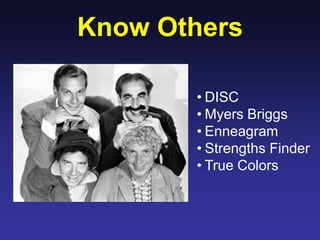
Know Others
• DISC
• Myers Briggs
• Enneagram
• Strengths Finder
• True Colors
Platinum Rule
Treat others the way
they want to be treated
Better Mood
(FYI… Mood Matters)
Happiness Research
“When you are experiencing positive
emotions like joy, contentment, and
love, you will see more possibilities
in your life.
These findings were among the first that
suggested positive emotions broaden
your sense of possibility and open your
mind up to more options.”
The Science of Positive Thinking: How Positive Thoughts Build Your Skills, Boost Your Health, and Improve Your Work
http://www.huffingtonpost.com/james-clear/positive-thinking_b_3512202.html
ASSUMPTION:
You are…
Creative
Resourceful
and Whole
It’s not what
they call you,
it’s what you
answer to.
-W.C. Fields
…one’s own small flame to the
central flames of life and the world.
We cannot predict the exact details of the
future, but we can have a hand in shaping
the heart of the future, including its context of
meaning and our commitment and courage in
advancing into the unknown.
Continually Connect…
- Robert K Cooper, Ayman Sawaf, Executive EQ
How Do you build the capacity,
competency and habit?
Six Factors of Effective Conversations
Concern
Trust
Respect
Appreciation
Affection
Hope
Nicholas Burbules, Dialogue in Teaching. Theory and Practice.
Amygdala Hijack
Image CC BY-SA 3.0 http://commons.wikimedia.org/wiki/File:EQbrain_optical_stim_en.jpg
Kouzes, J.M., & Posner, B.Z. (2007). The leadership challenge (4th ed.). San Francisco: Jossey-Bass.
Souba, W. W. (2014). The Phenomenology of Leadership. Open Journal of Leadership, 3, 77-105.
http://dx.doi.org/10.4236/ojl.2014.34008
Effective Communication
EQ Book Recommendations
The Triangle of Perceptions, Wants, and Actions
Based on The Triangle of Choice, in Leadership Simple by Steve and Jill Morris
THREE SPHERES OF CONTROL
• We can change what we want
• We can change our behavior
• We can change our perception
Actions
Wants Perceptions
The Gap
Actions
Wants Perceptions
The Gap
The Triangle of Perceptions, Wants, and Actions
Based on The Triangle of Choice, in Leadership Simple by Steve and Jill Morris
KEY INSIGHT: The gap
between what we perceive
and what we want creates
energy which can lead to
action.
Better Mood
(FYI… Mood Matters)
The Neurobiology of EQ:
How to Renew and Recharge
Reflection Helping others
Attention Training Exercise
Mindfulness Resonant Relationships
Journaling Prayer
Coaching Petting a pet
“Between stimulus and response
there is a space.
In that space is our power to choose
our response.
In our response lies our growth and
our freedom.”
- Viktor E. Frankl
Four Key Experiences that renew
and build resilience
Mindfulness
Hope
Compassion
Playfulness
The power of followership
Three Stories About Meaning
1. Victim
2. Hero
3. Learning

Influence When You Have No Power or Authority

  • 1.
    Influence http://www.flickr.com/photos/tomas_sobek/4649690892/sizes/l/in/photostream Utah State LibraryWebinar, 2/24/15 Peter Bromberg | peterbromberg.com {When you have no power or authority}
  • 2.
    Being an attemptto answer the question: How to be effective? Or … “Some things I’ve noticed or learned along the way”
  • 3.
    I Believe that… Weall exert influence We can make conscious choices that will improve our influence We can learn to make better choices more consciously and consistently http://www.flickr.com/photos/tomas_sobek/4649690892/sizes/l/in/photostream
  • 4.
    I Believe that… Higheremotional and social Intelligence correlates with our ability to have positive influence in the world and… These competencies can be developed.
  • 5.
    Why Are WeHere Today?
  • 6.
    Why Are WeHere Today?
  • 7.
    Why Are WeHere Today?
  • 8.
  • 9.
    Why Are WeHere Today?
  • 10.
    Why Are YOUHere Today?
  • 11.
    Think about someonewho has influenced you WHO? CHARACTERISTICS?
  • 12.
    Influence v. PositionalAuthority “A piece of spaghetti or a military unit can only be led from the front end.” - General George Patton
  • 13.
  • 14.
    Influence is somethingwe do not something we (i.e. “a LEADER” are or a position we hold. Influence is situational. It’s about the choices we make moment by moment that either move things in the direction of a desired goal or not. If not, we can choose again.
  • 15.
    Warren Bennis says… Leadershipis management of: Attention Self Meaning Trust
  • 16.
    Attention Do you consciously directyour attention and focus it in ways that help you direct energy effectively? Self Are you tuned into, and take responsibility for your needs, wants, behaviors, and emotions? Meaning Do you distinguish between the data you observe and the meaning you create? Trust Are your values, words, and actions congruent? Does your behavior generally inspire the trust of others?
  • 17.
    Emotional and SocialIntelligence Adapted from: A Framework of Emotional Competencies – 2002 - Daniel Goleman
  • 18.
    Emotional and SocialIntelligence Competencies • Emotional Awareness: Recognize one's emotions and their effects. • Accurate Self-assessment: Know one's strengths and limits. • Self-confidence: Have a strong sense of one's self- worth and capabilities. • Self-Control: Keep disruptive emotions and impulses in check. • Trustworthiness: Honesty and integrity. • Conscientiousness: Take responsibility for personal performance. • Adaptability: Flexible in handling change. • Empathy: Sense others' feelings and perspectives; take interest in their concerns. • Service Orientation: Have an honest desire to meet the needs of others. • Org. Awareness: Read a group's emotional currents and power relationships. • Communication: Listen openly. Express clearly. • Conflict Management: Negotiate and resolve disagreements.. • Change Catalyst: Initiate or manage change. • Build bonds: Nurture and foster relationships. • Collaborate and Inspire Adapted from: A Framework of Emotional Competencies – 2002 - Daniel Goleman
  • 19.
    Emotional and SocialIntelligence Competencies • Emotional Awareness: Recognize one's emotions and their effects. • Accurate Self-assessment: Know one's strengths and limits. • Self-confidence: Have a strong sense of one's self- worth and capabilities. • Self-Control: Keep disruptive emotions and impulses in check. • Trustworthiness: Honesty and integrity. • Conscientiousness: Take responsibility for personal performance. • Adaptability: Flexible in handling change. • Empathy: Sense others' feelings and perspectives; take interest in their concerns. • Service Orientation: Have an honest desire to meet the needs of others. • Org. Awareness: Read a group's emotional currents and power relationships. • Communication: Listen openly. Express clearly. • Conflict Management: Negotiate and resolve disagreements.. • Change Catalyst: Initiate or manage change. • Build bonds: Nurture and foster relationships. • Collaborate and Inspire Adapted from: A Framework of Emotional Competencies – 2002 - Daniel Goleman
  • 20.
    The Influence ofEmotional Contagion CC BY 2.0 www.flickr.com/photos/93393982@N00/3822687027 | CC BY-NC-SA 2.0 www.flickr.com/photos/83261600@N00/4944691233 CC BY-NC-SA 2.0 www.flickr.com/photos/9304463@N08/2217777720/
  • 21.
    The Influence ofEmotional Contagion CC BY 2.0 www.flickr.com/photos/93393982@N00/3822687027 | CC BY-NC-SA 2.0 www.flickr.com/photos/83261600@N00/4944691233 CC BY-NC-SA 2.0 www.flickr.com/photos/9304463@N08/2217777720/ “Being able to change your internal state might be one of the most powerful techniques you learn in becoming an effective leader– one who inspires others to learn, adapt and perform at their best.” -Richard Boyatzis, author of Primal Leadership and Becoming a Resonant Leader
  • 22.
    Free Coursera Course: InspiringLeadership through Emotional Intelligence CC BY 2.0 www.flickr.com/photos/93393982@N00/3822687027 | CC BY-NC-SA 2.0 www.flickr.com/photos/83261600@N00/4944691233 CC BY-NC-SA 2.0 www.flickr.com/photos/9304463@N08/2217777720/ https://www.coursera.org/course/lead-ei Led by Richard Boyatzis, Professor, Case Western Reserve author of Primal Leadership and Becoming a Resonant Leader
  • 23.
    It’s Not AboutBeing Nice Image: CC by 2.0 http://www.flickr.com/photos/dirigentens/4592361218/sizes/l/in/photostream
  • 24.
    Courageous Follower 1. Thecourage to assume responsibility 2. The courage to serve 3. The courage to challenge 4. The courage to participate in transformation 5. The courage to take moral action 6. The courage to speak to the hierarchy
  • 25.
    Courageous Followership “Followers don’tserve leaders. Both followers and leaders serve a common purpose, serve a vision. And they do it within a set of shared values.” -Ira Chaleff
  • 26.
    - No formalauthority - Motivate others - Initiate new ideas - Seek others’ opinions - Are passionate and involved (Emergent Leadership concept from Peter Northouse) Emergent Leaders (AKA Influencers) Photo cc license 2.0 courtesy flickr user Ian’s Shutter Habit flickr.com/photos/9289838@N06/3387635009/sizes/z/in/photostream/
  • 27.
    Emergent Leaders “I’ll justkeep going until someone tells me to dial it back.”
  • 28.
    “I’ll just keepgoing until someone tells me to dial it back.” And what will you do if someone tells you to dial it back? “I’ll still keep going” Emergent Leaders
  • 29.
    Connected Influence - MarkGoulston and John Ullment
  • 30.
    “You cannot antagonize andinfluence at the same time.” - J.S. Knox
  • 31.
  • 32.
  • 33.
    Three Traps thatDisconnect 1. Fight or Flight 2. Habit Handicap 3. Error Blindness - Adapted from “Real Influence” by Mark Goulston (CC BY-NC-SA 2.0) http://www.flickr.com/photos/7196003@N02/4128356306/“ Connected Influence
  • 34.
    Error Blindness 1. IgnoranceAssumption 2. Idiocy Assumption 3. Evil Assumption - Adapted from “Real Influence” by Mark Goulston Photo: CC BY-SA 2.0 Flickr: https://www.flickr.com/photos/32281196
  • 35.
    A Few Stepsto Connected Influence Adapted from Goulston and Ullmen CC BY-NC-ND 2.0 http://www.flickr.com/photos/wespeck/4960579336/sizes/l/in/photostream 1. Go for great outcomes (win/win) 2. Be influencable 3. Engage them in “their there”
  • 36.
    When we avoid difficultconversations we trade short term discomfort for long term dysfunction CC by 2.0 http://www.flickr.com/photos/jimwall/5129679770/sizes/z/in/photostream/
  • 37.
  • 38.
  • 39.
    (Adapted from “TheFifth Discipline” by Peter Senge.)
  • 40.
    (Adapted from “TheFifth Discipline” by Peter Senge.)
  • 41.
    Delivering the Message Withoutthe “Load” (Adapted from Fierce Conversations by Susan Scott) Blaming Name-calling Sarcasm Exaggerating Catastrophizing Ridiculing Mocking Threatening Gunnysacking Badmouthing Publicly shaming Diminishing Rolling eyes Facial expressions Ascribing motives Silent treatment Tone of voice Personalizing Nitpicking Denying contribution
  • 42.
    “We often refuseto accept an idea merely because the tone of voice in which it has been expressed is unsympathetic to us.” - Friedrich Nietzsche image: hchrisschmied.com/wp-content/uploads/2012/05/wont-listen.jpg The Importance of Emotion
  • 43.
    image: hchrisschmied.com/wp-content/uploads/2012/05/wont-listen.jpg “The peoplewho had received positive feedback accompanied by negative emotional signals reported feeling worse about their performance than did the participants who had received good-natured negative feedback. In effect, the delivery was more important than the message itself.” - Daniel Goleman & Richard Boyatzis, “Social Intelligence and the Biology of Leadership” The Importance of Emotion
  • 44.
    Axe photo: CCBY-NC-ND 2.0 www.flickr.com/photos/shaggyhill/5599951059/ Soup photo: CC BY-NC-ND 2.0 www.flickr.com/photos/21130538@N04/2448845969/ What do an axe and a bowl of soup have to do with each other?
  • 45.
    Axe photo: CCBY-NC-ND 2.0 www.flickr.com/photos/shaggyhill/5599951059/ Soup photo: CC BY-NC-ND 2.0 www.flickr.com/photos/21130538@N04/2448845969/ Research from Jonathan Haidt, author of The Righteous Mind: Why Good People are Divided by Politics and Religion suggests that… Relationship Trumps Reason
  • 46.
    Trust is theconduit for influence. It’s the medium through which ideas travel. If they don’t trust you, your ideas are just dead in the water. Having the best idea is worth nothing if people don’t trust you." - Amy Cuddy CC BY-SA 2.0 https://www.flickr.com/photos/42275232@N00/43253572/
  • 47.
  • 48.
    Coaching  Awarenessand Action Assess what is, then ask… 1.What do you want? 2. What have you tried? 3. What was the result? 4. What else can you do? 5. What WILL you do? Modified from Steve and Jill Morris’ Leadership Simple
  • 49.
    Coaching  Awarnessand Action 1. What do you want? 2. What have you tried? 3. What was the result? 4. What else can you do? 5. What WILL you do? Modified from Steve and Jill Morris’ Leadership Simple Accountability
  • 50.
    Provocative Questions • Whatresult do I want? • Where is my attention focused? • What else could this mean? • What resources are available? • What’s stopping me? • What assumptions am I making? • What have I tried? • What actions can I take? • What action WILL I commit to? • Did that move me in the right direction?
  • 51.
    Where ourattention goes,our energy goes Where our energy goes, action follows Where actions are taken, results follow
  • 52.
    It all startswith Attention
  • 53.
    “Repeated studies havedemonstrated that meditation can rewire how the brain responds to stress. Boston University researchers showed that after as little as three and a half hours of meditation training, subjects tend to react less to emotionally charged images. “Other research suggests that meditation improves working memory and executive function. And several studies of long-term practitioners show an increased ability to concentrate on fast-changing stimuli..” -Wired Magazine -http://www.wired.com/business/2013/06/meditation-mindfulness-silicon-valley/
  • 54.
    Participating in an8-week mindfulness meditation program appears to make measurable changes in brain regions associated with memory, sense of self, empathy and stress. "It is fascinating to see the brain's plasticity and that, by practicing meditation, we can play an active role in changing the brain and can increase our well-being and quality of life." says Britta Hölzel, PhD. - Science News Daily -http://www.sciencedaily.com/releases/2011/01/110121144007.htm
  • 56.
    It’s not justGoogle…
  • 57.
    “Choosing to acton ‘what matters’ is the choice to live a passionate existence… Acting on what matters is a stance whereby we declare we are accountable for the world around us and are willing to pursue what we define as important. - Peter Block
  • 58.
    “My job isto awaken possibility in other people” -Benjamin Zander, Conductor of the Boston Philharmonic Author of The Art of Possibility http://www.flickr.com/photos/radiorover/2787677403/
  • 59.
  • 60.
  • 61.
    Connected Influence Cc by2.0 http://Stockmonkeys.com
  • 62.
    What assumptions are youmaking that no longer serve you?
  • 63.
    Know Thyself Personality Styles CourtesyFlickr user mayhem (CC BY-NC-SA 2.0) http://www.flickr.com/photos/81126501@N00/3975910516 •DISC •Myers Briggs •Enneagram •Strengths Finder •True Colors
  • 64.
    Know Others • DISC •Myers Briggs • Enneagram • Strengths Finder • True Colors
  • 65.
    Platinum Rule Treat othersthe way they want to be treated
  • 66.
  • 67.
    Happiness Research “When youare experiencing positive emotions like joy, contentment, and love, you will see more possibilities in your life. These findings were among the first that suggested positive emotions broaden your sense of possibility and open your mind up to more options.” The Science of Positive Thinking: How Positive Thoughts Build Your Skills, Boost Your Health, and Improve Your Work http://www.huffingtonpost.com/james-clear/positive-thinking_b_3512202.html
  • 68.
  • 69.
    It’s not what theycall you, it’s what you answer to. -W.C. Fields
  • 70.
    …one’s own smallflame to the central flames of life and the world. We cannot predict the exact details of the future, but we can have a hand in shaping the heart of the future, including its context of meaning and our commitment and courage in advancing into the unknown. Continually Connect… - Robert K Cooper, Ayman Sawaf, Executive EQ
  • 71.
    How Do youbuild the capacity, competency and habit?
  • 72.
    Six Factors ofEffective Conversations Concern Trust Respect Appreciation Affection Hope Nicholas Burbules, Dialogue in Teaching. Theory and Practice.
  • 73.
    Amygdala Hijack Image CCBY-SA 3.0 http://commons.wikimedia.org/wiki/File:EQbrain_optical_stim_en.jpg
  • 74.
    Kouzes, J.M., &Posner, B.Z. (2007). The leadership challenge (4th ed.). San Francisco: Jossey-Bass. Souba, W. W. (2014). The Phenomenology of Leadership. Open Journal of Leadership, 3, 77-105. http://dx.doi.org/10.4236/ojl.2014.34008 Effective Communication
  • 75.
  • 76.
    The Triangle ofPerceptions, Wants, and Actions Based on The Triangle of Choice, in Leadership Simple by Steve and Jill Morris THREE SPHERES OF CONTROL • We can change what we want • We can change our behavior • We can change our perception Actions Wants Perceptions The Gap
  • 77.
    Actions Wants Perceptions The Gap TheTriangle of Perceptions, Wants, and Actions Based on The Triangle of Choice, in Leadership Simple by Steve and Jill Morris KEY INSIGHT: The gap between what we perceive and what we want creates energy which can lead to action.
  • 78.
  • 79.
    The Neurobiology ofEQ: How to Renew and Recharge Reflection Helping others Attention Training Exercise Mindfulness Resonant Relationships Journaling Prayer Coaching Petting a pet
  • 81.
    “Between stimulus andresponse there is a space. In that space is our power to choose our response. In our response lies our growth and our freedom.” - Viktor E. Frankl
  • 82.
    Four Key Experiencesthat renew and build resilience Mindfulness Hope Compassion Playfulness
  • 83.
    The power offollowership
  • 84.
    Three Stories AboutMeaning 1. Victim 2. Hero 3. Learning