Influence without Authority:
Establishing and Transforming Power
Andrea Ames @aames http://about.me/AndreaLAmes
IBM Senior Technical Staff member
Information Experience Strategist
LavaCon Unified Content Strategy Workshop
24 April 2013
Agenda
 Exercise
 Influence
 Establishing power: Creating an
environment of influence
 Using power
 Exercise debrief
About Andrea
 Technical communicator since 1983
 Areas of expertise
 Information experience design: Content strategy,
information architecture, and interaction design for
content display and delivery, within products and
interactive information delivery systems
 Architecture, design, and development of embedded assistance (content within
or near the product user interface)
 Information and product usability, from analysis through validation
 User-centered process for information development and
information experience design
 IBM Senior Technical Staff Member on corporate Total Information
Experience team in IBM CIO’s office
 University of CA Extension certificate coordinator and instructor
 STC Fellow, past president (2004-05), former member of
Board of Directors (1998-2006), and Intercom columnist (with Alyson Riley)
of The Strategic IA
 ACM Distinguished Engineer
3
Influence
Why influence?
 If you can:
 Design two UI panels
 Write three pages
 Create five icons
 Drive 10 marketing campaigns
 Track 45 project work items
 Write 90 lines of code
in a day, how many are accomplished when three people are driving,
tracking, writing, designing, creating? 50? 500? 5,000?
 Are you expert at every aspect of technical communication, marketing,
support, strategy, project management, and your product function? If so, do
you have the bandwidth to be a one-person show?
 Most complex situations require multiple judgments, skills, and experiences
And most importantly…
Have you ever had a great, innovative idea—like the need for a unified content
strategy??—and wanted it implemented in your organization?
5
From Wikipedia, influence is…
 When the actions or thoughts of individuals are changed
by another individual
 Amount of influence you exert often determined by your
confidence/self-esteem and perceived persona
 Ability to influence also affected by your perceived
expertise, or credibility—others’ trust of you and your
knowledge or skill
 Sometimes seen as persuasion, guiding people toward
the adoption of an idea, attitude, or action by rational and
symbolic (though not always logical) means; a problem-
solving strategy relying on "appeals" rather than strength
6
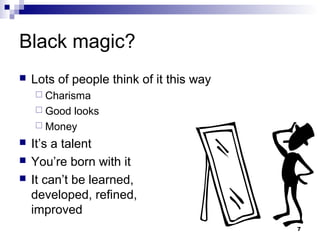
Black magic?
 Lots of people think of it this way
 Charisma
 Good looks
 Money
 It’s a talent
 You’re born with it
 It can’t be learned,
developed, refined,
improved
7
How I like to think of it
 It’s something you
acquire via your actions
and attitude
 Managing yourself and
your attitude
 Leadership—the ability to
(from Tom Peters)
 Inspire
 Liberate
 Achieve
 Gaining respect and trust
 Leading in every direction
 Setting and
communicating a clear
vision with enthusiasm
 Inspiring enthusiasm
in others
 Getting things done
through others that you
could not achieve alone
 It’s not black magic
8
What does this mean for us, as
individual leaders?
“With great power comes great responsibility”
 Understanding why people follow others means using
that understanding responsibly
 There is a hard way and an easy way—and they will
seem counterintuitive
 Harder: Causing others to change their minds
 Easier: Creating an environment of influence
 Others trust you
 They recognize value in your ideas
 The buy into and sponsor your ideas
 They execute those ideas 9
Causing others to change
 Why is this hard?
 It’s outward-focused
 You can’t change others
 Focusing on your sphere of influence vs.
your sphere of control (which will affect
your sphere of influence)
10
Creating an environment of
influence
 Become a leader
 Lead/manage yourself, first
 Focus on your sphere of control (you)
 That will positively impact your
sphere of influence (our
relationships with others)
 Our biggest hurdle is us
11
Establishing power: Creating
an environment of influence
What do the experts say?
 John Maxwell
 James Kouzes and Barry Posner
 Joel Garfinkle
5 Levels
of Leadership
John Maxwell,
Developing the
Leader within You
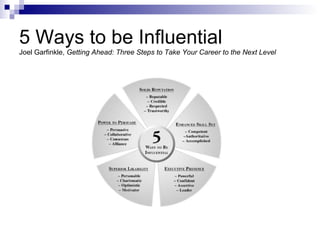
5 Ways to be Influential
Joel Garfinkle, Getting Ahead: Three Steps to Take Your Career to the Next Level
5 Practices of Exemplary Leadership
James Kouzes and Barry Posner, The Leadership Challenge
 Model the way—go first, set the example
 Inspire a shared vision—enlist others in the
vision, know constituents and speak their
language
 Challenge the process—innovate, grow,
improve, experiment, take risks
 Enable others to act—foster collaboration and
build trust
 Encourage the heart—recognize contributions,
celebrate values and victories
Key themes
 Credibility
 Trust
 Exemplar
 Enable others
 Inspire others
Self
Relationships
Where do you start?
 Goleman’s emotional intelligence
and (in backup)
 Covey’s 7 habits
 Maxwell’s approach to attitude
& 360-degree leadership
18
What is “emotional intelligence?”
“The capacity for
recognizing our own feelings
and those of others,
for motivating ourselves,
for managing emotions well
in ourselves and
in our relationships.”
-- Daniel Goleman
19
Emotional intelligence domains
Source: Primal Leadership, by Daniel Goleman, Harvard Business School Press, 2002. (my numbers/arrows
)
Self Others
Self-
Awareness
Knowing what we feel at
the moment and using that
to guide our decision-
making
Self
Management
Handling our emotions
so that they enhance
rather than interfere with
performance
Social
Awareness
Sensing what people are
feeling, understanding the
perspectives of others, and
cultivating rapport
Relationship
Management
Handling emotions in relationships
well, being able to read social
situations accurately, and using
these skills to persuade, lead,
and negotiate
Actions
Awareness
20
1
2
3
3
Emotional Intelligence Skills
Assessment (EISA)
authors: Steven J. Stein, Derek Mann, Peter Papadogiannis, and Wendy Gordon
 Perceiving—the ability to accurately recognize,
attend to, and understand emotion
 Managing—the ability to effectively manage,
control, and express emotions
 Decision making—the application of emotion to
manage change and solve problems
 Achieving—the ability to generate th enecessary
emotions to self-motivate in the pursuit of
realistic and meaningful objectives
 Influencing—the ability to recognize, manage,
and evoke emotion within oneself and others to
promote change
Work from the body, as well
as the mind
Amy Cuddy, Your Body Language Shapes Who You Are TED Talk
http://www.ted.com/talks/amy_cuddy_your_body_language_shapes_who_you_are.html
Fake it ’til you ARE it
1. Stand up
2. Raise your arms in a victory stance
3. You ARE powerful
Cesar Millan, Cesar’s Rules
Own the space
Using power
Once you have power…
 How do you use it?
 Only for good, not evil. 
Influence Model: Reciprocity
Allan Cohen and DavidBradford, Influence without Authority
 Think in terms of currencies
Inspiration-related
Task-related
Position-
related
Personal
Contextual forces shape behavior
Allan Cohen and DavidBradford, Influence without Authority
Power style—how we use our
power
Jay Hall and James Hawker, Power Management Inventory
 Discussion 1: .5 / .5 (share)
 Discussion 2: 0 / 1 (give it up)
 Discussion 3: 1 / 0 (keep it)
 Power spectrum
Power motivation—why we use our
power, part 1
Jay Hall and James Hawker, Power Management Inventory
 Personalized: achievement of personal
gain
 Socialized: need to influence others’
behavior for the common good
 Affiliative: need to be liked by others
Power motivation—why we use our
power, part 2
Jay Hall and James Hawker, Power Management Inventory
 Effective use of power within the org is
necessary
 Strong power motivation is essential to
good leaders (managers)
 Socialized power leads to more successful
leadership (management) than
personalized power
Interpreting PMI
Jay Hall and James Hawker, Power Management Inventory
 Both Socialized and Personalized should be higher than
Affiliative—ideally 25% higher
 If Affiliative is higher than both Socialized and
Personalized, indicates aversion to power
 For maximum leadership (managerial success), score
should reflect greater preference for Socialized power
 If Personalized Motive is dominant, you might be doing a
creditable job, but not without difficulties
 If Personalized is higher, stay alert to signs of potential
abuse of power
 Goal: Power motivation and power style consistency,
which indicates consistent intention vs. effect
Questions?
31
Backup
Start with…Covey and Maxwell
Emotional Intelligence details
Components of emotional intelligence
Definition Hallmarks
Self-Awareness • The ability to recognize and understand
your moods, emotions, and drives, as
well as their effect on others
• Self-confidence
• Realistic self-assessment
• Self-deprecating sense of humor
Self-Regulation
(Self management)
• The ability to control or redirect
disruptive impulses and moods
• The propensity of suspend judgment—
to think before acting
• Trustworthiness and integrity
• Comfort with ambiguity
• Openness to change
Motivation
(Self management)
• A passion to work for reasons that go
beyond money or status
• A propensity to pursue goals with
energy and persistence
• Strong drive to achieve
• Optimism, even in the face of failure
• Organizational commitment
Source: “What Makes a Leader?” Daniel Goleman, Harvard Business Review, Nov-Dec 1998.
33
Components of emotional intelligence (cont.)
Definition Hallmarks
Empathy
(Social awareness)
• The ability to understand the emotional
makeup of other people
• Skill in treating people according to their
emotional reactions
• Expertise in building and retaining talent
• Cross-cultural sensitivity
• Service to clients and customers
Social Skill
(Social awareness)
• Proficiency in managing relationships
and building networks
• An ability to find common ground and
build rapport
• Effectiveness in leading change
• Persuasiveness
• Expertise in building and leading teams
Source: “What Makes a Leader?” Daniel Goleman, Harvard Business Review, Nov-Dec 1998.
34
Components of emotional intelligence (cont.)
Definition Hallmarks
Influence
(Relationship management)
• Finding the right appeal for a given listener
• Knowing how to build buy-in from key
sponsors
• Building a network of support for an initiative
• Very persuasive
• Engaging when addressing a
group
Developing Others
(Relationship management)
• Understanding goals, strengths and
weaknesses
• Providing timely and constructive feedback
• Show genuine interest in others
• Natural mentor or coach
Source: Primal Leadership, by Daniel Goleman, Harvard Business School Press, 2002.
35
The seven habits
Dependence  Independence  Interdependence
 Private victory:
1. Be proactive
2. Begin with the end in mind
3. Put first things first
 Public victory:
4. Think win/win
5. Seek first to understand…
then to be understood
6. Synergize
7. Sharpen the saw
36
Source: The 7 Habits of Highly Effective People, by Stephen Covey, Simon & Schuster, Inc., 1989.
Attitude is everything
 Our attitude determines our approach to life
 Our attitude determines our relationships
with people
 Often our attitude is the only difference between
success and failure
 Our attitude at the beginning of a task will affect its
outcome more than anything else
 Our attitude can turn our problems into opportunities
 Our attitude can give us an
uncommonly positive perspective
37
Source: Attitude 101, by John Maxwell, Thomas Nelson, 2003.
Lead in every direction
 Key lead-up principles
 Lead yourself exceptionally well
 Lighten your leader’s load
 Invest in relational chemistry
 Become a go-to player
 Be better tomorrow than you are today
 Key lead-across principles
 Understand, practice, and complete the leadership loop
 Put completing fellow leaders ahead of competing with them
 Expand your circle of acquaintances (network)
 Let the best idea win
 Key lead-down principles
 See everyone as a “10” (give them an “A”)
 Develop each team member as a person
 Model the behavior you desire
38
Source: The 360° Leader, by John Maxwell, Thomas Nelson, 2003.

Influence without Authority: Establishing and Transforming Power

  • 1.
    Influence without Authority: Establishingand Transforming Power Andrea Ames @aames http://about.me/AndreaLAmes IBM Senior Technical Staff member Information Experience Strategist LavaCon Unified Content Strategy Workshop 24 April 2013
  • 2.
    Agenda  Exercise  Influence Establishing power: Creating an environment of influence  Using power  Exercise debrief
  • 3.
    About Andrea  Technicalcommunicator since 1983  Areas of expertise  Information experience design: Content strategy, information architecture, and interaction design for content display and delivery, within products and interactive information delivery systems  Architecture, design, and development of embedded assistance (content within or near the product user interface)  Information and product usability, from analysis through validation  User-centered process for information development and information experience design  IBM Senior Technical Staff Member on corporate Total Information Experience team in IBM CIO’s office  University of CA Extension certificate coordinator and instructor  STC Fellow, past president (2004-05), former member of Board of Directors (1998-2006), and Intercom columnist (with Alyson Riley) of The Strategic IA  ACM Distinguished Engineer 3
  • 4.
  • 5.
    Why influence?  Ifyou can:  Design two UI panels  Write three pages  Create five icons  Drive 10 marketing campaigns  Track 45 project work items  Write 90 lines of code in a day, how many are accomplished when three people are driving, tracking, writing, designing, creating? 50? 500? 5,000?  Are you expert at every aspect of technical communication, marketing, support, strategy, project management, and your product function? If so, do you have the bandwidth to be a one-person show?  Most complex situations require multiple judgments, skills, and experiences And most importantly… Have you ever had a great, innovative idea—like the need for a unified content strategy??—and wanted it implemented in your organization? 5
  • 6.
    From Wikipedia, influenceis…  When the actions or thoughts of individuals are changed by another individual  Amount of influence you exert often determined by your confidence/self-esteem and perceived persona  Ability to influence also affected by your perceived expertise, or credibility—others’ trust of you and your knowledge or skill  Sometimes seen as persuasion, guiding people toward the adoption of an idea, attitude, or action by rational and symbolic (though not always logical) means; a problem- solving strategy relying on "appeals" rather than strength 6
  • 7.
    Black magic?  Lotsof people think of it this way  Charisma  Good looks  Money  It’s a talent  You’re born with it  It can’t be learned, developed, refined, improved 7
  • 8.
    How I liketo think of it  It’s something you acquire via your actions and attitude  Managing yourself and your attitude  Leadership—the ability to (from Tom Peters)  Inspire  Liberate  Achieve  Gaining respect and trust  Leading in every direction  Setting and communicating a clear vision with enthusiasm  Inspiring enthusiasm in others  Getting things done through others that you could not achieve alone  It’s not black magic 8
  • 9.
    What does thismean for us, as individual leaders? “With great power comes great responsibility”  Understanding why people follow others means using that understanding responsibly  There is a hard way and an easy way—and they will seem counterintuitive  Harder: Causing others to change their minds  Easier: Creating an environment of influence  Others trust you  They recognize value in your ideas  The buy into and sponsor your ideas  They execute those ideas 9
  • 10.
    Causing others tochange  Why is this hard?  It’s outward-focused  You can’t change others  Focusing on your sphere of influence vs. your sphere of control (which will affect your sphere of influence) 10
  • 11.
    Creating an environmentof influence  Become a leader  Lead/manage yourself, first  Focus on your sphere of control (you)  That will positively impact your sphere of influence (our relationships with others)  Our biggest hurdle is us 11
  • 12.
    Establishing power: Creating anenvironment of influence
  • 13.
    What do theexperts say?  John Maxwell  James Kouzes and Barry Posner  Joel Garfinkle
  • 14.
    5 Levels of Leadership JohnMaxwell, Developing the Leader within You
  • 15.
    5 Ways tobe Influential Joel Garfinkle, Getting Ahead: Three Steps to Take Your Career to the Next Level
  • 16.
    5 Practices ofExemplary Leadership James Kouzes and Barry Posner, The Leadership Challenge  Model the way—go first, set the example  Inspire a shared vision—enlist others in the vision, know constituents and speak their language  Challenge the process—innovate, grow, improve, experiment, take risks  Enable others to act—foster collaboration and build trust  Encourage the heart—recognize contributions, celebrate values and victories
  • 17.
    Key themes  Credibility Trust  Exemplar  Enable others  Inspire others Self Relationships
  • 18.
    Where do youstart?  Goleman’s emotional intelligence and (in backup)  Covey’s 7 habits  Maxwell’s approach to attitude & 360-degree leadership 18
  • 19.
    What is “emotionalintelligence?” “The capacity for recognizing our own feelings and those of others, for motivating ourselves, for managing emotions well in ourselves and in our relationships.” -- Daniel Goleman 19
  • 20.
    Emotional intelligence domains Source:Primal Leadership, by Daniel Goleman, Harvard Business School Press, 2002. (my numbers/arrows ) Self Others Self- Awareness Knowing what we feel at the moment and using that to guide our decision- making Self Management Handling our emotions so that they enhance rather than interfere with performance Social Awareness Sensing what people are feeling, understanding the perspectives of others, and cultivating rapport Relationship Management Handling emotions in relationships well, being able to read social situations accurately, and using these skills to persuade, lead, and negotiate Actions Awareness 20 1 2 3 3
  • 21.
    Emotional Intelligence Skills Assessment(EISA) authors: Steven J. Stein, Derek Mann, Peter Papadogiannis, and Wendy Gordon  Perceiving—the ability to accurately recognize, attend to, and understand emotion  Managing—the ability to effectively manage, control, and express emotions  Decision making—the application of emotion to manage change and solve problems  Achieving—the ability to generate th enecessary emotions to self-motivate in the pursuit of realistic and meaningful objectives  Influencing—the ability to recognize, manage, and evoke emotion within oneself and others to promote change
  • 22.
    Work from thebody, as well as the mind Amy Cuddy, Your Body Language Shapes Who You Are TED Talk http://www.ted.com/talks/amy_cuddy_your_body_language_shapes_who_you_are.html Fake it ’til you ARE it 1. Stand up 2. Raise your arms in a victory stance 3. You ARE powerful Cesar Millan, Cesar’s Rules Own the space
  • 23.
  • 24.
    Once you havepower…  How do you use it?  Only for good, not evil. 
  • 25.
    Influence Model: Reciprocity AllanCohen and DavidBradford, Influence without Authority  Think in terms of currencies Inspiration-related Task-related Position- related Personal
  • 26.
    Contextual forces shapebehavior Allan Cohen and DavidBradford, Influence without Authority
  • 27.
    Power style—how weuse our power Jay Hall and James Hawker, Power Management Inventory  Discussion 1: .5 / .5 (share)  Discussion 2: 0 / 1 (give it up)  Discussion 3: 1 / 0 (keep it)  Power spectrum
  • 28.
    Power motivation—why weuse our power, part 1 Jay Hall and James Hawker, Power Management Inventory  Personalized: achievement of personal gain  Socialized: need to influence others’ behavior for the common good  Affiliative: need to be liked by others
  • 29.
    Power motivation—why weuse our power, part 2 Jay Hall and James Hawker, Power Management Inventory  Effective use of power within the org is necessary  Strong power motivation is essential to good leaders (managers)  Socialized power leads to more successful leadership (management) than personalized power
  • 30.
    Interpreting PMI Jay Halland James Hawker, Power Management Inventory  Both Socialized and Personalized should be higher than Affiliative—ideally 25% higher  If Affiliative is higher than both Socialized and Personalized, indicates aversion to power  For maximum leadership (managerial success), score should reflect greater preference for Socialized power  If Personalized Motive is dominant, you might be doing a creditable job, but not without difficulties  If Personalized is higher, stay alert to signs of potential abuse of power  Goal: Power motivation and power style consistency, which indicates consistent intention vs. effect
  • 31.
  • 32.
    Backup Start with…Covey andMaxwell Emotional Intelligence details
  • 33.
    Components of emotionalintelligence Definition Hallmarks Self-Awareness • The ability to recognize and understand your moods, emotions, and drives, as well as their effect on others • Self-confidence • Realistic self-assessment • Self-deprecating sense of humor Self-Regulation (Self management) • The ability to control or redirect disruptive impulses and moods • The propensity of suspend judgment— to think before acting • Trustworthiness and integrity • Comfort with ambiguity • Openness to change Motivation (Self management) • A passion to work for reasons that go beyond money or status • A propensity to pursue goals with energy and persistence • Strong drive to achieve • Optimism, even in the face of failure • Organizational commitment Source: “What Makes a Leader?” Daniel Goleman, Harvard Business Review, Nov-Dec 1998. 33
  • 34.
    Components of emotionalintelligence (cont.) Definition Hallmarks Empathy (Social awareness) • The ability to understand the emotional makeup of other people • Skill in treating people according to their emotional reactions • Expertise in building and retaining talent • Cross-cultural sensitivity • Service to clients and customers Social Skill (Social awareness) • Proficiency in managing relationships and building networks • An ability to find common ground and build rapport • Effectiveness in leading change • Persuasiveness • Expertise in building and leading teams Source: “What Makes a Leader?” Daniel Goleman, Harvard Business Review, Nov-Dec 1998. 34
  • 35.
    Components of emotionalintelligence (cont.) Definition Hallmarks Influence (Relationship management) • Finding the right appeal for a given listener • Knowing how to build buy-in from key sponsors • Building a network of support for an initiative • Very persuasive • Engaging when addressing a group Developing Others (Relationship management) • Understanding goals, strengths and weaknesses • Providing timely and constructive feedback • Show genuine interest in others • Natural mentor or coach Source: Primal Leadership, by Daniel Goleman, Harvard Business School Press, 2002. 35
  • 36.
    The seven habits Dependence Independence  Interdependence  Private victory: 1. Be proactive 2. Begin with the end in mind 3. Put first things first  Public victory: 4. Think win/win 5. Seek first to understand… then to be understood 6. Synergize 7. Sharpen the saw 36 Source: The 7 Habits of Highly Effective People, by Stephen Covey, Simon & Schuster, Inc., 1989.
  • 37.
    Attitude is everything Our attitude determines our approach to life  Our attitude determines our relationships with people  Often our attitude is the only difference between success and failure  Our attitude at the beginning of a task will affect its outcome more than anything else  Our attitude can turn our problems into opportunities  Our attitude can give us an uncommonly positive perspective 37 Source: Attitude 101, by John Maxwell, Thomas Nelson, 2003.
  • 38.
    Lead in everydirection  Key lead-up principles  Lead yourself exceptionally well  Lighten your leader’s load  Invest in relational chemistry  Become a go-to player  Be better tomorrow than you are today  Key lead-across principles  Understand, practice, and complete the leadership loop  Put completing fellow leaders ahead of competing with them  Expand your circle of acquaintances (network)  Let the best idea win  Key lead-down principles  See everyone as a “10” (give them an “A”)  Develop each team member as a person  Model the behavior you desire 38 Source: The 360° Leader, by John Maxwell, Thomas Nelson, 2003.