Copyright ©2009
South-Western, a division
of Cengage Learning
All rights reserved
Political Behavior in OrganizationsPolitical Behavior in Organizations
Organizational Politics -Organizational Politics - the use of
power and influence in organizations
Political Behavior -Political Behavior - actions not
officially sanctioned by an organization
that are taken to influence others in
order to meet one’s personal goals
Copyright ©2009
South-Western, a division
of Cengage Learning
All rights reserved
Conditions EncouragingConditions Encouraging
Political ActivityPolitical Activity
• Unclear goals
• Autocratic decision
making
• Ambiguous lines of
authority
• Scarce resources
• Uncertainty
Photos courtesy of Clips Online ©2008 Microsoft Corporation
Copyright ©2009
South-Western, a division
of Cengage Learning
All rights reserved
Effective Political CharacteristicsEffective Political Characteristics
What characteristics
do effective political
actors possess?
Photos courtesy of Clips Online ©2008 Microsoft Corporation
Copyright ©2009
South-Western, a division
of Cengage Learning
All rights reserved
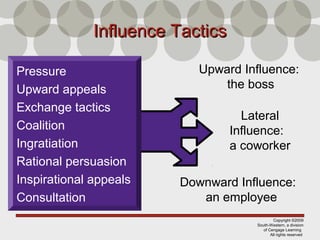
Influence TacticsInfluence Tactics
Upward Influence:
the boss
Downward Influence:
an employee
Lateral
Influence:
a coworker
Pressure
Upward appeals
Exchange tactics
Coalition
Ingratiation
Rational persuasion
Inspirational appeals
Consultation
Copyright ©2009
South-Western, a division
of Cengage Learning
All rights reserved
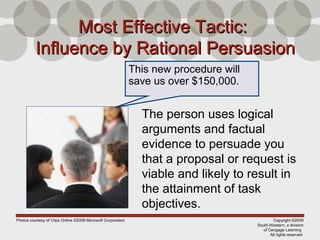
Most Effective Tactic:Most Effective Tactic:
Influence by Rational PersuasionInfluence by Rational Persuasion
The person uses logical
arguments and factual
evidence to persuade you
that a proposal or request is
viable and likely to result in
the attainment of task
objectives.
This new procedure will
save us over $150,000.
Photos courtesy of Clips Online ©2008 Microsoft Corporation
Copyright ©2009
South-Western, a division
of Cengage Learning
All rights reserved
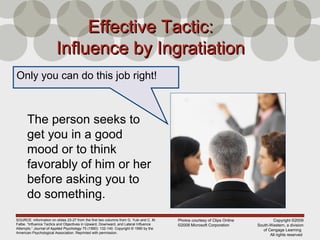
Effective Tactic:Effective Tactic:
Influence by IngratiationInfluence by Ingratiation
The person seeks to
get you in a good
mood or to think
favorably of him or her
before asking you to
do something.
SOURCE: Information on slides 23-27 from the first two columns from G. Yuki and C. M.
Falbe. “Influence Tactics and Objectives in Upward, Downward, and Lateral Influence
Attempts.” Journal of Applied Psychology 75 (1990): 132-140. Copyright © 1990 by the
American Psychological Association. Reprinted with permission.
Only you can do this job right!
Photos courtesy of Clips Online
©2008 Microsoft Corporation
Copyright ©2009
South-Western, a division
of Cengage Learning
All rights reserved
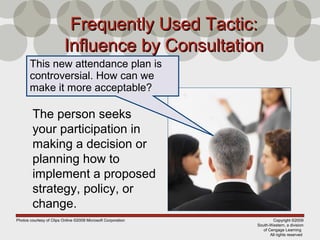
Frequently Used Tactic:Frequently Used Tactic:
Influence by ConsultationInfluence by Consultation
The person seeks
your participation in
making a decision or
planning how to
implement a proposed
strategy, policy, or
change.
This new attendance plan is
controversial. How can we
make it more acceptable?
Photos courtesy of Clips Online ©2008 Microsoft Corporation
Copyright ©2009
South-Western, a division
of Cengage Learning
All rights reserved
Frequently Used Tactic:Frequently Used Tactic:
Influence by Inspirational AppealsInfluence by Inspirational Appeals
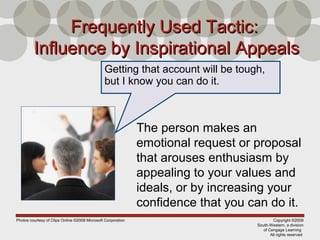
The person makes an
emotional request or proposal
that arouses enthusiasm by
appealing to your values and
ideals, or by increasing your
confidence that you can do it.
Getting that account will be tough,
but I know you can do it.
Photos courtesy of Clips Online ©2008 Microsoft Corporation
Copyright ©2009
South-Western, a division
of Cengage Learning
All rights reserved
Political SkillPolitical Skill
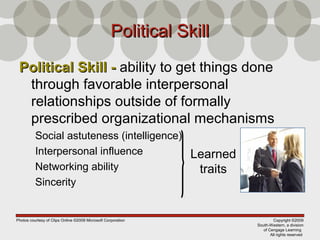
Political Skill -Political Skill - ability to get things done
through favorable interpersonal
relationships outside of formally
prescribed organizational mechanisms
Social astuteness (intelligence)
Interpersonal influence
Networking ability
Sincerity
Learned
traits
Photos courtesy of Clips Online ©2008 Microsoft Corporation
Copyright ©2009
South-Western, a division
of Cengage Learning
All rights reserved
Managing Political BehaviorManaging Political Behavior
• Maintain open communication
• Clarify performance expectations
• Use participative management
• Encourage cooperation among work
groups
• Manage scarce resources well
• Provide a supportive organizational
climate
Copyright ©2009
South-Western, a division
of Cengage Learning
All rights reserved
Managing Up: The BossManaging Up: The Boss
Understand Your Boss
and Her/his Context
 Her/his goals and
objectives
 The pressures on her
 Her strengths,
weaknesses, blind
spots
 Her preferred work
style
Assess Yourself
and Your Needs
 Your own strengths
and weaknesses
 Your personal style
 Your predisposition
toward dependence on
authority figures
Copyright ©2009
South-Western, a division
of Cengage Learning
All rights reserved
Managing Up: The BossManaging Up: The Boss
SOURCE: Information on slides 29-30 adapted and reprinted by permission of Harvard
Business Review. From “Managing Your Boss,” by J. J. Gabarro and J. P. Kotter, (May-
June 1993): p. 155. Copyright© 1993 by the Harvard Business School Publishing
Corporation; all rights reserved.
Develop and Maintain a Relationship that
• Fits both your needs and styles
• Is characterized by mutual expectations
• Keeps your boss informed
• Is based on dependability and honesty
• Selectively uses your boss’s time and resources
Copyright ©2009
South-Western, a division
of Cengage Learning
All rights reserved
Sharing Power: EmpowermentSharing Power: Empowerment
EmpowermentEmpowerment --
sharing power in such a
way that individuals learn
to believe in their ability
to do the job!
Copyright ©2009
South-Western, a division
of Cengage Learning
All rights reserved
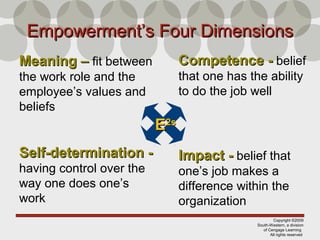
Empowerment’s Four DimensionsEmpowerment’s Four Dimensions
Meaning –Meaning – fit between
the work role and the
employee’s values and
beliefs
Self-determination -Self-determination -
having control over the
way one does one’s
work
Impact -Impact - belief that
one’s job makes a
difference within the
organization
Competence -Competence - belief
that one has the ability
to do the job well
EE2s2s
Copyright ©2009
South-Western, a division
of Cengage Learning
All rights reserved
Guidelines for EmpoweringGuidelines for Empowering
• Express confidence in employees
• Set high performance expectations
• Create opportunities for participative
decision making
• Remove bureaucratic constraints that
stifle autonomy
• Set inspirational and meaningful goals
Copyright ©2009
South-Western, a division
of Cengage Learning
All rights reserved
Sydney Finkelstein (Dartmouth University):Sydney Finkelstein (Dartmouth University):
Why Executives FailWhy Executives Fail
• See themselves and their companies as
dominant, without peers
• Think they have all the answers
• Eliminate those not 100% behind them
• Rely on what worked for them in the past
• No clear boundaries between personal
interests and corporate interests
Copyright ©2009
South-Western, a division
of Cengage Learning
All rights reserved
Kotter:Using Power EffectivelyKotter:Using Power Effectively
• Use power in ethical ways(utilitarian outcomes,
individual rights, distributive justice)
• Understand and use all of the various types of
power and influence
• Seek out jobs that allow you to develop your
power skills
• Use power tempered by maturity and self-control
• Accept that influencing people is an important
part of the management job

Class 14 power n politics 2

  • 1.
    Copyright ©2009 South-Western, adivision of Cengage Learning All rights reserved Political Behavior in OrganizationsPolitical Behavior in Organizations Organizational Politics -Organizational Politics - the use of power and influence in organizations Political Behavior -Political Behavior - actions not officially sanctioned by an organization that are taken to influence others in order to meet one’s personal goals
  • 2.
    Copyright ©2009 South-Western, adivision of Cengage Learning All rights reserved Conditions EncouragingConditions Encouraging Political ActivityPolitical Activity • Unclear goals • Autocratic decision making • Ambiguous lines of authority • Scarce resources • Uncertainty Photos courtesy of Clips Online ©2008 Microsoft Corporation
  • 3.
    Copyright ©2009 South-Western, adivision of Cengage Learning All rights reserved Effective Political CharacteristicsEffective Political Characteristics What characteristics do effective political actors possess? Photos courtesy of Clips Online ©2008 Microsoft Corporation
  • 4.
    Copyright ©2009 South-Western, adivision of Cengage Learning All rights reserved Influence TacticsInfluence Tactics Upward Influence: the boss Downward Influence: an employee Lateral Influence: a coworker Pressure Upward appeals Exchange tactics Coalition Ingratiation Rational persuasion Inspirational appeals Consultation
  • 5.
    Copyright ©2009 South-Western, adivision of Cengage Learning All rights reserved Most Effective Tactic:Most Effective Tactic: Influence by Rational PersuasionInfluence by Rational Persuasion The person uses logical arguments and factual evidence to persuade you that a proposal or request is viable and likely to result in the attainment of task objectives. This new procedure will save us over $150,000. Photos courtesy of Clips Online ©2008 Microsoft Corporation
  • 6.
    Copyright ©2009 South-Western, adivision of Cengage Learning All rights reserved Effective Tactic:Effective Tactic: Influence by IngratiationInfluence by Ingratiation The person seeks to get you in a good mood or to think favorably of him or her before asking you to do something. SOURCE: Information on slides 23-27 from the first two columns from G. Yuki and C. M. Falbe. “Influence Tactics and Objectives in Upward, Downward, and Lateral Influence Attempts.” Journal of Applied Psychology 75 (1990): 132-140. Copyright © 1990 by the American Psychological Association. Reprinted with permission. Only you can do this job right! Photos courtesy of Clips Online ©2008 Microsoft Corporation
  • 7.
    Copyright ©2009 South-Western, adivision of Cengage Learning All rights reserved Frequently Used Tactic:Frequently Used Tactic: Influence by ConsultationInfluence by Consultation The person seeks your participation in making a decision or planning how to implement a proposed strategy, policy, or change. This new attendance plan is controversial. How can we make it more acceptable? Photos courtesy of Clips Online ©2008 Microsoft Corporation
  • 8.
    Copyright ©2009 South-Western, adivision of Cengage Learning All rights reserved Frequently Used Tactic:Frequently Used Tactic: Influence by Inspirational AppealsInfluence by Inspirational Appeals The person makes an emotional request or proposal that arouses enthusiasm by appealing to your values and ideals, or by increasing your confidence that you can do it. Getting that account will be tough, but I know you can do it. Photos courtesy of Clips Online ©2008 Microsoft Corporation
  • 9.
    Copyright ©2009 South-Western, adivision of Cengage Learning All rights reserved Political SkillPolitical Skill Political Skill -Political Skill - ability to get things done through favorable interpersonal relationships outside of formally prescribed organizational mechanisms Social astuteness (intelligence) Interpersonal influence Networking ability Sincerity Learned traits Photos courtesy of Clips Online ©2008 Microsoft Corporation
  • 10.
    Copyright ©2009 South-Western, adivision of Cengage Learning All rights reserved Managing Political BehaviorManaging Political Behavior • Maintain open communication • Clarify performance expectations • Use participative management • Encourage cooperation among work groups • Manage scarce resources well • Provide a supportive organizational climate
  • 11.
    Copyright ©2009 South-Western, adivision of Cengage Learning All rights reserved Managing Up: The BossManaging Up: The Boss Understand Your Boss and Her/his Context  Her/his goals and objectives  The pressures on her  Her strengths, weaknesses, blind spots  Her preferred work style Assess Yourself and Your Needs  Your own strengths and weaknesses  Your personal style  Your predisposition toward dependence on authority figures
  • 12.
    Copyright ©2009 South-Western, adivision of Cengage Learning All rights reserved Managing Up: The BossManaging Up: The Boss SOURCE: Information on slides 29-30 adapted and reprinted by permission of Harvard Business Review. From “Managing Your Boss,” by J. J. Gabarro and J. P. Kotter, (May- June 1993): p. 155. Copyright© 1993 by the Harvard Business School Publishing Corporation; all rights reserved. Develop and Maintain a Relationship that • Fits both your needs and styles • Is characterized by mutual expectations • Keeps your boss informed • Is based on dependability and honesty • Selectively uses your boss’s time and resources
  • 13.
    Copyright ©2009 South-Western, adivision of Cengage Learning All rights reserved Sharing Power: EmpowermentSharing Power: Empowerment EmpowermentEmpowerment -- sharing power in such a way that individuals learn to believe in their ability to do the job!
  • 14.
    Copyright ©2009 South-Western, adivision of Cengage Learning All rights reserved Empowerment’s Four DimensionsEmpowerment’s Four Dimensions Meaning –Meaning – fit between the work role and the employee’s values and beliefs Self-determination -Self-determination - having control over the way one does one’s work Impact -Impact - belief that one’s job makes a difference within the organization Competence -Competence - belief that one has the ability to do the job well EE2s2s
  • 15.
    Copyright ©2009 South-Western, adivision of Cengage Learning All rights reserved Guidelines for EmpoweringGuidelines for Empowering • Express confidence in employees • Set high performance expectations • Create opportunities for participative decision making • Remove bureaucratic constraints that stifle autonomy • Set inspirational and meaningful goals
  • 16.
    Copyright ©2009 South-Western, adivision of Cengage Learning All rights reserved Sydney Finkelstein (Dartmouth University):Sydney Finkelstein (Dartmouth University): Why Executives FailWhy Executives Fail • See themselves and their companies as dominant, without peers • Think they have all the answers • Eliminate those not 100% behind them • Rely on what worked for them in the past • No clear boundaries between personal interests and corporate interests
  • 17.
    Copyright ©2009 South-Western, adivision of Cengage Learning All rights reserved Kotter:Using Power EffectivelyKotter:Using Power Effectively • Use power in ethical ways(utilitarian outcomes, individual rights, distributive justice) • Understand and use all of the various types of power and influence • Seek out jobs that allow you to develop your power skills • Use power tempered by maturity and self-control • Accept that influencing people is an important part of the management job