


INFERTILITY
PRESENTED BY,
SONAL PATEL
Terminology
TERM NAME DEFINITION
Fertility It is the ability to conceive
Sterility It is an absolute inability to
conceive
Fecundity It is the ability of a man
and a woman to reproduce.
Definition
“Infertility is failure to
conceive after one year of
unprotected regular
sexual intercourse with
average frequency (2-3
times / week)”.
-NICE
guideline, CG156
Type(Classification)
1. Primary infertility: Difficulty to conceive for
couple who has never before had a child.
2. Secondary infertility: Woman has previously
been pregnant regardless of the outcome of
the pregnancy and now unable to conceive.
Factors involved in fertility:
Frequency/Timing of sexual intercourse:
- Every 2 to 3 days optimizes the chance of pregnancy.
Frequency
of
intercourse
1 time per
week
3 time per
week
Probability of
conception(within
6 months)
17%
50%
Obesity:
- Women who have BMI of over 30 that to take longer to
conceive and will affect treatment success rates.
Low body weight
-Women with BMI less than 19 and irregular menstruation
should be counselled to gain weight.
Factors involved in fertility:
Smoking
- Strong association between smoking and fertility in both
partners.
- Affects success rates of ARTs.
Tight underwear
- Elevated scrotal temperature and reduced semen quality.
Factors involved in fertility:
Alcohol
- Female patients should be informed that 1 or 2 units
of alcohol once or twice per week reduces risk of
harming a developing fetus.
- Intoxication may affect semen quality.
Prescribed, over-the-counter and recreational
drug use
Occupation
Factors involved in fertility:
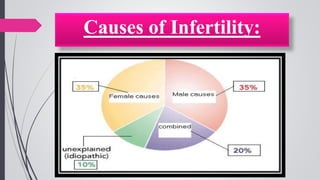
Causes of Infertility:
Female causes:(30- 40%)
Failure to ovulate
Poorly Functioning Fallopian Tubes
Additional Factors
Environment & Occupational Factors
Female causes:(Cont)
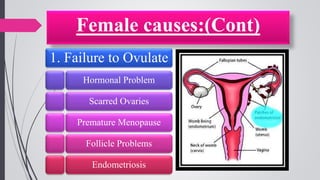
1. Failure to Ovulate
Hormonal Problem
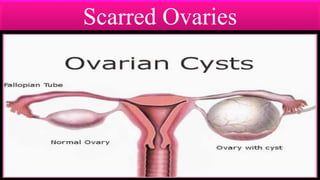
Scarred Ovaries
Premature Menopause
Follicle Problems
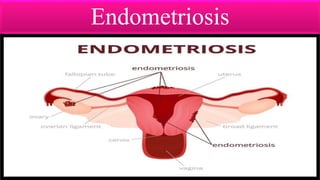
Endometriosis
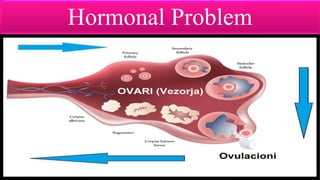
Hormonal Problem
Scarred Ovaries
Premature Menopause- Low Body Weight
Follicle Problems-Unruptured Follicle Syndrome
Endometriosis
Female causes:(Cont)
2. Poorly Functioning Fallopian Tubes
Infection
Abdominal Disease
Previous Surgeries
Ectopic Pregnancy
Congenital Defects
Infection
Hydrosalpnix
Abdominal Disease
Previous Surgeries
Ectopic Pregnancy
Congenital Defects
Female causes:(Cont)
3. Additional Factors
Other variables
Behavioral Factors
Environmental & Occupational
Factors
Female causes:(Cont)
Behavioral Factors
• Diet & Exercise
• Smoking
• Alcohol
• Drugs
Female causes:(Cont)
Environmental & Occupational Factors
• Lead
• Medical Treatment &Materials
• Ethylene Oxide
• Dibromochlopropane (DBCP)
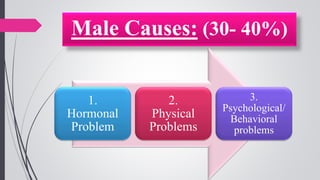
Male Causes: (30- 40%)
testicular
33%
1.
Hormonal
Problem
2.
Physical
Problems
3.
Psychological/
Behavioral
problems
Male Causes:
1. Hormonal Problems
Hyperprolactinemia
Hypothyroidism
Congenital Adrenal Hyperplasia
Hypogonadotropic Hypopituitarism
Panhypopituitaism
Male Causes:
2. Physical Problems
Varicocele
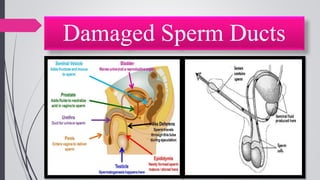
Damaged Sperm Ducts
Torsion
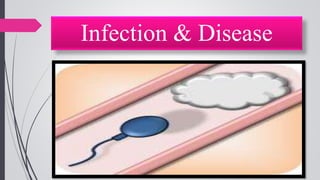
Infection & Disease
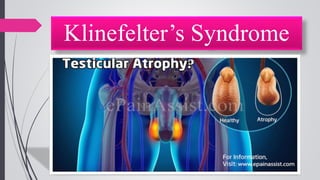
Klinefelter’s Syndrome
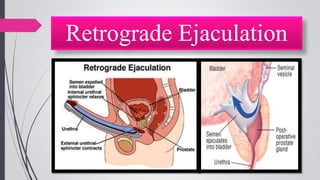
Retrograde Ejaculation
Varicocele
Damaged Sperm Ducts
Torsion
Infection & Disease
Klinefelter’s Syndrome
Retrograde Ejaculation
Male Causes:
3. Psychological/Behavioral Problems
Erectile Disfunction(ED)/ Importence
Premature Ejaculation
Ejaculatory Incompetence
Erectile Disfunction(ED)
Premature Ejaculation
Ejaculatory Incompetence
This rare psychological condition prevents
men from ejaculating during sexual
intercourse even through they can ejaculate
normally through masturbation.
Test for
Male
Infertility
Semen Analysis
Produced by masturbation after 2-7 days of sexual
abstinence
Do not use lubrication
2 to 3 samples required; additional if abnormal
Protect against extreme temperatures (<20C / >40 C)
Analysis within one hour of collection
Volume – 2 ml or more, pH - 7.2 or more
Cont…
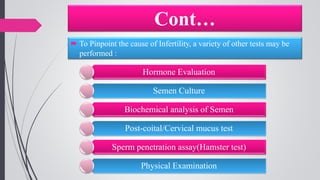
 To Pinpoint the cause of Infertility, a variety of other tests may be
performed :
Hormone Evaluation
Semen Culture
Biochemical analysis of Semen
Post-coital/Cervical mucus test
Sperm penetration assay(Hamster test)
Physical Examination
Treatment
for Male
Infertility
1. Treating
Hormonal
Problems
2. Treating
Psychological
Problems
3. Treating
Physical
Problems
Treatment for Male Infertility
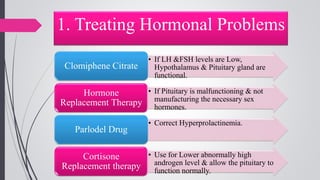
1. Treating Hormonal Problems
• If LH &FSH levels are Low,
Hypothalamus & Pituitary gland are
functional.
Clomiphene Citrate
• If Pituitary is malfunctioning & not
manufacturing the necessary sex
hormones.
Hormone
Replacement Therapy
• Correct Hyperprolactinemia.
Parlodel Drug
• Use for Lower abnormally high
androgen level & allow the pituitary to
function normally.
Cortisone
Replacement therapy
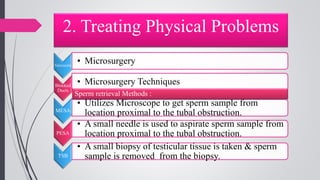
2. Treating Physical Problems
Varicocele
• Microsurgery
Blocked
Ducts
• Microsurgery Techniques
MESA
• Utilizes Microscope to get sperm sample from
location proximal to the tubal obstruction.
PESA
• A small needle is used to aspirate sperm sample from
location proximal to the tubal obstruction.
TSB
• A small biopsy of testicular tissue is taken & sperm
sample is removed from the biopsy.
Sperm retrieval Methods :
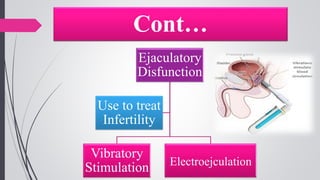
Cont…
Ejaculatory
Disfunction
Vibratory
Stimulation Electroejculation
Use to treat
Infertility
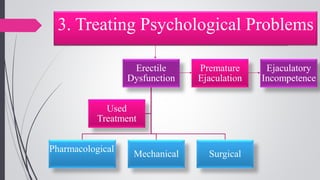
3. Treating Psychological Problems
Erectile
Dysfunction
Pharmacological
Mechanical Surgical
Used
Treatment
Premature
Ejaculation
Ejaculatory
Incompetence
Test for
Female
Infertility
Diagnostic Test
• Tests of Ovulation, Ultrasound Testing,
Luteal Phase TestingStep One
• Semen AnalysisStep Two
• Test Cervical Functioning
• A Post-Coitus testStep Three
• Evaluate the woman’s reproductive
tract & reproductive organ through
different means of imaging.
Step Four
• LaparoscopyStep Five
Diagnostic Test
A. Tests of Ovulation
B. Ultrasound testing
C. Luteal phase testing is conducted to assess
whether the uterus prepares itself properly to
receive & carry a fertilized egg, blood tests
(determine hormone levels), an endometrial
biopsy (to observe the development of the
uterine lining.)
Step One
Diagnostic Test
Step Two-Semen Analysis
 Evaluate the quantity, motility & shape of sperm.
 If initial analysis indicates a low sperm count,
abnormal sperm shapes, or low sperm motility,
additional analysis may be performed, including
penetration tests or the hemizona test.
 The Hemizona Assay Test/ Hamster Test determine
capability of sperm to penetrate egg during IVF.
Diagnostic Test
Tests Cervical Functioning, using the post-
coital test to assess if there is a problem in
the interaction between a woman’s
cervical mucus and her partner’s sperm.
Step Three
Diagnostic Test
Post-coital test (PCT): (Sim’s Huhner test)
Scheduled around 1-2day before ovulation (increased
estrogen effect)
48 hour of male abstinence before test.
No lubricants.
Evaluate up to 8-12 hours after coitus.
Remove mucus from cervix (forceps, syringe) which is
placed on a glass slide and then examined under a
microscope.
A Positive test will show reasonable numbers of
actively motile sperm. Indicating good cervical
insemination.
Diagnostic Test
Step Four-
HSG(Hysterosalpingography)
Usually after failed successive cycles of
ovulation induction.
Good predictive but requires expertise.
Diagnostic Procedures
Step Five- Laparoscopy
Invasive procedure.
To check for pelvic disease; such as
endometriosis and to check tubal patency.
Therapeutic as in laparoscopic
myomectomy and ovarian drilling
Treatment
for Female
Infertility
Drugs
Ovulatory disorders are involved in about 40% of
fertility problems.
Two Drugs used
to treat Ovulatory
disorders
Clomiphene
Citrate
Human
Menopausal
Gonadotropin
Intrauterine Insemination-IUI
(Artificial Insemination)
70-90% success rate.
Semen used is filtered for washing.
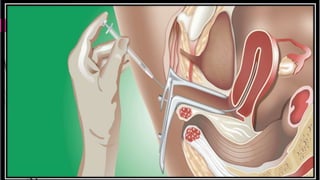
 A procedure in which a
fine catheter (tube) is
inserted through the
cervix into the uterus to
directly deposit a sperm
sample. The purpose of
procedure is to achieve
fertilization and
Pregnancy.
Definition
Types
AID(Artificial
Insemination
By Donor)
AIH(Artificial
Insemination
By Husband)
Indication
Cervical Problem
Mechanical Problem such as spinal cord injury &
other Physical Disability.
Antisperm Antibody in the man
Mild Oligospermia with satisfactory motility
Semen stored before starting of chemotherapy or
radiotherapy.
Indication for Donor Insemination
 Azospermia or Oligospermia in male Partner.
Excessive non-motile or abnormal sperm.
Risk of transmission of a hereditary disease.
Rh-isoimmunization, a rheses negative donor can
be used.
Lack of male Partner.
Selection of Donor
Must be of normal intelligence, fit & healthy with no
personal or Family History of diseases.
Test for STD including HIV are repeated at every visit.
The semen is frozen & stored for at least 3 months before
use to be sure & tests were negative.
Donor are matched as for as possible to the male partner
skin, hair, aye coloring, height build, & blood group.
The couple requesting Artificial Insemination Signs an
informed consent & a contract accepting the resultant
offspring as their legal hair.
Donor is not considered as father.
Procedure
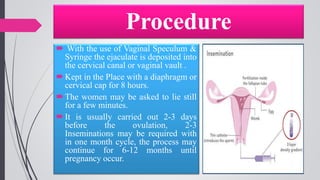
 With the use of Vaginal Speculum &
Syringe the ejaculate is deposited into
the cervical canal or vaginal vault .
Kept in the Place with a diaphragm or
cervical cap for 8 hours.
The women may be asked to lie still
for a few minutes.
It is usually carried out 2-3 days
before the ovulation, 2-3
Inseminations may be required with
in one month cycle, the process may
continue for 6-12 months until
pregnancy occur.
In Vitro Fertilization/Embryo
Transfer/Test Tube Conception
The first successful
IVF was performed
in Great Britain
1978.
Common whose
oviducts have been
damaged.
Definition
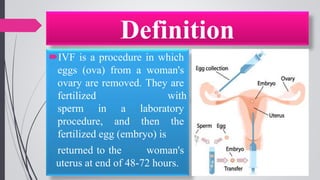
IVF is a procedure in which
eggs (ova) from a woman's
ovary are removed. They are
fertilized with
sperm in a laboratory
procedure, and then the
fertilized egg (embryo) is
returned to the woman's
uterus at end of 48-72 hours.
Tubal Damage
Oligospermia, Poor motility
Endometriosis
Pelvic Inflammatory diseases
Absence or diseases uterus
Idiopathic Infertility
Indication
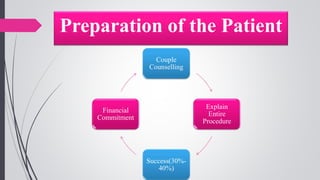
Preparation of the Patient
Couple
Counselling
Explain
Entire
Procedure
Success(30%-
40%)
Financial
Commitment
Procedure
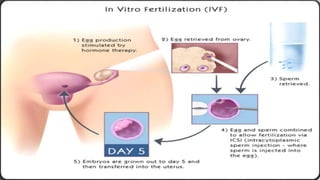
• Patient SelectionStep 1
• Ovulation Induction is
drugs.Step 2
• Ovum/Oocyte Retrieval is
Planned.Step 3
• Semen Collection to be
done.Step 4
Cont…
• Fertilization & Cleavage in
Laboratory with washed sperm &
ova was done.
Step 5
• Transfer of Zygotes to
the uterus.Step 6
• Establishment of
Pregnancy.Step 7
Risks of IVF
Genetic
Disorders
Low Birth
Weight
Preterm
Birth
Miscarriage
Advantages
4 Million Previously Infertile couple to the Children.
Permits Screening (presence of genetic disorders
avoiding starting pregnancy)
One can use frozen sperm allowing fatherhood for a
man who is no longer able to provide fresh sperm.
A number of morulas are created, the extras can be
frozen, stored, & used later.
Disadvantages
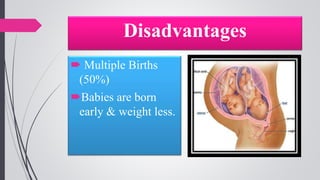
 Multiple Births
(50%)
Babies are born
early & weight less.
Nurses Role
 Assess the women’s Condition.
Give Guidance regarding the ART Procedure.
Sent for the Counseling Center.
Provide psychological support for the women’s.
Explain the procedure a formed in the infertility
treatment.
Infertility
Infertility
Infertility
Infertility
Infertility

Infertility

  • 1.
  • 2.
    Terminology TERM NAME DEFINITION FertilityIt is the ability to conceive Sterility It is an absolute inability to conceive Fecundity It is the ability of a man and a woman to reproduce.
  • 4.
    Definition “Infertility is failureto conceive after one year of unprotected regular sexual intercourse with average frequency (2-3 times / week)”. -NICE guideline, CG156
  • 6.
    Type(Classification) 1. Primary infertility:Difficulty to conceive for couple who has never before had a child. 2. Secondary infertility: Woman has previously been pregnant regardless of the outcome of the pregnancy and now unable to conceive.
  • 7.
    Factors involved infertility: Frequency/Timing of sexual intercourse: - Every 2 to 3 days optimizes the chance of pregnancy. Frequency of intercourse 1 time per week 3 time per week Probability of conception(within 6 months) 17% 50%
  • 8.
    Obesity: - Women whohave BMI of over 30 that to take longer to conceive and will affect treatment success rates. Low body weight -Women with BMI less than 19 and irregular menstruation should be counselled to gain weight. Factors involved in fertility:
  • 9.
    Smoking - Strong associationbetween smoking and fertility in both partners. - Affects success rates of ARTs. Tight underwear - Elevated scrotal temperature and reduced semen quality. Factors involved in fertility:
  • 10.
    Alcohol - Female patientsshould be informed that 1 or 2 units of alcohol once or twice per week reduces risk of harming a developing fetus. - Intoxication may affect semen quality. Prescribed, over-the-counter and recreational drug use Occupation Factors involved in fertility:
  • 11.
  • 12.
    Female causes:(30- 40%) Failureto ovulate Poorly Functioning Fallopian Tubes Additional Factors Environment & Occupational Factors
  • 13.
    Female causes:(Cont) 1. Failureto Ovulate Hormonal Problem Scarred Ovaries Premature Menopause Follicle Problems Endometriosis
  • 14.
  • 15.
  • 16.
  • 17.
  • 18.
  • 19.
    Female causes:(Cont) 2. PoorlyFunctioning Fallopian Tubes Infection Abdominal Disease Previous Surgeries Ectopic Pregnancy Congenital Defects
  • 20.
  • 21.
  • 22.
  • 23.
  • 24.
  • 25.
    Female causes:(Cont) 3. AdditionalFactors Other variables Behavioral Factors Environmental & Occupational Factors
  • 26.
    Female causes:(Cont) Behavioral Factors •Diet & Exercise • Smoking • Alcohol • Drugs
  • 27.
    Female causes:(Cont) Environmental &Occupational Factors • Lead • Medical Treatment &Materials • Ethylene Oxide • Dibromochlopropane (DBCP)
  • 28.
    Male Causes: (30-40%) testicular 33% 1. Hormonal Problem 2. Physical Problems 3. Psychological/ Behavioral problems
  • 29.
    Male Causes: 1. HormonalProblems Hyperprolactinemia Hypothyroidism Congenital Adrenal Hyperplasia Hypogonadotropic Hypopituitarism Panhypopituitaism
  • 30.
    Male Causes: 2. PhysicalProblems Varicocele Damaged Sperm Ducts Torsion Infection & Disease Klinefelter’s Syndrome Retrograde Ejaculation
  • 31.
  • 32.
  • 33.
  • 34.
  • 35.
  • 36.
  • 37.
    Male Causes: 3. Psychological/BehavioralProblems Erectile Disfunction(ED)/ Importence Premature Ejaculation Ejaculatory Incompetence
  • 38.
  • 39.
  • 40.
    Ejaculatory Incompetence This rarepsychological condition prevents men from ejaculating during sexual intercourse even through they can ejaculate normally through masturbation.
  • 41.
  • 42.
    Semen Analysis Produced bymasturbation after 2-7 days of sexual abstinence Do not use lubrication 2 to 3 samples required; additional if abnormal Protect against extreme temperatures (<20C / >40 C) Analysis within one hour of collection Volume – 2 ml or more, pH - 7.2 or more
  • 43.
    Cont…  To Pinpointthe cause of Infertility, a variety of other tests may be performed : Hormone Evaluation Semen Culture Biochemical analysis of Semen Post-coital/Cervical mucus test Sperm penetration assay(Hamster test) Physical Examination
  • 44.
  • 45.
    1. Treating Hormonal Problems 2. Treating Psychological Problems 3.Treating Physical Problems Treatment for Male Infertility
  • 46.
    1. Treating HormonalProblems • If LH &FSH levels are Low, Hypothalamus & Pituitary gland are functional. Clomiphene Citrate • If Pituitary is malfunctioning & not manufacturing the necessary sex hormones. Hormone Replacement Therapy • Correct Hyperprolactinemia. Parlodel Drug • Use for Lower abnormally high androgen level & allow the pituitary to function normally. Cortisone Replacement therapy
  • 47.
    2. Treating PhysicalProblems Varicocele • Microsurgery Blocked Ducts • Microsurgery Techniques MESA • Utilizes Microscope to get sperm sample from location proximal to the tubal obstruction. PESA • A small needle is used to aspirate sperm sample from location proximal to the tubal obstruction. TSB • A small biopsy of testicular tissue is taken & sperm sample is removed from the biopsy. Sperm retrieval Methods :
  • 48.
  • 49.
    3. Treating PsychologicalProblems Erectile Dysfunction Pharmacological Mechanical Surgical Used Treatment Premature Ejaculation Ejaculatory Incompetence
  • 50.
  • 51.
    Diagnostic Test • Testsof Ovulation, Ultrasound Testing, Luteal Phase TestingStep One • Semen AnalysisStep Two • Test Cervical Functioning • A Post-Coitus testStep Three • Evaluate the woman’s reproductive tract & reproductive organ through different means of imaging. Step Four • LaparoscopyStep Five
  • 52.
    Diagnostic Test A. Testsof Ovulation B. Ultrasound testing C. Luteal phase testing is conducted to assess whether the uterus prepares itself properly to receive & carry a fertilized egg, blood tests (determine hormone levels), an endometrial biopsy (to observe the development of the uterine lining.) Step One
  • 53.
    Diagnostic Test Step Two-SemenAnalysis  Evaluate the quantity, motility & shape of sperm.  If initial analysis indicates a low sperm count, abnormal sperm shapes, or low sperm motility, additional analysis may be performed, including penetration tests or the hemizona test.  The Hemizona Assay Test/ Hamster Test determine capability of sperm to penetrate egg during IVF.
  • 54.
    Diagnostic Test Tests CervicalFunctioning, using the post- coital test to assess if there is a problem in the interaction between a woman’s cervical mucus and her partner’s sperm. Step Three
  • 55.
    Diagnostic Test Post-coital test(PCT): (Sim’s Huhner test) Scheduled around 1-2day before ovulation (increased estrogen effect) 48 hour of male abstinence before test. No lubricants. Evaluate up to 8-12 hours after coitus. Remove mucus from cervix (forceps, syringe) which is placed on a glass slide and then examined under a microscope. A Positive test will show reasonable numbers of actively motile sperm. Indicating good cervical insemination.
  • 56.
    Diagnostic Test Step Four- HSG(Hysterosalpingography) Usuallyafter failed successive cycles of ovulation induction. Good predictive but requires expertise.
  • 58.
    Diagnostic Procedures Step Five-Laparoscopy Invasive procedure. To check for pelvic disease; such as endometriosis and to check tubal patency. Therapeutic as in laparoscopic myomectomy and ovarian drilling
  • 59.
  • 60.
    Drugs Ovulatory disorders areinvolved in about 40% of fertility problems. Two Drugs used to treat Ovulatory disorders Clomiphene Citrate Human Menopausal Gonadotropin
  • 61.
    Intrauterine Insemination-IUI (Artificial Insemination) 70-90%success rate. Semen used is filtered for washing.
  • 62.
     A procedurein which a fine catheter (tube) is inserted through the cervix into the uterus to directly deposit a sperm sample. The purpose of procedure is to achieve fertilization and Pregnancy. Definition
  • 64.
  • 65.
    Indication Cervical Problem Mechanical Problemsuch as spinal cord injury & other Physical Disability. Antisperm Antibody in the man Mild Oligospermia with satisfactory motility Semen stored before starting of chemotherapy or radiotherapy.
  • 66.
    Indication for DonorInsemination  Azospermia or Oligospermia in male Partner. Excessive non-motile or abnormal sperm. Risk of transmission of a hereditary disease. Rh-isoimmunization, a rheses negative donor can be used. Lack of male Partner.
  • 67.
    Selection of Donor Mustbe of normal intelligence, fit & healthy with no personal or Family History of diseases. Test for STD including HIV are repeated at every visit. The semen is frozen & stored for at least 3 months before use to be sure & tests were negative. Donor are matched as for as possible to the male partner skin, hair, aye coloring, height build, & blood group. The couple requesting Artificial Insemination Signs an informed consent & a contract accepting the resultant offspring as their legal hair. Donor is not considered as father.
  • 68.
    Procedure  With theuse of Vaginal Speculum & Syringe the ejaculate is deposited into the cervical canal or vaginal vault . Kept in the Place with a diaphragm or cervical cap for 8 hours. The women may be asked to lie still for a few minutes. It is usually carried out 2-3 days before the ovulation, 2-3 Inseminations may be required with in one month cycle, the process may continue for 6-12 months until pregnancy occur.
  • 70.
    In Vitro Fertilization/Embryo Transfer/TestTube Conception The first successful IVF was performed in Great Britain 1978. Common whose oviducts have been damaged.
  • 71.
    Definition IVF is aprocedure in which eggs (ova) from a woman's ovary are removed. They are fertilized with sperm in a laboratory procedure, and then the fertilized egg (embryo) is returned to the woman's uterus at end of 48-72 hours.
  • 72.
    Tubal Damage Oligospermia, Poormotility Endometriosis Pelvic Inflammatory diseases Absence or diseases uterus Idiopathic Infertility Indication
  • 73.
    Preparation of thePatient Couple Counselling Explain Entire Procedure Success(30%- 40%) Financial Commitment
  • 74.
    Procedure • Patient SelectionStep1 • Ovulation Induction is drugs.Step 2 • Ovum/Oocyte Retrieval is Planned.Step 3 • Semen Collection to be done.Step 4
  • 76.
    Cont… • Fertilization &Cleavage in Laboratory with washed sperm & ova was done. Step 5 • Transfer of Zygotes to the uterus.Step 6 • Establishment of Pregnancy.Step 7
  • 78.
    Risks of IVF Genetic Disorders LowBirth Weight Preterm Birth Miscarriage
  • 79.
    Advantages 4 Million PreviouslyInfertile couple to the Children. Permits Screening (presence of genetic disorders avoiding starting pregnancy) One can use frozen sperm allowing fatherhood for a man who is no longer able to provide fresh sperm. A number of morulas are created, the extras can be frozen, stored, & used later.
  • 80.
  • 81.
    Nurses Role  Assessthe women’s Condition. Give Guidance regarding the ART Procedure. Sent for the Counseling Center. Provide psychological support for the women’s. Explain the procedure a formed in the infertility treatment.