infertility note for nursing to understand and learn the ART
2.
• The inabilityto conceive following unprotected
sexual intercourse
• 1 year (age < 35) or 6 months (age >35)
• Affects 15% of reproductive couples
(6.1 million couples)
3.
• Infertility is“a disease of the reproductive system
defined by the failure to achieve a clinical
pregnancy after 12 months or more of regular
unprotected sexual intercourse
(WHO)
4.
TYPES
PRIMARY INFERTILITY
• Primaryinfertility is the term used to describe a
couple that has never been able to conceive a
pregnancy, after at least 1 year of unprotected
intercourse
5.
SECONDARY INFERTILITY
• Secondaryinfertility describes couples who have
previously been pregnant at least once, but have
not been able to achieve another pregnancy
6.
CAUSES
Male infertility :30%
• Impaired sperm production
• Impaired sperm transport (motility or
obstruction)
• Impaired deposition or ejaculation
Risk Factors
• Age- >35 years
• Smoking
• Alcohol consumption
• Body weight - BMI > 29 or < 19
• Sexually transmitted infections (STIs)
• Occupation (exposure to some pesticides,
herbicides, metals)
9.
FERTILITY ASSESSMENT
Objectives ofinvestigation
• To detect the etiological factors
• To rectify the abnormality in an attempt to
improve the fertility.
• To give assurance with explanation to the couple
if no abnormality is detected.
10.
• When toinvestigate?
The infertile couple should be investigated after one
year of regular unprotected intercourse with
adequate frequency.
11.
• The intervalis however, shortened to 6
months after the age of 35 years of the woman and
40 years of man.
• It is important that both partners should come at
the first visit.
12.
• What toinvestigate?
The basic investigations to be carried out are:
(i) Semen analysis.
(ii) Confirmation of ovulation and
(iii) Confirmation of tubal patency.
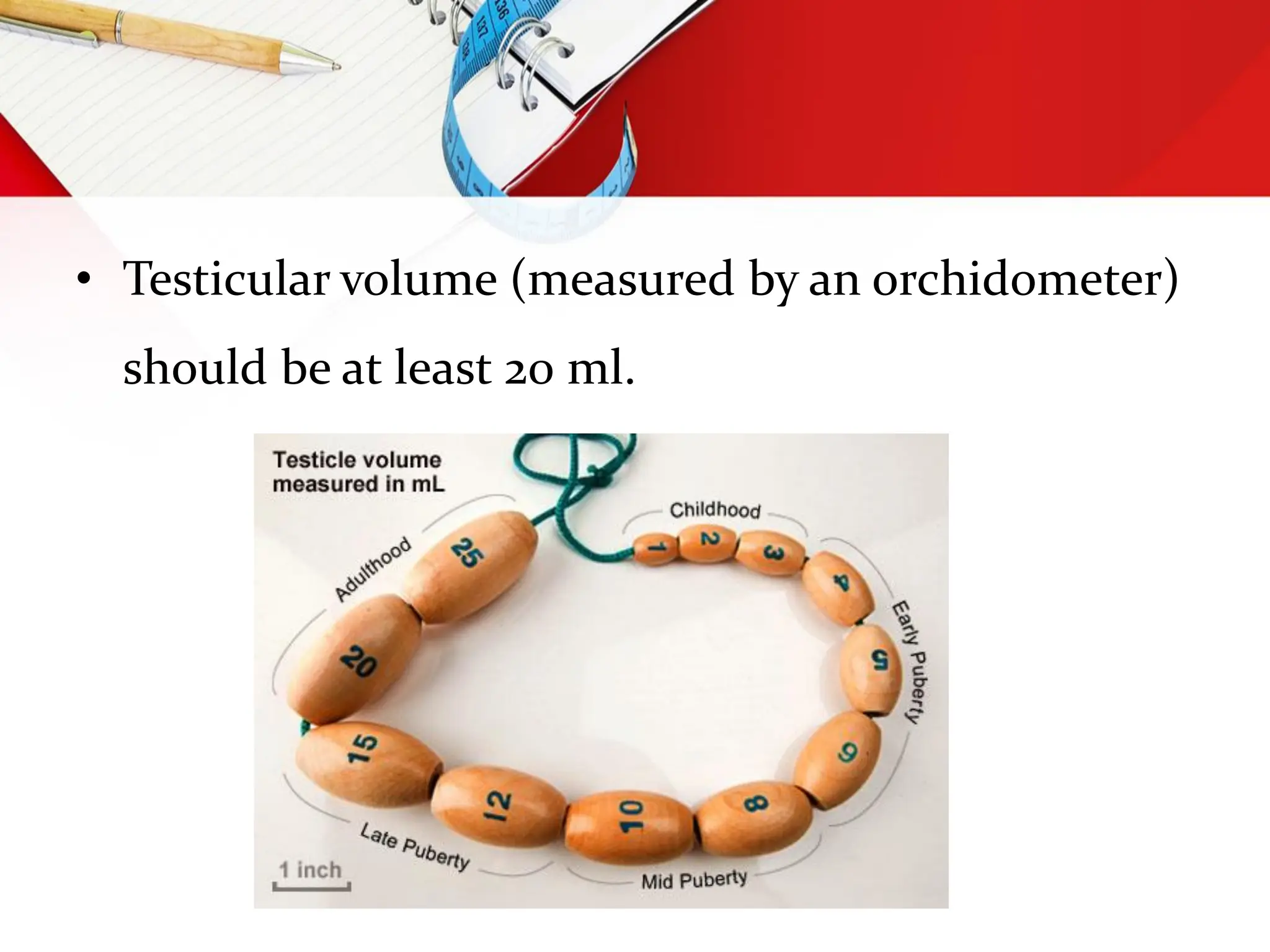
• PHYSICAL EXAMINATION
•A full physical examination is performed to
determine the general state of health.
• Examination of the reproductive system
includes—inspection and palpation of the
genitalia.
15.
• A fullphysical examination is performed to
• determine the general state of health.
• Examination of the reproductive system
includes—inspection and palpation of the
genitalia.
INVESTIGATIONS
• Routine investigations; urine and blood
examination including postprandial sugar.
• Semen analysis
• Serum FSH, LH, testosterone, prolactin, and TSH:
• Fructose content in the seminal fluid: Its absence
suggests congenital absence of seminal vesicle or
portion of the ductal system or both.
• Testicular biopsy: is done to differentiate primary
testicular failure from obstruction
18.
• Trans rectalultrasound (TRUS): is done to
visualize the seminal vesicles, prostate and
ejaculatory ducts obstruction.
• Indications of TRUS are:
1. Azoospermia or severe oligospermia with a
normal testicular volume,
2. Abnormal digital rectal examination,
3. Ejaculatory duct abnormality
19.
• Vasogram ;
Isa radiographic study done to evaluate the
ejaculatory duct obstruction.
20.
Karyotype analysis:
• Thisis to be done in cases with azoospermia or
severe oligospermia and raised FSH
• Klinefelter’s syndrome (XXY) is the commonest.
• Micro deletions of the long arm of Y chromosome
can also cause severe seminal abnormalities.
21.
Immunological tests:
• Twotypes of antibodies have been described—
sperm agglutinating and sperm immobilizing;
latter it may leads to infertility.
• Presence of sperm antibodies in the cervical
mucus is demonstrated by postcoital test
FEMALE
History:
• Age, durationof marriage, history of previous
marriage with proven fertility if any.
• A general medical history -tuberculosis, sexually
transmitted disease, pelvic inflammation or
diabetes.
24.
• surgical history
•Menstrual history
• Previous obstetric history
• Contraceptive practice
• Sexual problems
INDIRECT
• Menstrual history.
•Evaluation of peripheral or end organ changes due
to estrogen and progesterone.
• Basal body temperature
• Cervical mucus study
• Vaginal cytology-features of progesterone effect,
LUTEAL PHASE DEFECT(LPD)
BBT chart—
• Slow rise of temperature taking 4–5 days following
the fall in the midcycle.
• Rise of temperature sustains less than 10 days.
Endometrial biopsy
Serum progesterone
TUBAL FACTORS
Insufflation test(Rubin’s test)
• To find out the patency of tube
• Procedure ; Air /CO2 passed through cervical
canal ,it reaches peritoneal cavity .
35.
• The insufflationis usually carried out at a gas
pressure of less than 120 mm of Hg.
• The manometer reading decreases to 100 or less if the
tubes are clear;
• If between 120 and 130, there is probably partial
stricture;
• If it rises to 200 and above, it is suggestive that the
tubes are obstructed.
36.
Hysterosalpingography
• Instead ofair or CO2, dye is instilled
transcervically.
• It can precisely detect the side and site of block in
the tube.
• It can reveal any abnormality in the uterus
37.
MANAGEMENT
• MALE INFERTILITY
•General care: Improvement of general health,
reduction of weight in obese, avoidance of alcohol
and heavy smoking are of help.
• Medications that interfere spermatogenesis
should be avoided.(antihypertensive drugs)
38.
• The disordersof spermatogenesis can be treated
with
hCG 5000 IU intramuscularly once or twice a week
is given to stimulate endogenous testosterone
production.
39.
• Dopamine agonist(cabergoline) is given to restore
normal prolactin and testosterone level.
• doxycycline or erythromycin is given for a period
of 4–6 weeks to treat genital tract infection
• Phenylephrine (alpha-adrenergic agonist) is used
to improve the tone of internal urethral sphincter.
40.
• Surgical
• Vasoepididymostomyor vasovasostomy. To
correct obstruction of vas.
• Orchidopexy in undescended testes should be
done between 2–3 years of age to have adequate
spermatogenesis in later life.
41.
• Impotency
• Psychosexualtreatment
• For erectile dysfunction sildenafil (25–100 mg) or
tadalafil (10–20 mg) is currently advised.
• Assisted Reproductive Technology (Art)
General
• Psychotherapy toimprove the emotional causes,
if any.
• Reduction of weight in obesity as in PCOS cases
Drugs
• FSH
• hCG
• GnRH
• GnRH analogues
44.
• Clomiphene Citrate50 mg daily.
LUTEAL PHASE DEFECT (LPD)
• Natural progesterone
• hCG
• Clomiphene citrate to increases FSH
LUTEINIZED UNRUPTURED FOLLICLE (LUF)
• Optimally timed intramuscular injection of hCG
5000–10,000 IU.
Bromocriptine therapy, if associated with
hyperprolactinemia
45.
SURGERY
• Laparoscopic ovariandrilling (LOD) or laser
vaporization:
• This is done by multiple puncture (4–6 sites) of the cysts in
polycystic ovarian syndrome by diathermy or laser.
• Wedge resection:
• Surgical removal ovarian or adrenal tumor
• Bariatric surgery
46.
TUBAL AND PERITONEALFACTORS
• Peritubal adhesions; salpingo-ovariolysis
• Fimbrioplasty/fimbriolysis—Distal tubal block
• Neosalpingostomy—to create a new tubal opening
in an occluded tube.
47.
CERVICAL FACTOR –
•conjugated oestrogen 1.25mg orally for 5 days
IMMUNOLOGICAL FACTORS –
• Dexamethasone 0.5mg (anti-sperm antibody)
48.
ASSISTED REPRODUCTIVE
TECHNOLOGY
• Invitro fertilization
• In vitro fertilization is the technique of
letting fertilization of the male and
female gametes (sperm and egg) occur outside the
female body.
49.
• TRANSVAGINAL OVUMRETRIEVAL (OVR)
• It is the process whereby a small needle is inserted
through the back of the vagina and guided via
ultrasound into the ovarian follicles to collect the
fluid that contains the eggs.
50.
ASSISTED ZONA HATCHING(AZH)
• It is performed shortly before the embryo is
transferred to the uterus. A small opening is made
in the outer layer surrounding the egg in order to
help the embryo hatch out and aid in the
implantation process of the growing embryo
51.
INTRACYTOPLASMIC SPERM INJECTION(ICSI)
•It is beneficial in the case of male factor infertility
where sperm counts are very low or failed
fertilization occurred with previous IVF
attempt(s).
• The ICSI procedure involves a single sperm
carefully injected into the center of an egg using a
microneedle.
52.
• With ICSI,only one sperm per egg is needed.
Without ICSI, you need between 50,000 and
100,000. This method is also sometimes employed
when donor sperm is used.
53.
AUTOLOGOUS ENDOMETRIAL COCULTURE
•It is a possible treatment for patients who have failed
previous IVF attempts or who have poor embryo
quality.
• The patient's fertilized eggs are placed on top of a
layer of cells from the patient's own uterine lining,
creating a more natural environment for embryo
development
54.
ZYGOTE INTRAFALLOPIAN TRANSFER(ZIFT)
•Egg cells are removed from the woman's ovaries
and fertilized in the laboratory;
• The resulting zygote is then placed into the
fallopian tube.
55.
CYTOPLASMIC TRANSFER
• Itis the technique in which the contents of a
fertile egg from a donor are injected into the
infertile egg of the patient along with the sperm.
56.
EGG DONOR
• Inthe egg donor process, eggs are retrieved from a
donor's ovaries, fertilized in the laboratory with
the sperm from the recipient's partner, and the
resulting healthy embryos are returned to the
recipient's uterus.
57.
SPERM DONATION
• Itis the provision (or "donation") by a man
(known as a sperm donor) of his sperm(known as
donor sperm), principally for it to be used in
the artificial insemination of a woman or women
who are not his sexual partners.