INFERTILITY
PRESENTED BY:-
Abhishek Yadav
M Sc Nursing 1st Yea
OUTLINE
• Introduction of infertility.
• Definition of infertility.
• Risk factors of infertility.
• Causes of infertility in men & women.
• Types of infertility.
• Diagnosis of infertility.
• Treatment of infertility.
• Counseling for infertility.
• Ethical & legal aspects of ART.
INTRODUCTION OF INFERTILITY
 Infertility is a significant social and medical
problem affecting couples world wide.
 Infertility refers to an inability to conceive
after having regular unprotected sex.
 Average incidence of infertility is about 15%
globally. (varies in different populations ).
 Some causes can be detected and treated,
where as others can not:
 Unexplained infertility constitutes about 10 % of
all cases.
 According to Mayoclinic, USA :-
- 20% cases of infertility are due to a
problem in man.
- 40% to 50% cases are due to women.
- 30% cases are due to problem in both men
& women.
 In India , approximately 15% to 20% of couples
are infertile.
DEFINITION OF INFERTILITY
• Infertility is the failure to achieve
a birth ever a 12 months period
of unprotected intercourse.
OR
• Infertility is the inability of a
sexually active non contracepting
couple to achieve pregnancy in
one year.
RISK FACTORS OF INFERTILITY
CAUSES OF INFERTILITY
IN MEN & WOMEN
IN MEN:-
 Low sperm count:
- Less than 10 million sperm per ml of
semen.
- Normal count is 20 million sperm per
ml of semen or more.
 No sperm:
- Absence of sperms in semen.
 Low sperm motility:
- Sperms are immotile, can not swim.
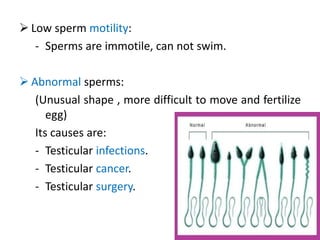
 Abnormal sperms:
(Unusual shape , more difficult to move and fertilize
egg)
Its causes are:
- Testicular infections.
- Testicular cancer.
- Testicular surgery.
Continued….
- Overheating testicles.
- Ejaculation disorders (Retrograde ejaculation).
- Variocele (includes varicose vein in scrotum).
- Undescended testicles.
- Hypogonadism (testosterone deficiency).
- Genetic abnormality.
- Mumps (testicular inflammation).
- Hypospadiasis.
- Chlamydia infection
IN WOMEN:-
Ovulation disorders:
- Premature ovarian failure (before age of
40)
- Polycystic ovary syndrome.
- Hyper-prolactinemia (in non pregnant
state)
- Poor egg quality.
Problems in uterus & fallopian tubes:
- Surgery.
- Sub-mucosal fibroids.
- Endometriosis.
- Previous sterilization treatment.
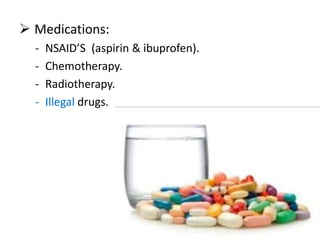
 Medications:
- NSAID’S (aspirin & ibuprofen).
- Chemotherapy.
- Radiotherapy.
- Illegal drugs.
TYPES OF INFERTILITY
• Two types of infertility:
– Primary Infertility.
– Secondary Infertility.
1. Primary Infertility:
When a women is unable to ever bear child .
2. Secondary Infertility:
When a women has been pregnant but
failure to achieve live birth after having a live
birth previously.
DIAGNOSIS OF INFERTILITY
TREATMENT FOR INFERTILITY
IN MEN:-
1. Premature ejaculation or Erectile dysfunction:
- Behavioral approaches (giving suggestions).
- or medications.
2. Variocele:
- If there is varicose vein in scrotum, it can be
surgically removed.
3. Blockage of the ejaculatory duct:
- Sperms can be extracted directly from the
testicles and injected into an egg in
laboratory.
4. Retrograde ejaculation:
- Sperms can be taken directly from the
bladder and injected into an egg in
laboratory.
5. Surgery for epididymal blockage:
- A bypass of the blockage can be
performed, called vaso-epididymostomy
(vas deferens is re-connected to
epididymis ).
IN WOMEN:-
1. Ovulation disorder:
Fertility drugs are prescribed ...
a) Clomifine:-
- To encourage ovulation (in case of PCOS,
etc).
b) Metformin:-
- Clients who do not respond to
clomiphine.
- Especially when client with PCOS linked to
insulin resistance.
c) FSH:-
- A hormone produced by pituitary.
- Controls estrogen production by ovaries.
- It stimulate ovaries to mature egg follicle.
- Ex: Gonal-F, Repronex,Follistim,(given S/C)
d) Human Menopausal Gonadotrophin:-
- EX: Bravelle, Repronex, and Menopur (given
I/M or can be S/C).
- Genetically engineered products.
- Contains both FSH & LH.
- In case of absent ovulation due to
pituitary dysfunction.
e) Human Chorionic Gonadotrophin :-
- Given in combination (clomiphine + HMG
+ FSH ).
- It stimulates follicles to ovulate.
- given I/M or S/C.
f) Gn- RH :-
- For women who ovulate premature follicle
during HMG treatment.
- Delivers constant supply of Gn-RH to
pituitary gland , which alters the
production of hormone , that allows
doctor to induce follicle growth with FSH.
-Given by intranasal spray, subcutaneous
injections
g) Bromocriptane:-
- Stimulate ovulation by inhibiting
production of prolactin.
- Prolactin stimulates milk production in
lactating mothers.
- Ex: Parlodel, Cycloset, (given oral or i/v)
INFERTILITY COUNSELING
• Infertility counseling deals with the psycho-
social impact of infertility in terms of :
– Intervention,
– Treatment, and
– After-effects of both successful and unsuccessful
treatments.
• It also involves therapeutic work to help
patient cope with the consequences of
infertility & treatment.
Objectives & need of infertility counseling:
–Informed consent.
–To offer coping strategies to couples.
–To facilitate decision making.
–To offer preparation for procedures.
–To help client in achieving a better quality
of life.
–To provide genetic counseling.
Counseling Services:
–IVF- group discussion by staff.
–Third party reproduction for both donors
& recipients.
–Therapeutic counseling.
–Crisis counseling.
–Assessment & Follow-up.
Advantages of infertility counseling:
–Helps to deal with the emotional stress.
–Provide extra support.
–Allow the client in exploring all possible
options for family.
–Help the couples in overcoming the
dilemmas & deciding the right fertility
treatment.
–Explains about the infertility management
& specific treatment.
Role of Nurse in Infertility counseling:
–Receiving the patient & family, and make
them accessible & comfortable for
counseling.
–Fertility nurse specialists provide care for
the individuals and couples before, during,
and after fertility treatment.
–Nurse need to obtain history as prenatal,
family and other relevant history.
–Nurse has to perform primary physical
examination and collect other relevant
information regarding patient of reports.
–Give psychological support throughout the
counseling.
–Collect other information about tests,
reports & documents.
–Establish plan of care with family and co-
ordinate care with other health care
professionals.
–Maintain privacy and confidentiality of all
cases.
–Performing inseminations.
–Performing embryo transfers.
–Ensure follow-up & supportive services to
individual and family during counseling.
ETHICAL & LEGAL ASPECT OF
ASSISTED REPRODUCTION
TECNOLOGY (ART)
• The aim of ART (fertility treatment) is to
promote the chances of fertilization and
subsequent pregnancy by bringing the sperm
and egg close to each other.
• Different types are:
Intra-uterine Insemination (IUI):-
• It is indicated as a first-line management
where there are problems such as:
–Hostile cervical mucus,
–Anti-sperm or male fertility problem (low
sperm count or premature ejaculation),
–Although tubal patency of female partner
must be assured.
• It is also useful for cases of unexplained
infertility.
• In order to increase the chances of success:
– Ovulation is monitored,
– Ovulation is induced oftenly,
– Sperms are prepared to maximize their fertility
before insertion into uterus.
In- vitro fertilization (IVF)/ Embryo transfer:-
• Describes lab techniques where the
fertilization occurs outside the body and is
one of the main types of ART.
• IVF is indicated in cases where the female
partner has:
– Uterine tube occlusion ,
– Endometriosis or cervical mucus problems,
– Or where male factors are main problem.
• Stimulation of the ovaries to produce more
than one egg is required and treatment starts
with pituitary desensitization (done by
Gonadotrophin injection).
Intracytoplasmic sperm injection (ICSI):
• Developed in 1992.
• It is a highly specialized variant of IVF
treatment that involves the injection of a
single sperm into the cytoplasm of an egg with
a fine glass needle.
• It is useful technique when sperm quality is
poor.
• In azoospermic man sperm can be obtained
surgically from the epididymis or by extraction
from testis itself.
Gamete intra-fallopian transfer (GIFT) &
Zygote intra-fallopian transfer (ZIFT) :-
–Both GIFT & ZIFT are laparoscopic technique
that offer little clinical advantage over in-
vitro fertilization (IVF) and are no longer
recommended.
Third party assisted ART:-
When couples do not achieve pregnancy from
the infertility treatments or traditional ART,
they may choose to use a third party assisted
ART method to have a child.
Sperm donation:
• Couples can be donated sperm when a man
does not produce sperm or produces very low
no. of sperm and if he has a genetic disease.
• Donated sperm can be used with intra-uterine
insemination or with IVF.
Egg donation:
• This can be used when a women does not
produce healthy egg that can be fertilized .
• An egg donor undergoes ovary stimulation
and egg retrieval steps of IVF.
• Donated egg can then be fertilized by sperm
from the women‘s partner, and resulting
embryo is placed into women’s uterus.
Surrogacy:-
• Legal arrangements for surrogacy require the
commencing (beginning) couple to both be
over the age of 18, married to each other and
the child genetically related to at least one of
them .
• Surrogate mother acts as a host as the embryo
is placed in her uterus.
REFRENCES
• Brunner & Suddarth’s , A textbook of Medical
Surgical Nursing, 2nd Volume, 13th Edition,
Published by Wolters kluwer Publication, Page
no.- 1636-1639.
• Joyce MB, Jane HH, A Textbook of Medical
Surgical Nursing , 1st Volume, 8th Edition ,
Sounders Elsevier Publication , Page no.- 866-
868.
• Chintamani, Lewi’s Medical Surgical Nursing
Assessment & Management of the Clinical
Problems, Mosby Elsevier Publication , Page no.
– 1352- 1354.
• Paul CA, , Carl K, Alexander H, Freeman, Jeffrey
DK, Arthur L, Reingold , and Purnima
M.Prevalence & correlates of primary infertilty
among young women in Mysore, India : Indian J.
Med Res, 2011 [ Cited 2001,oct.]; [P. 440-446]:
Available at:
http://www.ncbi.nlm.nih.gov/PMC/articles/PMC
327240/.
Infertility

Infertility

  • 1.
  • 2.
    OUTLINE • Introduction ofinfertility. • Definition of infertility. • Risk factors of infertility. • Causes of infertility in men & women. • Types of infertility. • Diagnosis of infertility. • Treatment of infertility. • Counseling for infertility. • Ethical & legal aspects of ART.
  • 3.
    INTRODUCTION OF INFERTILITY Infertility is a significant social and medical problem affecting couples world wide.  Infertility refers to an inability to conceive after having regular unprotected sex.  Average incidence of infertility is about 15% globally. (varies in different populations ).  Some causes can be detected and treated, where as others can not:  Unexplained infertility constitutes about 10 % of all cases.
  • 4.
     According toMayoclinic, USA :- - 20% cases of infertility are due to a problem in man. - 40% to 50% cases are due to women. - 30% cases are due to problem in both men & women.  In India , approximately 15% to 20% of couples are infertile.
  • 5.
    DEFINITION OF INFERTILITY •Infertility is the failure to achieve a birth ever a 12 months period of unprotected intercourse. OR • Infertility is the inability of a sexually active non contracepting couple to achieve pregnancy in one year.
  • 6.
    RISK FACTORS OFINFERTILITY
  • 7.
    CAUSES OF INFERTILITY INMEN & WOMEN IN MEN:-  Low sperm count: - Less than 10 million sperm per ml of semen. - Normal count is 20 million sperm per ml of semen or more.  No sperm: - Absence of sperms in semen.
  • 8.
     Low spermmotility: - Sperms are immotile, can not swim.  Abnormal sperms: (Unusual shape , more difficult to move and fertilize egg) Its causes are: - Testicular infections. - Testicular cancer. - Testicular surgery.
  • 9.
    Continued…. - Overheating testicles. -Ejaculation disorders (Retrograde ejaculation). - Variocele (includes varicose vein in scrotum). - Undescended testicles. - Hypogonadism (testosterone deficiency). - Genetic abnormality. - Mumps (testicular inflammation). - Hypospadiasis. - Chlamydia infection
  • 10.
    IN WOMEN:- Ovulation disorders: -Premature ovarian failure (before age of 40) - Polycystic ovary syndrome. - Hyper-prolactinemia (in non pregnant state) - Poor egg quality. Problems in uterus & fallopian tubes: - Surgery. - Sub-mucosal fibroids. - Endometriosis. - Previous sterilization treatment.
  • 11.
     Medications: - NSAID’S(aspirin & ibuprofen). - Chemotherapy. - Radiotherapy. - Illegal drugs.
  • 12.
    TYPES OF INFERTILITY •Two types of infertility: – Primary Infertility. – Secondary Infertility.
  • 13.
    1. Primary Infertility: Whena women is unable to ever bear child . 2. Secondary Infertility: When a women has been pregnant but failure to achieve live birth after having a live birth previously.
  • 14.
  • 17.
  • 18.
    IN MEN:- 1. Prematureejaculation or Erectile dysfunction: - Behavioral approaches (giving suggestions). - or medications. 2. Variocele: - If there is varicose vein in scrotum, it can be surgically removed. 3. Blockage of the ejaculatory duct: - Sperms can be extracted directly from the testicles and injected into an egg in laboratory.
  • 19.
    4. Retrograde ejaculation: -Sperms can be taken directly from the bladder and injected into an egg in laboratory. 5. Surgery for epididymal blockage: - A bypass of the blockage can be performed, called vaso-epididymostomy (vas deferens is re-connected to epididymis ).
  • 20.
    IN WOMEN:- 1. Ovulationdisorder: Fertility drugs are prescribed ... a) Clomifine:- - To encourage ovulation (in case of PCOS, etc). b) Metformin:- - Clients who do not respond to clomiphine. - Especially when client with PCOS linked to insulin resistance.
  • 21.
    c) FSH:- - Ahormone produced by pituitary. - Controls estrogen production by ovaries. - It stimulate ovaries to mature egg follicle. - Ex: Gonal-F, Repronex,Follistim,(given S/C) d) Human Menopausal Gonadotrophin:- - EX: Bravelle, Repronex, and Menopur (given I/M or can be S/C). - Genetically engineered products. - Contains both FSH & LH. - In case of absent ovulation due to pituitary dysfunction.
  • 22.
    e) Human ChorionicGonadotrophin :- - Given in combination (clomiphine + HMG + FSH ). - It stimulates follicles to ovulate. - given I/M or S/C. f) Gn- RH :- - For women who ovulate premature follicle during HMG treatment. - Delivers constant supply of Gn-RH to pituitary gland , which alters the production of hormone , that allows doctor to induce follicle growth with FSH. -Given by intranasal spray, subcutaneous injections
  • 23.
    g) Bromocriptane:- - Stimulateovulation by inhibiting production of prolactin. - Prolactin stimulates milk production in lactating mothers. - Ex: Parlodel, Cycloset, (given oral or i/v)
  • 24.
    INFERTILITY COUNSELING • Infertilitycounseling deals with the psycho- social impact of infertility in terms of : – Intervention, – Treatment, and – After-effects of both successful and unsuccessful treatments. • It also involves therapeutic work to help patient cope with the consequences of infertility & treatment.
  • 25.
    Objectives & needof infertility counseling: –Informed consent. –To offer coping strategies to couples. –To facilitate decision making. –To offer preparation for procedures. –To help client in achieving a better quality of life. –To provide genetic counseling.
  • 26.
    Counseling Services: –IVF- groupdiscussion by staff. –Third party reproduction for both donors & recipients. –Therapeutic counseling. –Crisis counseling. –Assessment & Follow-up.
  • 27.
    Advantages of infertilitycounseling: –Helps to deal with the emotional stress. –Provide extra support. –Allow the client in exploring all possible options for family. –Help the couples in overcoming the dilemmas & deciding the right fertility treatment. –Explains about the infertility management & specific treatment.
  • 28.
    Role of Nursein Infertility counseling: –Receiving the patient & family, and make them accessible & comfortable for counseling. –Fertility nurse specialists provide care for the individuals and couples before, during, and after fertility treatment.
  • 29.
    –Nurse need toobtain history as prenatal, family and other relevant history. –Nurse has to perform primary physical examination and collect other relevant information regarding patient of reports.
  • 30.
    –Give psychological supportthroughout the counseling. –Collect other information about tests, reports & documents. –Establish plan of care with family and co- ordinate care with other health care professionals.
  • 31.
    –Maintain privacy andconfidentiality of all cases. –Performing inseminations. –Performing embryo transfers. –Ensure follow-up & supportive services to individual and family during counseling.
  • 32.
    ETHICAL & LEGALASPECT OF ASSISTED REPRODUCTION TECNOLOGY (ART)
  • 33.
    • The aimof ART (fertility treatment) is to promote the chances of fertilization and subsequent pregnancy by bringing the sperm and egg close to each other. • Different types are:
  • 34.
    Intra-uterine Insemination (IUI):- •It is indicated as a first-line management where there are problems such as: –Hostile cervical mucus, –Anti-sperm or male fertility problem (low sperm count or premature ejaculation), –Although tubal patency of female partner must be assured.
  • 35.
    • It isalso useful for cases of unexplained infertility. • In order to increase the chances of success: – Ovulation is monitored, – Ovulation is induced oftenly, – Sperms are prepared to maximize their fertility before insertion into uterus.
  • 36.
    In- vitro fertilization(IVF)/ Embryo transfer:- • Describes lab techniques where the fertilization occurs outside the body and is one of the main types of ART. • IVF is indicated in cases where the female partner has: – Uterine tube occlusion , – Endometriosis or cervical mucus problems, – Or where male factors are main problem.
  • 37.
    • Stimulation ofthe ovaries to produce more than one egg is required and treatment starts with pituitary desensitization (done by Gonadotrophin injection).
  • 38.
    Intracytoplasmic sperm injection(ICSI): • Developed in 1992. • It is a highly specialized variant of IVF treatment that involves the injection of a single sperm into the cytoplasm of an egg with a fine glass needle.
  • 39.
    • It isuseful technique when sperm quality is poor. • In azoospermic man sperm can be obtained surgically from the epididymis or by extraction from testis itself.
  • 40.
    Gamete intra-fallopian transfer(GIFT) & Zygote intra-fallopian transfer (ZIFT) :- –Both GIFT & ZIFT are laparoscopic technique that offer little clinical advantage over in- vitro fertilization (IVF) and are no longer recommended.
  • 41.
    Third party assistedART:- When couples do not achieve pregnancy from the infertility treatments or traditional ART, they may choose to use a third party assisted ART method to have a child.
  • 42.
    Sperm donation: • Couplescan be donated sperm when a man does not produce sperm or produces very low no. of sperm and if he has a genetic disease. • Donated sperm can be used with intra-uterine insemination or with IVF.
  • 43.
    Egg donation: • Thiscan be used when a women does not produce healthy egg that can be fertilized . • An egg donor undergoes ovary stimulation and egg retrieval steps of IVF. • Donated egg can then be fertilized by sperm from the women‘s partner, and resulting embryo is placed into women’s uterus.
  • 44.
    Surrogacy:- • Legal arrangementsfor surrogacy require the commencing (beginning) couple to both be over the age of 18, married to each other and the child genetically related to at least one of them . • Surrogate mother acts as a host as the embryo is placed in her uterus.
  • 45.
    REFRENCES • Brunner &Suddarth’s , A textbook of Medical Surgical Nursing, 2nd Volume, 13th Edition, Published by Wolters kluwer Publication, Page no.- 1636-1639. • Joyce MB, Jane HH, A Textbook of Medical Surgical Nursing , 1st Volume, 8th Edition , Sounders Elsevier Publication , Page no.- 866- 868.
  • 46.
    • Chintamani, Lewi’sMedical Surgical Nursing Assessment & Management of the Clinical Problems, Mosby Elsevier Publication , Page no. – 1352- 1354. • Paul CA, , Carl K, Alexander H, Freeman, Jeffrey DK, Arthur L, Reingold , and Purnima M.Prevalence & correlates of primary infertilty among young women in Mysore, India : Indian J. Med Res, 2011 [ Cited 2001,oct.]; [P. 440-446]: Available at: http://www.ncbi.nlm.nih.gov/PMC/articles/PMC 327240/.