INFERTILITY
Evaluation and
Management Options
DEFINITION
A woman of reproductive age who has not conceived after
1 year of unprotected vaginal sexual intercourse, in the
absence of any known cause of infertility (WHO)
 earlier referral and assessment for
Woman aged 36 years or more
There is a known clinical cause of infertility or a history of
predisposing factors for infertility
 Primary infertility : not pregnant before
Secondary infertility : pregnant before irrespective of
outcome
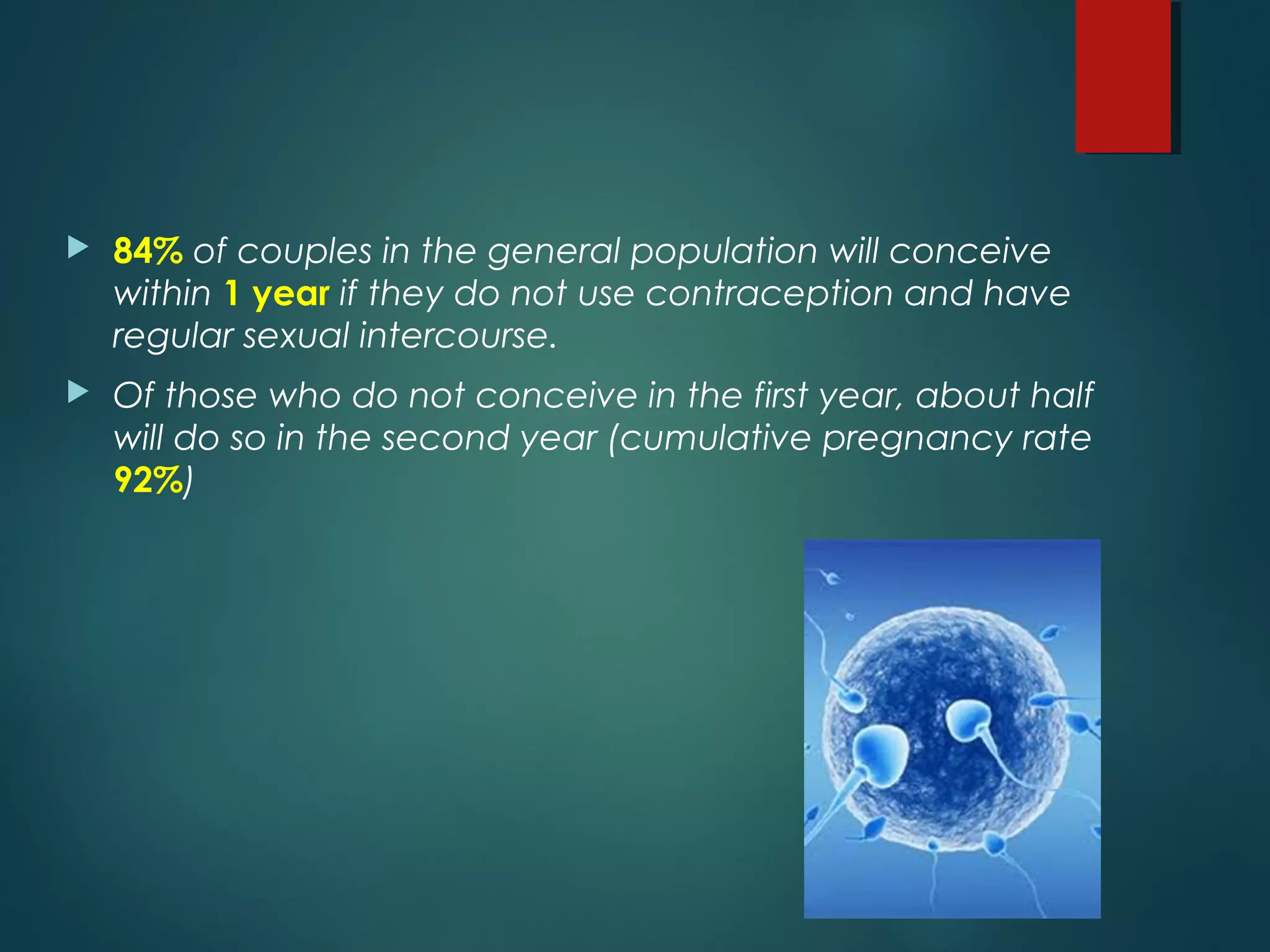
 84% of couples in the general population will conceive
within 1 year if they do not use contraception and have
regular sexual intercourse.
 Of those who do not conceive in the first year, about half
will do so in the second year (cumulative pregnancy rate
92%)
CAUSES
 Male infertility : 30%
 Impaired sperm production
 Impaired sperm transport
 Impaired deposition
 Female infertility : 55%
 Ovulatory disorder (25%) – PCOS accounts for 70% of cases
 Tubal damage (20%)
 Uterine or peritoneal disorders (30%)
 Combined : 10%
 Unknown : 25%
Risk Factors
 Age
 peak fertility : early of the third decade of life.
 beyond 35 years (and particularly after age 40 years), the
likelihood of becoming pregnant is getting less.
Dunson DB, Baird DD, Colombo B [2004]. Increased infertility with age
in men and women. Obstetrics and Gynecology 103: 51–6.
 Smoking
 reduce in fertility (active / passive smokers)
 reduce in semen quality
 Alcohol consumption
 women : < 1 or 2 units of alcohol once or twice per week
 men : < 3-4 units per day
 Body weight
 BMI > 29 or < 19, especially who are having irregular menses.
 Sexually transmitted infections (STIs)
 chlamydia can damage the fallopian tubes, as well as
making the man's scrotum become inflamed.
 Occupation
 Chemicals
 exposure to some pesticides, herbicides, metals (lead) and
solvents have been linked to fertility problems in both men and
women
Diagnosis & Investigations
General
age & duration of infertility
fertility in previous relationship
previous investigations and treatments
type & duration of previous contraception used
whether either of the partner requires to be away due to
occupational requirement – may affect the frequency of coitus
Post obstetric history
number of previous pregnancy
time taken to achieve previous pregnancy
history of post abortal / postpartum sepsis
Past medical/surgical/gynaecological history
STD, PID, IUCD usage
history of previous pelvic / abdominal surgeries (eg.
Appendicectomy, tubal surgery)
Female Partner - History
 Menstrual history
 frequency & regularity of cycles, dysmenorrhea
 regular cycles with spasmodic dysmenorrhoea : likely to be
ovulating
 flow & duration
 look for symptoms suggestive of endometriosis, PID or fibroid
 Sexual history
 sexual dysfunction : dyspareunia, vaginismus
 frequency of coitus
 knowledge regarding fertile period
 Systemic review
 weight changes, hirsutism, galactorrhoea
 symptoms of thyroid disease
 Family history
 including family members with infertility, birth defects, genetic
mutations, or mental retardation.
 Personal and lifestyle history
 occupation, changes in weight, smoking, and alcohol use.
** Unilateral oophorectomy generally do not have reduced fertility
in young women, since young women have many primordial
follicles per ovary
** However, unilateral oophorectomy may impact fertility in older
women as they may develop diminished ovarian reserve sooner
than women with two ovaries.
 BMI
 Secondary sexual characteristic
incomplete development : sign of hypogonadotropic hypogonadism
Turner’s Syndrome (45XO): short, square-shaped chest
Abnormalities of the thyroid gland, galactorrhea, or signs of
androgen excess (hirsutism, acne, male pattern baldness, virilization)
Examination of perineum & pelvic area
assess vulva, hymen
speculum examination : evidence of vaginitis, cervicitis, polyps
perform Pap Smear if due
bimanual : uterine size, position, mobility, tenderness, adnexal mass
Tenderness or mass in the adnexa or POD : chronic PID or endometriosis.
Uterine enlargement, irregularity, or lack of mobility are signs of a uterine
anomaly, leiomyoma, endometriosis, or pelvic adhesive disease.
Physical examination
General
duration of infertility
previous history of infertility with previous partner if any
Occupation
exposure to chemical/radiation/intense heat
Past medical history
infection e.g. mumps orchitis, epididymitis, STD
cryptorchidism (undescended testis)
Torsion
DM
Male Partner - History
 Past surgical history
 hernia repair (damage to the vas deferens or testicular blood
supply).
 radical pelvic or retroperitoneal surgery (absent seminal emission
secondary to sympathetic nerve injury)
 Drug history
 alcohol/nicotine, chemotherapy, anabolic steroid, sulphasalazine
 Sexual function
 coital frequency, erection, ejaculation
 knowledge regarding fertile period
BMIBMI
Evidence of hypoandrogenism & gynaecomastiaEvidence of hypoandrogenism & gynaecomastia
Groin & Genitalia :Groin & Genitalia :
Presence of inguinal herniaPresence of inguinal hernia
Palpate for normal position / volume( using an orchidometer) &Palpate for normal position / volume( using an orchidometer) &
tenderness of testestenderness of testes
Palpate epididymis for nodularity & tendernessPalpate epididymis for nodularity & tenderness
Check for varicoceleCheck for varicocele
Palpate for normality of VasPalpate for normality of Vas
Examine Penis for abnormalities : hypospadias etcExamine Penis for abnormalities : hypospadias etc
Physical examination
Investigations
 Seminal Fluid Analysis (SFA)Seminal Fluid Analysis (SFA)
 exclude abnormalities in semenexclude abnormalities in semen
 repeat after 3 months if abnormal.repeat after 3 months if abnormal.
 How to collect semen for SFA ?How to collect semen for SFA ?
 abstinence for 3-5 daysabstinence for 3-5 days
 non-spermicidal condomnon-spermicidal condom
 sterile containersterile container
 kept at body temperaturekept at body temperature
 sent to lab within 1 hour after ejaculationsent to lab within 1 hour after ejaculation
 SFA normal range (WHO 2010):
 pH : ≥7.2
 liquefaction : complete in 60 minutes
 sperm concentration : ≥ 15 million /ml
 Sperm count : ≥ 39 million / ejaculation
 Total motility : 40% or more; 32% progressive motility
 Vitality : ≥ 58% live
 Morphology : ≥ 4% normal
 If SFA abnormal, to repeat confirmatory test 3
months after the initial analysis to allow time for the
cycle of spermatozoa formation to be completed
 But if a gross spermatozoa deficiency has been
detected, to repeat test ASAP
Abnormal semen is responsible for about 75% of all cases ofis responsible for about 75% of all cases of
male infertility.male infertility.
Aspermia : No ejaculateAspermia : No ejaculate
Azoospermia: Absence of spermatozoa in the ejaculateAzoospermia: Absence of spermatozoa in the ejaculate
Oligospermia: < 15 millions/mlOligospermia: < 15 millions/ml
Severe oligospermia : <5 millionSevere oligospermia : <5 million
Asthenospermia :Slow motilityAsthenospermia :Slow motility
Teratospermia: Morphological abnormalitiesTeratospermia: Morphological abnormalities
Leucocytospemia: >1 million leucocyte /mlLeucocytospemia: >1 million leucocyte /ml
 Assess ovulatory functionAssess ovulatory function::
 regular cycles : mid luteal phase Serum progesterone (D21)regular cycles : mid luteal phase Serum progesterone (D21)
 irregular cyclesirregular cycles
 Se progesterone measured based on timing of menstrual periods (7Se progesterone measured based on timing of menstrual periods (7
days before next cycles)days before next cycles)
 FSH & LH (D2)FSH & LH (D2)
 Se Prolactin - only if ovulatory disorder, galactorhoea, pituitarySe Prolactin - only if ovulatory disorder, galactorhoea, pituitary
tumourtumour
 thyroid function test : only if sign / symptom of thyroid dysfunctionthyroid function test : only if sign / symptom of thyroid dysfunction
Investigations
 Pelvic ultrasound
 to detect uterine fibroids, endometrial polyps, ovarian cysts, andto detect uterine fibroids, endometrial polyps, ovarian cysts, and
other abnormalities in the pelvis.other abnormalities in the pelvis.
 Assess tubal patencyAssess tubal patency::
 screen for chlamydia before instrumental testing for tubalscreen for chlamydia before instrumental testing for tubal
patencypatency
 hysterosalphingography (without comorbidities, eg. PID,(without comorbidities, eg. PID,
endometriosis, previous ectopic pregnancy)endometriosis, previous ectopic pregnancy)
 laparoscopy & dye insufflation (with comorbidities, or if HSG(with comorbidities, or if HSG
shows tubal disease that can be repaired)shows tubal disease that can be repaired)
 Assess uterine cavity:
 not generally recommended unless clinically indicated
 Genetic testing
 find out whether a genetic abnormality is interfering with the
woman's fertility.
 Endometrial biopsy
 not recommended to evaluate the luteal phase
 Screening of viral status
Management
Management
 Non pharmacological therapy
 Including conservative management
 Pharmacological therapy
 Surgical treatment
 Assisted Reproductive Technology (ART)
 Treatment for Male Infertility
Non Pharmacological Therapy
 Couple educationCouple education
- Sexual intercourse 2-3 times per week may improve fertility.- Sexual intercourse 2-3 times per week may improve fertility.
 Smoking cessationSmoking cessation
 Limit alcohol intakeLimit alcohol intake
 Preconceptional advicePreconceptional advice
- check Rubella status- check Rubella status
- Folic acid supplementation.- Folic acid supplementation.
 Maintain BMI 19-29kg/m²Maintain BMI 19-29kg/m²
 Stress managementStress management
 Educate regarding fertile periodEducate regarding fertile period
Pharmacological
treatment
 WHO Group I ovulation disorders
 Pulsatile administration of gonadotrophin-releasing
hormone or gonadotrophins with luteinising hormone
activity
 WHO Group II ovulation disorders
 1st
line treatment
 Clomifene citrate
 block estrogen receptors in hypothalamus, interfereblock estrogen receptors in hypothalamus, interfere
normal feedback, then trigger FSH/LH releasenormal feedback, then trigger FSH/LH release
 70% of anovulatory women ovulate after treatment70% of anovulatory women ovulate after treatment
 failure to ovulate at dose of 150mg is consideredfailure to ovulate at dose of 150mg is considered
clomiphene-resistantclomiphene-resistant
 Metformin or
 Combination of both
 2nd
line treatment (clomiphene resistant)
 Laparoscopic ovarian drilling
 Combined treatment with clomiphene and metformin
if not already offered
 Gonadotrophins
 Human menopausal gonadotrophin – FSH + LH
 FSH alone
 Hyperprolactinaemic amenorrhea
 Dopamine agonist – bromocriptine, carbegoline
Surgical Treatment
Laparoscopic ovarian drilling – clomiphene resistant PCOSLaparoscopic ovarian drilling – clomiphene resistant PCOS
destroy ovarian androgen-producing tissue and reduce thedestroy ovarian androgen-producing tissue and reduce the
peripheral conversion of androgens to estrogens.peripheral conversion of androgens to estrogens.
A fall in the serum levels of androgens and LH and an increase inA fall in the serum levels of androgens and LH and an increase in
FSH levels have been demonstrated after ovarian drillingFSH levels have been demonstrated after ovarian drilling
Disadvantage of destroying ovarian reserve and formation ofDisadvantage of destroying ovarian reserve and formation of
adhesionadhesion
Tubal surgeries
Tubal microsurgery & laparoscopic tubal surgeryTubal microsurgery & laparoscopic tubal surgery
For mild tubal diseaseFor mild tubal disease
adhesiolysisadhesiolysis
Tubal catheterization / cannulationTubal catheterization / cannulation
selective salphingography with tubal catheterizationselective salphingography with tubal catheterization
or hysteroscopic tubal cannulation for proximal tubalor hysteroscopic tubal cannulation for proximal tubal
obstructionobstruction
SalpingectomySalpingectomy
For hydrosalpinges before IVF treatmentFor hydrosalpinges before IVF treatment
Uterine surgery
 Hysteroscopic adhesiolysis for intrauterine
adhesions – improve chance of pregnancy
Endometriosis
 Medical treatment does not enhance fertility
 Surgical ablation or resection; adhesiolysis
 Cystectomy
Assisted Reproductive
Technology
 Intrauterine Insemination (IUI)
 In Vitro Fertilization (IVF)
 Intracytoplasmic sperm injection (ICSI)
Intrauterine Insemination
 Insemination of sperm into uterusInsemination of sperm into uterus
 Indication :Indication :
 Physical disabilities or psychosexual problem causing vaginalPhysical disabilities or psychosexual problem causing vaginal
intercourse to be difficult or impossibleintercourse to be difficult or impossible
 Discordant HIV positive coupleDiscordant HIV positive couple
 Same sex relationshipSame sex relationship
 Stimulated or non-stimulatedStimulated or non-stimulated
 Multiple pregnancy is the major risk is ovarian stimulation is usedMultiple pregnancy is the major risk is ovarian stimulation is used
 Cycle is terminated if >3 developing folliclesCycle is terminated if >3 developing follicles
 Not routinely offered to couple withNot routinely offered to couple with
 Unexplained infertilityUnexplained infertility
 Mild endometriosisMild endometriosis
 Mild male factor infertilityMild male factor infertility
In-vitro Fertilisation
 Indication:Indication:
 Severe tubal dysfunctionSevere tubal dysfunction
 Endometriosis failed medical & surgical RxEndometriosis failed medical & surgical Rx
 Unexplained infertilityUnexplained infertility
In-vitro Fertilisation
Factors affecting the outcome of IVF :Factors affecting the outcome of IVF :
Female ageFemale age
Number of previous treatment cyclesNumber of previous treatment cycles
Previous pregnancy historyPrevious pregnancy history
BMIBMI
Lifestyles factorsLifestyles factors
Alcohol, smoking, caffeineAlcohol, smoking, caffeine
 Several steps during IVF cycles :Several steps during IVF cycles :
 Ovarian stimulationOvarian stimulation
 Follicular aspirationFollicular aspiration
 Oocyte classificationOocyte classification
 Sperm preparationSperm preparation
 Oocyte inseminationOocyte insemination
 Embryo cultureEmbryo culture
 Embryo transferEmbryo transfer
In-vitro Fertilisation
))
A single sperm is injected into an ovum to achieveA single sperm is injected into an ovum to achieve
fertilization. Then the embryo is transferred to the uterus orfertilization. Then the embryo is transferred to the uterus or
Fallopian tube. The likelihood of fertilization improvesFallopian tube. The likelihood of fertilization improves
significantly.significantly.
Indications :Indications :
severe deficits in semen qualitysevere deficits in semen quality
azoospermia.azoospermia.
Failed IVFFailed IVF
Intracytoplasmic spermIntracytoplasmic sperm
injection (ICSIinjection (ICSI
Indications :Indications :
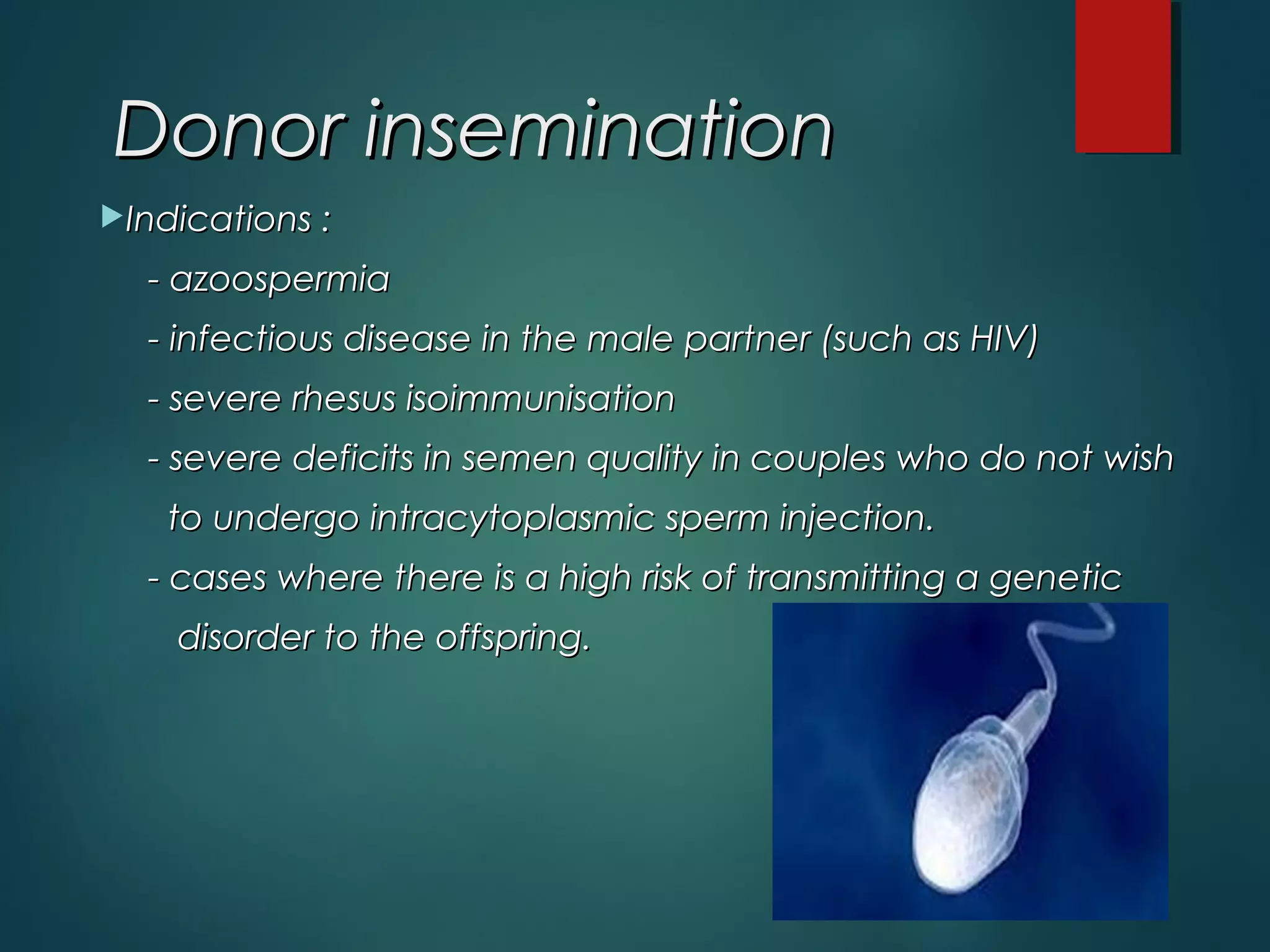
- azoospermia- azoospermia
- infectious disease in the male partner (such as HIV)- infectious disease in the male partner (such as HIV)
- severe rhesus isoimmunisation- severe rhesus isoimmunisation
- severe deficits in semen quality in couples who do not wish- severe deficits in semen quality in couples who do not wish
to undergo intracytoplasmic sperm injection.to undergo intracytoplasmic sperm injection.
- cases where there is a high risk of transmitting a genetic- cases where there is a high risk of transmitting a genetic
disorder to the offspring.disorder to the offspring.
Donor inseminationDonor insemination
 Indications :Indications :
- premature ovarian failure- premature ovarian failure
- gonadal dysgenesis including Turner syndrome- gonadal dysgenesis including Turner syndrome
- bilateral oophorectomy- bilateral oophorectomy
- ovarian failure following chemotherapy or radiotherapy- ovarian failure following chemotherapy or radiotherapy
- certain cases of IVF treatment failure.- certain cases of IVF treatment failure.
- cases where there is a high risk of transmitting a genetic- cases where there is a high risk of transmitting a genetic
disorder to the offspring.disorder to the offspring.
Oocyte donationOocyte donation
Treatment for Male Infertility
Erectile dysfunction or premature ejaculationErectile dysfunction or premature ejaculation
Medication and/or behavioral approaches can help men withMedication and/or behavioral approaches can help men with
general sexual problems, resulting in possibly improved fertility.general sexual problems, resulting in possibly improved fertility.
VaricoceleVaricocele
Surgical treatment of varicocele as a form of infertility treatmentSurgical treatment of varicocele as a form of infertility treatment
should not be offered as it does not improve pregnancy ratesshould not be offered as it does not improve pregnancy rates
Blockage of the ejaculatory ductBlockage of the ejaculatory duct
sperm can be extracted directly from the testicles and injectedsperm can be extracted directly from the testicles and injected
into an egg in the laboratory.into an egg in the laboratory.
Obstructive azoospermiaObstructive azoospermia
Surgery for epididymal blockageSurgery for epididymal blockage
Retrograde ejaculationRetrograde ejaculation
sperm can be taken directly from the bladder and injected intosperm can be taken directly from the bladder and injected into
an ovum in the laboratory.an ovum in the laboratory.
Treatment for male infertilityTreatment for male infertility
Complication of Infertility
Treatment
 Ovarian hyperstimulationOvarian hyperstimulation
syndrome (OHSS)syndrome (OHSS)
 Ectopic pregnancyEctopic pregnancy
 Multiple pregnancyMultiple pregnancy
 Adnexal torsionAdnexal torsion
 Spontaneous ruptured ofSpontaneous ruptured of
folliclesfollicles
Complications
Thank you.

Infertility

  • 1.
  • 2.
    DEFINITION A woman ofreproductive age who has not conceived after 1 year of unprotected vaginal sexual intercourse, in the absence of any known cause of infertility (WHO)  earlier referral and assessment for Woman aged 36 years or more There is a known clinical cause of infertility or a history of predisposing factors for infertility  Primary infertility : not pregnant before Secondary infertility : pregnant before irrespective of outcome
  • 3.
     84% ofcouples in the general population will conceive within 1 year if they do not use contraception and have regular sexual intercourse.  Of those who do not conceive in the first year, about half will do so in the second year (cumulative pregnancy rate 92%)
  • 4.
    CAUSES  Male infertility: 30%  Impaired sperm production  Impaired sperm transport  Impaired deposition  Female infertility : 55%  Ovulatory disorder (25%) – PCOS accounts for 70% of cases  Tubal damage (20%)  Uterine or peritoneal disorders (30%)  Combined : 10%  Unknown : 25%
  • 5.
    Risk Factors  Age peak fertility : early of the third decade of life.  beyond 35 years (and particularly after age 40 years), the likelihood of becoming pregnant is getting less. Dunson DB, Baird DD, Colombo B [2004]. Increased infertility with age in men and women. Obstetrics and Gynecology 103: 51–6.
  • 6.
     Smoking  reducein fertility (active / passive smokers)  reduce in semen quality  Alcohol consumption  women : < 1 or 2 units of alcohol once or twice per week  men : < 3-4 units per day  Body weight  BMI > 29 or < 19, especially who are having irregular menses.
  • 7.
     Sexually transmittedinfections (STIs)  chlamydia can damage the fallopian tubes, as well as making the man's scrotum become inflamed.  Occupation  Chemicals  exposure to some pesticides, herbicides, metals (lead) and solvents have been linked to fertility problems in both men and women
  • 8.
  • 9.
    General age & durationof infertility fertility in previous relationship previous investigations and treatments type & duration of previous contraception used whether either of the partner requires to be away due to occupational requirement – may affect the frequency of coitus Post obstetric history number of previous pregnancy time taken to achieve previous pregnancy history of post abortal / postpartum sepsis Past medical/surgical/gynaecological history STD, PID, IUCD usage history of previous pelvic / abdominal surgeries (eg. Appendicectomy, tubal surgery) Female Partner - History
  • 10.
     Menstrual history frequency & regularity of cycles, dysmenorrhea  regular cycles with spasmodic dysmenorrhoea : likely to be ovulating  flow & duration  look for symptoms suggestive of endometriosis, PID or fibroid  Sexual history  sexual dysfunction : dyspareunia, vaginismus  frequency of coitus  knowledge regarding fertile period  Systemic review  weight changes, hirsutism, galactorrhoea  symptoms of thyroid disease
  • 11.
     Family history including family members with infertility, birth defects, genetic mutations, or mental retardation.  Personal and lifestyle history  occupation, changes in weight, smoking, and alcohol use. ** Unilateral oophorectomy generally do not have reduced fertility in young women, since young women have many primordial follicles per ovary ** However, unilateral oophorectomy may impact fertility in older women as they may develop diminished ovarian reserve sooner than women with two ovaries.
  • 12.
     BMI  Secondarysexual characteristic incomplete development : sign of hypogonadotropic hypogonadism Turner’s Syndrome (45XO): short, square-shaped chest Abnormalities of the thyroid gland, galactorrhea, or signs of androgen excess (hirsutism, acne, male pattern baldness, virilization) Examination of perineum & pelvic area assess vulva, hymen speculum examination : evidence of vaginitis, cervicitis, polyps perform Pap Smear if due bimanual : uterine size, position, mobility, tenderness, adnexal mass Tenderness or mass in the adnexa or POD : chronic PID or endometriosis. Uterine enlargement, irregularity, or lack of mobility are signs of a uterine anomaly, leiomyoma, endometriosis, or pelvic adhesive disease. Physical examination
  • 13.
    General duration of infertility previoushistory of infertility with previous partner if any Occupation exposure to chemical/radiation/intense heat Past medical history infection e.g. mumps orchitis, epididymitis, STD cryptorchidism (undescended testis) Torsion DM Male Partner - History
  • 14.
     Past surgicalhistory  hernia repair (damage to the vas deferens or testicular blood supply).  radical pelvic or retroperitoneal surgery (absent seminal emission secondary to sympathetic nerve injury)  Drug history  alcohol/nicotine, chemotherapy, anabolic steroid, sulphasalazine  Sexual function  coital frequency, erection, ejaculation  knowledge regarding fertile period
  • 15.
    BMIBMI Evidence of hypoandrogenism& gynaecomastiaEvidence of hypoandrogenism & gynaecomastia Groin & Genitalia :Groin & Genitalia : Presence of inguinal herniaPresence of inguinal hernia Palpate for normal position / volume( using an orchidometer) &Palpate for normal position / volume( using an orchidometer) & tenderness of testestenderness of testes Palpate epididymis for nodularity & tendernessPalpate epididymis for nodularity & tenderness Check for varicoceleCheck for varicocele Palpate for normality of VasPalpate for normality of Vas Examine Penis for abnormalities : hypospadias etcExamine Penis for abnormalities : hypospadias etc Physical examination
  • 17.
    Investigations  Seminal FluidAnalysis (SFA)Seminal Fluid Analysis (SFA)  exclude abnormalities in semenexclude abnormalities in semen  repeat after 3 months if abnormal.repeat after 3 months if abnormal.  How to collect semen for SFA ?How to collect semen for SFA ?  abstinence for 3-5 daysabstinence for 3-5 days  non-spermicidal condomnon-spermicidal condom  sterile containersterile container  kept at body temperaturekept at body temperature  sent to lab within 1 hour after ejaculationsent to lab within 1 hour after ejaculation
  • 18.
     SFA normalrange (WHO 2010):  pH : ≥7.2  liquefaction : complete in 60 minutes  sperm concentration : ≥ 15 million /ml  Sperm count : ≥ 39 million / ejaculation  Total motility : 40% or more; 32% progressive motility  Vitality : ≥ 58% live  Morphology : ≥ 4% normal  If SFA abnormal, to repeat confirmatory test 3 months after the initial analysis to allow time for the cycle of spermatozoa formation to be completed  But if a gross spermatozoa deficiency has been detected, to repeat test ASAP
  • 19.
    Abnormal semen isresponsible for about 75% of all cases ofis responsible for about 75% of all cases of male infertility.male infertility. Aspermia : No ejaculateAspermia : No ejaculate Azoospermia: Absence of spermatozoa in the ejaculateAzoospermia: Absence of spermatozoa in the ejaculate Oligospermia: < 15 millions/mlOligospermia: < 15 millions/ml Severe oligospermia : <5 millionSevere oligospermia : <5 million Asthenospermia :Slow motilityAsthenospermia :Slow motility Teratospermia: Morphological abnormalitiesTeratospermia: Morphological abnormalities Leucocytospemia: >1 million leucocyte /mlLeucocytospemia: >1 million leucocyte /ml
  • 21.
     Assess ovulatoryfunctionAssess ovulatory function::  regular cycles : mid luteal phase Serum progesterone (D21)regular cycles : mid luteal phase Serum progesterone (D21)  irregular cyclesirregular cycles  Se progesterone measured based on timing of menstrual periods (7Se progesterone measured based on timing of menstrual periods (7 days before next cycles)days before next cycles)  FSH & LH (D2)FSH & LH (D2)  Se Prolactin - only if ovulatory disorder, galactorhoea, pituitarySe Prolactin - only if ovulatory disorder, galactorhoea, pituitary tumourtumour  thyroid function test : only if sign / symptom of thyroid dysfunctionthyroid function test : only if sign / symptom of thyroid dysfunction Investigations
  • 22.
     Pelvic ultrasound to detect uterine fibroids, endometrial polyps, ovarian cysts, andto detect uterine fibroids, endometrial polyps, ovarian cysts, and other abnormalities in the pelvis.other abnormalities in the pelvis.  Assess tubal patencyAssess tubal patency::  screen for chlamydia before instrumental testing for tubalscreen for chlamydia before instrumental testing for tubal patencypatency  hysterosalphingography (without comorbidities, eg. PID,(without comorbidities, eg. PID, endometriosis, previous ectopic pregnancy)endometriosis, previous ectopic pregnancy)  laparoscopy & dye insufflation (with comorbidities, or if HSG(with comorbidities, or if HSG shows tubal disease that can be repaired)shows tubal disease that can be repaired)
  • 23.
     Assess uterinecavity:  not generally recommended unless clinically indicated  Genetic testing  find out whether a genetic abnormality is interfering with the woman's fertility.  Endometrial biopsy  not recommended to evaluate the luteal phase  Screening of viral status
  • 24.
  • 25.
    Management  Non pharmacologicaltherapy  Including conservative management  Pharmacological therapy  Surgical treatment  Assisted Reproductive Technology (ART)  Treatment for Male Infertility
  • 26.
    Non Pharmacological Therapy Couple educationCouple education - Sexual intercourse 2-3 times per week may improve fertility.- Sexual intercourse 2-3 times per week may improve fertility.  Smoking cessationSmoking cessation  Limit alcohol intakeLimit alcohol intake  Preconceptional advicePreconceptional advice - check Rubella status- check Rubella status - Folic acid supplementation.- Folic acid supplementation.  Maintain BMI 19-29kg/m²Maintain BMI 19-29kg/m²  Stress managementStress management  Educate regarding fertile periodEducate regarding fertile period
  • 27.
    Pharmacological treatment  WHO GroupI ovulation disorders  Pulsatile administration of gonadotrophin-releasing hormone or gonadotrophins with luteinising hormone activity  WHO Group II ovulation disorders  1st line treatment  Clomifene citrate  block estrogen receptors in hypothalamus, interfereblock estrogen receptors in hypothalamus, interfere normal feedback, then trigger FSH/LH releasenormal feedback, then trigger FSH/LH release  70% of anovulatory women ovulate after treatment70% of anovulatory women ovulate after treatment  failure to ovulate at dose of 150mg is consideredfailure to ovulate at dose of 150mg is considered clomiphene-resistantclomiphene-resistant  Metformin or  Combination of both
  • 28.
     2nd line treatment(clomiphene resistant)  Laparoscopic ovarian drilling  Combined treatment with clomiphene and metformin if not already offered  Gonadotrophins  Human menopausal gonadotrophin – FSH + LH  FSH alone  Hyperprolactinaemic amenorrhea  Dopamine agonist – bromocriptine, carbegoline
  • 29.
    Surgical Treatment Laparoscopic ovariandrilling – clomiphene resistant PCOSLaparoscopic ovarian drilling – clomiphene resistant PCOS destroy ovarian androgen-producing tissue and reduce thedestroy ovarian androgen-producing tissue and reduce the peripheral conversion of androgens to estrogens.peripheral conversion of androgens to estrogens. A fall in the serum levels of androgens and LH and an increase inA fall in the serum levels of androgens and LH and an increase in FSH levels have been demonstrated after ovarian drillingFSH levels have been demonstrated after ovarian drilling Disadvantage of destroying ovarian reserve and formation ofDisadvantage of destroying ovarian reserve and formation of adhesionadhesion
  • 30.
    Tubal surgeries Tubal microsurgery& laparoscopic tubal surgeryTubal microsurgery & laparoscopic tubal surgery For mild tubal diseaseFor mild tubal disease adhesiolysisadhesiolysis Tubal catheterization / cannulationTubal catheterization / cannulation selective salphingography with tubal catheterizationselective salphingography with tubal catheterization or hysteroscopic tubal cannulation for proximal tubalor hysteroscopic tubal cannulation for proximal tubal obstructionobstruction SalpingectomySalpingectomy For hydrosalpinges before IVF treatmentFor hydrosalpinges before IVF treatment
  • 31.
    Uterine surgery  Hysteroscopicadhesiolysis for intrauterine adhesions – improve chance of pregnancy Endometriosis  Medical treatment does not enhance fertility  Surgical ablation or resection; adhesiolysis  Cystectomy
  • 32.
    Assisted Reproductive Technology  IntrauterineInsemination (IUI)  In Vitro Fertilization (IVF)  Intracytoplasmic sperm injection (ICSI)
  • 33.
    Intrauterine Insemination  Inseminationof sperm into uterusInsemination of sperm into uterus  Indication :Indication :  Physical disabilities or psychosexual problem causing vaginalPhysical disabilities or psychosexual problem causing vaginal intercourse to be difficult or impossibleintercourse to be difficult or impossible  Discordant HIV positive coupleDiscordant HIV positive couple  Same sex relationshipSame sex relationship  Stimulated or non-stimulatedStimulated or non-stimulated  Multiple pregnancy is the major risk is ovarian stimulation is usedMultiple pregnancy is the major risk is ovarian stimulation is used  Cycle is terminated if >3 developing folliclesCycle is terminated if >3 developing follicles  Not routinely offered to couple withNot routinely offered to couple with  Unexplained infertilityUnexplained infertility  Mild endometriosisMild endometriosis  Mild male factor infertilityMild male factor infertility
  • 34.
    In-vitro Fertilisation  Indication:Indication: Severe tubal dysfunctionSevere tubal dysfunction  Endometriosis failed medical & surgical RxEndometriosis failed medical & surgical Rx  Unexplained infertilityUnexplained infertility
  • 35.
    In-vitro Fertilisation Factors affectingthe outcome of IVF :Factors affecting the outcome of IVF : Female ageFemale age Number of previous treatment cyclesNumber of previous treatment cycles Previous pregnancy historyPrevious pregnancy history BMIBMI Lifestyles factorsLifestyles factors Alcohol, smoking, caffeineAlcohol, smoking, caffeine
  • 37.
     Several stepsduring IVF cycles :Several steps during IVF cycles :  Ovarian stimulationOvarian stimulation  Follicular aspirationFollicular aspiration  Oocyte classificationOocyte classification  Sperm preparationSperm preparation  Oocyte inseminationOocyte insemination  Embryo cultureEmbryo culture  Embryo transferEmbryo transfer In-vitro Fertilisation
  • 38.
    )) A single spermis injected into an ovum to achieveA single sperm is injected into an ovum to achieve fertilization. Then the embryo is transferred to the uterus orfertilization. Then the embryo is transferred to the uterus or Fallopian tube. The likelihood of fertilization improvesFallopian tube. The likelihood of fertilization improves significantly.significantly. Indications :Indications : severe deficits in semen qualitysevere deficits in semen quality azoospermia.azoospermia. Failed IVFFailed IVF Intracytoplasmic spermIntracytoplasmic sperm injection (ICSIinjection (ICSI
  • 39.
    Indications :Indications : -azoospermia- azoospermia - infectious disease in the male partner (such as HIV)- infectious disease in the male partner (such as HIV) - severe rhesus isoimmunisation- severe rhesus isoimmunisation - severe deficits in semen quality in couples who do not wish- severe deficits in semen quality in couples who do not wish to undergo intracytoplasmic sperm injection.to undergo intracytoplasmic sperm injection. - cases where there is a high risk of transmitting a genetic- cases where there is a high risk of transmitting a genetic disorder to the offspring.disorder to the offspring. Donor inseminationDonor insemination
  • 40.
     Indications :Indications: - premature ovarian failure- premature ovarian failure - gonadal dysgenesis including Turner syndrome- gonadal dysgenesis including Turner syndrome - bilateral oophorectomy- bilateral oophorectomy - ovarian failure following chemotherapy or radiotherapy- ovarian failure following chemotherapy or radiotherapy - certain cases of IVF treatment failure.- certain cases of IVF treatment failure. - cases where there is a high risk of transmitting a genetic- cases where there is a high risk of transmitting a genetic disorder to the offspring.disorder to the offspring. Oocyte donationOocyte donation
  • 41.
    Treatment for MaleInfertility
  • 42.
    Erectile dysfunction orpremature ejaculationErectile dysfunction or premature ejaculation Medication and/or behavioral approaches can help men withMedication and/or behavioral approaches can help men with general sexual problems, resulting in possibly improved fertility.general sexual problems, resulting in possibly improved fertility. VaricoceleVaricocele Surgical treatment of varicocele as a form of infertility treatmentSurgical treatment of varicocele as a form of infertility treatment should not be offered as it does not improve pregnancy ratesshould not be offered as it does not improve pregnancy rates Blockage of the ejaculatory ductBlockage of the ejaculatory duct sperm can be extracted directly from the testicles and injectedsperm can be extracted directly from the testicles and injected into an egg in the laboratory.into an egg in the laboratory. Obstructive azoospermiaObstructive azoospermia Surgery for epididymal blockageSurgery for epididymal blockage Retrograde ejaculationRetrograde ejaculation sperm can be taken directly from the bladder and injected intosperm can be taken directly from the bladder and injected into an ovum in the laboratory.an ovum in the laboratory. Treatment for male infertilityTreatment for male infertility
  • 43.
  • 44.
     Ovarian hyperstimulationOvarianhyperstimulation syndrome (OHSS)syndrome (OHSS)  Ectopic pregnancyEctopic pregnancy  Multiple pregnancyMultiple pregnancy  Adnexal torsionAdnexal torsion  Spontaneous ruptured ofSpontaneous ruptured of folliclesfollicles Complications
  • 45.