INFERTILITY (FEMALE AND MALE)
INFERTILITY
Definition
Primary infertility: a woman who has failed to
conceive for at least two years despite being
exposed to the possibility of pregnancy(having
unprotected sex with a fertile man.
• The couple has never conceived at any point.
• Subfertility: is used to describe a couple having difficulty in
conceiving because both partiners have reduced fertility.
• Secondary infertility: is applied to couples who have been
unable to conceive after one or more successful
pregnancies.
• Failure of pregnancy: the woman can conceive but cannot
carry the pregnancy to term.
Causes of male infertility
Impaired production or function of sperm
• Impaired shape or movement of sperm
• Low sperm concentration
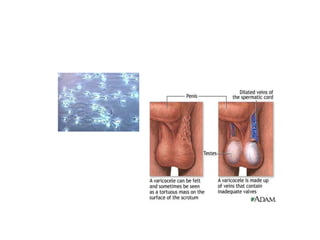
• Varicocele
• Undescended testicle
• Testosterone deficiency (male hypogonadism)
• Genetic defects
• Infections
Causes of male infertility
Impaired delivery of sperm
• Sexual issues
• Retrograde ejaculation
• Blockage of epididymis or ejaculatory ducts
• No semen (ejaculate)
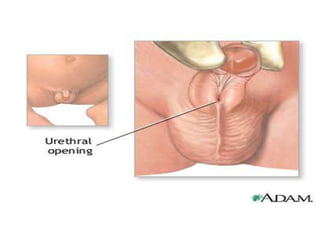
• Hypospadias
• Anti – sperm antibodies
• Cystic fibrosis
Causes of male infertility
General health and lifestyle
• Emotional stress
• Malnutrition
• Obesity
• Cancer and its treatment
• Alcohol and drugs
• Age
• Other medical conditions
Causes of male infertility
Environmental exposure
• Pesticides and other chemicals
• Overheating the testicles
• Substance abuse
• Tobacco smoking
CAUSES OF FEMALE INFERTILITY
1 Defective ovulation
Endocrine disorders
 dysfuntion of—
hypothalamus,pituitary,adrenals,thyroid
Systemic disease e.g diabetes mellitus,renal failure
Cont…
Physical disorders
Obesity
Anorexia nervosa or strict dieting
Excessive exercise
Ovarian disorders
Hormonal
Ovarian cyst or tumors
Cont…
Polycystic ovary disease
Ovaian endometriosis
2 DEFECTIVE TRANSPORT
Ovum
Tubal obstruction
-Infection( gonorrhoea, peritonitis,pelvic inflamatoery
disease)
Cont…
-Previous tubal surgery
 Fimbrial adhesions
-Previous surgery
-Endometriosis
Vagina
-Psychosexual problems(vaginismus)
-Infection( causing dyspareunia)
-Congenital anomaly
Cont…
Cervix
- Cervical trauma or surgery( cone biopsy)
-infection
-Hormonal( hostile mucus)
-Antisperm antibodies in the mucus
3. Defective implantation
Hormonal imbalance
Congenital anomalies
Infection
Fibroids
Risk factors
• Age
• Tobacco smoking
• Alcohol use
• Being overweight
• Caffeine intake
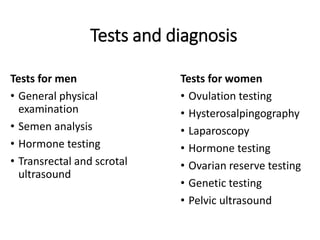
Tests and diagnosis
Tests for men
• General physical
examination
• Semen analysis
• Hormone testing
• Transrectal and scrotal
ultrasound
Tests for women
• Ovulation testing
• Hysterosalpingography
• Laparoscopy
• Hormone testing
• Ovarian reserve testing
• Genetic testing
• Pelvic ultrasound
MANAGEMENT OF INFERTILITY
• Initial management of infertile couples is through
• primary care-preliminary investigation of both partners and
subsequent referral is done.
• The investigative process is aimed at achieving an accurate
diagnosis and definition of any cause,
• an accurate estimation of the chance of conceiving without
treatment and full appraisal of treatment option
Cont…
• Both partners should be involved in the management of their
infertility.
• Full explanation should be given at each stage of the
investigation.
• Detailed history of drug usage.
• The female partiner should be investgated for progestrone
levels while the male partiner should have initial two semen
analysis done
Cont…
METHODS OF MANAGING INFERTILITY
1. Assessment
2.Pharmacologic agents
3.Therapeutic insemination
4.In vitro fertilization (IVF)
5.OTHERS
Assessment
• . The partners must be received together,
• then separately, in a quiet and relaxed atmosphere.
• A detailed history must be taken from both partners, with
special attention to past and present symptoms that may
point to any of the etiologies discussed above
Assessment
• The provider should allow enough time to discuss and give
explanations.
• Ask about duration of cohabitation;
Duration of marriage
How long the couple has tried to have a child
Number of times there is sexual intercourse in a week
Number of wife in case of polygamous marriage,
Assessment
Age of the last child
Couple’s knowledge of the menstrual cycle
Age of puberty
• Identify the type of infertility (primary or secondary)
• Get information about the following:
• Factors that may influence infertility: eg.
Frequent sexual intercourse
Absence of a partner from home
Assessment
• Sexual dysfunction (dyspareunia, vaginismus, impotence, premature
ejaculation, absence of ejaculation) .
• The menstrual cycle (including premenstrual syndrome, signs of
ovulation)
• Medical, surgical ,obstetrical, and gynecological history (STIs, earlier
use of contraception, history of hernias, abortion, premature labor,
post-abortion infections).
Assessment
• Each partner should be examined seperately to allow for
discovery of antecedents or history that may be unknown to
the other partner, such as STIs.
• The provider should conduct a complete physical
examination of both the internal and external and genital
organs, followed by a simple explanation of the physiology
of reproduction and factors that might affect fertility.
Assessment
• Examinations (Paraclinical or lab) must be explained and
discussed).
• The provider should also comfort the couple by explaining
that feelings of failure, guilt, or blame are common, and
explaining that infertility is a problem of couples, not an
individual problem.
1.Pharmacologic agents
• Clomiphene
• Insulin sensitizing agents
• Gonadotropins
• Bromocriptin
• Danazol
• Progestrone
2 Therapeutic insemination(artificial
insemination)
• It involves depositing sperm at the cervical os or in
the uterus by mechanical means
3. Invitro fertilization
Used in cases where
fertility has resulted from tubal factors,
mucus abnormalities,
male infertility,
unexplained infertility,
male and female immunologic infertility,
and cervical factors
Cont…
The woman eggs are collected from the ovaries,
fertized in the labolatory,
and placed into her uterus after normal embryo development
has begun
Other assisted reproductive techniques
• Gamete intrafallopian transfer
• Embryo cryopreservation
• In vitro fertilization using donor Oocytes
Cont…
• Embryo donation
• Micromanipulation and blastomere analysis
• - it allows individual eggs and sperm to be hundled through
the use of very fine, specialized instrument
- It allows the clinician to inject the sperm cell directly into an
egg
Cont…
• Preimplantation genetic diagnosis
• Invitro fertilization using a gestational carrier
5 Adoption
Others
Surgery
• Laparoscopic techniques
• Blockages, varicocele
• Electric or vibratory stimulation to achieve ejaculation
• Surgical sperm ejaculation
• Intracytoplasmic sperm injection (ICSI)
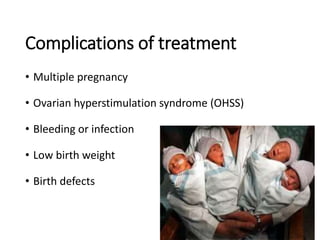
Complications of treatment
• Multiple pregnancy
• Ovarian hyperstimulation syndrome (OHSS)
• Bleeding or infection
• Low birth weight
• Birth defects
Prevention
Male:
• Avoid alcohol,
• tobacco
• street drugs
Female:
• Avoid alcohol, tobacco and
street drugs
• Avoid weight extremes
• Limit caffeine
• Limit medications
The end

2. INFERTILITY.pptx

  • 1.
  • 2.
    INFERTILITY Definition Primary infertility: awoman who has failed to conceive for at least two years despite being exposed to the possibility of pregnancy(having unprotected sex with a fertile man. • The couple has never conceived at any point.
  • 3.
    • Subfertility: isused to describe a couple having difficulty in conceiving because both partiners have reduced fertility. • Secondary infertility: is applied to couples who have been unable to conceive after one or more successful pregnancies.
  • 4.
    • Failure ofpregnancy: the woman can conceive but cannot carry the pregnancy to term.
  • 5.
    Causes of maleinfertility Impaired production or function of sperm • Impaired shape or movement of sperm • Low sperm concentration • Varicocele • Undescended testicle • Testosterone deficiency (male hypogonadism) • Genetic defects • Infections
  • 7.
    Causes of maleinfertility Impaired delivery of sperm • Sexual issues • Retrograde ejaculation • Blockage of epididymis or ejaculatory ducts • No semen (ejaculate) • Hypospadias • Anti – sperm antibodies • Cystic fibrosis
  • 9.
    Causes of maleinfertility General health and lifestyle • Emotional stress • Malnutrition • Obesity • Cancer and its treatment • Alcohol and drugs • Age • Other medical conditions
  • 10.
    Causes of maleinfertility Environmental exposure • Pesticides and other chemicals • Overheating the testicles • Substance abuse • Tobacco smoking
  • 12.
    CAUSES OF FEMALEINFERTILITY 1 Defective ovulation Endocrine disorders  dysfuntion of— hypothalamus,pituitary,adrenals,thyroid Systemic disease e.g diabetes mellitus,renal failure
  • 13.
    Cont… Physical disorders Obesity Anorexia nervosaor strict dieting Excessive exercise Ovarian disorders Hormonal Ovarian cyst or tumors
  • 14.
    Cont… Polycystic ovary disease Ovaianendometriosis 2 DEFECTIVE TRANSPORT Ovum Tubal obstruction -Infection( gonorrhoea, peritonitis,pelvic inflamatoery disease)
  • 15.
    Cont… -Previous tubal surgery Fimbrial adhesions -Previous surgery -Endometriosis Vagina -Psychosexual problems(vaginismus) -Infection( causing dyspareunia) -Congenital anomaly
  • 16.
    Cont… Cervix - Cervical traumaor surgery( cone biopsy) -infection -Hormonal( hostile mucus) -Antisperm antibodies in the mucus
  • 17.
    3. Defective implantation Hormonalimbalance Congenital anomalies Infection Fibroids
  • 18.
    Risk factors • Age •Tobacco smoking • Alcohol use • Being overweight • Caffeine intake
  • 19.
    Tests and diagnosis Testsfor men • General physical examination • Semen analysis • Hormone testing • Transrectal and scrotal ultrasound Tests for women • Ovulation testing • Hysterosalpingography • Laparoscopy • Hormone testing • Ovarian reserve testing • Genetic testing • Pelvic ultrasound
  • 20.
    MANAGEMENT OF INFERTILITY •Initial management of infertile couples is through • primary care-preliminary investigation of both partners and subsequent referral is done. • The investigative process is aimed at achieving an accurate diagnosis and definition of any cause, • an accurate estimation of the chance of conceiving without treatment and full appraisal of treatment option
  • 21.
    Cont… • Both partnersshould be involved in the management of their infertility. • Full explanation should be given at each stage of the investigation. • Detailed history of drug usage. • The female partiner should be investgated for progestrone levels while the male partiner should have initial two semen analysis done
  • 22.
    Cont… METHODS OF MANAGINGINFERTILITY 1. Assessment 2.Pharmacologic agents 3.Therapeutic insemination 4.In vitro fertilization (IVF) 5.OTHERS
  • 23.
    Assessment • . Thepartners must be received together, • then separately, in a quiet and relaxed atmosphere. • A detailed history must be taken from both partners, with special attention to past and present symptoms that may point to any of the etiologies discussed above
  • 24.
    Assessment • The providershould allow enough time to discuss and give explanations. • Ask about duration of cohabitation; Duration of marriage How long the couple has tried to have a child Number of times there is sexual intercourse in a week Number of wife in case of polygamous marriage,
  • 25.
    Assessment Age of thelast child Couple’s knowledge of the menstrual cycle Age of puberty • Identify the type of infertility (primary or secondary) • Get information about the following: • Factors that may influence infertility: eg. Frequent sexual intercourse Absence of a partner from home
  • 26.
    Assessment • Sexual dysfunction(dyspareunia, vaginismus, impotence, premature ejaculation, absence of ejaculation) . • The menstrual cycle (including premenstrual syndrome, signs of ovulation) • Medical, surgical ,obstetrical, and gynecological history (STIs, earlier use of contraception, history of hernias, abortion, premature labor, post-abortion infections).
  • 27.
    Assessment • Each partnershould be examined seperately to allow for discovery of antecedents or history that may be unknown to the other partner, such as STIs. • The provider should conduct a complete physical examination of both the internal and external and genital organs, followed by a simple explanation of the physiology of reproduction and factors that might affect fertility.
  • 28.
    Assessment • Examinations (Paraclinicalor lab) must be explained and discussed). • The provider should also comfort the couple by explaining that feelings of failure, guilt, or blame are common, and explaining that infertility is a problem of couples, not an individual problem.
  • 29.
    1.Pharmacologic agents • Clomiphene •Insulin sensitizing agents • Gonadotropins • Bromocriptin • Danazol • Progestrone
  • 30.
    2 Therapeutic insemination(artificial insemination) •It involves depositing sperm at the cervical os or in the uterus by mechanical means
  • 31.
    3. Invitro fertilization Usedin cases where fertility has resulted from tubal factors, mucus abnormalities, male infertility, unexplained infertility, male and female immunologic infertility, and cervical factors
  • 32.
    Cont… The woman eggsare collected from the ovaries, fertized in the labolatory, and placed into her uterus after normal embryo development has begun
  • 33.
    Other assisted reproductivetechniques • Gamete intrafallopian transfer • Embryo cryopreservation • In vitro fertilization using donor Oocytes
  • 34.
    Cont… • Embryo donation •Micromanipulation and blastomere analysis • - it allows individual eggs and sperm to be hundled through the use of very fine, specialized instrument - It allows the clinician to inject the sperm cell directly into an egg
  • 35.
    Cont… • Preimplantation geneticdiagnosis • Invitro fertilization using a gestational carrier 5 Adoption
  • 36.
    Others Surgery • Laparoscopic techniques •Blockages, varicocele • Electric or vibratory stimulation to achieve ejaculation • Surgical sperm ejaculation • Intracytoplasmic sperm injection (ICSI)
  • 37.
    Complications of treatment •Multiple pregnancy • Ovarian hyperstimulation syndrome (OHSS) • Bleeding or infection • Low birth weight • Birth defects
  • 38.
    Prevention Male: • Avoid alcohol, •tobacco • street drugs Female: • Avoid alcohol, tobacco and street drugs • Avoid weight extremes • Limit caffeine • Limit medications
  • 39.