MS.SASIKALA .N, MSC (N),
OBSTETRICS & GYNECOLOGICAL NURSING
LECTURER
GANGA COLLEGE OF NURSING
COIMBATORE
Infertility
Content overview
 Introduction
 Definition of infertility
 Types of infertility
 Incidence
 Risk factors
 Diagnosis
 Treatment
 Role of midwife
Introduction
Infertility happens when a couple cannot
conceive after having regular unprotected sex. It is
often defined as not conceiving after 12 months of
regular sexual intercourse without the use of birth
control. Lifestyle has a profound effect on fertility -
obesity,smoking,alcohol and recreational drugs
negatively affect the chance of conception and
pregnancy outcome.Worldwide,8 to 12 percent of
couples experience fertility problems.
Define - Infertility
• Infertility is the inability of a sexually active,non-
contracepting couple to achieve pregnancy in one
year.the male partner can be evaluated for infertility or
subfertility using a variety of clinical interventions,and
also from a laboratory evaluation of semen.
-semen manual,5th edition
• Infertility is a disease of the reproductive system
defined by the failure to achieve a clinical pregnancy
after 12 months of regular unprotected sexual
intercourse
-WHO-ICMART glossary
Types
Secondary Infertility
• Refers to couples who
have been able to get
pregnant at least
once, but now are
unable.
Primary Infertility
• Refers to couples who
have not become
pregnant after at least
1 year having sex
without using birth
control
Incidence
• Male : 35-40%
• Female : 35-40%
• Combined : 10-15%
• Unexplained : 10-15%
Risk factors
Female factors Male factors
• Hormonal factors
• Cervical factors
• Ovarian factors
• Advanced age
• Tubal factors
• Uterine factors
• Early menopause
• Environmental factors
• Coital frequency
• Mechanical factors
• Psychological stress
• Anti sperm antibodies
• Anatomic factors
• Infection
• Genetic causes
Causes
• Many physical and emotional factors can cause
infertility.it may be due to problems in the women,
men or both.
Female infertility:
Female infertility can occur when,
• A fertilized egg or embryo does not survive once it
attaches to the lining of the womb.
• The eggs cannot move from the ovaries to the
womb
• The ovaries have problems producing eggs
Cont..
• Eating disorder or poor nutrition
• Growths(such as fibroid or polyps) in the uterus
and cervix
• Hormone imbalances
• Being overweight or underweight
• Older age
• Ovarian cysts and polycystic ovary
syndrome(PCOS)
• Pelvic infection resulting in scarring or swelling of
Fallopian tubes (hydrosalpinx) or PID.
Cont..
• Scarring from sexually transmitted infection,
abdominal surgery or endometriosis
• Smoking
• Surgery to prevent pregnancy(Tubal ligation)or
failure of tubal ligation
• Thyroid disease
• Hypercalcemia : if prolactin levels are high and the
women is not pregnant or breast feeding, it may
affect ovulation and fertility.
Cont..
Male infertility occurs due to :
• Decreased number of sperm
• Blockage that prevents the sperm from being
released
• Defects in the sperm
• Birth defects
• Cancer treatments, including chemotherapy and
radiation
Cont..
• Exposure to high heat for prolonged periods
• Heavy use of alcohol, marijuana or cocaine
• Hormone imbalance
• History of testicular Infection, STIs, injury or
surgery
• Medicines such as Cimetidine, Spirinolactone and
Nitrofurantoin
• Obesity ,smoking and older age.
• Retrograde ejaculation
Diagnosis
Diagnosis
Infertility test for men :
• Medical history, medications and sexual habits
• Physical examination : the Testicle will be checked
for lumps or deformities and the shape and
structure of the penis will be examined for
abnormalities.
• Semen analysis : A sample may be taken to test for
sperm concentration,motility,color,quality,any
infections, and whether any blood is present.
Sperm counts can fluctuate, so that several
samples may be necessary.
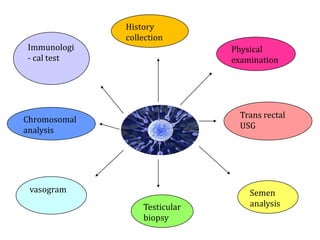
Immunologi
- cal test
History
collection
Chromosomal
analysis
vasogram
Testicular
biopsy
Semen
analysis
Trans rectal
USG
Physical
examination
Cont.…
Characteristics Normal values
Volume 2-5ml
ph 7.2 – 7.8
Sperm concentration 20 million/ml or more
Total sperm count Greater than or equal to 4
million /ejaculation
Motility 50% are more progressive
towards motility
Morphology 30% are more normal form
Viability 75% or more living
Leucocytes Less than 2
Cont..
• Blood test : To know the levels of testosterone and
the other hormones
• Ultrasound : This may reveal issues such as
ejaculatory duct obstruction or retrograde
ejaculation
• Chlamydia test :Chlamydia can affect fertility but
antibiotics can treat it.
Infertility test for women
History
Collection
Physical
examinati
on
Speculum
examinati
on
Diagnosis
of
ovulation
Diagnosis
of tubal
factors
Uetrine
factors
Cervical
factors
Endocrinop--
athy
Immunological
factors
Cont…
• A women under a general physical examination, her
medical history,medications,menstruation cycle and
sexual habits will be collected.
• Gynecological examinations
• Blood test : this can access hormonal levels and when
a women is ovulating.
• Hysterosalphingography :
Fluid is injected into the women’s uterus and x
rays are taken to determine whether the fluid travels
properly out of the uterus and into the fallopian tubes. If
a blockage is present, surgery may be necessary.
Cont..
• Laparoscopy :
A thin, flexible tube with a camera at the end is
inserted into the abdomen and pelvis, allowing a doctor
to look at the fallopian tubes, uterus and ovaries. This can
reveal signs of endometriosis,scarring,blockages, and
some irregularities of the uterus and fallopian tube.
Cont…
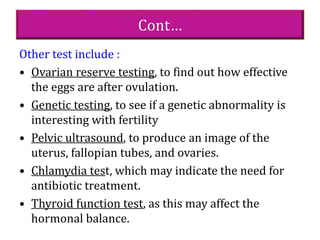
Other test include :
• Ovarian reserve testing, to find out how effective
the eggs are after ovulation.
• Genetic testing, to see if a genetic abnormality is
interesting with fertility
• Pelvic ultrasound, to produce an image of the
uterus, fallopian tubes, and ovaries.
• Chlamydia test, which may indicate the need for
antibiotic treatment.
• Thyroid function test, as this may affect the
hormonal balance.
Management
• Treatment will depend on many factors, including the
age of the person who wishes to conceive, how longthe
infertility has lasted,personal preferences and their
general state of health.
• Frequency of intercourse
• The couple may be advised o have sexual intercourse
more often around the time of ovulation.
• However a survey has suggested that the 3 days most
likely to offer a fertile window or the 2 days before
ovulation plus the 1 day of ovulation.
Cont…
Fertility test for men :
• Treatment depend on the underlying cause of the
fertility.
 Erectile dysfunction or premature ejaculation :
medication, behavioural approaches or both may help
improve fertility.
 Varicocele: surgically removing a varices vein in the
scrotum may help.
 Blockage of the ejaculatory duct :sperm can be
extracted directly from the testicles and injected into
an egg in the laboratory.
Cont…
 Retrograde ejaculation :sperm can be taken directly
from the bladder and injected into an egg in the
laboratory.
 Surgery for epididymal blockage :
a blocked epididymis can be surgically repaired.
the epididymis is a coil-like structure in the testicles
which helps store and transport sperm. if the epididymis
is blocked, sperm may not be ejaculated.
Cont..
Fertility treatment for women :
• Fertility drugs might prescribe to regulate or induce
ovulation. They include
 Clomiphene (clomid, serophene)
This encourages ovulation in case of PCODS etc.. It
makes the pituitary gland release more follicle
stimulating hormone(FSH)and luteinizing hormone(LH)
 Metformin(Glucophage)
If clomiphene is not effective, metformin may help
women with PCODS, especially when linked to insulin
resistance.
Cont…
 Human menopausal gonadotropin or HMG(repronex):
This contains both FSH and LH. Patients who do
not ovulate because of a fault in the pituitary gland.
 Follicle – stimulating hormone (gonal-F,Bravelle):
This hormone is produced by the pituitary gland
that controls oestrogen production by the ovaries. It
stimulates the ovaries to mature egg follicles.
Cont..
 Human chorionic gonadotropin(oveidrel,pregnyl):
Used together with clomiphene,HMG and FSH.
This can stimulate the follicle to ovulate.
 Gonadotropin releasing hormone (Gn-RH) analogue :
These can help women who ovulate premature
follicle during HMG treatment. It delivers a constant
supply of Gn-RH to the pituitary gland.which alters the
production of hormone, allowing the doctor to induce
follicle growth with FSH.
Cont..
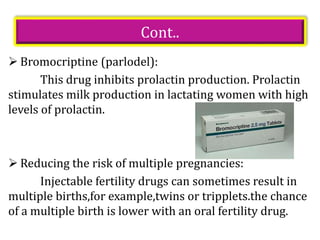
 Bromocriptine (parlodel):
This drug inhibits prolactin production. Prolactin
stimulates milk production in lactating women with high
levels of prolactin.
 Reducing the risk of multiple pregnancies:
Injectable fertility drugs can sometimes result in
multiple births,for example,twins or tripplets.the chance
of a multiple birth is lower with an oral fertility drug.
Surgical procedure for women
• If the fallopian tubes are blocked or scarred,
surgical repair may make it easier for eggs to pass
through.
• Endometriosis may be treated through laparoscopic
surgery.
Anatomic abnormalities are treated by
 Surgical treatments
Lysis of adhesion
Septoplasty
Tuboplasty
Myomectomy
 Surgery may be performed
Laparoscopically
Hysteroscopically
 If the fallopian tubes are beyond repair one must
consider In vitro fertilization.
Artificial Reproductive
Techniques
Intra Uterine Insemination(IUI)
Invitro Fertilization(IVF)
Gamete Intra Fallopian Transfer(GIFT)
Zygote Intrafallopian Transfer(ZIFT)
Intra Cytoplasmic Sperm Injection(ICSI)
Intrauterine insemination
• It is indicated as a first line management where
there are problems such as:
- Hostile cervical mucus
- Anti sperm or male fertility problem(low
sperm count or premature ejaculation)
- Although tubal patency of female partner
must be assured
Invitro Fertilization
• It is indicated in case where the
female partner has
-Uterine tube occlusion
-Endometriosis or cervical
mucus problems or where male
factors are main problems
• Stimulation of the ovaries to
produce more than one egg is
required and treatment starts
with pituitary desensitization
(done by gonadotrophin
injection)
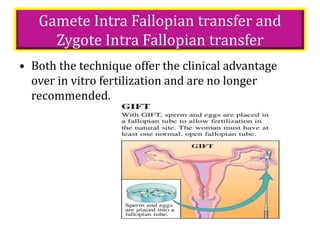
Gamete Intra Fallopian transfer and
Zygote Intra Fallopian transfer
• Both the technique offer the clinical advantage
over in vitro fertilization and are no longer
recommended.
Intra Cytoplasmic Sperm Injection
• Developed in 1992
• It is a highly specialized variant of IVF treatment
that involves the injection of a single sperm into
the cytoplasm of an egg with a fine glass needle.
• It is useful technique when sperm motility is poor.
• In azoospermia man sperm can be obtained
surgically from the epididymis or by extraction
from testis itself.
Third party assisted ART
• When couples do not achieve pregnancy from the
infertility treatments or traditional ART they may
choose to use a third party assisted ART method to
have a child.
Sperm donation
Egg donation
Surrogacy
Adoption
Sperm donation
• Couples can be donated sperm when a man does
not produces sperm or produces very low no of
sperm and if he has a genetic disease
• Donated sperm can be used with intra uterine
insemination or with IVF
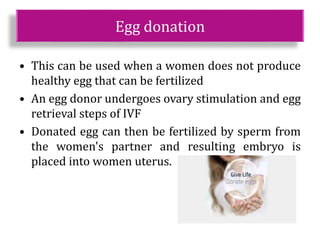
Egg donation
• This can be used when a women does not produce
healthy egg that can be fertilized
• An egg donor undergoes ovary stimulation and egg
retrieval steps of IVF
• Donated egg can then be fertilized by sperm from
the women's partner and resulting embryo is
placed into women uterus.
Surrogacy
• Legal arrangements for surrogacy require the
commencing couple to both over the age of
18,married to each other and the child genetically
related to at least one of them.
• Surrogate mother acts as a host as the embryo is
placed in her uterus
Infertility counselling
• Infertility counselling deals with the psycho social
impact of fertility in terms of:
• Intervention
• Treatment and
• After-effects of both successful and unsuccessful
treatments.
• It also involves therapeutic work to help patient cope
with the consequences of infertility & treatment.
Objectives and need of fertility
counselling
• Informed consent
• To offer coping strategies to couples
• To facilitate decision making
• To offer preparation for procedures
• To help client in achieving a better quality of life
• To provide genetic counselling.
Counselling services
• IVF – group discussion by staff
• Third party reproduction for both donors &
recipient.
• Therapeutic counselling
• Crisis counselling
• Assessment & follow up.
Advantages of Infertility counselling
• Helps to deal with the emotional stress.
• Provide extra support.
• Allow the client in exploring all possible options
for family.
• Help the couples in overcoming the dilemmas &
deciding the right fertility treatment.
• Explains about the infertility management &
specific treatment.
Role of nurse in infertility counselling
• Receiving the patient & family and make them
accessible & comfortable for counselling.
• Fertility nurse specialist provide care for the
individuals and couples before, during and after
fertility treatment.
Nurse need to obtain history
as prenatal, family and other
relevant history.
Cont..
• Nurse has to perform primary physical
examination and collect other relevant
information regarding patient of reports.
• Give psychological support throughout the
counselling.
• Collect other information about tests, reports and
documents.
• Establish plan of care with family and coordinate
care with other health care professionals.
Cont..
• Maintain privacy and confidentiality of all cases.
• Performing inseminations
• Performing embryo transfers.
• Ensure follow up & supportive services to
individual and family during counselling.
Infertility

Infertility

  • 1.
    MS.SASIKALA .N, MSC(N), OBSTETRICS & GYNECOLOGICAL NURSING LECTURER GANGA COLLEGE OF NURSING COIMBATORE
  • 2.
  • 3.
    Content overview  Introduction Definition of infertility  Types of infertility  Incidence  Risk factors  Diagnosis  Treatment  Role of midwife
  • 4.
    Introduction Infertility happens whena couple cannot conceive after having regular unprotected sex. It is often defined as not conceiving after 12 months of regular sexual intercourse without the use of birth control. Lifestyle has a profound effect on fertility - obesity,smoking,alcohol and recreational drugs negatively affect the chance of conception and pregnancy outcome.Worldwide,8 to 12 percent of couples experience fertility problems.
  • 5.
    Define - Infertility •Infertility is the inability of a sexually active,non- contracepting couple to achieve pregnancy in one year.the male partner can be evaluated for infertility or subfertility using a variety of clinical interventions,and also from a laboratory evaluation of semen. -semen manual,5th edition • Infertility is a disease of the reproductive system defined by the failure to achieve a clinical pregnancy after 12 months of regular unprotected sexual intercourse -WHO-ICMART glossary
  • 6.
    Types Secondary Infertility • Refersto couples who have been able to get pregnant at least once, but now are unable. Primary Infertility • Refers to couples who have not become pregnant after at least 1 year having sex without using birth control
  • 7.
    Incidence • Male :35-40% • Female : 35-40% • Combined : 10-15% • Unexplained : 10-15%
  • 8.
    Risk factors Female factorsMale factors • Hormonal factors • Cervical factors • Ovarian factors • Advanced age • Tubal factors • Uterine factors • Early menopause • Environmental factors • Coital frequency • Mechanical factors • Psychological stress • Anti sperm antibodies • Anatomic factors • Infection • Genetic causes
  • 9.
    Causes • Many physicaland emotional factors can cause infertility.it may be due to problems in the women, men or both. Female infertility: Female infertility can occur when, • A fertilized egg or embryo does not survive once it attaches to the lining of the womb. • The eggs cannot move from the ovaries to the womb • The ovaries have problems producing eggs
  • 10.
    Cont.. • Eating disorderor poor nutrition • Growths(such as fibroid or polyps) in the uterus and cervix • Hormone imbalances • Being overweight or underweight • Older age • Ovarian cysts and polycystic ovary syndrome(PCOS) • Pelvic infection resulting in scarring or swelling of Fallopian tubes (hydrosalpinx) or PID.
  • 11.
    Cont.. • Scarring fromsexually transmitted infection, abdominal surgery or endometriosis • Smoking • Surgery to prevent pregnancy(Tubal ligation)or failure of tubal ligation • Thyroid disease • Hypercalcemia : if prolactin levels are high and the women is not pregnant or breast feeding, it may affect ovulation and fertility.
  • 12.
    Cont.. Male infertility occursdue to : • Decreased number of sperm • Blockage that prevents the sperm from being released • Defects in the sperm • Birth defects • Cancer treatments, including chemotherapy and radiation
  • 13.
    Cont.. • Exposure tohigh heat for prolonged periods • Heavy use of alcohol, marijuana or cocaine • Hormone imbalance • History of testicular Infection, STIs, injury or surgery • Medicines such as Cimetidine, Spirinolactone and Nitrofurantoin • Obesity ,smoking and older age. • Retrograde ejaculation
  • 14.
  • 15.
    Diagnosis Infertility test formen : • Medical history, medications and sexual habits • Physical examination : the Testicle will be checked for lumps or deformities and the shape and structure of the penis will be examined for abnormalities. • Semen analysis : A sample may be taken to test for sperm concentration,motility,color,quality,any infections, and whether any blood is present. Sperm counts can fluctuate, so that several samples may be necessary.
  • 16.
  • 17.
    Cont.… Characteristics Normal values Volume2-5ml ph 7.2 – 7.8 Sperm concentration 20 million/ml or more Total sperm count Greater than or equal to 4 million /ejaculation Motility 50% are more progressive towards motility Morphology 30% are more normal form Viability 75% or more living Leucocytes Less than 2
  • 18.
    Cont.. • Blood test: To know the levels of testosterone and the other hormones • Ultrasound : This may reveal issues such as ejaculatory duct obstruction or retrograde ejaculation • Chlamydia test :Chlamydia can affect fertility but antibiotics can treat it.
  • 19.
    Infertility test forwomen History Collection Physical examinati on Speculum examinati on Diagnosis of ovulation Diagnosis of tubal factors Uetrine factors Cervical factors Endocrinop-- athy Immunological factors
  • 20.
    Cont… • A womenunder a general physical examination, her medical history,medications,menstruation cycle and sexual habits will be collected. • Gynecological examinations • Blood test : this can access hormonal levels and when a women is ovulating. • Hysterosalphingography : Fluid is injected into the women’s uterus and x rays are taken to determine whether the fluid travels properly out of the uterus and into the fallopian tubes. If a blockage is present, surgery may be necessary.
  • 21.
    Cont.. • Laparoscopy : Athin, flexible tube with a camera at the end is inserted into the abdomen and pelvis, allowing a doctor to look at the fallopian tubes, uterus and ovaries. This can reveal signs of endometriosis,scarring,blockages, and some irregularities of the uterus and fallopian tube.
  • 22.
    Cont… Other test include: • Ovarian reserve testing, to find out how effective the eggs are after ovulation. • Genetic testing, to see if a genetic abnormality is interesting with fertility • Pelvic ultrasound, to produce an image of the uterus, fallopian tubes, and ovaries. • Chlamydia test, which may indicate the need for antibiotic treatment. • Thyroid function test, as this may affect the hormonal balance.
  • 23.
    Management • Treatment willdepend on many factors, including the age of the person who wishes to conceive, how longthe infertility has lasted,personal preferences and their general state of health. • Frequency of intercourse • The couple may be advised o have sexual intercourse more often around the time of ovulation. • However a survey has suggested that the 3 days most likely to offer a fertile window or the 2 days before ovulation plus the 1 day of ovulation.
  • 24.
    Cont… Fertility test formen : • Treatment depend on the underlying cause of the fertility.  Erectile dysfunction or premature ejaculation : medication, behavioural approaches or both may help improve fertility.  Varicocele: surgically removing a varices vein in the scrotum may help.  Blockage of the ejaculatory duct :sperm can be extracted directly from the testicles and injected into an egg in the laboratory.
  • 25.
    Cont…  Retrograde ejaculation:sperm can be taken directly from the bladder and injected into an egg in the laboratory.  Surgery for epididymal blockage : a blocked epididymis can be surgically repaired. the epididymis is a coil-like structure in the testicles which helps store and transport sperm. if the epididymis is blocked, sperm may not be ejaculated.
  • 26.
    Cont.. Fertility treatment forwomen : • Fertility drugs might prescribe to regulate or induce ovulation. They include  Clomiphene (clomid, serophene) This encourages ovulation in case of PCODS etc.. It makes the pituitary gland release more follicle stimulating hormone(FSH)and luteinizing hormone(LH)  Metformin(Glucophage) If clomiphene is not effective, metformin may help women with PCODS, especially when linked to insulin resistance.
  • 27.
    Cont…  Human menopausalgonadotropin or HMG(repronex): This contains both FSH and LH. Patients who do not ovulate because of a fault in the pituitary gland.  Follicle – stimulating hormone (gonal-F,Bravelle): This hormone is produced by the pituitary gland that controls oestrogen production by the ovaries. It stimulates the ovaries to mature egg follicles.
  • 28.
    Cont..  Human chorionicgonadotropin(oveidrel,pregnyl): Used together with clomiphene,HMG and FSH. This can stimulate the follicle to ovulate.  Gonadotropin releasing hormone (Gn-RH) analogue : These can help women who ovulate premature follicle during HMG treatment. It delivers a constant supply of Gn-RH to the pituitary gland.which alters the production of hormone, allowing the doctor to induce follicle growth with FSH.
  • 29.
    Cont..  Bromocriptine (parlodel): Thisdrug inhibits prolactin production. Prolactin stimulates milk production in lactating women with high levels of prolactin.  Reducing the risk of multiple pregnancies: Injectable fertility drugs can sometimes result in multiple births,for example,twins or tripplets.the chance of a multiple birth is lower with an oral fertility drug.
  • 30.
    Surgical procedure forwomen • If the fallopian tubes are blocked or scarred, surgical repair may make it easier for eggs to pass through. • Endometriosis may be treated through laparoscopic surgery.
  • 31.
    Anatomic abnormalities aretreated by  Surgical treatments Lysis of adhesion Septoplasty Tuboplasty Myomectomy  Surgery may be performed Laparoscopically Hysteroscopically  If the fallopian tubes are beyond repair one must consider In vitro fertilization.
  • 32.
    Artificial Reproductive Techniques Intra UterineInsemination(IUI) Invitro Fertilization(IVF) Gamete Intra Fallopian Transfer(GIFT) Zygote Intrafallopian Transfer(ZIFT) Intra Cytoplasmic Sperm Injection(ICSI)
  • 33.
    Intrauterine insemination • Itis indicated as a first line management where there are problems such as: - Hostile cervical mucus - Anti sperm or male fertility problem(low sperm count or premature ejaculation) - Although tubal patency of female partner must be assured
  • 34.
    Invitro Fertilization • Itis indicated in case where the female partner has -Uterine tube occlusion -Endometriosis or cervical mucus problems or where male factors are main problems • Stimulation of the ovaries to produce more than one egg is required and treatment starts with pituitary desensitization (done by gonadotrophin injection)
  • 35.
    Gamete Intra Fallopiantransfer and Zygote Intra Fallopian transfer • Both the technique offer the clinical advantage over in vitro fertilization and are no longer recommended.
  • 36.
    Intra Cytoplasmic SpermInjection • Developed in 1992 • It is a highly specialized variant of IVF treatment that involves the injection of a single sperm into the cytoplasm of an egg with a fine glass needle. • It is useful technique when sperm motility is poor. • In azoospermia man sperm can be obtained surgically from the epididymis or by extraction from testis itself.
  • 37.
    Third party assistedART • When couples do not achieve pregnancy from the infertility treatments or traditional ART they may choose to use a third party assisted ART method to have a child. Sperm donation Egg donation Surrogacy Adoption
  • 38.
    Sperm donation • Couplescan be donated sperm when a man does not produces sperm or produces very low no of sperm and if he has a genetic disease • Donated sperm can be used with intra uterine insemination or with IVF
  • 39.
    Egg donation • Thiscan be used when a women does not produce healthy egg that can be fertilized • An egg donor undergoes ovary stimulation and egg retrieval steps of IVF • Donated egg can then be fertilized by sperm from the women's partner and resulting embryo is placed into women uterus.
  • 40.
    Surrogacy • Legal arrangementsfor surrogacy require the commencing couple to both over the age of 18,married to each other and the child genetically related to at least one of them. • Surrogate mother acts as a host as the embryo is placed in her uterus
  • 41.
    Infertility counselling • Infertilitycounselling deals with the psycho social impact of fertility in terms of: • Intervention • Treatment and • After-effects of both successful and unsuccessful treatments. • It also involves therapeutic work to help patient cope with the consequences of infertility & treatment.
  • 42.
    Objectives and needof fertility counselling • Informed consent • To offer coping strategies to couples • To facilitate decision making • To offer preparation for procedures • To help client in achieving a better quality of life • To provide genetic counselling.
  • 43.
    Counselling services • IVF– group discussion by staff • Third party reproduction for both donors & recipient. • Therapeutic counselling • Crisis counselling • Assessment & follow up.
  • 44.
    Advantages of Infertilitycounselling • Helps to deal with the emotional stress. • Provide extra support. • Allow the client in exploring all possible options for family. • Help the couples in overcoming the dilemmas & deciding the right fertility treatment. • Explains about the infertility management & specific treatment.
  • 45.
    Role of nursein infertility counselling • Receiving the patient & family and make them accessible & comfortable for counselling. • Fertility nurse specialist provide care for the individuals and couples before, during and after fertility treatment. Nurse need to obtain history as prenatal, family and other relevant history.
  • 46.
    Cont.. • Nurse hasto perform primary physical examination and collect other relevant information regarding patient of reports. • Give psychological support throughout the counselling. • Collect other information about tests, reports and documents. • Establish plan of care with family and coordinate care with other health care professionals.
  • 47.
    Cont.. • Maintain privacyand confidentiality of all cases. • Performing inseminations • Performing embryo transfers. • Ensure follow up & supportive services to individual and family during counselling.