INFERTILITY
 PRESENTED
BY
 Miss Daminee
Patel
DEFINITION
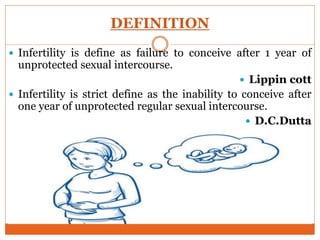
 Infertility is define as failure to conceive after 1 year of
unprotected sexual intercourse.
 Lippin cott
 Infertility is strict define as the inability to conceive after
one year of unprotected regular sexual intercourse.
 D.C.Dutta
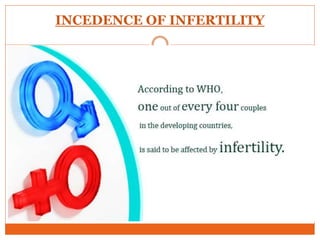
INCEDENCE OF INFERTILITY
FACTORS CONTRIBUTING TO
INFERTILITY
 Disturbance in spermatogenesis( production of
sperm cell)
 Obstruction in somniferous tubules, duezor
vessles preventing movement of spermatozoa.
 Qualitative and quantitative changes in seminal
fluid preventing sperm motility.
 Development of autoimmunity that mobilize
sperm.
 Problems in ejaculation or deposition preventing
spermatozoa from being placed close enough to
the women cervix to allow ready preparation and
fertilization.
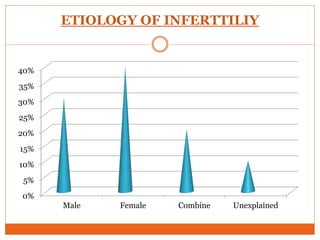
ETIOLOGY OF INFERTTILIY
0%
5%
10%
15%
20%
25%
30%
35%
40%
Male Female Combine Unexplained
MALE FACTORS
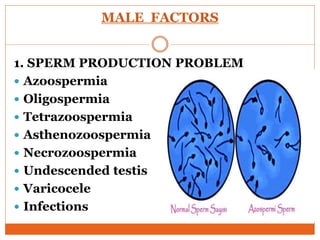
1. SPERM PRODUCTION PROBLEM
 Azoospermia
 Oligospermia
 Tetrazoospermia
 Asthenozoospermia
 Necrozoospermia
 Undescended testis
 Varicocele
 Infections
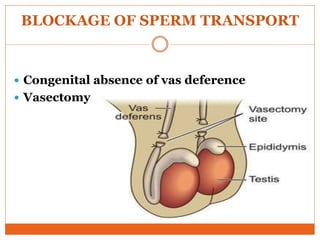
BLOCKAGE OF SPERM TRANSPORT
 Congenital absence of vas deference
 Vasectomy
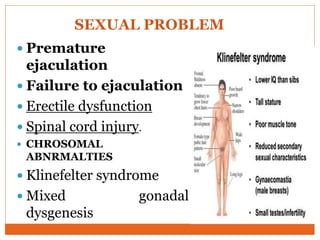
SEXUAL PROBLEM
 Premature
ejaculation
 Failure to ejaculation
 Erectile dysfunction
 Spinal cord injury.
 CHROSOMAL
ABNRMALTIES
 Klinefelter syndrome
 Mixed gonadal
dysgenesis
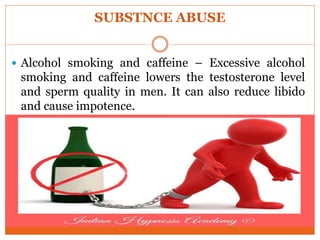
SUBSTNCE ABUSE
 Alcohol smoking and caffeine – Excessive alcohol
smoking and caffeine lowers the testosterone level
and sperm quality in men. It can also reduce libido
and cause impotence.
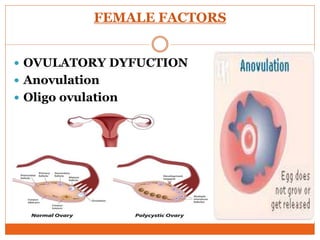
FEMALE FACTORS
 OVULATORY DYFUCTION
 Anovulation
 Oligo ovulation
DECREASED OVARIAN RESERVE
 The number of resting non growing
primordial follicle refers to as the ovarian
reserve. The main reason for decreasing
ovarian reserve is -
 Advance maternal age
 Premature ovarian failure
 Resistant ovary syndrome
TUBAL FACTORS
 Pelvic infections
 Tubal pregnancy
 Endometriosis
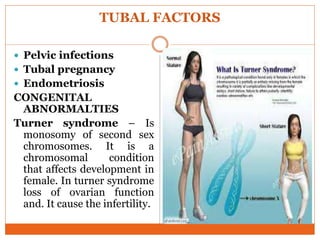
CONGENITAL
ABNORMALTIES
Turner syndrome – Is
monosomy of second sex
chromosomes. It is a
chromosomal condition
that affects development in
female. In turner syndrome
loss of ovarian function
and. It cause the infertility.
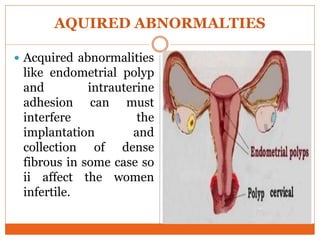
AQUIRED ABNORMALTIES
 Acquired abnormalities
like endometrial polyp
and intrauterine
adhesion can must
interfere the
implantation and
collection of dense
fibrous in some case so
ii affect the women
infertile.
 CERVICAL FACTORS
 PERITONEAL FACTORS
 Disease of peritoneal cavity may cause infertility,
Infertility due to peritoneal polyp.
 Peritubal and periovarian adhesion and tubal
abstructtion cause infertility.
 Kinking ( twisting) of fallopian tube.
 ANTISPERM ANTIBODIES
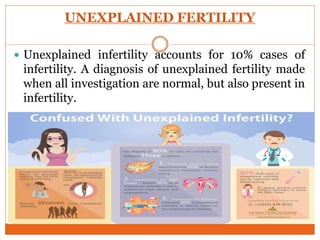
UNEXPLAINED FERTILITY
 Unexplained infertility accounts for 10% cases of
infertility. A diagnosis of unexplained fertility made
when all investigation are normal, but also present in
infertility.
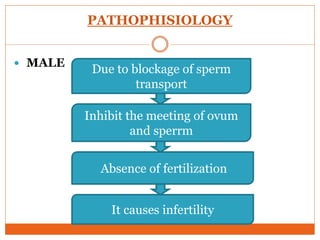
PATHOPHISIOLOGY
 MALE
Due to blockage of sperm
transport
Inhibit the meeting of ovum
and sperrm
Absence of fertilization
It causes infertility
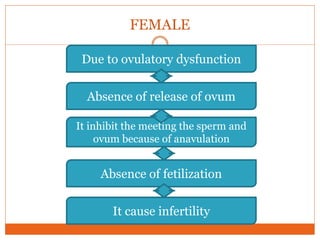
FEMALE
Due to ovulatory dysfunction
Absence of release of ovum
It inhibit the meeting the sperm and
ovum because of anavulation
Absence of fetilization
It cause infertility
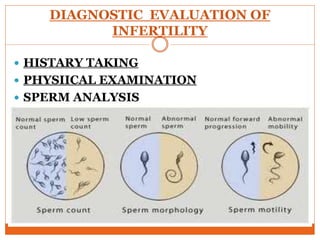
DIAGNOSTIC EVALUATION OF
INFERTILITY
 HISTARY TAKING
 PHYSIICAL EXAMINATION
 SPERM ANALYSIS
Immuno beads are small beads that are treated with
special proteins. If antibodies to sperm are present,
these beads will attach to the sperm. One hundred
motile (swimming) sperm are evaluated for bead
attachment. For the male, if twenty or more of these
sperm have beads attached to them (a result of 20%
or greater), this is considered a positive test and
indicates that antisperm antibodies may be present.
For the female, a result greater than 10% is
considered a positive test.
ANTISPERM ANTIBODY TESTING
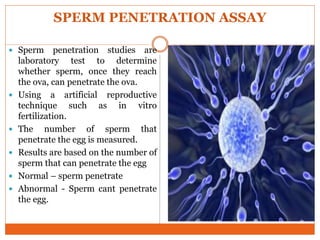
SPERM PENETRATION ASSAY
 Sperm penetration studies are
laboratory test to determine
whether sperm, once they reach
the ova, can penetrate the ova.
 Using a artificial reproductive
technique such as in vitro
fertilization.
 The number of sperm that
penetrate the egg is measured.
 Results are based on the number of
sperm that can penetrate the egg
 Normal – sperm penetrate
 Abnormal - Sperm cant penetrate
the egg.
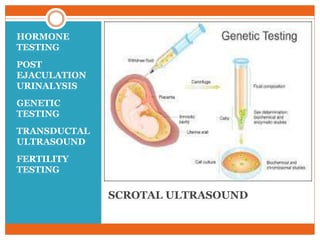
SCROTAL ULTRASOUND
HORMONE
TESTING
POST
EJACULATION
URINALYSIS
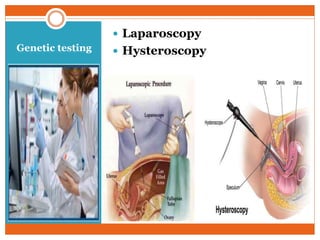
GENETIC
TESTING
TRANSDUCTAL
ULTRASOUND
FERTILITY
TESTING
FEMALE
 DETERMINATION OF OVULATION
 By basal body temperature
 Determination by cervical mucus assessment
 Determination by strip
 ASSESSMENT OF OVARIAN RESERVE (
AMH TESTING)
 ASSESSMENT OF THE FALLOPIAN TUBES
AND UTERUS
 Hysterosalpingogram (HSG)
Genetic testing
 Laparoscopy
 Hysteroscopy
MANAGEMENT
 MALE PARTENR
 Antisperm antibodies
 Retrograde ejaculation
 Lifestyle
 SURGICAL CARE
 Varicocelectomy
 Vasovasostomy or vasoepididymostomy
Electroejaculation
Important
Nutrients for
Male Fertility
Health
Zinc
Folic acid
B12
Vitamin C
Eat at least one
large green salad
per day
FEMALE PARTNER
 Correction of underlying problem
 Assisted Reproductive Technology or
ART: Assisted reproductive
technology (ART) is the technology used to
achieve pregnancy in procedures such
as fertility medication, in vitro
fertilization and surrogacy. It is reproductive
technology used primarily
for infertility treatments, and is also known
as fertility treatment.
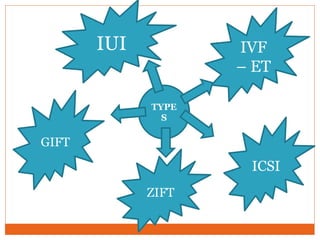
TYPE
S
GIFT
IVF
– ET
IUI
ZIFT
ICSI
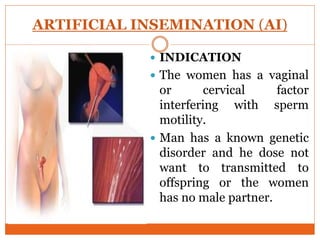
ARTIFICIAL INSEMINATION (AI)
 INDICATION
 The women has a vaginal
or cervical factor
interfering with sperm
motility.
 Man has a known genetic
disorder and he dose not
want to transmitted to
offspring or the women
has no male partner.
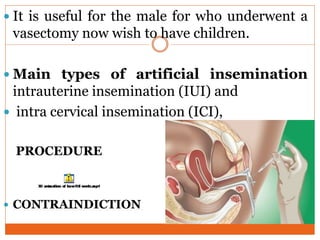
 It is useful for the male for who underwent a
vasectomy now wish to have children.
 Main types of artificial insemination
intrauterine insemination (IUI) and
 intra cervical insemination (ICI),
PROCEDURE
 CONTRAINDICTION
IN VITROFERTILIZATION AND EMBRYO
TRANSFER
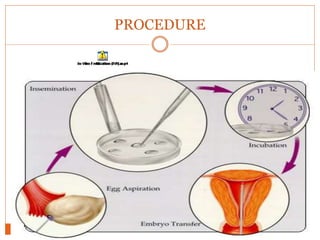
 In Vitro Fertilization is an assisted reproductive
technology (ART) commonly referred to as IVF. IVF is
the process of fertilization by extracting eggs,
retrieving a sperm sample, and then manually
combining an egg and sperm in a laboratory dish. The
embryo(s) is then transferred to the uterus.
 INDICTION
 Damage follopian tube
 Decreased sperm count
 Genetic and ovulation disorder
PROCEDURE
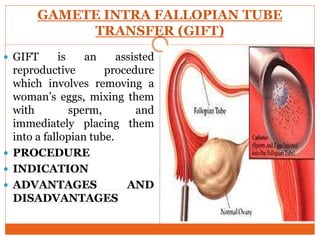
GAMETE INTRA FALLOPIAN TUBE
TRANSFER (GIFT)
 GIFT is an assisted
reproductive procedure
which involves removing a
woman’s eggs, mixing them
with sperm, and
immediately placing them
into a fallopian tube.
 PROCEDURE
 INDICATION
 ADVANTAGES AND
DISADVANTAGES
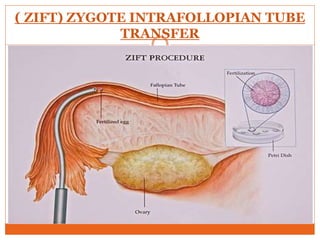
( ZIFT) ZYGOTE INTRAFOLLOPIAN TUBE
TRANSFER
PROCEDURE
 A woman’s ovaries are stimulated with medications to
increase the probability of producing multiple eggs.
 Eggs are then collected through an aspiration procedure.
 Those eggs are fertilized in a laboratory in a procedure
identical to IVF, with the exception of the time frame.
During the ZIFT procedure, fertilized eggs are
transferred within 24 hours, versus 3-5 days as used in a
regular IVF cycle.
 The fertilized eggs are then transferred through a
laparoscopic procedure where a catheter is placed deep
in the fallopian tube and the fertilized eggs injected.
 The final step is to watch for early pregnancy symptoms.
The fertility specialist will probably use a blood test to
determine if pregnancy has occurred.
INDICATINON
 Tubal blockage
 Significant tubal damage
 An anatomic problem with the uterus, such as severe
intrauterine adhesions
 Sperm that is not able to penetrate an egg
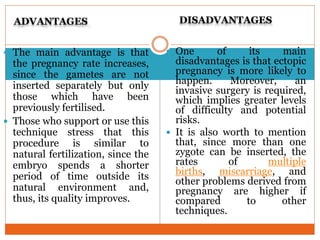
ADVANTAGES DISADVANTAGES
 The main advantage is that
the pregnancy rate increases,
since the gametes are not
inserted separately but only
those which have been
previously fertilised.
 Those who support or use this
technique stress that this
procedure is similar to
natural fertilization, since the
embryo spends a shorter
period of time outside its
natural environment and,
thus, its quality improves.
 One of its main
disadvantages is that ectopic
pregnancy is more likely to
happen. Moreover, an
invasive surgery is required,
which implies greater levels
of difficulty and potential
risks.
 It is also worth to mention
that, since more than one
zygote can be inserted, the
rates of multiple
births, miscarriage, and
other problems derived from
pregnancy are higher if
compared to other
techniques.
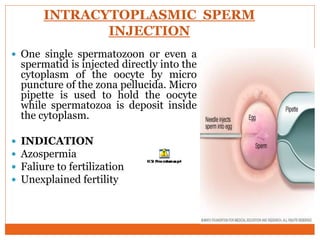
INTRACYTOPLASMIC SPERM
INJECTION
 One single spermatozoon or even a
spermatid is injected directly into the
cytoplasm of the oocyte by micro
puncture of the zona pellucida. Micro
pipette is used to hold the oocyte
while spermatozoa is deposit inside
the cytoplasm.
 INDICATION
 Azospermia
 Faliure to fertilization
 Unexplained fertility
OTHER TECHNIQUE
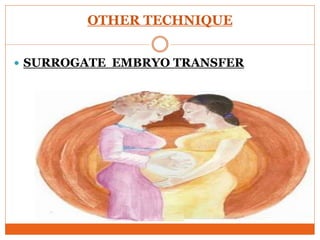
 SURROGATE EMBRYO TRANSFER
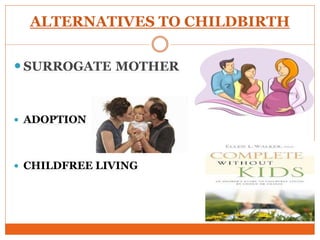
ALTERNATIVES TO CHILDBIRTH
 SURROGATE MOTHER
 ADOPTION
 CHILDFREE LIVING
ADOPTION PROCEDURE
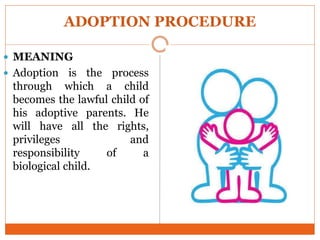
 MEANING
 Adoption is the process
through which a child
becomes the lawful child of
his adoptive parents. He
will have all the rights,
privileges and
responsibility of a
biological child.
Who can be adopted?
 An orphan
 An abandoned child
 A surrendered child
WHO CAN ADOPT?
 Any Indian, NRI or foreign citizen can adopt a child,
though the procedure for all three is different.
 Any male or female irrespective of their marital
status is eligible to adopt.
 A single female can adopt a child of any gender but a
single male cannot adopt a girl child.
 If a couple is adopting, they should have two years of
stable marriage and consent of both the spouses is
necessary.
 Age difference should not be less than 25years
between the adoptive parents and the adoptive child.
CONDITIONS TO BE FULFILLED
 The prospective parents should be emotionally,
mentally and physically stable.
 They should be financially capable to raise a child.
 They should not have more than four kids.
 They should not be suffering from a life threatening
disease
Procedure followed for adoption of a child
 Prospective parents register online or can reach District
Child Protection Officer (DCPO) to register the
prospective parents online. The application form is
available atwww.cara.nic.in.
 The adoption agency prepares a Home Study report
describing the various factors and circumstances of the
family within one month of the registration.
 The home study report shall be posted on the database by
the adoption agency.
 The parents are given chance to choose their prospective
child based on their preferences.
 They are shown photographs, child study reports and
medical examination reports of up to six children.
 The prospective adoptive parents may reserve one child
within a period of forty eight hours for possible adoption
and the rest of the children would be released for other
prospective parents.
 The adoption agency will fix the meeting of the
prospective adoptive parents to access whether they are
suitable parents or not. The parents should also be
allowed to have a meeting with the child.
 The entire process of matching should not take more than
fifteen days.
 While accepting the child the prospective adoptive parents
should sign the Child Study Report in presence of social
worker.
 If prospective parent do not accept the child or the child
do not accept the parent then same procedure will be
followed for other chances.
LEGAL AND ETHICAL ISSUES THAT ARE
REGULATED INCLUDE
 The use of donor sperm and eggs: for example,
anonymity is guaranteed in law for donors in Greece, but no
longer allowed in the UK.
 The use and payment of surrogates: for example,
commercial surrogacy is banned in many countries but is
completely legal in India.
 The in vitro development period allowed for
embryos: for example, in many countries, embryos are
allowed to develop for several days to allow selection of the
healthiest candidates but in others only early embryos can be
implanted.

 The selection process for embryos, including sex
selection and genetic screening: for example, pre-
implantation genetic diagnosis (PGD) is banned in some
countries but allowed under strict regulations in others.
 The maximum number of embryos that can be
transferred: for example, many countries have strict
single embryo transfer policies, while others will leave the
number of embryos implanted up to the discretion of the
fertility specialist.
 The maximum storage time for frozen embryos: for
example, Spain and Canada allow unlimited storage,
whereas Brazil has a limit of just three years.
Infertility  slideshare

Infertility slideshare

  • 1.
  • 2.
    DEFINITION  Infertility isdefine as failure to conceive after 1 year of unprotected sexual intercourse.  Lippin cott  Infertility is strict define as the inability to conceive after one year of unprotected regular sexual intercourse.  D.C.Dutta
  • 3.
  • 4.
    FACTORS CONTRIBUTING TO INFERTILITY Disturbance in spermatogenesis( production of sperm cell)  Obstruction in somniferous tubules, duezor vessles preventing movement of spermatozoa.  Qualitative and quantitative changes in seminal fluid preventing sperm motility.  Development of autoimmunity that mobilize sperm.  Problems in ejaculation or deposition preventing spermatozoa from being placed close enough to the women cervix to allow ready preparation and fertilization.
  • 7.
  • 8.
    MALE FACTORS 1. SPERMPRODUCTION PROBLEM  Azoospermia  Oligospermia  Tetrazoospermia  Asthenozoospermia  Necrozoospermia  Undescended testis  Varicocele  Infections
  • 9.
    BLOCKAGE OF SPERMTRANSPORT  Congenital absence of vas deference  Vasectomy
  • 10.
    SEXUAL PROBLEM  Premature ejaculation Failure to ejaculation  Erectile dysfunction  Spinal cord injury.  CHROSOMAL ABNRMALTIES  Klinefelter syndrome  Mixed gonadal dysgenesis
  • 11.
    SUBSTNCE ABUSE  Alcoholsmoking and caffeine – Excessive alcohol smoking and caffeine lowers the testosterone level and sperm quality in men. It can also reduce libido and cause impotence.
  • 12.
    FEMALE FACTORS  OVULATORYDYFUCTION  Anovulation  Oligo ovulation
  • 13.
    DECREASED OVARIAN RESERVE The number of resting non growing primordial follicle refers to as the ovarian reserve. The main reason for decreasing ovarian reserve is -  Advance maternal age  Premature ovarian failure  Resistant ovary syndrome
  • 14.
    TUBAL FACTORS  Pelvicinfections  Tubal pregnancy  Endometriosis CONGENITAL ABNORMALTIES Turner syndrome – Is monosomy of second sex chromosomes. It is a chromosomal condition that affects development in female. In turner syndrome loss of ovarian function and. It cause the infertility.
  • 15.
    AQUIRED ABNORMALTIES  Acquiredabnormalities like endometrial polyp and intrauterine adhesion can must interfere the implantation and collection of dense fibrous in some case so ii affect the women infertile.
  • 16.
     CERVICAL FACTORS PERITONEAL FACTORS  Disease of peritoneal cavity may cause infertility, Infertility due to peritoneal polyp.  Peritubal and periovarian adhesion and tubal abstructtion cause infertility.  Kinking ( twisting) of fallopian tube.  ANTISPERM ANTIBODIES
  • 17.
    UNEXPLAINED FERTILITY  Unexplainedinfertility accounts for 10% cases of infertility. A diagnosis of unexplained fertility made when all investigation are normal, but also present in infertility.
  • 18.
    PATHOPHISIOLOGY  MALE Due toblockage of sperm transport Inhibit the meeting of ovum and sperrm Absence of fertilization It causes infertility
  • 19.
    FEMALE Due to ovulatorydysfunction Absence of release of ovum It inhibit the meeting the sperm and ovum because of anavulation Absence of fetilization It cause infertility
  • 20.
    DIAGNOSTIC EVALUATION OF INFERTILITY HISTARY TAKING  PHYSIICAL EXAMINATION  SPERM ANALYSIS
  • 21.
    Immuno beads aresmall beads that are treated with special proteins. If antibodies to sperm are present, these beads will attach to the sperm. One hundred motile (swimming) sperm are evaluated for bead attachment. For the male, if twenty or more of these sperm have beads attached to them (a result of 20% or greater), this is considered a positive test and indicates that antisperm antibodies may be present. For the female, a result greater than 10% is considered a positive test. ANTISPERM ANTIBODY TESTING
  • 22.
    SPERM PENETRATION ASSAY Sperm penetration studies are laboratory test to determine whether sperm, once they reach the ova, can penetrate the ova.  Using a artificial reproductive technique such as in vitro fertilization.  The number of sperm that penetrate the egg is measured.  Results are based on the number of sperm that can penetrate the egg  Normal – sperm penetrate  Abnormal - Sperm cant penetrate the egg.
  • 23.
  • 24.
    FEMALE  DETERMINATION OFOVULATION  By basal body temperature  Determination by cervical mucus assessment  Determination by strip  ASSESSMENT OF OVARIAN RESERVE ( AMH TESTING)  ASSESSMENT OF THE FALLOPIAN TUBES AND UTERUS  Hysterosalpingogram (HSG)
  • 25.
  • 26.
    MANAGEMENT  MALE PARTENR Antisperm antibodies  Retrograde ejaculation  Lifestyle  SURGICAL CARE  Varicocelectomy  Vasovasostomy or vasoepididymostomy Electroejaculation
  • 27.
    Important Nutrients for Male Fertility Health Zinc Folicacid B12 Vitamin C Eat at least one large green salad per day
  • 28.
    FEMALE PARTNER  Correctionof underlying problem  Assisted Reproductive Technology or ART: Assisted reproductive technology (ART) is the technology used to achieve pregnancy in procedures such as fertility medication, in vitro fertilization and surrogacy. It is reproductive technology used primarily for infertility treatments, and is also known as fertility treatment.
  • 29.
  • 30.
    ARTIFICIAL INSEMINATION (AI) INDICATION  The women has a vaginal or cervical factor interfering with sperm motility.  Man has a known genetic disorder and he dose not want to transmitted to offspring or the women has no male partner.
  • 31.
     It isuseful for the male for who underwent a vasectomy now wish to have children.  Main types of artificial insemination intrauterine insemination (IUI) and  intra cervical insemination (ICI), PROCEDURE  CONTRAINDICTION
  • 32.
    IN VITROFERTILIZATION ANDEMBRYO TRANSFER  In Vitro Fertilization is an assisted reproductive technology (ART) commonly referred to as IVF. IVF is the process of fertilization by extracting eggs, retrieving a sperm sample, and then manually combining an egg and sperm in a laboratory dish. The embryo(s) is then transferred to the uterus.  INDICTION  Damage follopian tube  Decreased sperm count  Genetic and ovulation disorder
  • 33.
  • 34.
    GAMETE INTRA FALLOPIANTUBE TRANSFER (GIFT)  GIFT is an assisted reproductive procedure which involves removing a woman’s eggs, mixing them with sperm, and immediately placing them into a fallopian tube.  PROCEDURE  INDICATION  ADVANTAGES AND DISADVANTAGES
  • 35.
    ( ZIFT) ZYGOTEINTRAFOLLOPIAN TUBE TRANSFER
  • 36.
    PROCEDURE  A woman’sovaries are stimulated with medications to increase the probability of producing multiple eggs.  Eggs are then collected through an aspiration procedure.  Those eggs are fertilized in a laboratory in a procedure identical to IVF, with the exception of the time frame. During the ZIFT procedure, fertilized eggs are transferred within 24 hours, versus 3-5 days as used in a regular IVF cycle.  The fertilized eggs are then transferred through a laparoscopic procedure where a catheter is placed deep in the fallopian tube and the fertilized eggs injected.  The final step is to watch for early pregnancy symptoms. The fertility specialist will probably use a blood test to determine if pregnancy has occurred.
  • 37.
    INDICATINON  Tubal blockage Significant tubal damage  An anatomic problem with the uterus, such as severe intrauterine adhesions  Sperm that is not able to penetrate an egg
  • 38.
    ADVANTAGES DISADVANTAGES  Themain advantage is that the pregnancy rate increases, since the gametes are not inserted separately but only those which have been previously fertilised.  Those who support or use this technique stress that this procedure is similar to natural fertilization, since the embryo spends a shorter period of time outside its natural environment and, thus, its quality improves.  One of its main disadvantages is that ectopic pregnancy is more likely to happen. Moreover, an invasive surgery is required, which implies greater levels of difficulty and potential risks.  It is also worth to mention that, since more than one zygote can be inserted, the rates of multiple births, miscarriage, and other problems derived from pregnancy are higher if compared to other techniques.
  • 39.
    INTRACYTOPLASMIC SPERM INJECTION  Onesingle spermatozoon or even a spermatid is injected directly into the cytoplasm of the oocyte by micro puncture of the zona pellucida. Micro pipette is used to hold the oocyte while spermatozoa is deposit inside the cytoplasm.  INDICATION  Azospermia  Faliure to fertilization  Unexplained fertility
  • 40.
  • 41.
    ALTERNATIVES TO CHILDBIRTH SURROGATE MOTHER  ADOPTION  CHILDFREE LIVING
  • 42.
    ADOPTION PROCEDURE  MEANING Adoption is the process through which a child becomes the lawful child of his adoptive parents. He will have all the rights, privileges and responsibility of a biological child.
  • 43.
    Who can beadopted?  An orphan  An abandoned child  A surrendered child
  • 44.
    WHO CAN ADOPT? Any Indian, NRI or foreign citizen can adopt a child, though the procedure for all three is different.  Any male or female irrespective of their marital status is eligible to adopt.  A single female can adopt a child of any gender but a single male cannot adopt a girl child.  If a couple is adopting, they should have two years of stable marriage and consent of both the spouses is necessary.  Age difference should not be less than 25years between the adoptive parents and the adoptive child.
  • 45.
    CONDITIONS TO BEFULFILLED  The prospective parents should be emotionally, mentally and physically stable.  They should be financially capable to raise a child.  They should not have more than four kids.  They should not be suffering from a life threatening disease
  • 46.
    Procedure followed foradoption of a child  Prospective parents register online or can reach District Child Protection Officer (DCPO) to register the prospective parents online. The application form is available atwww.cara.nic.in.  The adoption agency prepares a Home Study report describing the various factors and circumstances of the family within one month of the registration.  The home study report shall be posted on the database by the adoption agency.  The parents are given chance to choose their prospective child based on their preferences.  They are shown photographs, child study reports and medical examination reports of up to six children.
  • 47.
     The prospectiveadoptive parents may reserve one child within a period of forty eight hours for possible adoption and the rest of the children would be released for other prospective parents.  The adoption agency will fix the meeting of the prospective adoptive parents to access whether they are suitable parents or not. The parents should also be allowed to have a meeting with the child.  The entire process of matching should not take more than fifteen days.  While accepting the child the prospective adoptive parents should sign the Child Study Report in presence of social worker.  If prospective parent do not accept the child or the child do not accept the parent then same procedure will be followed for other chances.
  • 48.
    LEGAL AND ETHICALISSUES THAT ARE REGULATED INCLUDE  The use of donor sperm and eggs: for example, anonymity is guaranteed in law for donors in Greece, but no longer allowed in the UK.  The use and payment of surrogates: for example, commercial surrogacy is banned in many countries but is completely legal in India.  The in vitro development period allowed for embryos: for example, in many countries, embryos are allowed to develop for several days to allow selection of the healthiest candidates but in others only early embryos can be implanted. 
  • 49.
     The selectionprocess for embryos, including sex selection and genetic screening: for example, pre- implantation genetic diagnosis (PGD) is banned in some countries but allowed under strict regulations in others.  The maximum number of embryos that can be transferred: for example, many countries have strict single embryo transfer policies, while others will leave the number of embryos implanted up to the discretion of the fertility specialist.  The maximum storage time for frozen embryos: for example, Spain and Canada allow unlimited storage, whereas Brazil has a limit of just three years.