Dr M.Sanjeevappa
M.D.(paeds)
Asst.Professor
Dept of Paediatrics GMC ,ATP.
Objectives:
 Definition
 Etiology
 Epidemiology
 Clinical features
 Diagnosis
 Treatment
 Prognosis and complications
 Prevention
IE defined as an infection of the
endocardial surface of the heart ,which may
include one or more heart valves, the mural
endocardium, or a septal defect.
Its intra cardiac effects include severe
valvular insufficiency ,which may lead to
congestive heart failure and myocardial
abscesses.
COMMON UNCOMMON
NATIVE VALVE OR OTHER CARDIAC LESIONS
 Streptococcus viridans
 Staphylococcus aureus
 Group D streptococcus
PROSTHETIC VALVE
 Staphylococcus epidermidis
 Staphylococcus aureus
 Viridans group streptococcus
 Pseudomonas aeruginosa
 Serratia marcescens
 Diphtheroids
 Legionella species*
 HACEK group
 Fungi
NATIVE VALVE OR OTHER CARDIAC LESIONS
 Streptococcus pneumoniae
 Haemophilus influenzae
 Coagulase-negative
staphylococci
 Abiotrophia defectiva
 Coxiella burnetii (Q fever)
 Neisseria gonorrhoeae
 Brucella
 Chlamydia psittaci
 Chlamydia trachomatis
 Chlamydia pneumoniae
 Legionella
 Bartonella
 Tropheryma whipplei
 HACEK group
 Streptobacillus moniliformis
 Pasteurella multocida
 Campylobacter fetus
 Often a complication of congenital or rheumatic heart disease.
 1.7 and 1.2 per 100,000 male and female children younger than 10
years respectively.
High risk group :
 Unrepaired cyanotic congenital heart disease.
 Prosthetic cardiac valves or prosthetic material used for cardiac valve
repair.
 Completely repaired defects with prosthetic material or device.
 Repaired congenital heart disease with residual defects.
 permanent valve disease from rheumatic fever , previous infective
endocarditis.
NEITHER SECUNDUM ASD NOR PDA OR PULMONIC STENOSIS
AFTER REPAIR IS ASSOCIATED WITH IE.
HISTORY:
 Prior congenital or rheumatic heart disease.
 Preceding dental, urinary tract, or intestinal
procedure.
 Intravenous drug use.
 Central venous catheter.
 Prosthetic heart valve.
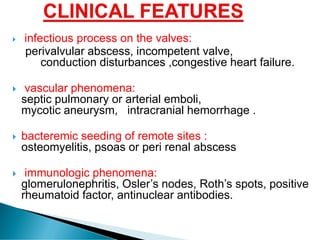
 infectious process on the valves:
perivalvular abscess, incompetent valve,
conduction disturbances ,congestive heart failure.
 vascular phenomena:
septic pulmonary or arterial emboli,
mycotic aneurysm, intracranial hemorrhage .
 bacteremic seeding of remote sites :
osteomyelitis, psoas or peri renal abscess
 immunologic phenomena:
glomerulonephritis, Osler’s nodes, Roth’s spots, positive
rheumatoid factor, antinuclear antibodies.
SYMPTOMS:
 Fever
 Chest and abdominal pain
 Arthralgia, myalgia
 Dyspnea
 Weight loss
 CNS manifestations (stroke, seizures, headache)
SIGNS:
 Tachycardia.
 Embolic phenomena.
 Janeway lesions.
 New or changing murmur.
 Splenomegaly.
 Arthritis.
 Heart failure.
 Metastatic infection.
 Clubbing.
 Blood culture: 3 to 5 samples to be taken with in 24 hrs
 Echocardiography:valve vegetations, prosthetic valve
dysfunction or leak, myocardial abscess, new-onset valve
Insufficiency
 CXR: bilateral infiltrates, pleural effusions
 Elevated erythrocyte sedimentation rate
 Elevated C-reactive protein
 Anemia
 Leukocytosis
 Hypocomplementemia
 Rheumatoid factor
 Hematuria
Major criteria:
 Positive blood cultures.
 Evidence of endocarditis on echocardiography.
Minor criteria:
 Predisposing conditions, fever, embolic-vascular signs.
 Immune complex phenomena (glomerulonephritis,
arthritis , janeway lesions)
 A single, positive blood culture or serologic evidence of
infection.
 Echocardiographic signs not meeting the major criteria.
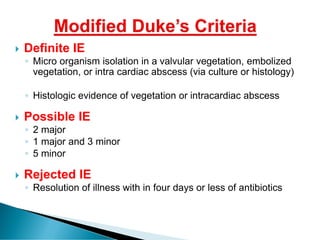
 Definite IE
◦ Micro organism isolation in a valvular vegetation, embolized
vegetation, or intra cardiac abscess (via culture or histology)
◦ Histologic evidence of vegetation or intracardiac abscess
 Possible IE
◦ 2 major
◦ 1 major and 3 minor
◦ 5 minor
 Rejected IE
◦ Resolution of illness with in four days or less of antibiotics
REGIMRN DOSAGE & ROUTE DURATION
Aqueous crystalline
penicillin G sodium
200,000 U/kg per 24 hr IV in
4-6 equally divided doses
4 weeks
or
Ceftriaxone sodium
100 mg/kg per 24 hr
IV/IM in 1 dose
4 weeks
or
Ceftriaxone sodium
plus
Gentamicin sulfate
100 mg/kg per 24 hr
IV/IM in 1 dose
3 mg/kg per 24 hr IV/IM in 1
dose,
or 3 equally divided doses
2weeks
2weeks
or
Vancomycin
hydrochloride
40 mg/kg per 24 hr
IV in 2-3 equally divided doses
4weeks
REGIMRN DOSAGE & ROUTE DURATION
OXACILLIN-SUSCEPTIBLE
STRAINS
Nafcillin or oxacillin
with
gentamicin sulfate
Nafcillin or oxacillin
200 mg/kg per 24 hr IV in 4-6
equally divided doses
3 mg/kg per 24 hr IV/IM in 3
equally divided doses
6 Weeks
3-5 days
For penicillin-allergic
patients:
Cefazolin
with
gentamicin sulfate
cefazolin 100 mg/kg per
24 hr IV in 3 equally divided doses.
3 mg/kg per 24 hr IV/IM in 3
equally divided doses
6 Weeks
3-5 days
OXACILLIN-RESISTANT
STRAINS
Vancomycin
40 mg/kg per 24 hr
IV in 2-3 equally divided doses
6weeks
 mortality remains high- 20-25%.
 morbidity - 50-60%
COMPLICATIONS:
 heart failure.
 Myocardial abscesses.
 Pulmonary emboli.
 mycotic aneurysms.
 rupture of a sinus of Valsalva.
 obstruction of a valve.
 heart block.
 Meningitis.
 Osteomyelitis.
 Arthritis.
 renal abscess.
 Purulent pericarditis.
 immune complex-mediated glomerulonephritis.
 Prosthetic cardiac valve or prosthetic material
used for cardiac valve repair.
 Previous infective endocarditis.
CONGENITAL HEART DISEASE (CHD)
 Unrepaired cyanotic CHD, including palliative shunts
and conduits.
 Completely repaired CHD with prosthetic material or
device.
 Repaired CHD with residual defects at the site or
adjacent to the site of a prosthetic patch, or prosthetic
device.
 Cardiac transplantation recipients who develop
cardiac valvulopathy.
Oral medication Amoxicillin 50 mg/kg
Unable to take oral
medication
Ampicillin
or
Cefazolin
or
ceftriaxone
50 mg/kg IM or IV
50 mg/kg IM or IV
50 mg/kg IM or IV
Allergic to penicillins or
ampicillin—oral
Cephalexin
or
Clindamycin
or
Azithromycin or
clarithromycin
50 mg/kg
20 mg/kg
15 mg/kg
Allergic to penicillins or
ampicillin and unable to
take oral medication
Cefazolin
Or
ceftriaxone
or
clindamycin
50 mg/kg IM or IV
50 mg/kg IM or IV
20 mg/kg IM or IV
Objectives:
 Definition
 Etiology
 Clinical features
 Diagnosis
 Treatment
 Prognosis and complications
 Prevention
 Myocarditis is defined as inflammation of the
heart muscle.
 Characterized by inflammatory cell infiltrates,
myocyte necrosis, or myocyte degeneration.
Viral Infections:
 Enteroviruses - Coxsackievirus
 adenovirus,
 parvovirus,
 Epstein-Barr virus,
 influenza virus,
 cytomegalovirus
 hepatitis C virus
Bacterial Infections:
 Diphtheritic myocarditis
Other infections:
 rickettsia, protozoa, parasitic infections, fungal
infections
Injury and innate immune response
Virus or toxin Initial myocyte injury
from pathogen or toxin
Decreased regulatory T-cell function,
activation of cytolytic T cells,
and increased Th1 and Th2 cytokines
Acquired immune response
Antigen-presenting cells stimulate
pathogen-specific T-cell response
Antibodies to pathogens may
cross-react with endogenous epitopes
(e.g., cardiac myosin and -adrenergic receptor)
Epitope spreading between
endogenous myocardial epitopes
Recovery or persistent cardiomyopathy
Viral clearance and Ongoing injury with persistent viral infection
or immune response
down-regulation of immune response
Myocyte cell death from direct
viral damage, cytolytic T cells, or
apoptosis
Exposure of innate immune
system to pathogens and
intracellular sequestered
APC
Regulatory T cell
Infants and young children:
 Fever.
 Respiratory distress.
 Tachycardia.
 Hypotension.
 Gallop rhythm, and cardiac murmur.
acute or chronic myocarditis:
 chest discomfort.
 Fever.
 Palpitations.
 easy fatigability.
 syncope/near syncope.
On examination:
 Hyperactive precordial impulse.
 Gallop rhythm.
 Apical systolic murmur of mitral insufficiency.
 Hepatic enlargement
 Peripheral edema.
 Pulmonary findings such as wheezes or rales.
Electrocardiographic changes:
 Sinus tachycardia,
 Atrial or ventricular arrhythmias, heart block,
 Diminished QRS voltages
Chest x-ray:
 Cardiomegaly,
 Pulmonary vascular prominence or pulmonary edema.
 Pleural effusions.
Echocardiography:
 Diminished ventricular systolic function,
 Cardiac chamber enlargement,
 Mitral insufficiency,
 Pericardial infusion.
Cardiac MRI :
 Presence and extent of edema,
 Gadolinium-enhanced hyperemic capillary leak.
 Myocyte necrosis.
 Left ventricular dysfunction.
Endomyocardial biopsy:
 Inflammatory cell infiltrates.
 Myocyte damage.
 Performing molecular viral analysis using PCR.
Nonspecific tests:
 ESR
 CPK levels.
 Cardiac troponin I, and brain natriuretic peptide levels.
Supportive care :
 Inotropic agents : milrinone, dobutamine.
 Diuretics .
 Mechanical ventilatory support.
 Antiarrhythmic agents : amiodarone.
Intravenous immune globulin.
corticosteroids have been reported to improve cardiac
function.
 prognosis in newborns is poor-75%mortality.
 prognosis is better for children and adolescents.
 DCM -cardiac transplantation.
 Recovery of ventricular function -10-50% of patients.
Infective endocarditis

Infective endocarditis

  • 1.
  • 2.
    Objectives:  Definition  Etiology Epidemiology  Clinical features  Diagnosis  Treatment  Prognosis and complications  Prevention
  • 3.
    IE defined asan infection of the endocardial surface of the heart ,which may include one or more heart valves, the mural endocardium, or a septal defect. Its intra cardiac effects include severe valvular insufficiency ,which may lead to congestive heart failure and myocardial abscesses.
  • 5.
    COMMON UNCOMMON NATIVE VALVEOR OTHER CARDIAC LESIONS  Streptococcus viridans  Staphylococcus aureus  Group D streptococcus PROSTHETIC VALVE  Staphylococcus epidermidis  Staphylococcus aureus  Viridans group streptococcus  Pseudomonas aeruginosa  Serratia marcescens  Diphtheroids  Legionella species*  HACEK group  Fungi NATIVE VALVE OR OTHER CARDIAC LESIONS  Streptococcus pneumoniae  Haemophilus influenzae  Coagulase-negative staphylococci  Abiotrophia defectiva  Coxiella burnetii (Q fever)  Neisseria gonorrhoeae  Brucella  Chlamydia psittaci  Chlamydia trachomatis  Chlamydia pneumoniae  Legionella  Bartonella  Tropheryma whipplei  HACEK group  Streptobacillus moniliformis  Pasteurella multocida  Campylobacter fetus
  • 6.
     Often acomplication of congenital or rheumatic heart disease.  1.7 and 1.2 per 100,000 male and female children younger than 10 years respectively. High risk group :  Unrepaired cyanotic congenital heart disease.  Prosthetic cardiac valves or prosthetic material used for cardiac valve repair.  Completely repaired defects with prosthetic material or device.  Repaired congenital heart disease with residual defects.  permanent valve disease from rheumatic fever , previous infective endocarditis. NEITHER SECUNDUM ASD NOR PDA OR PULMONIC STENOSIS AFTER REPAIR IS ASSOCIATED WITH IE.
  • 7.
    HISTORY:  Prior congenitalor rheumatic heart disease.  Preceding dental, urinary tract, or intestinal procedure.  Intravenous drug use.  Central venous catheter.  Prosthetic heart valve.
  • 8.
     infectious processon the valves: perivalvular abscess, incompetent valve, conduction disturbances ,congestive heart failure.  vascular phenomena: septic pulmonary or arterial emboli, mycotic aneurysm, intracranial hemorrhage .  bacteremic seeding of remote sites : osteomyelitis, psoas or peri renal abscess  immunologic phenomena: glomerulonephritis, Osler’s nodes, Roth’s spots, positive rheumatoid factor, antinuclear antibodies.
  • 9.
    SYMPTOMS:  Fever  Chestand abdominal pain  Arthralgia, myalgia  Dyspnea  Weight loss  CNS manifestations (stroke, seizures, headache)
  • 10.
    SIGNS:  Tachycardia.  Embolicphenomena.  Janeway lesions.  New or changing murmur.  Splenomegaly.  Arthritis.  Heart failure.  Metastatic infection.  Clubbing.
  • 16.
     Blood culture:3 to 5 samples to be taken with in 24 hrs  Echocardiography:valve vegetations, prosthetic valve dysfunction or leak, myocardial abscess, new-onset valve Insufficiency  CXR: bilateral infiltrates, pleural effusions  Elevated erythrocyte sedimentation rate  Elevated C-reactive protein  Anemia  Leukocytosis  Hypocomplementemia  Rheumatoid factor  Hematuria
  • 17.
    Major criteria:  Positiveblood cultures.  Evidence of endocarditis on echocardiography. Minor criteria:  Predisposing conditions, fever, embolic-vascular signs.  Immune complex phenomena (glomerulonephritis, arthritis , janeway lesions)  A single, positive blood culture or serologic evidence of infection.  Echocardiographic signs not meeting the major criteria.
  • 18.
     Definite IE ◦Micro organism isolation in a valvular vegetation, embolized vegetation, or intra cardiac abscess (via culture or histology) ◦ Histologic evidence of vegetation or intracardiac abscess  Possible IE ◦ 2 major ◦ 1 major and 3 minor ◦ 5 minor  Rejected IE ◦ Resolution of illness with in four days or less of antibiotics
  • 19.
    REGIMRN DOSAGE &ROUTE DURATION Aqueous crystalline penicillin G sodium 200,000 U/kg per 24 hr IV in 4-6 equally divided doses 4 weeks or Ceftriaxone sodium 100 mg/kg per 24 hr IV/IM in 1 dose 4 weeks or Ceftriaxone sodium plus Gentamicin sulfate 100 mg/kg per 24 hr IV/IM in 1 dose 3 mg/kg per 24 hr IV/IM in 1 dose, or 3 equally divided doses 2weeks 2weeks or Vancomycin hydrochloride 40 mg/kg per 24 hr IV in 2-3 equally divided doses 4weeks
  • 20.
    REGIMRN DOSAGE &ROUTE DURATION OXACILLIN-SUSCEPTIBLE STRAINS Nafcillin or oxacillin with gentamicin sulfate Nafcillin or oxacillin 200 mg/kg per 24 hr IV in 4-6 equally divided doses 3 mg/kg per 24 hr IV/IM in 3 equally divided doses 6 Weeks 3-5 days For penicillin-allergic patients: Cefazolin with gentamicin sulfate cefazolin 100 mg/kg per 24 hr IV in 3 equally divided doses. 3 mg/kg per 24 hr IV/IM in 3 equally divided doses 6 Weeks 3-5 days OXACILLIN-RESISTANT STRAINS Vancomycin 40 mg/kg per 24 hr IV in 2-3 equally divided doses 6weeks
  • 21.
     mortality remainshigh- 20-25%.  morbidity - 50-60% COMPLICATIONS:  heart failure.  Myocardial abscesses.  Pulmonary emboli.  mycotic aneurysms.  rupture of a sinus of Valsalva.  obstruction of a valve.  heart block.  Meningitis.  Osteomyelitis.  Arthritis.  renal abscess.  Purulent pericarditis.  immune complex-mediated glomerulonephritis.
  • 22.
     Prosthetic cardiacvalve or prosthetic material used for cardiac valve repair.  Previous infective endocarditis. CONGENITAL HEART DISEASE (CHD)  Unrepaired cyanotic CHD, including palliative shunts and conduits.  Completely repaired CHD with prosthetic material or device.  Repaired CHD with residual defects at the site or adjacent to the site of a prosthetic patch, or prosthetic device.  Cardiac transplantation recipients who develop cardiac valvulopathy.
  • 23.
    Oral medication Amoxicillin50 mg/kg Unable to take oral medication Ampicillin or Cefazolin or ceftriaxone 50 mg/kg IM or IV 50 mg/kg IM or IV 50 mg/kg IM or IV Allergic to penicillins or ampicillin—oral Cephalexin or Clindamycin or Azithromycin or clarithromycin 50 mg/kg 20 mg/kg 15 mg/kg Allergic to penicillins or ampicillin and unable to take oral medication Cefazolin Or ceftriaxone or clindamycin 50 mg/kg IM or IV 50 mg/kg IM or IV 20 mg/kg IM or IV
  • 24.
    Objectives:  Definition  Etiology Clinical features  Diagnosis  Treatment  Prognosis and complications  Prevention
  • 25.
     Myocarditis isdefined as inflammation of the heart muscle.  Characterized by inflammatory cell infiltrates, myocyte necrosis, or myocyte degeneration.
  • 26.
    Viral Infections:  Enteroviruses- Coxsackievirus  adenovirus,  parvovirus,  Epstein-Barr virus,  influenza virus,  cytomegalovirus  hepatitis C virus Bacterial Infections:  Diphtheritic myocarditis Other infections:  rickettsia, protozoa, parasitic infections, fungal infections
  • 27.
    Injury and innateimmune response Virus or toxin Initial myocyte injury from pathogen or toxin Decreased regulatory T-cell function, activation of cytolytic T cells, and increased Th1 and Th2 cytokines Acquired immune response Antigen-presenting cells stimulate pathogen-specific T-cell response Antibodies to pathogens may cross-react with endogenous epitopes (e.g., cardiac myosin and -adrenergic receptor) Epitope spreading between endogenous myocardial epitopes Recovery or persistent cardiomyopathy Viral clearance and Ongoing injury with persistent viral infection or immune response down-regulation of immune response Myocyte cell death from direct viral damage, cytolytic T cells, or apoptosis Exposure of innate immune system to pathogens and intracellular sequestered APC Regulatory T cell
  • 28.
    Infants and youngchildren:  Fever.  Respiratory distress.  Tachycardia.  Hypotension.  Gallop rhythm, and cardiac murmur. acute or chronic myocarditis:  chest discomfort.  Fever.  Palpitations.  easy fatigability.  syncope/near syncope.
  • 29.
    On examination:  Hyperactiveprecordial impulse.  Gallop rhythm.  Apical systolic murmur of mitral insufficiency.  Hepatic enlargement  Peripheral edema.  Pulmonary findings such as wheezes or rales.
  • 30.
    Electrocardiographic changes:  Sinustachycardia,  Atrial or ventricular arrhythmias, heart block,  Diminished QRS voltages Chest x-ray:  Cardiomegaly,  Pulmonary vascular prominence or pulmonary edema.  Pleural effusions. Echocardiography:  Diminished ventricular systolic function,  Cardiac chamber enlargement,  Mitral insufficiency,  Pericardial infusion.
  • 31.
    Cardiac MRI : Presence and extent of edema,  Gadolinium-enhanced hyperemic capillary leak.  Myocyte necrosis.  Left ventricular dysfunction. Endomyocardial biopsy:  Inflammatory cell infiltrates.  Myocyte damage.  Performing molecular viral analysis using PCR. Nonspecific tests:  ESR  CPK levels.  Cardiac troponin I, and brain natriuretic peptide levels.
  • 32.
    Supportive care : Inotropic agents : milrinone, dobutamine.  Diuretics .  Mechanical ventilatory support.  Antiarrhythmic agents : amiodarone. Intravenous immune globulin. corticosteroids have been reported to improve cardiac function.
  • 33.
     prognosis innewborns is poor-75%mortality.  prognosis is better for children and adolescents.  DCM -cardiac transplantation.  Recovery of ventricular function -10-50% of patients.