Dr M.Sanjeevappa
M.D.(paeds)
Asst.Professor
Dept. of Paediatrics
GMC ,Ananthapuramu
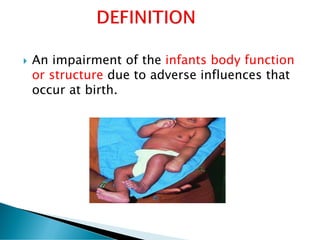
 An impairment of the infants body function
or structure due to adverse influences that
occur at birth.
 morbidity rate : 2.8 per 1,000 live births
 mortality rate : 0.5 per 100,000 live births.
1. Primi parity
2. Short stature
3. Maternal pelvic anomalies
4. Prolonged or unusually rapid labor
5. Oligohydramnios
6. Malpresentation of the fetus
7. Use of midforceps or vacuum extraction
8. Versions and extraction
9. Very low birth weight or extreme prematurity
10. Fetal macrosomia or large fetal head
 Head and neck injuries.
 Cranial nerve, spinal cord, and peripheral
nerve injuries.
 Bone injuries.
 Intra-abdominal Injuries.
 Soft tissue injuries.
1. Injuries associated with intrapartum fetal
monitoring.
2. Extracranial haemorrhage.
3. Intracranial haemorrhage.
4. Skull fracture.
5. Facial or mandibular fractures.
6. Nasal injuries.
7. Ocular injuries.
8. Ear injuries.
9. Sternocleidomastoid (SCM) injury.
10. Pharyngeal injury
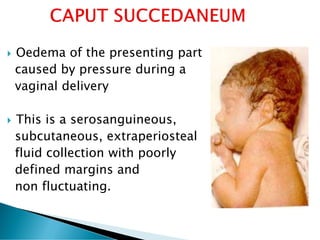
 Oedema of the presenting part
caused by pressure during a
vaginal delivery
 This is a serosanguineous,
subcutaneous, extraperiosteal
fluid collection with poorly
defined margins and
non fluctuating.
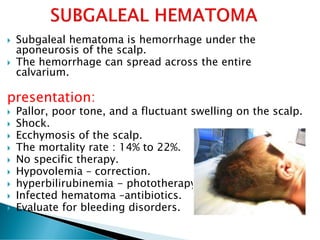
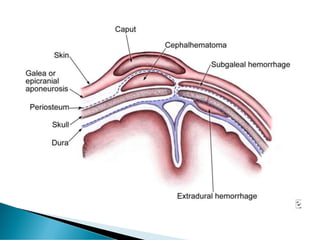
 Subgaleal hematoma is hemorrhage under the
aponeurosis of the scalp.
 The hemorrhage can spread across the entire
calvarium.
presentation:
 Pallor, poor tone, and a fluctuant swelling on the scalp.
 Shock.
 Ecchymosis of the scalp.
 The mortality rate : 14% to 22%.
 No specific therapy.
 Hypovolemia – correction.
 hyperbilirubinemia - phototherapy .
 Infected hematoma –antibiotics.
 Evaluate for bleeding disorders.
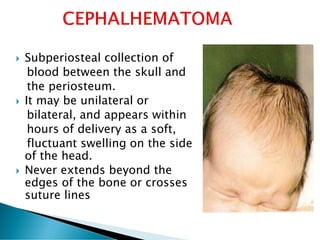
 Subperiosteal collection of
blood between the skull and
the periosteum.
 It may be unilateral or
bilateral, and appears within
hours of delivery as a soft,
fluctuant swelling on the side
of the head.
 Never extends beyond the
edges of the bone or crosses
suture lines
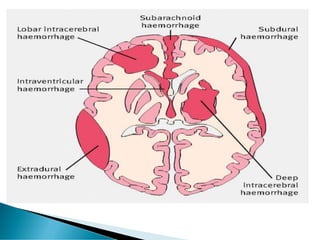
 Bleeding can occur
– External to the brain into the epidural,
subdural or subarachnoid space.
– In to the parenchyma of the cerebrum or
cerebellum.
– Into the ventricles from the subependymal
germinal matrix or choroid plexus.
 Epidural hemorrhage.
 Subdural hemorrhage.
 Subarachnoid hemorrhage.
 Intraparenchymal haemorrhage.
 Intraventricular haemorrhage.
 SDH is due to rupture of the draining veins and
sinuses of the brain that occupy the subdural
space.
Clinical presentation :
 Nuchal rigidity or opisthotonus posturing ,coma.
 Apnea, abnormal respiratory patterns.
 Unreactive pupils.
 Abnormal extraocular movements.
 Bulging fontanelle and/or widely split sutures.
 Seizures
Diagnosis :
 MRI brain .
 CT brain .
 Neurosonogram.
 LP contraindicated in large SDH.
Management :
 Most infants with SDH do not require surgical
intervention.
 Management of shock.
 Management of seizures.
 large SDH -Open surgical evacuation of the Clot.
 Rule out sepsis or a bleeding diathesis.
 A common form of ICH among newborns.
 Source of bleeding is ruptured bridging veins of
SA space or ruptured small meningeal vessels.
Clinical presentation :
 Suspicion of SAH may result because of blood
loss or neurologic dysfunction.
 Seizures, irritability, mild alteration of mental
status.
Diagnosis :
 MRI brain
 CT brain
 Neurosonogram
 LP
Management :
 requires only symptomatic therapy.
 Neurosurgical intervention.
 hydrocephalus will develop after a moderate-
large SAH, thus follow-up neurosonograms
should be performed.
 Primary cerebral haemorrhage is uncommon.
 Secondary haemorrhage into a region of
hypoxic-ischemic brain injury.
 In infants undergoing ECMO.
 Intracerebellar haemorrhage occurs more
commonly in preterm infants.
 MRI is the best imaging modality.
Management :
 Acute management of IPH is similar to that for
SDH and SAH.
 Long-term prognosis largely relates to location
and size of the IPH and GA of the infant.
 IVH is found mainly in the preterm infant.
 Incidence :15% to 20% in infants born at
<32weeks of GA.
 IVH in the term infant is related to difficult
delivery or perinatal asphyxia.
COMPLICATIONS :
 Periventricular hemorrhagic infarction (PVHI).
 Posthemorrhagic ventricular dilation (PVD).
CLINICAL PRESENTATION :
 Clinically silent syndrome.
 Majority of IVH occur within 72 hours after birth.
 The term newbom with IVH presents with
seizures, apnea, irritability or lethargy, vomiting
with dehydration, or a full fontanelle.
MANAGEMENT :
 Prevention of IVH should be the primary goal.
 Premature newborn - supportive care.
 Term newborn - supportive care and treatment
of seizures during the acute phase.
 PVD - careful monitoring of ventricle size by
serial CUS and appropriate intervention when
needed to reduce CSF accumulation.
 Macrosomia.
 Shoulder dystocia.
 Instrumented deliveries.
 Malpresentation.
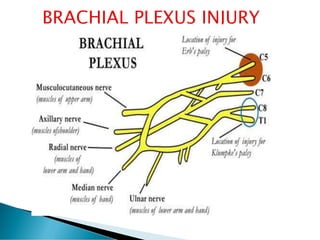
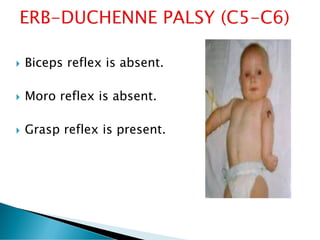
 The most common.
 Lack of shoulder movement.
 The involved arm is held in the ‘‘waiter’s tip’’
position :
 adduction and internal rotation of the shoulder.
 extension of the elbow.
 pronation of the forearm.
 flexion of the wrist and fingers.
 may be associated with injury tothe phrenic nerve.
 Biceps reflex is absent.
 Moro reflex is absent.
 Grasp reflex is present.
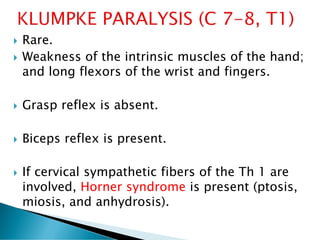
 Rare.
 Weakness of the intrinsic muscles of the hand;
and long flexors of the wrist and fingers.
 Grasp reflex is absent.
 Biceps reflex is present.
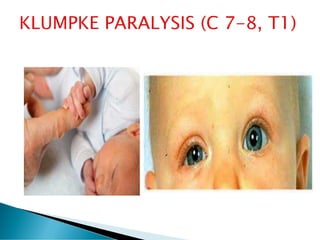
 If cervical sympathetic fibers of the Th 1 are
involved, Horner syndrome is present (ptosis,
miosis, and anhydrosis).
 Physical examination.
 Radiographs of the shoulder and upper arm.
 Initial treatment is conservative.
 The arm is immobilized across the upper
abdomen vs elevated in abduction external
rotation of shoulder during the first week.
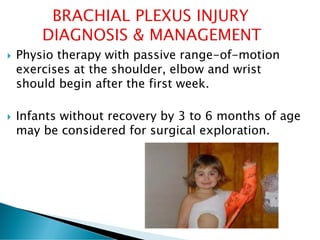
 Physio therapy with passive range-of-motion
exercises at the shoulder, elbow and wrist
should begin after the first week.
 Infants without recovery by 3 to 6 months of age
may be considered for surgical exploration.
 The phrenic nerve arises from the third through
fifth cervical nerve roots.
 Injury to the phrenic nerve leads to paralysis of
the ipsilateral diaphragm.
 Respiratory distress, with diminished breath
sounds on the affected side.
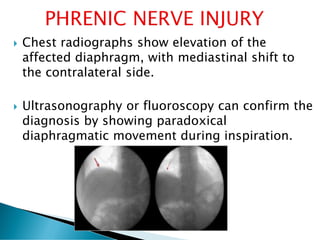
 Chest radiographs show elevation of the
affected diaphragm, with mediastinal shift to
the contralateral side.
 Ultrasonography or fluoroscopy can confirm the
diagnosis by showing paradoxical
diaphragmatic movement during inspiration.
 Initial treatment is supportive Oxygen.
 Respiratory failure may be treated with
continuous positive airway pressure or
mechanical ventilation.
 Gavage feedings.
 Plication of the diaphragm
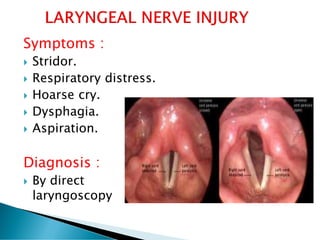
Symptoms :
 Stridor.
 Respiratory distress.
 Hoarse cry.
 Dysphagia.
 Aspiration.
Diagnosis :
 By direct
laryngoscopy
TREATMENT :
 Small frequent feedings may be required to
decrease the risk of aspiration.
 Intubation.
 Tracheostomy.
Causes :
 pressure on the facial nerves during birth.
 by the use of forceps during birth.
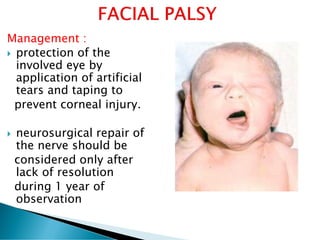
Clinical features :
 The affected side of the face droops and the
infant is unable to close the eye tightly on that
side.
 When crying the mouth is pulled across to the
normal side.
Management :
 protection of the
involved eye by
application of artificial
tears and taping to
prevent corneal injury.
 neurosurgical repair of
the nerve should be
considered only after
lack of resolution
during 1 year of
observation
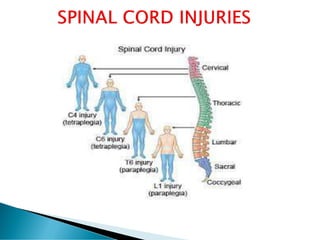
Clinical findings :
 decreased or absent spontaneous movement.
 absent deep tendon reflexes.
 absent or periodic breathing.
 lack of response to painful stimuli below the level of
the lesion.
 Lesions above C4 are almost always associated with
apnea.
 Lesions between C4 and T4 may have respiratory
distress.
Management :
If cord injury is suspected in the delivery room :
 The head, neck, and spine should be
immobilized.
 Therapy is supportive.
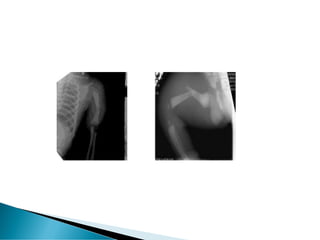
 Clavicle is the most frequently injured bone in
the neonate during birth.
 The infant may present with pseudoparalysis.
 Examination may reveal crepitus, palpable
bony irregularity, and sternocleidomastoid
muscle spasm.
 Desault's bandage should be used for 7-10
days.
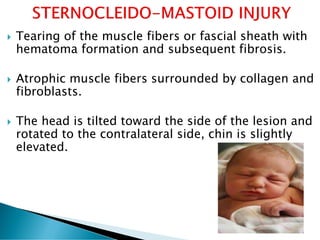
 Tearing of the muscle fibers or fascial sheath with
hematoma formation and subsequent fibrosis.
 Atrophic muscle fibers surrounded by collagen and
fibroblasts.
 The head is tilted toward the side of the lesion and
rotated to the contralateral side, chin is slightly
elevated.
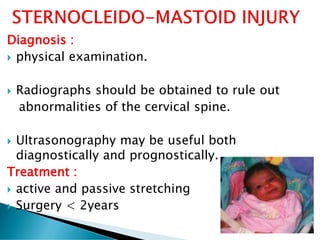
Diagnosis :
 physical examination.
 Radiographs should be obtained to rule out
abnormalities of the cervical spine.
 Ultrasonography may be useful both
diagnostically and prognostically.
Treatment :
 active and passive stretching
 Surgery < 2years
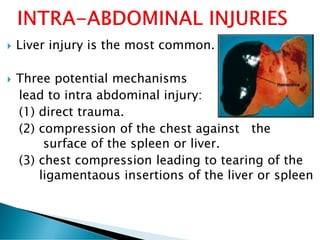
 Liver injury is the most common.
 Three potential mechanisms
lead to intra abdominal injury:
(1) direct trauma.
(2) compression of the chest against the
surface of the spleen or liver.
(3) chest compression leading to tearing of the
ligamentaous insertions of the liver or spleen
Clinical manifestations :
 With hepatic or splenic rupture, patients
develop sudden pallor, hemorrhagic shock,
abdominal distention, and abdominal
discoloration.
 Subcapsular hematomas may present more
insidiously, with anemia, poor feeding,
tachypnea, and tachycardia.
Diagnosis :
 abdominal ultrasound.
 Computed tomography.
 Abdominal radiographs may show nonspecific
intraperitoneal fluid or hepatomegaly.
 Abdominal paracentesis is diagnostic ,if a
hemoperitoneum is present.
Treatment :
 Volume replacement.
 Correction of any coagulopathy.
 Hemodynamically stable infant, conservative
management is indicated.
 With rupture or hemodynamic instability, a
laparotomy is required to control the bleeding.
Birth injuries

Birth injuries

  • 1.
  • 2.
     An impairmentof the infants body function or structure due to adverse influences that occur at birth.
  • 3.
     morbidity rate: 2.8 per 1,000 live births  mortality rate : 0.5 per 100,000 live births.
  • 4.
    1. Primi parity 2.Short stature 3. Maternal pelvic anomalies 4. Prolonged or unusually rapid labor 5. Oligohydramnios 6. Malpresentation of the fetus 7. Use of midforceps or vacuum extraction 8. Versions and extraction 9. Very low birth weight or extreme prematurity 10. Fetal macrosomia or large fetal head
  • 5.
     Head andneck injuries.  Cranial nerve, spinal cord, and peripheral nerve injuries.  Bone injuries.  Intra-abdominal Injuries.  Soft tissue injuries.
  • 6.
    1. Injuries associatedwith intrapartum fetal monitoring. 2. Extracranial haemorrhage. 3. Intracranial haemorrhage. 4. Skull fracture. 5. Facial or mandibular fractures. 6. Nasal injuries. 7. Ocular injuries. 8. Ear injuries. 9. Sternocleidomastoid (SCM) injury. 10. Pharyngeal injury
  • 8.
     Oedema ofthe presenting part caused by pressure during a vaginal delivery  This is a serosanguineous, subcutaneous, extraperiosteal fluid collection with poorly defined margins and non fluctuating.
  • 9.
     Subgaleal hematomais hemorrhage under the aponeurosis of the scalp.  The hemorrhage can spread across the entire calvarium. presentation:  Pallor, poor tone, and a fluctuant swelling on the scalp.  Shock.  Ecchymosis of the scalp.  The mortality rate : 14% to 22%.  No specific therapy.  Hypovolemia – correction.  hyperbilirubinemia - phototherapy .  Infected hematoma –antibiotics.  Evaluate for bleeding disorders.
  • 10.
     Subperiosteal collectionof blood between the skull and the periosteum.  It may be unilateral or bilateral, and appears within hours of delivery as a soft, fluctuant swelling on the side of the head.  Never extends beyond the edges of the bone or crosses suture lines
  • 13.
     Bleeding canoccur – External to the brain into the epidural, subdural or subarachnoid space. – In to the parenchyma of the cerebrum or cerebellum. – Into the ventricles from the subependymal germinal matrix or choroid plexus.  Epidural hemorrhage.  Subdural hemorrhage.  Subarachnoid hemorrhage.  Intraparenchymal haemorrhage.  Intraventricular haemorrhage.
  • 15.
     SDH isdue to rupture of the draining veins and sinuses of the brain that occupy the subdural space. Clinical presentation :  Nuchal rigidity or opisthotonus posturing ,coma.  Apnea, abnormal respiratory patterns.  Unreactive pupils.  Abnormal extraocular movements.  Bulging fontanelle and/or widely split sutures.  Seizures
  • 16.
    Diagnosis :  MRIbrain .  CT brain .  Neurosonogram.  LP contraindicated in large SDH. Management :  Most infants with SDH do not require surgical intervention.  Management of shock.  Management of seizures.  large SDH -Open surgical evacuation of the Clot.  Rule out sepsis or a bleeding diathesis.
  • 17.
     A commonform of ICH among newborns.  Source of bleeding is ruptured bridging veins of SA space or ruptured small meningeal vessels. Clinical presentation :  Suspicion of SAH may result because of blood loss or neurologic dysfunction.  Seizures, irritability, mild alteration of mental status.
  • 18.
    Diagnosis :  MRIbrain  CT brain  Neurosonogram  LP Management :  requires only symptomatic therapy.  Neurosurgical intervention.  hydrocephalus will develop after a moderate- large SAH, thus follow-up neurosonograms should be performed.
  • 19.
     Primary cerebralhaemorrhage is uncommon.  Secondary haemorrhage into a region of hypoxic-ischemic brain injury.  In infants undergoing ECMO.  Intracerebellar haemorrhage occurs more commonly in preterm infants.  MRI is the best imaging modality.
  • 20.
    Management :  Acutemanagement of IPH is similar to that for SDH and SAH.  Long-term prognosis largely relates to location and size of the IPH and GA of the infant.
  • 21.
     IVH isfound mainly in the preterm infant.  Incidence :15% to 20% in infants born at <32weeks of GA.  IVH in the term infant is related to difficult delivery or perinatal asphyxia.
  • 23.
    COMPLICATIONS :  Periventricularhemorrhagic infarction (PVHI).  Posthemorrhagic ventricular dilation (PVD).
  • 24.
    CLINICAL PRESENTATION : Clinically silent syndrome.  Majority of IVH occur within 72 hours after birth.  The term newbom with IVH presents with seizures, apnea, irritability or lethargy, vomiting with dehydration, or a full fontanelle.
  • 25.
    MANAGEMENT :  Preventionof IVH should be the primary goal.  Premature newborn - supportive care.  Term newborn - supportive care and treatment of seizures during the acute phase.  PVD - careful monitoring of ventricle size by serial CUS and appropriate intervention when needed to reduce CSF accumulation.
  • 28.
     Macrosomia.  Shoulderdystocia.  Instrumented deliveries.  Malpresentation.
  • 29.
     The mostcommon.  Lack of shoulder movement.  The involved arm is held in the ‘‘waiter’s tip’’ position :  adduction and internal rotation of the shoulder.  extension of the elbow.  pronation of the forearm.  flexion of the wrist and fingers.  may be associated with injury tothe phrenic nerve.
  • 30.
     Biceps reflexis absent.  Moro reflex is absent.  Grasp reflex is present.
  • 31.
     Rare.  Weaknessof the intrinsic muscles of the hand; and long flexors of the wrist and fingers.  Grasp reflex is absent.  Biceps reflex is present.  If cervical sympathetic fibers of the Th 1 are involved, Horner syndrome is present (ptosis, miosis, and anhydrosis).
  • 33.
     Physical examination. Radiographs of the shoulder and upper arm.  Initial treatment is conservative.  The arm is immobilized across the upper abdomen vs elevated in abduction external rotation of shoulder during the first week.
  • 34.
     Physio therapywith passive range-of-motion exercises at the shoulder, elbow and wrist should begin after the first week.  Infants without recovery by 3 to 6 months of age may be considered for surgical exploration.
  • 35.
     The phrenicnerve arises from the third through fifth cervical nerve roots.  Injury to the phrenic nerve leads to paralysis of the ipsilateral diaphragm.  Respiratory distress, with diminished breath sounds on the affected side.
  • 36.
     Chest radiographsshow elevation of the affected diaphragm, with mediastinal shift to the contralateral side.  Ultrasonography or fluoroscopy can confirm the diagnosis by showing paradoxical diaphragmatic movement during inspiration.
  • 37.
     Initial treatmentis supportive Oxygen.  Respiratory failure may be treated with continuous positive airway pressure or mechanical ventilation.  Gavage feedings.  Plication of the diaphragm
  • 38.
    Symptoms :  Stridor. Respiratory distress.  Hoarse cry.  Dysphagia.  Aspiration. Diagnosis :  By direct laryngoscopy
  • 39.
    TREATMENT :  Smallfrequent feedings may be required to decrease the risk of aspiration.  Intubation.  Tracheostomy.
  • 41.
    Causes :  pressureon the facial nerves during birth.  by the use of forceps during birth. Clinical features :  The affected side of the face droops and the infant is unable to close the eye tightly on that side.  When crying the mouth is pulled across to the normal side.
  • 42.
    Management :  protectionof the involved eye by application of artificial tears and taping to prevent corneal injury.  neurosurgical repair of the nerve should be considered only after lack of resolution during 1 year of observation
  • 44.
    Clinical findings : decreased or absent spontaneous movement.  absent deep tendon reflexes.  absent or periodic breathing.  lack of response to painful stimuli below the level of the lesion.  Lesions above C4 are almost always associated with apnea.  Lesions between C4 and T4 may have respiratory distress.
  • 45.
    Management : If cordinjury is suspected in the delivery room :  The head, neck, and spine should be immobilized.  Therapy is supportive.
  • 47.
     Clavicle isthe most frequently injured bone in the neonate during birth.  The infant may present with pseudoparalysis.  Examination may reveal crepitus, palpable bony irregularity, and sternocleidomastoid muscle spasm.  Desault's bandage should be used for 7-10 days.
  • 49.
     Tearing ofthe muscle fibers or fascial sheath with hematoma formation and subsequent fibrosis.  Atrophic muscle fibers surrounded by collagen and fibroblasts.  The head is tilted toward the side of the lesion and rotated to the contralateral side, chin is slightly elevated.
  • 50.
    Diagnosis :  physicalexamination.  Radiographs should be obtained to rule out abnormalities of the cervical spine.  Ultrasonography may be useful both diagnostically and prognostically. Treatment :  active and passive stretching  Surgery < 2years
  • 51.
     Liver injuryis the most common.  Three potential mechanisms lead to intra abdominal injury: (1) direct trauma. (2) compression of the chest against the surface of the spleen or liver. (3) chest compression leading to tearing of the ligamentaous insertions of the liver or spleen
  • 52.
    Clinical manifestations : With hepatic or splenic rupture, patients develop sudden pallor, hemorrhagic shock, abdominal distention, and abdominal discoloration.  Subcapsular hematomas may present more insidiously, with anemia, poor feeding, tachypnea, and tachycardia.
  • 53.
    Diagnosis :  abdominalultrasound.  Computed tomography.  Abdominal radiographs may show nonspecific intraperitoneal fluid or hepatomegaly.  Abdominal paracentesis is diagnostic ,if a hemoperitoneum is present.
  • 54.
    Treatment :  Volumereplacement.  Correction of any coagulopathy.  Hemodynamically stable infant, conservative management is indicated.  With rupture or hemodynamic instability, a laparotomy is required to control the bleeding.