UNIT- V
IMPLICATIONS OF
EQUALITY OF
EDUCATIONAL
OPPORTUNITY
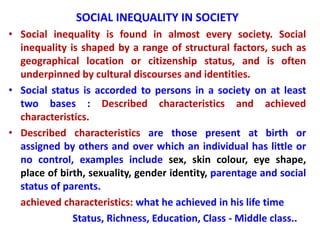
SOCIAL INEQUALITY IN SOCIETY
• Social inequality is found in almost every society. Social
inequality is shaped by a range of structural factors, such as
geographical location or citizenship status, and is often
underpinned by cultural discourses and identities.
• Social status is accorded to persons in a society on at least
two bases : Described characteristics and achieved
characteristics.
• Described characteristics are those present at birth or
assigned by others and over which an individual has little or
no control, examples include sex, skin colour, eye shape,
place of birth, sexuality, gender identity, parentage and social
status of parents.
achieved characteristics: what he achieved in his life time
Status, Richness, Education, Class - Middle class..
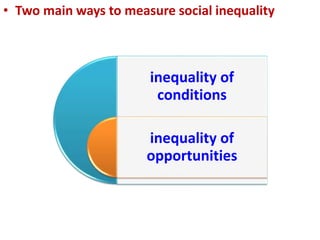
• Two main ways to measure social inequality
inequality of
conditions
inequality of
opportunities
• Inequality of conditions refers to the unequal
distribution of income, wealth, and material
goods.
• Inequality of opportunities refers to the unequal
distribution of life chances across individuals.
• This is reflected in measures such as level of
education, health status, and treatment by the
criminal justice system.
Cause for inequality, discrimination and
marginalization in education
• The only cause for inequality,
discrimination and marginalization in India
is due to social stratification.
• Social stratification is the condition of
being arranged in a social strata or classes
within a group.
Social stratification
• According to Young and Mork:
In many societies, people classify one
another into categories and rank these
categories from the higher to lower.
This process of defining such category
is called Social Stratification.
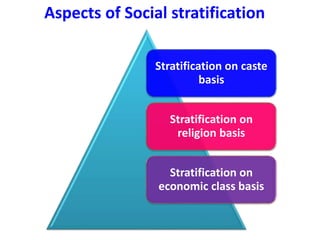
Aspects of Social stratification
Stratification on caste
basis
Stratification on
religion basis
Stratification on
economic class basis
• Problems caused by stratification:
• The disadvantage of social stratification
system is the conflict between various
strata of the hierarchy.
• Inaccessibility of various resources and lack
of social mobility further intensifies this
conflict.
• The wealth and luxury remains highly
concentrated at the top of the hierarchy.
• Social mobility also is the factor for social
stratification.
Social mobility
• Any transition of an individual
from one position to another in
a constellation of social group
and strata.
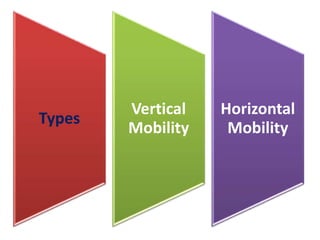
Types
Vertical
Mobility
Horizontal
Mobility
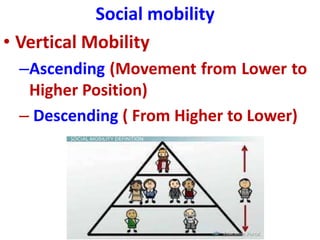
Social mobility
• Vertical Mobility
–Ascending (Movement from Lower to
Higher Position)
– Descending ( From Higher to Lower)
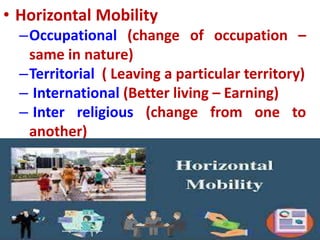
• Horizontal Mobility
–Occupational (change of occupation –
same in nature)
–Territorial ( Leaving a particular territory)
– International (Better living – Earning)
– Inter religious (change from one to
another)
• The caste system status is hereditary:
• It is based on birth, it is purely an
described status.
• Once such positions are assigned, they
cannot advance and improve their
social status in any way.
• Hence, caste as a major type of social
stratification does not facilitate vertical
social mobility.
• Class is an open system:
• Movement from one status to another has
no barrier. Status is based on achievement.
• It is determined by the talents, wealth,
money, intelligence, power, education,
income etc of a person.
• There is no inheritance of parental status.
• It divides society into haves and have not,
could lead to crime, poor health, illiteracy,
class struggle, benefits of progress limited
to few and low income.
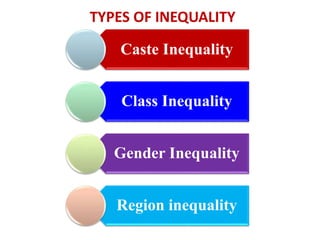
TYPES OF INEQUALITY
Caste Inequality
Class Inequality
Gender Inequality
Region inequality
1. Caste Inequality
–The Brahmins
–The Kshatriya
–The Vaishya and
–The Sudra
• It was well entrenched by the end of the Rig
Vedic period.
• The Vedic Caste system that was divided into four
divisions which is still prevalent in Indian society.
• The Brahmanas was to study and teach, sacrifice,
give and receive gifts,
• The Kshatriya to protect the people, sacrifice and
study;
• The Vaishya to breed cattle till earth, pursue
trade and lend money, though he too may study
and sacrifice;
• The Sudra was to serve the other three classes.
Gradually, the system became so deeply
entrenched in the social structure that it
continues to this day, though the rigidity is
gradually being diluted.
2. Class Inequality
• In general, social class can be defined as a large category
of similarly ranked people located in a hierarchy and
distinguished from other large categories in the
hierarchy by much traits as occupation, education,
income and wealth.
• In modern Western societies, inequalities are often
broadly classified into three major divisions of social
class: upper class, middle class and lower class, Each of
these classes can be further subdivided into smaller
classes (e.g. “upper middle”).
• Members of different classes have varied access to
financial resources, which affects their placement in the
social stratification system.
3.Gender Inequality
• Sex and gender based prejudice and
discrimination, called sexism, are
major contributing factors to social
inequality.
4. Region inequality
• One of the critical problems facing India’s
economy is the sharp and growing regional
variations among India’s different states and
territories in terms of per capita income, poverty,
availability of infrastructure and socio-economic
development.
• Seven low-income states – Bihar, Chhattisgarh,
Jharkhand, Madhya Pradesh, Orissa, Rajasthan
and Uttar Pradesh are home to more than half of
India’s population.
• The five-year plans have attempted to
reduce regional disparities by encouraging
industrial development if the interior
regions, but industries still tend to
concentrate around urban areas and port
cities.
• After liberalization, the more advanced
states are better placed to benefit from
them, with infrastructure like well
developed ports, urbanization and an
educated and skilled workforce which
attract manufacturing and service sectors.
ELIMINATION OF SOCIAL INEQUALITIES THROUGH
EDUCATION
• Make inequality a political campaign issue
• Introduce land reforms and raise taxation
for the wealthy
• Give a voice to oppressed groups
• Improve the balance of mass media
• Eliminate caste discrimination
• Harness the power of technology
• Widen access to quality basic services
• Make women more visible in public life
and institutions
• Ensure that India’s growth is for the
benefit of the many, not the few.
• Make development inclusive of those
with disabilities
• Challenge the growth agenda
• Ensure that all groups and communities
can express their voice without fear
• Stop the blame game
Meaning of Equality of Educational Opportunity
• It does not mean provision of equal education to all
but to get suitable education for each individual to
prosper in their life.
• New Education Policy 1986 - Equality of Educational
opportunity means the provision of standard
education from primary education to university
education to all the students irrespective of caste,
religion, creed, residence, sex etc. and providing
opportunities for students to attain success in
education.
• Dr. Radhakrishnan - Equality in Education means
providing educational opportunities to everyone to
develop their innate potentialities to the maximum
level.
Need of Equalization of Educational Opportunities
• Equality in education is concerned with the
development of innate potentialities of children
belonging to all sorts of people.
• As the children of lower class people receive
equal educational opportunities their social
justice is maintained.
• Education is democratized when equal
opportunity is available. As a result social unrest
(conflict) in averted (stopped).
• Exploitation of the underprivileged people of the
society is minimized.
• Resources and talents of all sorts of people are
channelized for the development of the country.
• Equality in education lays the foundation for the
formation of equalitarian society.
• Promotes national integration, preserves and
extended democratic values.
Constitutional Provisions for Education
• Adequate measures have been taken by the
framers of the constitution to see that social
justice, economic and educational interests for
the weaker sections of the people are protected
in the best possible manner.
• Article 45 of the constitution clearly directs that
the provision of Universal Free and Compulsory
Education is the joint responsibility of the centre
and the states.
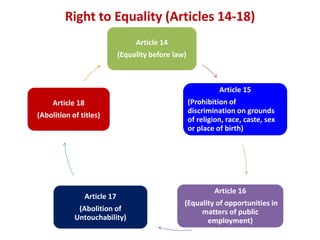
Right to Equality (Articles 14-18)
Article 14
(Equality before law)
Article 15
(Prohibition of
discrimination on grounds
of religion, race, caste, sex
or place of birth)
Article 16
(Equality of opportunities in
matters of public
employment)
Article 17
(Abolition of
Untouchability)
Article 18
(Abolition of titles)
• Article 14 (Equality before law)
• Article 14 says that state shall not deny to
any person equality before the law or the
equal protection of the laws within the
territory of India.
• Article 15 (Prohibition of discrimination on
grounds of religion, race, caste, sex or place
of birth)
• Article 15 says that the state shall not
discriminate against only of religion, race,
sex, place of birth or any of them.
• Under article 15 (3) & (4), government can
make special provisions for women &
children and for group of citizens who are
economically and socially backward.
• Article 16 (Equality of opportunities in
matters of public employment)
• Article 16 says that there shall be
equality of opportunity for all citizens in
matters relating to employment or
appointment to any office under the
state.
Article 17 (Abolition of Untouchability)
• Article 17 says that
• Untouchability is abolished and its
practice in any form is forbidden the
enforcement of any disability arising out
of untouchability shall be an offence
punishable in accordance with law.
Equality of opportunity in Educational
Institution
• Article 29(1) states,
No citizen shall be denied admission into any
educational institution maintained by the states or
receiving aid out to state funds, on ground only of
religion, race caste, language or any of them.
• Article 30(1) also states,
“All minorities whether based on religion,
class, caste, language shall have the right to
establish and administer educational institutions of
their choice.
Causes and factors for inequalities in Education
Inequality in management of Educational institution
Regional Imbalance
Poverty
Inequality in the quality of education
Home Environment
Non-Uniform Standards
Rural - Urban
Gender Disparity
Economic Disparity
Disabled Children
Inequality in management of Educational
institution
• All educational institutions across the country
are not under the same management.
• Most of the educational institutions are under
the management of state or central
governments.
• There are also a large number of educational
institutions under private management.
• The quality of education are not same in these
institution.
Regional Imbalance
• Glaring imbalances of educational development
in different parts of the country are also
responsible for such inequalities.
• The magnitude of inter-reginal disparities in
educational opportunities is evident from the fact
that in 1991, Kerala’s literacy rate was 89.81%
while that of Bihar was 38.48 while Kerala
actually has a female literacy rate of about 86 %,
Bihar and Uttar Pradesh have female literacy
rate around 55-60 percent.
• Even across different districts within the same
state educational opportunities vary.
Poverty
• The chronic poverty, from which the majority
of people are suffering, is not enabling them to
avail of the equalization of educational
opportunity provided to them.
• Of every 100 children of 6 years of age 20 never
go to school, 55 drop out at an early age, only
25 complete class 8.
• When the children of rich people study in
public schools in hill stations where they are
charging high fees, the children of poor people
study in the government schools.
Inequality in the quality of education available
• Differences in standards of schools and colleges
create an extremely interactive form of
educational inequality.
• High standard in urban schools than the rural.
• Infrastructure also very low in rural schools.
(Practical and Lab Systems)
Home Environment
• Inequalities arise from differences in home
environment.
• Children with non-literate parents, parents
who doesn’t understand the value of
education, does not have the same
opportunity which a child from an upper
class home with highly educated parents has.
Non-uniform standards
• The differences in educational standards of
schools and colleges also cause inequalities.
• There are various types of syllabus patterns
followed in our country such as CBSE, state
board syllabus, Matriculation syllabus etc.
• Under state board pattern English is taught only
at the 3rd standard level, Whereas the students
of same age coming under matriculation pattern
are learning computer language.
• So the students hailing from state Board schools
are not able to compete with the students getting
education under matric syllabus.
• Rural - Urban:
Application of the same standard to the
rural and urban population. S
tandard in educational measurement handicaps
rural students who lack equal environment
opportunity.
• Home environments:
Educationally retarded conditions status
of homes and low cultural background of
homes are also responsible for the inequalities
in the spread of education.
Gender disparity:
• Education is a luxury for the poor rural girl.
• Some orthodox parents do not like to send
their daughters out of their homes for higher
education.
• In the year 1990-91 the number of women in
higher education is 47 only.
• According to 1991 census male literacy rate
is 63.86% where as female literacy rate is
just 39.42%.
• Economic Disparity:
– Economic disparity among states leads to
economic imbalance and this affect
educational development.
Disabled children
• The number of schools available for the
handicapped are not sufficient to fulfill the
needs of education to all.
• The government has made efforts towards this
but still there is a lot to be done in this direction.
• Government study in 2004 revealed that only
0.51% disabled students are in mainstream
educational institutions at the school level the
rates of educational participation and outcomes
of education, remain very poor for children and
young adults with disabilities.
• Illiteracy rates for this group remain much
higher than the general population and school
attendance continues to lag behind that of non-
disabled peers.
• A study by the World bank (2007) for examble,
noted that children with disability are five
times more likely to be out of school than
children belonging to scheduled castes or
scheduled tribes; a 2003 District Primary
Education Programme report stated that there
are more than 3200 special schools throughout
India.
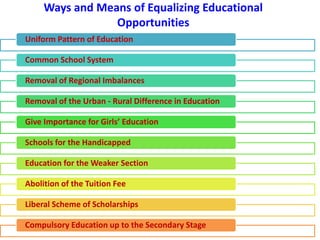
Ways and Means of Equalizing Educational
Opportunities
Uniform Pattern of Education
Common School System
Removal of Regional Imbalances
Removal of the Urban - Rural Difference in Education
Give Importance for Girls’ Education
Schools for the Handicapped
Education for the Weaker Section
Abolition of the Tuition Fee
Liberal Scheme of Scholarships
Compulsory Education up to the Secondary Stage
Uniform Pattern of Education
• A scheme of Uniform Pattern of education
should be implemented across the country in all
schools.
• As a first step towards nationalizing all
educational institutions in the country.
• Government should grant liberal grants to all
schools and enforce uniform pattern of
curriculum and ensure almost comparable
standards in all schools.
Common School System
• We must move towards the goal of a common system
of public education.
 which will be open to all children irrespective of caste,
creed, community, religion, economic conditions and
social status.
 where access to good education will depend, not on
wealth or class but on talent.
 Which would maintain adequate standards in all
schools and provide at least a reasonable proportion of
quality institutions.
 In which no tuition fee will be charged and
 Which would meet the needs of the average parent so
that he would not ordinarily feel the need to send this
children to expensive schools out-side the system.
Removal of Regional Imbalance
• The Union government at the centre should
make available special financial package for
educationally backward states.
Removal of the Urban-Rural Difference in
Education
• Schools in large number are to be opened in
rural areas and good standard should be
maintained in these schools, comparable to that
in urban schools.
Importance for Girls Education
• Educational and employment facilities for girls
should be expanded so that they could compete
with men in all walks of life on equal terms.
Schools for the Handicapped
• Special schools for the education of the
handicapped should be opened at least one in
every taluk.
Education of the weaker sections in society
• Scheduled castes and Tribes are educationally
backward and suffer from bad socio - economic
conditions of life.
• More number of schools are to be opened in hill
areas as well as urban slums, facilitating the
education of the weaker sections of the society.
Abolition of Tuition Fee
• In a phased manner, education at all stages
should be made free. To start with, primary
education should be made completely free.
Liberal Scheme of Scholarships
• A liberal scheme should be formulated to grant
scholarships and financial assistance for
meritorious poor students.
• Through banks, educational loans at nominal
interest should be made available for needy
students at the higher education level.
Compulsory education up to the Secondary Stage
• We should quickly move to the stage of making
education free and compulsory till the
secondary level throughout the country.
Role of the Central Government in Equalizing Educational
Opportunities
• Government of India provide universal education for
children in the age group of 6 to 14 years.
• It has implemented uniform pattern of education
throughout the country viz. 10+2+3.
• It has floated the concepts of ‘Common Schools’ and
‘Neighbourhood Schools’.
• To center the needs of the talented children, it has
opened ‘Navodhaya Vidyalayas’ in every district of the
country.
• NPE - for education the school - dropouts, a system of
Non-formal education and multiple point entry system
in formal education have been put into practice.
• The target of establishing an elementary school within a
distance of 2 K.M. from the residence of each child has
been largely achieved.
Position of Equality in Education in Tamilnadu
• In Tamilnadu special efforts have been taken to
equalize educational opportunities and is a
model State in India in this matter.
• The following measures have been undertaken
over the years.
Measures:
• Excellent Educational Standard
• Progress of Girl’s Education
• Removing the Economic Barriers
• Removing the social Barriers
• Expanding Educational opportunities for the
Disabled children
Excellent Educational Standard
• Govt. schools have been established in nook and
corner of the state.
• There is at least one Govt.College of Arts and
Science in every district of the state.
• Tamilnadu Government itself publishes quality
text books through Tamilnadu Text Book Society,
Chennai for Std I to XII in all school subjects.
Progress of Girl’s Education
• Separate schools for Girls
• Co-Education Schools are allowed
• Eg. Mother Teresa Women’s University
• Female teachers for Primary Schools
• Govt. offering Rs. 5000/- to meet the marriage
expenses of those poor girls who leave
completed VIII.
Removing the Economic Barriers
• Free education in govt. and govt. aided school
upto Classes XII for tribal children.
• Separate hostels are also maintained for such
children to stay and continue their education.
• Scheme for uniform, text books, noon meal.
• Free cycles are distributed to all poor students
studying in class XI.
• For college students less bus fare through bus
pass.
Removing the Social Barriers
• Reservation of seats for SC/ST and Backward
class people.
• Free coaching of IAS and other allied
examinations and collecting nominal
examination fee.
Expanding Educational opportunities for Tribal
• Special schools establishment
• Special Quota
• In education and employment.
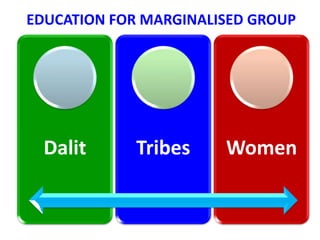
EDUCATION FOR MARGINALISED GROUP
Dalit Tribes Women
1. Who are Dalit?
• Schedule Castes are those castes in the
country that suffer from extreme social,
educational and economic backwardness
arising out of age-old practice of
untouchability.
• They need special consideration for
safeguarding their interests and for their
accelerated socio-economic development.
• These communities were notified as
scheduled Castes as per provisions contained
in clause 1 of Article 341 of the constitution.
Issues regarding Education of Dalits
• The dwellings of the Schedule caste people lacks
in proper drinking water, roads, health and
sanitations.
• They need special programs like education,
employment, self-employed can be
implemented in their areas.
• To break the caste-based occupational
stereotyping, special efforts need to be made to
encourage them to use educational concessions.
• There is a need to vocational education the
education right at the school level to promote
occupational mobility for these groups.
• Today the Dalit population represents 16% of the
country’s population.
• They still struggle to achieve social equality.
• There remains geographic division within
Indian cities and villages.
• Dalits have attempted to avoid the caste system by
converting from Hinduism to other religions.
• Providing education to them is an effective, useful
and permanent solution for their standard life.
Constitutional Provisions:
• Article 46 - Education for the weaker
sections especially for SC and STs.
• Article 330, 332,325,338 and 342 support to
implement the objectives of Article 46.
• Article 16 (A) - Reservation for SC and Sts
Measures taken for giving education for Dalits
• Incentives to indigent families to send their children to
school regularly till they reach the age of 14.
• Pre matric Scholarship enables for children of families
engaged in unclean occupational such as scavenging etc.
(From class I onwards to Matriculation level)
• Post matric scholarship enables the SC students to obtain
post - secondary and higher level of education.
• Constant micro planning and verification to ensure that
the enrolment, retentions and successful completion of
courses
• The recruitment of teachers from scheduled caste.
• Providing hostel facilities
• Location of school building, balwadis and adult
education
Who are tribal?
• Tribes in India had been called ‘hill tribes’, ‘forest
tribes’, backward tribes and depressed classes.
• They generally speak in their own dialect observe
their own political and cultural patterns.
• They have their own political and cultural
patterns, live in isolated areas and they are
economically and socially backward.
• They are very poor, illiterate and have no assets.
• Adivasis are believed to be the ‘original people’.
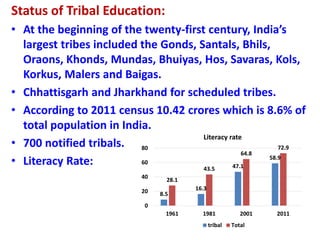
Status of Tribal Education:
• At the beginning of the twenty-first century, India’s
largest tribes included the Gonds, Santals, Bhils,
Oraons, Khonds, Mundas, Bhuiyas, Hos, Savaras, Kols,
Korkus, Malers and Baigas.
• Chhattisgarh and Jharkhand for scheduled tribes.
• According to 2011 census 10.42 crores which is 8.6% of
total population in India.
• 700 notified tribals.
• Literacy Rate:
8.5
16.3
47.1
58.9
28.1
43.5
64.8
72.9
0
20
40
60
80
1961 1981 2001 2011
Literacy rate
tribal Total
Issues Regarding Tribal Education
• Tribal in most parts of the country live in hilly and
forest areas with poor roads and other means of
communication.
• They live mostly in scattered homesteads rather than
villages, which makes it difficult to provide access to
schools within short distance for all students.
• Teachers from nontribal areas are often unwilling to
work in schools in tribal areas because of distance from
towns, lack of housing and other amenities.
• Teacher form other areas are also not familiar with
local tribal languages and dialects and are not able to
communicate effectively with tribal students,
particularly in lower primary sections.
measures for education of tribal children:
• The Ministry of Tribal Affairs was constituted in
the year 1999 to provide more focused attention
towards development of ST.
• Since 1997-98, a part of funds under Article 275
(1) of the constitution is also released to provide
quality education.
• It gives reservation facilities for Sts.
• 1993-1994 - ‘Education of Girls in Low Literacy
Pockets’
• Post matric scholarship system
• Priority will be accorded to opening primary
schools in tribal areas;
• There is need to develop curricula and devise
instructional material in tribal languages at the
initial stages with arrangements for switch-over
to regional languages;
• ST Youths will be encouraged to take up teaching
in tribal areas;
• Ashram Schools / residential schools will be
established on a large scale in tribal areas;
• Incentive schemes will be formulated for the STs,
keeping in view their special needs and lifestyle.
Need and importance of women Education
• Economic and prosperity: Education will empower
women to come forward and contribute towards
the development and prosperity of the country.
• Economic empowerment: So long as women
remain backward and economically dependent on
men, the helpless condition of theirs cannot be
changed.
• Improved life: Education helps a woman to live a
good life. Her identity as an individual would never
get lost. She can read and lean about her rights.
Her rights would not get trodden down.
• Improved health: Educated girls and women
are aware of the importance of health and
hygiene.
• Dignity and honor: Educated women are now
looked upon with dignity and honour.
• Justice: Educated women are more informed
of their rights for justice.
Constitutional Rights
• Article 14 - it confers equal rights and opportunities on
men and women in the political, economic and social
sphere.
• Article 15 - prohibits discrimination against any citizen on
the ground of sex, religion, race, caste and place of birth
or any of them.
• Article 15 (3) - empowers the state to make affirmative
discrimination in favour of women.
• Article 16 - provides for equality of opportunity in the
matters of public appointments for all citizens.
• Article 39 - equal payment for work
• Article 42 - humane conditions of work and maternity
relief.
• Article 51 - dignity of the women
• In India constitutionally equal rights have
been granted to woman on par with men. In
practice, however they are very much
behind the men. Even today, women are
restricted to home.
• Child marriage and Sati also practiced in
some parts of India.
• Violence against women’s takes the form of
physical abuse, sexual harassment, eve
teasing in public places etc.
• Dowry is the extreme form of violence
practices against women.
• Causes for slow progress of learning
• Economic backwardness:
dropouts are there
Girls are assigned duties at home
like cooking, looking after their
younger siblings, etc
• Social backwardness:
social customs and practices are
insists the superstitious
• Lack of facilities:
proper schools
Lack of teachers
Infrastructure
Refreshing facilities
 lack of guidance
• Lack of proper curriculum:
the curriculum does not meet the
needs of the society.
No interest towards the curriculum

INEQUALITY, DISCRIMINATION, Equality-of-Educational-Opportunities

  • 1.
    UNIT- V IMPLICATIONS OF EQUALITYOF EDUCATIONAL OPPORTUNITY
  • 2.
    SOCIAL INEQUALITY INSOCIETY • Social inequality is found in almost every society. Social inequality is shaped by a range of structural factors, such as geographical location or citizenship status, and is often underpinned by cultural discourses and identities. • Social status is accorded to persons in a society on at least two bases : Described characteristics and achieved characteristics. • Described characteristics are those present at birth or assigned by others and over which an individual has little or no control, examples include sex, skin colour, eye shape, place of birth, sexuality, gender identity, parentage and social status of parents. achieved characteristics: what he achieved in his life time Status, Richness, Education, Class - Middle class..
  • 3.
    • Two mainways to measure social inequality inequality of conditions inequality of opportunities
  • 4.
    • Inequality ofconditions refers to the unequal distribution of income, wealth, and material goods. • Inequality of opportunities refers to the unequal distribution of life chances across individuals. • This is reflected in measures such as level of education, health status, and treatment by the criminal justice system.
  • 5.
    Cause for inequality,discrimination and marginalization in education • The only cause for inequality, discrimination and marginalization in India is due to social stratification. • Social stratification is the condition of being arranged in a social strata or classes within a group.
  • 6.
    Social stratification • Accordingto Young and Mork: In many societies, people classify one another into categories and rank these categories from the higher to lower. This process of defining such category is called Social Stratification.
  • 7.
    Aspects of Socialstratification Stratification on caste basis Stratification on religion basis Stratification on economic class basis
  • 8.
    • Problems causedby stratification: • The disadvantage of social stratification system is the conflict between various strata of the hierarchy. • Inaccessibility of various resources and lack of social mobility further intensifies this conflict. • The wealth and luxury remains highly concentrated at the top of the hierarchy. • Social mobility also is the factor for social stratification.
  • 9.
    Social mobility • Anytransition of an individual from one position to another in a constellation of social group and strata.
  • 10.
  • 11.
    Social mobility • VerticalMobility –Ascending (Movement from Lower to Higher Position) – Descending ( From Higher to Lower)
  • 12.
    • Horizontal Mobility –Occupational(change of occupation – same in nature) –Territorial ( Leaving a particular territory) – International (Better living – Earning) – Inter religious (change from one to another)
  • 13.
    • The castesystem status is hereditary: • It is based on birth, it is purely an described status. • Once such positions are assigned, they cannot advance and improve their social status in any way. • Hence, caste as a major type of social stratification does not facilitate vertical social mobility.
  • 14.
    • Class isan open system: • Movement from one status to another has no barrier. Status is based on achievement. • It is determined by the talents, wealth, money, intelligence, power, education, income etc of a person. • There is no inheritance of parental status. • It divides society into haves and have not, could lead to crime, poor health, illiteracy, class struggle, benefits of progress limited to few and low income.
  • 15.
    TYPES OF INEQUALITY CasteInequality Class Inequality Gender Inequality Region inequality
  • 16.
    1. Caste Inequality –TheBrahmins –The Kshatriya –The Vaishya and –The Sudra • It was well entrenched by the end of the Rig Vedic period. • The Vedic Caste system that was divided into four divisions which is still prevalent in Indian society.
  • 17.
    • The Brahmanaswas to study and teach, sacrifice, give and receive gifts, • The Kshatriya to protect the people, sacrifice and study; • The Vaishya to breed cattle till earth, pursue trade and lend money, though he too may study and sacrifice; • The Sudra was to serve the other three classes. Gradually, the system became so deeply entrenched in the social structure that it continues to this day, though the rigidity is gradually being diluted.
  • 18.
    2. Class Inequality •In general, social class can be defined as a large category of similarly ranked people located in a hierarchy and distinguished from other large categories in the hierarchy by much traits as occupation, education, income and wealth. • In modern Western societies, inequalities are often broadly classified into three major divisions of social class: upper class, middle class and lower class, Each of these classes can be further subdivided into smaller classes (e.g. “upper middle”). • Members of different classes have varied access to financial resources, which affects their placement in the social stratification system.
  • 19.
    3.Gender Inequality • Sexand gender based prejudice and discrimination, called sexism, are major contributing factors to social inequality.
  • 20.
    4. Region inequality •One of the critical problems facing India’s economy is the sharp and growing regional variations among India’s different states and territories in terms of per capita income, poverty, availability of infrastructure and socio-economic development. • Seven low-income states – Bihar, Chhattisgarh, Jharkhand, Madhya Pradesh, Orissa, Rajasthan and Uttar Pradesh are home to more than half of India’s population.
  • 21.
    • The five-yearplans have attempted to reduce regional disparities by encouraging industrial development if the interior regions, but industries still tend to concentrate around urban areas and port cities. • After liberalization, the more advanced states are better placed to benefit from them, with infrastructure like well developed ports, urbanization and an educated and skilled workforce which attract manufacturing and service sectors.
  • 22.
    ELIMINATION OF SOCIALINEQUALITIES THROUGH EDUCATION • Make inequality a political campaign issue • Introduce land reforms and raise taxation for the wealthy • Give a voice to oppressed groups • Improve the balance of mass media • Eliminate caste discrimination • Harness the power of technology • Widen access to quality basic services
  • 23.
    • Make womenmore visible in public life and institutions • Ensure that India’s growth is for the benefit of the many, not the few. • Make development inclusive of those with disabilities • Challenge the growth agenda • Ensure that all groups and communities can express their voice without fear • Stop the blame game
  • 24.
    Meaning of Equalityof Educational Opportunity • It does not mean provision of equal education to all but to get suitable education for each individual to prosper in their life. • New Education Policy 1986 - Equality of Educational opportunity means the provision of standard education from primary education to university education to all the students irrespective of caste, religion, creed, residence, sex etc. and providing opportunities for students to attain success in education. • Dr. Radhakrishnan - Equality in Education means providing educational opportunities to everyone to develop their innate potentialities to the maximum level.
  • 25.
    Need of Equalizationof Educational Opportunities • Equality in education is concerned with the development of innate potentialities of children belonging to all sorts of people. • As the children of lower class people receive equal educational opportunities their social justice is maintained. • Education is democratized when equal opportunity is available. As a result social unrest (conflict) in averted (stopped). • Exploitation of the underprivileged people of the society is minimized.
  • 26.
    • Resources andtalents of all sorts of people are channelized for the development of the country. • Equality in education lays the foundation for the formation of equalitarian society. • Promotes national integration, preserves and extended democratic values.
  • 27.
    Constitutional Provisions forEducation • Adequate measures have been taken by the framers of the constitution to see that social justice, economic and educational interests for the weaker sections of the people are protected in the best possible manner. • Article 45 of the constitution clearly directs that the provision of Universal Free and Compulsory Education is the joint responsibility of the centre and the states.
  • 28.
    Right to Equality(Articles 14-18) Article 14 (Equality before law) Article 15 (Prohibition of discrimination on grounds of religion, race, caste, sex or place of birth) Article 16 (Equality of opportunities in matters of public employment) Article 17 (Abolition of Untouchability) Article 18 (Abolition of titles)
  • 29.
    • Article 14(Equality before law) • Article 14 says that state shall not deny to any person equality before the law or the equal protection of the laws within the territory of India.
  • 30.
    • Article 15(Prohibition of discrimination on grounds of religion, race, caste, sex or place of birth) • Article 15 says that the state shall not discriminate against only of religion, race, sex, place of birth or any of them. • Under article 15 (3) & (4), government can make special provisions for women & children and for group of citizens who are economically and socially backward.
  • 31.
    • Article 16(Equality of opportunities in matters of public employment) • Article 16 says that there shall be equality of opportunity for all citizens in matters relating to employment or appointment to any office under the state.
  • 32.
    Article 17 (Abolitionof Untouchability) • Article 17 says that • Untouchability is abolished and its practice in any form is forbidden the enforcement of any disability arising out of untouchability shall be an offence punishable in accordance with law.
  • 33.
    Equality of opportunityin Educational Institution • Article 29(1) states, No citizen shall be denied admission into any educational institution maintained by the states or receiving aid out to state funds, on ground only of religion, race caste, language or any of them. • Article 30(1) also states, “All minorities whether based on religion, class, caste, language shall have the right to establish and administer educational institutions of their choice.
  • 34.
    Causes and factorsfor inequalities in Education Inequality in management of Educational institution Regional Imbalance Poverty Inequality in the quality of education Home Environment Non-Uniform Standards Rural - Urban Gender Disparity Economic Disparity Disabled Children
  • 35.
    Inequality in managementof Educational institution • All educational institutions across the country are not under the same management. • Most of the educational institutions are under the management of state or central governments. • There are also a large number of educational institutions under private management. • The quality of education are not same in these institution.
  • 36.
    Regional Imbalance • Glaringimbalances of educational development in different parts of the country are also responsible for such inequalities. • The magnitude of inter-reginal disparities in educational opportunities is evident from the fact that in 1991, Kerala’s literacy rate was 89.81% while that of Bihar was 38.48 while Kerala actually has a female literacy rate of about 86 %, Bihar and Uttar Pradesh have female literacy rate around 55-60 percent. • Even across different districts within the same state educational opportunities vary.
  • 37.
    Poverty • The chronicpoverty, from which the majority of people are suffering, is not enabling them to avail of the equalization of educational opportunity provided to them. • Of every 100 children of 6 years of age 20 never go to school, 55 drop out at an early age, only 25 complete class 8. • When the children of rich people study in public schools in hill stations where they are charging high fees, the children of poor people study in the government schools.
  • 38.
    Inequality in thequality of education available • Differences in standards of schools and colleges create an extremely interactive form of educational inequality. • High standard in urban schools than the rural. • Infrastructure also very low in rural schools. (Practical and Lab Systems)
  • 39.
    Home Environment • Inequalitiesarise from differences in home environment. • Children with non-literate parents, parents who doesn’t understand the value of education, does not have the same opportunity which a child from an upper class home with highly educated parents has.
  • 40.
    Non-uniform standards • Thedifferences in educational standards of schools and colleges also cause inequalities. • There are various types of syllabus patterns followed in our country such as CBSE, state board syllabus, Matriculation syllabus etc. • Under state board pattern English is taught only at the 3rd standard level, Whereas the students of same age coming under matriculation pattern are learning computer language. • So the students hailing from state Board schools are not able to compete with the students getting education under matric syllabus.
  • 41.
    • Rural -Urban: Application of the same standard to the rural and urban population. S tandard in educational measurement handicaps rural students who lack equal environment opportunity. • Home environments: Educationally retarded conditions status of homes and low cultural background of homes are also responsible for the inequalities in the spread of education.
  • 42.
    Gender disparity: • Educationis a luxury for the poor rural girl. • Some orthodox parents do not like to send their daughters out of their homes for higher education. • In the year 1990-91 the number of women in higher education is 47 only. • According to 1991 census male literacy rate is 63.86% where as female literacy rate is just 39.42%.
  • 43.
    • Economic Disparity: –Economic disparity among states leads to economic imbalance and this affect educational development.
  • 44.
    Disabled children • Thenumber of schools available for the handicapped are not sufficient to fulfill the needs of education to all. • The government has made efforts towards this but still there is a lot to be done in this direction. • Government study in 2004 revealed that only 0.51% disabled students are in mainstream educational institutions at the school level the rates of educational participation and outcomes of education, remain very poor for children and young adults with disabilities.
  • 45.
    • Illiteracy ratesfor this group remain much higher than the general population and school attendance continues to lag behind that of non- disabled peers. • A study by the World bank (2007) for examble, noted that children with disability are five times more likely to be out of school than children belonging to scheduled castes or scheduled tribes; a 2003 District Primary Education Programme report stated that there are more than 3200 special schools throughout India.
  • 46.
    Ways and Meansof Equalizing Educational Opportunities Uniform Pattern of Education Common School System Removal of Regional Imbalances Removal of the Urban - Rural Difference in Education Give Importance for Girls’ Education Schools for the Handicapped Education for the Weaker Section Abolition of the Tuition Fee Liberal Scheme of Scholarships Compulsory Education up to the Secondary Stage
  • 47.
    Uniform Pattern ofEducation • A scheme of Uniform Pattern of education should be implemented across the country in all schools. • As a first step towards nationalizing all educational institutions in the country. • Government should grant liberal grants to all schools and enforce uniform pattern of curriculum and ensure almost comparable standards in all schools.
  • 48.
    Common School System •We must move towards the goal of a common system of public education.  which will be open to all children irrespective of caste, creed, community, religion, economic conditions and social status.  where access to good education will depend, not on wealth or class but on talent.  Which would maintain adequate standards in all schools and provide at least a reasonable proportion of quality institutions.  In which no tuition fee will be charged and  Which would meet the needs of the average parent so that he would not ordinarily feel the need to send this children to expensive schools out-side the system.
  • 49.
    Removal of RegionalImbalance • The Union government at the centre should make available special financial package for educationally backward states. Removal of the Urban-Rural Difference in Education • Schools in large number are to be opened in rural areas and good standard should be maintained in these schools, comparable to that in urban schools.
  • 50.
    Importance for GirlsEducation • Educational and employment facilities for girls should be expanded so that they could compete with men in all walks of life on equal terms. Schools for the Handicapped • Special schools for the education of the handicapped should be opened at least one in every taluk.
  • 51.
    Education of theweaker sections in society • Scheduled castes and Tribes are educationally backward and suffer from bad socio - economic conditions of life. • More number of schools are to be opened in hill areas as well as urban slums, facilitating the education of the weaker sections of the society. Abolition of Tuition Fee • In a phased manner, education at all stages should be made free. To start with, primary education should be made completely free.
  • 52.
    Liberal Scheme ofScholarships • A liberal scheme should be formulated to grant scholarships and financial assistance for meritorious poor students. • Through banks, educational loans at nominal interest should be made available for needy students at the higher education level. Compulsory education up to the Secondary Stage • We should quickly move to the stage of making education free and compulsory till the secondary level throughout the country.
  • 53.
    Role of theCentral Government in Equalizing Educational Opportunities • Government of India provide universal education for children in the age group of 6 to 14 years. • It has implemented uniform pattern of education throughout the country viz. 10+2+3. • It has floated the concepts of ‘Common Schools’ and ‘Neighbourhood Schools’. • To center the needs of the talented children, it has opened ‘Navodhaya Vidyalayas’ in every district of the country. • NPE - for education the school - dropouts, a system of Non-formal education and multiple point entry system in formal education have been put into practice. • The target of establishing an elementary school within a distance of 2 K.M. from the residence of each child has been largely achieved.
  • 54.
    Position of Equalityin Education in Tamilnadu • In Tamilnadu special efforts have been taken to equalize educational opportunities and is a model State in India in this matter. • The following measures have been undertaken over the years.
  • 55.
    Measures: • Excellent EducationalStandard • Progress of Girl’s Education • Removing the Economic Barriers • Removing the social Barriers • Expanding Educational opportunities for the Disabled children
  • 56.
    Excellent Educational Standard •Govt. schools have been established in nook and corner of the state. • There is at least one Govt.College of Arts and Science in every district of the state. • Tamilnadu Government itself publishes quality text books through Tamilnadu Text Book Society, Chennai for Std I to XII in all school subjects.
  • 57.
    Progress of Girl’sEducation • Separate schools for Girls • Co-Education Schools are allowed • Eg. Mother Teresa Women’s University • Female teachers for Primary Schools • Govt. offering Rs. 5000/- to meet the marriage expenses of those poor girls who leave completed VIII.
  • 58.
    Removing the EconomicBarriers • Free education in govt. and govt. aided school upto Classes XII for tribal children. • Separate hostels are also maintained for such children to stay and continue their education. • Scheme for uniform, text books, noon meal. • Free cycles are distributed to all poor students studying in class XI. • For college students less bus fare through bus pass.
  • 59.
    Removing the SocialBarriers • Reservation of seats for SC/ST and Backward class people. • Free coaching of IAS and other allied examinations and collecting nominal examination fee.
  • 60.
    Expanding Educational opportunitiesfor Tribal • Special schools establishment • Special Quota • In education and employment.
  • 61.
    EDUCATION FOR MARGINALISEDGROUP Dalit Tribes Women
  • 62.
    1. Who areDalit? • Schedule Castes are those castes in the country that suffer from extreme social, educational and economic backwardness arising out of age-old practice of untouchability. • They need special consideration for safeguarding their interests and for their accelerated socio-economic development. • These communities were notified as scheduled Castes as per provisions contained in clause 1 of Article 341 of the constitution.
  • 63.
    Issues regarding Educationof Dalits • The dwellings of the Schedule caste people lacks in proper drinking water, roads, health and sanitations. • They need special programs like education, employment, self-employed can be implemented in their areas. • To break the caste-based occupational stereotyping, special efforts need to be made to encourage them to use educational concessions. • There is a need to vocational education the education right at the school level to promote occupational mobility for these groups.
  • 64.
    • Today theDalit population represents 16% of the country’s population. • They still struggle to achieve social equality. • There remains geographic division within Indian cities and villages. • Dalits have attempted to avoid the caste system by converting from Hinduism to other religions. • Providing education to them is an effective, useful and permanent solution for their standard life.
  • 65.
    Constitutional Provisions: • Article46 - Education for the weaker sections especially for SC and STs. • Article 330, 332,325,338 and 342 support to implement the objectives of Article 46. • Article 16 (A) - Reservation for SC and Sts
  • 66.
    Measures taken forgiving education for Dalits • Incentives to indigent families to send their children to school regularly till they reach the age of 14. • Pre matric Scholarship enables for children of families engaged in unclean occupational such as scavenging etc. (From class I onwards to Matriculation level) • Post matric scholarship enables the SC students to obtain post - secondary and higher level of education. • Constant micro planning and verification to ensure that the enrolment, retentions and successful completion of courses • The recruitment of teachers from scheduled caste. • Providing hostel facilities • Location of school building, balwadis and adult education
  • 67.
    Who are tribal? •Tribes in India had been called ‘hill tribes’, ‘forest tribes’, backward tribes and depressed classes. • They generally speak in their own dialect observe their own political and cultural patterns. • They have their own political and cultural patterns, live in isolated areas and they are economically and socially backward. • They are very poor, illiterate and have no assets. • Adivasis are believed to be the ‘original people’.
  • 68.
    Status of TribalEducation: • At the beginning of the twenty-first century, India’s largest tribes included the Gonds, Santals, Bhils, Oraons, Khonds, Mundas, Bhuiyas, Hos, Savaras, Kols, Korkus, Malers and Baigas. • Chhattisgarh and Jharkhand for scheduled tribes. • According to 2011 census 10.42 crores which is 8.6% of total population in India. • 700 notified tribals. • Literacy Rate: 8.5 16.3 47.1 58.9 28.1 43.5 64.8 72.9 0 20 40 60 80 1961 1981 2001 2011 Literacy rate tribal Total
  • 69.
    Issues Regarding TribalEducation • Tribal in most parts of the country live in hilly and forest areas with poor roads and other means of communication. • They live mostly in scattered homesteads rather than villages, which makes it difficult to provide access to schools within short distance for all students. • Teachers from nontribal areas are often unwilling to work in schools in tribal areas because of distance from towns, lack of housing and other amenities. • Teacher form other areas are also not familiar with local tribal languages and dialects and are not able to communicate effectively with tribal students, particularly in lower primary sections.
  • 70.
    measures for educationof tribal children: • The Ministry of Tribal Affairs was constituted in the year 1999 to provide more focused attention towards development of ST. • Since 1997-98, a part of funds under Article 275 (1) of the constitution is also released to provide quality education. • It gives reservation facilities for Sts. • 1993-1994 - ‘Education of Girls in Low Literacy Pockets’ • Post matric scholarship system
  • 71.
    • Priority willbe accorded to opening primary schools in tribal areas; • There is need to develop curricula and devise instructional material in tribal languages at the initial stages with arrangements for switch-over to regional languages; • ST Youths will be encouraged to take up teaching in tribal areas; • Ashram Schools / residential schools will be established on a large scale in tribal areas; • Incentive schemes will be formulated for the STs, keeping in view their special needs and lifestyle.
  • 72.
    Need and importanceof women Education • Economic and prosperity: Education will empower women to come forward and contribute towards the development and prosperity of the country. • Economic empowerment: So long as women remain backward and economically dependent on men, the helpless condition of theirs cannot be changed. • Improved life: Education helps a woman to live a good life. Her identity as an individual would never get lost. She can read and lean about her rights. Her rights would not get trodden down.
  • 73.
    • Improved health:Educated girls and women are aware of the importance of health and hygiene. • Dignity and honor: Educated women are now looked upon with dignity and honour. • Justice: Educated women are more informed of their rights for justice.
  • 74.
    Constitutional Rights • Article14 - it confers equal rights and opportunities on men and women in the political, economic and social sphere. • Article 15 - prohibits discrimination against any citizen on the ground of sex, religion, race, caste and place of birth or any of them. • Article 15 (3) - empowers the state to make affirmative discrimination in favour of women. • Article 16 - provides for equality of opportunity in the matters of public appointments for all citizens. • Article 39 - equal payment for work • Article 42 - humane conditions of work and maternity relief. • Article 51 - dignity of the women
  • 75.
    • In Indiaconstitutionally equal rights have been granted to woman on par with men. In practice, however they are very much behind the men. Even today, women are restricted to home. • Child marriage and Sati also practiced in some parts of India. • Violence against women’s takes the form of physical abuse, sexual harassment, eve teasing in public places etc. • Dowry is the extreme form of violence practices against women.
  • 76.
    • Causes forslow progress of learning • Economic backwardness: dropouts are there Girls are assigned duties at home like cooking, looking after their younger siblings, etc
  • 77.
    • Social backwardness: socialcustoms and practices are insists the superstitious • Lack of facilities: proper schools Lack of teachers Infrastructure Refreshing facilities  lack of guidance
  • 78.
    • Lack ofproper curriculum: the curriculum does not meet the needs of the society. No interest towards the curriculum