INDIAN CONSTITUTION
& EDUCATION
A PRESENTATION BY
RAMSHEENA K
KEYI SAHIB TRAINING COLLEGE
How Preamble
Promote Education?
Educational
Institutions and
facilities should be
enjoyed by each
regardless to any sort
of ethnic or social
difference
Socialism
means equal
distribution
of state
properties
SECULARISM
Secularism is a state in which
people of different religions
have the right to follow their
religious customs and rituals
without violating the rights of
people of other religions, and
no sort of discrimination
should be practiced by the
Government towards any
religious group in the state.
Educational Institutions and
facilities should be enjoyed
by each regardless to their
religious faith and practice
SECULARISM
No system can ensure social
justice until it provides education
for its citizens regardless to caste,
religion, and other social
diversified factors
Each and every one of
the country has got
the freedom to
choose his own
course of study and
career
EQUALITY OF OPPERTUNITIES
No one can not deny some
categories of the society better
opportunities which are enjoyed
by other categories
School is the most
useful place for
cultivating
friendship among
the people of
different categories
of the society
Fundamental Rights are
the basic rights that
should be provided to
each citizen regardless to
any social status. These
rights are enforceable by
courts.
FUNDAMENTAL DUTIES
Fundamental Duties are
defined as the moral
obligations of all
citizens to help
promote a spirit of
patriotism and to
uphold the unity of
India. These are not
legally enforceable.
The Directive Principles of
State Policy are guidelines
for the framing of laws by
the government. These
also are not legally
enforceable. The State is
expected to keep these
principles in mind while
framing laws and policies
2. National Integration
3. Development of Nation
4. Conservation of Culture
1. Cultivate Democratic
Values
5. Cultivation of Moral Values
6. Cultivation of Social Values
Aims of Education in India, as the
Constitution Put Forth
Aims of Education in India, as the
Constitution Put Forth
7. Promotion of Secularism
8. Promotion of Socialism
9. Education on Social
Inequalities
10. Promotion of
Modernization
11. Cultivation of Traditional
Values
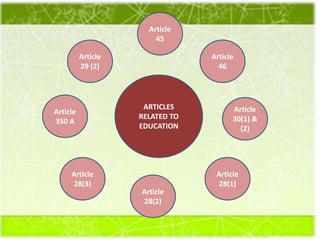
ARTICLES
RELATED TO
EDUCATION
Article
29 (2)
Article
350 A
Article
28(3)
Article
28(2)
Article
45
Article
46
Article
30(1) &
(2)
Article
28(1)
The State shall endeavour to provide, within a
period of ten years from the commencement
of this Constitution, for free and compulsory
education for all children until they complete
the age of fourteen years
ARTICLE 45
The State shall promote with
special care the educational
and economic interests of the
weaker sections of the people,
and, in particular, of the
Scheduled Castes and the
Scheduled Tribes, and shall
protect them from social
injustice and all forms of
exploitation.
ARTICLE 46
ARTICLE 30 (1) AND (2)
(1) All minorities, whether
based on religion or
language, shall have the
right to establish and
administer educational
institutions of their
choice.
(2) The State shall not, in
granting aid to
educational institutions,
discriminate against any
educational institution
on the ground that it is
under the management
of a minority, whether
based on religion or
language
No religious instruction shall be
provided in any educational
institution wholly maintained out of
State funds
Article 28(1)
Nothing in clause ( 1 ) shall apply to an
educational institution which is administered
by the State but has been established under
any endowment or trust which requires that
religious instruction shall be imparted in such
institution
Article 28(2)
No person attending any educational
institution recognized by the State or receiving
aid out of State funds shall be required to take
part in any religious instruction that may be
imparted in such institution or to attend any
religious worship that may be conducted in
such institution or in any premises attached
thereto unless such person or, if such person is
a minor, his guardian has given his consent
thereto Cultural and Educational Rights
Article 28(3)
It shall be the endeavour of every State and of
every local authority within the State to
provide adequate facilities for instruction in
the mother-tongue at the primary stage of
education to children belonging to linguistic
minority groups; and the President may issue
such directions to any State as he considers
necessary or proper for securing the provision
of such facilities.
Article 350A
No citizen shall be denied
admission into any educational
institution maintained by the
State or receiving aid out of
State funds on grounds only of
religion, race, caste, language
or any of them
Article 29(2)
A PRESENTATION BY
RAMSHEENA K
KEYI SAHIB TRAINING COLLEGE

Indian constitution &education

  • 1.
    INDIAN CONSTITUTION & EDUCATION APRESENTATION BY RAMSHEENA K KEYI SAHIB TRAINING COLLEGE
  • 4.
  • 5.
    Educational Institutions and facilities shouldbe enjoyed by each regardless to any sort of ethnic or social difference Socialism means equal distribution of state properties
  • 6.
    SECULARISM Secularism is astate in which people of different religions have the right to follow their religious customs and rituals without violating the rights of people of other religions, and no sort of discrimination should be practiced by the Government towards any religious group in the state. Educational Institutions and facilities should be enjoyed by each regardless to their religious faith and practice SECULARISM
  • 7.
    No system canensure social justice until it provides education for its citizens regardless to caste, religion, and other social diversified factors
  • 8.
    Each and everyone of the country has got the freedom to choose his own course of study and career
  • 9.
    EQUALITY OF OPPERTUNITIES Noone can not deny some categories of the society better opportunities which are enjoyed by other categories
  • 10.
    School is themost useful place for cultivating friendship among the people of different categories of the society
  • 11.
    Fundamental Rights are thebasic rights that should be provided to each citizen regardless to any social status. These rights are enforceable by courts.
  • 12.
    FUNDAMENTAL DUTIES Fundamental Dutiesare defined as the moral obligations of all citizens to help promote a spirit of patriotism and to uphold the unity of India. These are not legally enforceable.
  • 13.
    The Directive Principlesof State Policy are guidelines for the framing of laws by the government. These also are not legally enforceable. The State is expected to keep these principles in mind while framing laws and policies
  • 14.
    2. National Integration 3.Development of Nation 4. Conservation of Culture 1. Cultivate Democratic Values 5. Cultivation of Moral Values 6. Cultivation of Social Values Aims of Education in India, as the Constitution Put Forth
  • 15.
    Aims of Educationin India, as the Constitution Put Forth 7. Promotion of Secularism 8. Promotion of Socialism 9. Education on Social Inequalities 10. Promotion of Modernization 11. Cultivation of Traditional Values
  • 16.
    ARTICLES RELATED TO EDUCATION Article 29 (2) Article 350A Article 28(3) Article 28(2) Article 45 Article 46 Article 30(1) & (2) Article 28(1)
  • 17.
    The State shallendeavour to provide, within a period of ten years from the commencement of this Constitution, for free and compulsory education for all children until they complete the age of fourteen years ARTICLE 45
  • 18.
    The State shallpromote with special care the educational and economic interests of the weaker sections of the people, and, in particular, of the Scheduled Castes and the Scheduled Tribes, and shall protect them from social injustice and all forms of exploitation. ARTICLE 46
  • 19.
    ARTICLE 30 (1)AND (2) (1) All minorities, whether based on religion or language, shall have the right to establish and administer educational institutions of their choice. (2) The State shall not, in granting aid to educational institutions, discriminate against any educational institution on the ground that it is under the management of a minority, whether based on religion or language
  • 20.
    No religious instructionshall be provided in any educational institution wholly maintained out of State funds Article 28(1)
  • 21.
    Nothing in clause( 1 ) shall apply to an educational institution which is administered by the State but has been established under any endowment or trust which requires that religious instruction shall be imparted in such institution Article 28(2)
  • 22.
    No person attendingany educational institution recognized by the State or receiving aid out of State funds shall be required to take part in any religious instruction that may be imparted in such institution or to attend any religious worship that may be conducted in such institution or in any premises attached thereto unless such person or, if such person is a minor, his guardian has given his consent thereto Cultural and Educational Rights Article 28(3)
  • 23.
    It shall bethe endeavour of every State and of every local authority within the State to provide adequate facilities for instruction in the mother-tongue at the primary stage of education to children belonging to linguistic minority groups; and the President may issue such directions to any State as he considers necessary or proper for securing the provision of such facilities. Article 350A
  • 24.
    No citizen shallbe denied admission into any educational institution maintained by the State or receiving aid out of State funds on grounds only of religion, race, caste, language or any of them Article 29(2)
  • 25.
    A PRESENTATION BY RAMSHEENAK KEYI SAHIB TRAINING COLLEGE