INTRODUCTION
 It is a simple laundry-list type of device
 It is consisting of prepared list of items.
 It is used to record the presence or absence of the
item by checking ‘yes’ or ‘no’.
 It is used in educational surveys to get facts and
also in observational studies of behavior.
 Also used to record observations of an individual,
a group or a whole class.
USES OF CHECK LIST
 Check list is useful in
 collecting educational statistics
 to find out the needs of students
 facilities available in educational institutions
 to observe and record students behavioral traits
 They are also useful to find out the student’s
learning efficiency and evaluating the
effectiveness of classroom teaching learning
activities.
 The checklist could be used easily by the
investigator
 It takes only a few minutes to fill in the
details to be provided as they are indicated
using tick mark or words or numbers.
 As information are obtained through
observation, there is no need to doubt them.
 Each segment of the information or item
could be used easily to compute its
frequency, average and percentage.
 There are four steps in designing a check
list.
 Identification of the skills to be included
 Separate listing of target behaviors
 Sequential organization of the checklist
 Record keeping
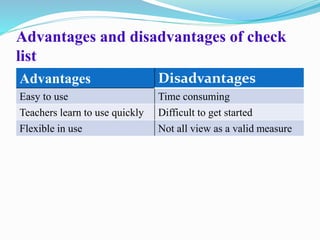
Advantages and disadvantages of check
list
Advantages Disadvantages
Easy to use Time consuming
Teachers learn to use quickly Difficult to get started
Flexible in use Not all view as a valid measure
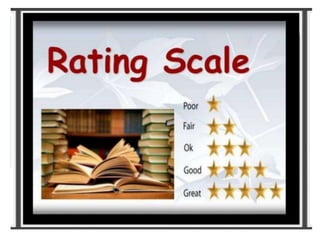
RATING SCALE
 Rating scale is superior to check list.
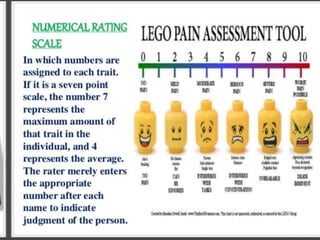
 Rating scale is a device containing a set of
graded categories in small numbers
The numbers help an individual to express
his/her judgment regarding how much certain
characteristic traits or attributes are present
in some situation,object,or behavior.
Definition of a rating scale
 According to A.S.Barr and others,
“Rating is a term applied to expression
of opinion or judgment regarding some
situation, objects or characters.
 Opinions are usually expressed on a scale
of values.
TYPES OF RATING SCALE
 Numerical Rating Scale
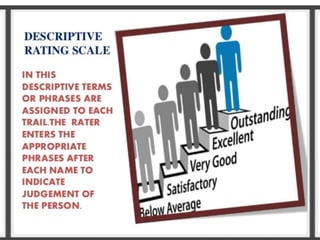
 Descriptive Rating Scale
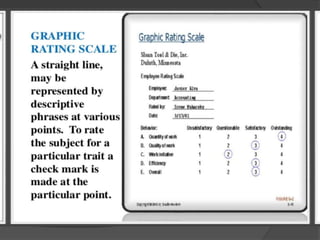
 Graphic Rating Scale
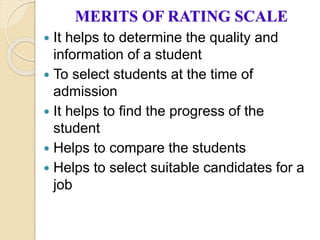
MERITS OF RATING SCALE
 It helps to determine the quality and
information of a student
 To select students at the time of
admission
 It helps to find the progress of the
student
 Helps to compare the students
 Helps to select suitable candidates for a
job
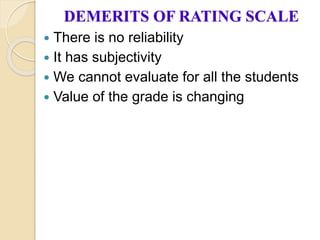
DEMERITS OF RATING SCALE
 There is no reliability
 It has subjectivity
 We cannot evaluate for all the students
 Value of the grade is changing
3. check list & rating scale

3. check list & rating scale

  • 2.
    INTRODUCTION  It isa simple laundry-list type of device  It is consisting of prepared list of items.  It is used to record the presence or absence of the item by checking ‘yes’ or ‘no’.  It is used in educational surveys to get facts and also in observational studies of behavior.  Also used to record observations of an individual, a group or a whole class.
  • 3.
    USES OF CHECKLIST  Check list is useful in  collecting educational statistics  to find out the needs of students  facilities available in educational institutions  to observe and record students behavioral traits  They are also useful to find out the student’s learning efficiency and evaluating the effectiveness of classroom teaching learning activities.
  • 4.
     The checklistcould be used easily by the investigator  It takes only a few minutes to fill in the details to be provided as they are indicated using tick mark or words or numbers.  As information are obtained through observation, there is no need to doubt them.  Each segment of the information or item could be used easily to compute its frequency, average and percentage.
  • 5.
     There arefour steps in designing a check list.  Identification of the skills to be included  Separate listing of target behaviors  Sequential organization of the checklist  Record keeping
  • 6.
    Advantages and disadvantagesof check list Advantages Disadvantages Easy to use Time consuming Teachers learn to use quickly Difficult to get started Flexible in use Not all view as a valid measure
  • 8.
    RATING SCALE  Ratingscale is superior to check list.  Rating scale is a device containing a set of graded categories in small numbers The numbers help an individual to express his/her judgment regarding how much certain characteristic traits or attributes are present in some situation,object,or behavior.
  • 9.
    Definition of arating scale  According to A.S.Barr and others, “Rating is a term applied to expression of opinion or judgment regarding some situation, objects or characters.  Opinions are usually expressed on a scale of values.
  • 10.
    TYPES OF RATINGSCALE  Numerical Rating Scale  Descriptive Rating Scale  Graphic Rating Scale
  • 15.
    MERITS OF RATINGSCALE  It helps to determine the quality and information of a student  To select students at the time of admission  It helps to find the progress of the student  Helps to compare the students  Helps to select suitable candidates for a job
  • 16.
    DEMERITS OF RATINGSCALE  There is no reliability  It has subjectivity  We cannot evaluate for all the students  Value of the grade is changing