RUBRICS
INTRODUCTION:
The word Rubric comes from the Latin word
for red.
The online Merriam-Webster dictionary lists
the first meaning of rubric as "an authoritative
rule"
 and also it refers as "a guide listing specific
criteria for grading or scoring academic papers,
projects, or tests.“
 A rubric is a great tool for teachers because it is
a simple way to set up a grading criteria for
assignments.
 this tool is useful not only for the teachers but
also it is helpful for students.
Purpose and uses of
rubrics The main purpose of rubrics is to assess
performances.
 Provides tool for systematic recording
of observation .
 Provides tool for self –assessment
 The teacher can evaluate their specific
skills, attitudes, behaviour etc..
 For clarifying the students instructional
needs by presenting a record of current
accomplishments.
Types of Performances That Can Be Assessed with
Rubrics
Type of Performance Examples
Processes
•Physical skills
•Use of equipment
•Oral communication
•Work habits
=>Playing a musical
instrument
=>Preparing a slide for the
microscope speech
=>Making a to the class
=>Reading aloud
=>Conversing in a foreign
language
=>Working independently
Products
=>Constructed objects
=>Written essays, themes,
reports, term papers
=>Other academic products
that demonstrate
understanding of concepts
=>Handmade apron
=>Watercolor painting
=>Laboratory report
=>Term paper on theatrical
conventions in Shakespeare's
day
=>Model or diagram of a
structure (atom, flower,
planetary system, etc.)
=>Concept map
Advantages and importance of
Rubrics
 Helps the grading process become more
efficient
 Helps faculty to grade/score more
accurately, fairly and reliably
 Supports uniform and standardized grading
processes among different faculty members
 Clarifies quality expectations to students
about their assignments
 Students can understand better the
rationale and the reason for grades
Disadvantages of Rubrics
 Development of rubrics can be complex
and time-consuming
•Using the correct language to express
performance expectation can be difficult
 Defining the correct set of criteria to
define performance can be complex
ASSESSMENTS
TOOLS
FOR AFFECTIVE
DOMAIN
There are three categories are in
educational activities
Cognitive
Domain
Affective
Domain
Psychomotor
Domain
• Cognitive is for mental skills
(Knowledge)
• Affective is for growth in feelings or
emotional areas (Attitude)
• Psychomotor is for manual or physical
skills (Skills).
AFFECTIVE DOMAIN :
• 5 Components
* Receiving
* responding
* valuing
* organisation
* characterization
EXAMPLES :
RECEIVING - TO LISTEN
RESPONDING - TO ANSWER A QUESTION
VALUING - VOLUNTARILY ATTENDING
LECTURES
ORGANISATION - TO ARRANGE
CHARACTERISATION - TO REVISE
TOOLS USED IN ASSESSMENT
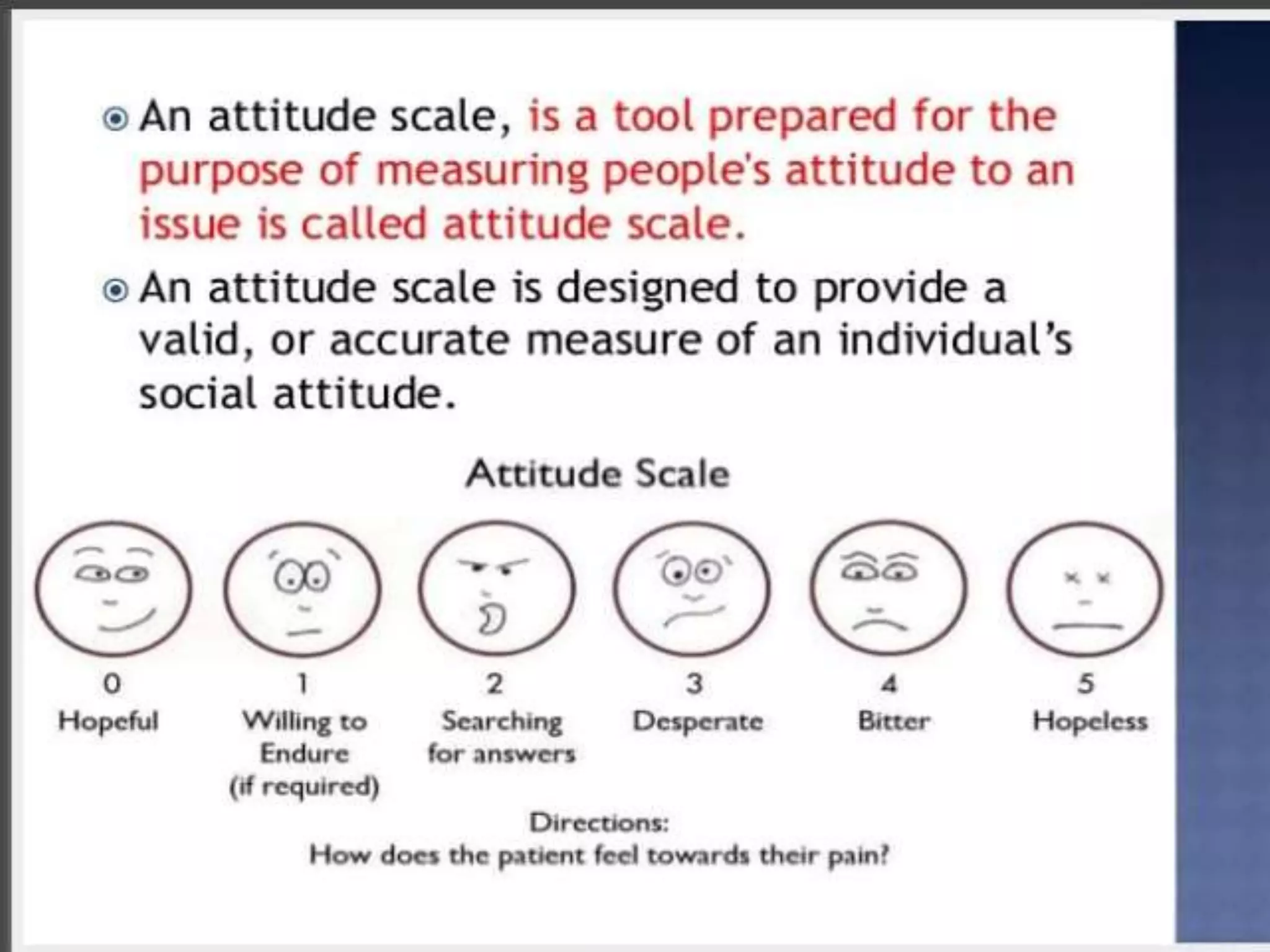
• ATTITUDE SCALES
• MOTIVATIONAL SCALES
• INTEREST INVENTORY
Advantages
• we can get the quality of a thing.
• According to it we can change the respondents
• we can analyse the new curriculum after getting
students attitude
 they are not able to understand the concept
 no one studies the form
Disadvantages
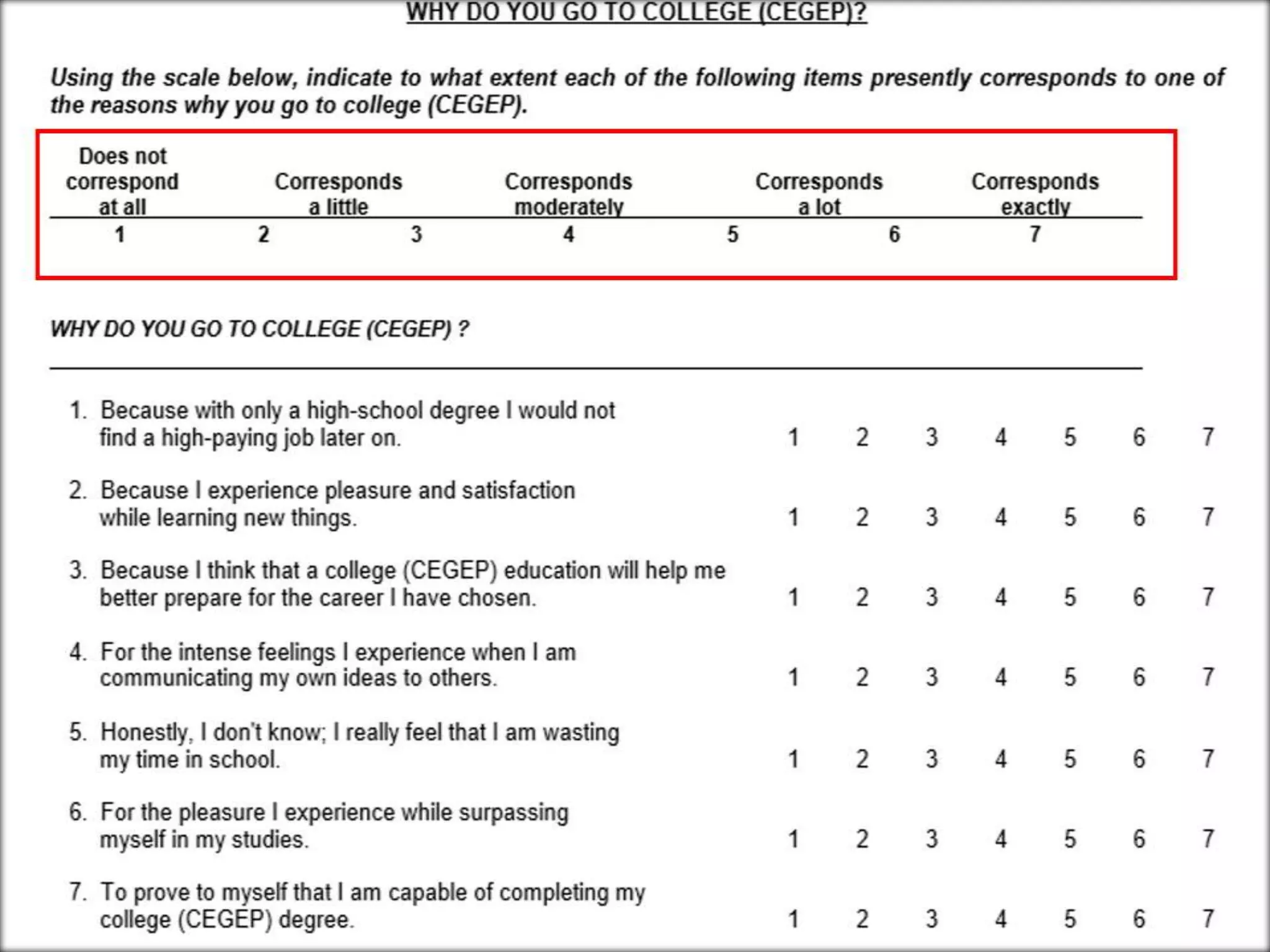
MOTIVATIONAL
SCALE
Meaning
• Motivation is a set of internal and external
facts and arguments used to support to attain
a goal.
• The Motivation Assessment Scale (MAS) is a
rating scale that assesses functions of problem
behavior in individuals with developmental
disabilities through informant responses.
Effective ways for motivation
• Encourage the students
• Get them involved
• Offer incentives (Award)
• Get creative
• Draw connections of real life
Meaning of interest
 Getting involved oneself with a thing or
activity shows his interest in that.
 No compulsion in such involvement.
Interest – is a behaviour orientation towards
certain objects, activities or experiences.
Voluntary
involvement
Indication
interest
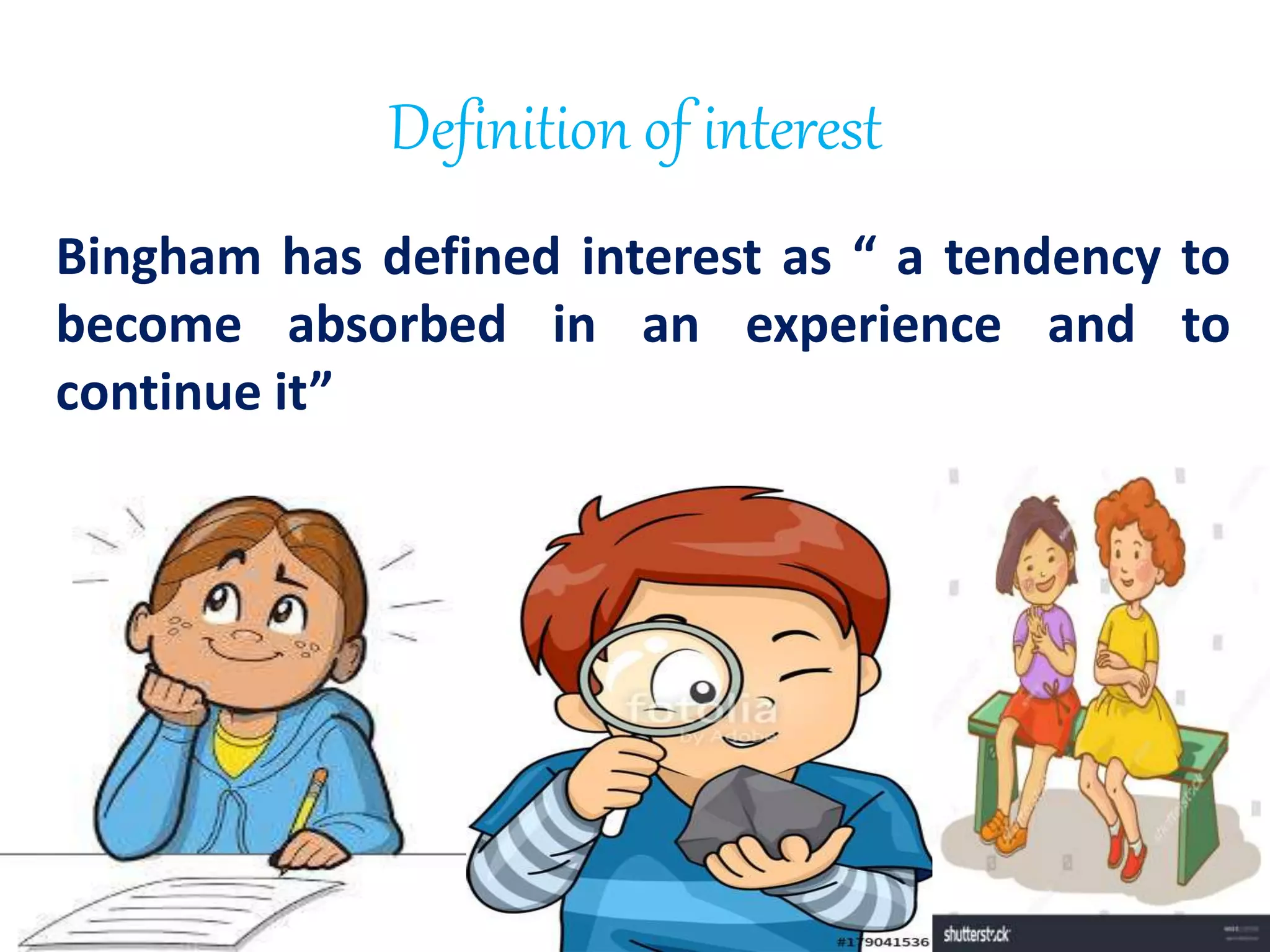
Definition of interest
Bingham has defined interest as “ a tendency to
become absorbed in an experience and to
continue it”
Interest inventory
• It is a testing instrument designed for the
purpose of measuring and evaluating the level
of an individual interest.
• Test to measure interest are developed in
three board areas
General interest Vocational
interest
Educational
interest
 The kind of interest measurable are subjective in
nature and are obtained by interest inventories.
 Guildford – close relationship between a
person’s interest and vocation.
Interest in mechanics
Interest in business
Interest in science
Some important interest inventories
Kuder preference record
Which could be administered to pupils between the
age of 9 and 16 , published in 1939 and revised in
1949.
 The blank contains 504 items, each offering three
possible choices.
 Develope new varieties of flowers.
 Conduct advertising campaign for florists.
 Take telephone orders in florist shop.
Strong vocational interest blank(SVLB)
 E.K. Strong of standford university, U.S.A.
published his vocational interest blank in 1927.
 It was subsequently revised in 1915.
 It there were listed 47 vocations for men and 28
vocations for women under 11 sections.
 The main purpose of SVLB is to compare how far
the interests and preferences of the testee agree with
those of successful persons
Strong campbell interest inventory (SCLL)
 David p. campbell modified strong vocational
interest Blank and published it in 1974 with 325
items.
Occupation
School
subjects
Activity in
day to day
life
Amusement
Day-to-day
contact
THRUSTONE’S OCCUPATIONAL INTEREST
SCHEDULE
ώ This was developed by L.L.Thurstone.
ώ The paring is done in such a way that a
particular occupation placed first in a pair gets
placed second in another combination of two
occupations.
Physical interest Biological interest Business
interest
Physicist Physician Banker
Engineer Physicist Machine Designer
LEE-THORPE OCCUPATIONAL
INTEREST INVENTORY
 The occupation interest inventory developed by
Lee and Thorpe, consisting of 240 items, attempt to
measure one’s occupation related interest.
 The area of occupation contained in the
occupation interest inventory are:
Social interest
Related to ’Nature’
Mechanical
Arts
Science
4. rubrics and affective domain tool

4. rubrics and affective domain tool

  • 1.
    RUBRICS INTRODUCTION: The word Rubriccomes from the Latin word for red. The online Merriam-Webster dictionary lists the first meaning of rubric as "an authoritative rule"  and also it refers as "a guide listing specific criteria for grading or scoring academic papers, projects, or tests.“  A rubric is a great tool for teachers because it is a simple way to set up a grading criteria for assignments.  this tool is useful not only for the teachers but also it is helpful for students.
  • 2.
    Purpose and usesof rubrics The main purpose of rubrics is to assess performances.  Provides tool for systematic recording of observation .  Provides tool for self –assessment  The teacher can evaluate their specific skills, attitudes, behaviour etc..  For clarifying the students instructional needs by presenting a record of current accomplishments.
  • 3.
    Types of PerformancesThat Can Be Assessed with Rubrics
  • 4.
    Type of PerformanceExamples Processes •Physical skills •Use of equipment •Oral communication •Work habits =>Playing a musical instrument =>Preparing a slide for the microscope speech =>Making a to the class =>Reading aloud =>Conversing in a foreign language =>Working independently Products =>Constructed objects =>Written essays, themes, reports, term papers =>Other academic products that demonstrate understanding of concepts =>Handmade apron =>Watercolor painting =>Laboratory report =>Term paper on theatrical conventions in Shakespeare's day =>Model or diagram of a structure (atom, flower, planetary system, etc.) =>Concept map
  • 6.
    Advantages and importanceof Rubrics  Helps the grading process become more efficient  Helps faculty to grade/score more accurately, fairly and reliably  Supports uniform and standardized grading processes among different faculty members  Clarifies quality expectations to students about their assignments  Students can understand better the rationale and the reason for grades
  • 7.
    Disadvantages of Rubrics Development of rubrics can be complex and time-consuming •Using the correct language to express performance expectation can be difficult  Defining the correct set of criteria to define performance can be complex
  • 8.
  • 9.
    There are threecategories are in educational activities Cognitive Domain Affective Domain Psychomotor Domain
  • 10.
    • Cognitive isfor mental skills (Knowledge) • Affective is for growth in feelings or emotional areas (Attitude) • Psychomotor is for manual or physical skills (Skills).
  • 11.
    AFFECTIVE DOMAIN : •5 Components * Receiving * responding * valuing * organisation * characterization
  • 12.
    EXAMPLES : RECEIVING -TO LISTEN RESPONDING - TO ANSWER A QUESTION VALUING - VOLUNTARILY ATTENDING LECTURES ORGANISATION - TO ARRANGE CHARACTERISATION - TO REVISE
  • 13.
    TOOLS USED INASSESSMENT • ATTITUDE SCALES • MOTIVATIONAL SCALES • INTEREST INVENTORY
  • 20.
    Advantages • we canget the quality of a thing. • According to it we can change the respondents • we can analyse the new curriculum after getting students attitude  they are not able to understand the concept  no one studies the form Disadvantages
  • 21.
  • 22.
    Meaning • Motivation isa set of internal and external facts and arguments used to support to attain a goal. • The Motivation Assessment Scale (MAS) is a rating scale that assesses functions of problem behavior in individuals with developmental disabilities through informant responses.
  • 24.
    Effective ways formotivation • Encourage the students • Get them involved • Offer incentives (Award) • Get creative • Draw connections of real life
  • 26.
    Meaning of interest Getting involved oneself with a thing or activity shows his interest in that.  No compulsion in such involvement. Interest – is a behaviour orientation towards certain objects, activities or experiences. Voluntary involvement Indication interest
  • 27.
    Definition of interest Binghamhas defined interest as “ a tendency to become absorbed in an experience and to continue it”
  • 28.
    Interest inventory • Itis a testing instrument designed for the purpose of measuring and evaluating the level of an individual interest. • Test to measure interest are developed in three board areas General interest Vocational interest Educational interest
  • 29.
     The kindof interest measurable are subjective in nature and are obtained by interest inventories.  Guildford – close relationship between a person’s interest and vocation. Interest in mechanics Interest in business Interest in science
  • 30.
    Some important interestinventories Kuder preference record Which could be administered to pupils between the age of 9 and 16 , published in 1939 and revised in 1949.  The blank contains 504 items, each offering three possible choices.  Develope new varieties of flowers.  Conduct advertising campaign for florists.  Take telephone orders in florist shop.
  • 31.
    Strong vocational interestblank(SVLB)  E.K. Strong of standford university, U.S.A. published his vocational interest blank in 1927.  It was subsequently revised in 1915.  It there were listed 47 vocations for men and 28 vocations for women under 11 sections.  The main purpose of SVLB is to compare how far the interests and preferences of the testee agree with those of successful persons
  • 32.
    Strong campbell interestinventory (SCLL)  David p. campbell modified strong vocational interest Blank and published it in 1974 with 325 items. Occupation School subjects Activity in day to day life Amusement Day-to-day contact
  • 33.
    THRUSTONE’S OCCUPATIONAL INTEREST SCHEDULE ώThis was developed by L.L.Thurstone. ώ The paring is done in such a way that a particular occupation placed first in a pair gets placed second in another combination of two occupations. Physical interest Biological interest Business interest Physicist Physician Banker Engineer Physicist Machine Designer
  • 34.
    LEE-THORPE OCCUPATIONAL INTEREST INVENTORY The occupation interest inventory developed by Lee and Thorpe, consisting of 240 items, attempt to measure one’s occupation related interest.  The area of occupation contained in the occupation interest inventory are: Social interest Related to ’Nature’ Mechanical Arts Science