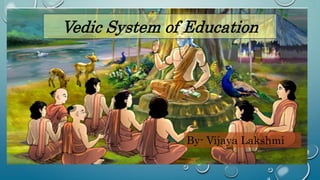
Vedic System of Education
By- Vijaya Lakshmi
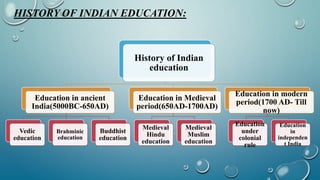
HISTORY OF INDIAN EDUCATION:
History of Indian
education
Education in ancient
India(5000BC-650AD)
Vedic
education
Brahminic
education
Buddhist
education
Education in Medieval
period(650AD-1700AD)
Medieval
Hindu
education
Medieval
Muslim
education
Education in modern
period(1700 AD- Till
now)
Education
under
colonial
rule
Education
in
independen
t India
INTRODUCTION-
In India contrary to many other nations we have not
borrowed education from west. Instead we have our
own traditions and a glorious history in this area,
since Vedic period. India has been best owned upon
with the blessings of knowledge. In fact we had a
perfect education system in Vedic age and Buddhist
period.
In ancient Indian education emerged from the Vedas
because the Vedas are the sources of Indian
philosophy of life. The “Veda” means knowledge.
SYSTEM OF EDUCATION DURING VEDIC PERIOD
The system of education during the Vedic period was totally different from
today's education system.
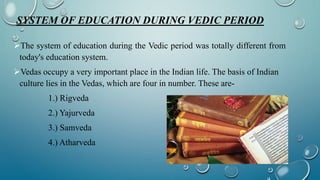
Vedas occupy a very important place in the Indian life. The basis of Indian
culture lies in the Vedas, which are four in number. These are-
1.) Rigveda
2.) Yajurveda
3.) Samveda
4.) Atharveda
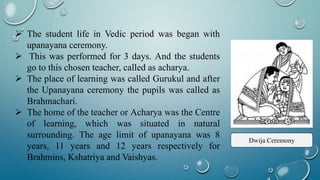
 The student life in Vedic period was began with
upanayana ceremony.
 This was performed for 3 days. And the students
go to this chosen teacher, called as acharya.
 The place of learning was called Gurukul and after
the Upanayana ceremony the pupils was called as
Brahmachari.
 The home of the teacher or Acharya was the Centre
of learning, which was situated in natural
surrounding. The age limit of upanayana was 8
years, 11 years and 12 years respectively for
Brahmins, Kshatriya and Vaishyas.
Dwija Ceremony
 But the learning process was almost dominated by the Brahmins. At the time passed
the other two castes Katriya and Vaishyas entered to receive education but the
Shudra castle's people were denied to study the holy scripture.
8 Years 111 Years 12 Years
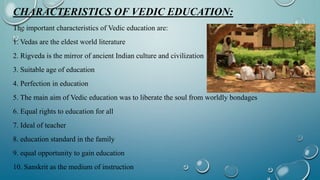
CHARACTERISTICS OF VEDIC EDUCATION:
The important characteristics of Vedic education are:
1. Vedas are the eldest world literature
2. Rigveda is the mirror of ancient Indian culture and civilization
3. Suitable age of education
4. Perfection in education
5. The main aim of Vedic education was to liberate the soul from worldly bondages
6. Equal rights to education for all
7. Ideal of teacher
8. education standard in the family
9. equal opportunity to gain education
10. Sanskrit as the medium of instruction
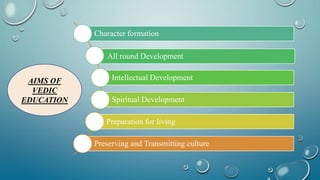
Character formation
All round Development
Intellectual Development
Spiritual Development
Preparation for living
Preserving and Transmitting culture
AIMS OF
VEDIC
EDUCATION
CURRICULUM:
Although the education of this period was dominated by the study of Vedic literature,
historical study, stories of heroic lives and discourses on the puranas also formed a part of
the syllabus. Students had necessarily to obtain knowledge of metrics. Arithmetic was
supplemented by the knowledge of geometry. Students were given knowledge of four
Vedas – Rigveda, Yajurveda, Samaveda and Atharvaveda.
The syllabus took with in its compass such subjects as spiritual as well as materialistic
knowledge, Vedas, Vedic grammar, arithmetic knowledge of gods, knowledge of the
absolute, knowledge of ghosts, astronomy, logic philosophy ethics, conduct etc. The
richness of the syllabus was responsible of the creation of brahman literature in this
period.
FORMS OF EDUCATIONAL INSTITUTIONS IN
VEDIC PERIOD:
• 1. Gurukuls
• Gurukuls were the dwelling houses of gurus situated in natural surroundings away from
noise and bustle of cities. Parents sent their wards at the age of five years to nine years
according to their castes after celebrating their upanayana Sanskar. Pupils lived under the
roof of their guru, under the direct supervision of their guru.
• Gurukula as the name indicates was the family of the teacher and his residence where the
students used to stay during the period of study. Gradually, the gurukula were extended to
include a number of buildings. However the institution was built up around the family of
teacher. The primary duty of the student was to serve the teacher and his family. The
students were like sons of the teacher and the whole institution lived like family.
• 2. Parishads:
• Parishads were bigger educational institutions where several teachers used to teach
different subjects. This may be compared to a college parishad in Upanishads, has been
used for a conference of learned men, assembled for deliberations upon philosophical
problems. Later on the ‘parishads’ were set up at the places where learned men lived in
good number and gradually these institutions became permanent centers of imparting
knowledge. In the words of dr. R. K. Mukherjee parishad correspondences to university
of students belonging to different colleges.
• 3. Sammelan:
• Sammelan literally means getting together for a particular purpose. In this type of
educational institutions scholars gathered at one place for learned discussions and
competitions generally on the invitation of the king. Scholars were appropriately
rewarded.
TEACHER:
• Guru enjoyed predominant place not only in his gurukul but in the
• entire society. He was regarded as a great guide for all. He was treated
• as parents for the students.
• To his pupils he showered all love and affection and used to teach them whatever he knew, but
before doing this he always tested the deservingness of a particular pupil. The pupils were free to
discuss points freely with the guru.
• He was more respected than the king in society. The guru was regarded as a rishi (sage) or acharya
(one who practices what he professes). The guru was given this significant place, because without
him it was impossible to attain knowledge.
• He used to bring light wherever there was darkness. Thus the people always felt his necessity
whenever there was a difficulty in solving any issue or problem.
• To make good relationship among students and teacher and development of the children's character.
DUTIES OF STUDENTS:
(A) Begging Alms: It was the usual rule for the Brahmachari
to go about begging for his teacher and the gurukula.
Begging has certain educative value. That is,
It produce in the students a spirit of humility and renunciation.
It makes him ego less.
It helps him in the complete organization of personality and a deeper loyalty to
the gurukula system.
It was a sort of ritual for the cultivation of impersonal relations in life.
It taught the students to feel how unattached he is to any ties.
A sense of independence
(B) Tending the sacred fires:
Go to the forest, cut and collect fuel and fetch it to the gurukula for
tending the scared fire. Worship of ‘Agni' by offering of choice
objects had much spiritual and cultural significance. The ‘Agnihotra'
ceremony was performed in the gurukula to enable the students to
understand the reality of religion in the form of sacrifice.
Agriculture, Animal husbandry and all the arrangement of gurukula
was done by students.
DISCIPLINE:
• Gurukula life was totally based on discipline .
• Discipline leads to the control over senses.
• Self-control or self-discipline was considered
to be the best discipline.
• Discipline includes early rise, prayer, dress code, food, sleep, bath ( to obtain physical
purity which was intimately connected with mental purity.
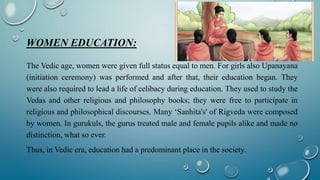
WOMEN EDUCATION:
The Vedic age, women were given full status equal to men. For girls also Upanayana
(initiation ceremony) was performed and after that, their education began. They
were also required to lead a life of celibacy during education. They used to study the
Vedas and other religious and philosophy books; they were free to participate in
religious and philosophical discourses. Many ‘Sanhita's' of Rigveda were composed
by women. In gurukuls, the gurus treated male and female pupils alike and made no
distinction, what so ever.
Thus, in Vedic era, education had a predominant place in the society.
CONCLUSION:
• In Vedic era education had the prominent place in society. It was considered as pious
and important for society. Education was must for everybody for becoming cultured.
Relationship between guru and pupils were very cordial during Vedic and Post- Vedic
period. By means of education efforts were being made to infuse ―Satyam, Shivam and
Sundaram inside the students.
• A great importance was attached to Veda in education system, self study Swadhyaya was
considered more important during that period. The Vedic period favored women
education.
• The ancient Indian education system was successful in preserving end spreading its
culture and literature even without the help of art of writing.
Vedic Education.pptx

Vedic Education.pptx

  • 1.
    Vedic System ofEducation By- Vijaya Lakshmi
  • 2.
    HISTORY OF INDIANEDUCATION: History of Indian education Education in ancient India(5000BC-650AD) Vedic education Brahminic education Buddhist education Education in Medieval period(650AD-1700AD) Medieval Hindu education Medieval Muslim education Education in modern period(1700 AD- Till now) Education under colonial rule Education in independen t India
  • 3.
    INTRODUCTION- In India contraryto many other nations we have not borrowed education from west. Instead we have our own traditions and a glorious history in this area, since Vedic period. India has been best owned upon with the blessings of knowledge. In fact we had a perfect education system in Vedic age and Buddhist period. In ancient Indian education emerged from the Vedas because the Vedas are the sources of Indian philosophy of life. The “Veda” means knowledge.
  • 4.
    SYSTEM OF EDUCATIONDURING VEDIC PERIOD The system of education during the Vedic period was totally different from today's education system. Vedas occupy a very important place in the Indian life. The basis of Indian culture lies in the Vedas, which are four in number. These are- 1.) Rigveda 2.) Yajurveda 3.) Samveda 4.) Atharveda
  • 5.
     The studentlife in Vedic period was began with upanayana ceremony.  This was performed for 3 days. And the students go to this chosen teacher, called as acharya.  The place of learning was called Gurukul and after the Upanayana ceremony the pupils was called as Brahmachari.  The home of the teacher or Acharya was the Centre of learning, which was situated in natural surrounding. The age limit of upanayana was 8 years, 11 years and 12 years respectively for Brahmins, Kshatriya and Vaishyas. Dwija Ceremony
  • 6.
     But thelearning process was almost dominated by the Brahmins. At the time passed the other two castes Katriya and Vaishyas entered to receive education but the Shudra castle's people were denied to study the holy scripture. 8 Years 111 Years 12 Years
  • 7.
    CHARACTERISTICS OF VEDICEDUCATION: The important characteristics of Vedic education are: 1. Vedas are the eldest world literature 2. Rigveda is the mirror of ancient Indian culture and civilization 3. Suitable age of education 4. Perfection in education 5. The main aim of Vedic education was to liberate the soul from worldly bondages 6. Equal rights to education for all 7. Ideal of teacher 8. education standard in the family 9. equal opportunity to gain education 10. Sanskrit as the medium of instruction
  • 8.
    Character formation All roundDevelopment Intellectual Development Spiritual Development Preparation for living Preserving and Transmitting culture AIMS OF VEDIC EDUCATION
  • 10.
    CURRICULUM: Although the educationof this period was dominated by the study of Vedic literature, historical study, stories of heroic lives and discourses on the puranas also formed a part of the syllabus. Students had necessarily to obtain knowledge of metrics. Arithmetic was supplemented by the knowledge of geometry. Students were given knowledge of four Vedas – Rigveda, Yajurveda, Samaveda and Atharvaveda. The syllabus took with in its compass such subjects as spiritual as well as materialistic knowledge, Vedas, Vedic grammar, arithmetic knowledge of gods, knowledge of the absolute, knowledge of ghosts, astronomy, logic philosophy ethics, conduct etc. The richness of the syllabus was responsible of the creation of brahman literature in this period.
  • 12.
    FORMS OF EDUCATIONALINSTITUTIONS IN VEDIC PERIOD: • 1. Gurukuls • Gurukuls were the dwelling houses of gurus situated in natural surroundings away from noise and bustle of cities. Parents sent their wards at the age of five years to nine years according to their castes after celebrating their upanayana Sanskar. Pupils lived under the roof of their guru, under the direct supervision of their guru. • Gurukula as the name indicates was the family of the teacher and his residence where the students used to stay during the period of study. Gradually, the gurukula were extended to include a number of buildings. However the institution was built up around the family of teacher. The primary duty of the student was to serve the teacher and his family. The students were like sons of the teacher and the whole institution lived like family.
  • 13.
    • 2. Parishads: •Parishads were bigger educational institutions where several teachers used to teach different subjects. This may be compared to a college parishad in Upanishads, has been used for a conference of learned men, assembled for deliberations upon philosophical problems. Later on the ‘parishads’ were set up at the places where learned men lived in good number and gradually these institutions became permanent centers of imparting knowledge. In the words of dr. R. K. Mukherjee parishad correspondences to university of students belonging to different colleges. • 3. Sammelan: • Sammelan literally means getting together for a particular purpose. In this type of educational institutions scholars gathered at one place for learned discussions and competitions generally on the invitation of the king. Scholars were appropriately rewarded.
  • 14.
    TEACHER: • Guru enjoyedpredominant place not only in his gurukul but in the • entire society. He was regarded as a great guide for all. He was treated • as parents for the students. • To his pupils he showered all love and affection and used to teach them whatever he knew, but before doing this he always tested the deservingness of a particular pupil. The pupils were free to discuss points freely with the guru. • He was more respected than the king in society. The guru was regarded as a rishi (sage) or acharya (one who practices what he professes). The guru was given this significant place, because without him it was impossible to attain knowledge. • He used to bring light wherever there was darkness. Thus the people always felt his necessity whenever there was a difficulty in solving any issue or problem. • To make good relationship among students and teacher and development of the children's character.
  • 15.
    DUTIES OF STUDENTS: (A)Begging Alms: It was the usual rule for the Brahmachari to go about begging for his teacher and the gurukula. Begging has certain educative value. That is, It produce in the students a spirit of humility and renunciation. It makes him ego less. It helps him in the complete organization of personality and a deeper loyalty to the gurukula system. It was a sort of ritual for the cultivation of impersonal relations in life. It taught the students to feel how unattached he is to any ties. A sense of independence
  • 16.
    (B) Tending thesacred fires: Go to the forest, cut and collect fuel and fetch it to the gurukula for tending the scared fire. Worship of ‘Agni' by offering of choice objects had much spiritual and cultural significance. The ‘Agnihotra' ceremony was performed in the gurukula to enable the students to understand the reality of religion in the form of sacrifice. Agriculture, Animal husbandry and all the arrangement of gurukula was done by students.
  • 17.
    DISCIPLINE: • Gurukula lifewas totally based on discipline . • Discipline leads to the control over senses. • Self-control or self-discipline was considered to be the best discipline. • Discipline includes early rise, prayer, dress code, food, sleep, bath ( to obtain physical purity which was intimately connected with mental purity.
  • 18.
    WOMEN EDUCATION: The Vedicage, women were given full status equal to men. For girls also Upanayana (initiation ceremony) was performed and after that, their education began. They were also required to lead a life of celibacy during education. They used to study the Vedas and other religious and philosophy books; they were free to participate in religious and philosophical discourses. Many ‘Sanhita's' of Rigveda were composed by women. In gurukuls, the gurus treated male and female pupils alike and made no distinction, what so ever. Thus, in Vedic era, education had a predominant place in the society.
  • 19.
    CONCLUSION: • In Vedicera education had the prominent place in society. It was considered as pious and important for society. Education was must for everybody for becoming cultured. Relationship between guru and pupils were very cordial during Vedic and Post- Vedic period. By means of education efforts were being made to infuse ―Satyam, Shivam and Sundaram inside the students. • A great importance was attached to Veda in education system, self study Swadhyaya was considered more important during that period. The Vedic period favored women education. • The ancient Indian education system was successful in preserving end spreading its culture and literature even without the help of art of writing.