CONTENTS
 Equality
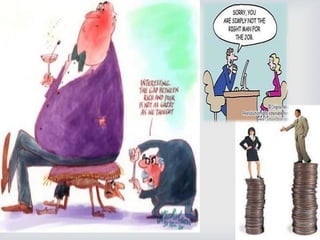
 The myth
                             
 The reality
 Types of inequality
 The struggle for equality in India
 Government efforts
 Current scenario
 Reasons for inequality
 Progress in recent years
 People who broke barriers
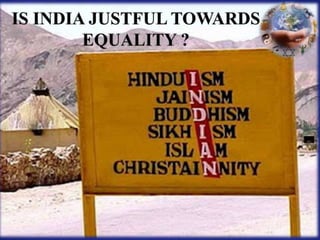
 Is India justful ?
Equality
                      
 the state or quality of being equal correspondence in
  quantity, degree, value, rank, or ability.
 "The craving for equality can express itself either as a
  desire to pull everyone down to our own level (by
  belittling them, excluding them, tripping them up) or
  as a desire to raise ourselves up along with everyone
  else (by acknowledging them, helping them, and
  rejoicing in their success)."
 -Friedrich Nietzsche

The reality
                       
   Ms' Roy criticised Indian society as the most “rotten” in the world
    with its people failing to fight against injustice.
   According to a study in India by an Indo-Canadian team of
    researchers, about 5,00,000 female foetuses have been aborted
    annually.
   Income gap between the rich and the poor increasing day by day .
   Recent survey stated India as the most unsafe place for women.
   Literacy rate growing by just 1.74% p.a and India is on the 6th rank
    with 74.4% literacy in 2011.
   Lower GDP rate . Farmers committing suicide.
   Taslima Nasreen is not allowed in any Muslim country because of
    her secular thoughts in a book.
Types of inequalities
Gender   
Income
Education
Caste /religion
Racism
Social
Economic inequality
Females are considered as the weaker
 sections.
                 
Religious riots are increasing day by
 day
The gap between rich and the poor is
 widening
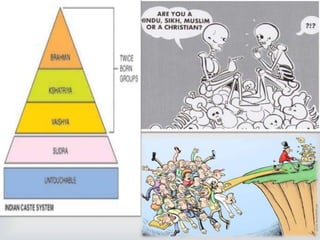
Caste system still persists in rural
 areas.
Education reservations
Income gap between males and females
The Struggle for Equality in
           India
                             
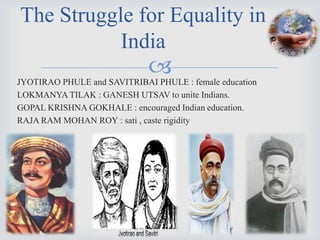
JYOTIRAO PHULE and SAVITRIBAI PHULE : female education
LOKMANYA TILAK : GANESH UTSAV to unite Indians.
GOPAL KRISHNA GOKHALE : encouraged Indian education.
RAJA RAM MOHAN ROY : sati , caste rigidity
Government efforts
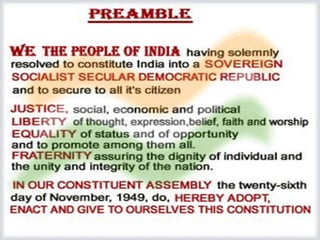
               right to equality
                                   
 Right to equality is an important right provided for in Articles 14, 15,
  16, 17 and 18 of the constitution to bring equality in the country.

 It is the principal foundation of all other rights and liberties, and
  guarantees the following:

 Social equality and equal access to public areas: Article 15 of the
  constitution states that no person shall be discriminated on the basis of
  caste, colour, language etc. Every person shall have equal access to
  public places like public parks, museums, wells, bathing Ghats and
  temples etc. However, the State may make any special provision for
  women and children. Special provisions may be made for the
  advancements of any socially or educationally backward class
  or scheduled castes or scheduled tribes.
Government efforts
                                    
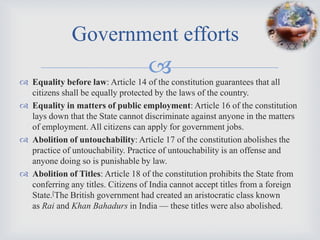
 Equality before law: Article 14 of the constitution guarantees that all
  citizens shall be equally protected by the laws of the country.
 Equality in matters of public employment: Article 16 of the constitution
  lays down that the State cannot discriminate against anyone in the matters
  of employment. All citizens can apply for government jobs.
 Abolition of untouchability: Article 17 of the constitution abolishes the
  practice of untouchability. Practice of untouchability is an offense and
  anyone doing so is punishable by law.
 Abolition of Titles: Article 18 of the constitution prohibits the State from
  conferring any titles. Citizens of India cannot accept titles from a foreign
  State.[The British government had created an aristocratic class known
  as Rai and Khan Bahadurs in India — these titles were also abolished.
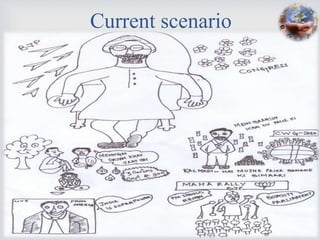
Current scenario

      

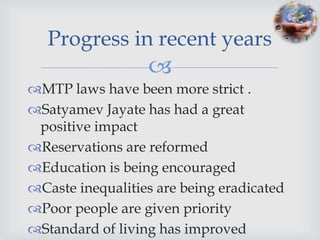
Reasons for inequality

1.
                       
     Psychology of people
2.   Universal believe about females
3.   Lack of education
4.   Corruption
5.   Reservation
6.   Migration
7.   Inheritance
8.   Casual behavior of government
Progress in recent years
                  
MTP laws have been more strict .
Satyamev Jayate has had a great
 positive impact
Reservations are reformed
Education is being encouraged
Caste inequalities are being eradicated
Poor people are given priority
Standard of living has improved
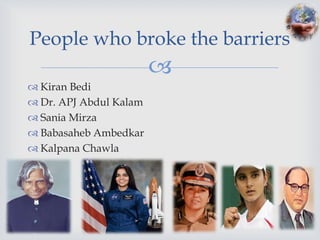
People who broke the barriers
                        
 Kiran Bedi
 Dr. APJ Abdul Kalam
 Sania Mirza
 Babasaheb Ambedkar
 Kalpana Chawla
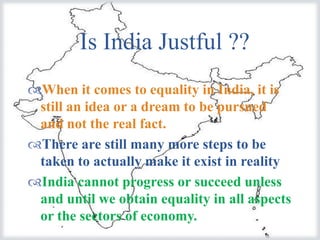
Is India Justful ??
                
When it comes to equality in India, it is
 still an idea or a dream to be pursued
 and not the real fact.
There are still many more steps to be
 taken to actually make it exist in reality
India cannot progress or succeed unless
 and until we obtain equality in all aspects
 or the sectors of economy.
THANK YOU
         
Rikkin Patel 308
Ankita Popli 316
Uday Powar 317
Titiksha Rajput 324
Nehali Shewale 345

equality

  • 2.
    CONTENTS  Equality  Themyth   The reality  Types of inequality  The struggle for equality in India  Government efforts  Current scenario  Reasons for inequality  Progress in recent years  People who broke barriers  Is India justful ?
  • 3.
    Equality   the state or quality of being equal correspondence in quantity, degree, value, rank, or ability.  "The craving for equality can express itself either as a desire to pull everyone down to our own level (by belittling them, excluding them, tripping them up) or as a desire to raise ourselves up along with everyone else (by acknowledging them, helping them, and rejoicing in their success)."  -Friedrich Nietzsche
  • 4.
  • 5.
    The reality   Ms' Roy criticised Indian society as the most “rotten” in the world with its people failing to fight against injustice.  According to a study in India by an Indo-Canadian team of researchers, about 5,00,000 female foetuses have been aborted annually.  Income gap between the rich and the poor increasing day by day .  Recent survey stated India as the most unsafe place for women.  Literacy rate growing by just 1.74% p.a and India is on the 6th rank with 74.4% literacy in 2011.  Lower GDP rate . Farmers committing suicide.  Taslima Nasreen is not allowed in any Muslim country because of her secular thoughts in a book.
  • 6.
    Types of inequalities Gender  Income Education Caste /religion Racism Social Economic inequality
  • 7.
    Females are consideredas the weaker sections.  Religious riots are increasing day by day The gap between rich and the poor is widening Caste system still persists in rural areas. Education reservations Income gap between males and females
  • 8.
    The Struggle forEquality in India  JYOTIRAO PHULE and SAVITRIBAI PHULE : female education LOKMANYA TILAK : GANESH UTSAV to unite Indians. GOPAL KRISHNA GOKHALE : encouraged Indian education. RAJA RAM MOHAN ROY : sati , caste rigidity
  • 9.
    Government efforts right to equality   Right to equality is an important right provided for in Articles 14, 15, 16, 17 and 18 of the constitution to bring equality in the country.  It is the principal foundation of all other rights and liberties, and guarantees the following:  Social equality and equal access to public areas: Article 15 of the constitution states that no person shall be discriminated on the basis of caste, colour, language etc. Every person shall have equal access to public places like public parks, museums, wells, bathing Ghats and temples etc. However, the State may make any special provision for women and children. Special provisions may be made for the advancements of any socially or educationally backward class or scheduled castes or scheduled tribes.
  • 10.
    Government efforts   Equality before law: Article 14 of the constitution guarantees that all citizens shall be equally protected by the laws of the country.  Equality in matters of public employment: Article 16 of the constitution lays down that the State cannot discriminate against anyone in the matters of employment. All citizens can apply for government jobs.  Abolition of untouchability: Article 17 of the constitution abolishes the practice of untouchability. Practice of untouchability is an offense and anyone doing so is punishable by law.  Abolition of Titles: Article 18 of the constitution prohibits the State from conferring any titles. Citizens of India cannot accept titles from a foreign State.[The British government had created an aristocratic class known as Rai and Khan Bahadurs in India — these titles were also abolished.
  • 11.
  • 12.
  • 14.
    Reasons for inequality 1.  Psychology of people 2. Universal believe about females 3. Lack of education 4. Corruption 5. Reservation 6. Migration 7. Inheritance 8. Casual behavior of government
  • 15.
    Progress in recentyears  MTP laws have been more strict . Satyamev Jayate has had a great positive impact Reservations are reformed Education is being encouraged Caste inequalities are being eradicated Poor people are given priority Standard of living has improved
  • 16.
    People who brokethe barriers   Kiran Bedi  Dr. APJ Abdul Kalam  Sania Mirza  Babasaheb Ambedkar  Kalpana Chawla
  • 17.
    Is India Justful??  When it comes to equality in India, it is still an idea or a dream to be pursued and not the real fact. There are still many more steps to be taken to actually make it exist in reality India cannot progress or succeed unless and until we obtain equality in all aspects or the sectors of economy.
  • 18.
    THANK YOU  Rikkin Patel 308 Ankita Popli 316 Uday Powar 317 Titiksha Rajput 324 Nehali Shewale 345